
A complete issue · 34 pages · 1922
Life — May 18, 1922
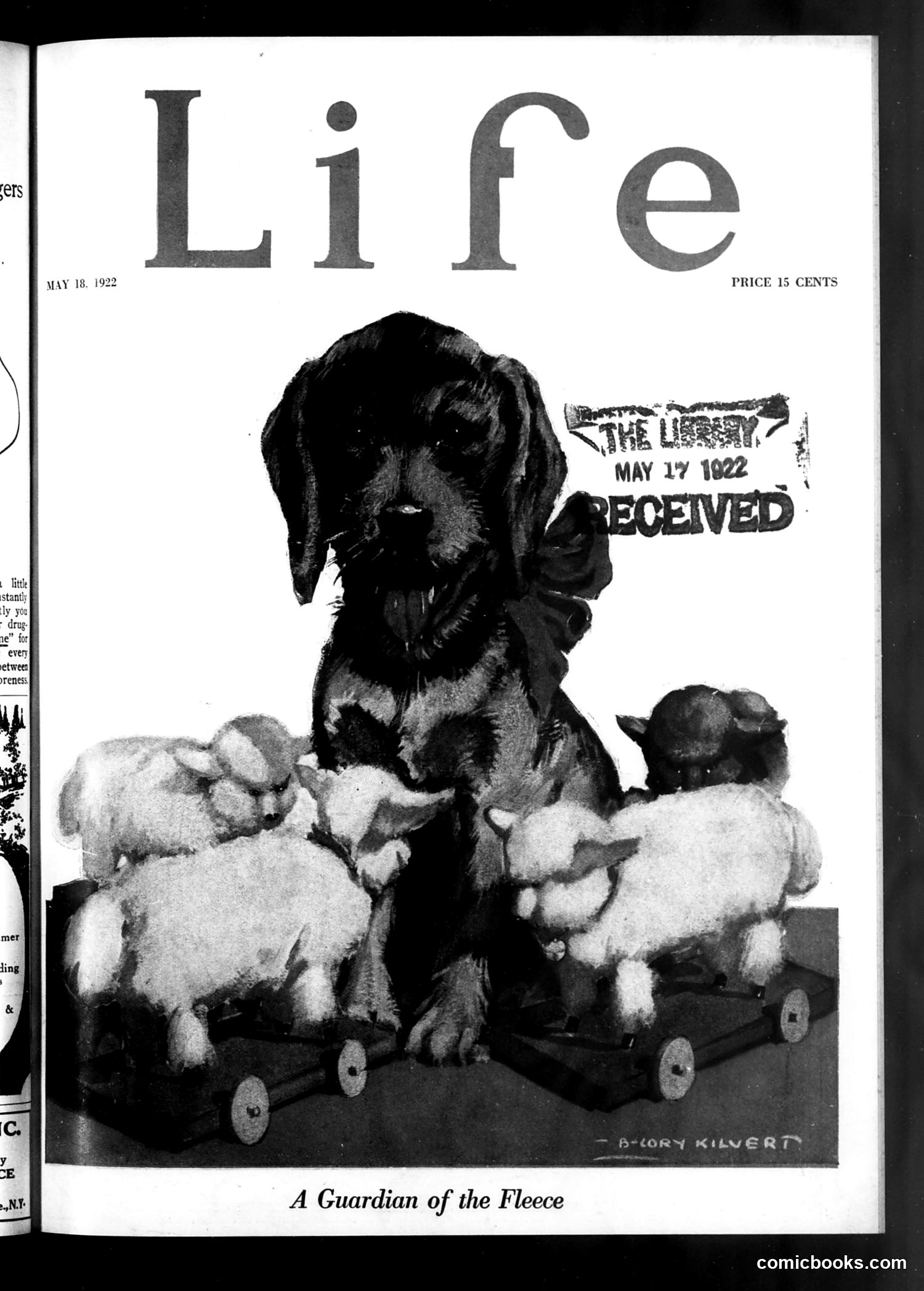
This cover features a large dog (appears to be a St. Bernard or similar breed) with three small lambs on wheeled platforms, captioned "A Guardian of the Fleece." The image likely plays on the dog's traditional role as a protective sheepdog, using "fleece" as a pun—both referring to wool and to the slang term meaning to swindle someone out of money. Without additional context from the magazine's interior, the precise satirical target remains unclear. However, given Life's 1920s focus on social commentary, this probably critiques either financial fraud, corrupt authority figures presented as false protectors, or possibly labor/economic exploitation of the era. The humor relies on the visual contrast between the vulnerable lambs and their supposed guardian.
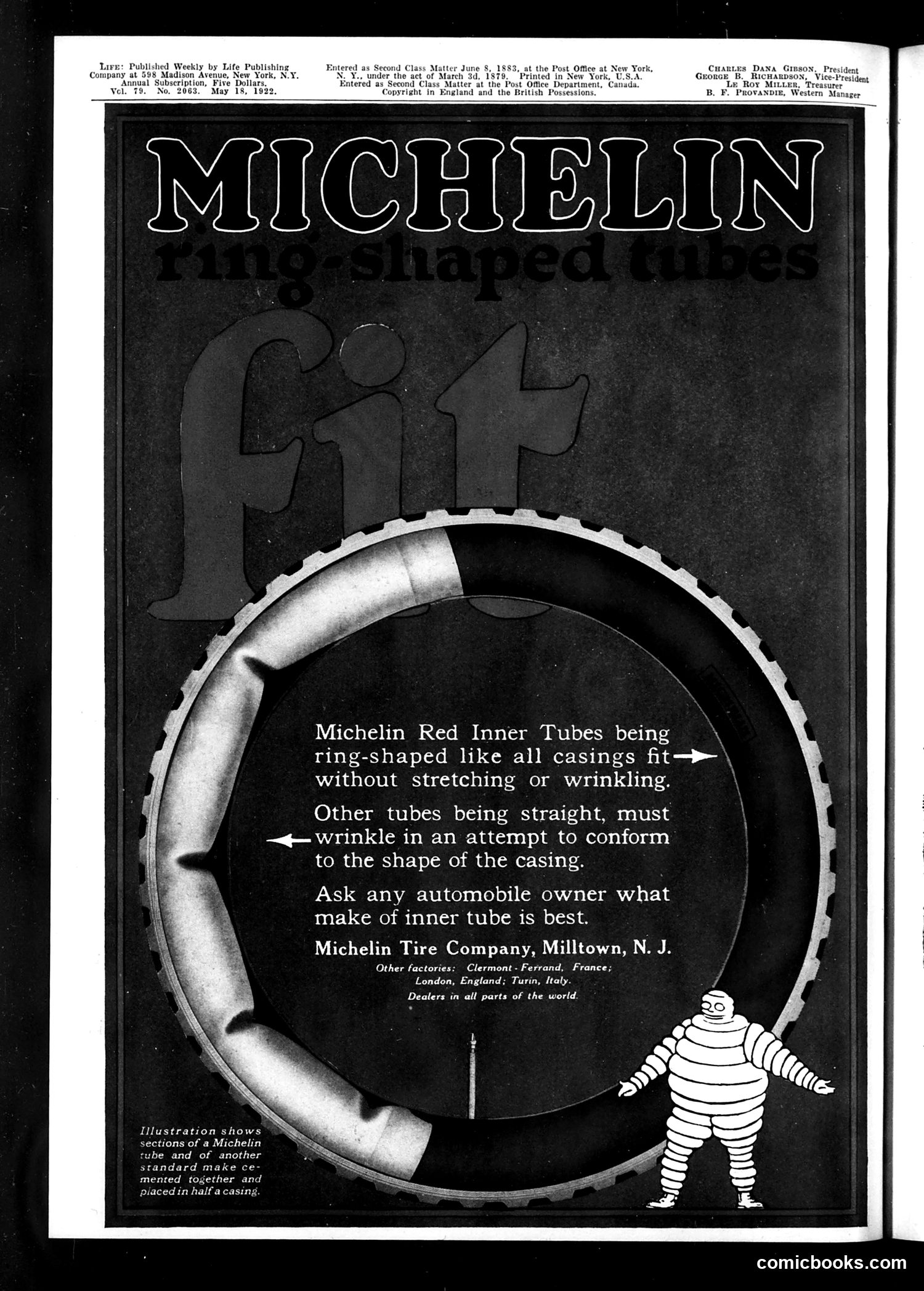
This is a **product advertisement**, not political satire. It promotes Michelin Red Inner Tubes, featuring the company's iconic mascot—Bibendum, the rotund "Michelin Man" made of stacked tire rings (visible at bottom right). The advertisement emphasizes a technical advantage: Michelin's ring-shaped inner tubes conform naturally to tire casings without stretching or wrinkling, unlike competitors' straight tubes that must wrinkle to fit. The cross-section diagram illustrates this design difference. The copy addresses automobile owners directly, asking them to verify Michelin's superiority. Headquarters are listed as Milltown, New Jersey, with factories in France, England, and Italy. This represents early automotive-era marketing emphasizing engineering innovation over style.
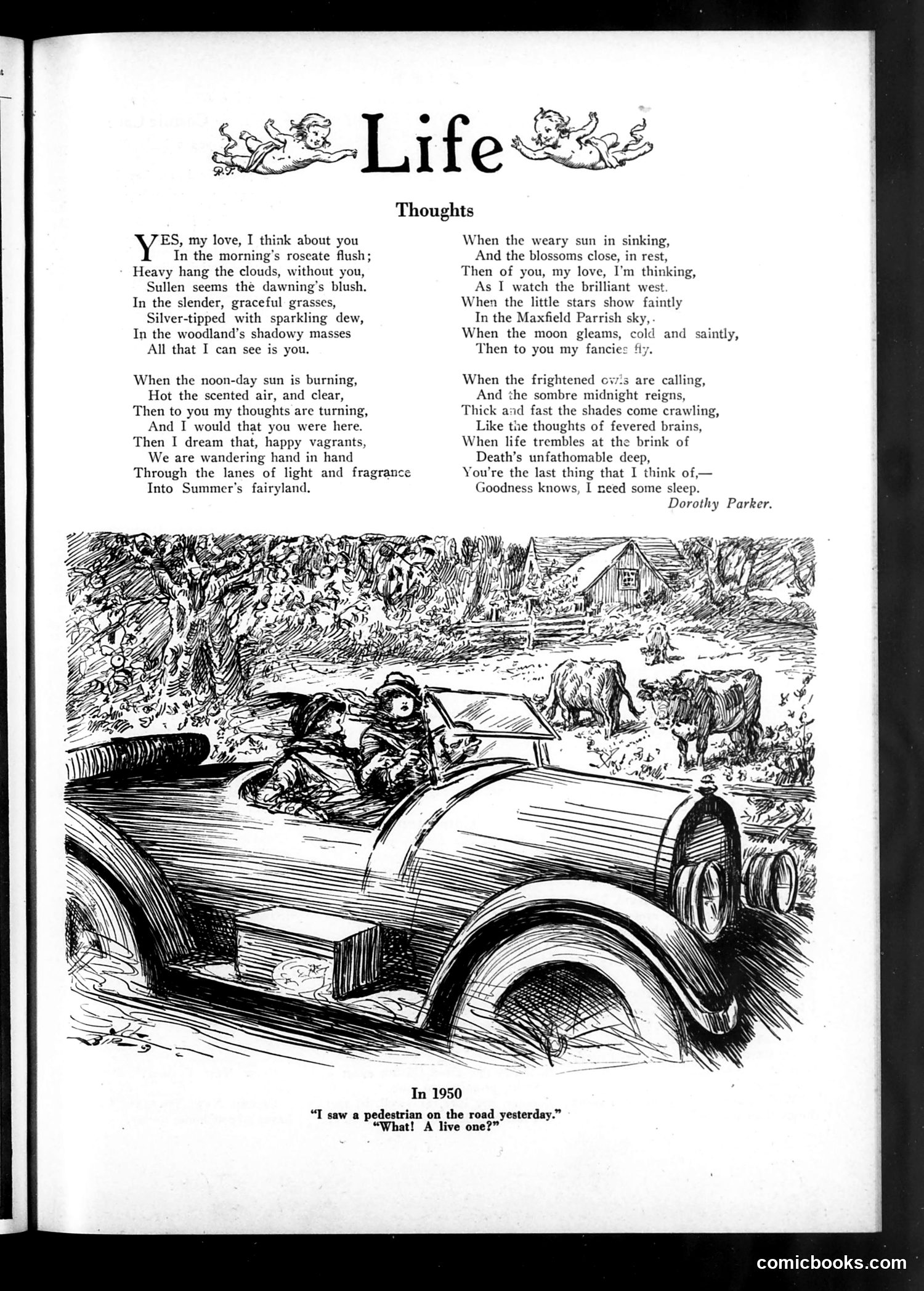
This page from *Life* magazine features a poem titled "Thoughts" by Dorothy Parker, a renowned American humorist and poet. The poem expresses romantic sentiments about constantly thinking of a beloved across different times of day and night. The cartoon below illustrates a 1950s-era joke about automobiles and safety. Two figures in an old-fashioned open-air car encounter a pedestrian, prompting one to exclaim "I saw a pedestrian on the road yesterday" and receive the shocked response "What! A live one?" The joke satirizes the danger posed by automobiles in 1950, suggesting that pedestrians killed by cars were so common that seeing one alive was noteworthy. It's dark social commentary on traffic fatalities and reckless driving culture of the era.
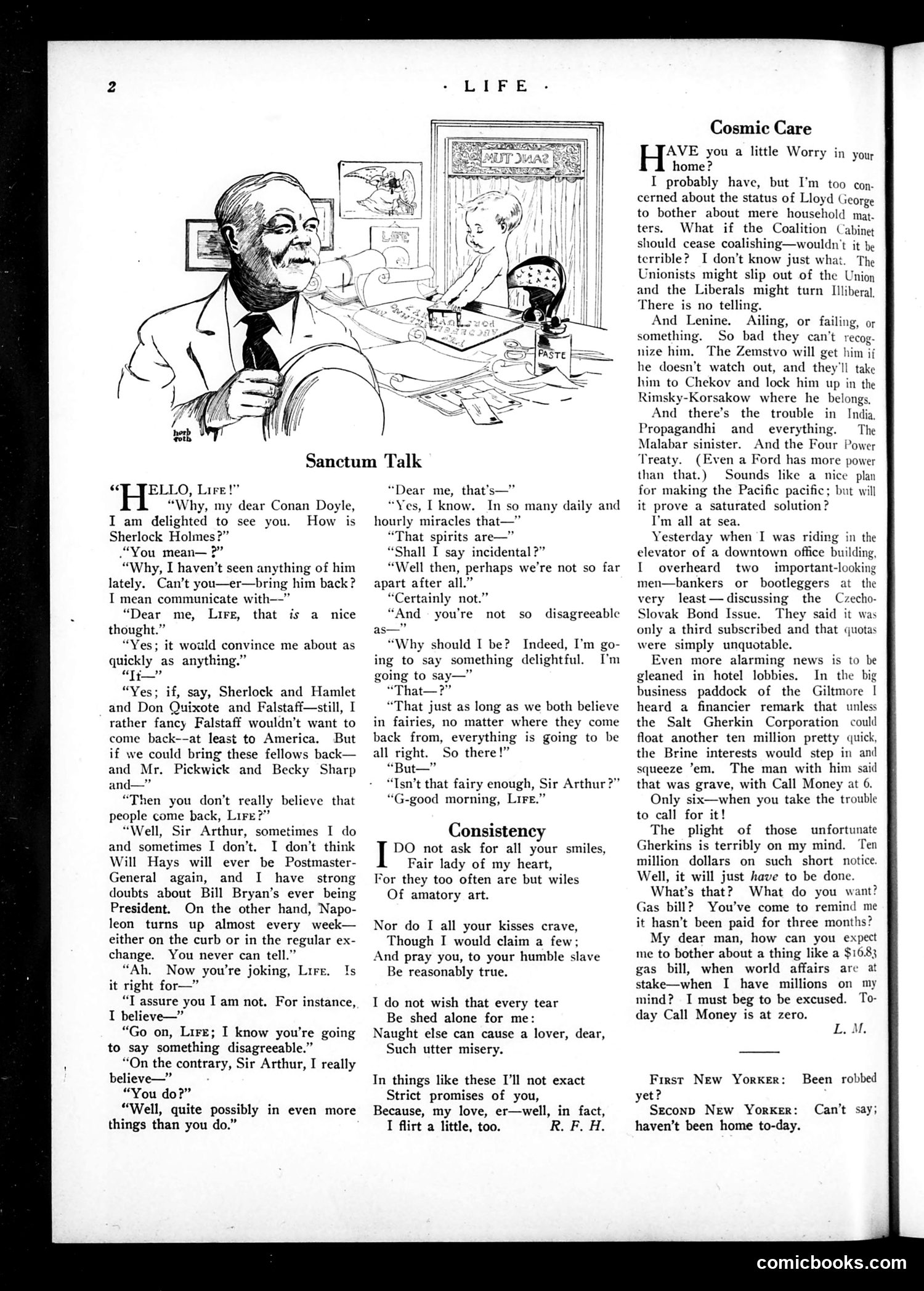
This page features a conversation between "Life" (the magazine personified) and an unnamed figure identified as resembling Conan Doyle, the famous author. The cartoon satirizes contemporary political anxieties—specifically concerns about the Coalition Cabinet remaining stable, fears about the Bolsheviks/Communists (references to Lenin, Zemstvo, and Chekov), and worries about Irish independence and the Mahabir minister's treaty negotiations. The humor derives from "Life" reassuring the worried figure that despite these serious threats to political stability, literary figures like Sherlock Holmes, Hamlet, and Don Quixote somehow endure. It's essentially satirizing how people remain preoccupied with trivial cultural concerns even amid serious political crises. The surrounding text columns address additional social/political issues and financial worries of the era.
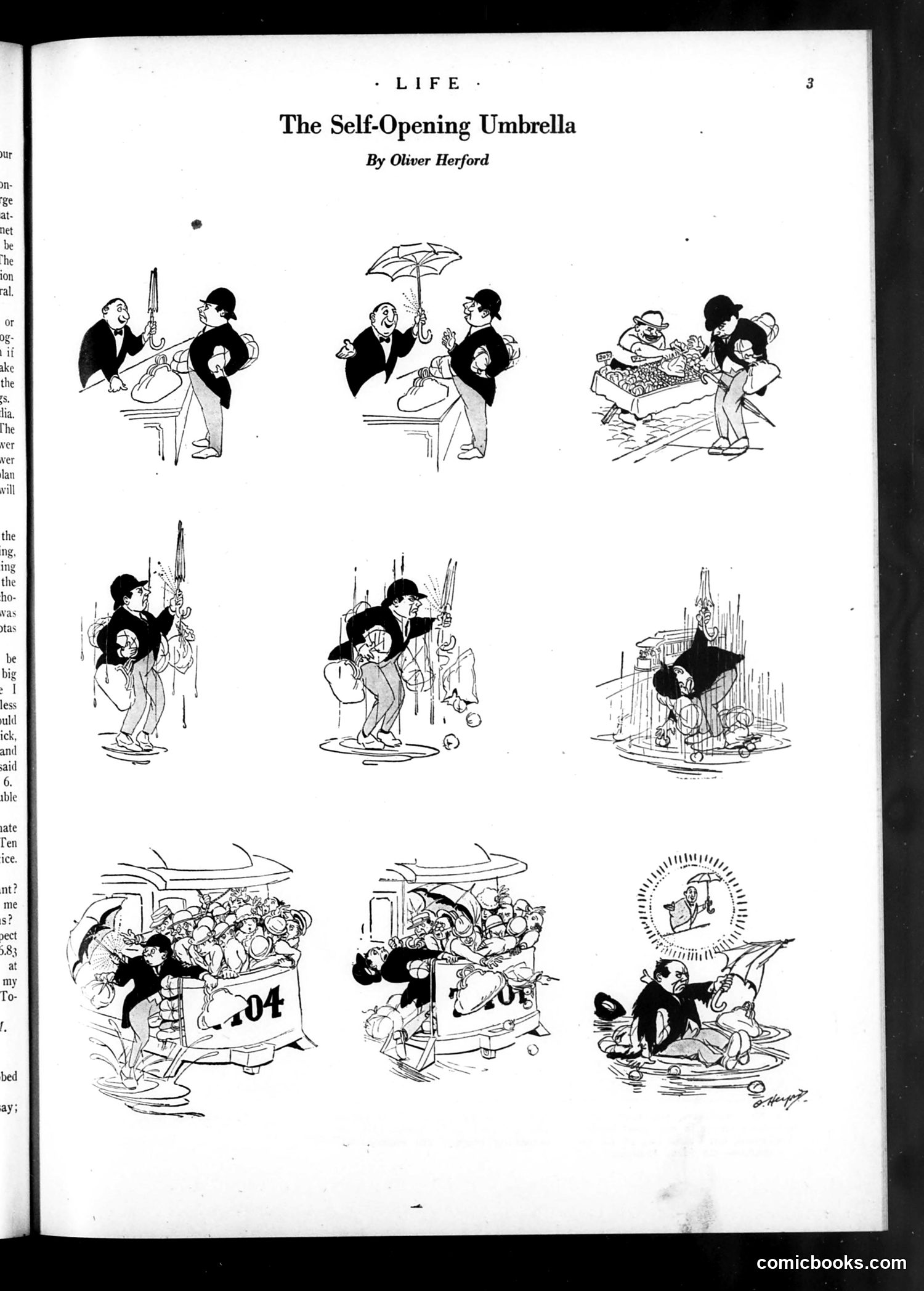
This is a humorous visual sequence about an automatic umbrella malfunctioning in increasingly absurd ways. The narrative progresses from a gentleman attempting to open a self-opening umbrella at a dining table, through it spontaneously opening in various locations (indoors, outdoors), to finally opening so vigorously it launches him into the air and deposits him into what appears to be a taxi or vehicle packed with other people. The satire targets over-engineered gadgets and modern conveniences that fail spectacularly. Rather than solving problems, this "self-opening" mechanism creates chaos—the umbrella opens when unwanted and with destructive force. It's a commentary on mechanical innovation gone wrong, a common theme in early 20th-century humor about progress and technology.
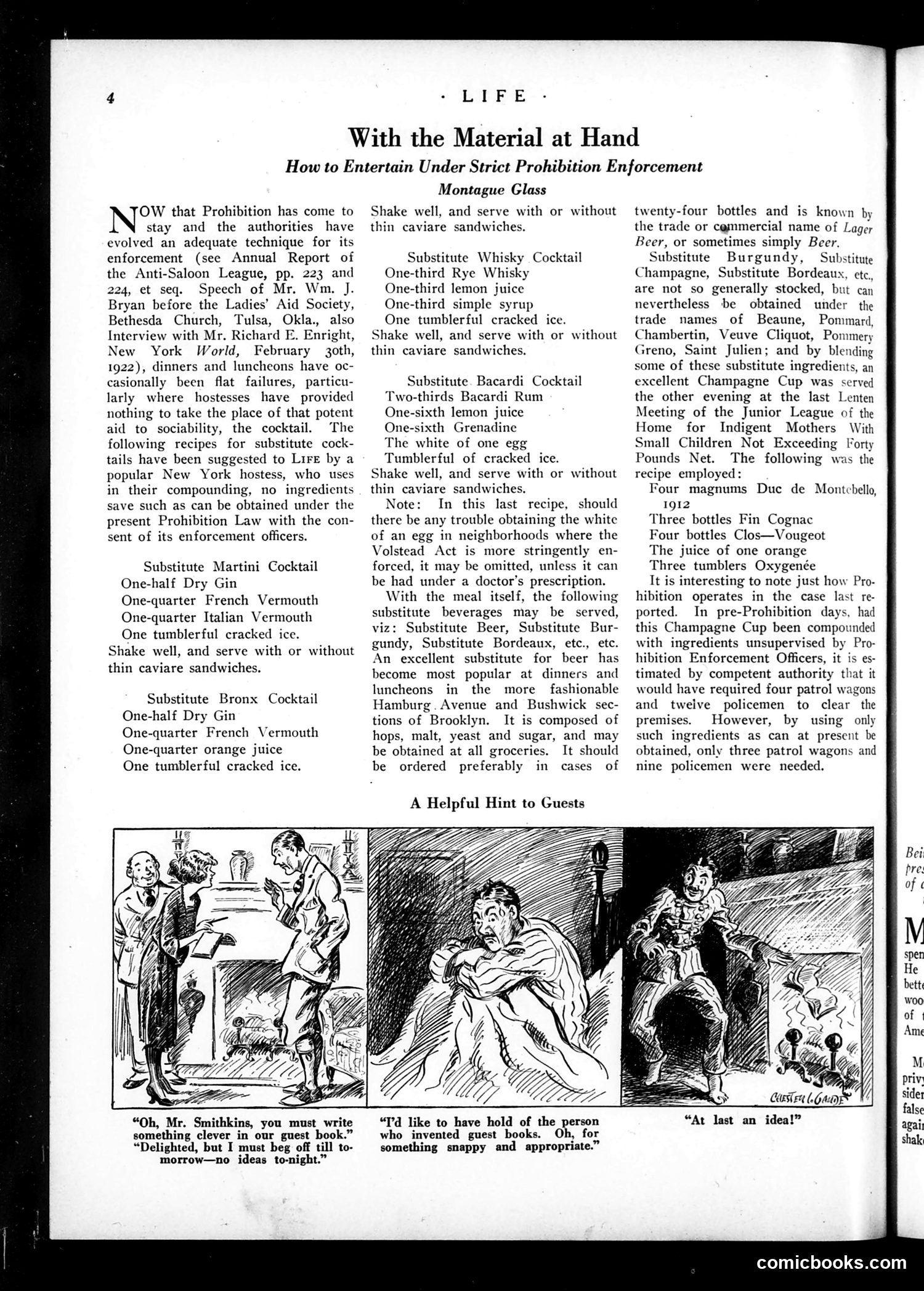
This page satirizes enforcement of Prohibition (1920-1933). The article "With the Material at Hand" offers humorous substitute cocktail recipes—Martinis made with French Vermouth, Bacardi made with rum substitutes—mocking both the law and creative workarounds by affluent hosts. The three cartoons below, titled "A Helpful Hint to Guests," depict social awkwardness around Prohibition. The leftmost shows a guest being asked to write something clever in a guest book. The middle and right panels appear to show guests struggling with inappropriate behavior or comments at dinner parties—likely depicting the tension between maintaining social propriety while everyone understood illegal drinking occurred. The satire targets the absurdity of Prohibition enforcement among the well-to-do, who simply substituted ingredients rather than abstaining.
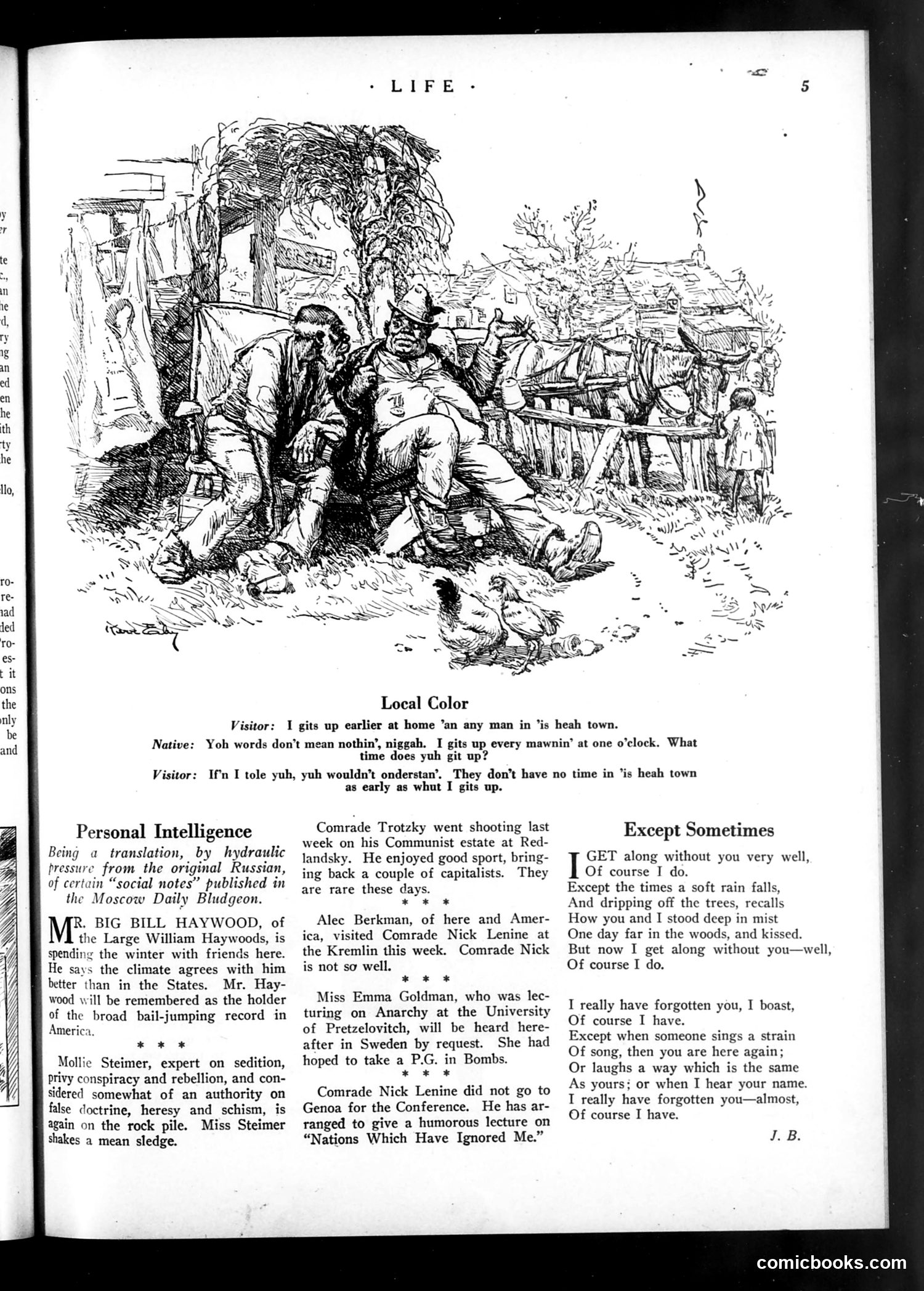
This sketch depicts a dialogue between a visitor and native using exaggerated rural dialect ("gits up," "yuh," "nigah"). The humor relies on a stereotypical "country bumpkin" character who claims to wake early and work all day, contrasted with the visitor's metropolitan assumptions about small-town life. The satire appears to mock both urban visitors' condescending expectations of rural communities AND rural residents' defensive pride about their work ethic. The crude dialect representation was typical of early 20th-century American humor, though offensive by modern standards. The accompanying text snippets reference Bolshevism, Comrade Trotsky, and Lenin—suggesting this *Life* issue engaged contemporary political anxieties about communism and revolution, which contrasts sharply with the rural Americana of the main cartoon.
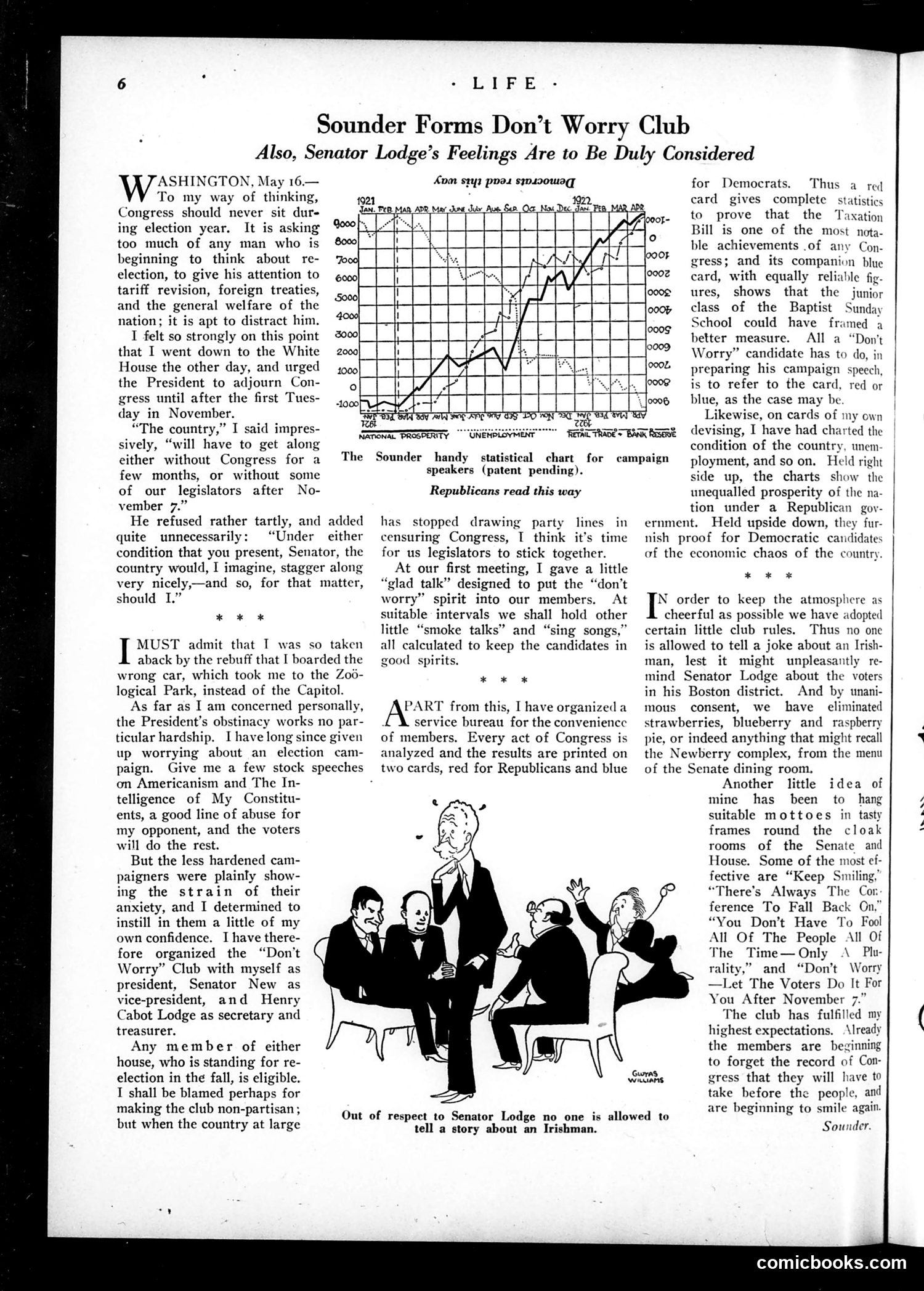
This May 1916 *Life* magazine page satirizes congressional pessimism about the 1916 election. The article describes forming a "Don't Worry" Club with Senator New as president and Henry Cabot Lodge as secretary—politicians trying to boost Republican morale. The cartoon depicts these GOP leaders attempting to keep candidates cheerful during what they feared would be a Democratic victory. The accompanying chart shows economic conditions under Republican governance, presented to prove Republican competence. The satire targets both the Republicans' anxiety about losing power and their patronizing attempts to manage candidate confidence through organized "worry" prevention. The author (signed "Sounder") mocks their efforts as simultaneously non-partisan and transparently partisan spin.
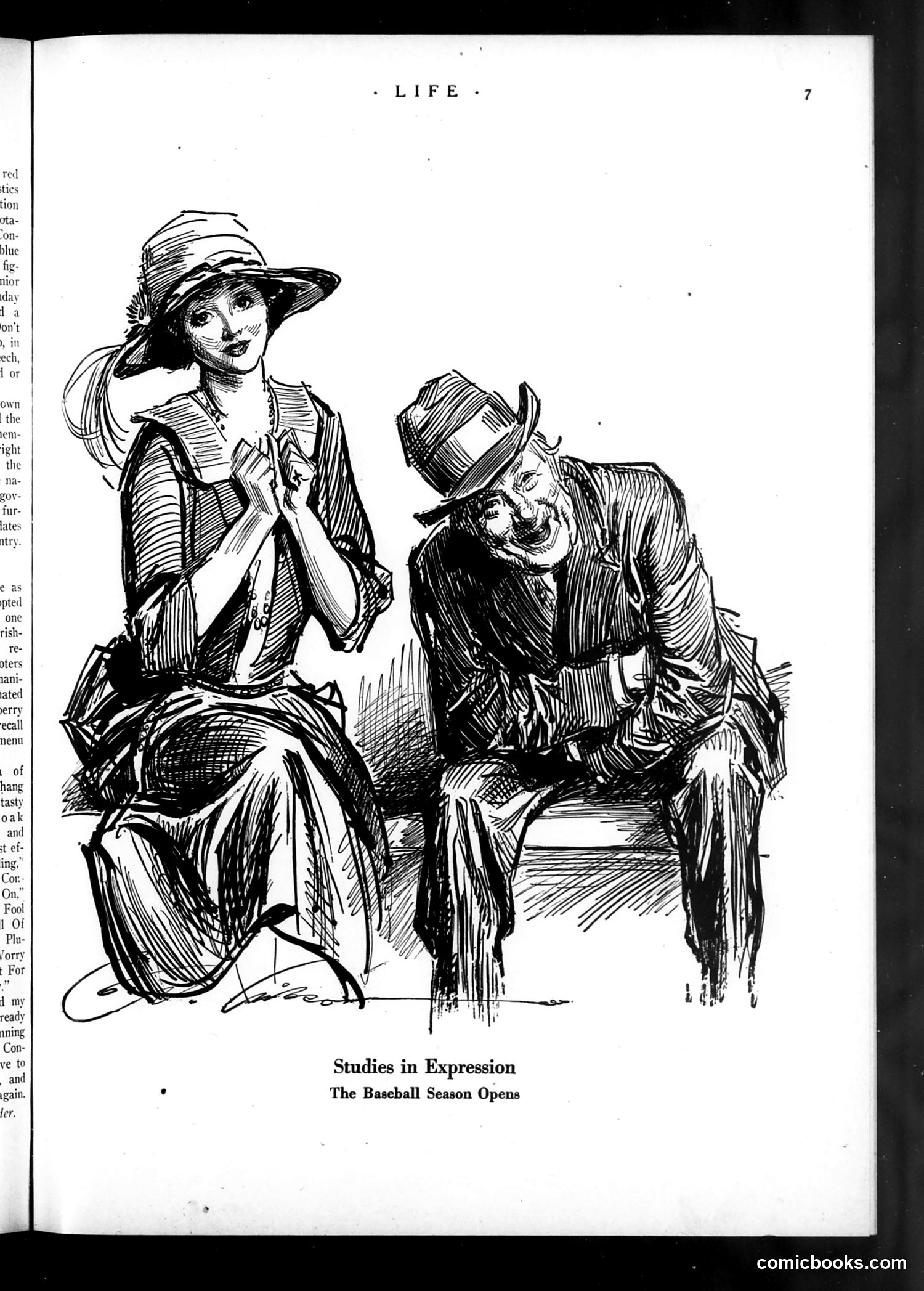
This illustration presents two figures in what appears to be a comedic "studies in expression" sketch about baseball season opening. The woman on the left, wearing a fashionable wide-brimmed hat and striped blouse, displays an enthusiastic, animated expression with clasped hands—presumably eager anticipation about the baseball season. The man beside her, also in period dress with a hat, shows a contrasting weary or skeptical expression, slouching slightly. The satire likely comments on gender differences in enthusiasm about baseball or spring activities circa early 1900s. The woman's eager optimism contrasts with the man's apparent indifference or exhaustion, humorously capturing different attitudes toward the season's opening.
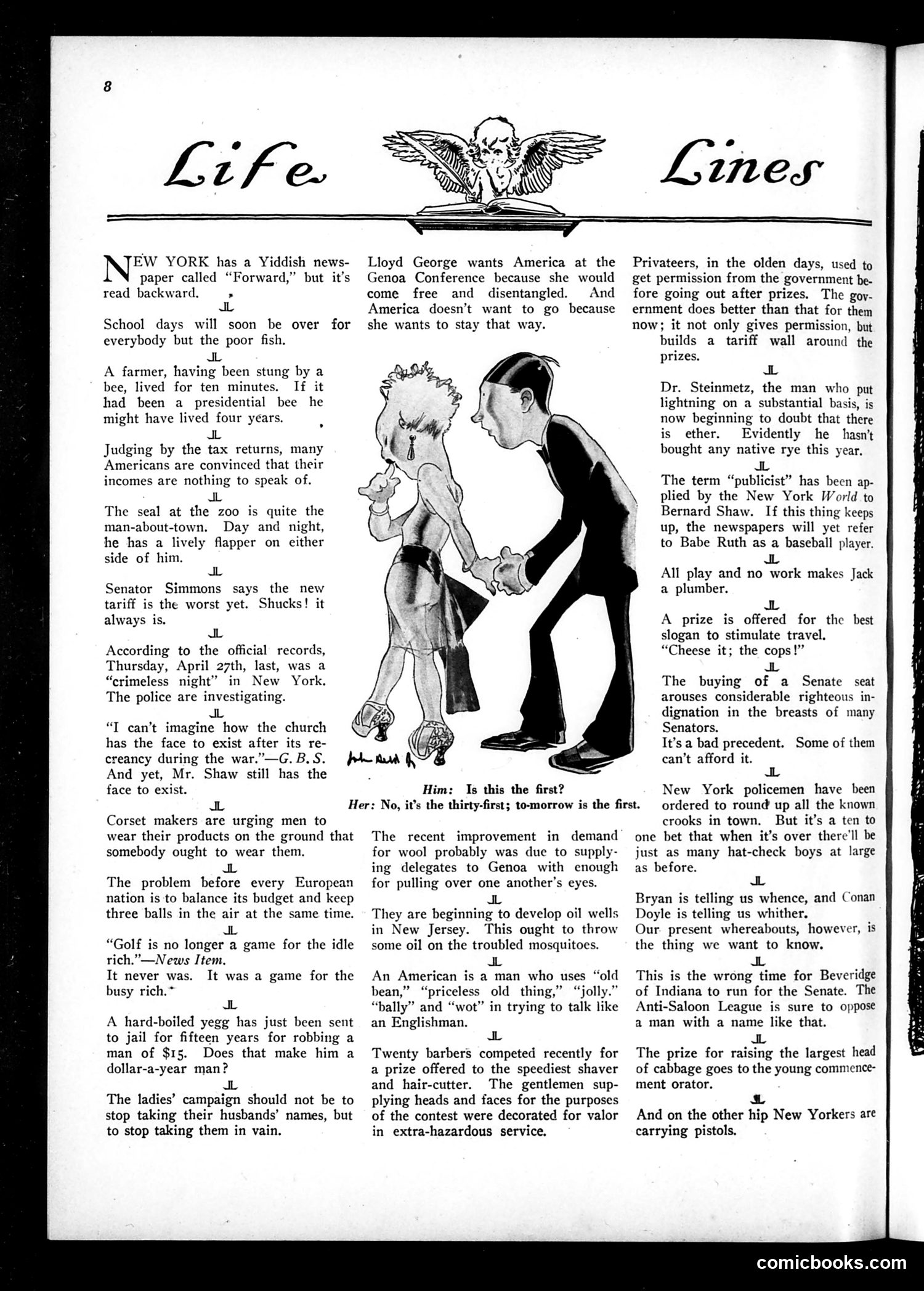
This is a satirical humor column with a central cartoon. The cartoon depicts a couple dancing, with the woman asking "Is this the first?" and the man responding "No, it's the thirty-first; to-morrow is the first." The joke appears to reference **infidelity or romantic indiscretion**—the man is claiming numerous previous encounters while presenting tomorrow's meeting as "the first," suggesting deception about the relationship's nature. The surrounding text consists of brief satirical observations on contemporary American topics: Yiddish newspapers, tariffs, presidential bees, tax returns, zoos, tariffs again, church attendance during war, corsets, European budgets, golf, hard-boiled eggs, barber competitions, and pistol-carrying in New York. These brief items represent typical Life magazine satirical commentary on early 20th-century American social, political, and economic conditions, using humor to critique various aspects of society.
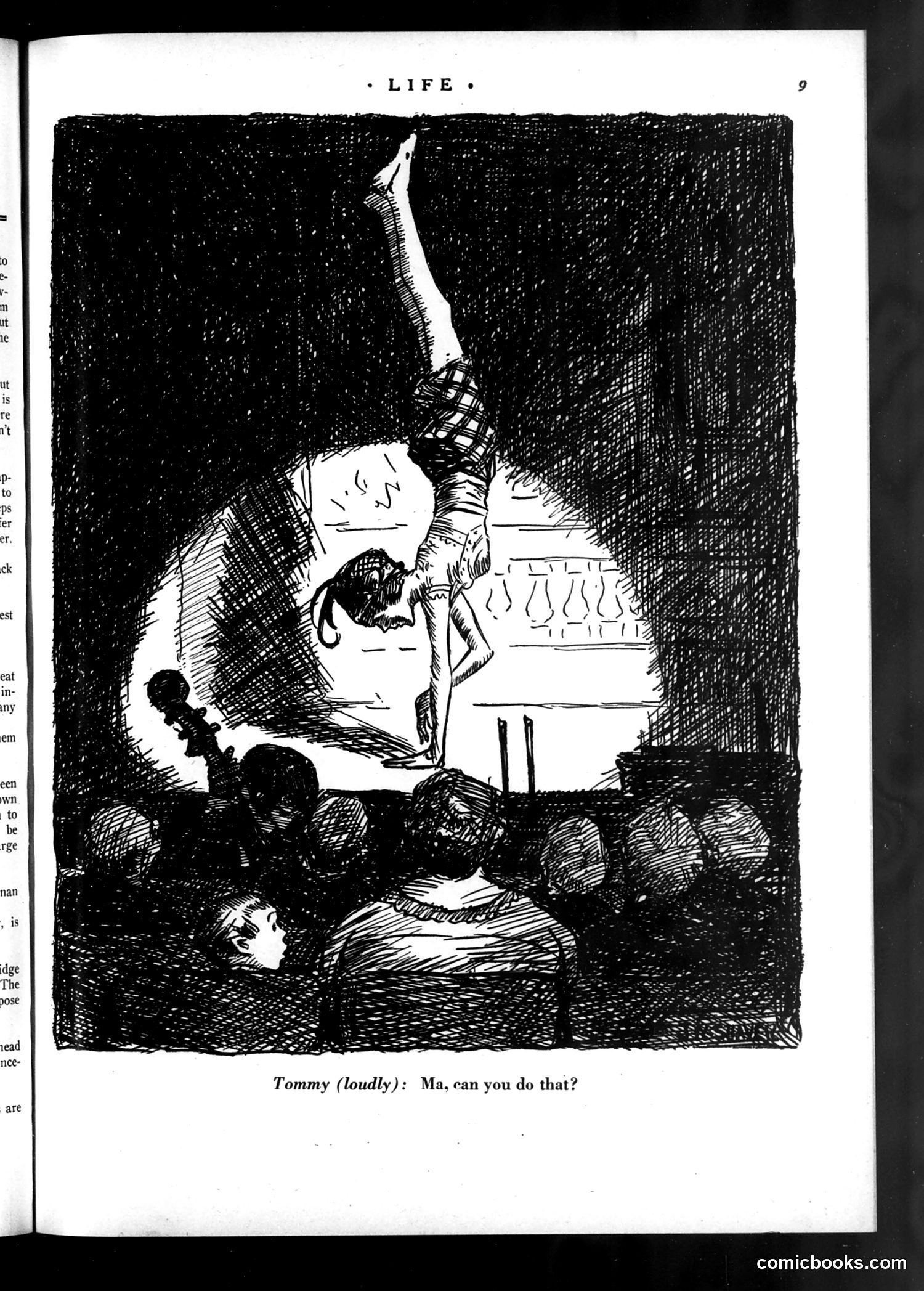
This is a single-panel cartoon from *Life* magazine (page 9) depicting a domestic scene. A mother performs an acrobatic feat—standing on her head with one leg extended upward—while children watch from below. The caption reads: "Tommy (loudly): Ma, can you do that?" The satire targets early 20th-century motherhood ideals. The cartoon humorously suggests that modern mothers are expected to be endlessly flexible, athletic, and entertaining—performing impossible physical feats to amuse their children. The "loudly" qualifier implies Tommy's unfiltered, demanding nature represents childhood's relentless expectations. The joke reflects anxieties about evolving gender roles and the physical/emotional demands placed on women as cultural attitudes toward parenting and entertainment shifted during this era.
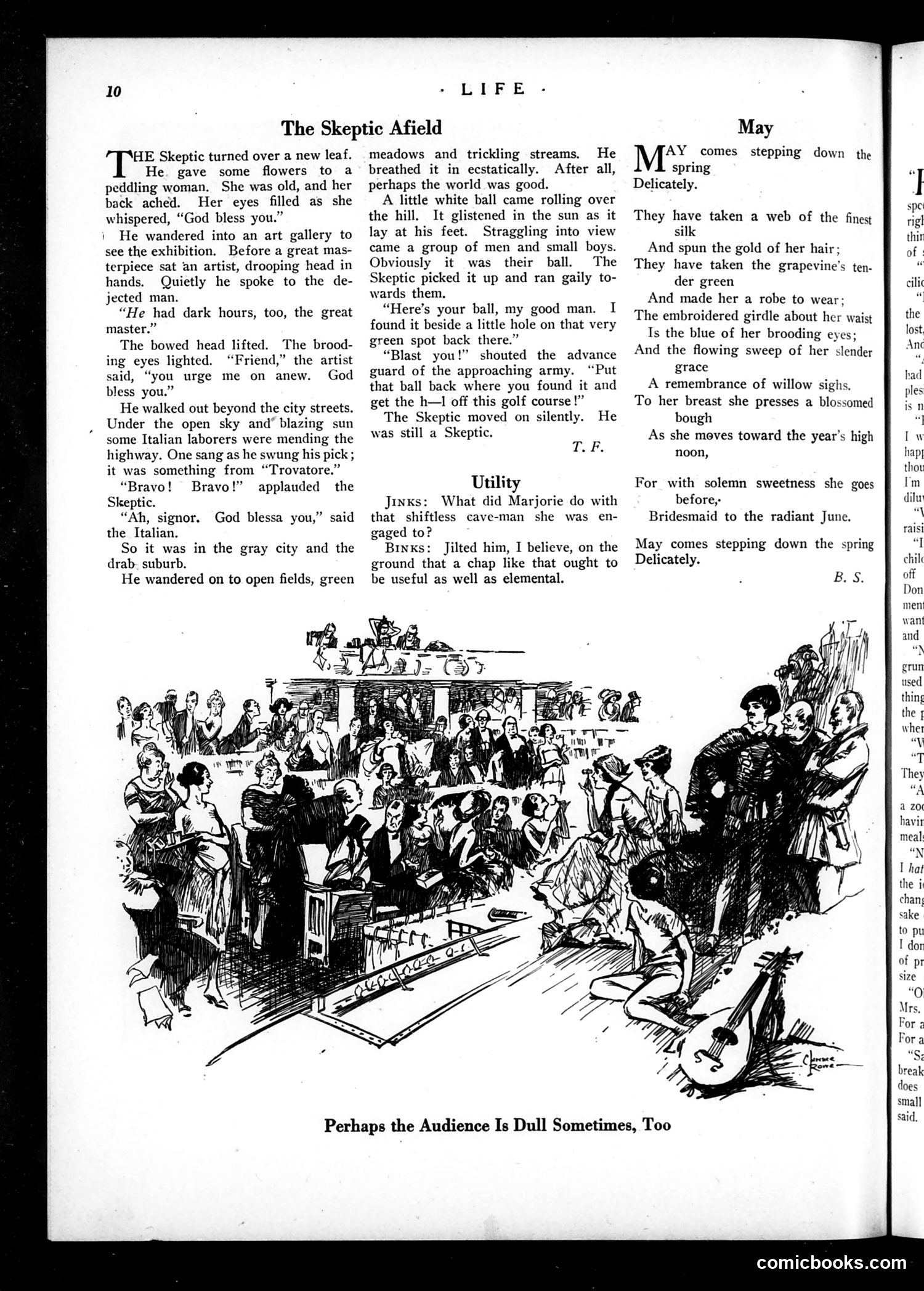
This cartoon satirizes what appears to be a public entertainment event or performance—possibly an outdoor concert or theatrical production. The large illustration shows a crowded, mixed-class audience gathered around a stage or performance area, with musicians visible (including what appears to be a guitarist in the foreground). The caption's irony suggests the performers blame their audience for being unresponsive or unappreciative, rather than acknowledging their own performance quality. The cartoon critiques mutual finger-pointing between entertainers and patrons about who bears responsibility for a lackluster event. The page also contains literary content titled "The Skeptic Afield" and a short piece called "Utility," typical of *Life* magazine's mix of satire, poetry, and social commentary from this era.
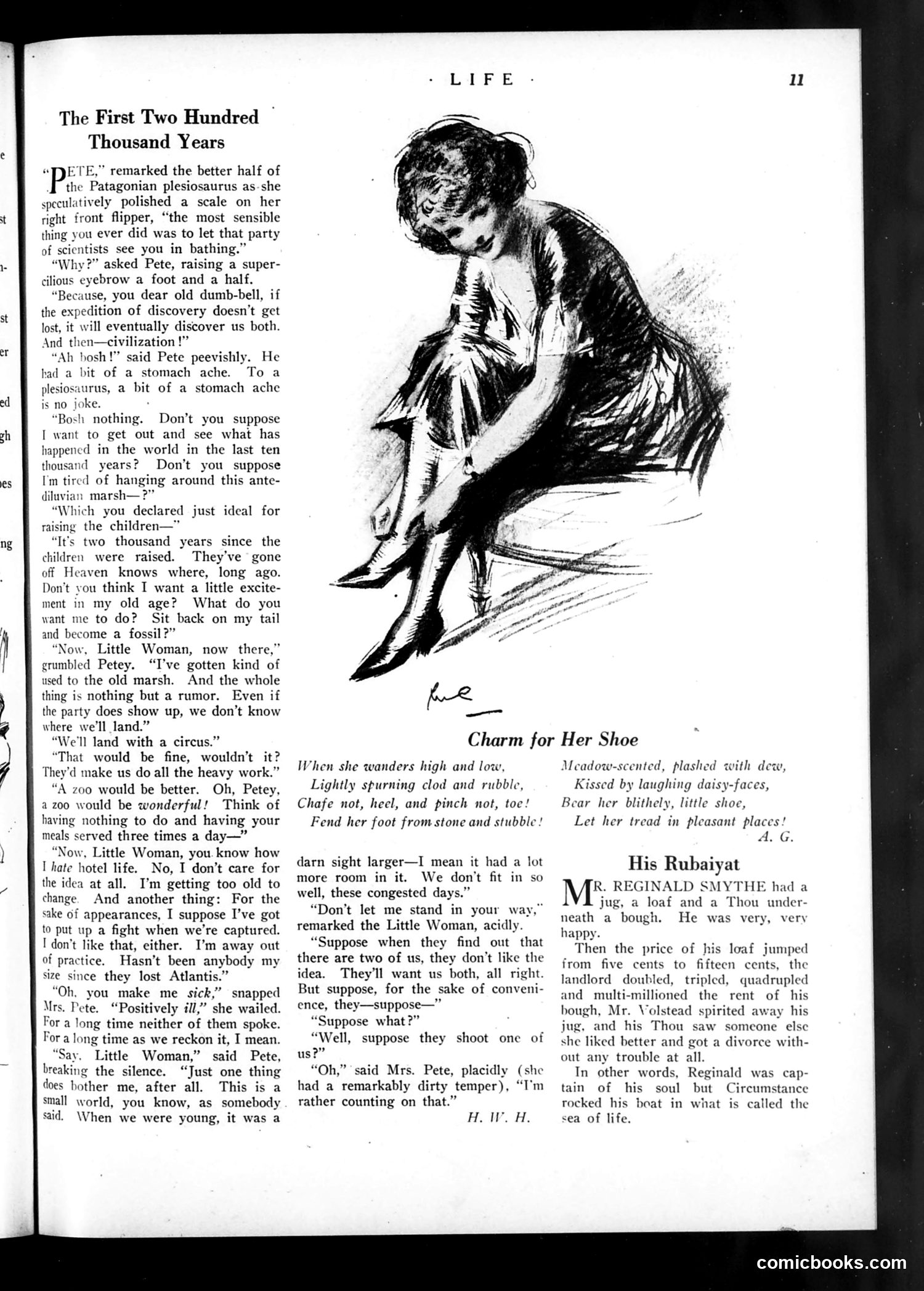
This page contains a sketch of a woman examining her shoe, accompanied by a poem titled "Charm for Her Shoe." The verse is lighthearted, addressing a woman who "wanders high and low" with "lightly spurning clod and rubble," celebrating her resilience despite wear on her footwear from rough conditions. The cartoon appears to be gentle satirical commentary on women's fashion and durability—specifically, the contrast between delicate feminine ideals and practical reality. The poem humorously acknowledges that despite women's refined appearance and pretensions, their shoes endure harsh treatment from daily life. The accompanying story fragments discuss early 20th-century social attitudes toward marriage, domesticity, and gender relations, typical of *Life* magazine's satirical tone during that era.
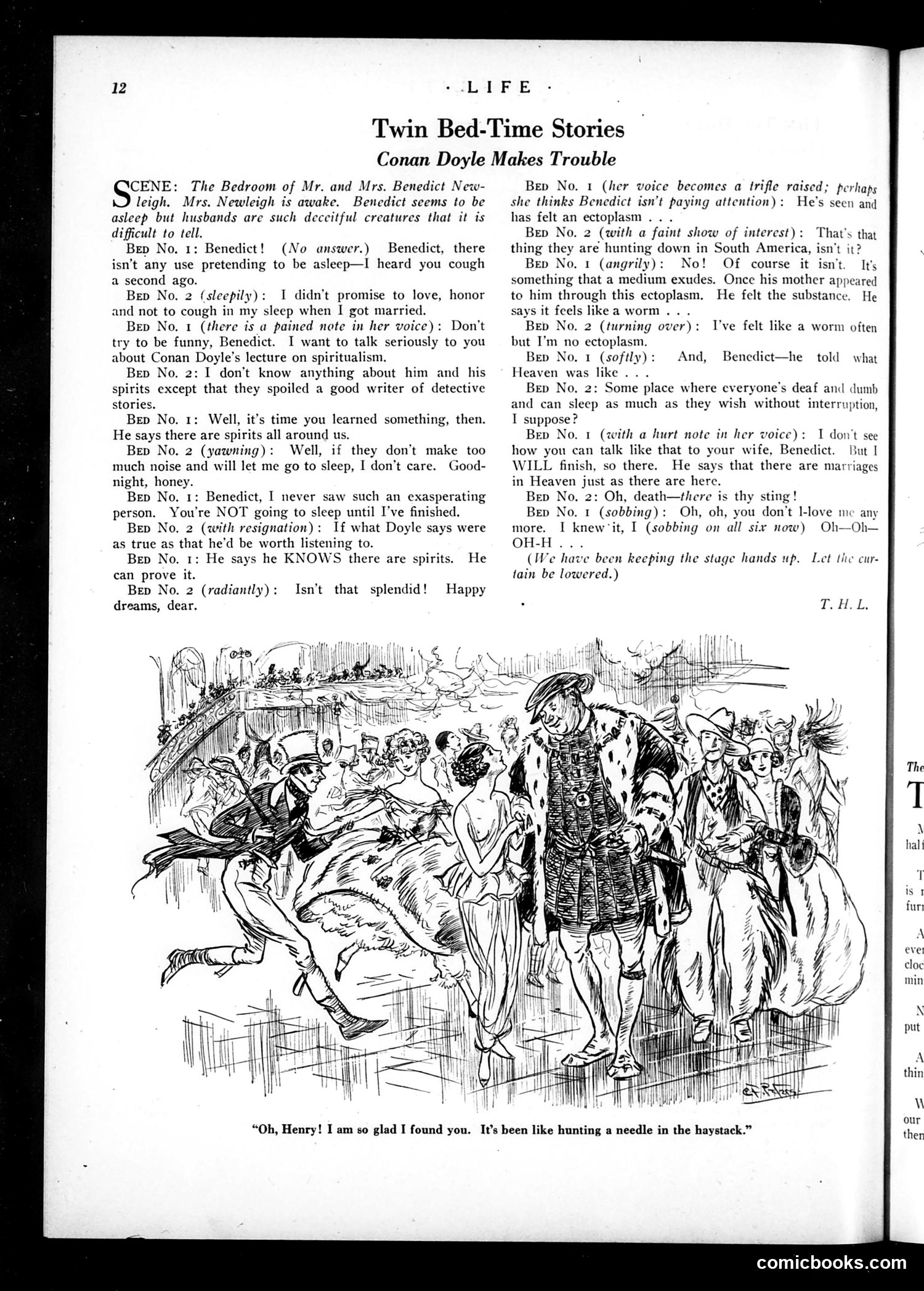
This is a humorous sketch about a married couple's bedtime conversation. Benedict (likely referencing Arthur Conan Doyle's character Sherlock Holmes) irritates his wife by lecturing about spiritualism and the afterlife when she wants to sleep. She repeatedly tries to end the conversation; he insists on continuing. The illustration shows a crowded social scene, unrelated to the bedroom dialogue—possibly depicting a spiritualist séance or party, given references to "spirits" in the text. The satire targets both Conan Doyle's famous interest in spiritualism (which was controversial at the time) and the stock marital complaint of one partner monopolizing conversation while the other wants rest. The "trouble" is the husband's pedantic, unstoppable lecturing.
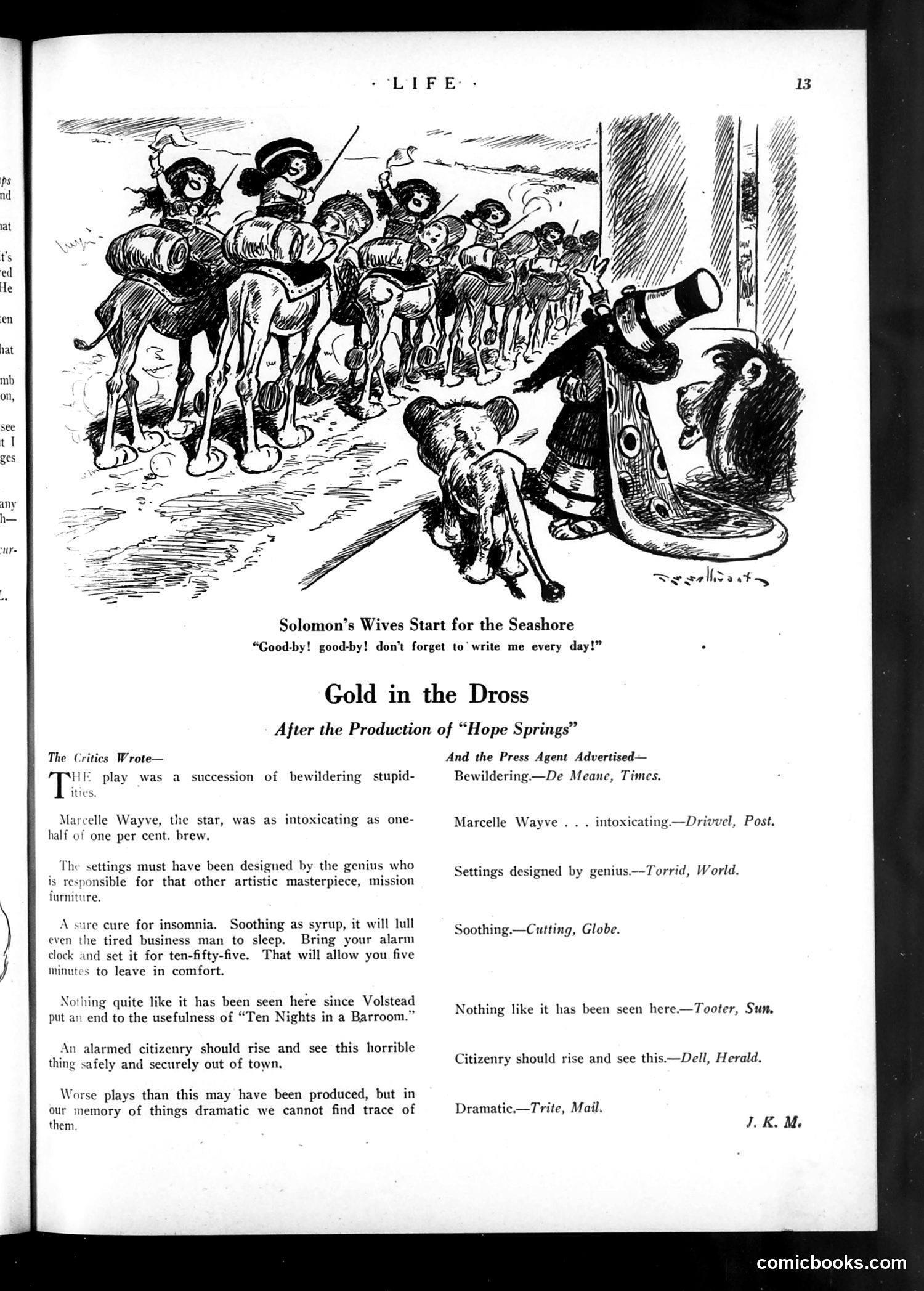
This page reviews a theatrical production called "Hope Springs," starring Marcelle Wayve. The cartoon depicts a procession of camels carrying Solomon's wives heading toward the seashore, with the caption "Good-by! good-by! don't forget to write me every day!" The satire mocks the play as absurdly bad. Critics called it "bewildering stupidities" with settings "designed by genius" (sarcastic). One reviewer compared it unfavorably to Volstead's "Ten Nights in a Barroom"—suggesting this play was worse than an already-infamous theatrical disaster. The recurring joke: despite terrible reviews, the publication notes it's so bad "we cannot find trace" of worse dramatic works, implying it may be uniquely awful. The comic exaggeration of the biblical harem departure emphasizes the play's apparent ridiculousness.
This page contains an editorial essay titled "While there is Life there's Hope" discussing France and French culture, particularly critiquing French attitudes toward food, drink, and national character. The text sarcastically compares French and American perspectives, arguing that France's self-interested isolationism (living "for herself alone") represents a moral failing. The author criticizes what appears to be France's reluctance to cooperate internationally post-WWI, suggesting French nationalism and economic self-preservation take priority over collective security. The small cartoon illustrations appear to be decorative embellishments rather than political commentary—showing everyday scenes of dining or domestic life, consistent with the essay's focus on French culinary and social habits. The overall tone suggests post-WWI tension between American and French interests regarding European cooperation and reconstruction.
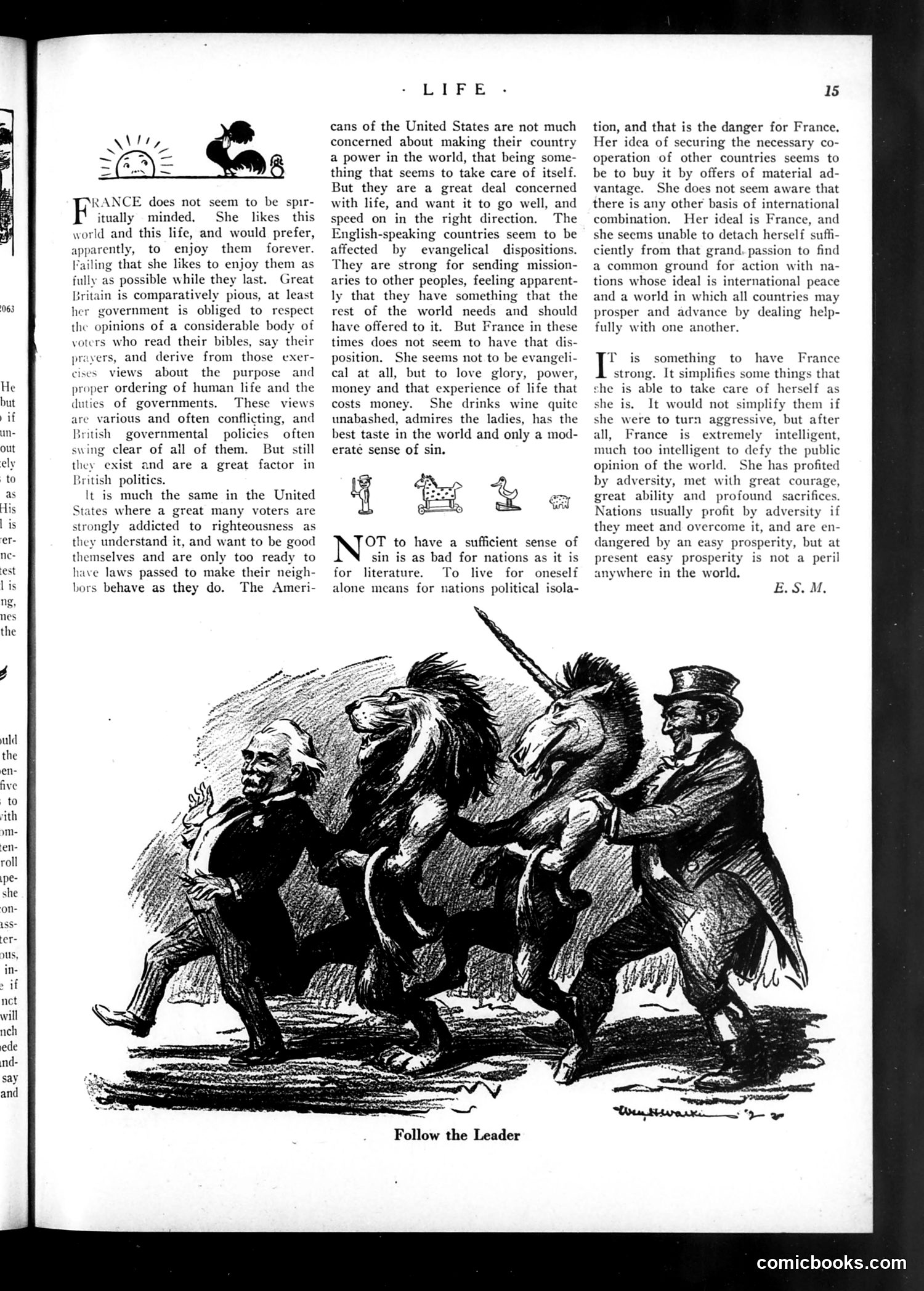
This page contrasts national characters through a political-moral lens typical of early 20th-century commentary. The text criticizes France for lacking "righteousness" and pursuing power, glory, and material pleasure (wine, ladies, fine taste) rather than idealistic international cooperation based on shared moral values. The cartoon "Follow the Leader" depicts men riding an unruly horse, illustrating the essay's point: France operates on self-interest alone ("political isolation"), making it unpredictable and difficult for other nations to follow or cooperate with. The satire suggests that Anglo-American countries (Britain, USA) approach foreign policy through evangelical moralism and shared ethical principles, while France pursues naked national advantage. The author argues this isolates France diplomatically—nations won't cooperate without moral common ground, only material incentives France cannot sustainably offer. The piece is essentially Western paternalism critiquing French pragmatism as spiritually deficient.
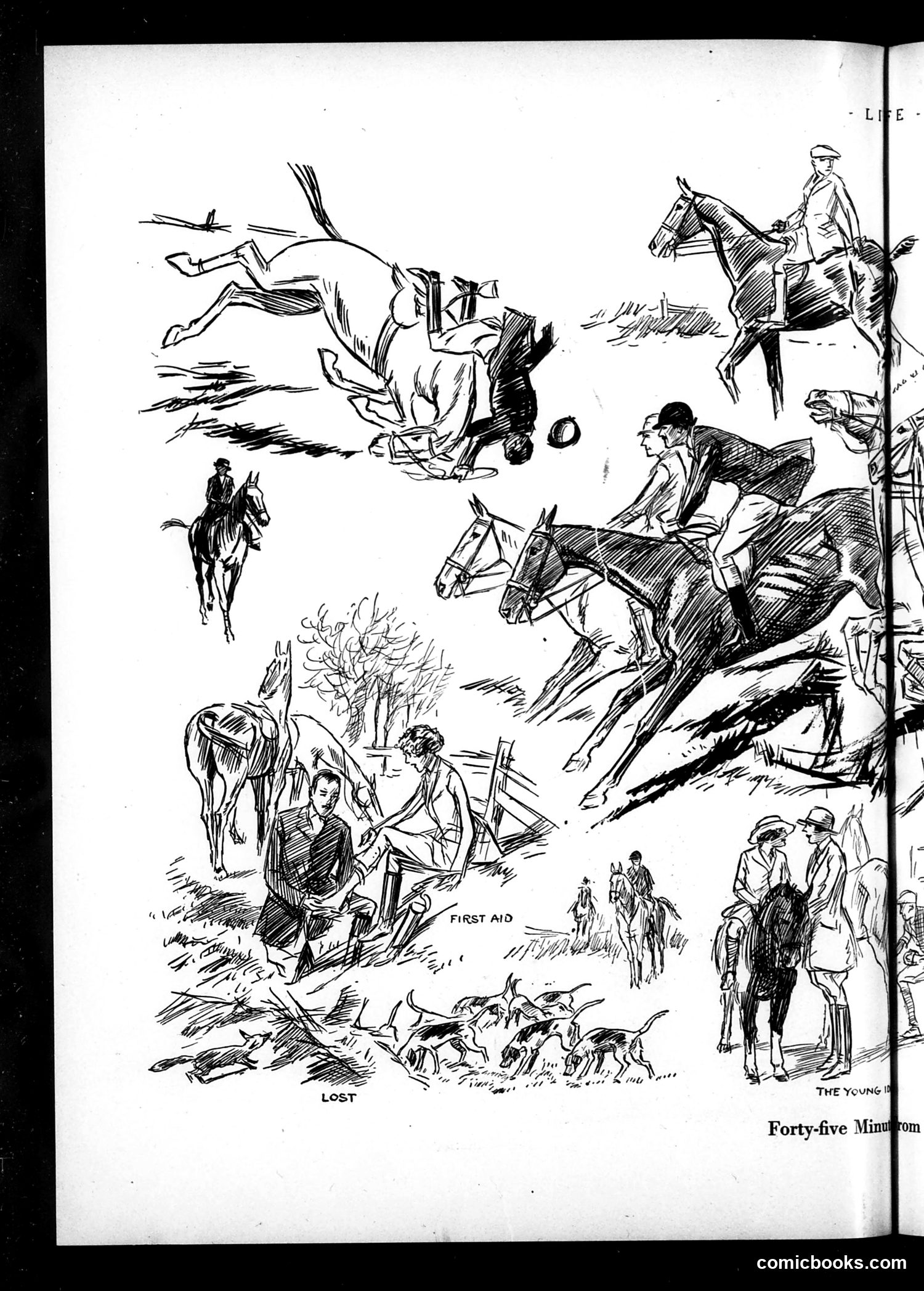
This appears to be a satirical illustration about fox hunting or a similar equestrian sport, depicting various scenes of the hunt's mishaps and chaos. The labeled vignettes show: - **"Lost"** - hunters separated from the group - **"First Aid"** - someone attending to an injured rider - **"The Young"** - younger participants The composition humorously catalogs the disasters that befall amateur riders during a forty-five-minute hunt: spills, lost riders, injuries requiring medical attention, and general disorder. The busy, overlapping scenes satirize the chaotic reality of what participants imagine as a genteel sporting activity. The exact date and author aren't legible, but this is clearly satirizing upper-class leisure pursuits through depicting their comic failures and physical consequences.
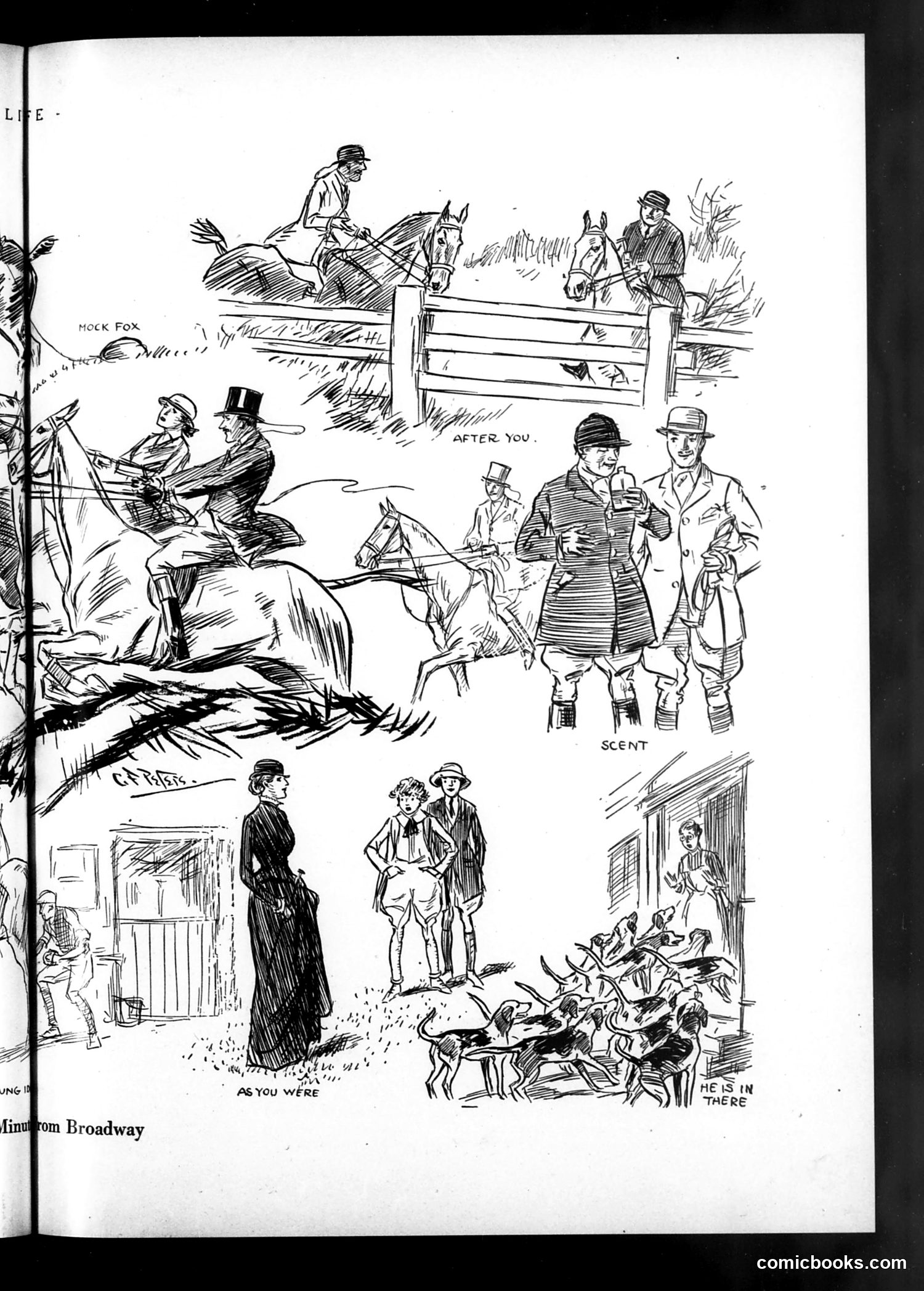
This page satirizes fox hunting, an upper-class sport. The sequential panels show the hunt's progression: "Mock Fox" (a fake fox chase), "After You" (hunters jumping fences), "Scent" (following the trail with horses), "As You Were" (a woman arriving at a manor house), and "He Is In There" (dogs surrounding kennels). The humor appears to target the pretension and absurdity of elaborate fox-hunting rituals among wealthy gentlemen in formal dress. The final panel's comic payoff—discovering the "fox" is actually domestic dogs in kennels—deflates the supposed sport's dignity. The satire mocks both the ritual's complexity and the hunters' pompous behavior, suggesting their elaborate chase is ultimately ridiculous.
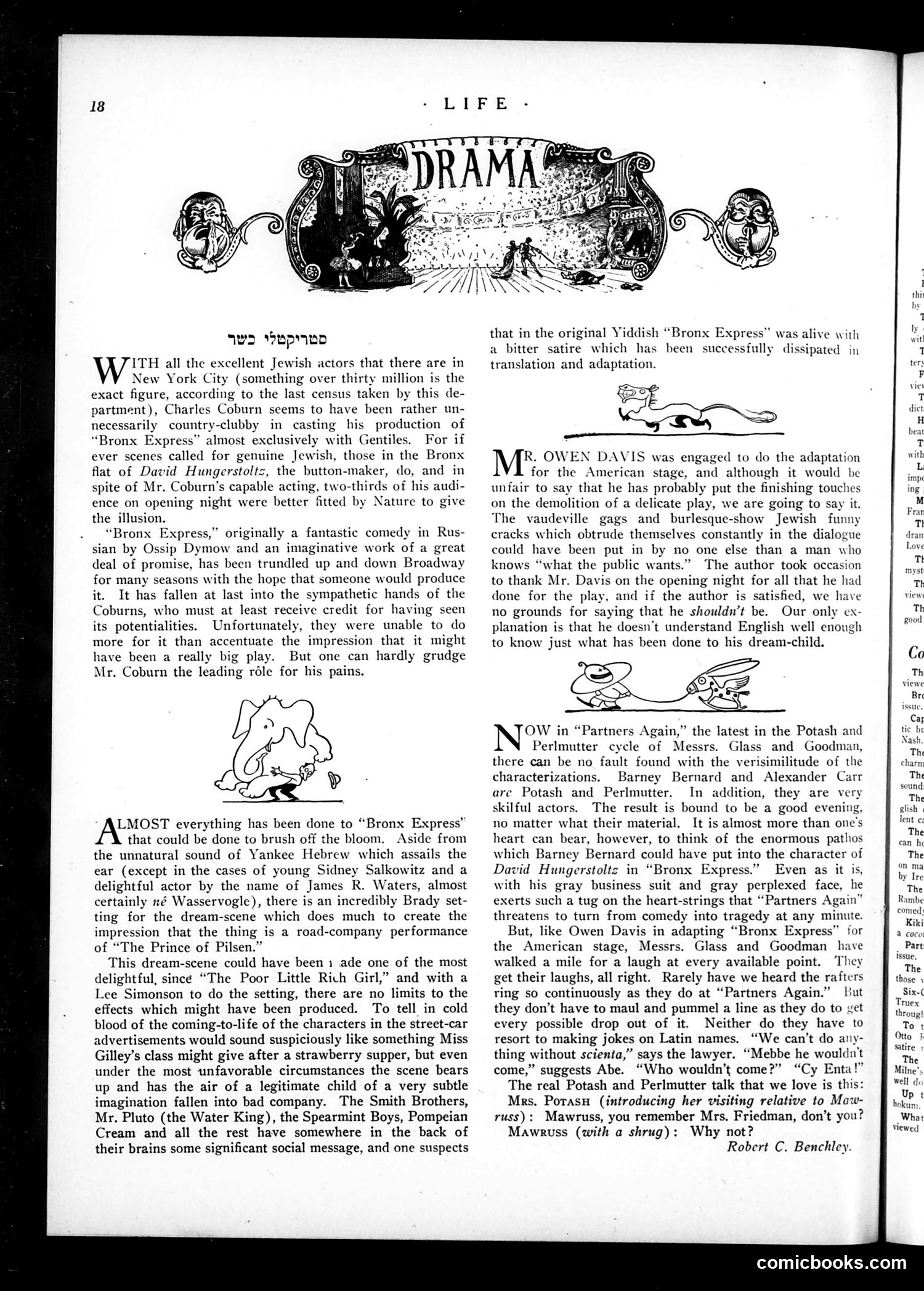
This page critiques two Broadway productions through pointed satire. The main targets are: **"Bronx Express"**: The reviewer attacks Charles Coburn's casting choices—notably excluding Jewish actors despite the play's Jewish setting in a Bronx button-maker's apartment. The satire is sharp: Life sarcastically notes there are "thirty million" Jewish actors in New York City, yet Coburn cast "almost exclusively with Gentiles." The review further lambastes adapter Owen Davis for diluting the original Yiddish play's "bitter satire" with vaudeville gags and crude "Jewish funny cracks" pandering to what Davis assumes "the public wants." **"Partners Again"**: Praised for authentic characterization in the Potash and Perlmutter cycle, with Jewish actors Barney Bernard and Alexander Carr playing their signature roles. The underlying critique: authentic Jewish representation matters. The satire exposes both Coburn's assimilationist casting and Davis's assumption that American audiences demand stereotypical humor over genuine dramatic content. Life's ethnic specificity reflects 1920s theater demographics and debates over authenticity versus commercial pandering.
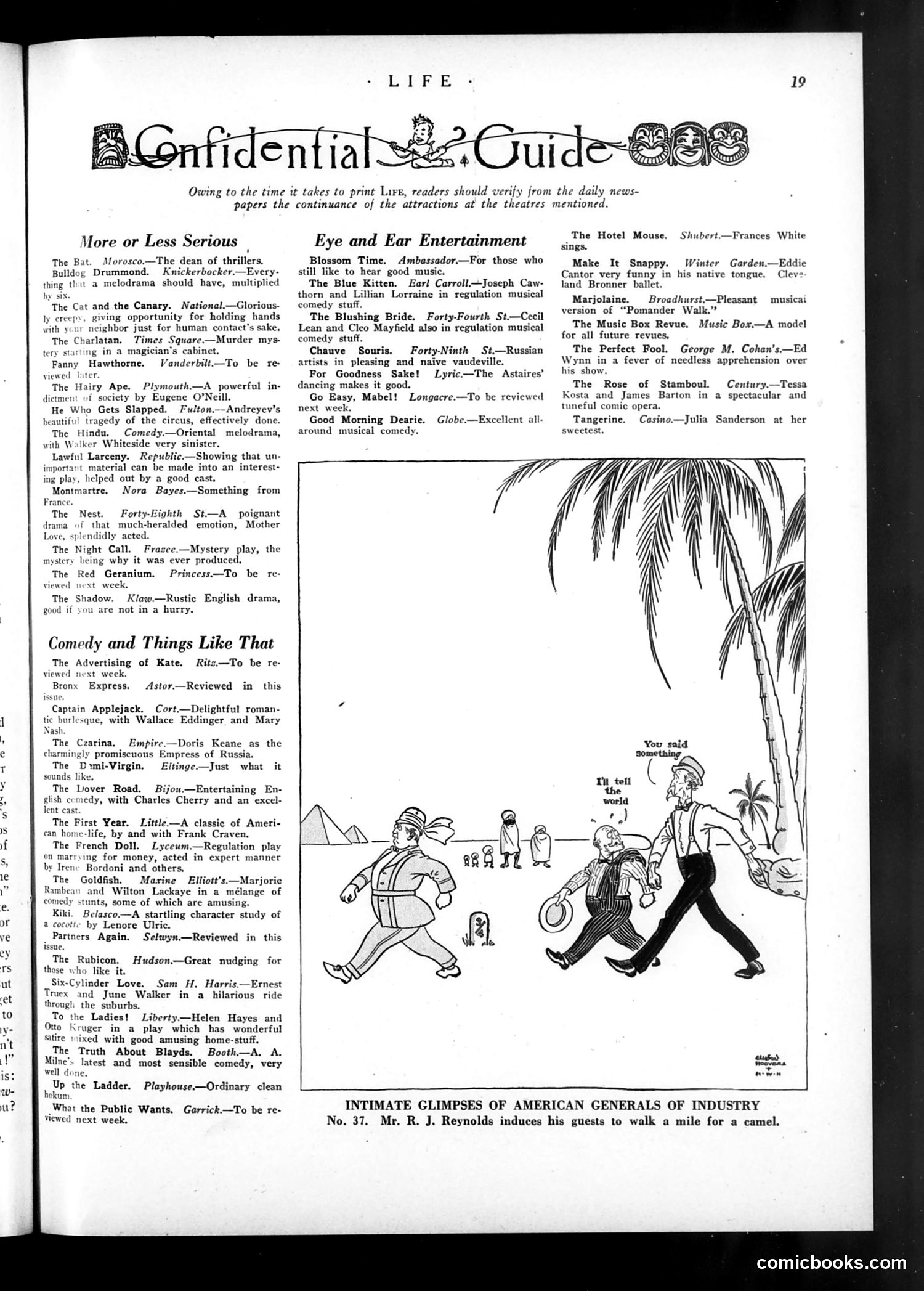
This page is a theater guide—a "Confidential Guide" to Broadway shows and entertainments. It's organized into three sections reviewing current productions: "More or Less Serious" plays, "Comedy and Things Like That," and "Eye and Ear Entertainment" (musicals). The cartoon at bottom depicts an industrialist (labeled as "Mr. R. J. Reynolds") inducing guests to "walk a mile for a camel"—a direct reference to Reynolds' famous cigarette advertising slogan. The joke satirizes how brazenly corporations use their wealth and influence to promote consumption, even disguising advertising as casual social activities. The page itself functions as entertainment journalism mixed with theater advertising—typical of Life's role as a satirical magazine covering American leisure and consumer culture in the early 1920s. The casual reviews reflect the magazine's audience: affluent New Yorkers with disposable income for Broadway shows and branded consumer goods.
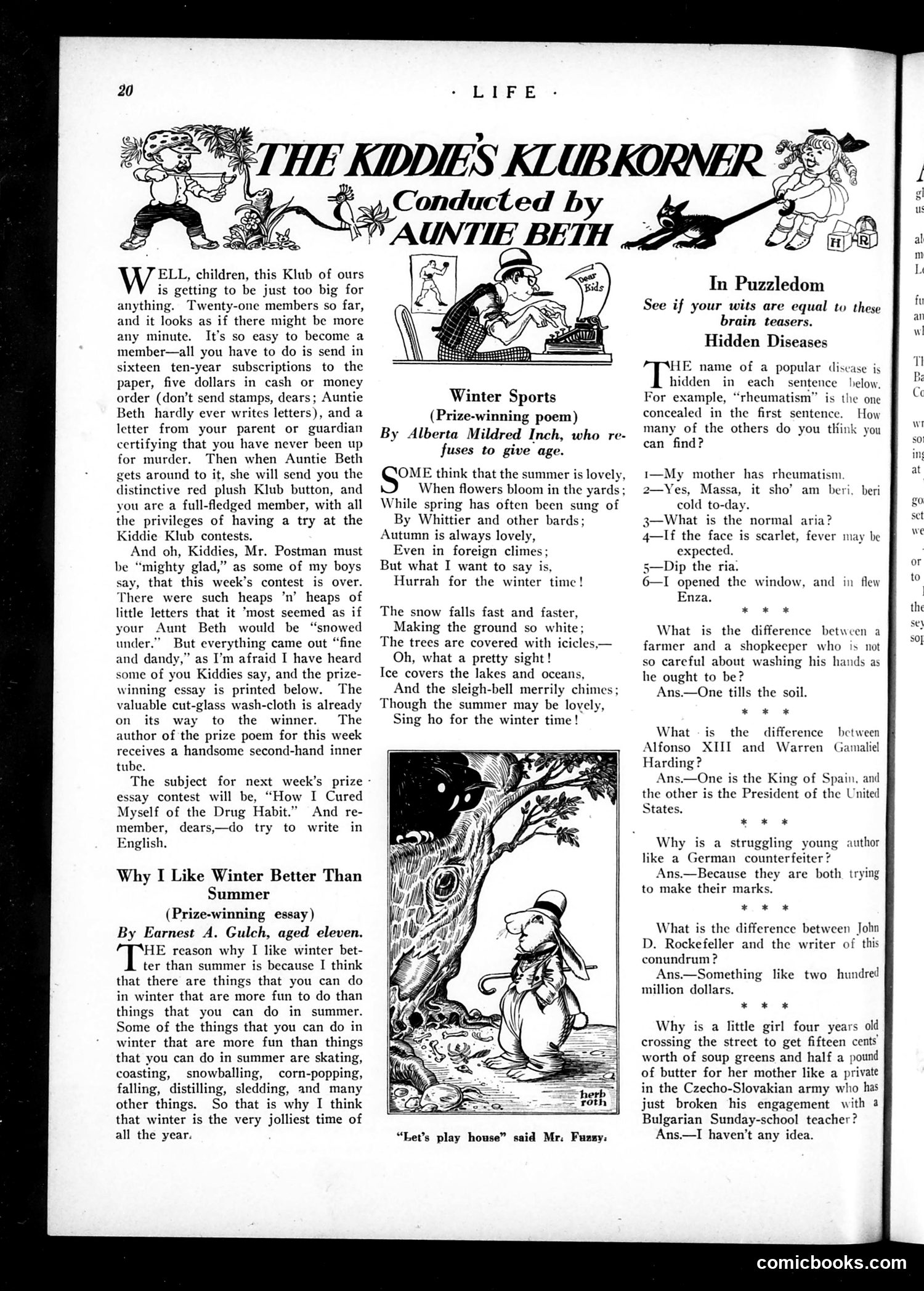
This page features "The Kiddies Klub Korner," conducted by "Auntie Beth," a children's section of *Life* magazine. The humor operates on multiple levels: **The Setup**: Auntie Beth humorously complains the club is growing too large, requiring extensive subscription commitments and parental letters certifying children "have never been up for murder"—a dark joke about the submission burden. **The Content**: Prize-winning submissions appear deliberately mediocre. The essay "Why I Like Winter Better Than Summer" by eleven-year-old Earnest Gulch is repetitive and poorly reasoned ("winter is more fun because there are fun things to do"). The poem by Alberta Mildred Inch contains spelling errors ("icic" for "icicles"). **The Satire**: *Life* satirizes children's publications and amateur writing contests by presenting genuinely amateurish work as prize-winners, mocking both the contests' standards and readers' expectations. The "brain teasers" section adds mild humor through wordplay. **Context**: This reflects early-1900s *Life* magazine's sophisticated satire aimed at adult readers, not actual children.
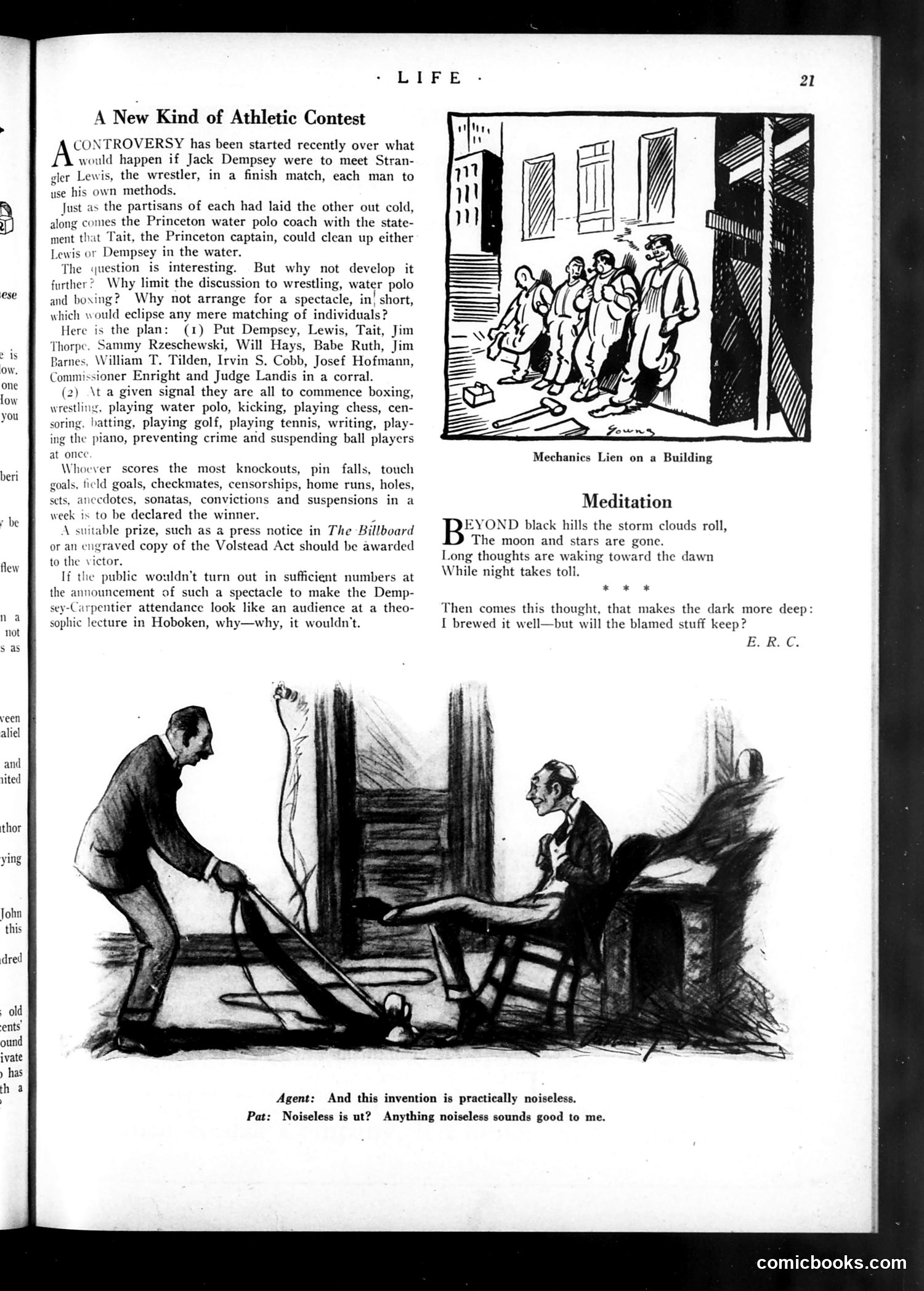
**"A New Kind of Athletic Contest"** satirizes the era's obsession with comparing athletic champions across different sports. The piece references a real debate: boxer Jack Dempsey versus wrestler "Strangler" Lewis. The author mockingly proposes a absurd solution—throw famous athletes and public figures (Babe Ruth, Jim Thorpe, tennis player Tilden, Judge Landis) into a corral to simultaneously compete in boxing, chess, golf, piano-playing, and crime prevention, scoring points across all activities. The satire targets overheated sports journalism and the public's appetite for celebrity spectacles. References to the "Volstead Act" (Prohibition) and Commissioner Enright (a real Prohibition enforcer) add topical bite. The bottom cartoon about a "noiseless" invention is a separate, unrelated gag about an agent promoting an ineffectual device—a standard format for Life's humor.
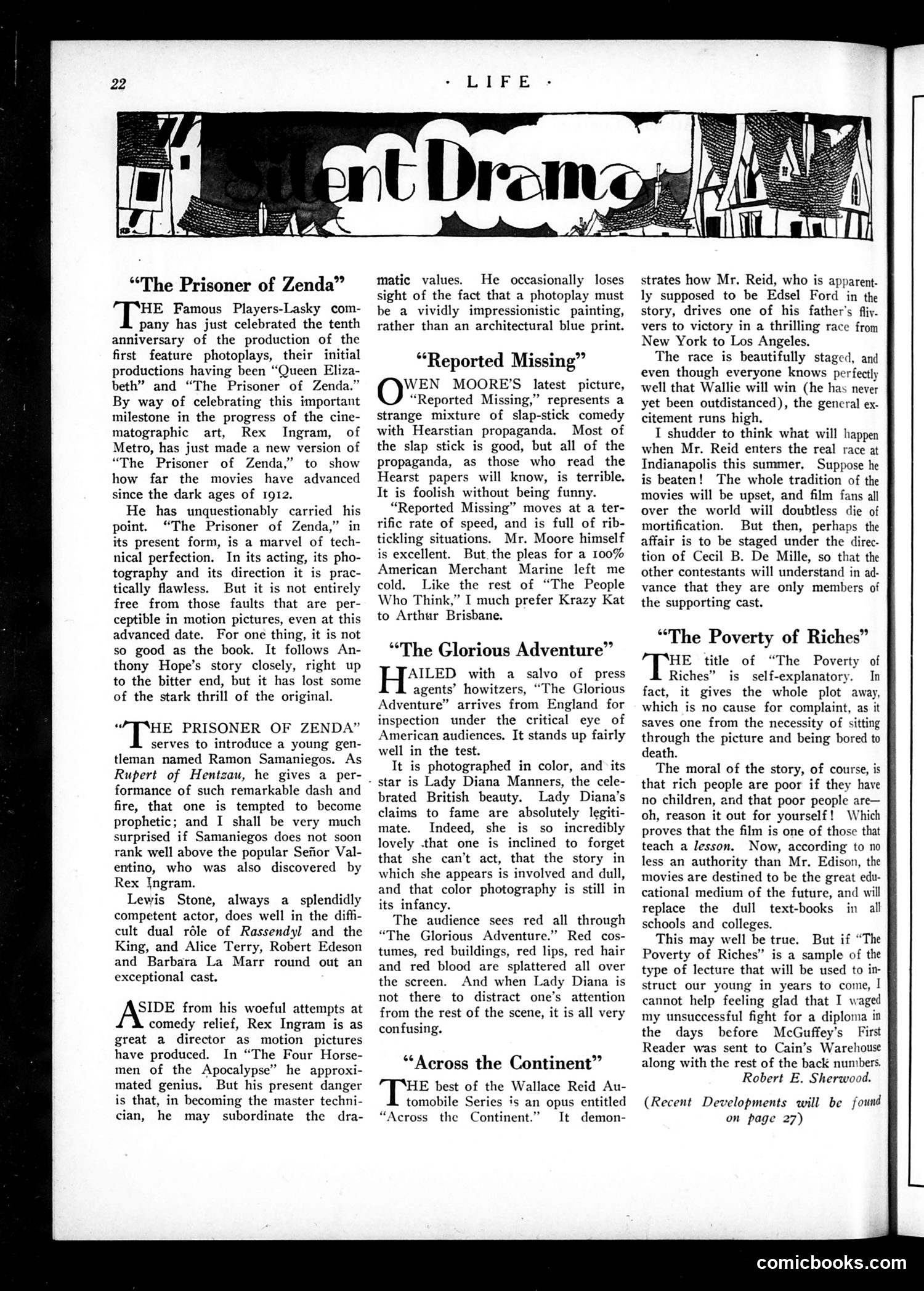
This page contains film criticism from Life magazine's "Ent Drama" (Entertainment Drama) section, reviewing contemporary movies circa 1922. The reviews discuss: - **"The Prisoner of Zenda"**: A remake of an early feature film, praised for technical excellence but criticized for losing the dramatic intensity of Anthony Hope's novel. The critic notes director Rex Ingram may prioritize technical perfection over emotional impact. - **"Reported Missing"**: Owen Moore's comedy criticized for mixing slapstick with "Hearstian propaganda"—apparently pro-American Merchant Marine messaging the critic finds tedious. The review mocks "The People Who Think" (readers of serious publications) who prefer Krazy Kat cartoons to such messaging. - **"The Glorious Adventure"**: Featuring British actress Lady Diana Manners, shot in color. The critic acknowledges her beauty but notes weak acting and an excessive use of the color red throughout, making scenes confusing. The page exemplifies early 1920s film criticism balancing technical innovation against storytelling and acting quality.
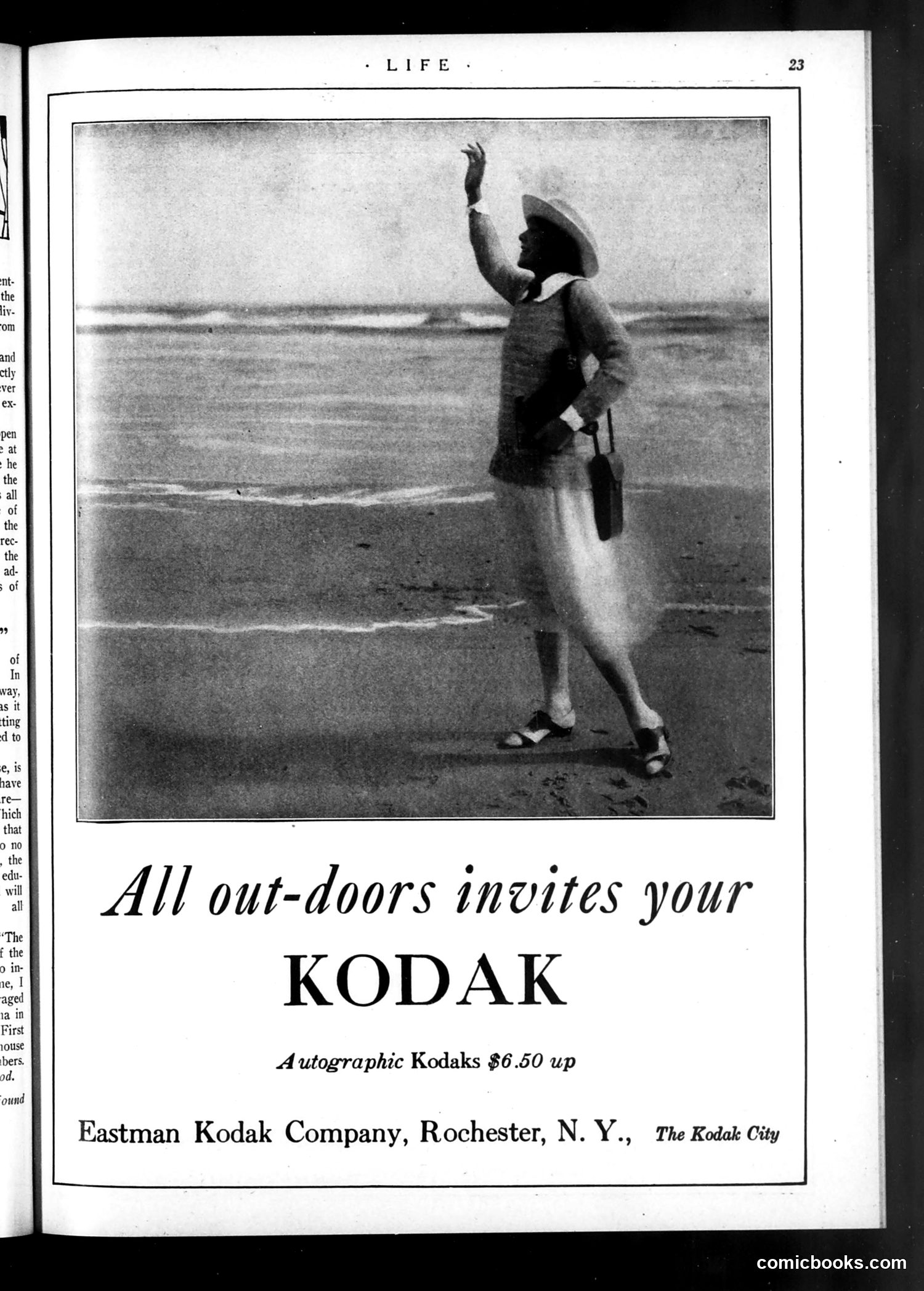
This is a **Kodak advertisement**, not a political cartoon or satire. The page shows a woman at the beach in period dress (appearing to be early 1900s based on her outfit and hat), shielding her eyes while looking out at the ocean. The ad's messaging is straightforward: "All out-doors invites your KODAK" encourages consumers to bring cameras on outdoor activities. Autographic Kodaks are promoted at $6.50 and up—a significant price point for the era, positioning the camera as aspirational consumer technology. The beach scene exemplifies leisure activities where photography would enhance personal memories, a marketing strategy Kodak pioneered by democratizing camera ownership and promoting amateur photography as a middle-class pursuit.
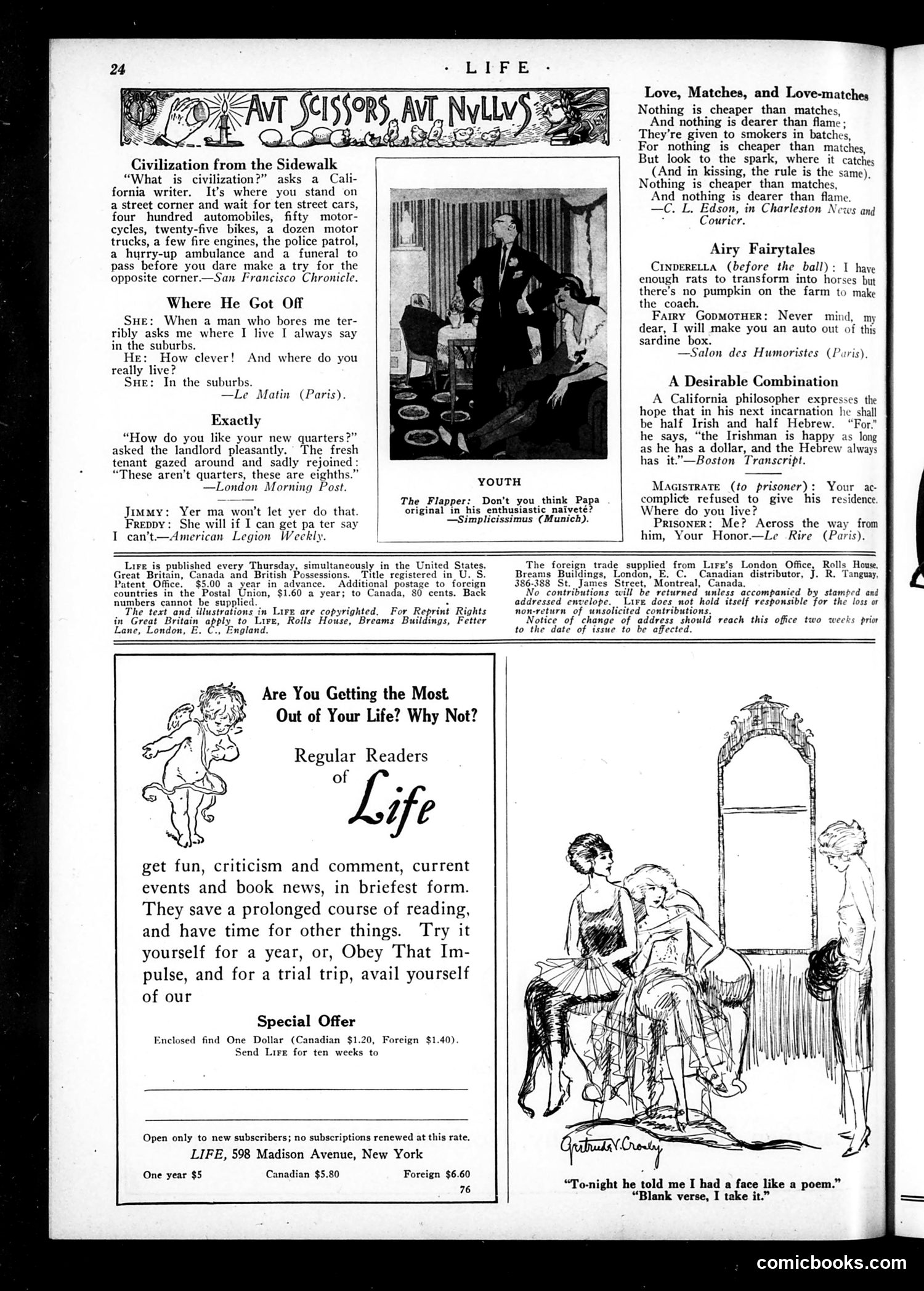
This page from *Life* magazine consists primarily of **brief humorous anecdotes and advertising** rather than political cartoons. The content includes: **Humor pieces**: Short jokes reprinted from various sources (San Francisco Chronicle, Le Matin, London Morning Post, American Legion Weekly, Simplicissimus, Boston Transcript, Le Rire) on everyday topics—urban congestion, suburban living, landlord relations, and fairy tale modernization. These are mild observational humor typical of early 20th-century magazines. **One cartoon** (bottom right, artist signed): Shows a woman telling a man he has "a face like a poem," with his response "Blank verse, I take it"—a pun on poetry terminology. **Poetry section** about matches and flame (likely early 1900s). **Subscription advertisement**: Promoting *Life* magazine's value to regular readers seeking "fun, criticism and comment" in brief form. The page reflects *Life*'s satirical mission through gentle social commentary rather than sharp political critique. No specific political figures or events are referenced—the satire targets universal human experiences and pretension.
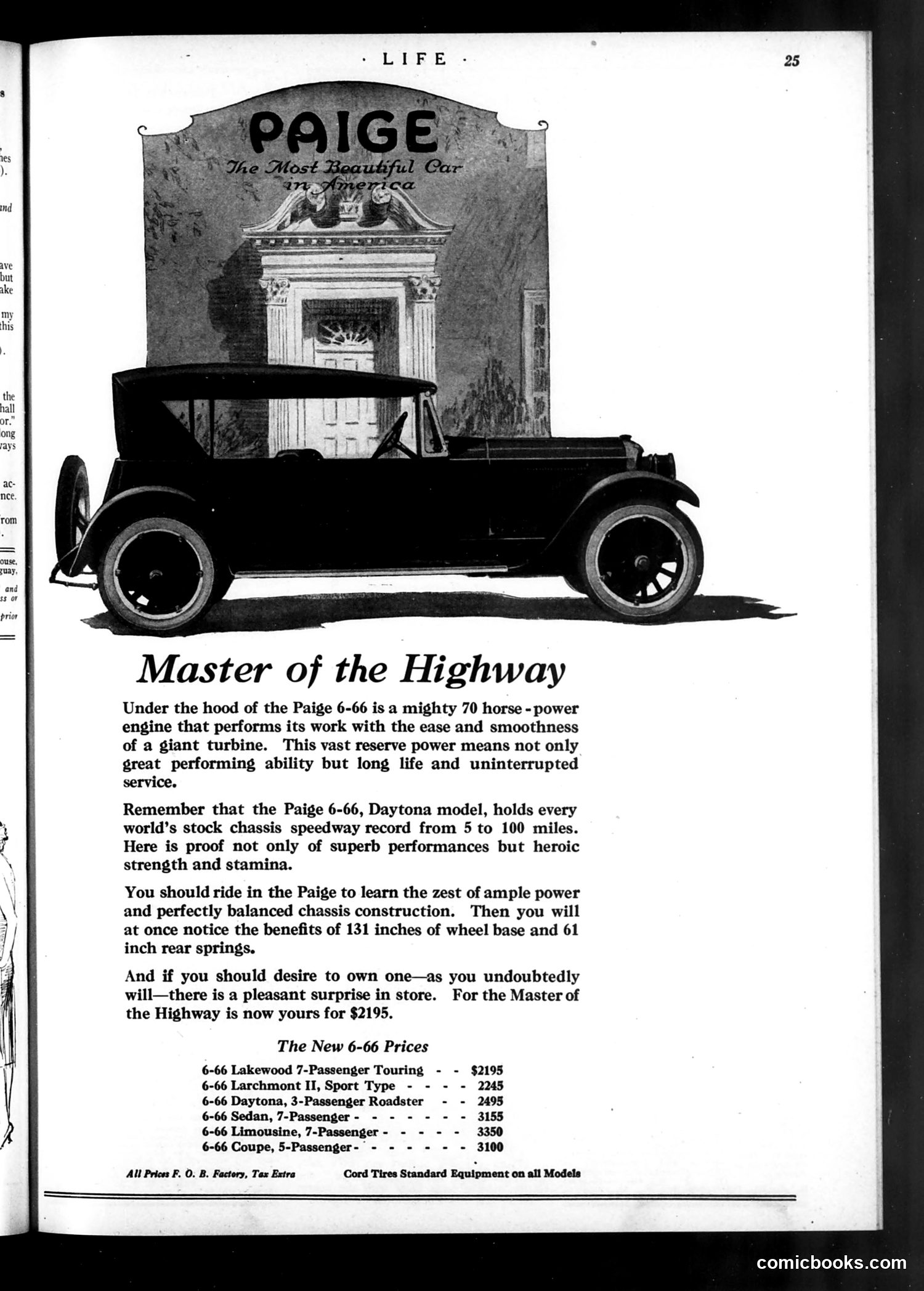
This page is primarily **automobile advertising**, not satire or political commentary. It promotes the Paige 6-66 automobile, marketed as "The Most Beautiful Car in America" and "Master of the Highway." The visual shows a sleek 1920s roadster positioned against a classical neoclassical building, emphasizing luxury and status. The text uses hyperbolic language typical of period advertising—claiming the car's 70 horsepower engine performs "with the ease and smoothness of a giant turbine" and referencing speedway records to suggest both performance and reliability. The pricing structure (ranging from $2,195 to $3,350) indicates this was positioned as an upscale vehicle. For modern readers, the significance lies in understanding how early automotive advertising used grandiose claims and aspirational imagery to sell cars as status symbols and technological marvels, rather than practical transportation.
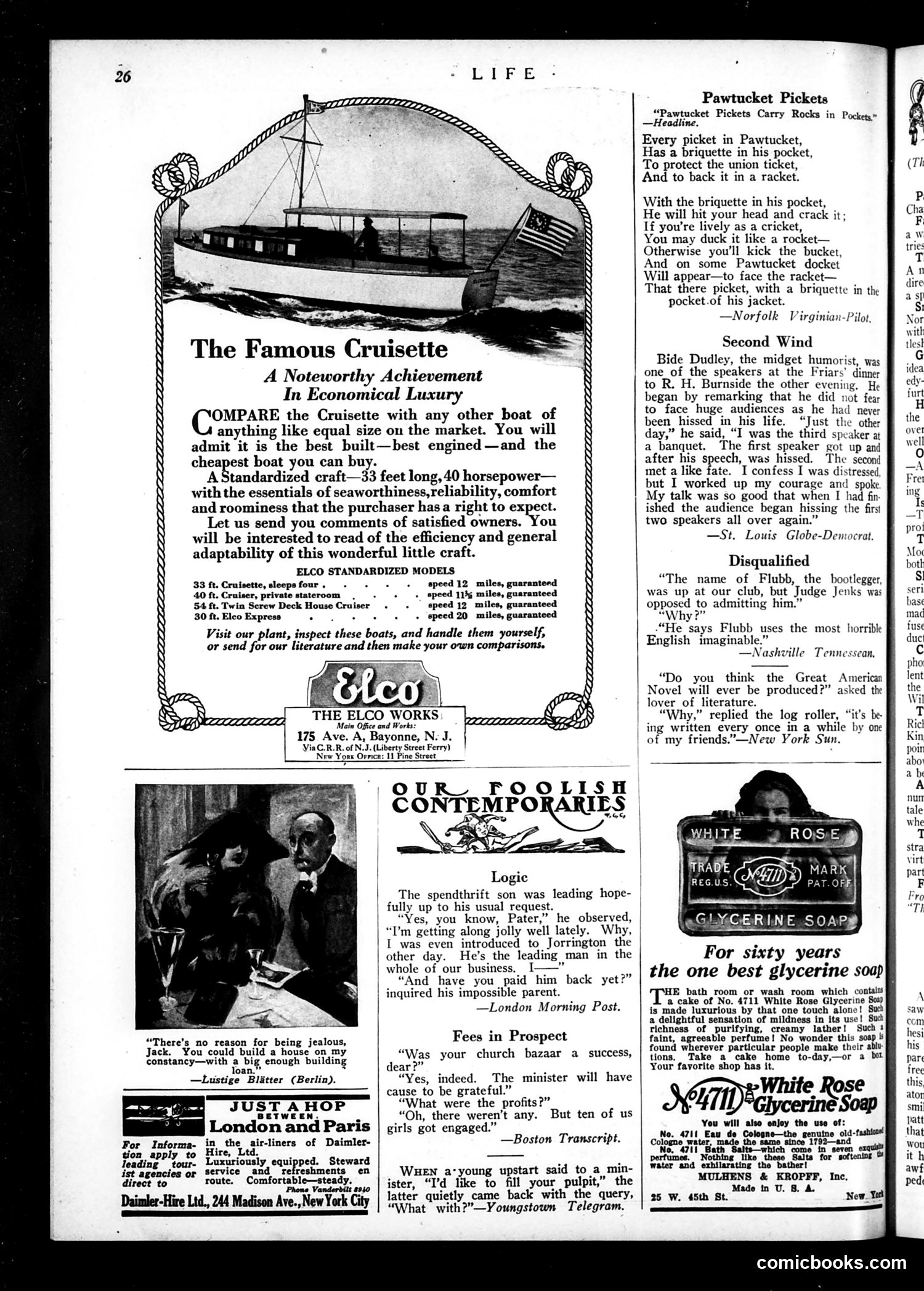
This page is **primarily advertising** (Elco boats, White Rose soap, Daimler-Hire) with a minor satirical section titled "Our Foolish Contemporaries." The satirical content consists of brief, unrelated humorous anecdotes mocking human behavior: - A husband jokes about his wife's faithfulness as collateral for loans - A clergyman refuses to admit a bootlegger to his club (Prohibition-era reference) - A church bazaar succeeds financially only through ten engagements - A young minister is asked what he'd fill a pulpit with The **"Pawtucket Pickets"** poem satirizes labor strike violence in Pawtucket (likely Rhode Island), mocking strikers who carry bricks/briquettes in their pockets as weapons to intimidate union opponents. **Bide Dudley** anecdote humorously describes a midget comedian's stage confidence—he wasn't hissed because he spoke last, after the audience had already hissed earlier speakers. These are lightweight, disconnected jokes typical of *Life*'s satirical humor—gentle social commentary rather than serious political critique.
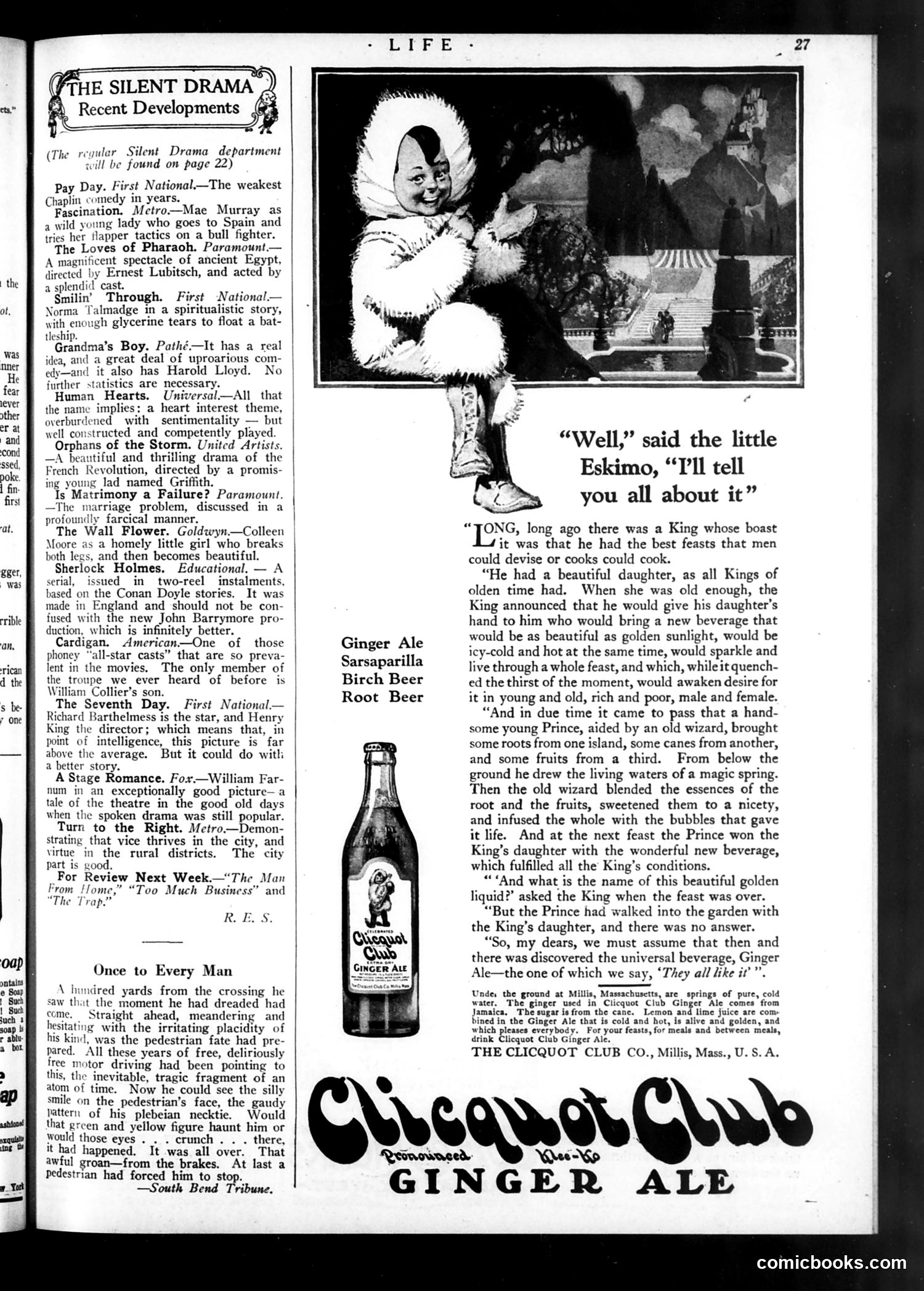
This page contains two distinct elements: **Left side:** "The Silent Drama—Recent Developments" is a film review column critiquing current silent movies (1920s era). It dismisses Charlie Chaplin's "Pay Day" as his weakest comedy, praises Harold Lloyd's "Grandma's Boy," and reviews other theatrical releases. The tone is snappy and dismissive—typical period film criticism. **Right side:** An illustrated advertisement for Clicquot Club Ginger Ale. An Eskimo character (reflecting period advertising conventions, now considered offensive) tells a fairy tale about a King seeking the perfect beverage. The narrative describes a magical drink that is "icy-cold and hot," sparkles, and quenches thirst—obviously describing the advertised ginger ale. This uses fantastical storytelling as a sales pitch, anthropomorphizing the product's qualities as royal-worthy. The "Once to Every Man" section below is satirical flash fiction about a driver finally hitting a pedestrian—dark humor about traffic hazards.
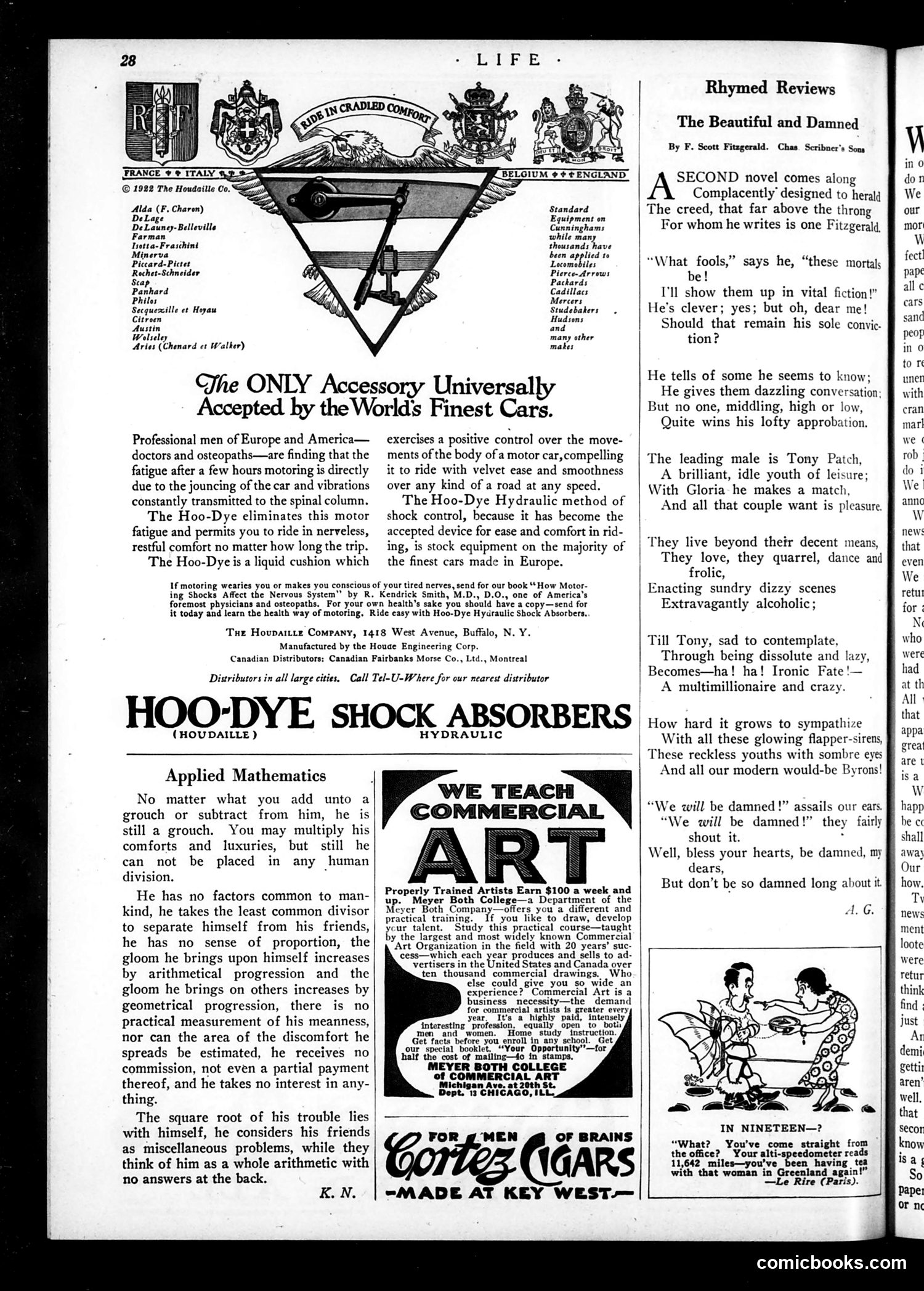
This page predominantly features **automobile advertising**, particularly for Hoo-Dye hydraulic shock absorbers. The upper section showcases a prestigious list of luxury car brands (Packard, Cadillac, Pierce-Arrow, Mercer, etc.) that have adopted this accessory, establishing it as a status symbol among the "world's finest cars." The page includes three distinct sections: 1. **Shock Absorber Ad**: Medical professionals (doctors, osteopaths) endorse the product as eliminating motor fatigue and nervous strain from early automobiles' rough rides—a genuine concern for frequent motorists. 2. **"Applied Mathematics" Satire**: A tongue-in-cheek essay comparing a grouch to mathematical principles, suggesting grouchiness follows arithmetical/geometrical progression—satirizing pessimistic people. 3. **Meyer Roth College Advertisement**: Promoting commercial art training, claiming artists earn $100+ weekly. The page is fundamentally commercial, mixing product promotion with light satirical commentary. The "Beautiful and Damned" book review (right margin) appears unrelated contextually.
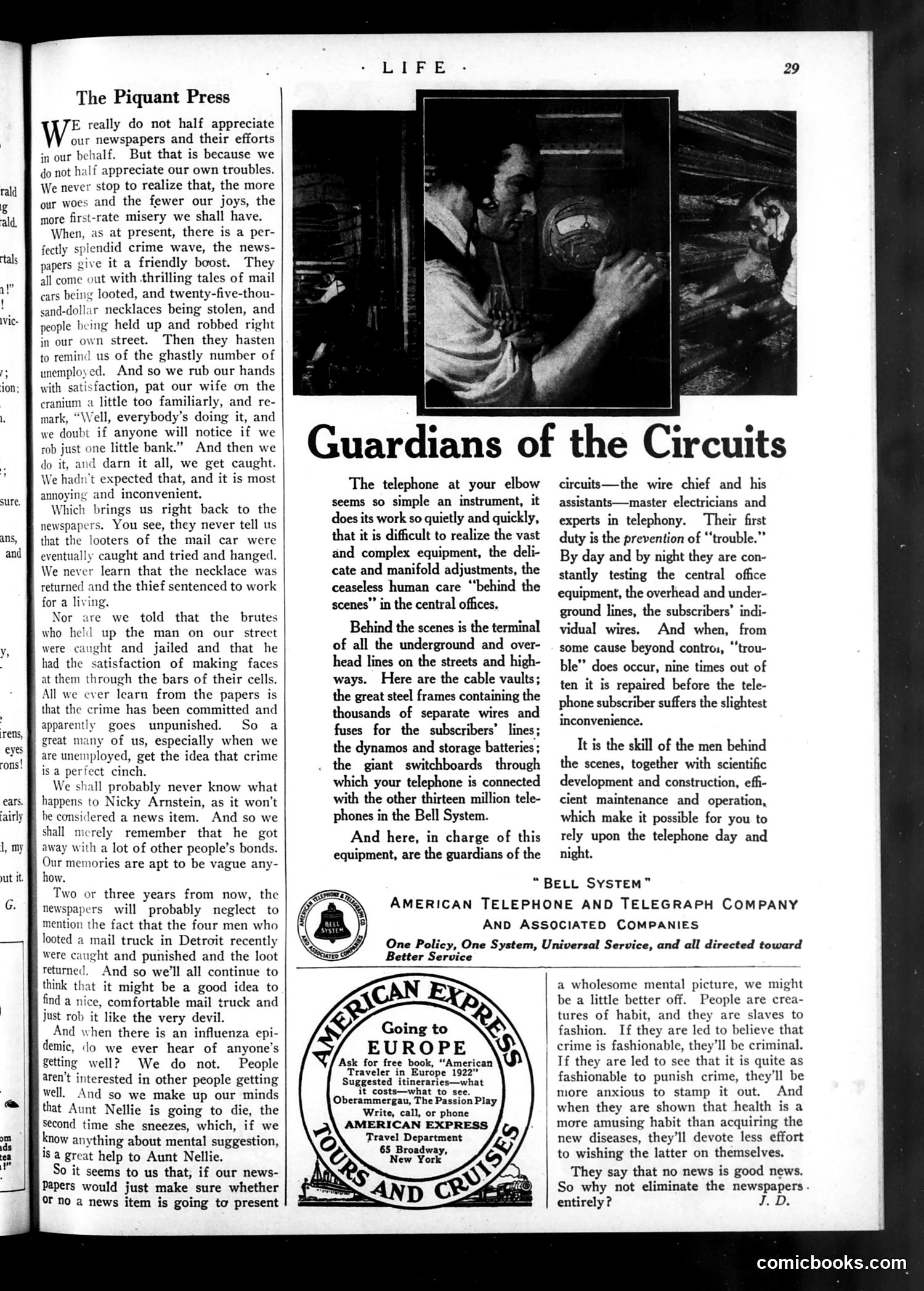
This editorial column satirizes how newspapers amplify crime and misery while ignoring positive outcomes. The author argues that papers emphasize dramatic crimes—mail robberies, stolen necklaces, street holdups—but rarely report when criminals are caught and punished. This selective coverage creates a false impression that crime "goes unpunished," potentially inspiring readers to commit crimes themselves. The piece references "Nicky Arnstein" (a real figure involved in a bond theft scandal), using him as an example of someone whose eventual consequences newspapers likely won't report. The satire's point: newspapers' focus on sensational negative news over resolutions distorts public perception, damages morale, and ironically encourages criminal behavior by making crime seem consequence-free. The adjacent Bell System advertisement about telephone infrastructure operators appears coincidental placement rather than thematic connection.
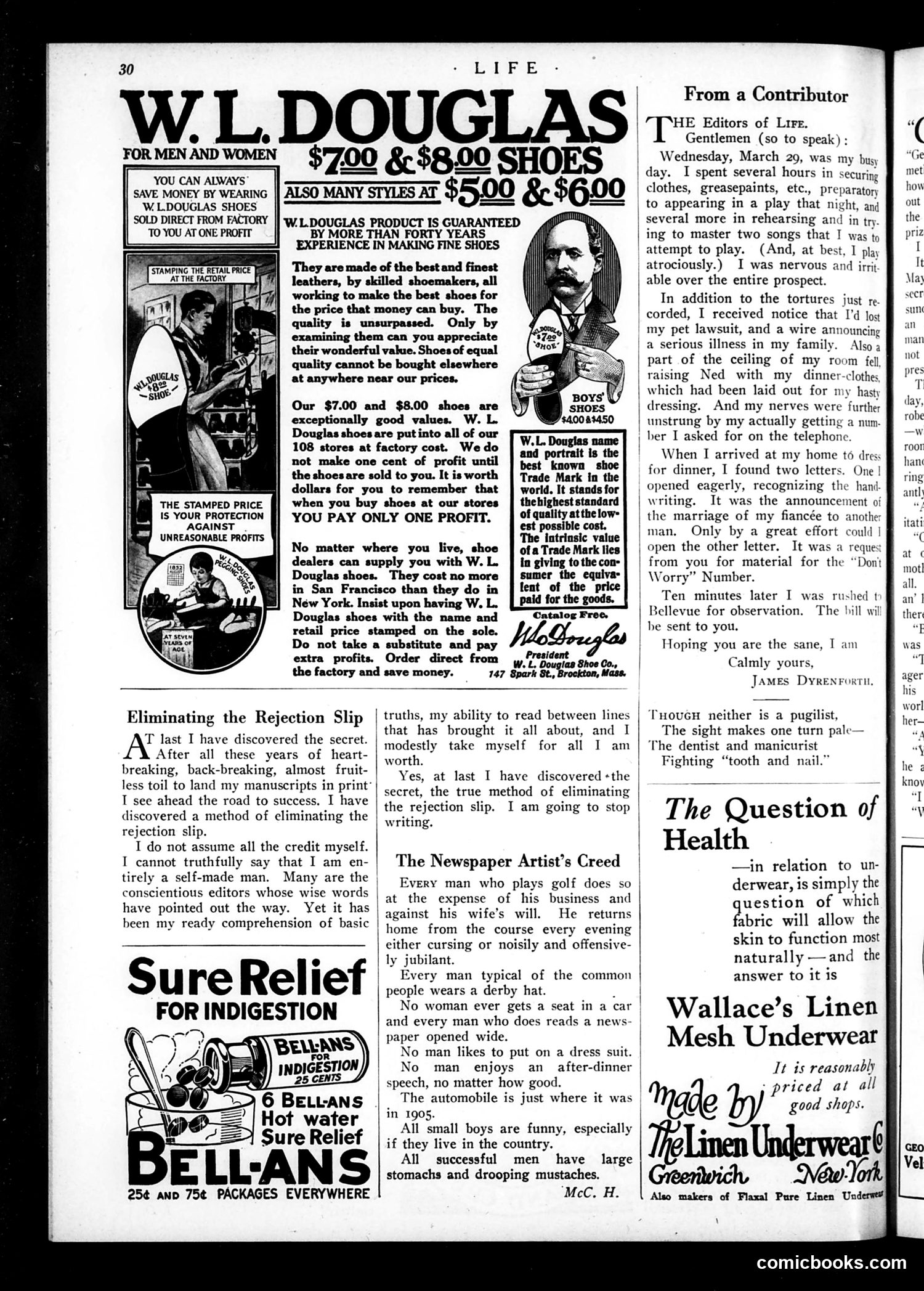
This page is primarily **advertising** for W.L. Douglas shoes, prominently featuring the company founder/trademark figure with a distinctive mustache. The ads emphasize direct factory sales eliminating middleman profits—a selling point relevant to early 20th-century consumer economics. The remaining editorial content consists of three brief pieces: "Eliminating the Rejection Slip" (a humorous confession about discovering how to get manuscripts published by stopping submissions), "The Newspaper Artist's Creed" (satirical observations about artistic clichés—golfers, derby hats, automobiles stuck in 1905), and "From a Contributor" (a personal anecdote about a stressful day preparing for a theatrical performance). These pieces showcase *Life*'s characteristic light satire targeting contemporary conventions and human foibles rather than specific political figures or events. The humor is genteel and observational rather than pointed commentary.
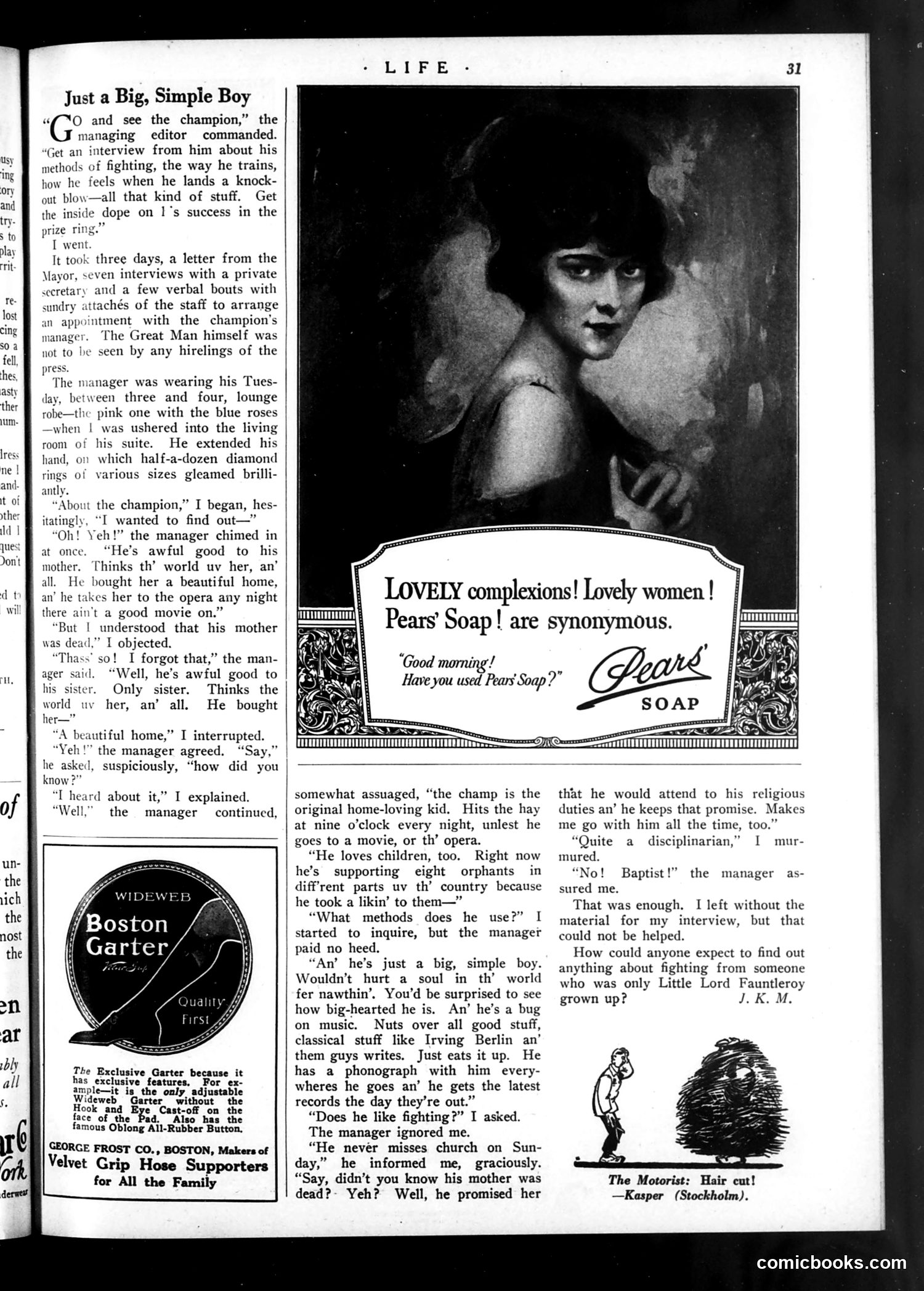
This page satirizes celebrity publicity culture and boxing promoters' sanitized public relations narratives. The unnamed "champion" boxer is presented through his manager's absurdly sanitized biography—the manager obsessively emphasizes the fighter's filial piety, charity work, church attendance, and love of classical music, while dodging every question about actual fighting ability or training methods. The satire's point: the manager has transformed a prize fighter into "Little Lord Fauntleroy" (a fictional overly-genteel character), creating a manufactured image disconnected from reality. The interviewer cannot extract meaningful information because the manager controls the narrative entirely, offering clichéd sentimentality instead of substance. The cartoon mocks how sports promoters use flattering fiction to sanitize brutish professions, and how managers prioritize image management over honesty. The humor relies on the absurdity of this disconnect between what a boxer actually *is* and what his handlers claim he represents.
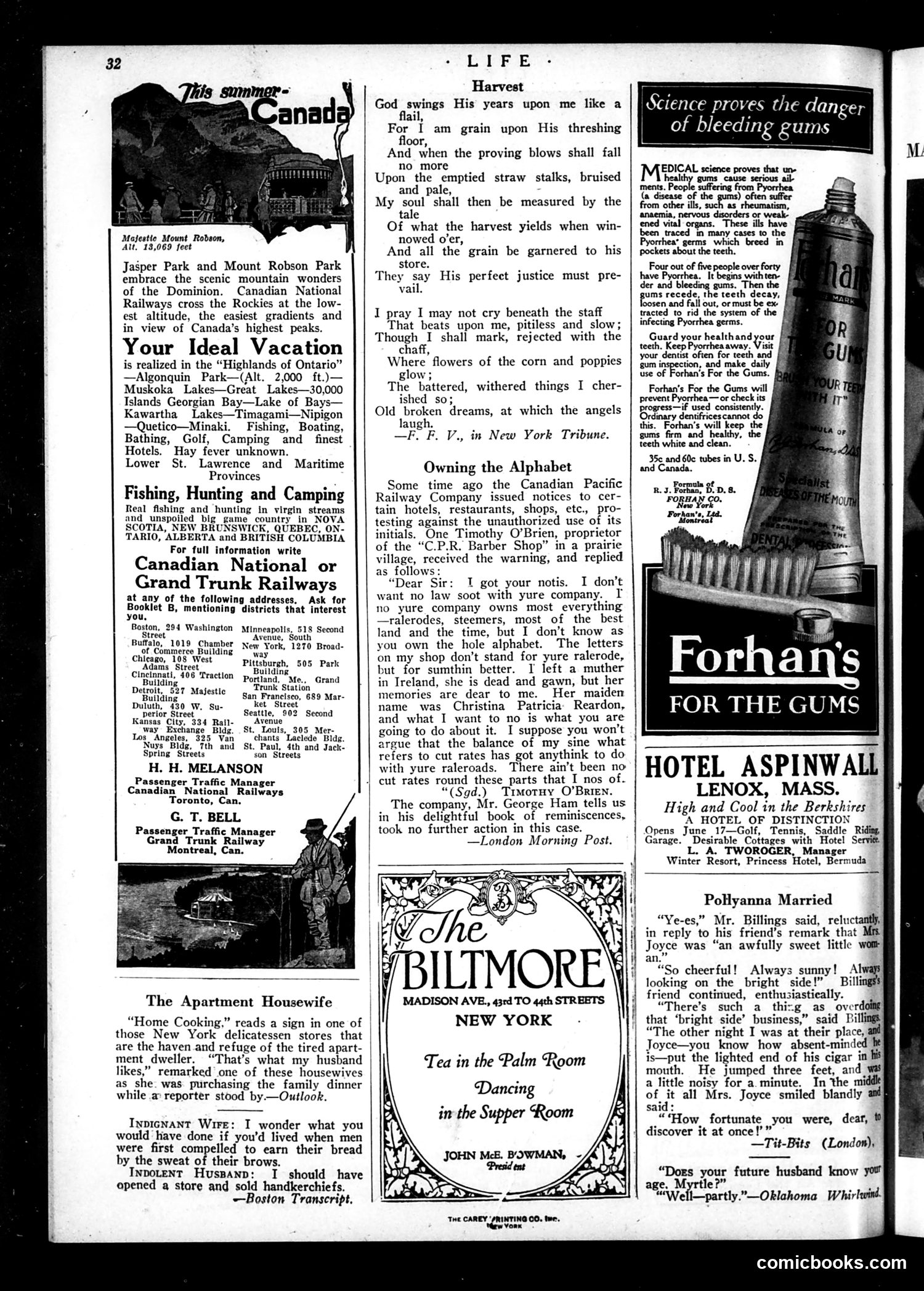
This page is primarily **advertising and literary content** rather than political cartoons. The main elements include: **Travel Advertisements**: Canadian National and Grand Trunk Railways promote vacation destinations in Ontario and maritime provinces, emphasizing fishing, hunting, and natural scenery. These ads reflect 1920s leisure tourism marketing. **Humorous Anecdotes**: Two short jokes satirize urban apartment life and lazy husbands—common themes mocking modern domestic inconvenience. **The "Alphabet" Story**: A charming rural comedy piece features "Timothy O'Brien," an Irish-Canadian barber defending his right to use "C.P.R." initials (for "Christina Patricia Reardon," his deceased Irish mother) against corporate overreach by the Canadian Pacific Railway. The humor relies on O'Brien's phonetic spelling and working-class perspective challenging corporate ownership claims. The page reflects early-20th-century attitudes: nostalgia for "unspoiled" nature, gentle mockery of immigrants and rural folk, and satirical tension between corporate power and individual autonomy.