
Life, 1922-05-18 · page 13 of 34
Life — May 18, 1922 — page 13: what you’re looking at
What you’re looking at
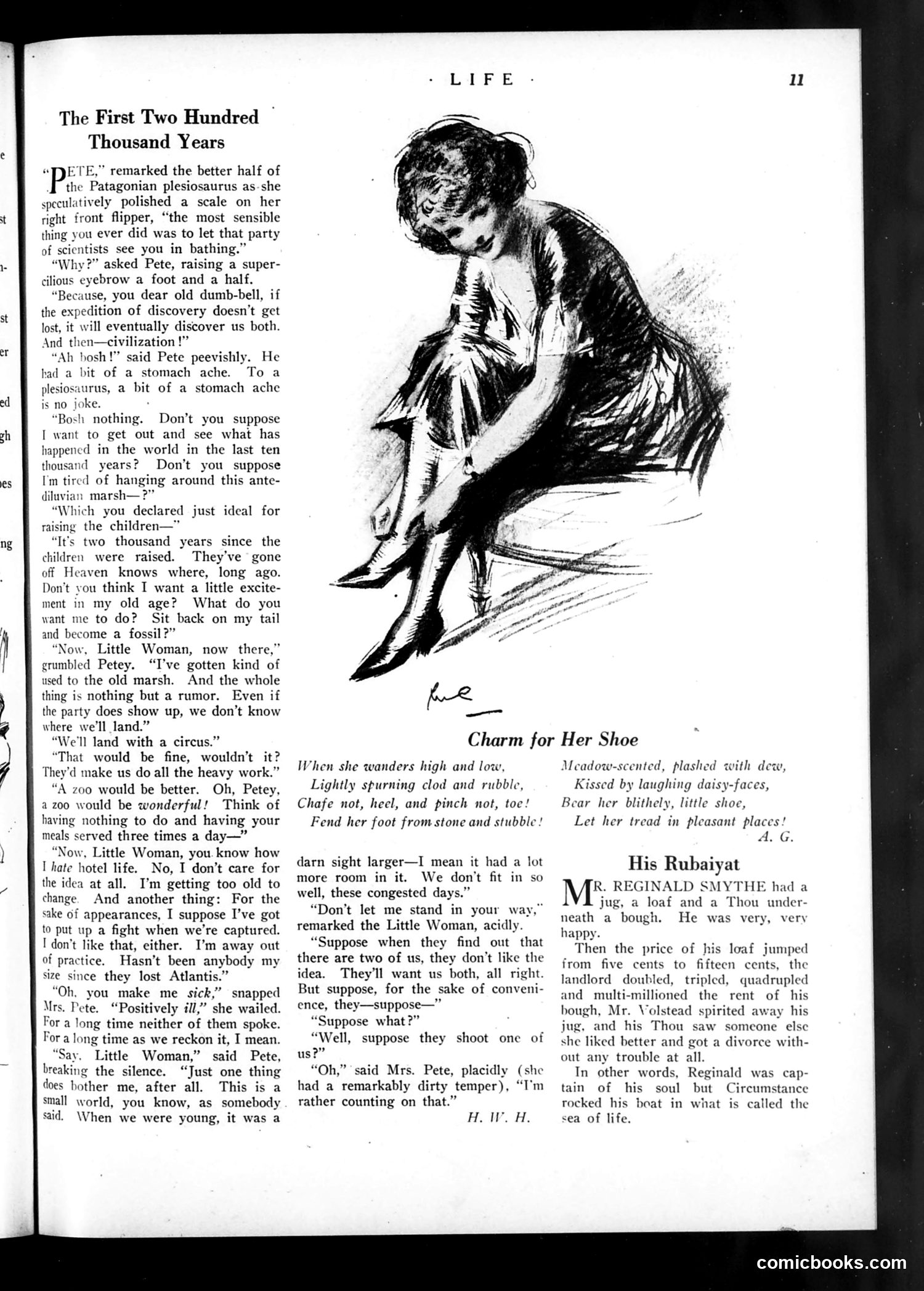
This page contains a sketch of a woman examining her shoe, accompanied by a poem titled "Charm for Her Shoe." The verse is lighthearted, addressing a woman who "wanders high and low" with "lightly spurning clod and rubble," celebrating her resilience despite wear on her footwear from rough conditions. The cartoon appears to be gentle satirical commentary on women's fashion and durability—specifically, the contrast between delicate feminine ideals and practical reality. The poem humorously acknowledges that despite women's refined appearance and pretensions, their shoes endure harsh treatment from daily life. The accompanying story fragments discuss early 20th-century social attitudes toward marriage, domesticity, and gender relations, typical of *Life* magazine's satirical tone during that era.
📄 Transcribed text from this page (OCR, searchable)
Machine-transcribed from the original scan — historical spelling and the odd misread are preserved.
The First Two Hundred ~ Thousand Years ‘ =,” remarked the better half of Pre Patagonian plesiosaurus as-she speculatively polished a scale on her right front flipper, “the most sensible thing you ever did was to let that party of scientists see you in bathing.” “Why?” asked Pete, raising a super- cilious eyebrow a foot and a half. “Because, you dear old dumb-bell, if the expedition of discovery doesn’t get lost, it will eventually discover us both. And then—civilization !” “Ah bosh!” said Pete peevishly. He bit of a stomach ache. To a plesiosaurus, a bit of a stomach ache is no joke. “Bosh nothing. Don’t you suppose I want to get out and see what has happened in the world in the last ten thousand years? Don’t you suppose I'm tired of hanging around this ante- diluvian marsh—?” “Which you declared just ideal for raising the children—” “It's two thousand years since the children were raised. They’ve gone off Heaven knows where, long ago. Don’t you think I want a little excite- ment in my old age? What do you want me to do? Sit back on my tail and become a fossil?” “Now, Little Woman, now there,” grumbled Petey. “I’ve gotten kind of used to the old marsh. And the whole thing is nothing but a rumor. Even if the party does show up, we don’t know where we'll land.” “We'll land with a circus.” “That would be fine, wouldn’t it? They'd make us do all the heavy work.” “A zoo would be better. Oh, Petey, a zoo would be wonderful! Think of having nothing to do and having your meals served three times a day—” “Now, Little Woman, you. know how I hate hotel life. No, I don’t care for the idea at all. I’m getting too old to change. And another thing: For the sake Of appearances, I suppose I’ve got to put up a fight when we’re captured. I don’t like that, either. I’m away out of practice. Hasn’t been anybody my size since they lost Atlantis.” “Oh, you make me sick,” snapped Mrs, Pete. “Positively ill,” she wailed. For a long time neither of them spoke. For a long time as we reckon it, I mean. “Say. Little Woman,” said Pete, breaking the silence. “Just one thing does bother me, after all. This is a small world, you know, as somebody said. When we were young, it was a Charm for Her Shoe When she wanders high and low, Lightly spurning clod and rubble, Chafe not, heel, and pinch not, toe! Fend her foot from stone and stubble! darn sight larger—I mean it had a lot more room in it. We don't fit in so well, these congested days.” “Don’t let me stand in your way, remarked the Little Woman, acidly. “Suppose when they find out that there are two of us, they don’t like the idea. They'll want us both, all right. But suppose, for the sake of conveni- ence, they—suppose—” Suppose what?” “Well, suppose they shoot one of us?” “Oh,” said Mrs. Pete, placidly (she had a remarkably dirty temper), “I'm rather counting on that.” H.W. H. Mcadow-scented, plashed with dew, Kissed by laughing daisy-faces, Bear her blithely, little shoe, Let her tread in pleasant places! A. G. His Rubaiyat R. REGINALD SMYTHE had a jug, a loaf and a Thou under- neath a bough. He was very, very happy. Then the price of his loaf jumped from five cents to fi 1 cents, the landlord doubled, tripled, quadrupled and multi-millioned the rent of his bough, Mr. Volstead spirited away his jug, and his Thou saw someone else she liked better and got a divorce with- out any trouble at all. In other words, Reginald was cap- tain of his soul but Circumstance rocked his boat in what is called the sea of life. comicbooks.com