
Life, 1922-05-18 · page 17 of 34
Life — May 18, 1922 — page 17: what you’re looking at
What you’re looking at
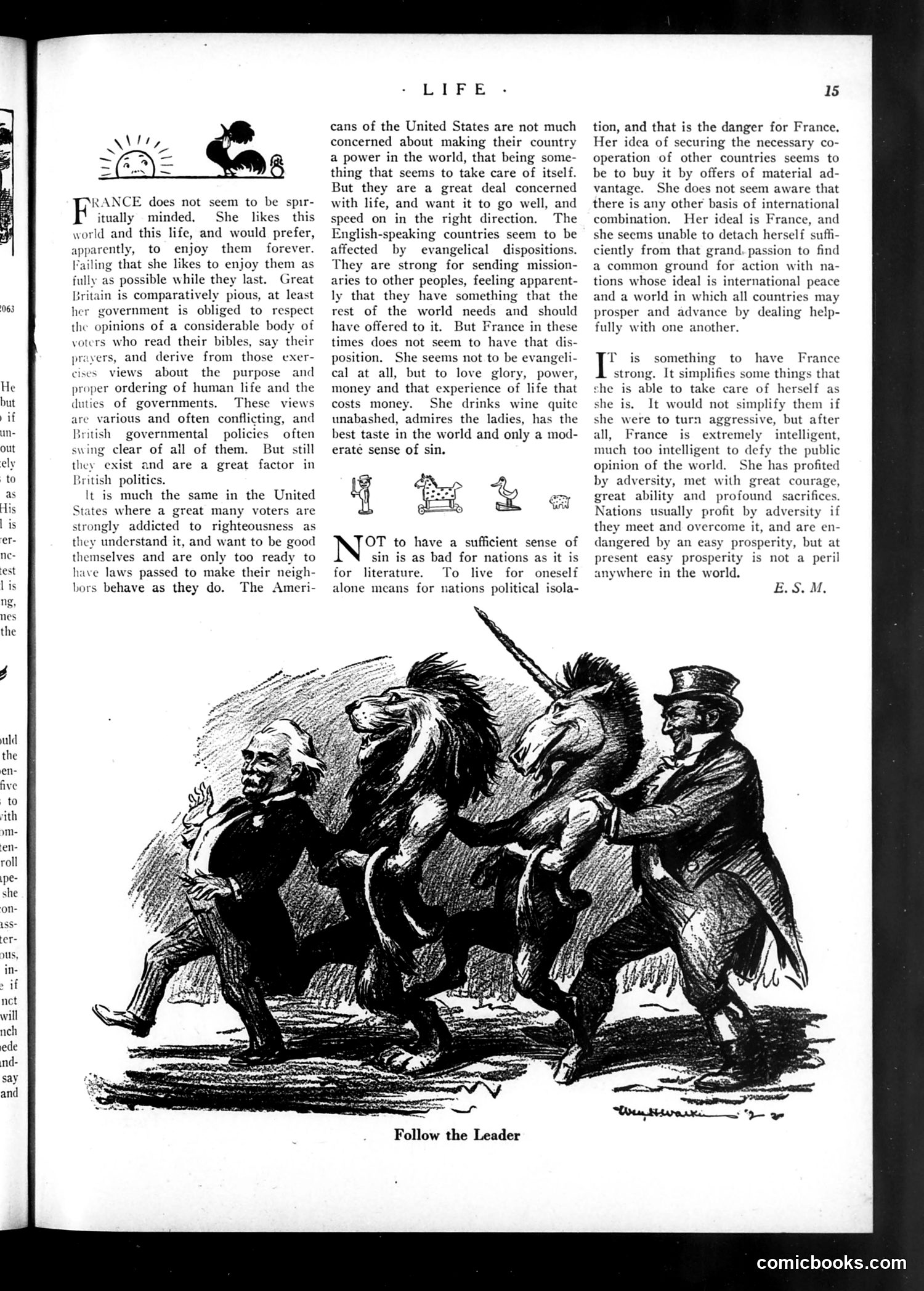
This page contrasts national characters through a political-moral lens typical of early 20th-century commentary. The text criticizes France for lacking "righteousness" and pursuing power, glory, and material pleasure (wine, ladies, fine taste) rather than idealistic international cooperation based on shared moral values. The cartoon "Follow the Leader" depicts men riding an unruly horse, illustrating the essay's point: France operates on self-interest alone ("political isolation"), making it unpredictable and difficult for other nations to follow or cooperate with. The satire suggests that Anglo-American countries (Britain, USA) approach foreign policy through evangelical moralism and shared ethical principles, while France pursues naked national advantage. The author argues this isolates France diplomatically—nations won't cooperate without moral common ground, only material incentives France cannot sustainably offer. The piece is essentially Western paternalism critiquing French pragmatism as spiritually deficient.
📄 Transcribed text from this page (OCR, searchable)
Machine-transcribed from the original scan — historical spelling and the odd misread are preserved.
RANCE does not seem to be spir- itually minded. She likes this world and this life, and would prefer, apparently, to enjoy them forever. Failing that she likes to enjoy them as fully as possible while they last. Great Britain is comparatively pious, at least her government is obliged to respect the opinions of a considerable body of yoters who read their bibles, say their prayers, and derive from those exer- views about the purpose and proper ordering of human life and the duties of governments. These views are various and often conflicting, and British governmental policies often swing clear of all of them. But still they exist and are a great factor in British politics. It is much the same in the United States where a great many voters are strongly addicted to righteousness as they understand it, and want to be good themselves and are only too ready to have laws passed to make their neigh- bors behave as they do. The Ameri- cises LIFE .- cans of the United States are not much concerned about making their country a power in the world, that being some- thing that seems to take care of itself. But they are a great deal concerned with life, and want it to go well, and speed on in the right direction. The English-speaking countries seem to be affected by evangelical dispositions. They are strong for sending mission- aries to other peoples, feeling apparent- ly that they have something that the rest of the world needs and should have offered to it. But France in these times does not seem to have that dis- position. She seems not to be evangeli- cal at all, but to love glory, power, money and that experience of life that costs money. She drinks wine quite unabashed, admires the ladies, has the best taste in the world and only a mod- erate sense of sin. S * Sal OT to have a sufficient sense of sin is as bad for nations as it is for literature. To live for oneself alone means for nations political isola- te Follow the Leader 15 tion, and that is the danger for France. Her idea of securing the necessary co- operation of other countries seems to be to buy it by offers of material ad- vantage. She does not seem aware that there is any other basis of international combination. Her ideal is France, and she seems unable to detach herself suflfi- ciently from that grand, passion to find a common ground for action with na- tions whose ideal is international peace and a world in which all countries may prosper and advance by dealing help- fully with one another. I’ is something to have France strong. It simplifies some things that she is able to take care of herself as she is. It would not simplify them if she were to turn aggressive, but after all, France is extremely intelligent, much too intelligent to defy the public opinion of the world. She has profited by adversity, met with great courage, great ability and profound sacrifices. Nations usually profit by adversity if they meet and overcome it, and are en- dangered by an easy prosperity, but at present easy prosperity is not a peril anywhere in the world. E.S. M. comicbooks.com