
Life, 1922-05-18 · page 20 of 34
Life — May 18, 1922 — page 20: what you’re looking at
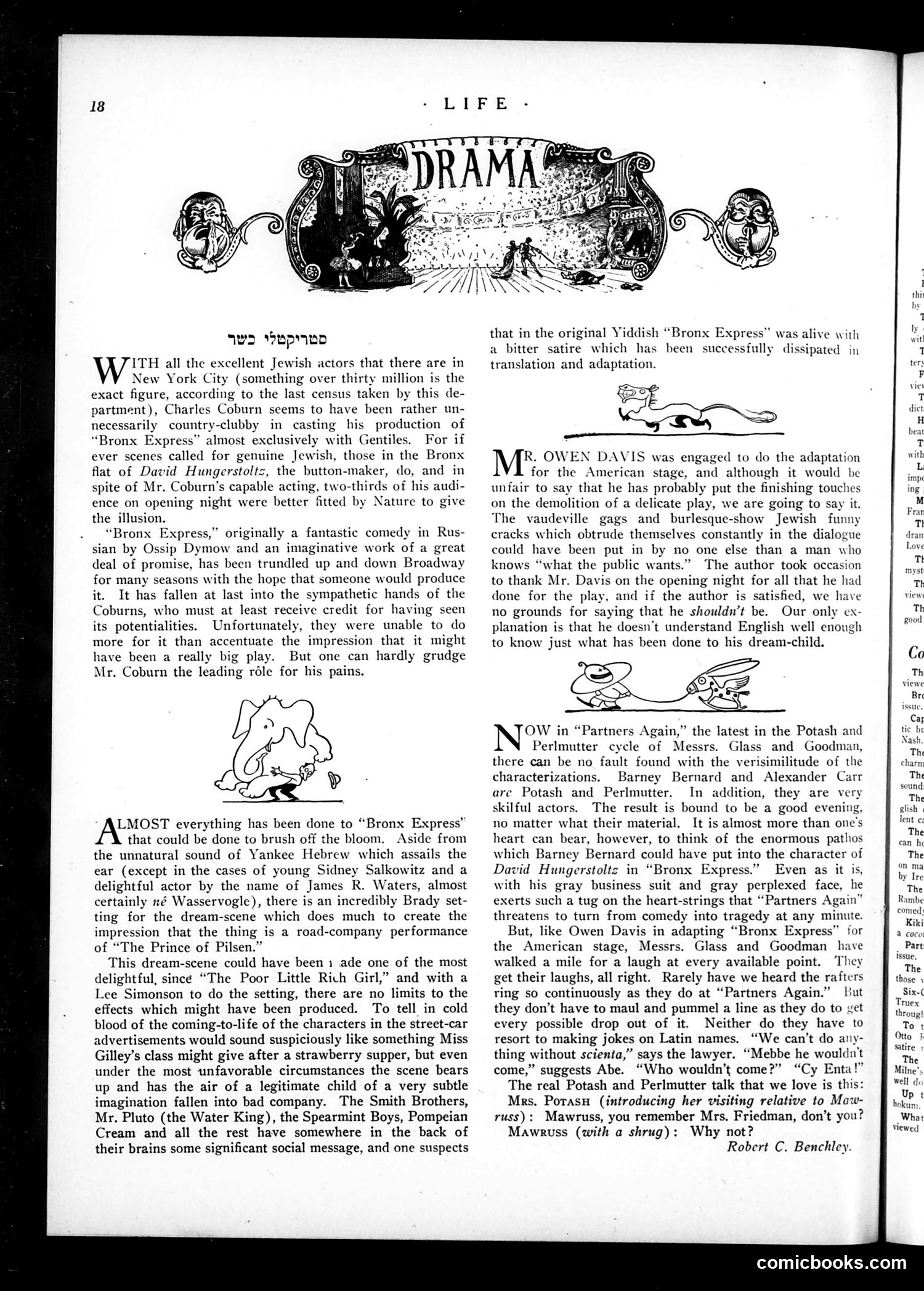
What you’re looking at
This page critiques two Broadway productions through pointed satire. The main targets are: **"Bronx Express"**: The reviewer attacks Charles Coburn's casting choices—notably excluding Jewish actors despite the play's Jewish setting in a Bronx button-maker's apartment. The satire is sharp: Life sarcastically notes there are "thirty million" Jewish actors in New York City, yet Coburn cast "almost exclusively with Gentiles." The review further lambastes adapter Owen Davis for diluting the original Yiddish play's "bitter satire" with vaudeville gags and crude "Jewish funny cracks" pandering to what Davis assumes "the public wants." **"Partners Again"**: Praised for authentic characterization in the Potash and Perlmutter cycle, with Jewish actors Barney Bernard and Alexander Carr playing their signature roles. The underlying critique: authentic Jewish representation matters. The satire exposes both Coburn's assimilationist casting and Davis's assumption that American audiences demand stereotypical humor over genuine dramatic content. Life's ethnic specificity reflects 1920s theater demographics and debates over authenticity versus commercial pandering.
📄 Transcribed text from this page (OCR, searchable)
Machine-transcribed from the original scan — historical spelling and the odd misread are preserved.
sw> ‘oepyno ITH all the excellent Jewish actors that there are in New York City (something over thirty million is the exact figure, according to the last census taken by this de- partment), Charles Coburn seems to have been rather un- necessarily country-clubby in casting his production of “Bronx Express” almost exclusively with Gentiles. For if ever scenes called for genuine Jewish, those in the Bronx flat of David Hungerstolts, the button-maker, do, and in spite of Mr. Coburn’s capable acting, two-thirds of his audi- ence on opening night were better fitted by Nature to give the illusion. “Bronx Express,” originally a fantastic comedy in Rus- sian by p Dymow and an imaginative work of a great deal of promise, has been trundled up and down Broadway for many seasons with the hope that someone would produce it. It has fallen at last into the sympathetic hands of the Coburns, who must at least receive credit for having seen its potentialities. Unfortunately, they were unable to do more for it than accentuate the impression that it might have been a really big play. But one can hardly grudge Mr. Coburn the leading réle for his pains. LMOST everything has been done to “Bronx Express’ that could be done to brush off the bloom. Aside from the unnatural sound of Yankee Hebrew which assails the ear (except in the cases of young Sidney Salkowitz and a delightful actor by the name of James R. Waters, almost ceftainly né Wasservogle), there is an incredibly Brady set- ting for the dream-scene which does much to create the impression that the thing is a road-company performance of “The Prince of Pilsen.” This dream-scene could have been 1 ade one of the most delightful, since “The Poor Little Rich Girl,” and with a Lee Simonson to do the setting, there are no limits to the effects which might have been produced. To tell in cold blood of the coming-to-life of the characters in the street-car advertisements would sound suspiciously like something Miss Gilley’s class might give after a strawberry supper, but even under the most unfavorable circumstances the scene bears up and has the air of a legitimate child of a very subtle imagination fallen into bad company. The Smith Brothers, Mr. Pluto (the Water King), the Spearmint Boys, Pompeian Cream and all the rest have somewhere in the back of their brains some significant social message, and one suspects that in the original Yiddish “Bronx Express” was alive with a bitter satire which has been successfully dissipated in translation and adaptation. R. OWEN DAVIS was engaged to do the adaptation for the American stage, and although it would be unfair to say that he has probably put the finishing touches on the demolition of a delicate play, we are going to say it. The vaudeville gags and burlesque-show Jewish funny cracks which obtrude themselves constantly in the dialogue could have been put in by no one else than a man who knows “what the public wants.” The author took occasion to thank Mr. Davis on the opening night for all that he had done for the play, and if the author is satisfied, we have no grounds for saying that he shouldn’t be. Our only ex- planation is that he doesn’t understand English well enough to know just what has been done to his dream-child. OW in “Partners Again,” the latest in the Potash and Perlmutter cycle of Messrs. Glass and Goodman, there can be no fault found with the verisimilitude of the characterizations. Barney Bernard and Alexander Carr are Potash and Perlmutter. In addition, they are very skilful actors. The result is bound to be a good evening, no matter what their material. It is almost more than one’s heart can bear, however, to think of the enormous pathos which Barney Bernard could have put into the character of David Hungerstolts in “Bronx Express.” Even as it is, with his gray business suit and gray perplexed face, he exerts such a tug on the heart-strings that “Partners Again” threatens to turn from comedy into tragedy at any minute. But, like Owen Davis in adapting “Bronx Express” for the American stage, Messrs. Glass and Goodman have walked a mile for a laugh at every available point. They get their laughs, all right. Rarely have we heard the rafters ring so continuously as they do at “Partners Again.” But they don’t have to maul and pummel a line as they do to get every possible drop out of it. Neither do they have to resort to making jokes on Latin names. “We can’t do any- thing without scienta,” says the lawyer. “Mebbe he wouldn't come,” suggests Abe. “Who wouldn’t come?” “Cy Enta!” The real Potash and Perlmutter talk that we love is this: Mrs. Porasu (introducing her visiting relative to Maw- russ): Mawruss, you remember Mrs. Friedman, don’t you? Mawruss (with a shrug): Why not? Robert C. Benchley. ly wit 1 tery F 7 dict H beat T with L impe ing Th Co Th viewe Br issue. Cay tic be Nash. Th charm The sound The glish | Tent e: The can h The on ma by Ire The Rambe comed. Kiki a coco Part issue The those Six-¢ Truex throug! viewed comicbooks.com