
Life, 1922-05-18 · page 24 of 34
Life — May 18, 1922 — page 24: what you’re looking at
What you’re looking at
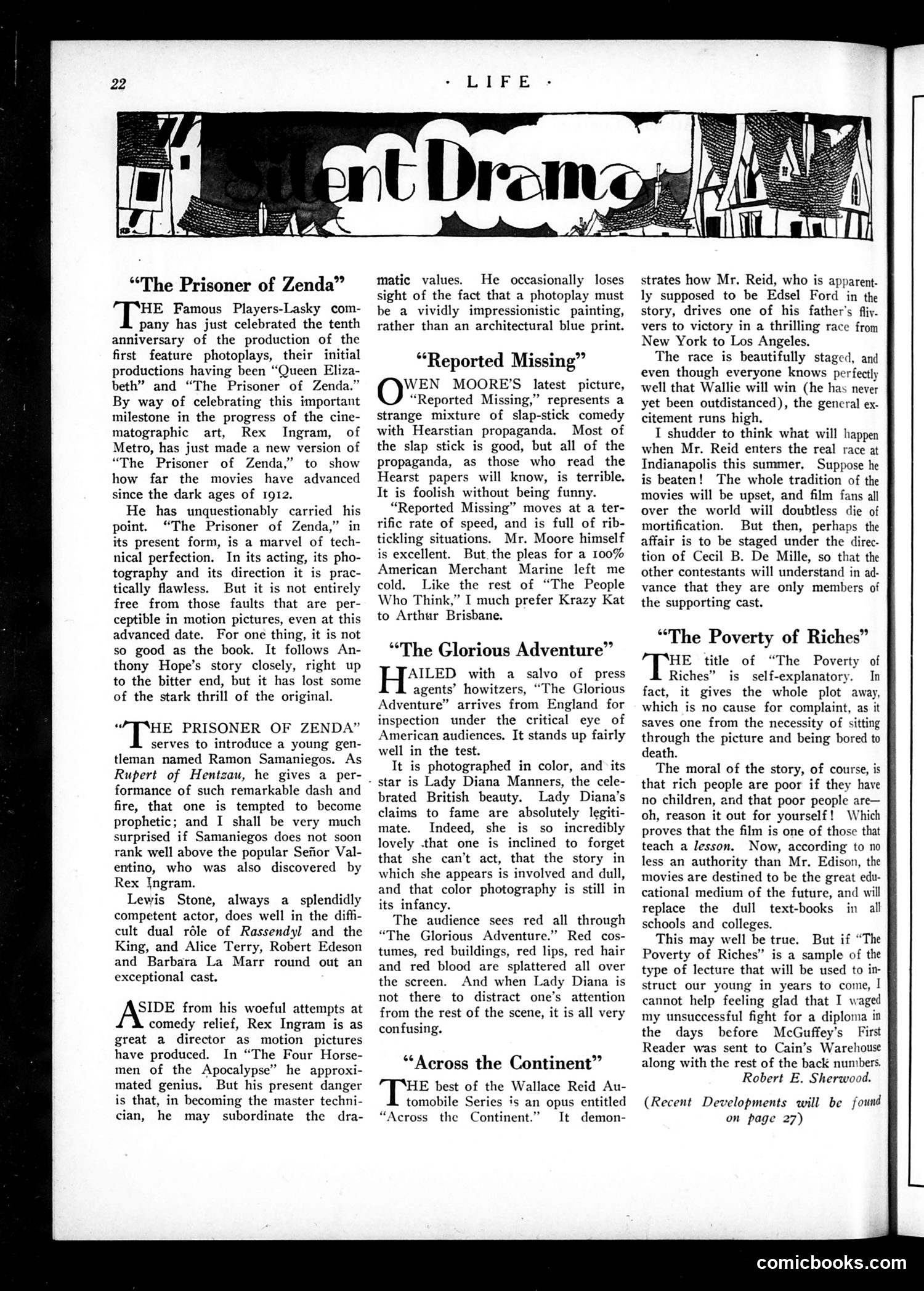
This page contains film criticism from Life magazine's "Ent Drama" (Entertainment Drama) section, reviewing contemporary movies circa 1922. The reviews discuss: - **"The Prisoner of Zenda"**: A remake of an early feature film, praised for technical excellence but criticized for losing the dramatic intensity of Anthony Hope's novel. The critic notes director Rex Ingram may prioritize technical perfection over emotional impact. - **"Reported Missing"**: Owen Moore's comedy criticized for mixing slapstick with "Hearstian propaganda"—apparently pro-American Merchant Marine messaging the critic finds tedious. The review mocks "The People Who Think" (readers of serious publications) who prefer Krazy Kat cartoons to such messaging. - **"The Glorious Adventure"**: Featuring British actress Lady Diana Manners, shot in color. The critic acknowledges her beauty but notes weak acting and an excessive use of the color red throughout, making scenes confusing. The page exemplifies early 1920s film criticism balancing technical innovation against storytelling and acting quality.
📄 Transcribed text from this page (OCR, searchable)
Machine-transcribed from the original scan — historical spelling and the odd misread are preserved.
“The Prisoner of Zenda” ‘HE Famous Players-Lasky com- pany has just celebrated the tenth anniversary of the production of the first feature photoplays, their initial productions having been “Queen Eliza- beth” and “The Prisoner of Zenda.” By way of celebrating this important milestone in the progress of the cine- matographic art, Rex Ingram, of Metro, has just made a new version of “The Prisoner of Zenda,” to show how far the movies have advanced since the dark ages of 1912. He has unquestionably carried his point. “The Prisoner of Zenda,” in its present form, is a marvel of tech- nical perfection. In its acting, its pho- tography and its direction it is prac- tically flawless. But it is not entirely free from those faults that are per- ceptible in motion pictures, even at this advanced date. For one thing, it is not so good as the book. It follows An- thony Hope’s story closely, right up to the bitter end, but it has lost some of the stark thrill of the original. a HE PRISONER OF ZENDA” serves to introduce a young gen- tleman named Ramon Samaniegos. As Rupert of Hentzau, he gives a per- formance of such remarkable dash and fire, that one is tempted to become prophetic; and I shall be very much surprised if Samaniegos does not soon rank well above the popular Sefior Val- entino, who was also discovered by Rex Ingram. Lewis Stone, always a splendidly competent actor, does well in the diffi- cult dual réle of Rassendyl and the King, and Alice Terry, Robert Edeson and Barbara La Marr round out an exceptional cast. SIDE from his woeful attempts at comedy relief, Rex Ingram is as great a director as motion pictures have produced. In “The Four Horse- men of the Apocalypse” he approxi- mated genius. But his present danger is that, in becoming the master techni- cian, he may subordinate the dra- matic values. He occasionally loses sight of the fact that a photoplay must be a vividly impressionistic painting, rather than an architectural blue print. “Reported Missing” WEN MOORE’S latest picture, “Reported Missing,” represents a strange mixture of slap-stick comedy with Hearstian propaganda. Most of the slap stick is good, but all of the propaganda, as those who read the Hearst papers will know, is terrible. It is foolish without being funny. “Reported Missing” moves at a ter- tific rate of speed, and is full of rib- tickling situations. Mr. Moore himself is excellent. But. the pleas for a 100% American Merchant Marine left me cold. Like the rest of “The People Who Think,” I much prefer Krazy Kat to Arthur Brisbane. “The Glorious Adventure” AILED with a salvo of press agents’ howitzers, “The Glorious Adventure” arrives from England for inspection under the critical eye of American audiences. It stands up fairly well in the test. It is photographed in color, and its - star is Lady Diana Manners, the cele- brated British beauty. Lady Diana’s claims to fame are absolutely legiti- mate. Indeed, she is so incredibly lovely .that one is inclined to forget that she can’t act, that the story in which she appears is involved and dull, and that color photography is still in its infancy. The audience sees red all through “The Glorious Adventure.” Red cos- tumes, red buildings, red lips, red hair and red blood are splattered all over the screen. And when Lady Diana is not there to distract one’s attention from the rest of the scene, it is all very confusing. “Across the Continent” ‘HE best of the Wallace Reid Au- tomobile Series is an opus entitled “Across the Continent.” It demon- strates how Mr. Reid, who is apparent. ly supposed to be Edsel Ford in the story, drives one of his father’s fliy- vers to victory in a thrilling race from New York to Los Angeles. The race is beautifully staged, and even though everyone knows perfectly well that Wallie will win (he has never yet been outdistanced), the general ex- citement runs high. I shudder to think what will happen when Mr. Reid enters the real race at Indianapolis this summer. Suppose he is beaten! The whole tradition of the movies will be upset, and film fans all over the world will doubtless die of mortification. But then, perhaps the affair is to be staged under the direc- tion of Cecil B. De Mille, so that the other contestants will understand in ad- vance that they are only members of the supporting cast. “The Poverty of Riches” ‘HE title of “The Poverty of Riches” is self-explanatory. In fact, it gives the whole plot away, which is no cause for complaint, as it saves one from the necessity of sitting through the picture and being bored to death. The moral of the story, of course, is that rich people are poor if they have no children, and that poor people are— oh, reason it out for yourself! Which proves that the film is one of those that teach a lesson. Now, according to no less an authority than Mr. Edison, the movies are destined to be the great edu- cational medium of the future, and will replace the dull text-books in all schools and colleges. This may well be true. But if “The Poverty of Riches” is a sample of the type of lecture that will be used to in- struct our young in years to come, | cannot help feeling glad that I waged my unsuccessful fight for a diploma in the days before McGuffey’s First Reader was sent to Cain’s Warehouse along with the rest of the back numbers. Robert E. Sherwood. (Recent Developments will be found on page 27) comicbooks.com