
Life, 1922-05-18 · page 31 of 34
Life — May 18, 1922 — page 31: what you’re looking at
What you’re looking at
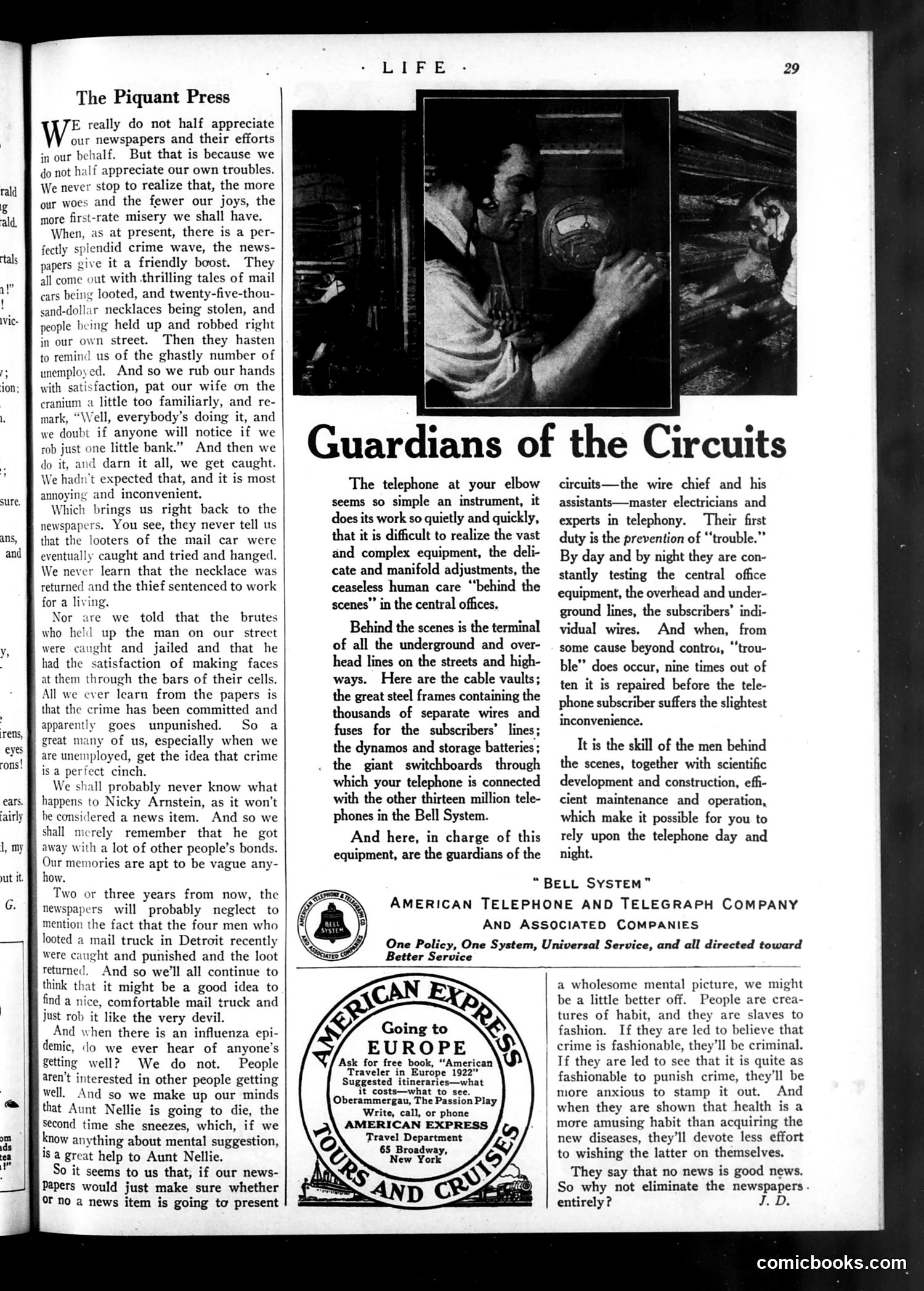
This editorial column satirizes how newspapers amplify crime and misery while ignoring positive outcomes. The author argues that papers emphasize dramatic crimes—mail robberies, stolen necklaces, street holdups—but rarely report when criminals are caught and punished. This selective coverage creates a false impression that crime "goes unpunished," potentially inspiring readers to commit crimes themselves. The piece references "Nicky Arnstein" (a real figure involved in a bond theft scandal), using him as an example of someone whose eventual consequences newspapers likely won't report. The satire's point: newspapers' focus on sensational negative news over resolutions distorts public perception, damages morale, and ironically encourages criminal behavior by making crime seem consequence-free. The adjacent Bell System advertisement about telephone infrastructure operators appears coincidental placement rather than thematic connection.
📄 Transcribed text from this page (OCR, searchable)
Machine-transcribed from the original scan — historical spelling and the odd misread are preserved.
The Piquant Press E really do not half appreciate our newspapers and their efforts in our behalf. But that is because we do not half appreciate our own troubles. We never stop to realize that, the more our woes and the fewer our joys, the more first-rate misery we shall have. When, as at present, there is a per- fectly splendid crime wave, the news- papers give it a friendly boost. They all come out with thrilling tales of mail cars being looted, and twenty-five-thou- sand-dollar necklaces being stolen, and people being held up and robbed right in our own street. Then they hasten to remind us of the ghastly number of unemployed. And so we rub our hands with satisfaction, pat our wife on the cranium a little too familiarly, and re- mark, “Well, everybody’s doing it, and we doubt if anyone will notice if we rob just one little bank.” And then we | do it, and darn it all, we get caught. We hadn't expected that, and it is most annoying and inconvenient. Wh brings us right back to the newspapers. You see, they never tell us that the looters of the mail car were eventually caught and tried and hanged. We never learn that the necklace was returned and the thief sentenced to work for a living. Nor are we told that the brutes who held up the man on our strect were caught and jailed and that he had the satisfaction of making faces at them through the bars of their cells. All we ever learn from the papers is that the crime has been committed and apparently goes unpunished. So a great many of us, especially when we are unemployed, get the idea that crime is a perfect cinch. We shall probably never know what happens to Nicky Arnstein, as it won't be considered a news item. And so we shall merely remember that he got away with a lot of other people’s bonds. Our memories are apt to be vague any- how. Two or three years from now, the newspapers will probably neglect to mention the fact that the four men who looted a mail truck in Detroit recently were caught and punished and the loot returned. And so we'll all continue to think that it might be a good idea to find a nice, comfortable mail truck and Just rob it like the very devil. And when there is an influenza epi- demic, do we ever hear of anyone's getting well? We do not. People aren't interested in other people getting well. And so we make up our minds that Aunt Nellie is going to die, the second time she sneezes, which, if we know anything about mental suggestion, 18a great help to Aunt Nellie. So it seems to us that, if our news- Papers would just make sure whether or no a news item is going to present Guardians of the Circuits The telephone at your elbow seems so simple an instrument, it does its work so quietly and quickly, that it is difficult to realize the vast and complex equipment, the deli- cate and manifold adjustments, the ceaseless human care “behind the scenes” in the central offices. Behind the scenes is the terminal of all the underground and over- head lines on the streets and high- ways. Here are the cable vaults; the great steel frames containing the thousands of separate wires and fuses for the subscribers’ lines; the dynamos and storage batteries ; the giant switchboards through which your telephone is connected with the other thirteen million tele- phones in the Bell System. And here, in charge of this equipment, are the guardians of the circuits—the wire chief and his assistants—master electricians and experts in telephony. Their first duty is the prevention of “‘trouble.”” By day and by night they are con- stantly testing the central office equipment, the overhead and under- ground lines, the subscribers’ indi- vidual wires. And when, from some cause beyond contro:, “‘trou- ble” does occur, nine times out of ten it is repaired before the tele- phone subscriber suffers the slightest inconvenience. It is the skill of the men behind the scenes, together with scientific development and construction, effi- cient maintenance and operation, which make it possible for you to rely upon the telephone day and night. “BELL SYSTEM” AMERICAN TELEPHONE AND TELEGRAPH COMPANY AND ASSOCIATED COMPANIES One Policy, One System, Universal Service, and all directed toward Better Service EUROPE Ask for free book, “American Traveler in Europe 1922” Suggested itineraries—what it costs—what to see. Oberammergau, The Passion Play Write, call, or phone AMERICAN EXPRESS Travel Department 65 Broadway, New York a wholesome mental picture, we might be a little better off. People are crea- tures of habit, and they are slaves to fashion. If they are led to believe that crime is fashionable, they’ll be criminal. If they are led to see that it is quite as fashionable to punish crime, they'll be more anxious to stamp it out. And when they are shown that health is a more amusing habit than acquiring the new diseases, they’ll devote less effort to wishing the latter on themselves. They say that no news is good news. So why not eliminate the newspapers . entirely? JD s comicbooks.com.