
A complete issue · 34 pages · 1922
Life — April 20, 1922
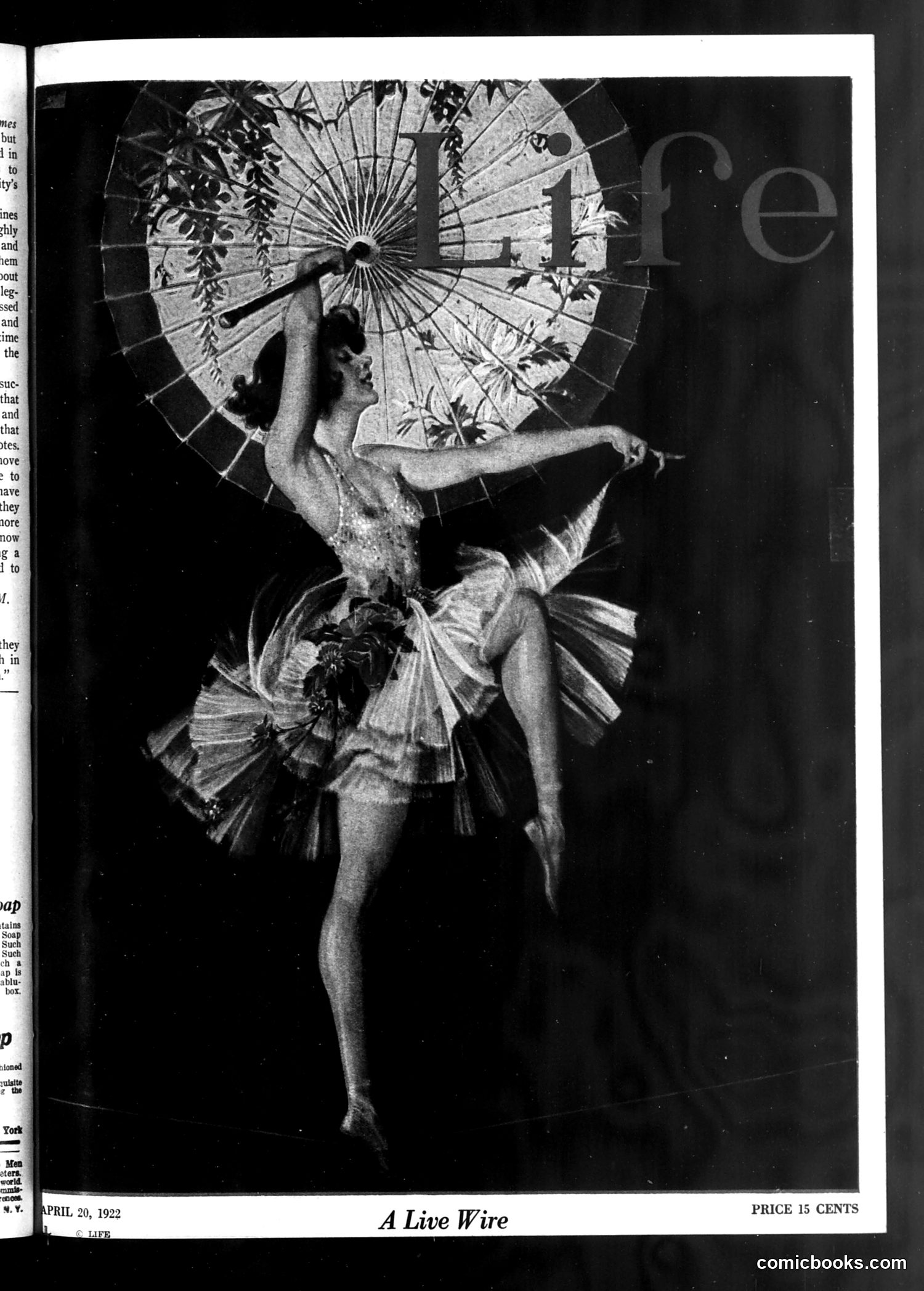
This theatrical photograph shows a female performer in an elaborate costume striking a dramatic pose with a decorative parasol. The title "A Live Wire" suggests energetic, dynamic quality—a common phrase of the 1920s era for someone lively and engaging. The image appears to be a theatrical or vaudeville-style photograph rather than political satire. The performer wears a short, ruffled skirt and demonstrates the kind of exaggerated showmanship typical of 1920s entertainment. The "live wire" reference likely plays on both the performer's spirited character and the electrical/modern imagery of the parasol design. Without additional OCR text visible, the specific satirical intent remains unclear, though it likely comments on contemporary entertainment or fashion trends of the Jazz Age period.

This is an **advertisement, not a cartoon or satire**. It's a Michelin tire company ad from an early 20th-century issue of *Life* magazine. The image uses dramatic visual contrast: an enormous Michelin tire dominates the composition, towering over a tiny village scene below with period automobiles and buildings. The copy addresses consumers who already trust Michelin's "Ring Shaped Tubes" (their inner tubes), rhetorically asking why they wouldn't choose Michelin Cords (tires) since "they are just as good." The Michelin Man mascot (the Bibendum character) appears in the lower left corner. The ad's strategy relies on brand loyalty and comparative product quality claims to sell their tire line to an early automotive market.
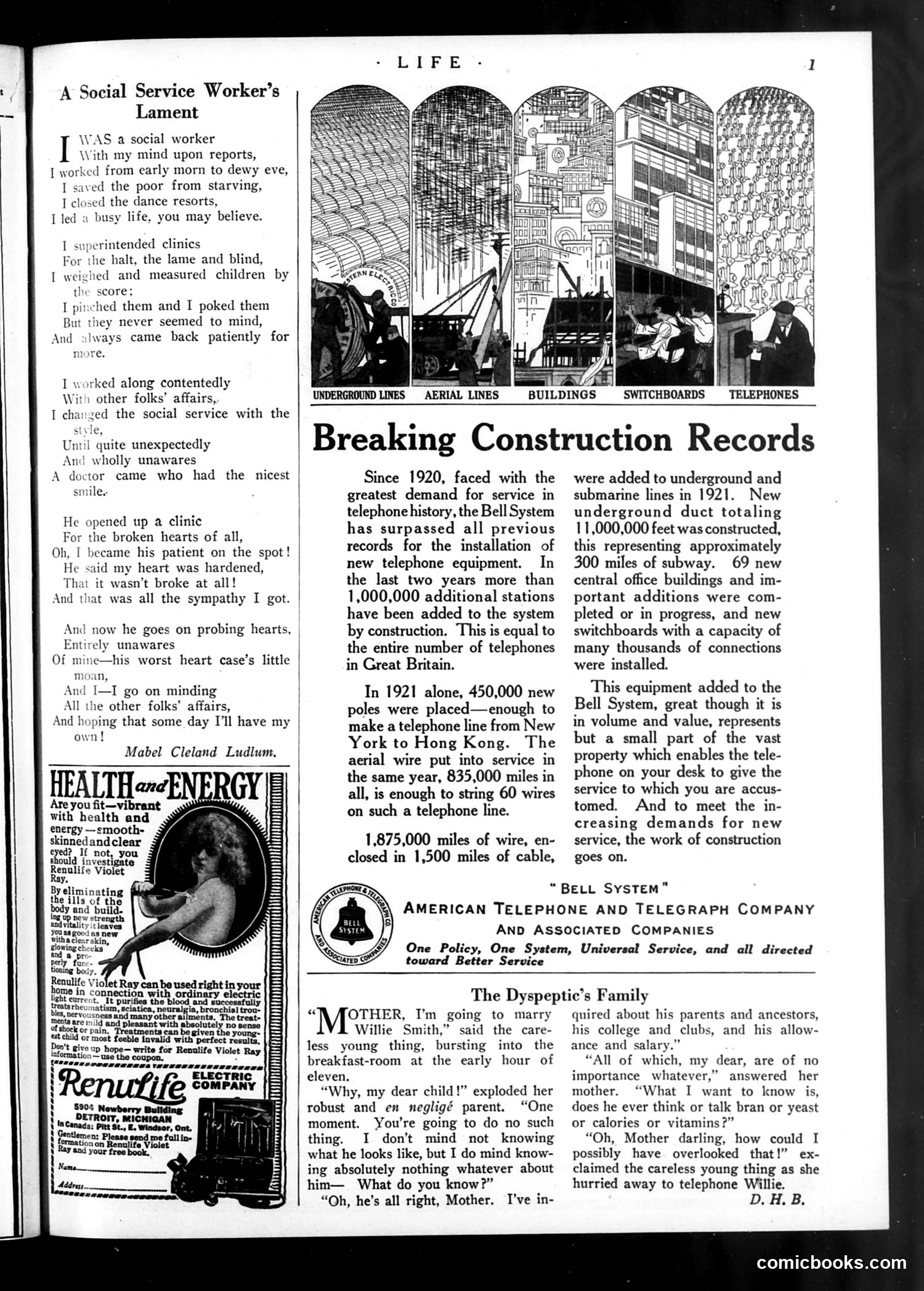
This page contains three distinct sections: **"A Social Service Worker's Lament"** (left): A poem by Mabel Cleland Ludlum satirizing social workers' experiences—depicting their exhausting work with poor populations, clinic management, and emotional toll. The speaker ironically notes their heart "hardened" despite sympathetic intentions, ending with regret about sacrificing personal life. **"Breaking Construction Records"** (center/right): A Bell System advertisement highlighting telephone infrastructure expansion since 1920—450,000 new poles installed in 1921 alone, with accompanying statistics about wire installation and underground construction. This celebrates industrial progress and technological achievement. **"The Dyspeptic's Family"** (bottom): A humorous domestic scene where a mother disapproves of her son's engagement to "Willie Smith," dismissing him as unambitious, and frets about nutritional details rather than his character. The page mixes social commentary with corporate promotion and domestic humor typical of 1920s satirical magazines.
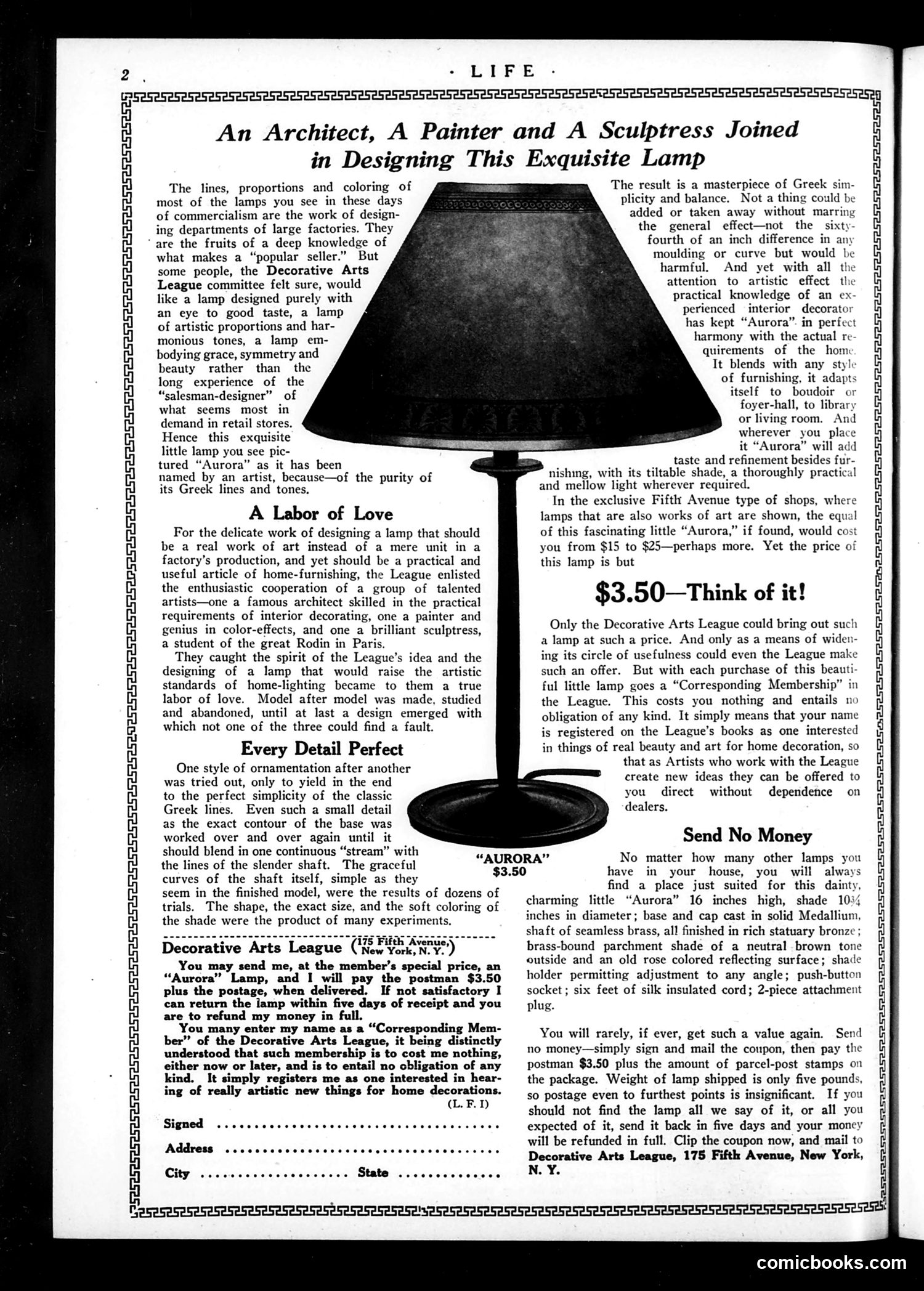
This page is **not a political cartoon or satire**—it's a straightforward advertisement for the "Aurora" lamp, priced at $3.50. The content describes a decorative table lamp designed collaboratively by an architect, painter, and sculptress through the Decorative Arts League. The text emphasizes the lamp's artistic merit, Greek-inspired proportions, and practical functionality as a response to mass-produced "salesman-designer" lamps dominating retail stores. The ad uses prestige marketing language ("labor of love," "masterpiece of Greek simplicity") to justify the price point and encourage mail-order purchases. It's a period example of how luxury goods were marketed to middle-class consumers seeking artistic taste and refinement in home furnishings.
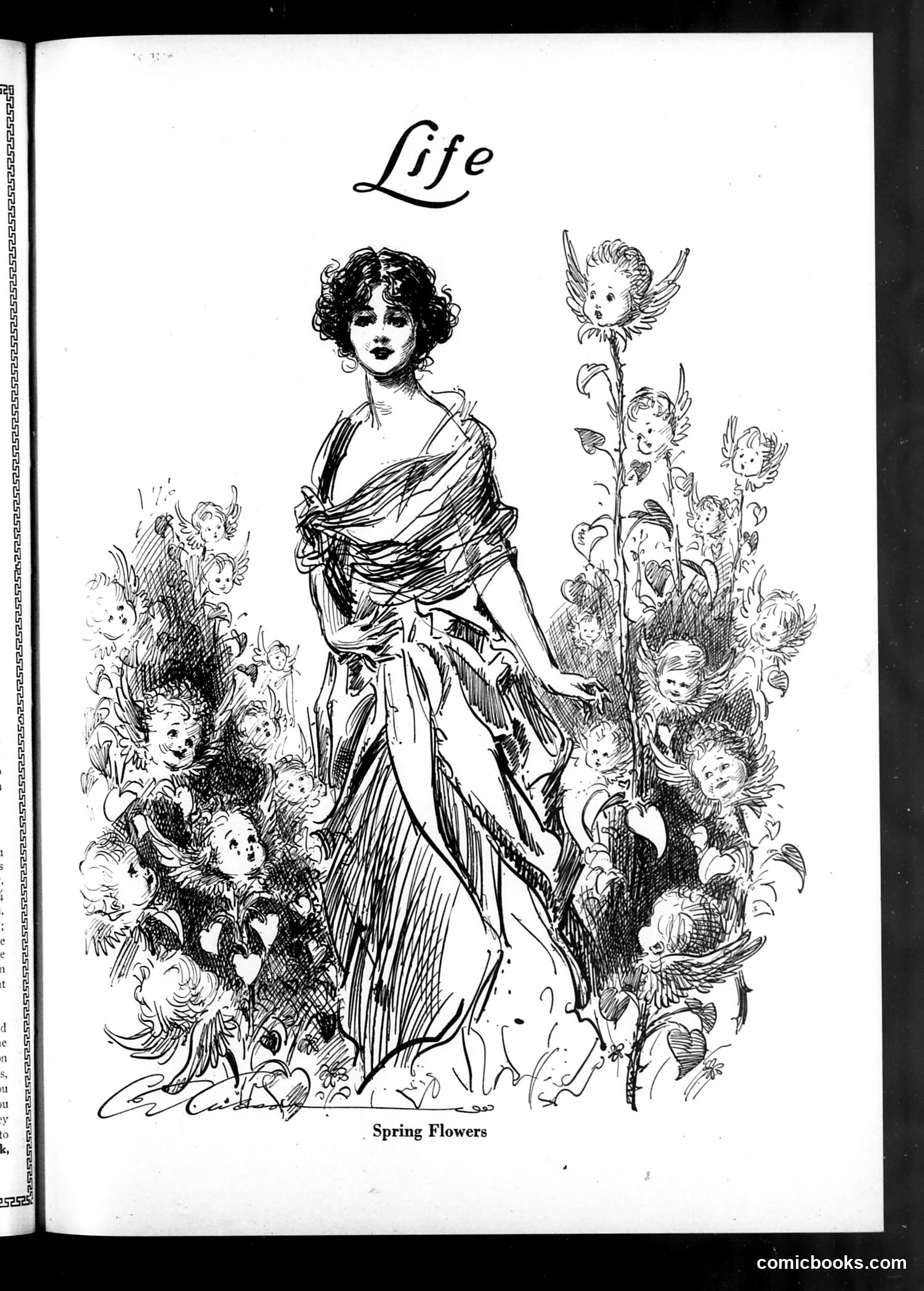
This illustration appears to be an allegorical representation of "Life" itself, depicted as a graceful woman in classical drapery surrounded by cherubs or putti among flowering plants. The caption "Spring Flowers" suggests themes of renewal, growth, and fertility. The image likely represents an idealized, romantic vision of life's vitality and beauty—common in early-to-mid 20th century satirical and literary publications. The cherubs and flowers symbolize innocence, youth, and natural abundance. Rather than biting political satire, this seems more a gentle, philosophical meditation on life's cyclical nature, possibly serving as a thematic or decorative cover or section divider for *Life* magazine's content. The classical artistic style emphasizes timeless beauty over contemporary commentary.
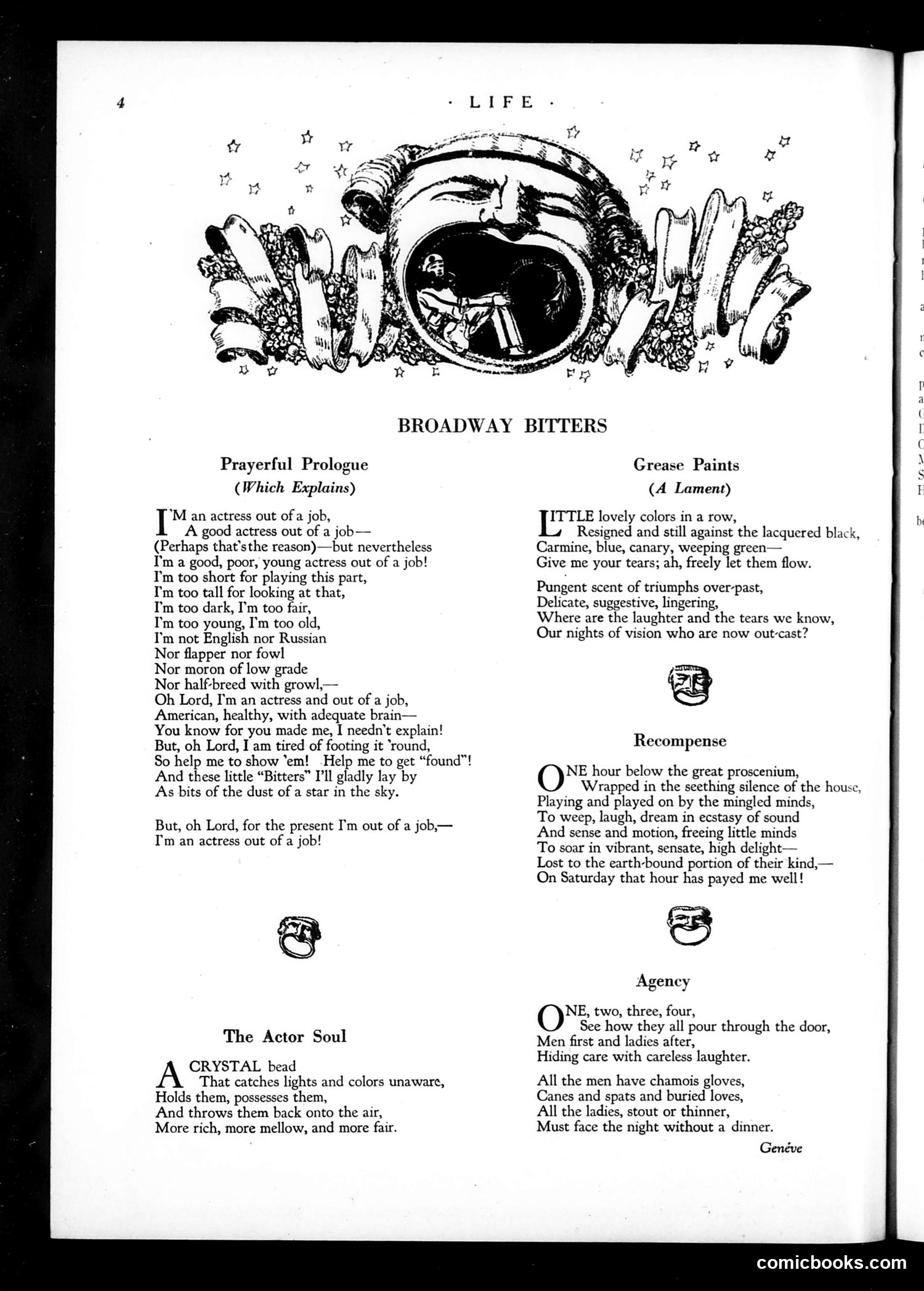
This page from *Life* magazine satirizes theatrical life through four poems about Broadway performers and their experiences. The main illustration shows a theatrical mask with an open mouth, surrounded by corn and vegetables—a visual pun on "Broadway Bitters," playing on the patent medicine "Angostura Bitters" (a common advertising reference of the era). The poems mock various aspects of theater: - "Prayerful Prologue" satirizes an unemployed actress desperately seeking work - "Grease Paints" laments the harsh realities behind theatrical glamour - "Recompense" celebrates the brief escape theater provides performers - "Agency" humorously depicts the chaos of theatrical casting calls The satire targets the gap between theater's glamorous public image and performers' actual struggling lives—unemployment, poverty, and the desperate scramble for roles. The small theatrical masks serve as section dividers throughout.
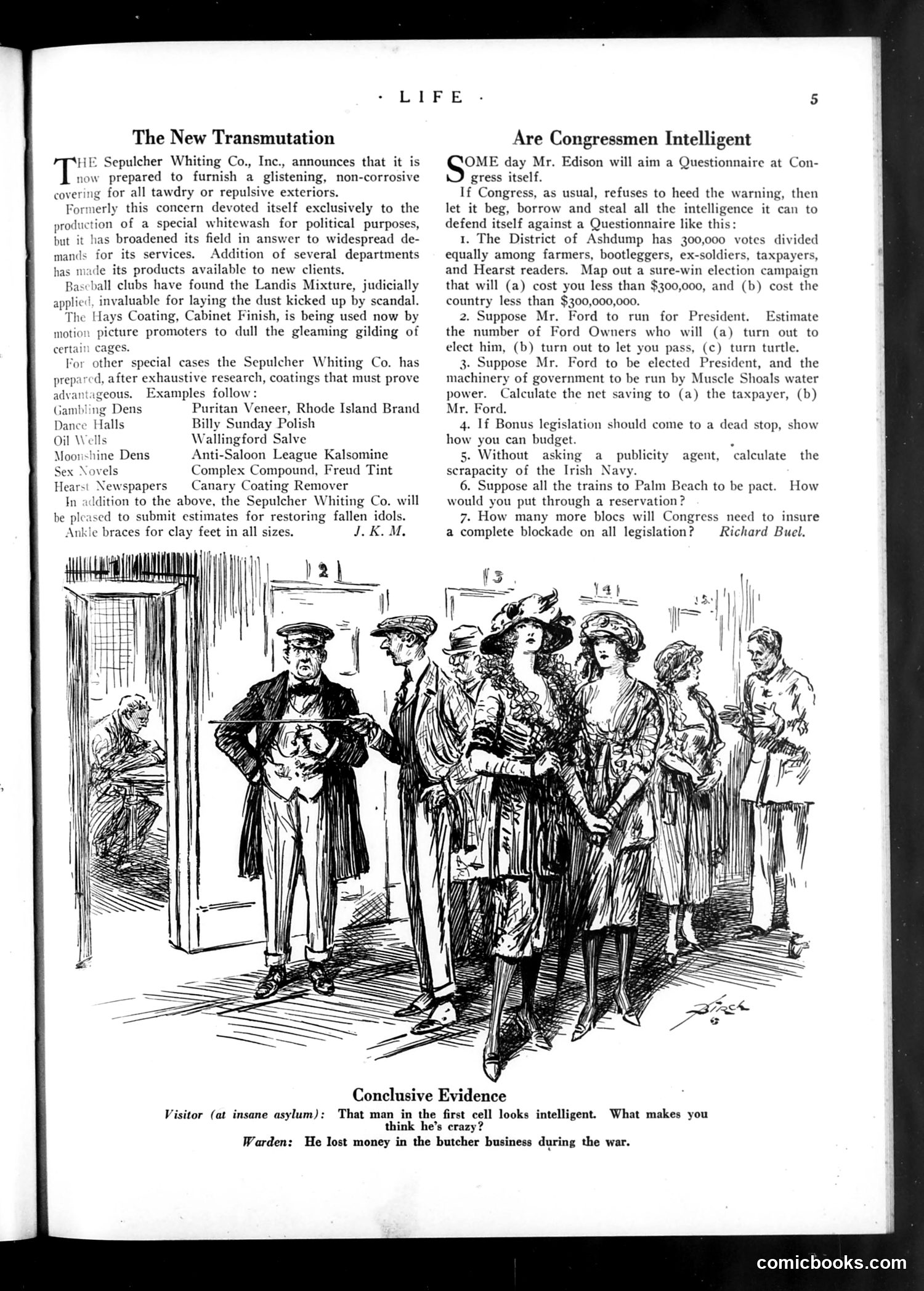
This page contains two distinct satirical pieces: **"The New Transmutation"** mocks the Seputcher Whiting Company's claim to have created a "glistening, non-corrosive covering for all traders or punishable exteriors" for political purposes. The satire suggests politicians use such whitewash to obscure scandals. The piece lists absurd product names (like "Billy Sunday Polish" and "Anti-Saloon League Kalsomine") to ridicule the era's reformers and their rhetorical tactics. **"Are Congressmen Intelligent"** presents a mock questionnaire supposedly submitted to Congress by Mr. Edison, filled with practical questions about costs and efficiency—sarcastically implying Congress cannot answer such basic calculations. **"Conclusive Evidence"** (the cartoon) shows an asylum visitor questioning the warden about an inmate's sanity. The punchline—"He lost money in the butcher business during the war"—suggests wartime profiteering was so rampant that *not* getting rich seemed insane.
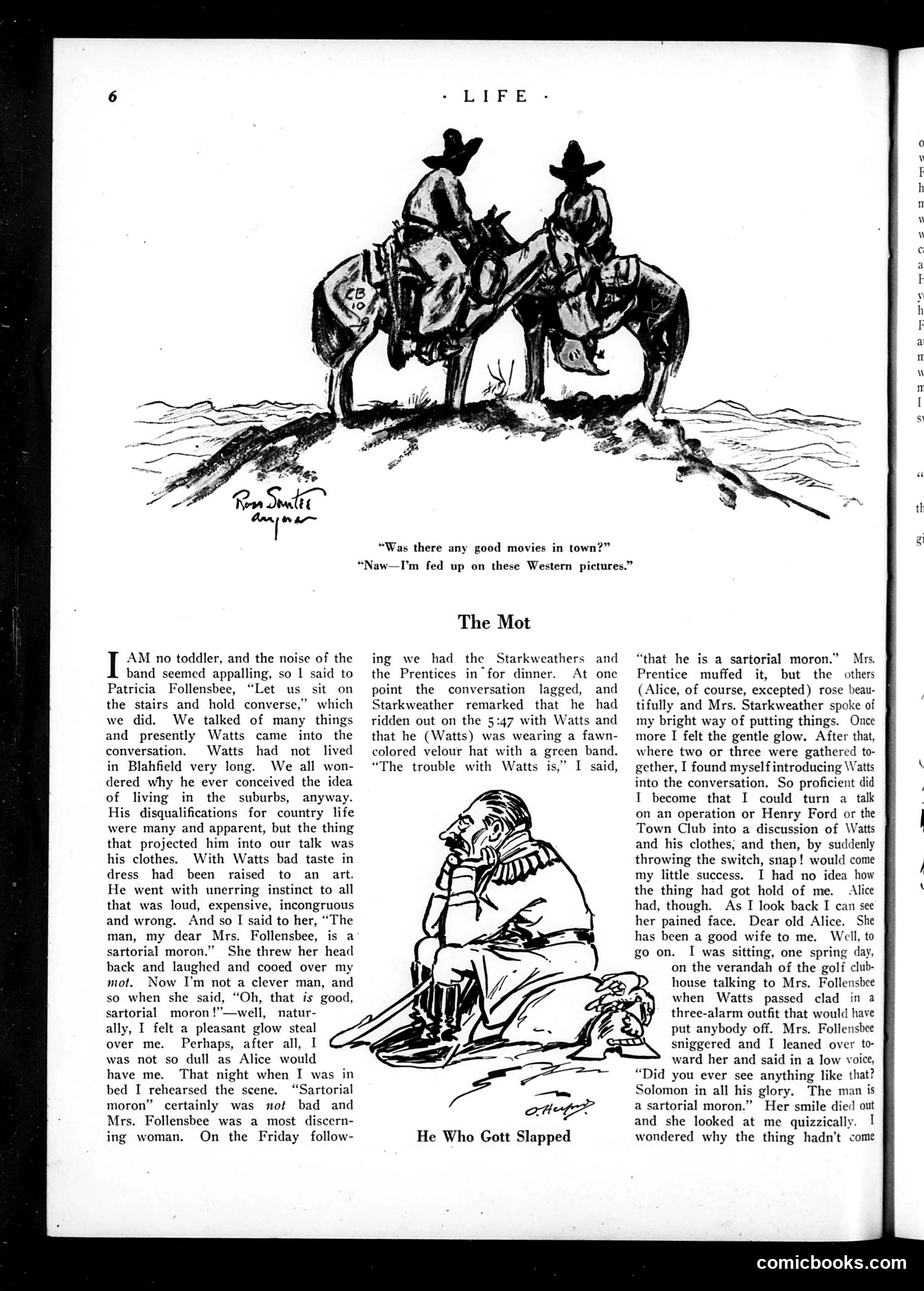
This page from *Life* magazine contains two distinct pieces: **Top Cartoon:** Two cowboys on horseback in a desert landscape. One complains about Western movies in town, saying he's "fed up on these Western pictures." This satirizes the early film industry's oversaturation of Western content—a popular but increasingly clichéd genre. **Story Section ("The Mot"):** A prose piece about social awkwardness. The narrator discusses Mrs. Follenshee calling someone a "sartorial moron" for wearing a loud, garish outfit. The accompanying illustration shows a pompous military figure. The humor stems from critiquing pretentious fashion judgment and social one-upmanship among the middle/upper classes. The story explores how absurd commentary about clothing and appearance circulates in polite society. Both pieces mock different aspects of American culture—mass entertainment and social pretension.
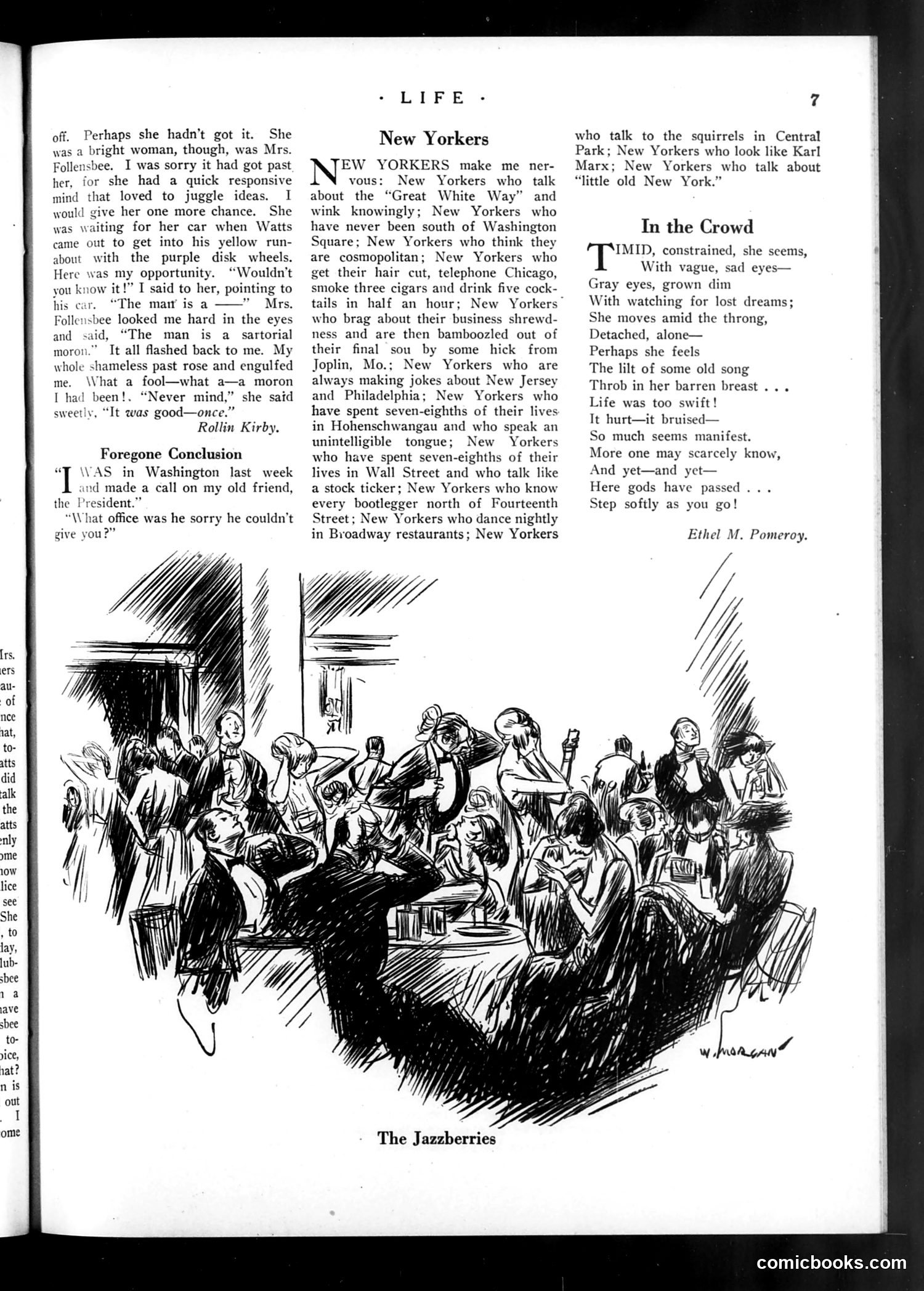
This cartoon depicts a crowded, energetic jazz club scene during the Jazz Age. The sketch shows well-dressed patrons in animated poses—dancing, drinking, and socializing in what appears to be a speakeasy or nightclub. The accompanying text sections satirize different types of New Yorkers: wealthy urbanites obsessed with status symbols, Wall Street types, and those affected by Jazz Age culture. The "New Yorkers" section mocks pretentious city dwellers and their shallow concerns. "In the Crowd" (a poem by Ethel M. Pomeroy) appears to critique the hollowness of Jazz Age social life—describing participants as "timid, constrained" despite outward gaiety, suggesting the scene represents superficial conformity and lost dreams beneath the era's glittering surface. The overall message critiques 1920s urban excess and social artificiality.
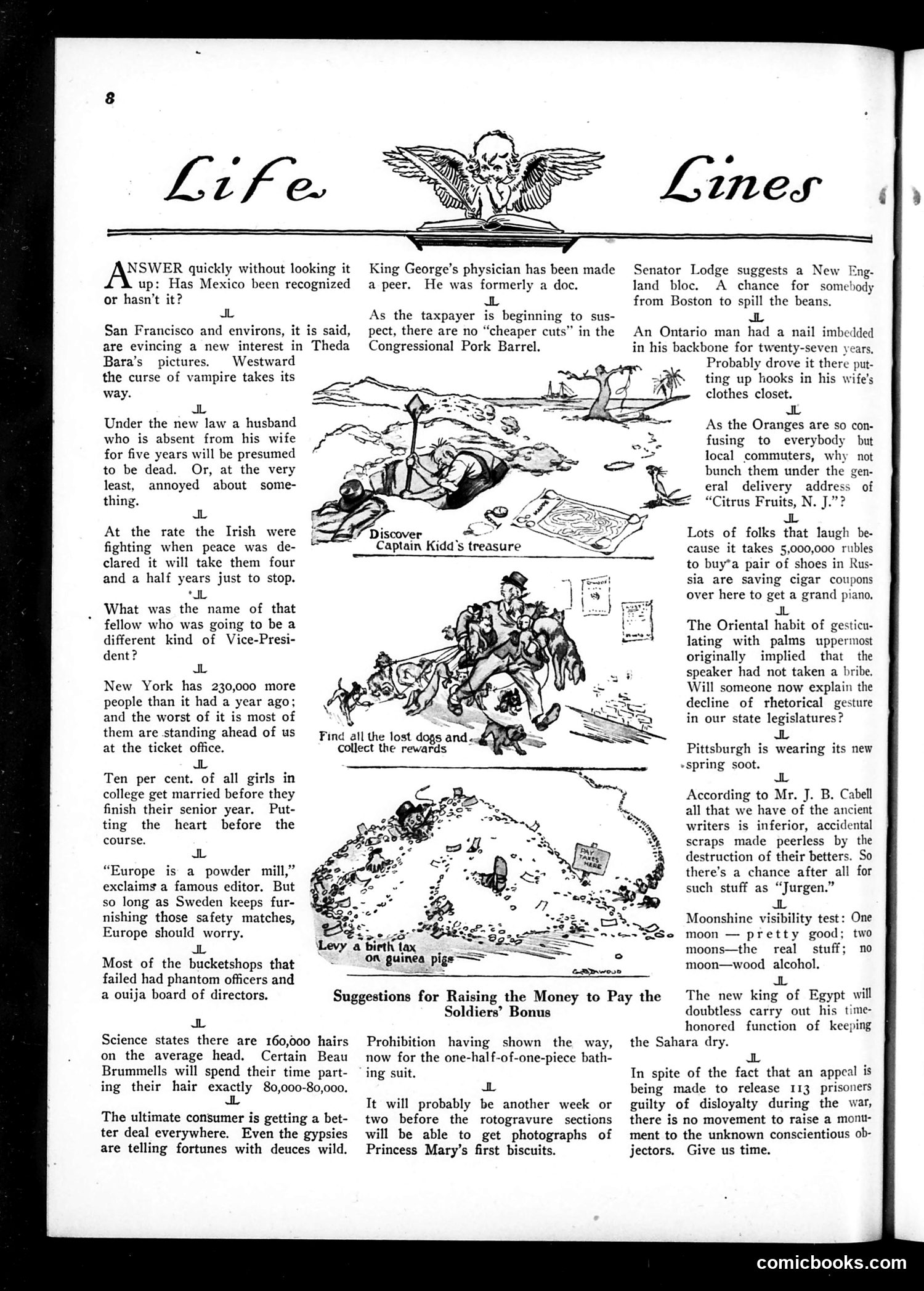
This page contains humorous short items ("Life Lines") and three cartoon illustrations satirizing American life during WWI era. The cartoons depict: 1. **"Discover Captain Kidd's treasure"** - showing figures digging, likely mocking get-rich-quick schemes. 2. **"Find all the lost dogs and collect the rewards"** - illustrating an absurd money-making suggestion. 3. **"Levy a bushel on guinea pigs"** - proposing ridiculous taxation methods. The bottom section, titled **"Suggestions for Raising the Money to Pay the Soldiers' Bonus,"** frames these as satirical proposals for funding veterans' benefits. The text mentions "Prohibition having shown the way" and references raising funds through unconventional means, mocking both post-WWI financial struggles and government proposals. The humor targets economic hardship and absurd solutions to funding soldiers' compensation.
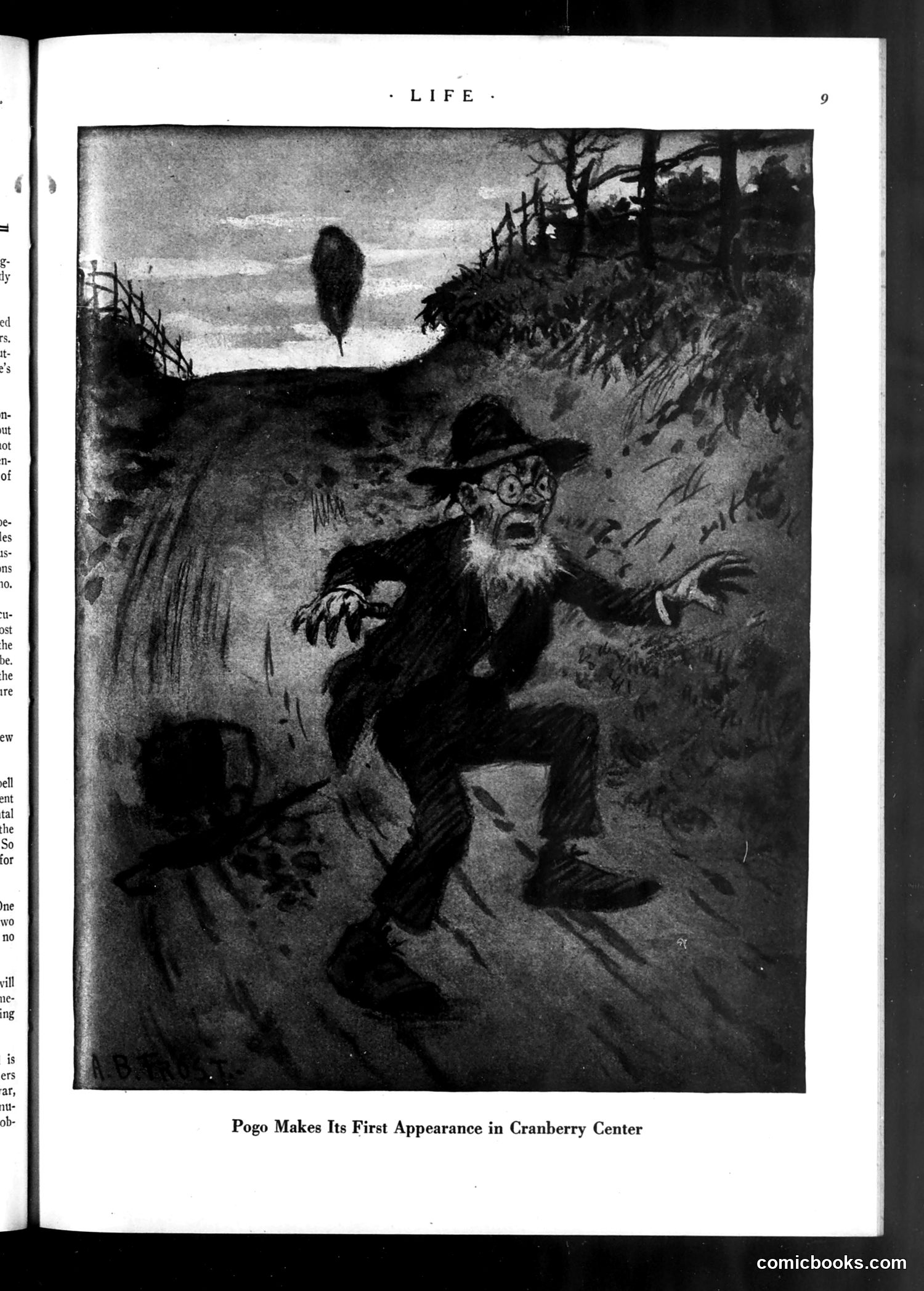
This illustration depicts **Pogo**, a character making his debut appearance in what the caption identifies as "Cranberry Center." The image shows a wizened, elderly figure with exaggerated features—large eyes behind spectacles, a long beard, and gnarled hands—dressed in ragged clothes in a swampy, wooded setting. Pogo became famous as the protagonist of Walt Kelly's comic strip (debuting 1948), set in the Okefenokee Swamp. The character was used for satirical social and political commentary. This appears to be an early promotional image or illustration announcing Pogo's introduction to readers, showcasing the character's distinctive grotesque yet sympathetic appearance that would define the strip's unique visual style.
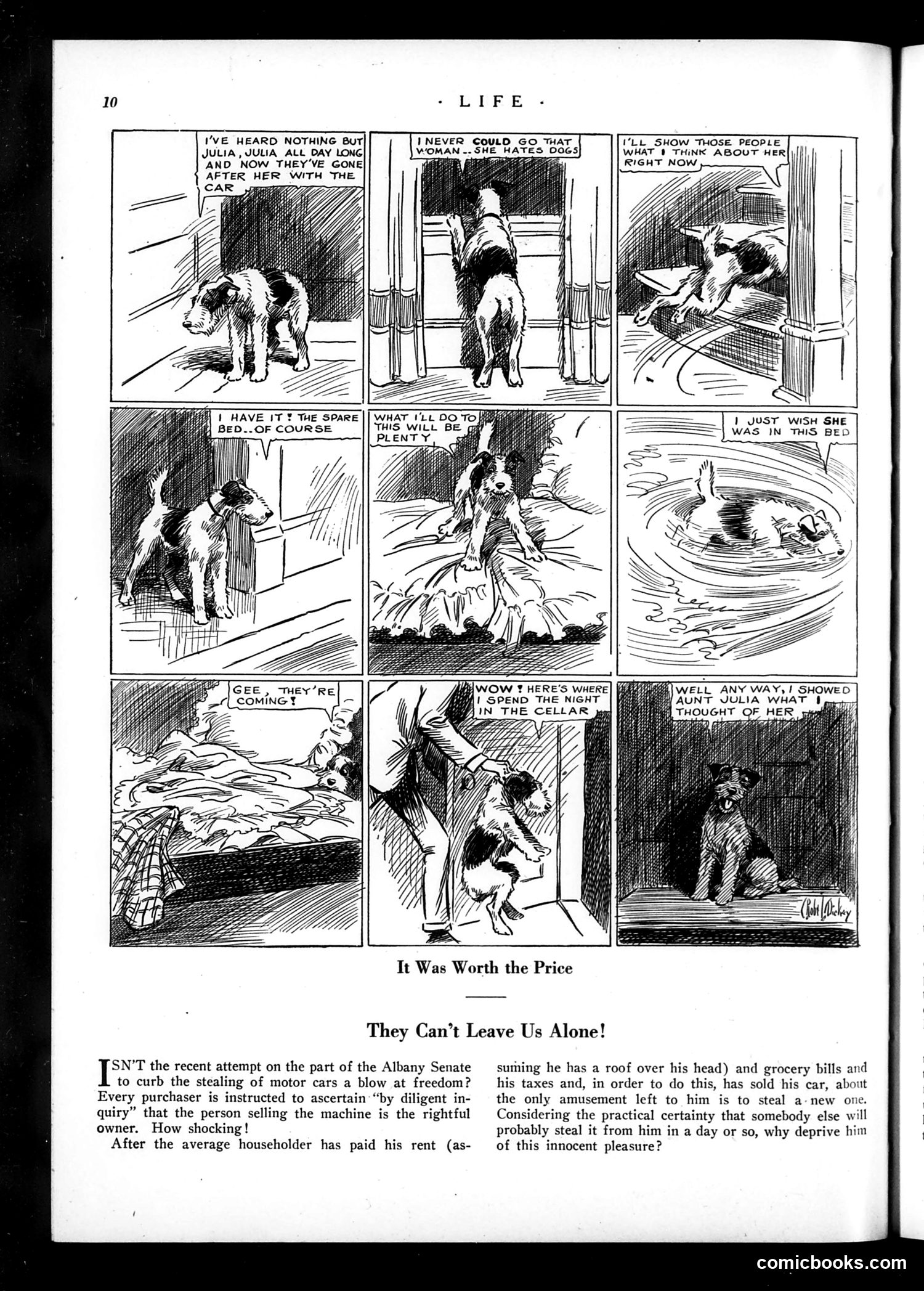
The comic strip depicts a dog's perspective on being confined indoors by its owner, "Aunt Julia." The narrative follows the dog's repeated escape attempts and eventual acceptance of captivity, climaxing when it finds refuge in the owner's bed. The accompanying article critiques an Albany Senate attempt to regulate used-car sales. It argues that property owners should have absolute rights to their purchases without government interference—even if those rights enable questionable behavior. The piece sarcastically questions why the government should "deprive" owners of their freedom to exploit possessions or deceive buyers. The juxtaposition suggests the comic illustrates themes of ownership, control, and resignation to constraints imposed by those claiming authority.
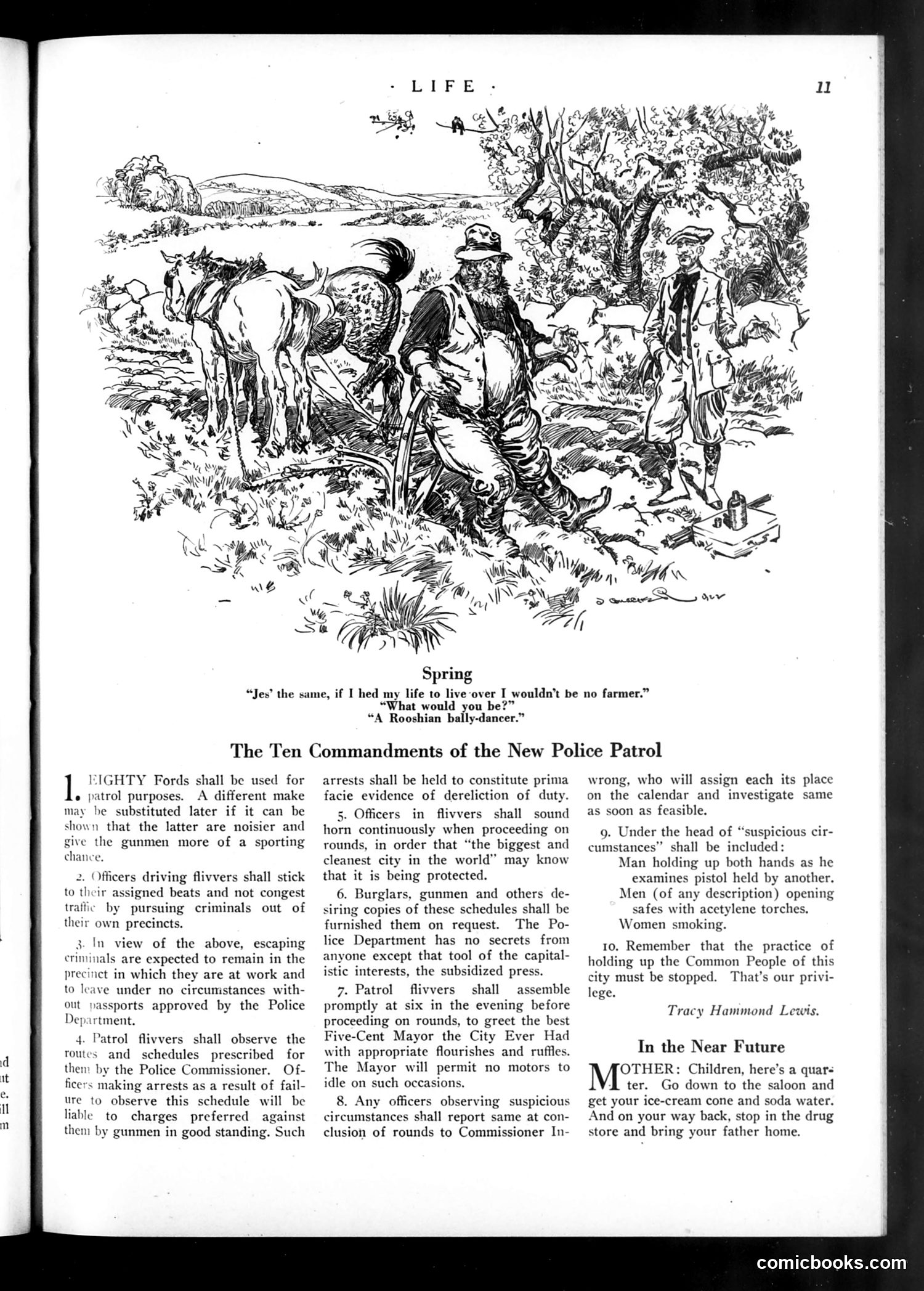
The top illustration depicts a rural spring scene with farmers and a horse, accompanying a humorous exchange about life ambitions. One character states he'd be a farmer if forced to live over; when asked what he'd be otherwise, he replies "A Rooshian bally-dancer"—satirizing the exotic appeal of Russian performers to American audiences. Below, "The Ten Commandments of the New Police Patrol" presents mock rules for police conduct, likely critiquing early 20th-century police reform efforts in New York City. The satirical "commandments" address patrol duties, schedule adherence, and preventing corruption—suggesting actual police practices fell short of these ideals. The final item, "In the Near Future," appears to be humorous domestic satire about children's errands.
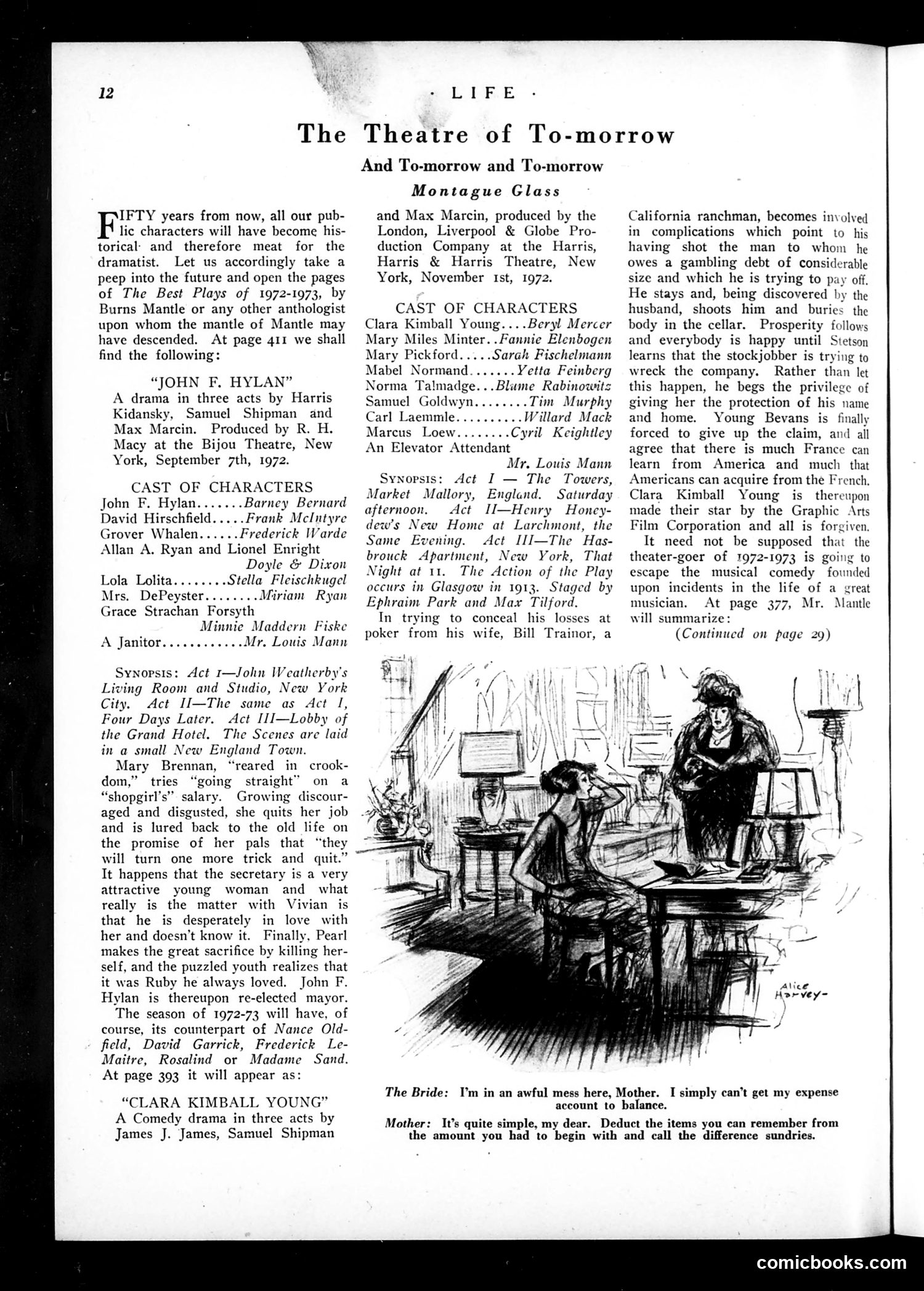
This page from *Life* magazine is primarily theatrical content—not political satire. It previews three plays expected in the 1972-1973 season, fifty years hence (in 2022-2023). The illustration shows a domestic scene: a bride discussing finances with her mother. The dialogue satirizes marital economics—the bride complains she "can't get my expense account to balance," and her mother offers mundane advice about tracking deductions and "call the difference sundries." The joke is gentle social commentary on newlywed financial naivety and domestic budgeting struggles, not political critique. The illustration depicts ordinary middle-class domestic life circa 1972, presented humorously through the exasperation of a young married woman struggling with household accounting.
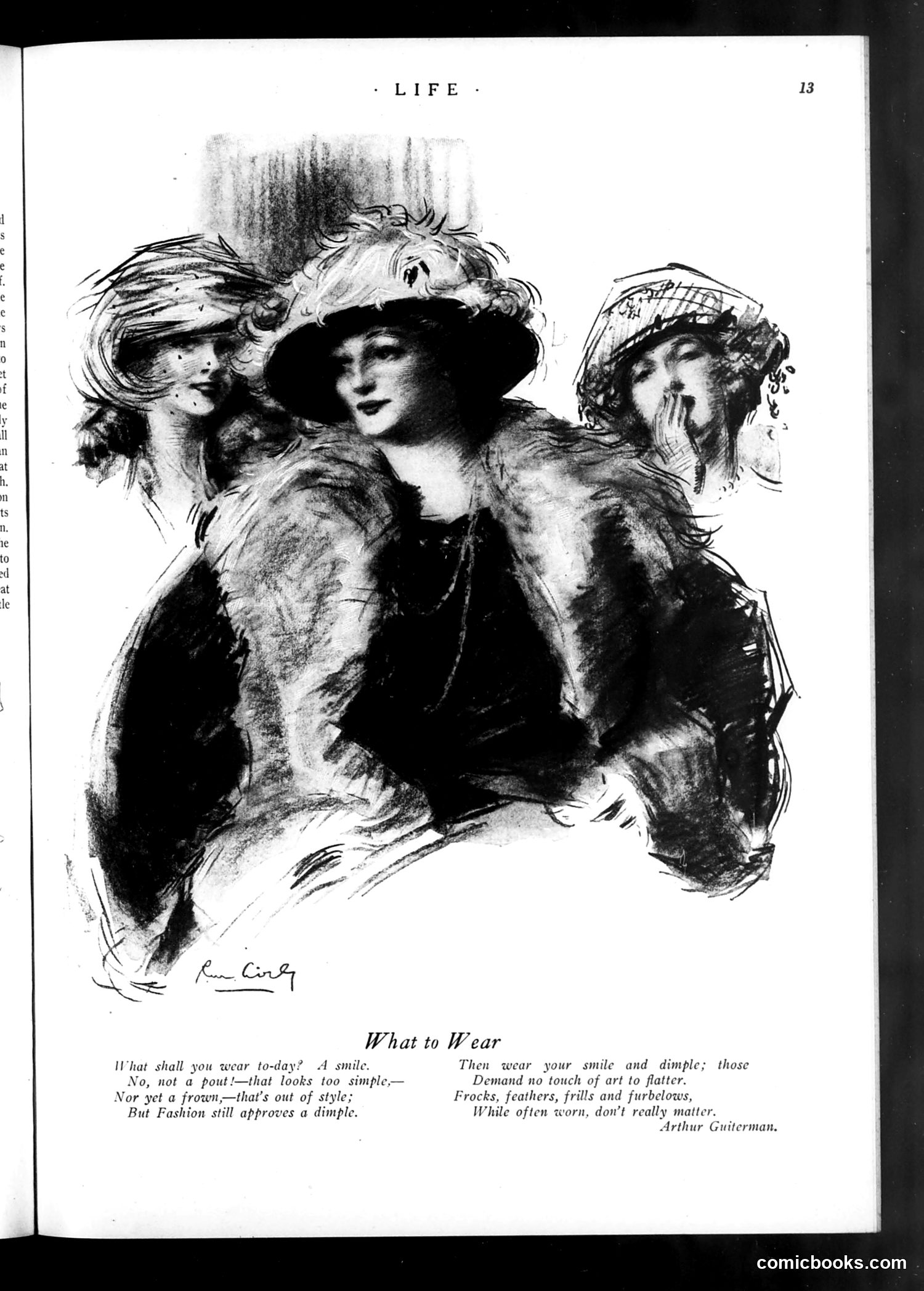
This page features an illustration by R. Cody (signature visible) depicting three fashionable women wearing elaborate hats and furs, accompanying a poem titled "What to Wear" attributed to Arthur Guiterman. The satire targets early 20th-century women's fashion excess. Guiterman's poem mocks the contradiction between fashion's demands for ornate dress ("frocks, feathers, frills and furbelows") and practical simplicity. The opening line—"What shall you wear today? A smile"—suggests that genuine elegance requires only confidence, not expensive accessories. The illustration showcases the very extravagance the poem criticizes: towering, elaborate hats and heavy fur stoles. The joke lies in this visual contradiction—the artwork demonstrates precisely the overcomplicated fashion the text satirizes, creating ironic commentary on Edwardian-era women's dress codes and their social pressures.
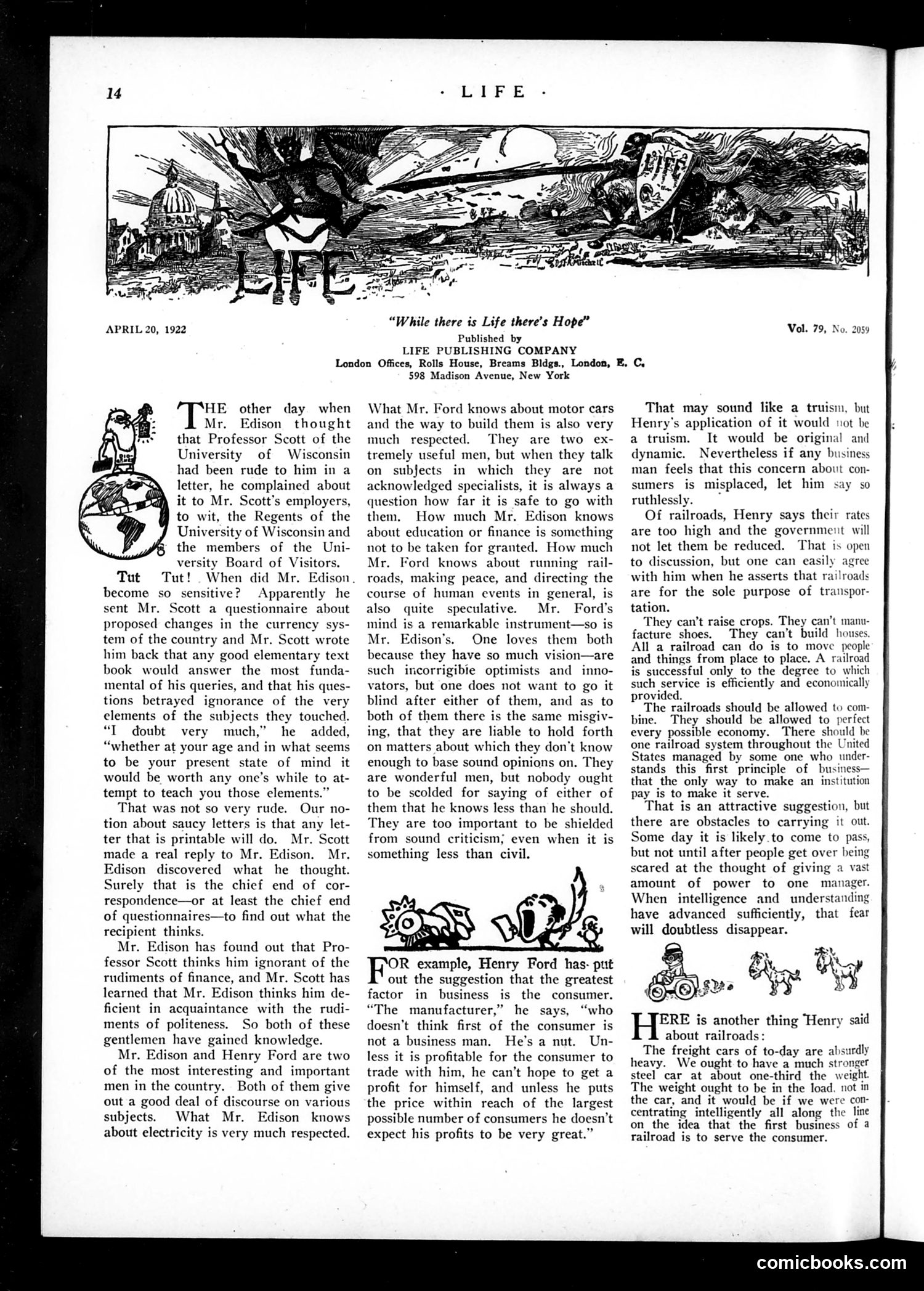
This page discusses a letter complaint from Thomas Edison about Professor Scott of the University of Wisconsin. Scott had criticized Edison's views on currency reform and business education, prompting Edison's defensive response. The article satirizes both men: Edison, despite his scientific genius, apparently lacks knowledge of finance and education—subjects beyond his expertise. Scott is mocked for his academic arrogance. The satire suggests that highly specialized experts (like Edison with electricity, or Ford with automobiles) often overestimate their competence in unrelated fields. The broader point: intelligent people shouldn't pontificate on subjects outside their domain. The piece humorously illustrates how even brilliant minds can hold forth ignorantly when venturing beyond their expertise—a timeless critique of intellectual overreach.
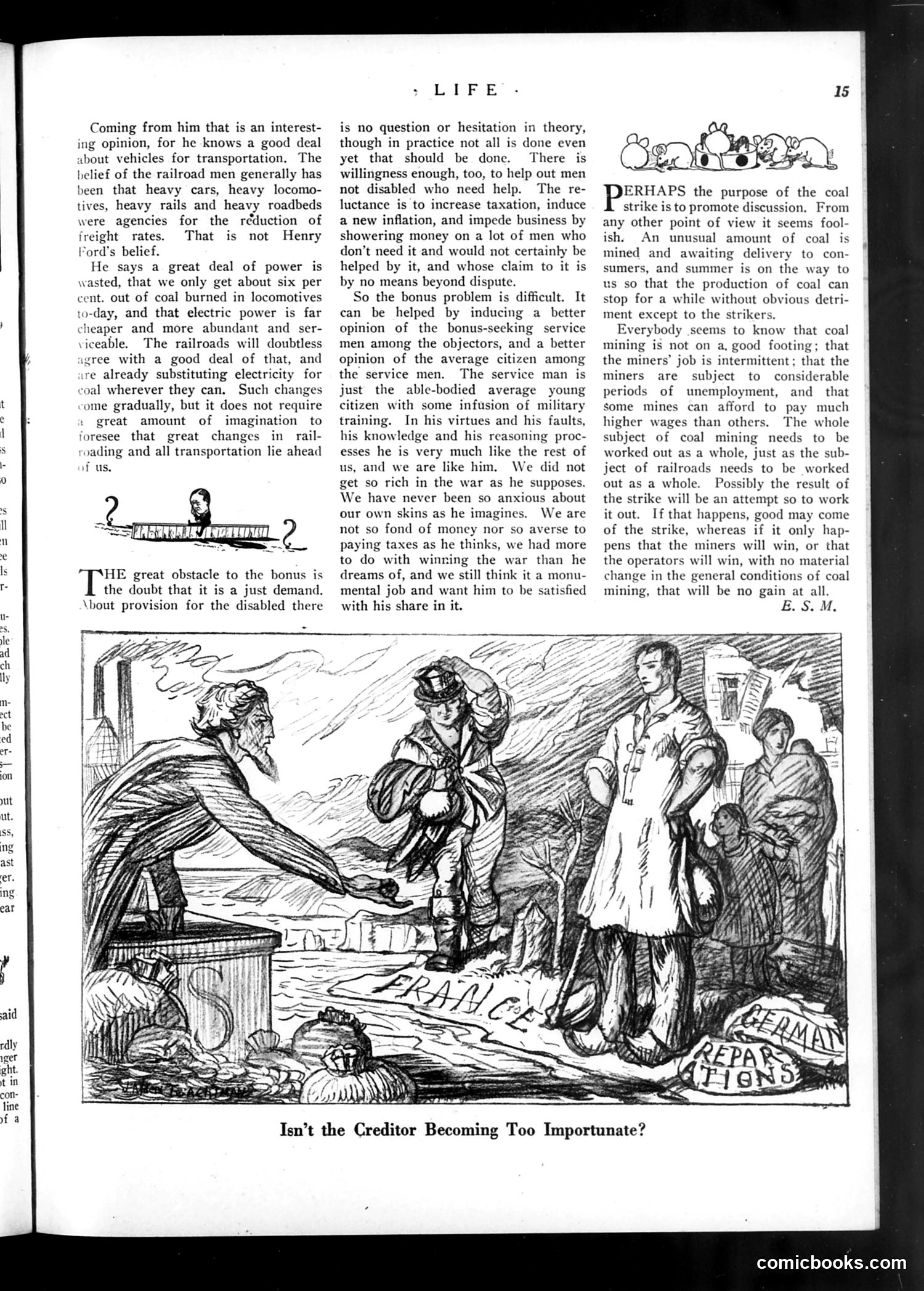
This political cartoon appears to address post-WWI reparations and war debt, likely referencing German war reparations. The skeleton figure on the left (representing a creditor nation, likely America) aggressively demands payment from a weakened central European figure, while distressed civilians (women and children) huddle in the background—representing the German population suffering under reparation burdens. The cartoon's title poses a rhetorical question: is the creditor being too demanding? The satire suggests that excessive financial penalties imposed on a defeated enemy may be counterproductive or inhumane, creating social hardship rather than justice. The accompanying text discusses bonus payments to WWI veterans and coal mining labor disputes—suggesting the page examines competing post-war economic demands and fairness issues across American society.
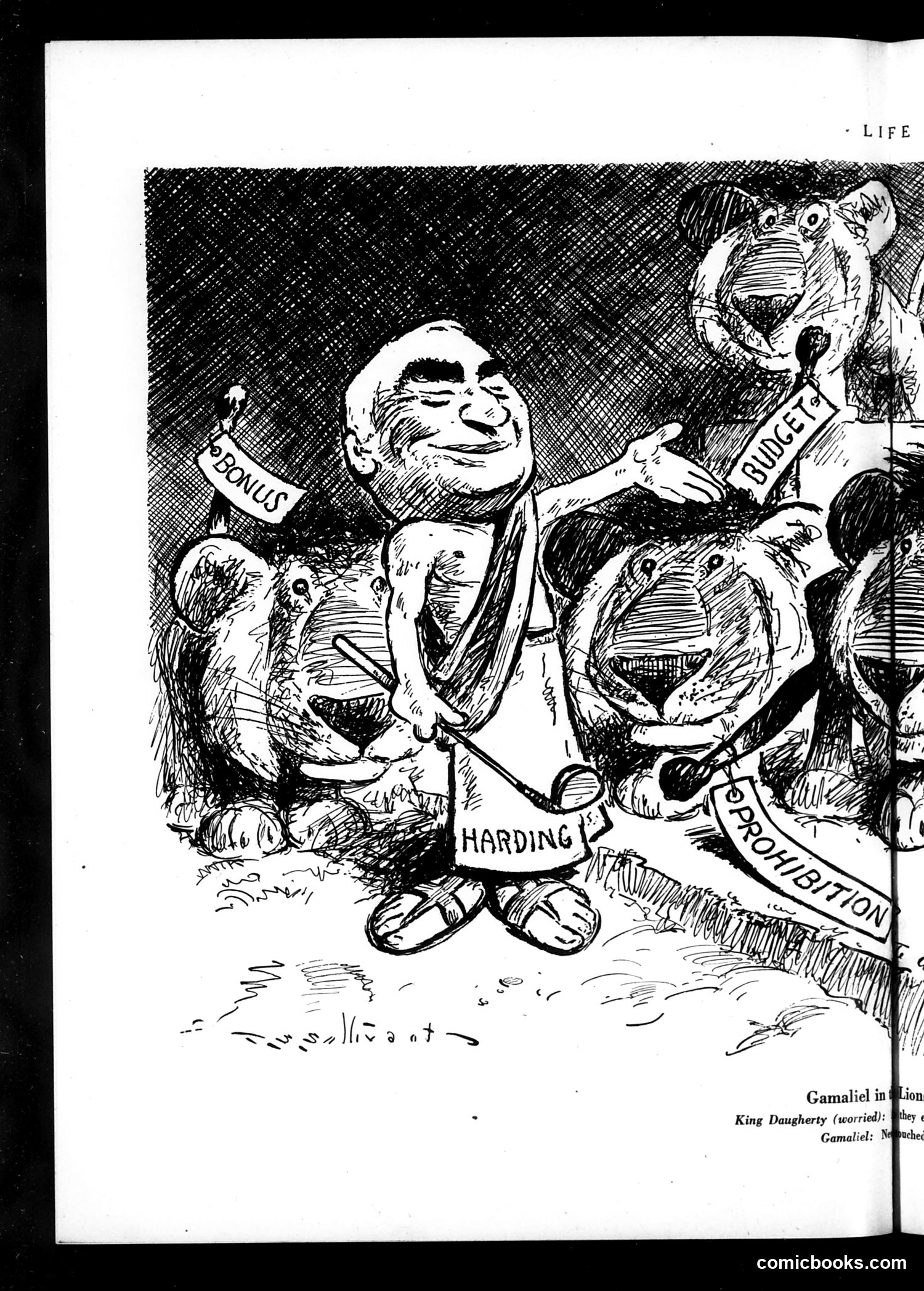
This appears to be a satirical cartoon from Life magazine featuring a caricatured figure labeled "Gamaliel" herding various animals marked with labels including "Bonus," "Budget," and "Prohibition." The caption references "King Daugherty (worried)," likely referring to Harry Daugherty, Attorney General under President Warren G. Harding. The cartoon satirizes the difficulty of managing competing political pressures and interest groups—represented as unruly animals requiring "herding." The specific issues (Bonus, Budget, Prohibition) reflect major political controversies of the early 1920s: veterans' bonuses, federal spending, and alcohol prohibition enforcement. Gamaliel likely refers to Harding himself, satirizing his struggling attempts to control conflicting political factions and policies during his administration.
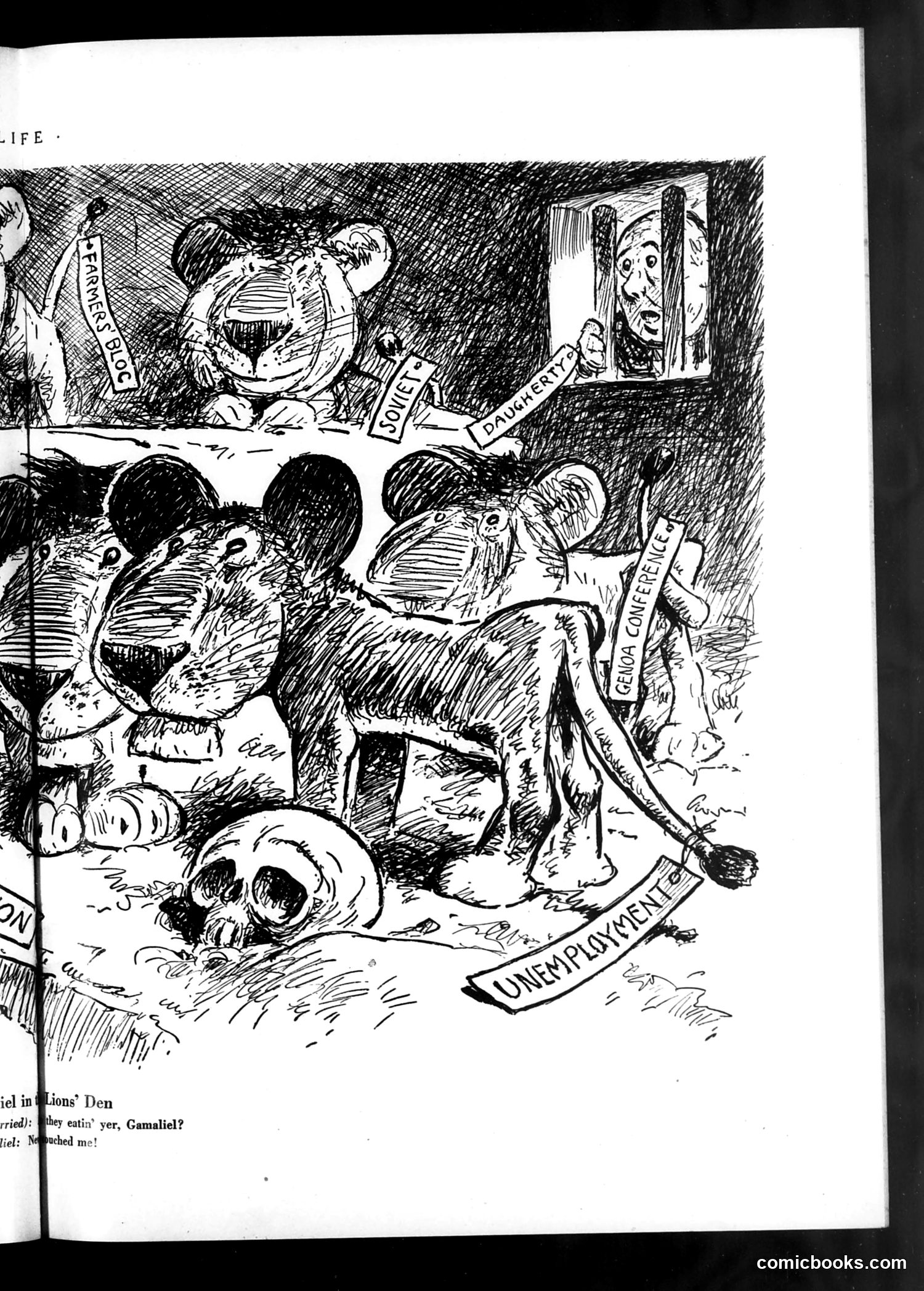
This is a satirical cartoon depicting what appears to be a den or cage scene with multiple animal figures (possibly lions or similar beasts) alongside human figures labeled with social issues: "Unemployment," "Danger," "Dull Care," and "Gloom Converge." The dialogue fragment "they eatin' yer, Gamaliel?" suggests someone named Gamaliel is being consumed or threatened by these problems. The imagery satirizes how economic hardship and social anxieties "devour" or overwhelm individuals during difficult times—likely referencing the Great Depression era based on the prominence of unemployment and the visual style. The cartoon uses the metaphor of dangerous predators to represent abstract social problems threatening ordinary people.
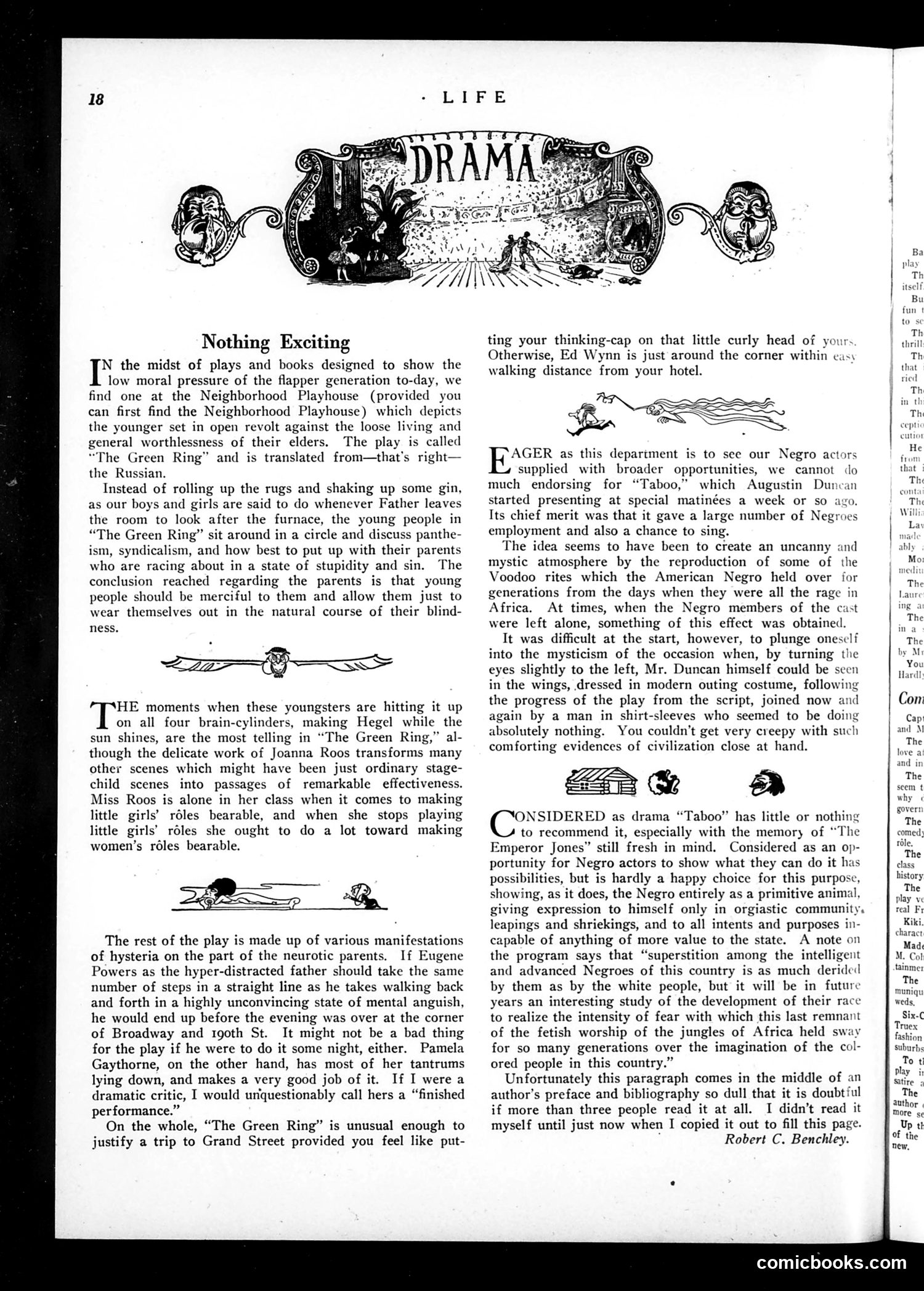
This page reviews two theatrical productions from the 1920s era, critiquing them through the magazine's satirical lens. **"The Green Ring"**: The reviewer mocks this Russian play for its pretentiousness—young people discussing Hegelian philosophy and syndicalism rather than engaging in the stereotypical "flapper" behavior (gin, dancing, loose morals) that contemporary society expected. The satire targets both the play's intellectual pretension and generational anxiety about youth morality. The reviewer suggests audiences might prefer Ed Wynn's lighter entertainment instead. **"Taboo"**: This section critiques a production directed by Augustin Duncan featuring Black performers attempting to recreate African Voodoo rituals. The reviewer's complaint reveals the artificiality: the "mystical atmosphere" collapses when one glimpses Duncan offstage in modern clothes, reading the script. The satire targets the production's failed authenticity and the broader practice of exoticizing Black performers and African culture for white audiences. Both reviews mock artistic pretension while revealing period attitudes about race and entertainment.
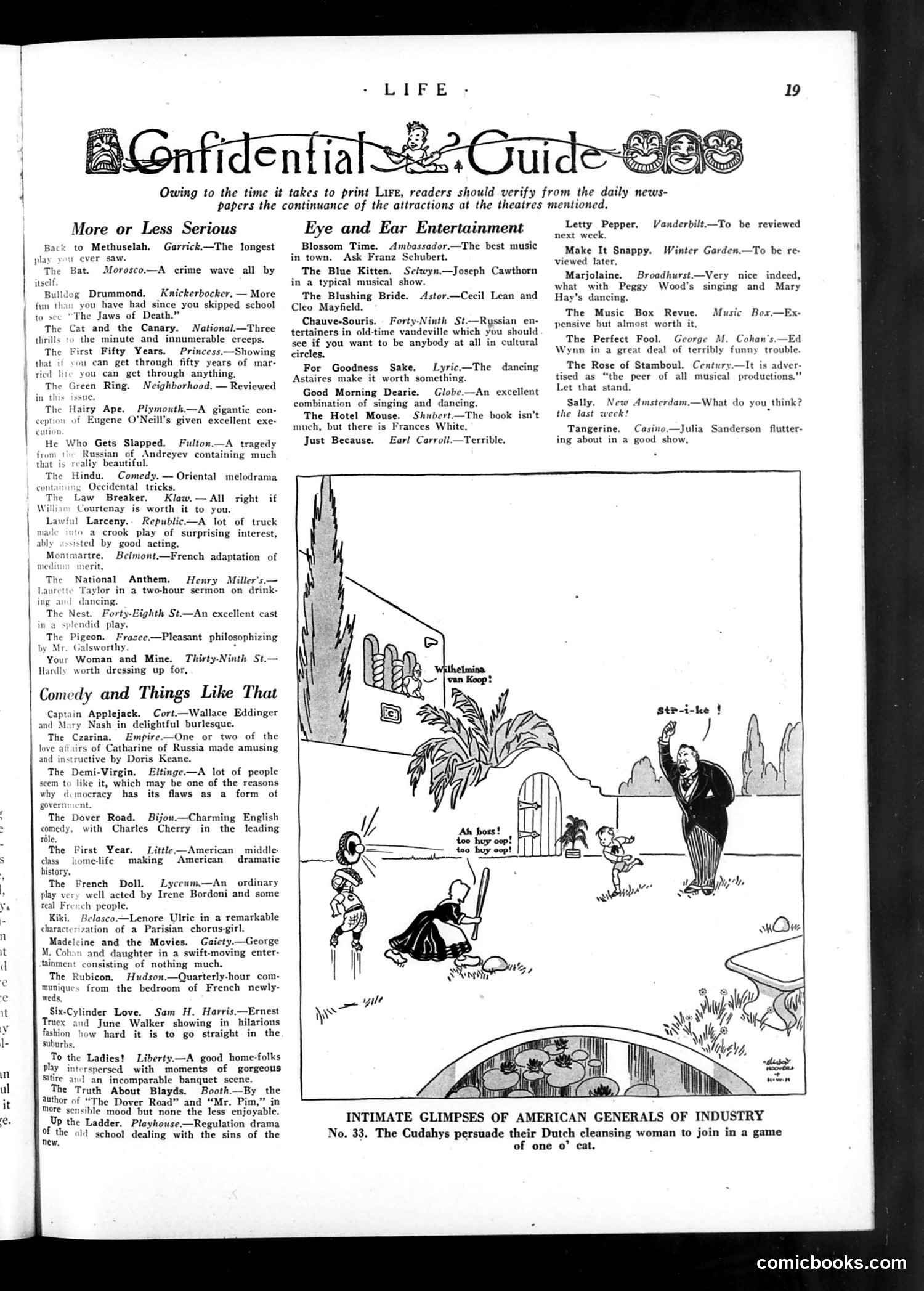
This is a **theater review section** from Life magazine, listing Broadway shows and their quality. The reviews use humorous, often cutting commentary—Life's signature style of theatrical criticism. The main cartoon depicts the **Cudahys**, a wealthy American family, playing a parlor game where they persuade their Dutch cleaning woman to join a game involving "one o' cat" (a baseball variant). The satire targets **upper-class obliviousness**: wealthy people treating their servants as entertainment and equals in a condescending, presumptuous way. The "Intimate Glimpses of American Generals" caption appears to be satirizing American military leadership, though details are unclear from this image alone. The reviews themselves showcase Life's wit—describing "Back to Methuselah" as "the longest play you ever saw," or noting that "The Demi-Virgin" succeeding proves "democracy has its flaws."
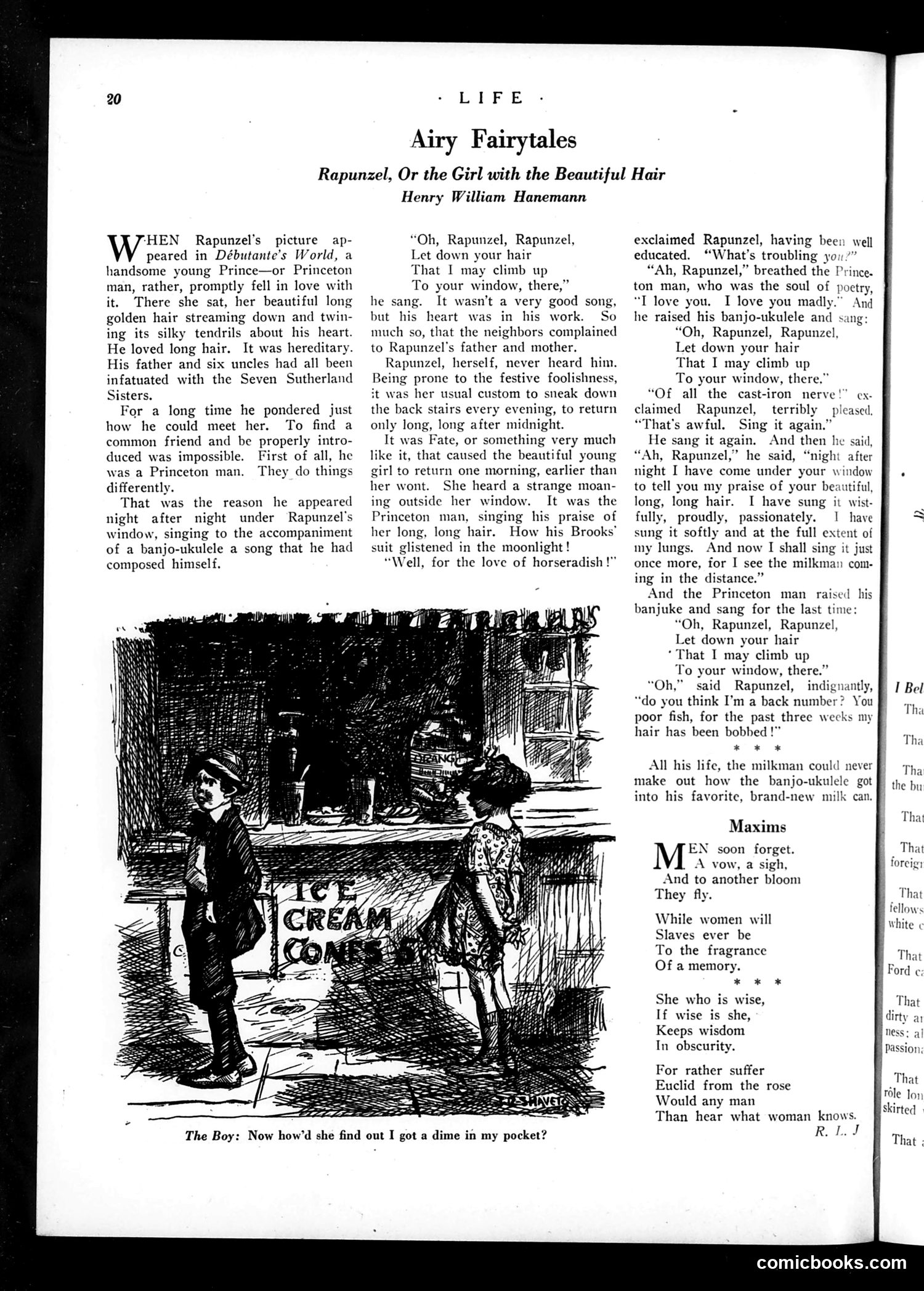
This satirical retelling mocks early 1920s courtship customs and the "Princeton man" archetype. A wealthy Princeton student becomes obsessed with a debutante's photograph, specifically her long hair, and serenades her nightly with a banjo-ukulele—behavior presented as simultaneously ridiculous and typical of his class. The joke pivots on the "bob" haircut, a radical 1920s fashion trend where women cut their long hair short. When Rapunzel reveals hers has been bobbed, the suitor's romantic efforts become instantly obsolete. The cartoon mocks both the Princeton man's superficiality (loving only the hair, not the person) and the generational clash represented by the modern woman who dismisses his outdated romantic gestures. The punchline—the milk can—suggests his banjo-ukulele ends up in the milkman's delivery, a final indignity to the pretentious serenader. The piece satirizes class pretension, romantic cliché, and generational change.
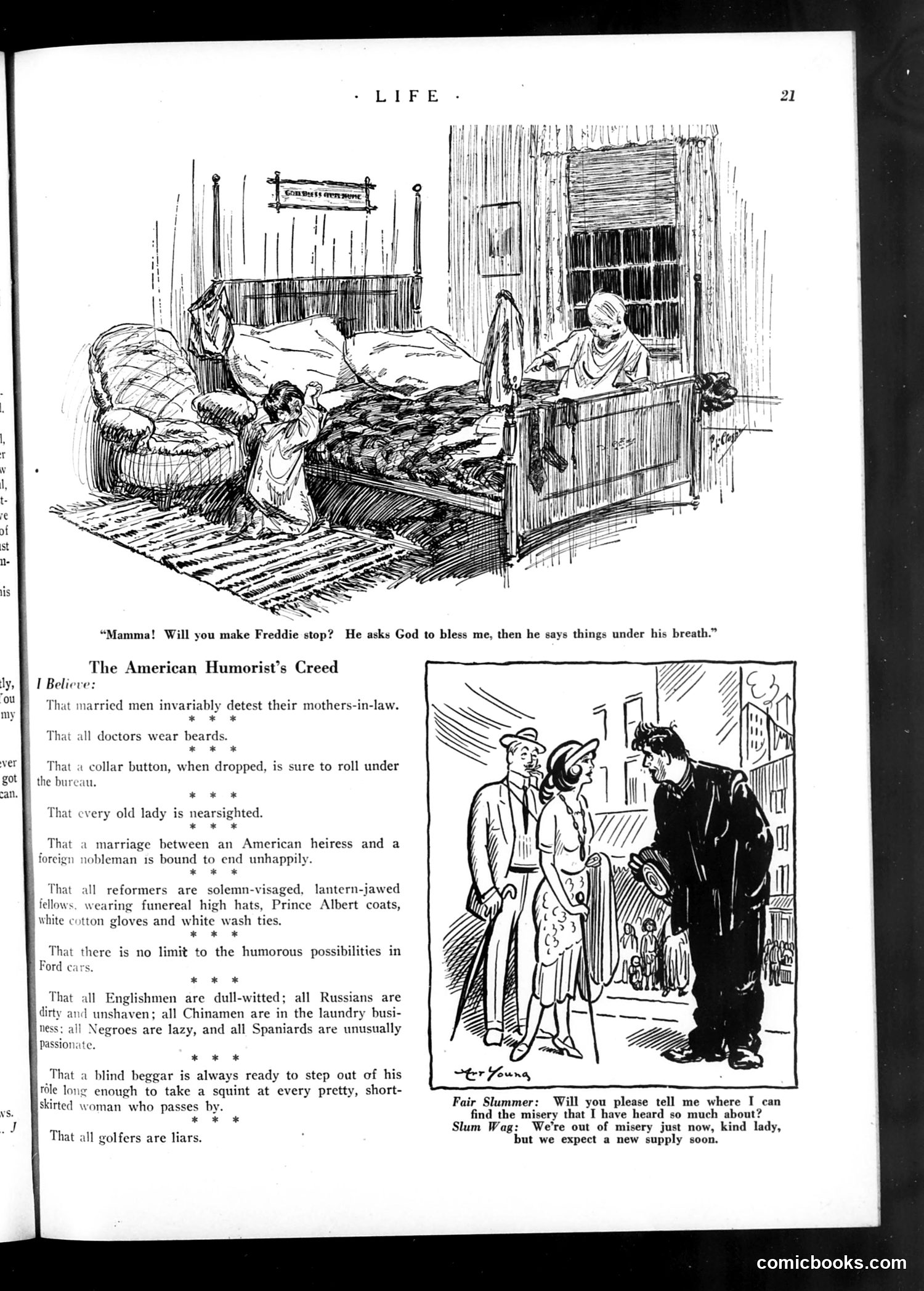
This page satirizes the lazy stereotypes and clichés that American humor writers repeatedly relied on. The "Creed" lists tired comic premises—mothers-in-law are universally despised, all doctors have beards, lost collar buttons roll under furniture—that had become so formulaic they'd lost genuine wit. The page mocks both the predictability of period humor *and* the ethnic/national stereotypes it casually perpetuated: Englishmen are dull, Russians dirty, Chinese people laundry workers, Black people lazy, Spaniards passionate. The two cartoons above and below reinforce this critique: one shows a child innocently mixing prayer with profanity (mocking sentimental domestic humor), the other depicts a wealthy tourist asking a "Slum Wag" where to find poverty—a jab at patronizing "slumming" narratives that treated urban misery as a tourist attraction rather than genuine human suffering.
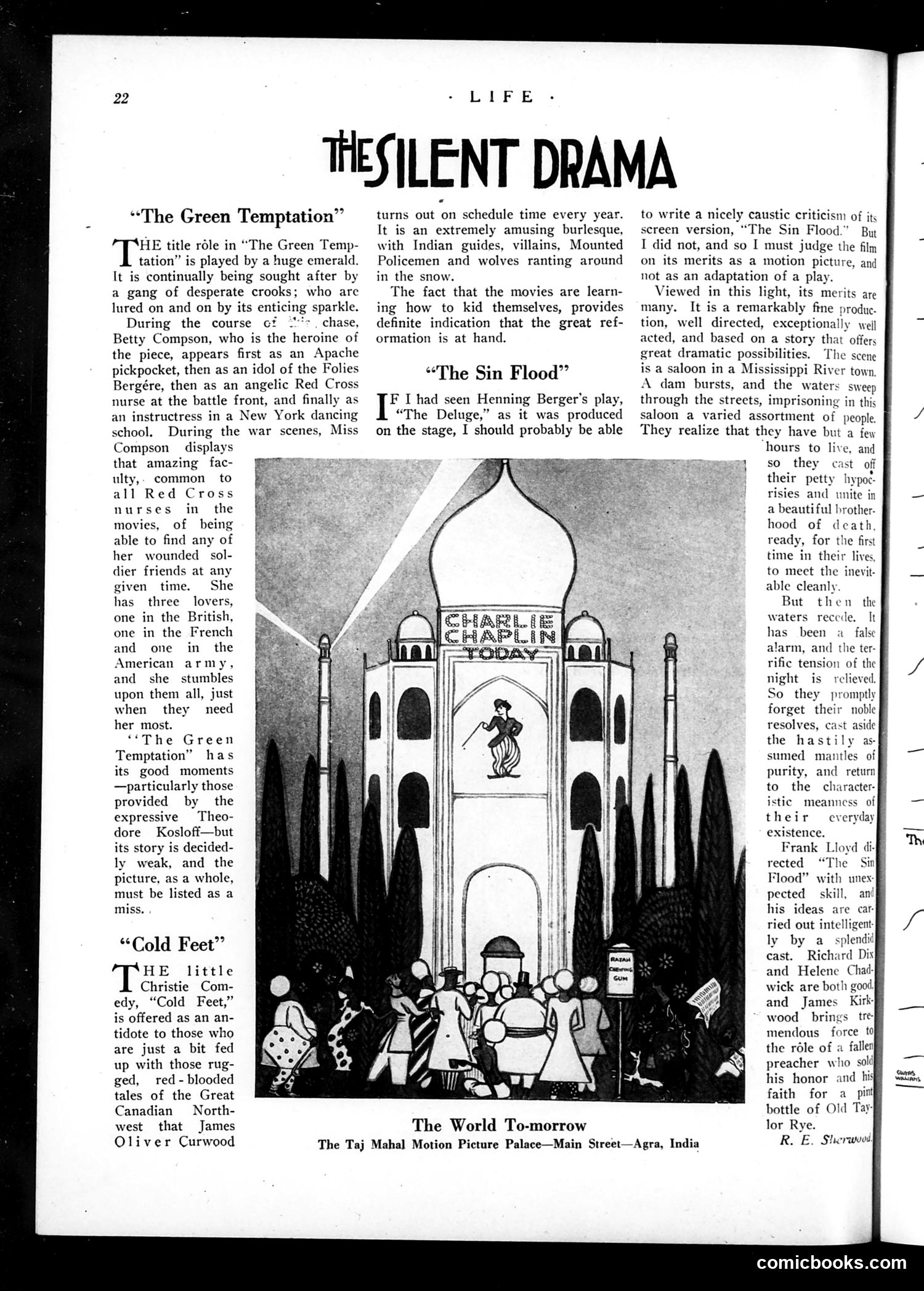
This is a film review column from Life magazine covering four silent movies. The page includes a large illustration labeled "The World To-morrow" depicting the Taj Mahal converted into a motion picture palace on a Main Street in Agra, India—a satirical commentary on American cinema's global reach and the Americanization of iconic non-Western landmarks. The reviews themselves critique contemporary silent films: "The Green Temptation" (weak despite good performances), "Cold Feet" (praised as self-aware satire of adventure tropes), and "The Sin Flood" (dramatically effective, starring Richard Dix and Helene Chadwick). The satire's main point: movies are learning "to kid themselves"—Hollywood is becoming self-aware about its own formulaic narratives and clichés, which the critic presents as cultural progress. The Taj Mahal illustration extends this joke globally, suggesting American entertainment culture exports homogenizing influence worldwide.
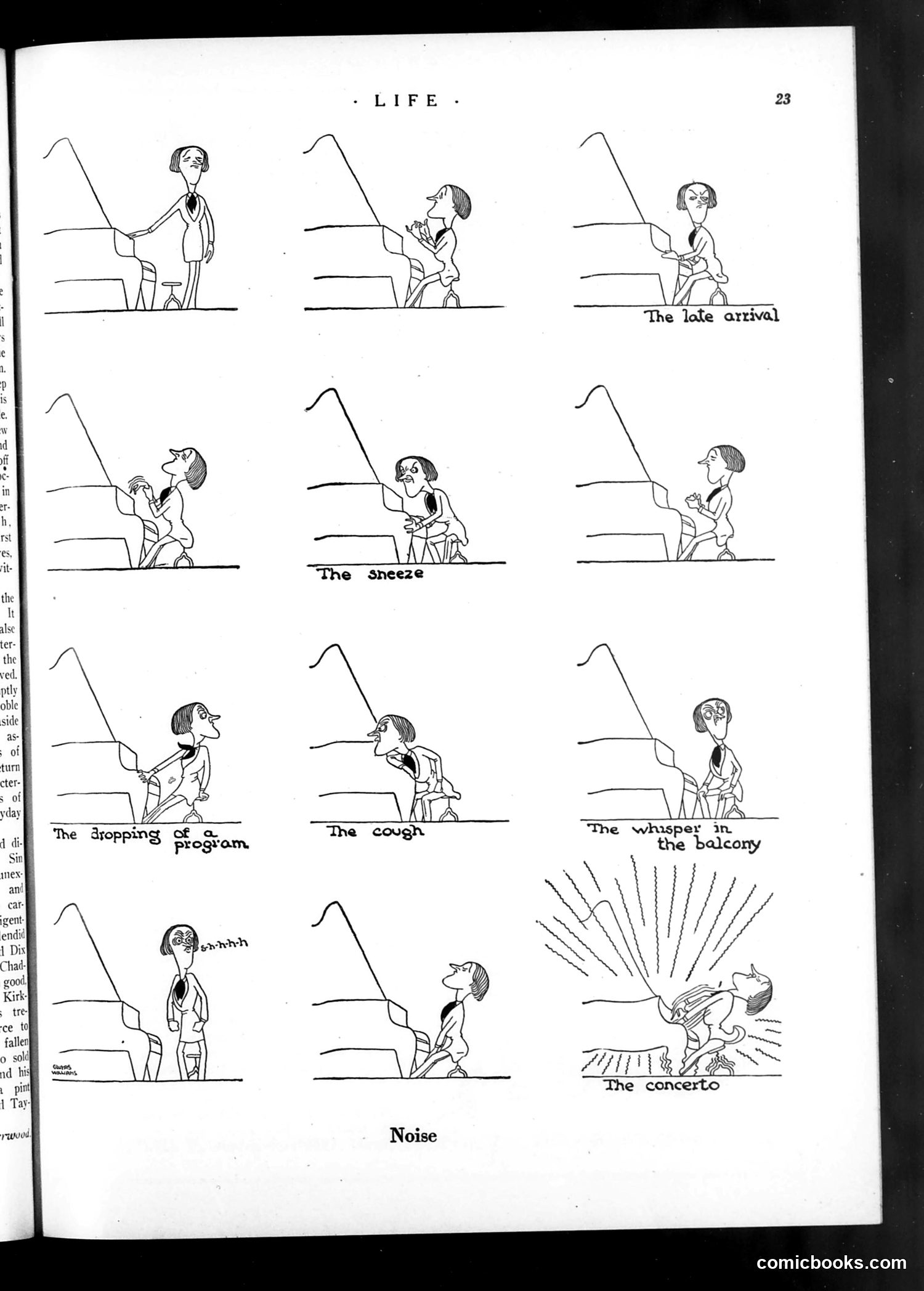
This page presents a humorous sequence showing various ways audiences create disturbances during a concert or theatrical performance. Each panel depicts a different type of noise-making: - "The late arrival" — someone entering after the performance begins - "The sneeze" — an involuntary outburst - "The dropping of a program" — accidental noise - "The cough" — another uncontrollable sound - "The whisper in the balcony" — intentional talking - "The concerto" — the finale shows the musician overwhelmed by accumulated audience noise The satire targets the contradiction between audiences' expectation of enjoying refined entertainment and their actual behavior—their inability to remain quiet during performances. The final panel, with its radiating lines suggesting chaos, emphasizes how audience noise can overshadow the actual music. This reflects common complaints about theater etiquette in the early 20th century.
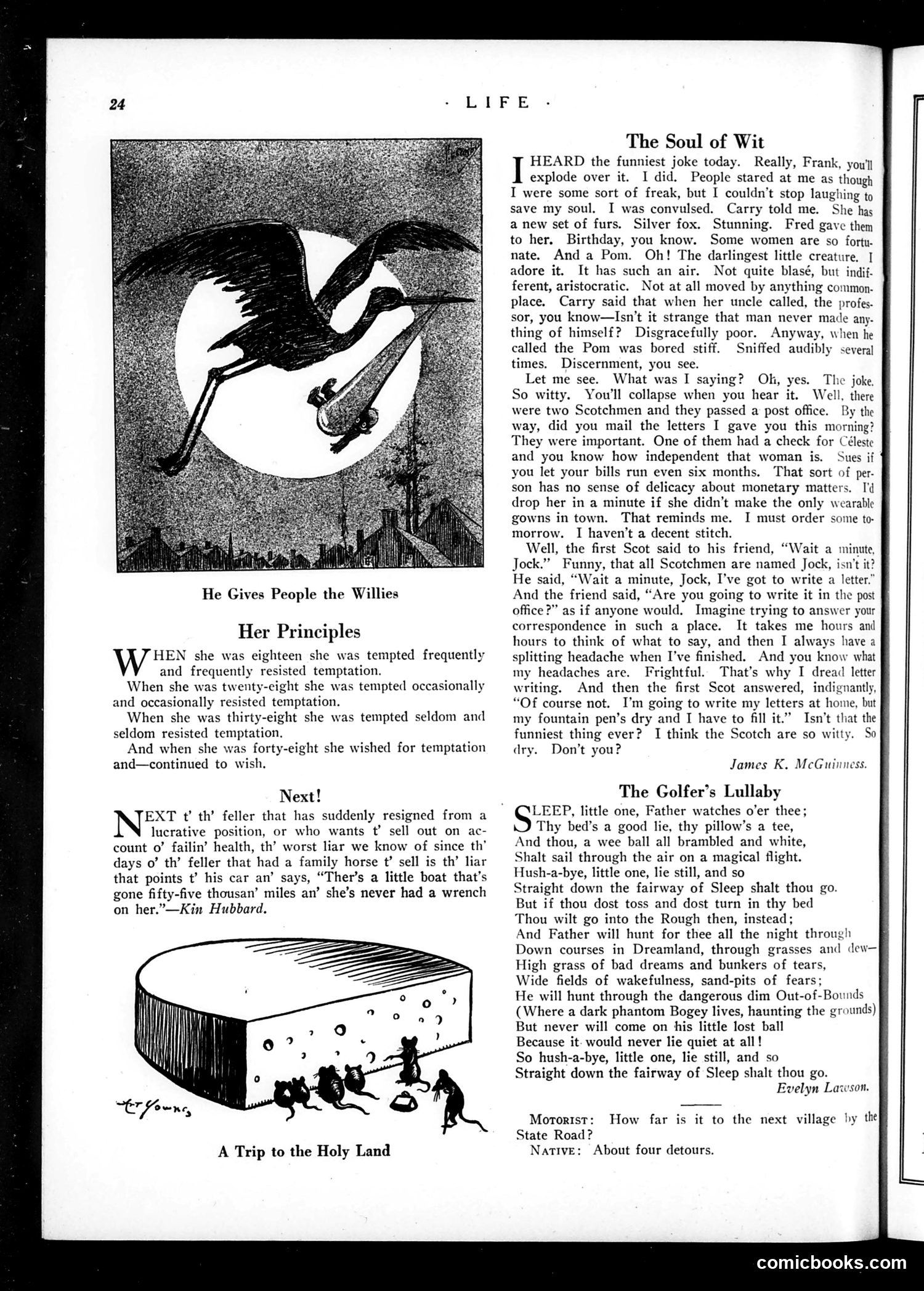
This page from *Life* magazine contains several pieces of social satire typical of early 20th-century American humor: **"The Soul of Wit"** mocks vapid society women who cannot tell a joke coherently. The narrator launches into an anecdote about Scottish men but constantly digresses into gossip about furs, a Pomeranian dog, and correspondence—completely losing the thread. The satire targets wealthy, scattered women of leisure whose self-absorption and pretension render them incapable of genuine wit or communication. **"Her Principles"** presents a cynical progression: a woman resists temptation in youth, gradually succumbs with age, and finally desperately wishes for temptation in old age—satirizing hypocrisy about morality and desire. **"A Trip to the Holy Land"** illustrates a common con: someone falsely claims their worn-out car has traveled 55,000 miles without repair—mocking people who lie transparently when selling used goods. **"The Golfer's Lullaby"** is lighthearted verse addressing a baby as if it were a golf ball, playing on golfers' obsessive passion. All pieces exemplify *Life*'s satirical tone targeting pretension, dishonesty, and social absurdity.
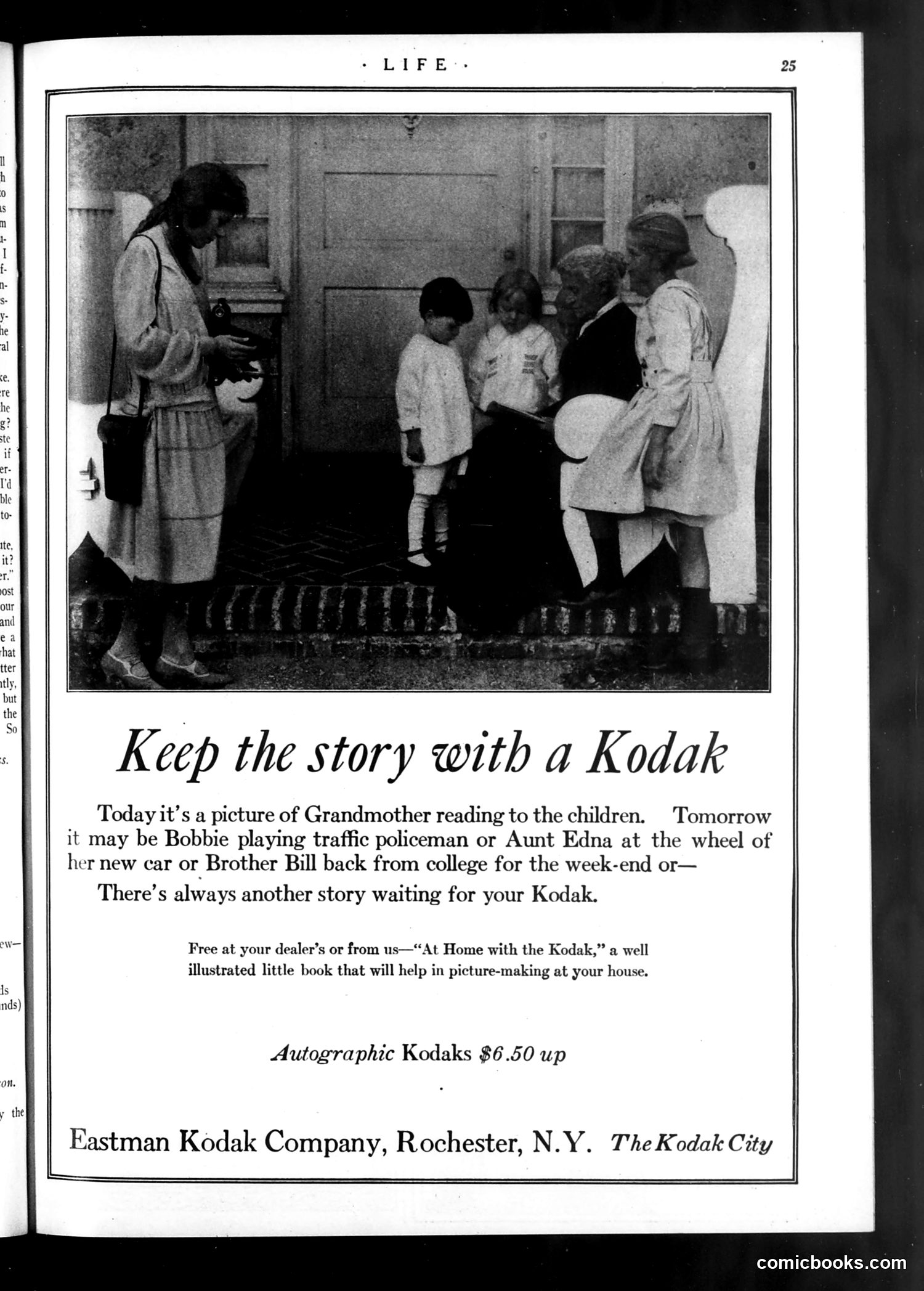
This is a **Kodak camera advertisement**, not a political cartoon. The image shows a grandmother reading to children while adults observe—a domestic scene meant to appeal to family-oriented consumers. The ad's messaging centers on **capturing everyday life moments**: grandmother reading, children playing, relatives visiting home from college, women driving cars. These activities represent modern domestic life in the early 20th century. The advertising strategy emphasizes that **life continuously offers new photo opportunities**—"There's always another story waiting for your Kodak." By positioning photography as a way to preserve family memories and document life's ordinary but meaningful moments, Kodak marketed cameras as essential household items. The price point ($6.50 up) and the free instructional booklet ("At Home with the Kodak") suggest Kodak was making photography accessible to middle-class consumers, positioning the camera as an important family possession for memorializing domestic life.
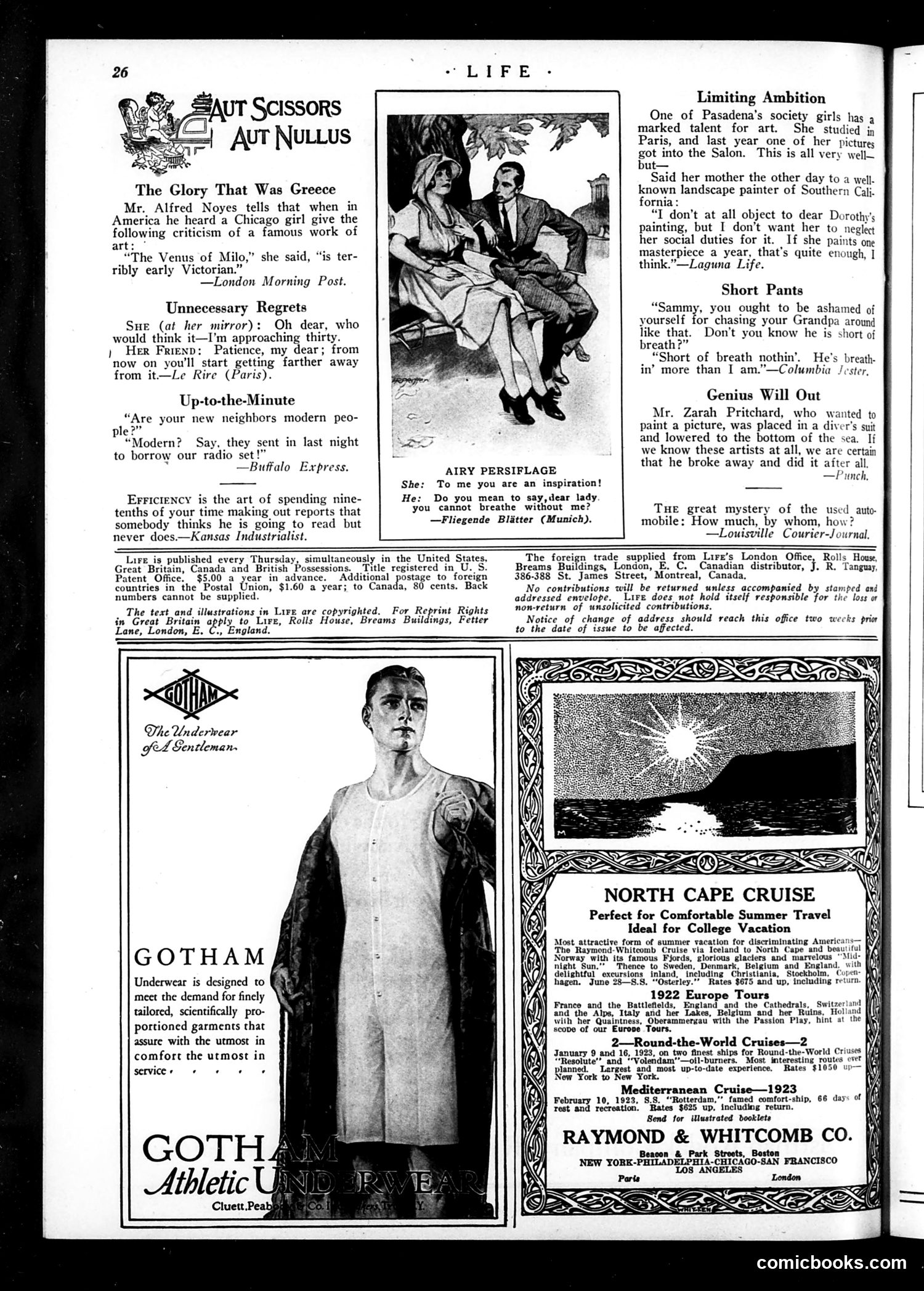
This page from *Life* magazine consists primarily of **short humorous anecdotes** rather than political cartoons. The jokes satirize early 20th-century American society and attitudes: **"The Glory That Was Greece"** mocks American cultural ignorance—a Chicago girl dismisses the classical Venus of Milo as "terribly early Victorian," revealing she doesn't recognize ancient art. **"Limiting Ambition"** satirizes shallow priorities among wealthy Pasadena women: a mother approves of her daughter's artistic talent only if painting doesn't interfere with social obligations, limiting her to "one masterpiece a year." **"Genius Will Out"** humorously suggests an artist's compulsion is so strong that even placed underwater in a diving suit, he'd somehow manage to paint. The remaining items joke about aging women, modern neighbors obsessed with new technology (radio), and breathlessness. The page also contains advertisements for Gotham underwear and Raymond & Whitcomb cruise tours, typical of *Life's* commercial content. These vignettes reflect period anxieties about materialism, artistic pretension, and changing social customs.
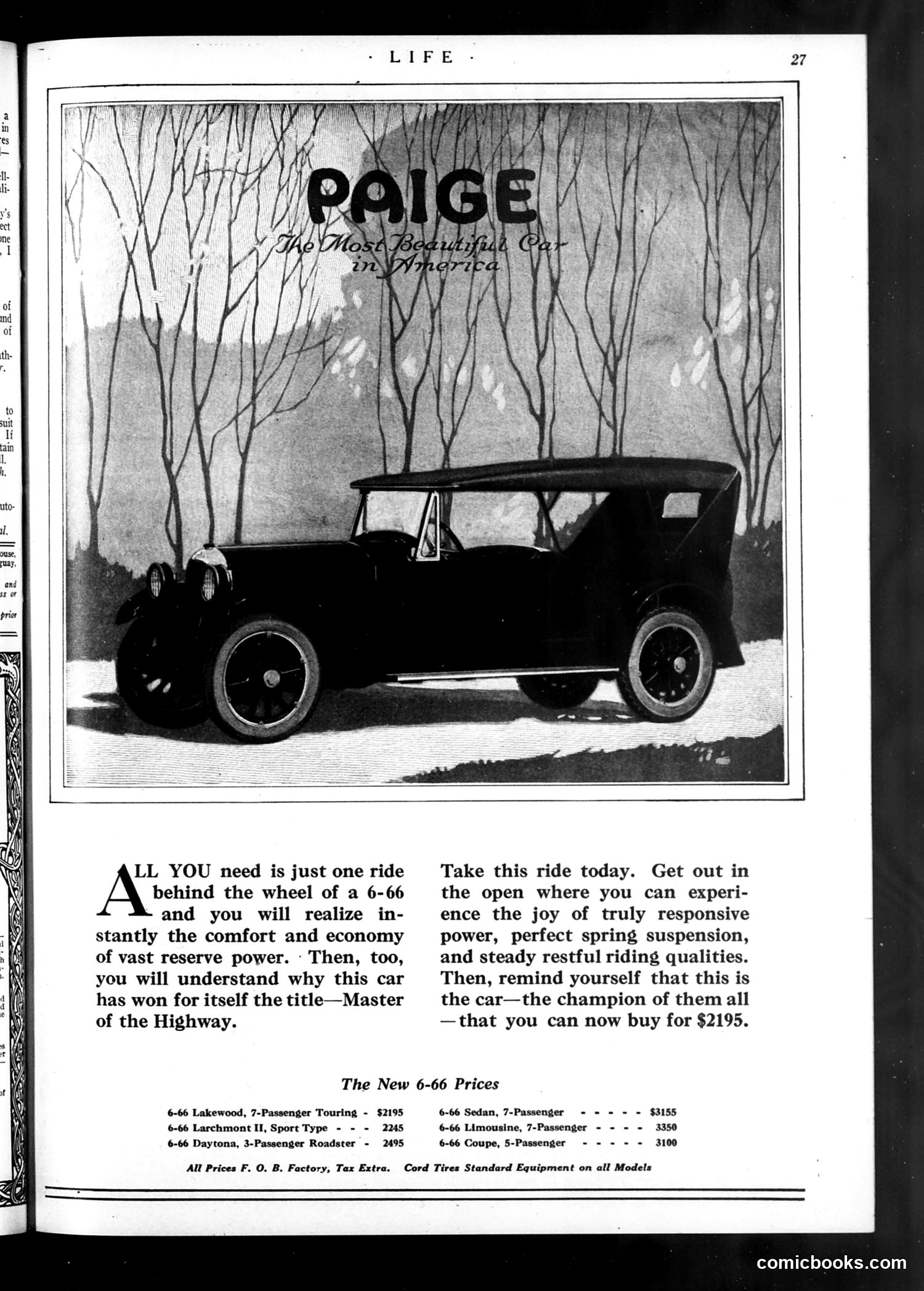
This is **not a cartoon or satire**—it's a straightforward automobile advertisement from Life magazine's early era. The page promotes the **Paige 6-66 automobile**, marketed as "The Most Beautiful Car in America." The advertisement uses the tagline "Master of the Highway" to emphasize the vehicle's performance, comfort, and reliability. The copy encourages potential buyers to test-drive the car to experience its "responsive power" and "perfect spring suspension." The image shows a sleek, open-air touring car photographed against a winter landscape with bare trees, presenting an aspirational lifestyle image typical of 1920s automotive advertising. The pricing listed ($2,195–$3,359 depending on model) reflects early twentieth-century luxury vehicle costs. This is period advertising, not satire—Life magazine in its early decades mixed editorial content with premium advertising to wealthy readers.
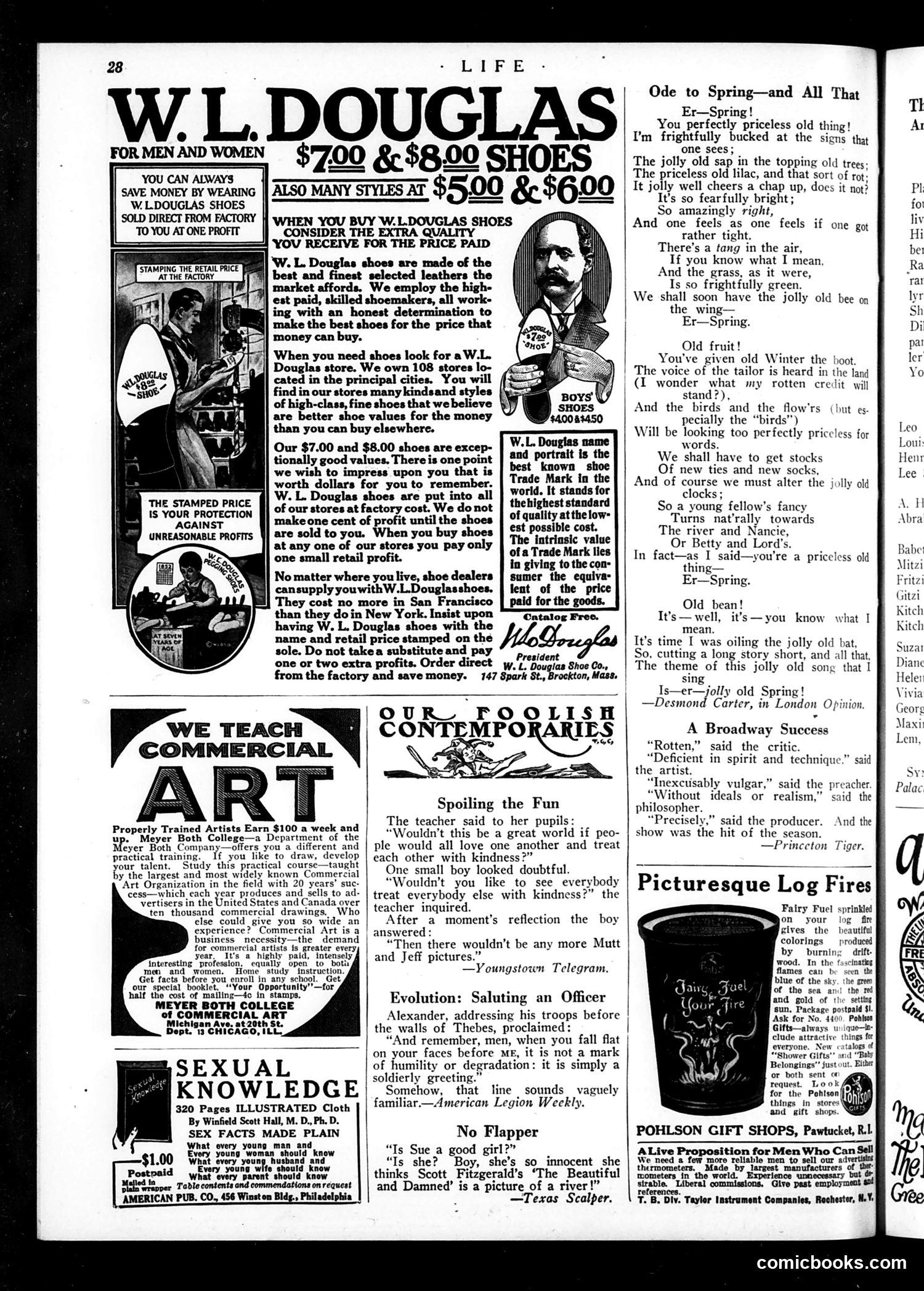
This page is primarily **commercial advertising** for W.L. Douglas shoes, which dominates the layout. The ad emphasizes factory-direct sales eliminating middleman profits—a business model pitch rather than satire. The **humor sections** are brief: 1. **"Spoiling the Fun"**: A schoolteacher asks children if everyone treating each other kindly would be wonderful. A boy objects because then there'd be "no more Mutt and Jeff pictures"—referencing a popular comic strip known for slapstick humor and conflict. The joke: conflict and misbehavior fuel entertainment. 2. **"Evolution: Saluting an Officer"**: A historical anecdote about Alexander the Great claiming soldiers prostrating before him isn't degradation but "soldierly greeting." The humor suggests this sounds like modern military rhetoric—likely referencing post-WWI military culture, implying leaders still use flowery language to justify subordination. Both jokes are lightweight social observation rather than sharp political satire. The page reflects early 20th-century advertising dominance in magazines.
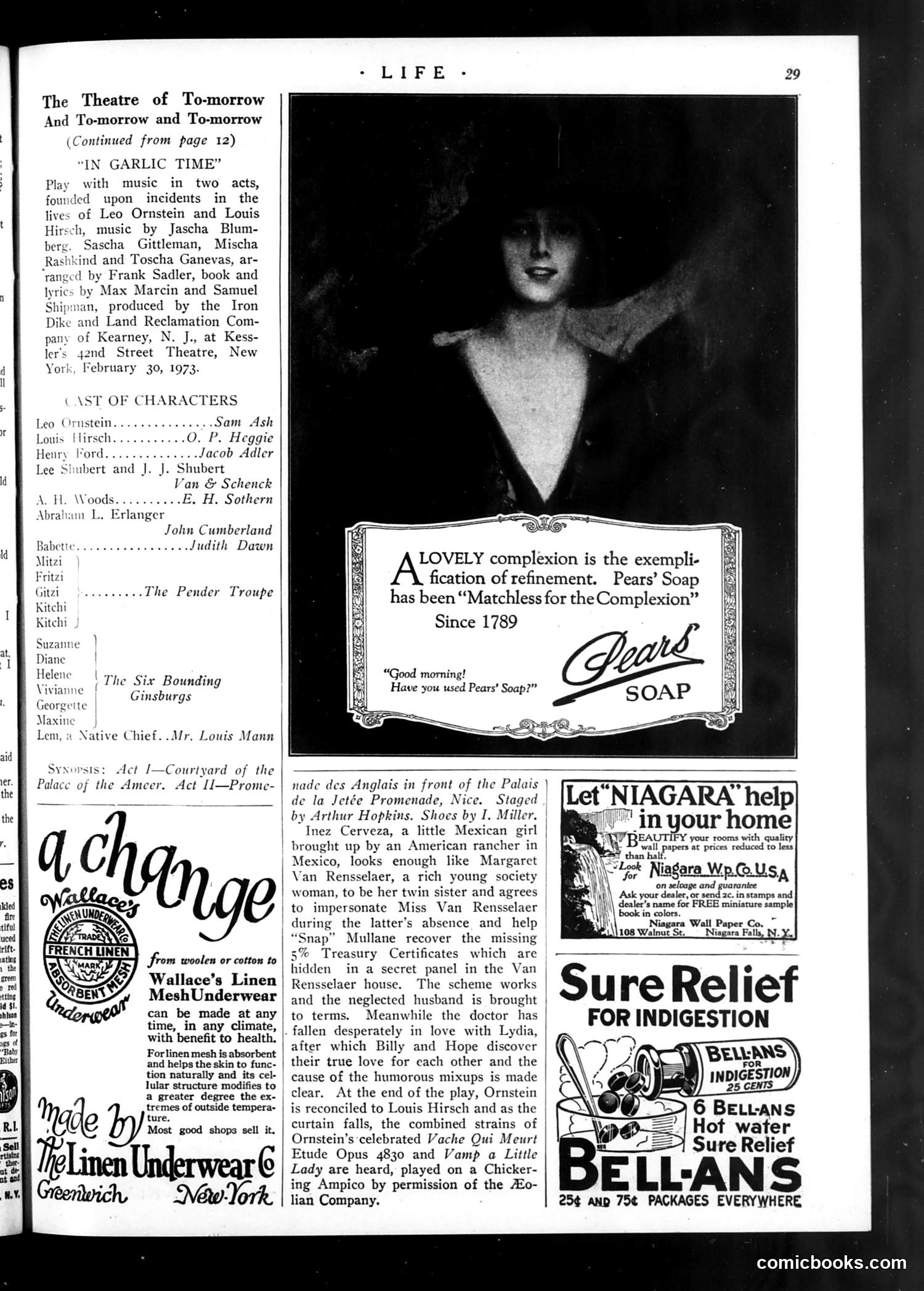
This page is primarily **theatre and advertising content**, not political satire. The main text describes "In Garlic Time," a 1973 theatrical production featuring music by Jewish composers (Ornstein, Hirsch, and others). The cast list and plot synopsis—involving a Mexican girl impersonating a wealthy society woman—suggest a light comedic play. The satirical element appears subtle: the play's title "In Garlic Time" and the Jewish composers' names may constitute ethnic humor typical of 1920s entertainment, though the specific jest isn't explicit here. The page is dominated by **period advertisements** (Pears' Soap, Bellans indigestion remedy, Niagara wallpaper) rather than editorial cartoons. These ads reflect early 20th-century consumer culture and marketing claims now seen as quaint or dubious.
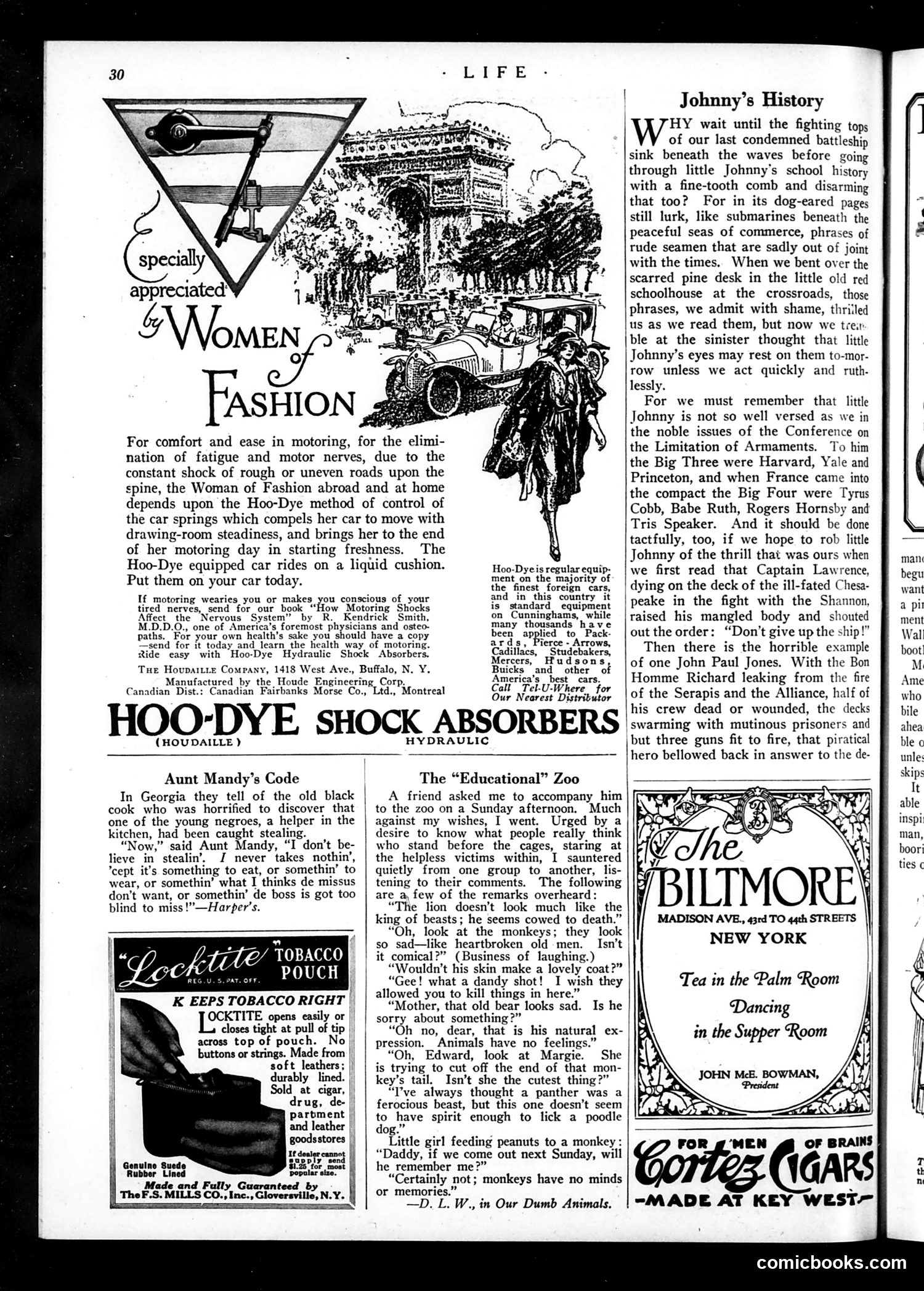
This page contains primarily **advertisements and humor columns** rather than political cartoons. **Main Content:** The "Johnny's History" column (top right) satirizes American education by suggesting schoolchildren learn naval warfare through outdated textbooks rather than current events. It references the sinking of a condemned battleship and mentions figures from WWI-era conferences (Harvard, Yale, Princeton, the "Big Three" of Woodrow Wilson, and references to "Cobb, Babe Ruth, Rogers Hornsby")—implying the curriculum ignores contemporary history. **"Aunt Mandy's Code"** uses dialect humor to depict an African American cook's loose morality regarding theft—a racist stereotype common to 1920s publications. **"The 'Educational' Zoo"** satirizes casual cruelty toward captive animals and public indifference to animal suffering, with visitors making callous remarks about shooting or skinning creatures. The advertisements promote Hoo-Dye shock absorbers (targeting women drivers) and Locktite tobacco pouches.
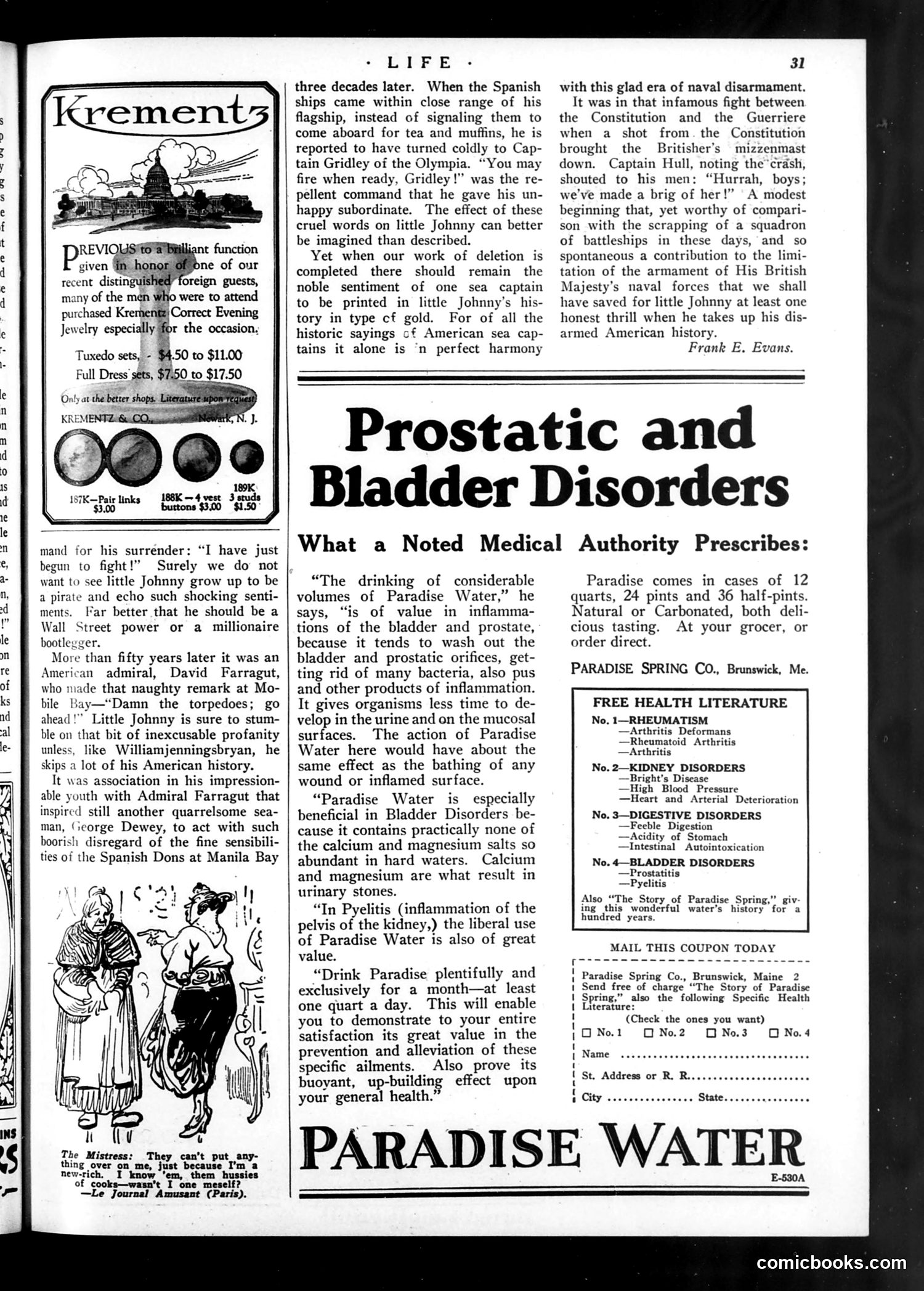
This page contains two distinct elements: **Main Article (Top):** A satirical essay mocking American historical sanitization. The author criticizes efforts to remove "profanity" from famous American naval commanders' quotes—specifically Admiral Farragut's "Damn the torpedoes" and Commodore Perry's order to fire on the Spanish fleet. The satire argues that removing such "colorful" language from history books to protect children's morals is excessive, yet praises Captain Hull's modest exclamation during the Constitution-Guerrière naval battle (War of 1812) as perfectly fitting a "naval disarmament era." The piece ridicules selective historical editing while mocking post-WWI pacifist sentiment. **Advertisement (Bottom):** A patent medicine ad for "Paradise Water," claiming medical benefits for prostate and bladder disorders. This represents the era's commonplace unregulated health product marketing, relying on pseudo-scientific authority ("noted medical authority") and free health literature offers. The page exemplifies early 20th-century Life magazine's blend of political satire and period advertising.
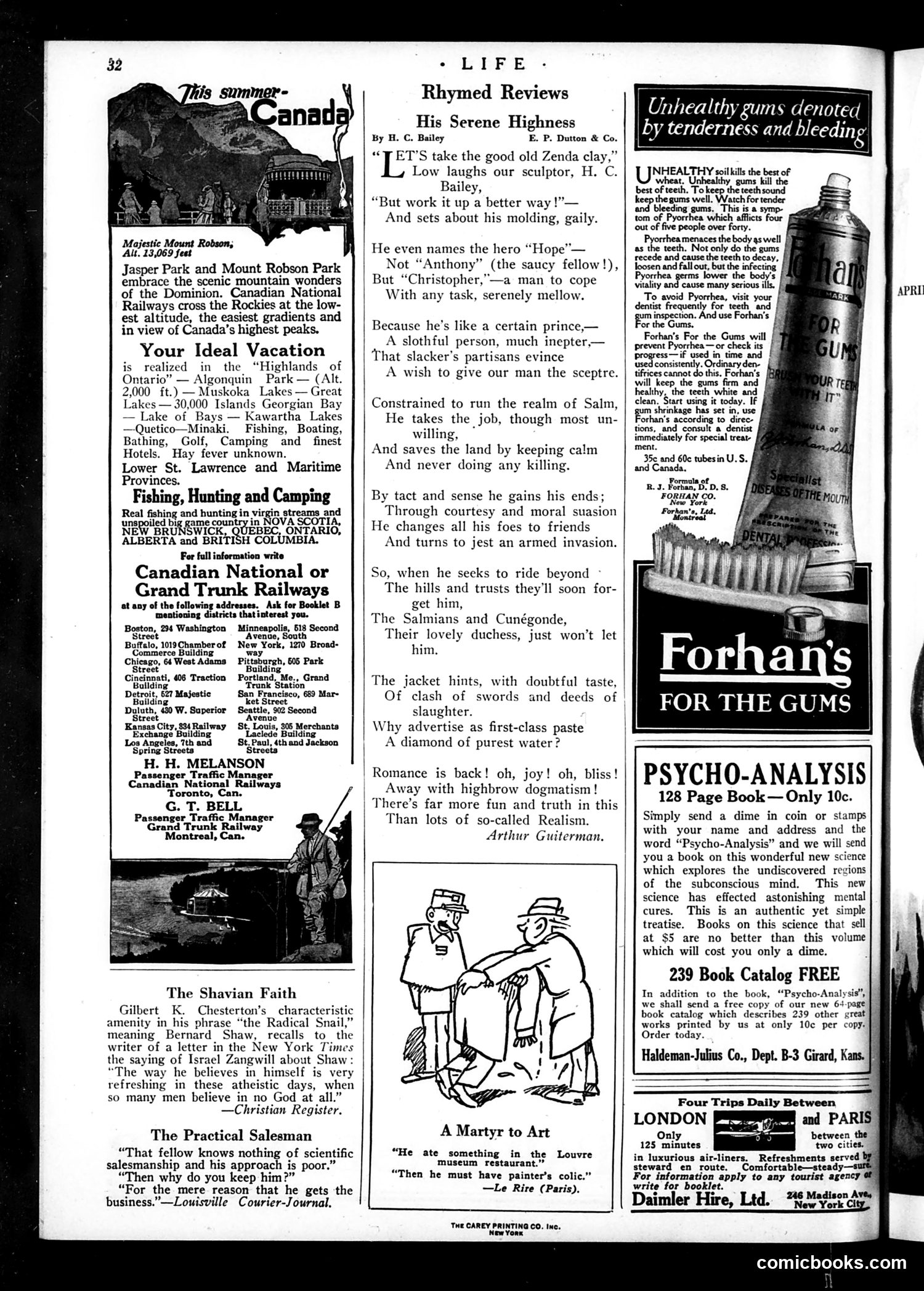
This page is primarily **advertising with some entertainment content**, not political satire. The main illustrated content is a **book review** of H.C. Bailey's novel "His Serene Highness," compared to Anthony Hope's popular 1894 adventure novel "The Prisoner of Zenda." The reviewer humorously notes that Bailey's story features similar elements—a reluctant hero named "Christopher" who must govern a fictional European kingdom (Salm) while avoiding violence and assassination plots. The joke is that the book advertises itself with dramatic imagery of sword-clashes and violence, when it's actually about a pacifist solving problems through courtesy and diplomacy—a "diamond of purest water" disguised as mere "paste." The page's bulk is **travel and product advertising**: Canadian railways promoting vacation destinations, a dental hygiene product (Forhan's For the Gums treating pyorrhea), and a mail-order psychology book. None of these contain political references or require historical context beyond their surface meanings.