
Life, 1922-04-20 · page 21 of 34
Life — April 20, 1922 — page 21: what you’re looking at
What you’re looking at
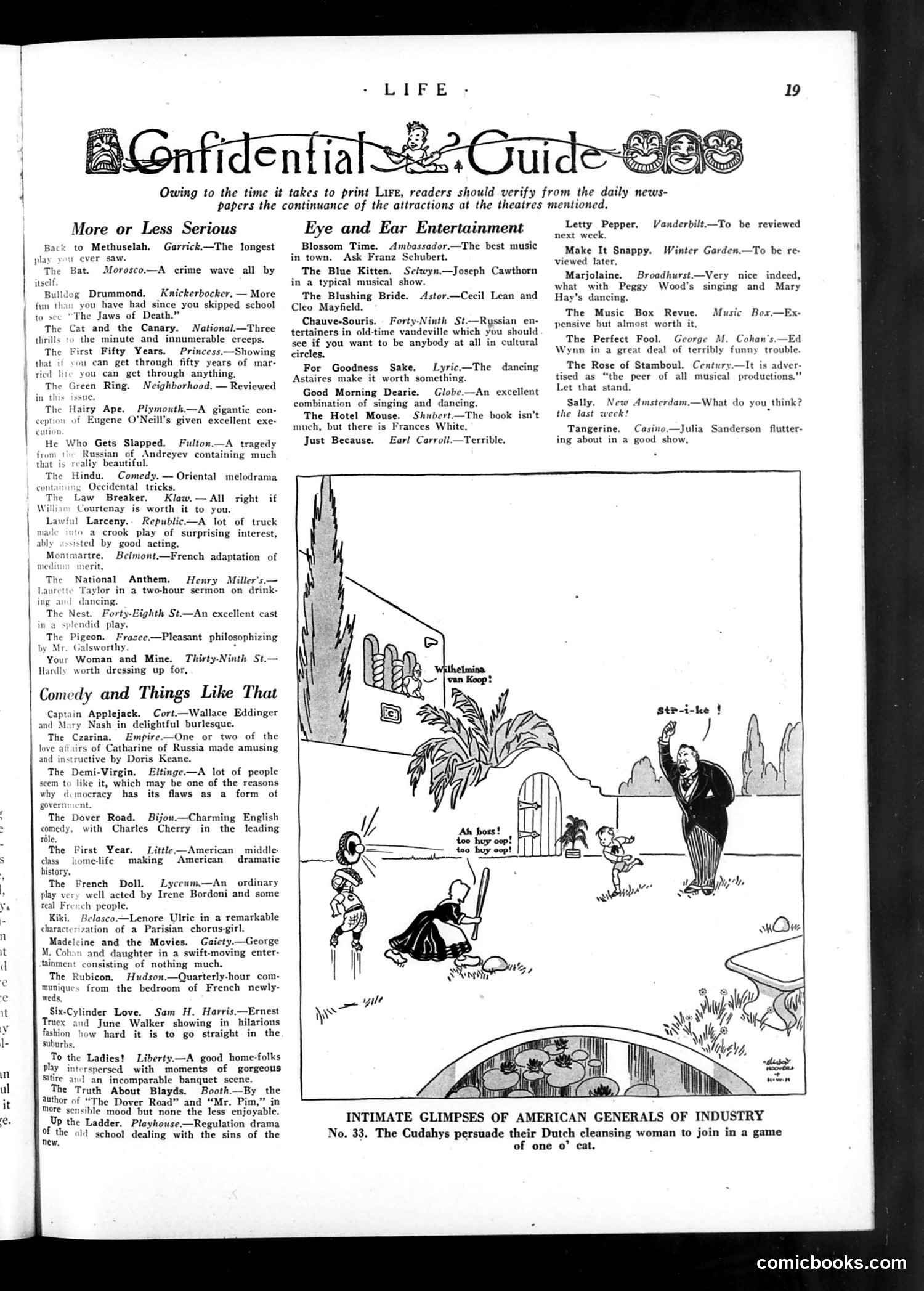
This is a **theater review section** from Life magazine, listing Broadway shows and their quality. The reviews use humorous, often cutting commentary—Life's signature style of theatrical criticism. The main cartoon depicts the **Cudahys**, a wealthy American family, playing a parlor game where they persuade their Dutch cleaning woman to join a game involving "one o' cat" (a baseball variant). The satire targets **upper-class obliviousness**: wealthy people treating their servants as entertainment and equals in a condescending, presumptuous way. The "Intimate Glimpses of American Generals" caption appears to be satirizing American military leadership, though details are unclear from this image alone. The reviews themselves showcase Life's wit—describing "Back to Methuselah" as "the longest play you ever saw," or noting that "The Demi-Virgin" succeeding proves "democracy has its flaws."
📄 Transcribed text from this page (OCR, searchable)
Machine-transcribed from the original scan — historical spelling and the odd misread are preserved.
19 Owing to the time it takes to print Lire, readers should verify from the daily news- papers the continuance of the attractions at the theatres mentioned. More or Less Serious Back to Methuselah. Garrick.—The longest play you ever saw. Bat. Morosco—A crime wave all by itself Bulldog Drummond. Knickerbocker. — More fun t you have had since you skipped school to sce “The Jaws of Deat The Cat and the Canary. National.—Three thrills 0 the minute and innumerable creeps. The First Fifty Years. Princess.—Showing that if you can get through fifty years of mar- ried hic you can get through anything, The Green Ring. Neighborhood. — Reviewed in this The Hairy Ape. Plymouth—A gigantic con- of ne O'Neill's given excellent exe- ssue, cution He Who Gets Slapped. Fulton. from the Russian of Andreyev con tragedy ing ‘much that 'y beautiful. The Hindu. Comedy. — Oriental melodrama containing Occidental tricks. The Law Breaker. Klaw.—All right if Will Courtenay is worth it to you. Larceny.. Republic—A lot of truck » a crook play of surprising interest, sted by good acting. ttre. Belmont.—French adaptation of National Anthem. Henry Miller’. Taylor in a two-hour sermon on drin! ing a neing. The Forty-Eighth St.—An excellent cast ina d_ play. The Pigeon. Frazee—Pleasant philosophizing by Mr. Galsworthy. : Your Woman and Mine. Thirty-Ninth St.— Hardly worth dressing up for, Comedy and Things Like That Captain Applejack. Cort.—Wallace Eddinger and Mary Nash in delightful burlesque. The Czarina. Empire-—One or two of the love afiuirs of Catharine of Russia made amusing and instructive by Doris Keane. The Demi-Virgin. Eltinge—A lot of people seem to like it, which may be one of the reasons why democracy has its flaws as a form of governnient. The Dover Road. Bijou.—Charming English comedy, with Charles Cherry in the leading rile. The First Year. Little—American _middle- class homelife making American dramatic history. The French Doll. Lyceum—An_ ordinary play very well acted by Irene Bordoni and some real French people. Kiki. Belasco—Lenore Ulric in a remarkable characterization of a Parisian chorus-girl. Madeleine and the Movies. Gaiety.—George M. Cohan and daughter in a swift-moving enter- tainment consisting of nothing much. The Rubicon. Hudson,—Quarterly-hour com- muniques from the bedroom of French newly- weds. Six-Cylinder Love. Sam H. Harris—Ernest Truex and June Walker showing in_ hilarious fshon now hard it is to go straight in the suburbs To the Ladies! Liberty.—A good home-folks phy interspersed with moments of gorgeous Stire an an incomparable banquet scene. The Truth About Blayds. Booth.—By the author of “The Dover Road” and “Mr. Pim,” in more sensible mood but none the less enjoyable. Up the Ladder. Playhouse.—Regulation drama “ the old school dealing with the sins of the Ww, Eye and Ear Entertainment Blossom Time. Ambassador—The best music in town. Ask Franz Schubert. The Blue Kitten. Selwyn.—Joseph Cawthorn in a typical musical show. The Blushing Bride. Astor—Cecil Lean and Cleo Mayfield. Chauve-Souris. Forty-Ninth St—Ryssian en- tertainers in old-time vaudeville which you should see if you want to be anybody at all in cultural circles. For Goodness Sake. Lyric.—The Astaires make it worth something. Good Morning Dearie. Globe.—An excellent combination of singing and dancing. The Hotel Mouse. Shubert.—The book isn’t much, but there is Frances White. Just Because. Earl Carroll.—Terrible. dancing Letty Pepper. next week. Make It Snappy. viewed later. Vanderbilt.—To be reviewed Winter Garden.—To be re- Marjolaine. Broadhurst—Very nice indeed, what with Peggy Wood’s singing and Mary Hay’s dancing. The Music Box Revue. Music Box.—Ex- pensive but almost worth it, The Perfect Fool. George M. Cohan's.—Ed Wynn in a great deal of terribly funny trouble. The Rose of Stamboul. Century.—It is adver- tised as “the peer of all musical productions.” Let that stand. Sally. the last Amsterdam.—What do you think? Tangerine. Casino.—Julia Sanderson flutter- ing about in a good show, INTIMATE GLIMPSES OF AMERICAN GENERALS OF INDUSTRY No. 33. The Cudahys persuade their Dutch cleansing woman to join in a game of one o” cat. comicbooks.com