
Life, 1922-04-20 · page 16 of 34
Life — April 20, 1922 — page 16: what you’re looking at
What you’re looking at
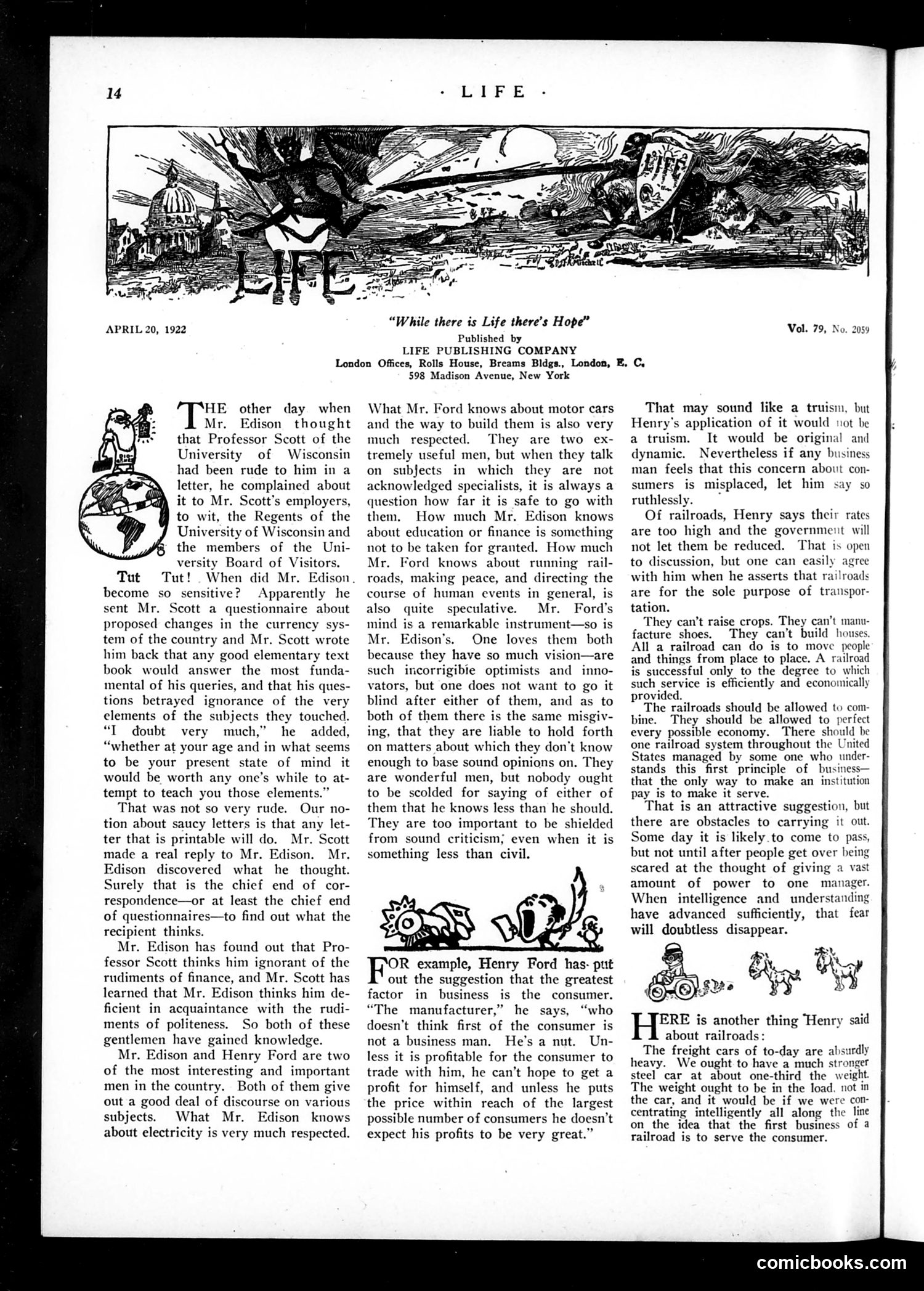
This page discusses a letter complaint from Thomas Edison about Professor Scott of the University of Wisconsin. Scott had criticized Edison's views on currency reform and business education, prompting Edison's defensive response. The article satirizes both men: Edison, despite his scientific genius, apparently lacks knowledge of finance and education—subjects beyond his expertise. Scott is mocked for his academic arrogance. The satire suggests that highly specialized experts (like Edison with electricity, or Ford with automobiles) often overestimate their competence in unrelated fields. The broader point: intelligent people shouldn't pontificate on subjects outside their domain. The piece humorously illustrates how even brilliant minds can hold forth ignorantly when venturing beyond their expertise—a timeless critique of intellectual overreach.
📄 Transcribed text from this page (OCR, searchable)
Machine-transcribed from the original scan — historical spelling and the odd misread are preserved.
APRIL 20, 1922 “While there is Life there’s Hope” Published by LIFE PUBLISHING COMPANY Vol. 79, No. 2059 London Offices, Rolls House, Breams Bldgs., London, E. Cy HE other day when Mr. Edison thought that Professor Scott of the University of Wisconsin had been rude to him in a letter, he complained about it to Mr. Scott's employers, to wit, the Regents of the University of Wisconsin and the members of the Uni- versity Board of Visitors. Tut Tut! When did Mr. become so sensitive? Apparently he sent Mr. Scott a questionnaire about proposed changes in the currency sys- tem of the country and Mr. Scott wrote him back that any good elementary text book would answer the most funda- mental of his queries, and that his ques- tions betrayed ignorance of the very elements of the subjects they touched. “TI doubt very much,” he added, “whether at your age and in what seems to be your present state of mind it would be worth any one’s while to at- tempt to teach you those elements.” That was not so very rude. Our no- tion about saucy letters is that any let- ter that is printable will do. Mr. Scott made a real reply to Mr. Edison. Mr. Edison discovered what he thought. Surely that is the chief end of cor- respondence—or at least the chief end of questionnaires—to find out what the recipient thinks. Mr. Edison has found out that Pro- fessor Scott thinks him ignorant of the rudiments of finance, and Mr. Scott has learned that Mr. Edison thinks him de- ficient in acquaintance with the rudi- ments of politeness. So both of these gentlemen have gained knowledge. Mr. Edison and Henry Ford are two of the most interesting and important men in the country. Both of them give out a good deal of discourse on various subjects. What Mr. Edison knows about electricity is very much respected. Edison . 598 Madison Avenue, New York What Mr. Ford knows about motor cars and the way to build them is also very much respected. They are two ex- tremely useful men, but when they talk on subjects in which they are not acknowledged specialists, it is always a question how far it is safe to go with them. How much Mr. Edison knows about education or finance is something not to be taken for granted. How much Mr. Ford knows about running rail- roads, making peace, and directing the course of human events in general, is also quite speculative. Mr. Ford's mind is a remarkable instrument—so is Mr. Edison's. One loves them both because they have so much vision—are such incorrigibie optimists and inno- vators, but one does not want to go it blind after either of them, and as to both of them there is the same misgiv- ing, that they are liable to hold forth on matters about which they don’t know enough to base sound opinions on, They are wonderful men, but nobody ought to be scolded for saying of cither of them that he knows less than he should. They are too important to be shielded from sound criticism; even when it is something less than civil. R example, Henry Ford has- put out the suggestion that the greatest factor in business is the consumer. “The manufacturer,” he says, “who doesn’t think first of the consumer is not a business man. He's a nut. Un- less it is profitable for the consumer to trade with him, he can’t hope to get a profit for himself, and unless he puts the price within reach of the largest possible number of consumers he doesn't expect his profits to be very great.” That may sound like a truism, but Henry's application of it would not be a truism. It would be original and dynamic. Nevertheless if any business man feels that this concern about con- sumers is misplaced, let him say so ruthlessly. . Of railroads, Henry says their rates are too high and the government will not let them be reduced. That is open to discussion, but one can easily agree with him when he asserts that railroads are for the sole purpose of transpor- tation. They can’t raise crops. They can’t manu- facture shoes. They can’t build houses. All a railroad can do is to move people and things from place to place. A railroad is successful only to the degree to which such service is efficiently and economically provided. The railroads should be allowed to com- bine. They should be allowed to perfect every possible economy. There should be one railroad system throughout the United States managed by some one who under- stands this first principle of business— that the only way to make an institution pay is to make it serve. That is an attractive suggestion, but there are obstacles to carrying it out. Some day it is likely to come to pass, but not until after people get over being scared at the thought of giving a vast amount of power to one manager. When intelligence and understanding have advanced sufficiently, that fear will doubtless disappear. ERE is another thing ‘Henry said about railroads: The freight cars of to-day are absurdly heavy. We ought to have a much stronger steel car at about one-third the weight The weight ought to be in the load. not in the car, and it would be if we were con- centrating intelligently all along the line on the idea that the first business of a railroad is to serve the consumer. comicbooks.com