
Life, 1922-04-20 · page 14 of 34
Life — April 20, 1922 — page 14: what you’re looking at
What you’re looking at
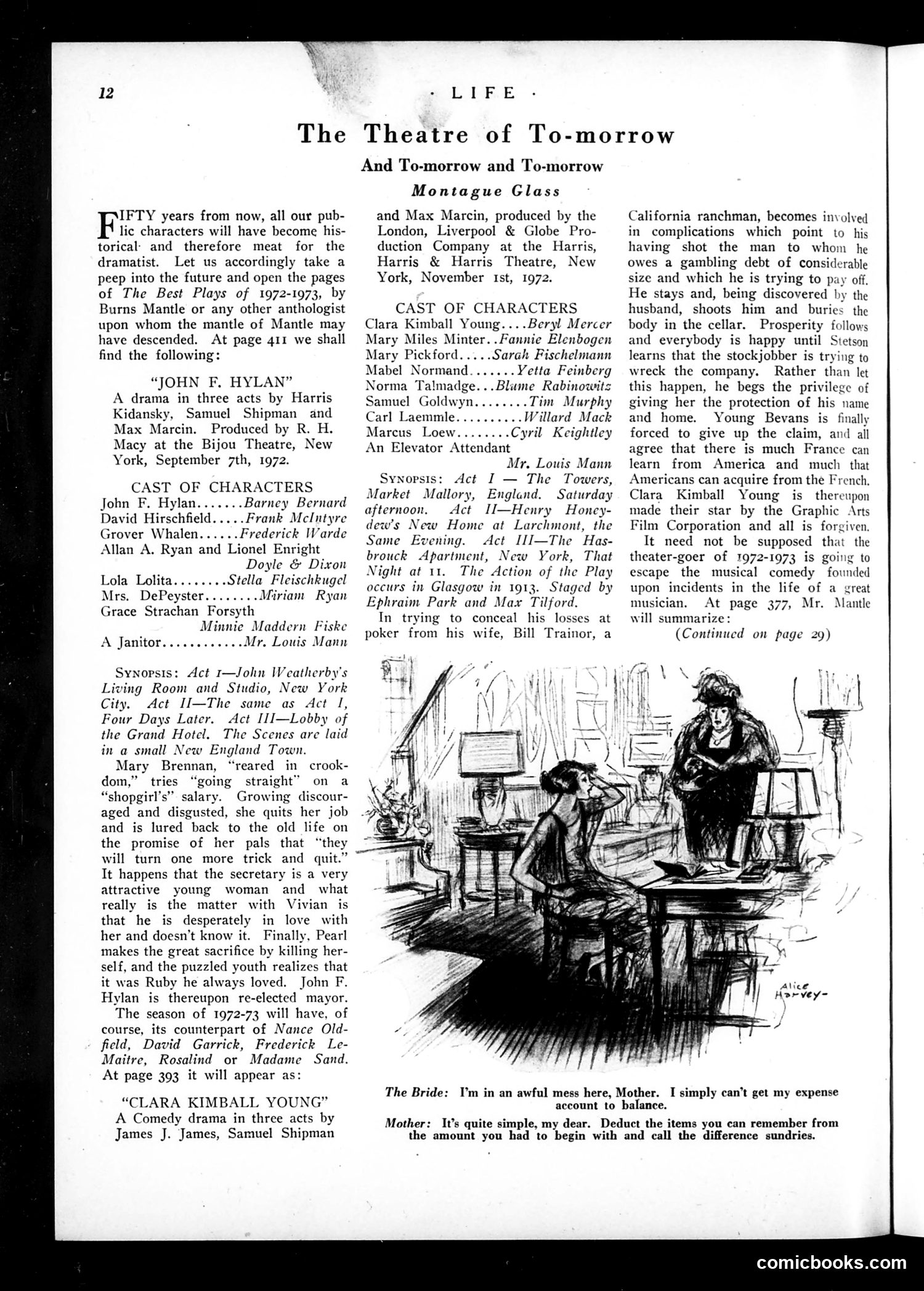
This page from *Life* magazine is primarily theatrical content—not political satire. It previews three plays expected in the 1972-1973 season, fifty years hence (in 2022-2023). The illustration shows a domestic scene: a bride discussing finances with her mother. The dialogue satirizes marital economics—the bride complains she "can't get my expense account to balance," and her mother offers mundane advice about tracking deductions and "call the difference sundries." The joke is gentle social commentary on newlywed financial naivety and domestic budgeting struggles, not political critique. The illustration depicts ordinary middle-class domestic life circa 1972, presented humorously through the exasperation of a young married woman struggling with household accounting.
📄 Transcribed text from this page (OCR, searchable)
Machine-transcribed from the original scan — historical spelling and the odd misread are preserved.
IFTY years from now, all our pub- lic characters will have become his- torical: and therefore meat for the dramatist. Let us accordingly take a peep into the future and open the pages of The Best Plays of 1972-1973, by Burns Mantle or any other anthologist upon whom the mantle of Mantle may have descended. At page 411 we shall find the following: “JOHN F. HYLAN” A drama in three acts by Harris Kidansky, Samuel Shipman and Max Marcin. Produced by R. H. Macy at the Bijou Theatre, New York, September 7th, 1972. CAST OF CHARACTERS John F, Hylan Barney Bernard David Hirschfie Frank Melutyre Grover Whalen......Frederick Warde Allan A, Ryan and Lionel Enright Doyle & Dixon Lola Lolita Stella Fleischkugel Mrs. DePeyster........1 Miriam Ryan Grace Strachan Forsyth Minnie Maddern Fiske A Janitor..... waieieiaierel Mr. Louis Mann Synopsis: Act 1—John Weatherby's Living Room and Studio, New York City. Act II—The same as Act I, Four Days Later. Act I1I—Lobby of the Grand Hotel. The Scenes are laid in a small New England Town. Mary Brennan, “reared in crook- dom,” tries “going straight” on a “shopgirl’s” salary. Growing discour- aged and disgusted, she quits her job and is lured back to the old life on the promise of her pals that “they will turn one more trick and quit.” It happens that the secretary is a very attractive young woman and what really is the matter with Vivian is that he is desperately in love with her and doesn’t know it. Finally, Pearl makes the great sacrifice by killing her- self, and the puzzled youth realizes that it was Ruby he always loved. John F. Hylan is thereupon re-elected mayor. The season of 1972-73 will have, of course, its counterpart of Nance Old- field, David Garrick, Frederick Le- Maitre, Rosalind or Madame Sand. At page 393 it will appear as: “CLARA KIMBALL YOUNG” A Comedy drama in three acts by James J. James, Samuel Shipman oe LIFE Theatre of To-morrow And To-morrow and To-morrow Montague Glass and Max Marcin, produced by the London, Liverpool & Globe Pro- duction Company at the Harris, Harris & Harris Theatre, New York, November ist, 1972. CAST OF CHARACTERS Clara Kimball Young... .Beryl Mercer Mary Miles Minter. .Fannie Elenbogen Mary Pickford Sarah Fischelmann Mabel Normand.......Yetta Feinberg Norma Talmadge...Blume Rabinowitz Samuel Goldwyn. «Tim Murphy Carl Laemmie. . -Willard Mack Marcus Loew -Cyril Keightley An Elevator Attendant Mr. Louis Mann Synopsis: Act I — The Towers, Market Mallory, England. Saturday afternoon. Act Il—Henry Honey- dew’s New Home at Larchmont, the Same Evening. Act Il1l—The Has- brouck Apartment, New York, That Night at 11. The Action of the Play occurs in Glasgow in 1913. Staged by Ephraim Park and Max Tilford. In trying to conceal his losses at poker from his wife, Bill Trainor, a The Bride: California ranchman, becomes involved in complications which point to his having shot the man to whom he owes a gambling debt of considerable size and which he is trying to pay off. He stays and, being discovered by the husband, shoots him and buries the body in the cellar. Prosperity follows and everybody is happy until Stetson learns that the stockjobber is trying to wreck the company, Rather than let this happen, he begs the privilege of giving her the protection of his name and home. Young Bevans is finally forced to give up the claim, and all agree that there is much France can learn from America and much that Americans can acquire from the French. Clara Kimball Young is thereupon made their star by the Graphic Arts Film Corporation and all is forgiven, It need not be supposed that the theater-goer of 1972-1973 is going to escape the musical comedy founded upon incidents in the life of a great musician. At page 377, Mr. Mantle will summarize: (Continued on page 29) I’m in an awful mess here, Mother. I simply can’t get my expense account to balance. Mother: It’s quite simple, my dear. Deduct the items you can remember from the amount you had to begin with and call the difference sundries. comicbooks.com