
Life, 1922-04-20 · page 17 of 34
Life — April 20, 1922 — page 17: what you’re looking at
What you’re looking at
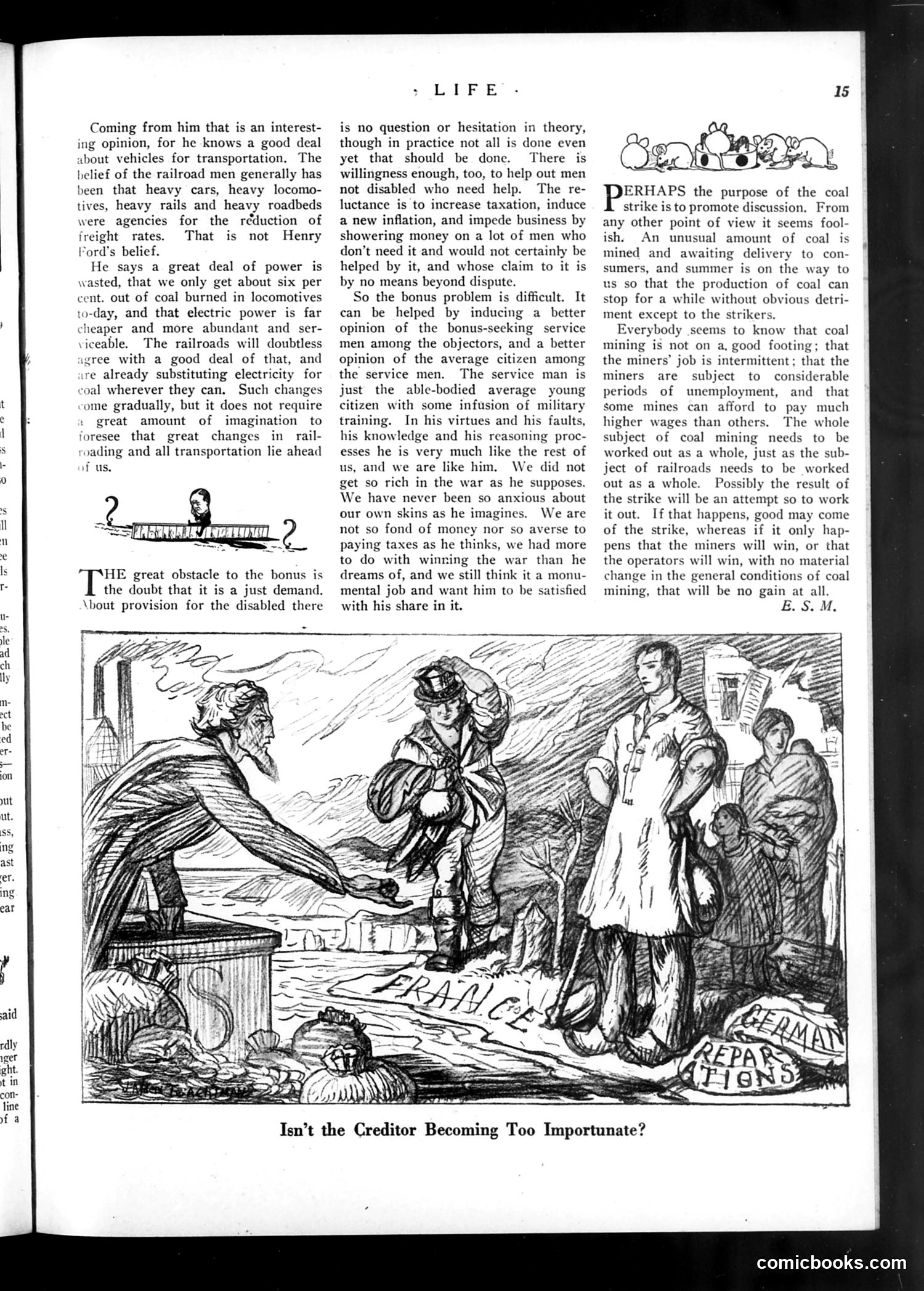
This political cartoon appears to address post-WWI reparations and war debt, likely referencing German war reparations. The skeleton figure on the left (representing a creditor nation, likely America) aggressively demands payment from a weakened central European figure, while distressed civilians (women and children) huddle in the background—representing the German population suffering under reparation burdens. The cartoon's title poses a rhetorical question: is the creditor being too demanding? The satire suggests that excessive financial penalties imposed on a defeated enemy may be counterproductive or inhumane, creating social hardship rather than justice. The accompanying text discusses bonus payments to WWI veterans and coal mining labor disputes—suggesting the page examines competing post-war economic demands and fairness issues across American society.
📄 Transcribed text from this page (OCR, searchable)
Machine-transcribed from the original scan — historical spelling and the odd misread are preserved.
Coming from him that is an interest- ing opinion, for he knows a good deal ibout vehicles for transportation. The belief of the railroad men generally has been that heavy cars, heavy locomo- tives, heavy rails and heavy roadbeds were agencies for the réduction of freight rates. That is not Henry Ford's belief. He says a great deal of power is wasted, that we only get about six per cent. out of coal burned in locomotives to-day, and that electric power is far cheaper and more abundant and ser- viceable. The railroads will doubtless igree with a good deal of that, and re already substituting electricity for coal wherever they can. Such changes ome gradually, but it does not require great amount of imagination to foresee that great changes in rail- vading and all transportation lie ahead of us, HE great obstacle to the bonus is the doubt that it is a just demand. \bout provision for the disabled there > LIFE is no question or hesitation in theory, though in practice not all is done even yet that should be done. There is willingness enough, too, to help out men not disabled who need help. The re- luctance is to increase taxation, induce a new inflation, and impede business by showering money on a lot of men who don’t need it and would not certainly be helped by it, and whose claim to it is by no means beyond dispute. So the bonus problem is difficult. It can be helped by inducing a_ better opinion of the bonus-seeking service men among the objectors, and a better opinion of the average citizen among the service men. The service man is just the able-bodied average young citizen with some infusion of military training. In his virtues and his faults, his knowledge and his reasoning proc- esses he is very much like the rest of us, and we are like him. We did not get so rich in the war as he supposes. We have never been so anxious about our own skins as he imagines. We are not so fond of money nor so averse to paying taxes as he thinks, we had more to do with winning the war than he dreams of, and we still think it a monu- mental job and want him to be satisfied with his share in it. ERHAPS the purpose of the coal strike is to promote discussion. From any other point of view it seems fool- ish. An unusual amount of coal is mined and awaiting delivery to con- sumers, and summer is on the way to us so that the production of coal can stop for a while without obvious detri- ment except to the strikers. Everybody seems to know that coal mining is not on a, good footing; that the miners’ job is intermittent; that the miners are subject to considerable periods of unemployment, and_ that some mines can afford to pay much higher wages than others. The whole subject of coal mining needs to be worked out as a whole, just as the sub- ject of railroads needs to be worked out as a whole. Possibly the result of the strike will be an attempt so to work it out. If that happens, good may come of the strike, whereas if it only hap- pens that the miners will win, or that the operators will win, with no material change in the general conditions of coal mining, that will be no gain at all. Isn’t the Creditor Becoming Too Importunate? comicbooks.com