
Life, 1922-04-20 · page 20 of 34
Life — April 20, 1922 — page 20: what you’re looking at
What you’re looking at
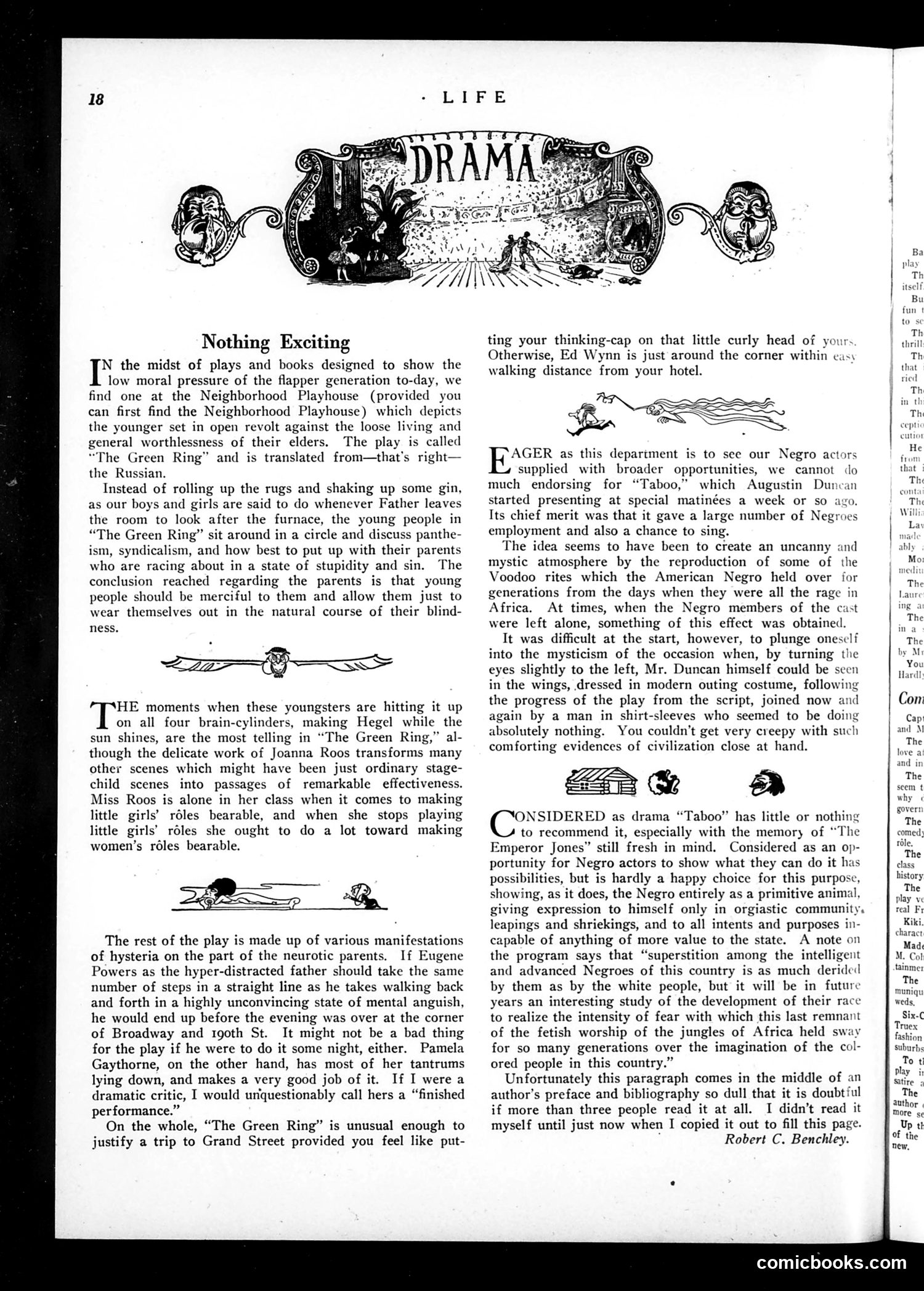
This page reviews two theatrical productions from the 1920s era, critiquing them through the magazine's satirical lens. **"The Green Ring"**: The reviewer mocks this Russian play for its pretentiousness—young people discussing Hegelian philosophy and syndicalism rather than engaging in the stereotypical "flapper" behavior (gin, dancing, loose morals) that contemporary society expected. The satire targets both the play's intellectual pretension and generational anxiety about youth morality. The reviewer suggests audiences might prefer Ed Wynn's lighter entertainment instead. **"Taboo"**: This section critiques a production directed by Augustin Duncan featuring Black performers attempting to recreate African Voodoo rituals. The reviewer's complaint reveals the artificiality: the "mystical atmosphere" collapses when one glimpses Duncan offstage in modern clothes, reading the script. The satire targets the production's failed authenticity and the broader practice of exoticizing Black performers and African culture for white audiences. Both reviews mock artistic pretension while revealing period attitudes about race and entertainment.
📄 Transcribed text from this page (OCR, searchable)
Machine-transcribed from the original scan — historical spelling and the odd misread are preserved.
Nothing Exciting N the midst of plays and books designed to show the low moral pressure of the flapper generation to-day, we find one at the Neighborhood Playhouse (provided you can first find the Neighborhood Playhouse) which depicts the younger set in open revolt against the loose living and general worthlessness of their elders. The play is called “The Green Ring” and is translated from—that’s right— the Russian. Instead of rolling up the rugs and shaking up some gin, as our boys and girls are said to do whenever Father leaves the room to look after the furnace, the young people in “The Green Ring” sit around in a circle and discuss panthe- ism, syndicalism, and how best to put up with their parents who are racing about in a state of stupidity and sin. The conclusion reached regarding the parents is that young people should be merciful to them and allow them just to wear themselves out in the natural course of their blind- ness. aa HE moments when these youngsters are hitting it up on all four brain-cylinders, making Hegel while the sun shines, are the most telling in “The Green Ring,” al- though the delicate work of Joanna Roos transforms many other scenes which might have been just ordinary stage- child scenes into passages of remarkable effectiveness. Miss Roos is alone in her class when it comes to making little girls’ réles bearable, and when she stops playing little girls’ réles she ought to do a lot toward making women’s rdles bearable. 2, & The rest of the play is made up of various manifestations of hysteria on the part of the neurotic parents. If Eugene Powers as the hyper-distracted father should take the same number of steps in a straight line as he takes walking back and forth in a highly unconvincing state of mental anguish, he would end up before the evening was over at the corner of Broadway and 1goth St. It might not be a bad thing for the play if he were to do it some night, either. Pamela Gaythorne, on the other hand, has most of her tantrums lying down, and makes a very good job of it. If I were a dramatic critic, I would unquestionably call hers a “finished performance.” On the whole, “The Green Ring” is unusual enough to justify a trip to Grand Street provided you feel like put- ting your thinking-cap on that little curly head of your, Otherwise, Ed Wynn is just around the corner within ea walking distance from your hotel. Bn SS —< AGER as this department is to see our Negro actors supplied with broader opportunities, we cannot do much endorsing for “Taboo,” which Augustin Duncan started presenting at special matinées a week or so ago. Its chief merit was that it gave a large number of Negroes employment and also a chance to sing. The idea seems to have been to create an uncanny and mystic atmosphere by the reproduction of some of the Voodoo rites which the American Negro held over for generations from the days when they were all the rage in Africa. At times, when the Negro members of the cast were left alone, something of this effect was obtained. It was difficult at the start, however, to plunge oneself into the mysticism of the occasion when, by turning the eyes slightly to the left, Mr. Duncan himself could be seen in the wings, dressed in modern outing costume, following the progress of the play from the script, joined now and again by a man in shirt-sleeves who seemed to be doing absolutely nothing. You couldn't get very creepy with such comforting evidences of civilization close at hand. '‘ONSIDERED as drama “Taboo” has little or nothing to recommend it, especially with the memory of “The Emperor Jones” still fresh in mind. Considered as an op- portunity for Negro actors to show what they can do it has possibilities, but is hardly a happy choice for this purpose, showing, as it does, the Negro entirely as a primitive animal, giving expression to himself only in orgiastic community. leapings and shriekings, and to all intents and purposes in- capable of anything of more value to the state. A note on the program says that “superstition among the intelligent and advanced Negroes of this country is as much derided by them as by the white people, but it will be in future years an interesting study of the development of their race to realize the intensity of fear with which this last remnant of the fetish worship of the jungles of Africa held sway for so many generations over the imagination of the col- ored people in this country.” Unfortunately this paragraph comes in the middle of an author's preface and bibliography so dull that it is doubtful if more than three people read it at all. I didn’t read it myself until just now when I copied it out to fill this page. Robert C. Benchley. govern The comed; rile, The class history The play vi real F; Kiki. charact Mad M. Col tainmer The muniqu weds, Six-c Truex fashion suburbs comicbooks.com