
A complete issue · 34 pages · 1921
Life — September 22, 1921
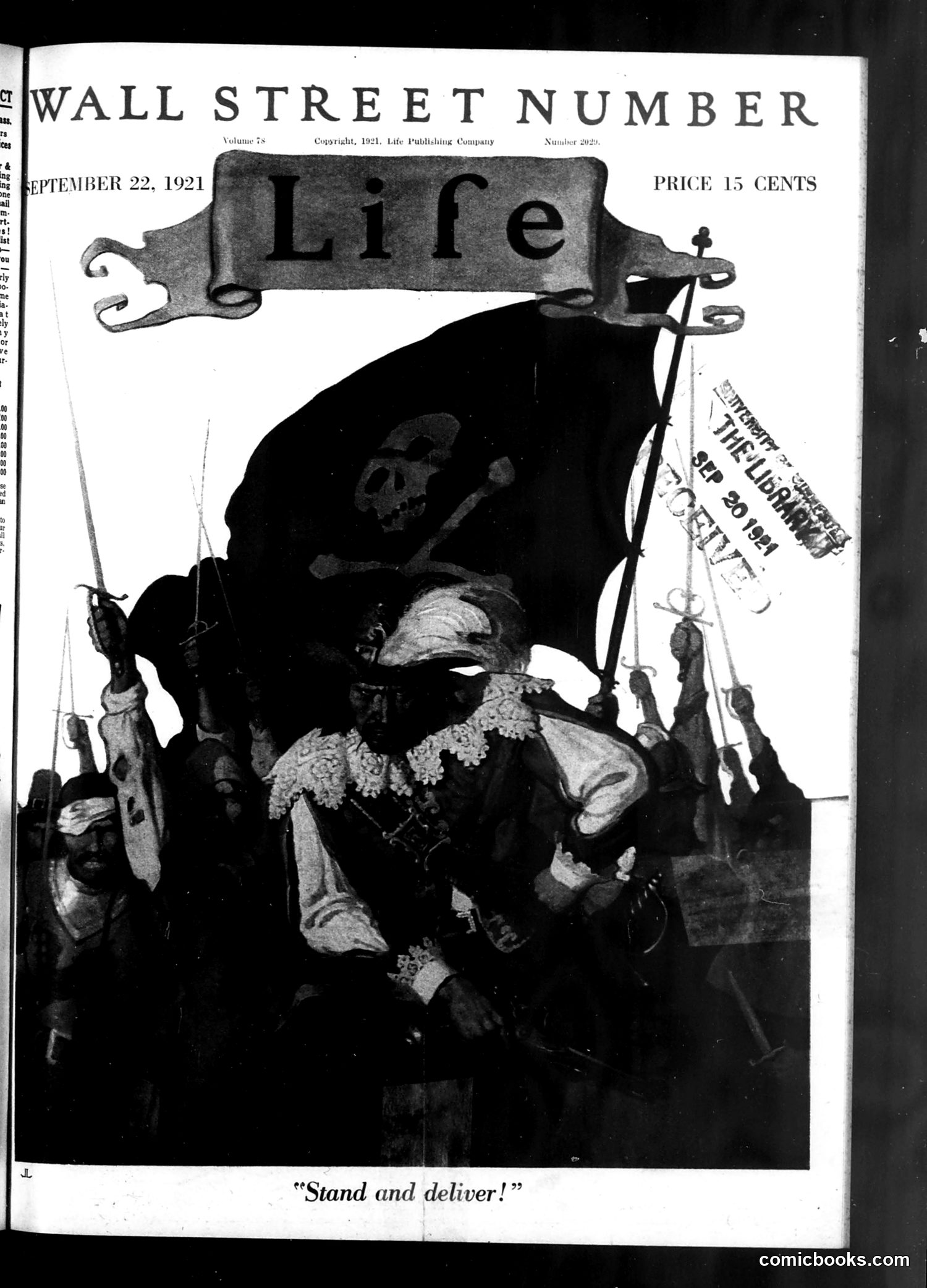
This cover depicts a figure in 18th-century colonial military dress holding a large black flag, surrounded by armed soldiers with bayonets. The caption reads "Stand and deliver!"—a phrase historically associated with highwaymen and robbery. The imagery appears to satirize the post-WWI period, likely critiquing either radical political movements or labor unrest that was prominent in 1921 America. The revolutionary flag and militaristic staging suggest commentary on perceived threats to established order—possibly referencing the "Red Scare" or labor strikes occurring during this era. The historical costume mixed with contemporary concern creates ironic contrast, suggesting the cartoonist views these movements as anachronistic threats dressed in revolutionary rhetoric. Without additional context, the specific target remains somewhat unclear, but the overall message warns of perceived danger to American stability.
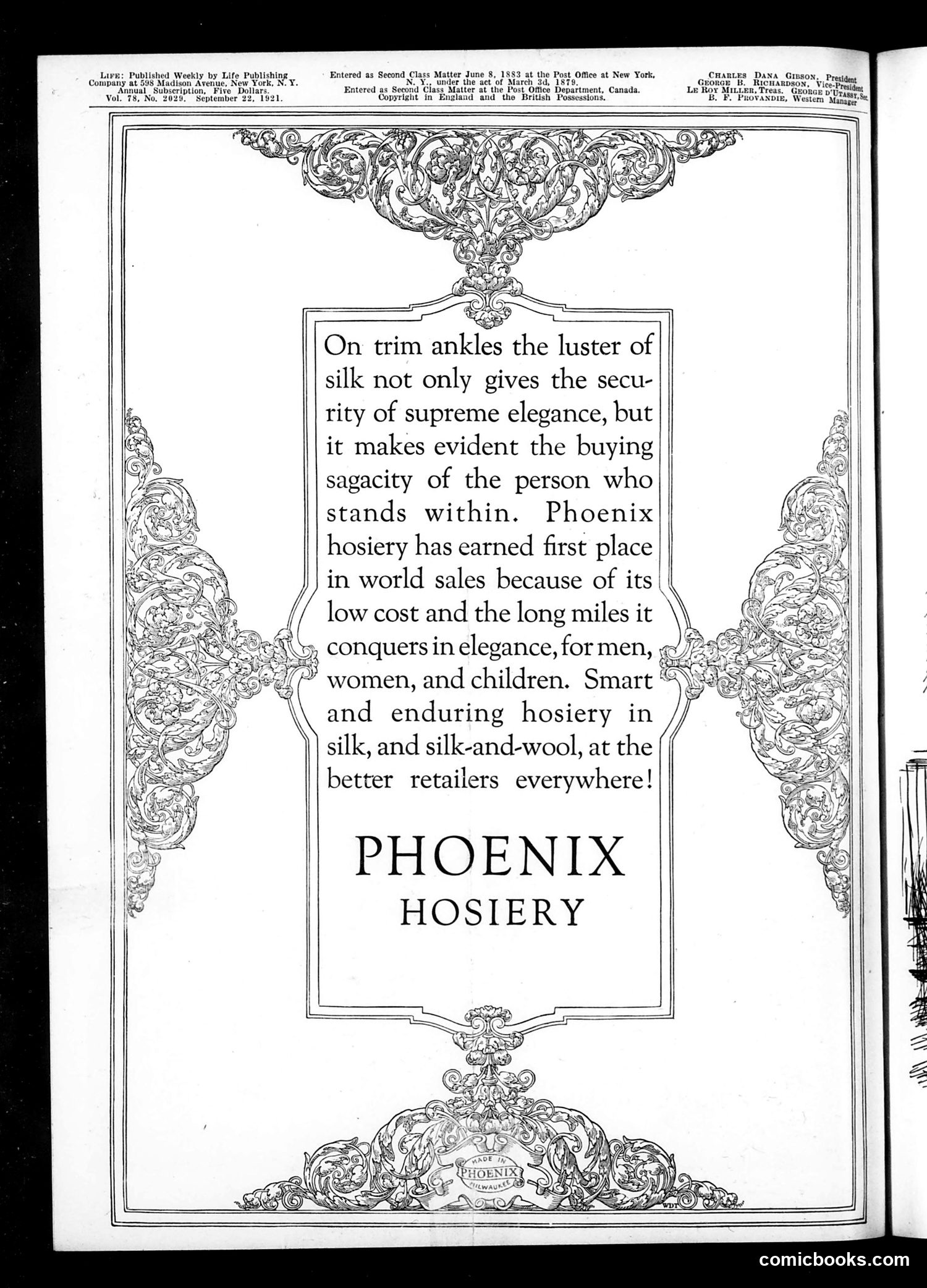
This page is **not a cartoon or satire** — it is a straightforward **advertisement for Phoenix Hosiery**, published in Life magazine's September 22, 1921 issue. The ad uses ornate decorative borders typical of 1920s design and makes a sales pitch emphasizing quality and value. It claims Phoenix hosiery achieves "first place in world sales" due to "low cost" combined with "elegance," targeting "men, women, and children." The ad specifically promotes silk and silk-and-wool blends available at "better retailers everywhere." This is purely commercial advertising, not political or social commentary. The "trim ankles" reference reflects 1920s fashion when women's hemlines were becoming shorter, revealing hosiery as a visible fashion statement.
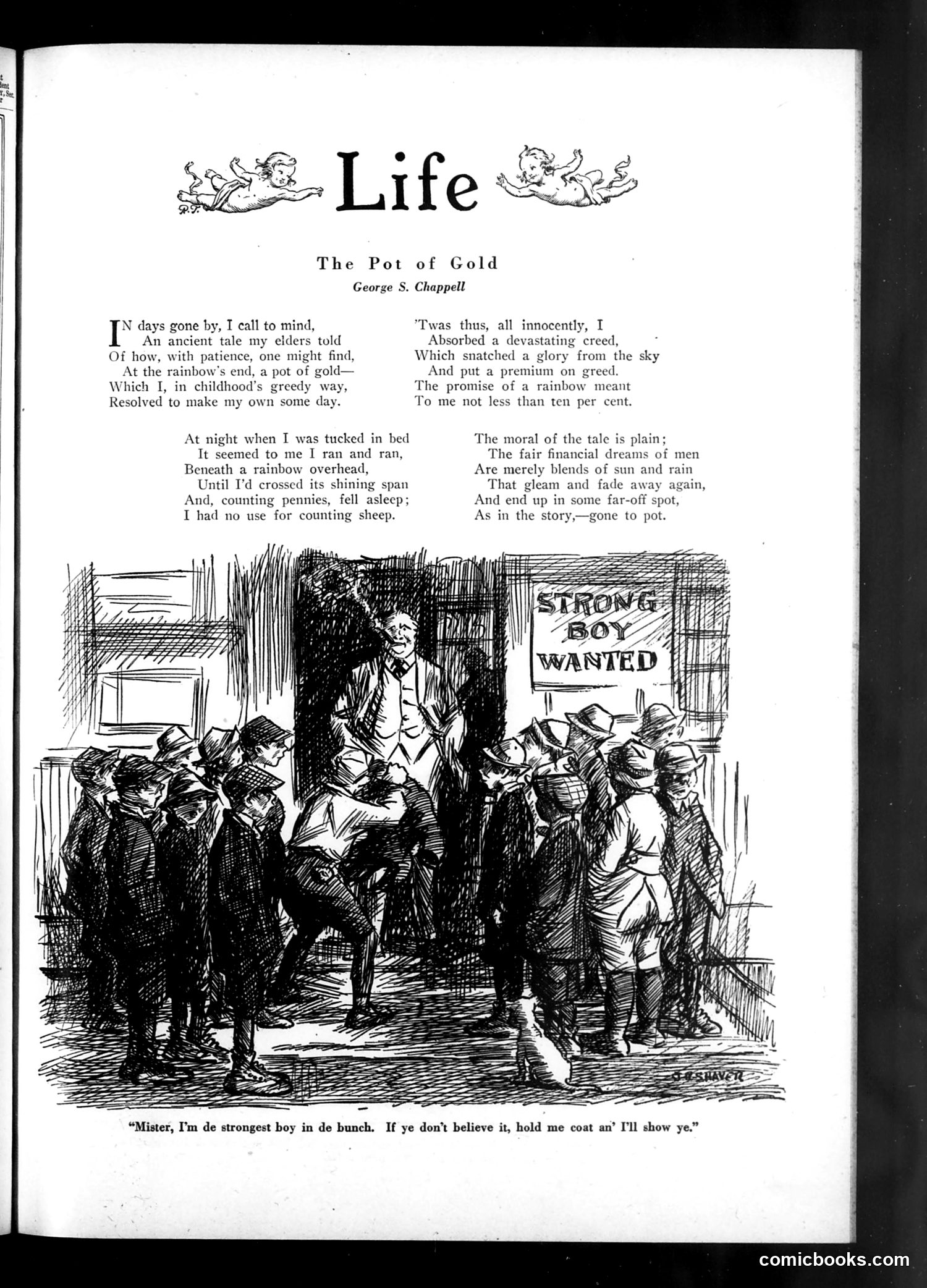
This page contains a poem about childhood dreams of wealth followed by a satirical illustration. The poem describes how children pursue the fantasy of finding a "pot of gold" at a rainbow's end—a metaphor for unrealistic financial dreams that fade with maturity. The illustration depicts a street scene where a man (appearing to be a factory foreman or employer) sits elevated above a crowd of eager boys surrounding a "Strong Boy Wanted" sign. One boy boasts about his strength to prove his worth. The satire critiques economic desperation: poor children compete for meager jobs, their youthful hopes for wealth reduced to competing for manual labor. The "pot of gold" represents the false promise of prosperity through hard work—a reality check on American economic mobility myths.
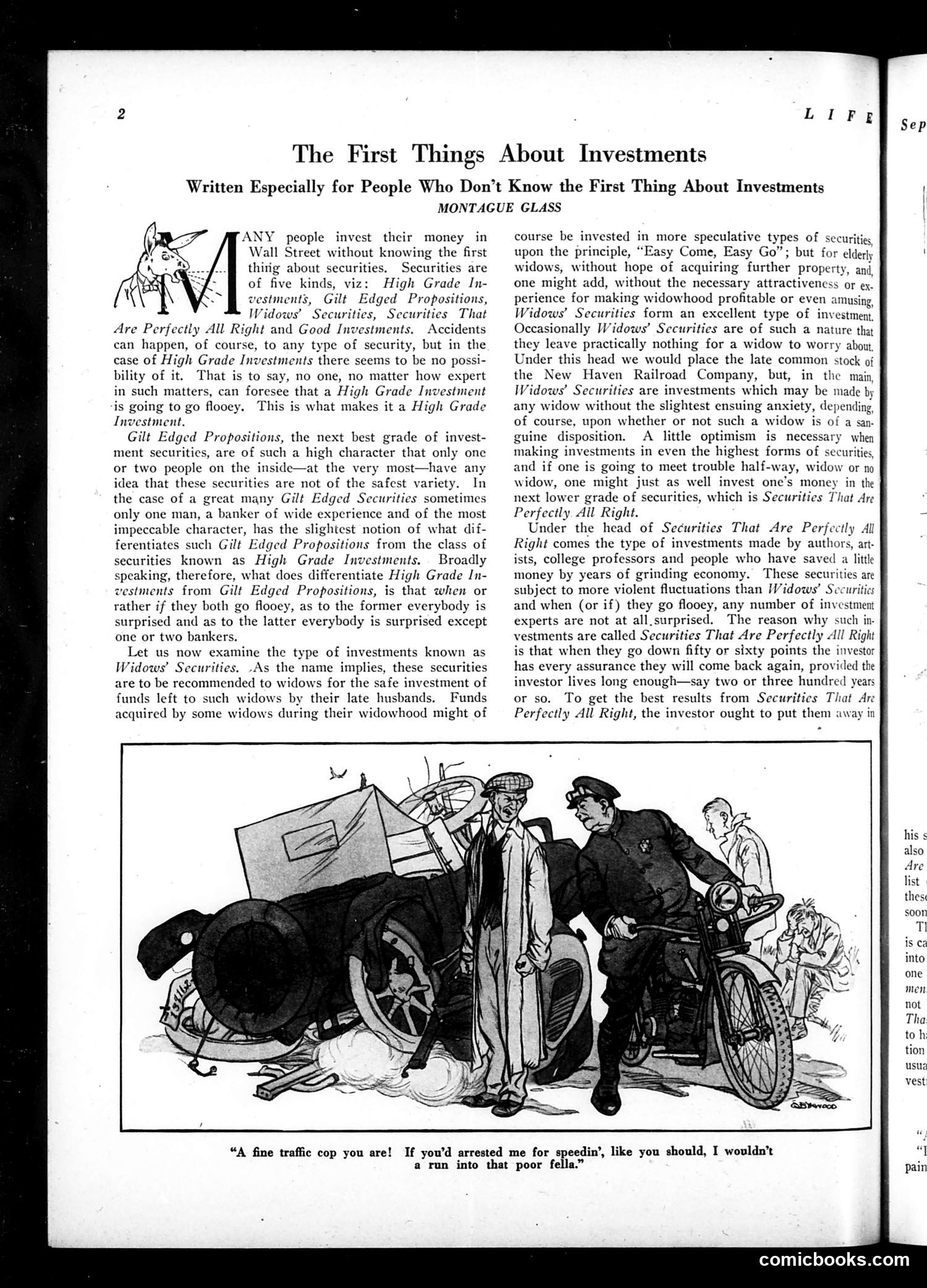
This cartoon illustrates an article about investment securities for novices. The caption's dialogue—"A fine traffic cop you are! If you'd arrested me for speedin', like you should, I wouldn't a run into that poor fella'"—uses a traffic accident as metaphor for financial risk. The figure appears to be a motorist confronting a traffic officer, with an overturned vehicle and cyclists visible. The joke suggests that lax enforcement (or inadequate regulation) led to preventable harm. In the investment context, this parallels the article's point: without proper guidance and "regulation" of one's investment choices, ordinary people—particularly widows—could suffer financial "accidents." The satire warns against unvetted speculation and advocates for careful, conservative investment practices.
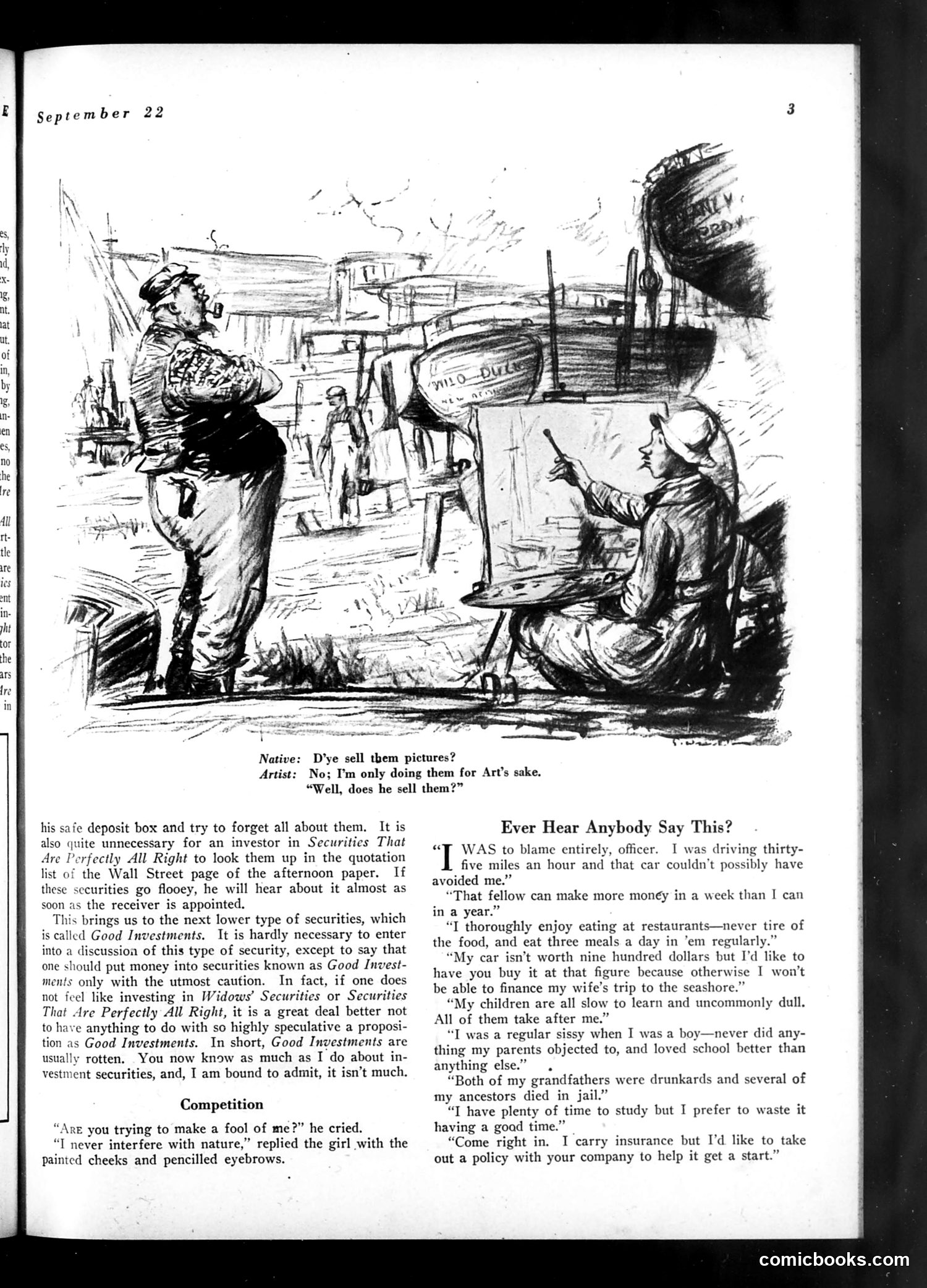
The cartoon depicts an artist painting outdoors while a man in military uniform watches. The dialogue reveals the satire: when asked if he's selling the pictures, the artist claims he's "only doing them for Art's sake," yet the officer skeptically asks "Well, does he sell them?" This mocks artists who claim pure artistic motivation while actually profiting from their work—a common hypocrisy. The military setting may suggest wartime, when such contradictions became more visible or contentious. Below, "Ever Hear Anybody Say This?" collects absurd boasts and excuses people make about money, cars, and personal habits—satirizing common American self-deception and materialism of the era.
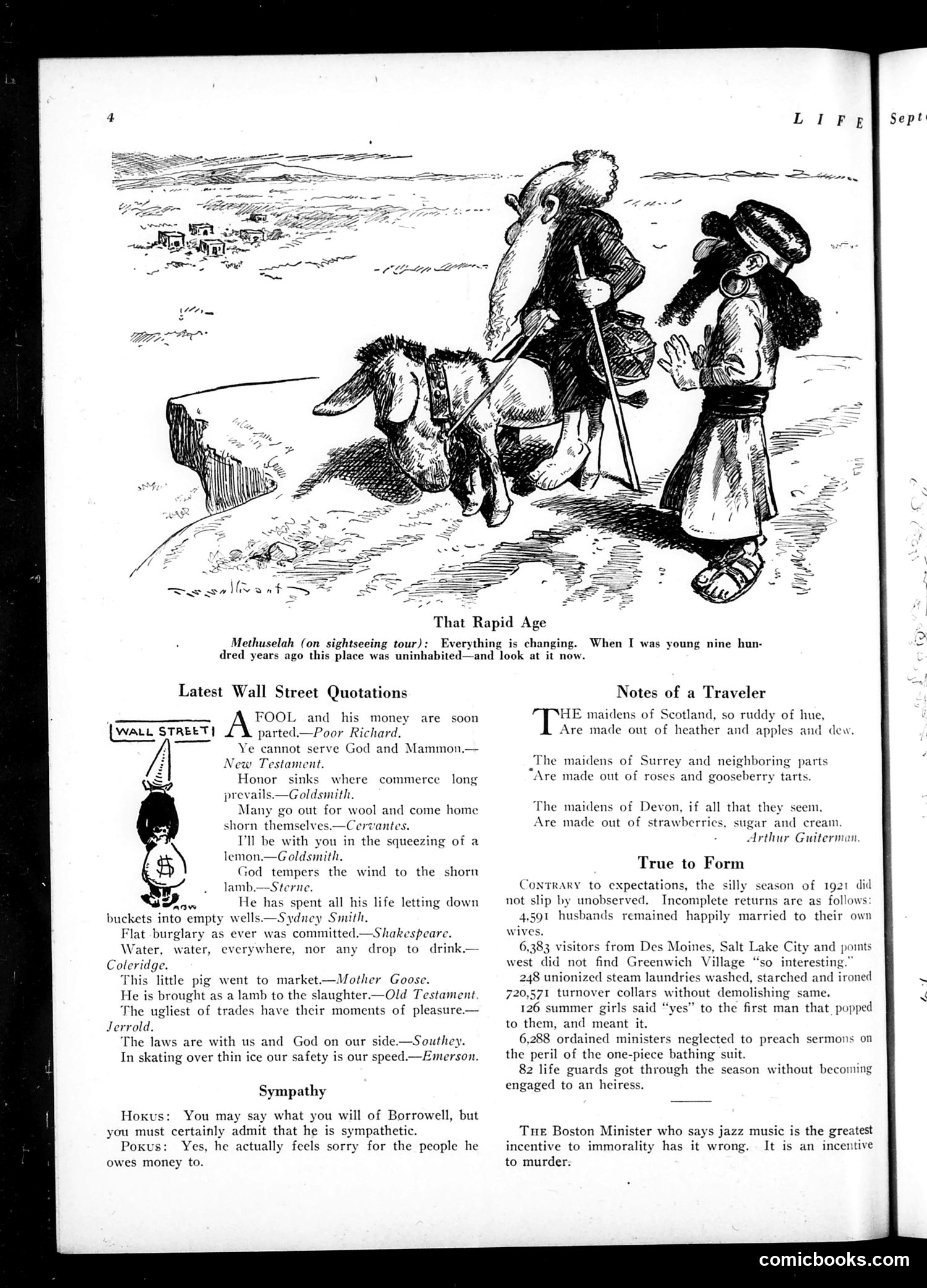
This cartoon depicts a Methuselah (biblical figure known for extreme longevity) on a sightseeing tour, expressing shock at how much has changed in ninety years. The elderly figure, assisted by a cane and accompanied by a young woman guide, represents someone from an earlier era confronting modernity's pace of change. The satire critiques early 1920s rapid social and technological transformation. The contrast between the ancient, weathered Methuselah and the modern landscape (with distant buildings) emphasizes how unrecognizable the world has become. The joke targets contemporary anxieties about how quickly society is evolving—a common concern during the 1920s, an era of significant cultural, technological, and social upheaval.
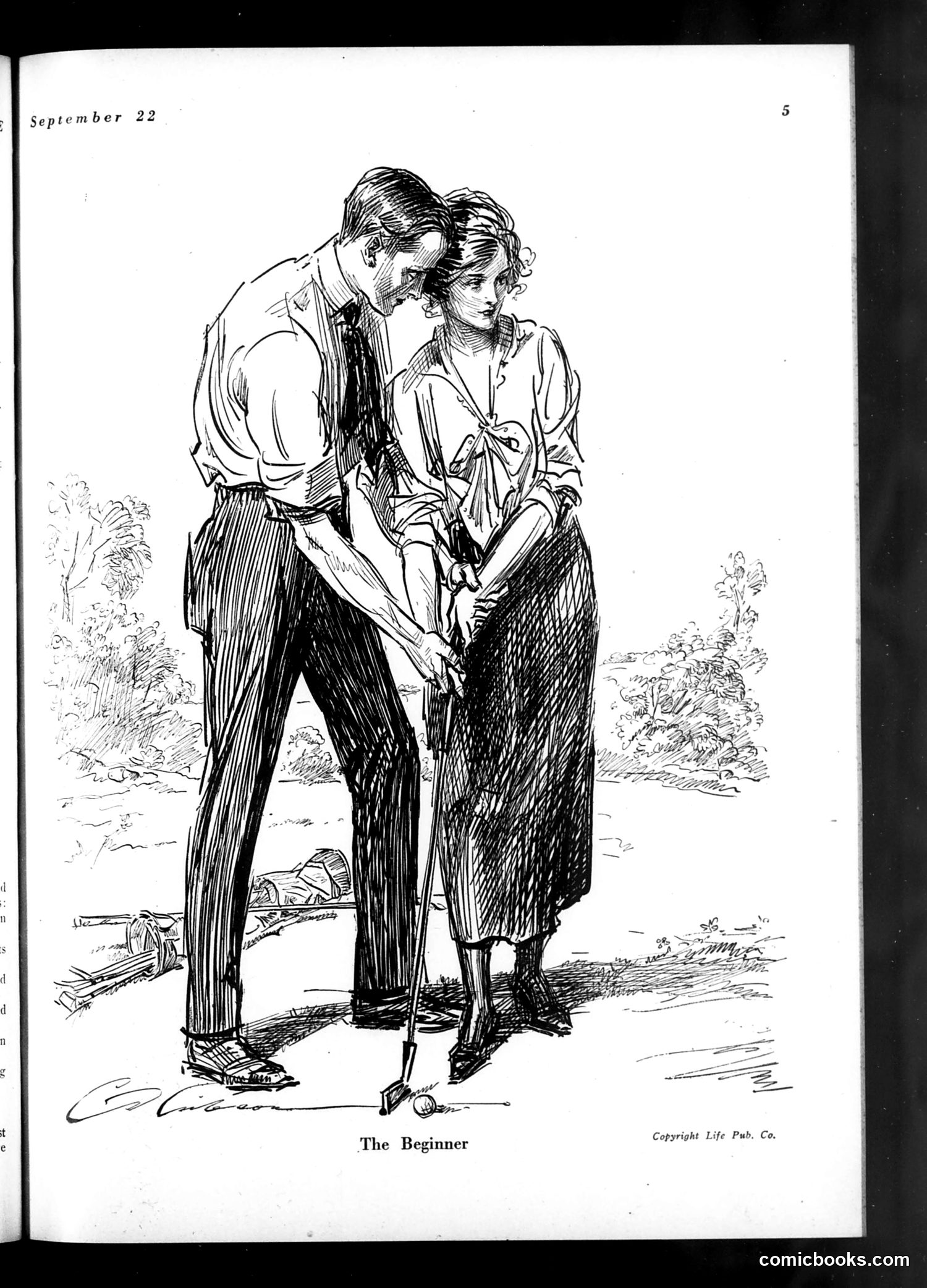
This ink sketch depicts a man instructing a woman in golf, titled "The Beginner." The man stands behind her, guiding her grip on the club as she prepares to swing at a ball. The illustration is signed by the artist (signature illegible) and credited "Copyright Life Pub. Co." The cartoon likely satirizes early 20th-century social dynamics around women entering sports traditionally dominated by men. The positioning—with the man physically guiding the woman—may mock either the condescension men showed female athletes or the novelty of women participating in golf. The rural setting and casual attire suggest leisure-class recreation. Without additional context from the magazine's text, the specific satirical point remains somewhat unclear, though it appears to comment on gender roles in athletics or courtship rituals of the era.
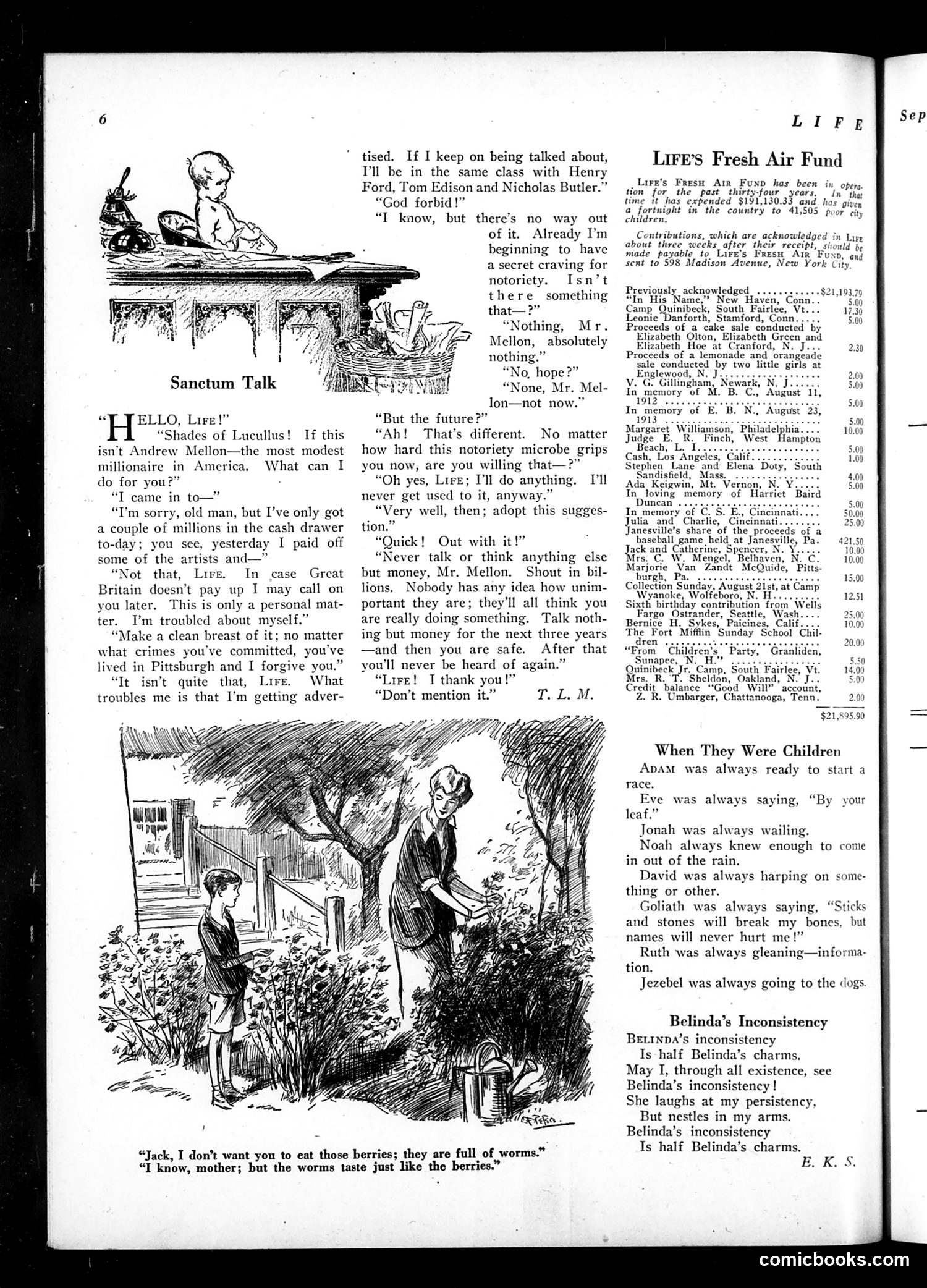
This page contains three distinct sections: 1. **"Sanctum Talk" cartoon**: A dialogue between "Life" (personified) and "Lucullus" (a figure associated with luxury/excess). Life confronts a wealthy man about his notoriety and secret craving for motoriety, warning him about consequences. The satire targets wealthy individuals living scandalously while maintaining respectability. 2. **Lower cartoon**: Shows a mother warning a child against eating berries due to worms. The joke plays on the child's innocent logic that "worms taste just like the berries." 3. **Right column**: Contains a charitable fund announcement for "Life's Fresh Air Fund" (a real program providing outdoor experiences for underprivileged children) and literary submissions titled "When They Were Children" and "Belinda's Inconsistency." The page reflects early 20th-century American satire and moral commentary.
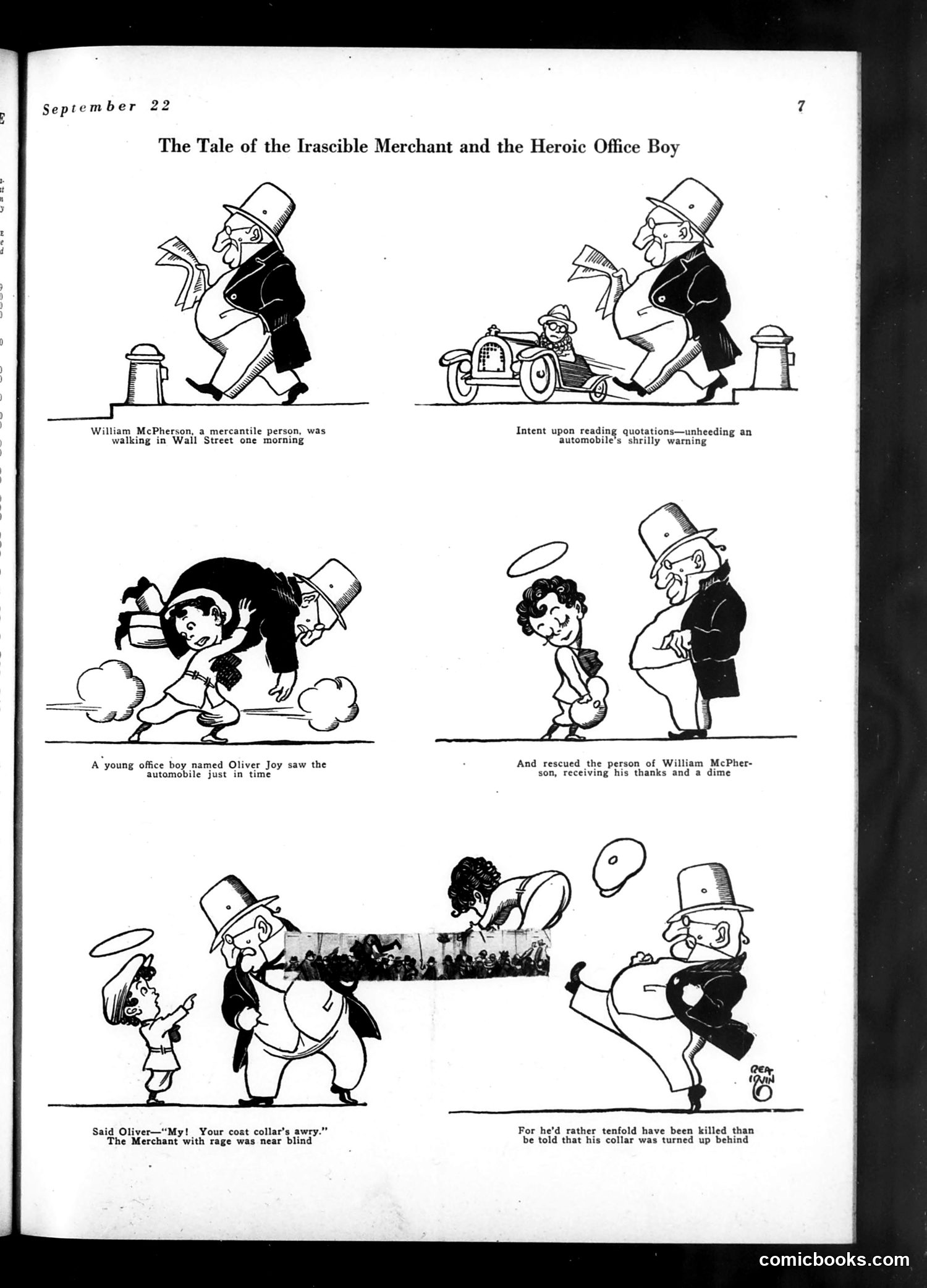
This is a comic strip satirizing class conflict and workplace hierarchies. William McPherson, a wealthy Wall Street merchant, walks preoccupied with financial quotations while nearly struck by an automobile. Oliver Joy, a young office boy, heroically saves him by pushing him out of harm's way—though the merchant's coat collar tears in the process. Rather than gratitude, McPherson erupts in rage over the damaged collar, nearly blinding with anger. The satire targets the merchant's misplaced priorities: he values his expensive clothing more than his own life or the boy's selfless rescue. The final panel suggests McPherson would rather die than acknowledge the collar's damage, mocking wealthy merchants' obsession with status symbols over human decency.
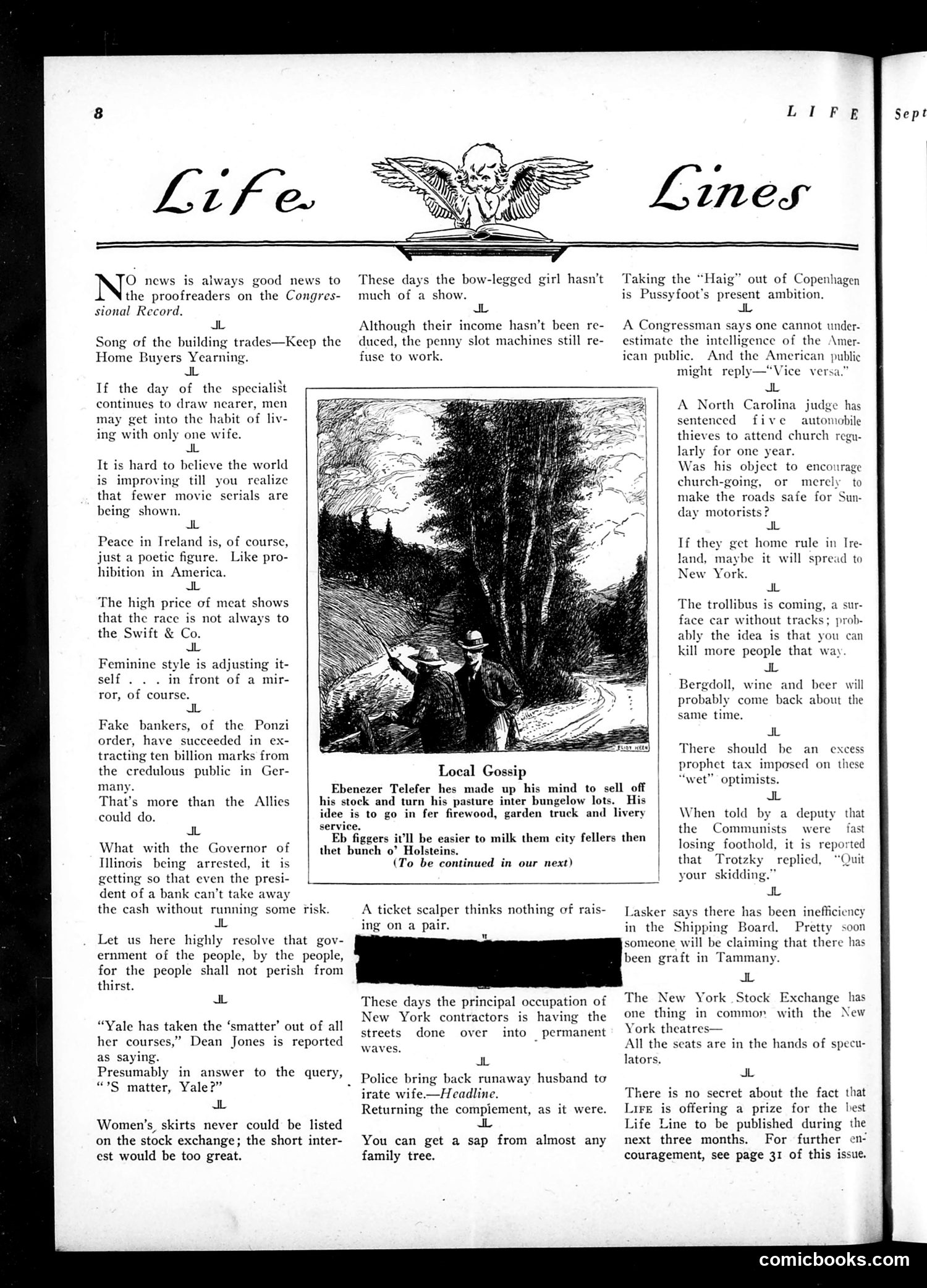
This page contains satirical commentary and miscellaneous observations rather than a single cartoon. The central illustration depicts a rural scene with figures and trees—likely accompanying the "Local Gossip" section about Ebenezer Telefer selling his stock. The text items mock various targets: corrupt bankers, inefficiency in government agencies (Shipping Board), high meat prices, Irish political unrest, and stock market speculation. One note sarcastically praises Yale for removing "the 'smatter' out of all her courses." The references suggest post-WWI American concerns: economic instability, profiteering, labor unrest (the "Haig" reference to Copenhagen), and social upheaval. The tone is cynical about both government competence and public gullibility regarding various schemes and shortages of the era.
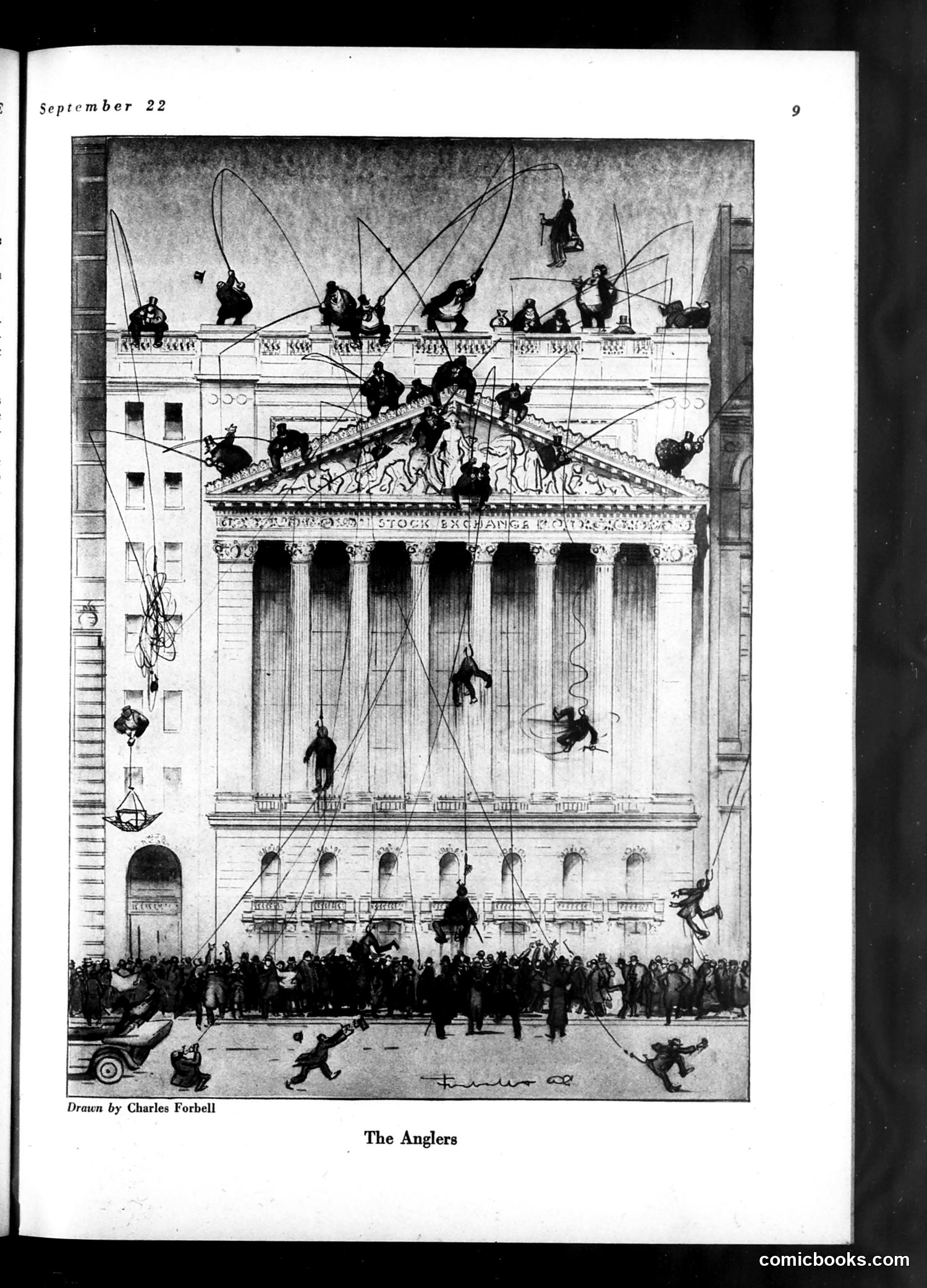
This cartoon depicts the New York Stock Exchange building swarming with figures fishing from its facade and roof. The "anglers" are stock speculators casting lines downward toward a crowd of people gathered below on the street. The satire critiques stock market speculation as predatory—wealthy investors ("anglers") literally fishing for money from ordinary citizens below. The crowds represent the general public, while the building itself symbolizes Wall Street finance. The drawing likely dates from the early 20th century and reflects anxieties about financial manipulation and the gap between speculators and working people. The humor works through the extended metaphor of fishing: speculators "catch" money from unsuspecting victims below, much as fishermen catch fish.
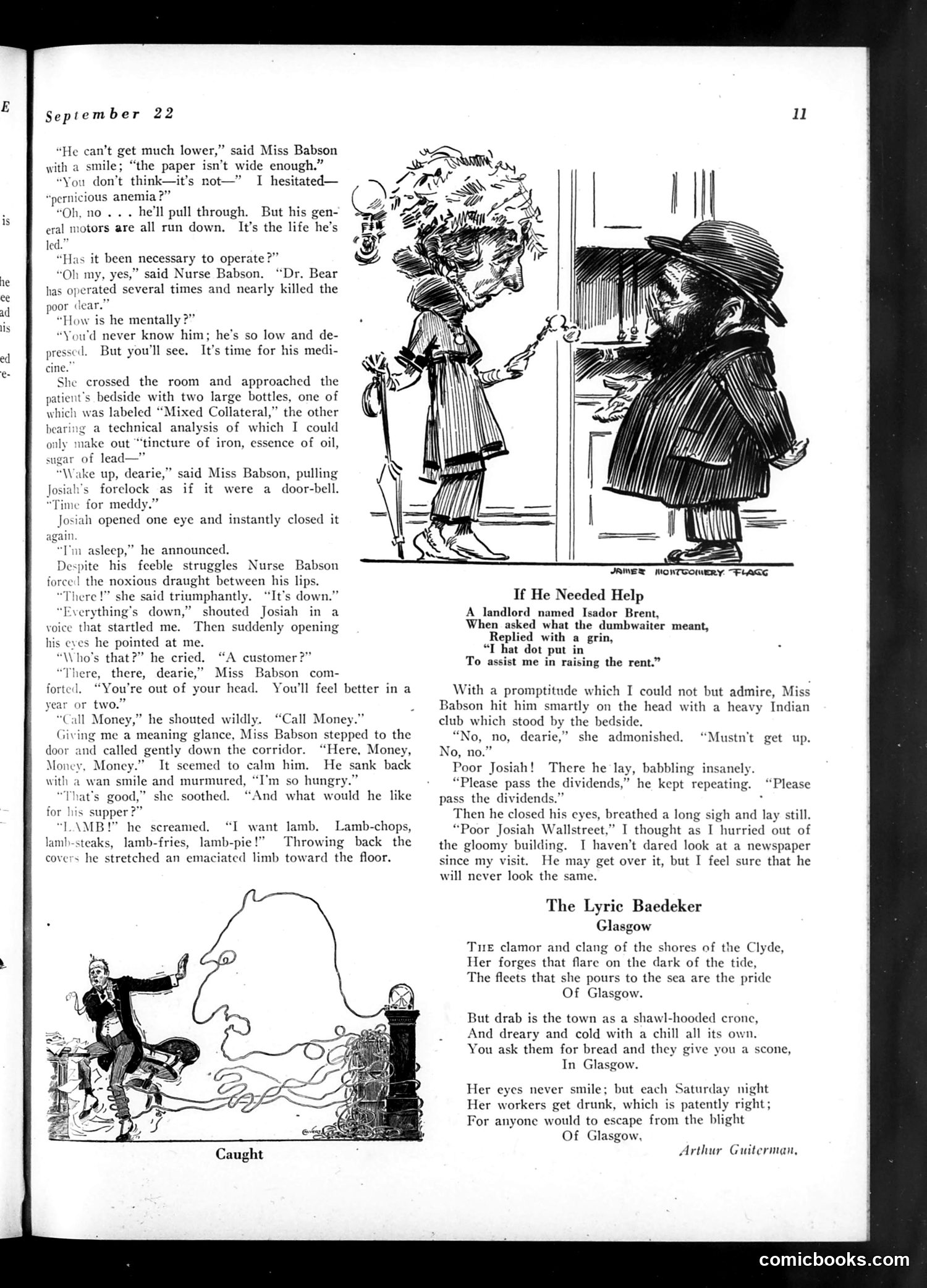
This page contains three distinct pieces: **"If He Needed Help"** (top): A satirical story about a landlord and dauntwarter (rent collector). The accompanying cartoon shows a woman hitting a man with a club—illustrating the story's darkly comic resolution when the landlord tries collecting rent from a mentally unstable tenant named Josiah. **"Caught"** (bottom left): A simple cartoon showing a figure fishing, pulling up what appears to be another person on the line—likely a visual gag about unexpected catches. **"The Lyric Baedeker: Glasgow"** (bottom right): A poem by Arthur Guiterman mocking Glasgow, Scotland, describing it as dreary, industrial, and depressing—a satirical travel commentary suggesting the city offers little but drunkenness and despair. The page represents Life's mix of humor: domestic farce, visual gags, and literary satire.
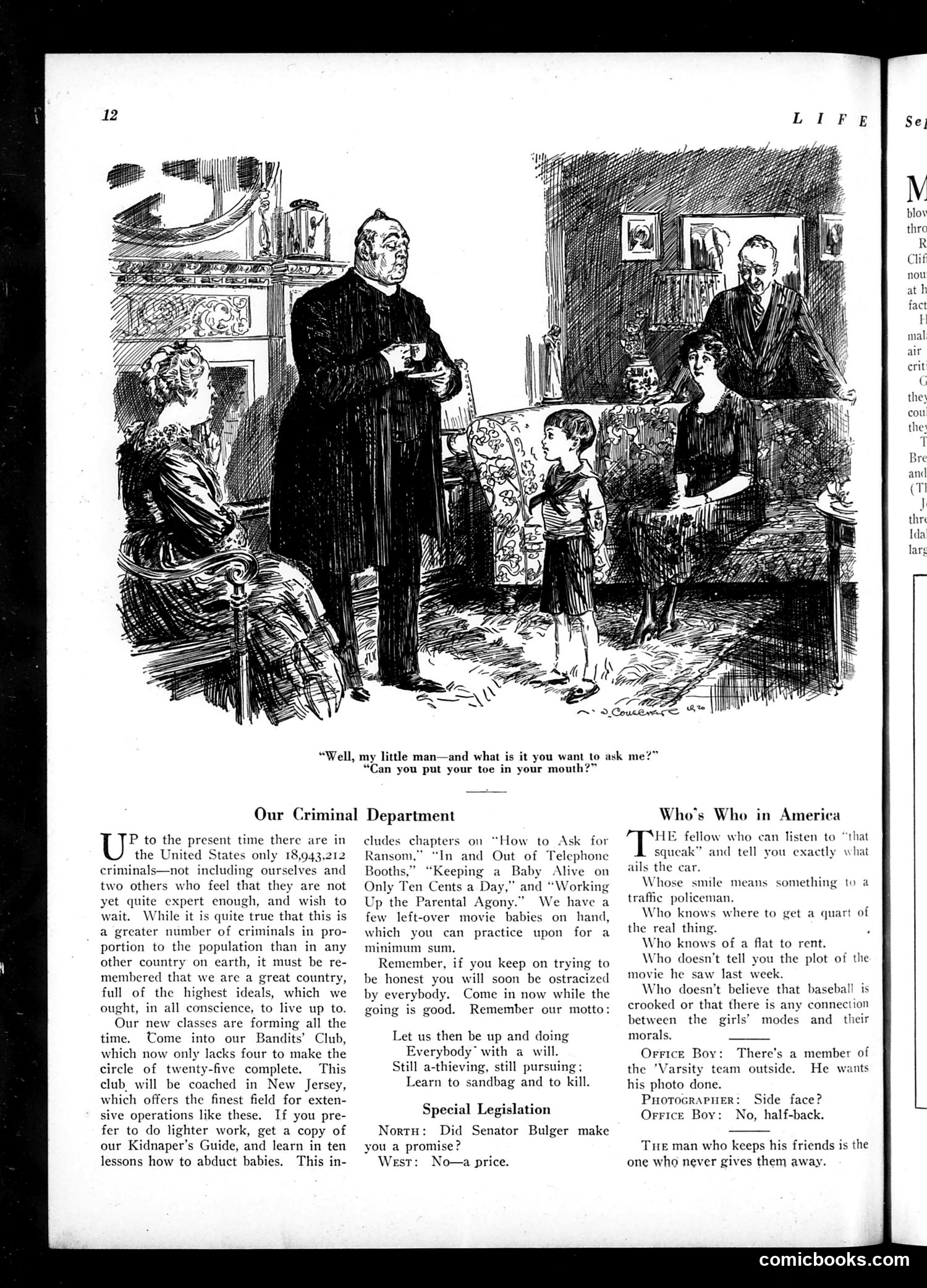
The main cartoon depicts a stern adult (likely a priest or authority figure in dark robes) standing over a young boy in an interior setting, asking: "Well, my little man—and what is it you want to ask me?" The boy responds: "Can you put your toe in your mouth?" The satire targets adult hypocrisy and pomposity. The cartoon mocks how authority figures adopt exaggerated formality and self-importance when addressing children, while children respond with innocent, literal-minded questions that deflate such pretension. The humor lies in the contrast between the adult's dignified pose and the child's absurdly practical query—exposing how adults' ceremonial gravity means nothing to youngsters. The accompanying article "Our Criminal Department" humorously suggests America has abundant criminals worthy of study and offers satirical "instruction" in criminal behavior.
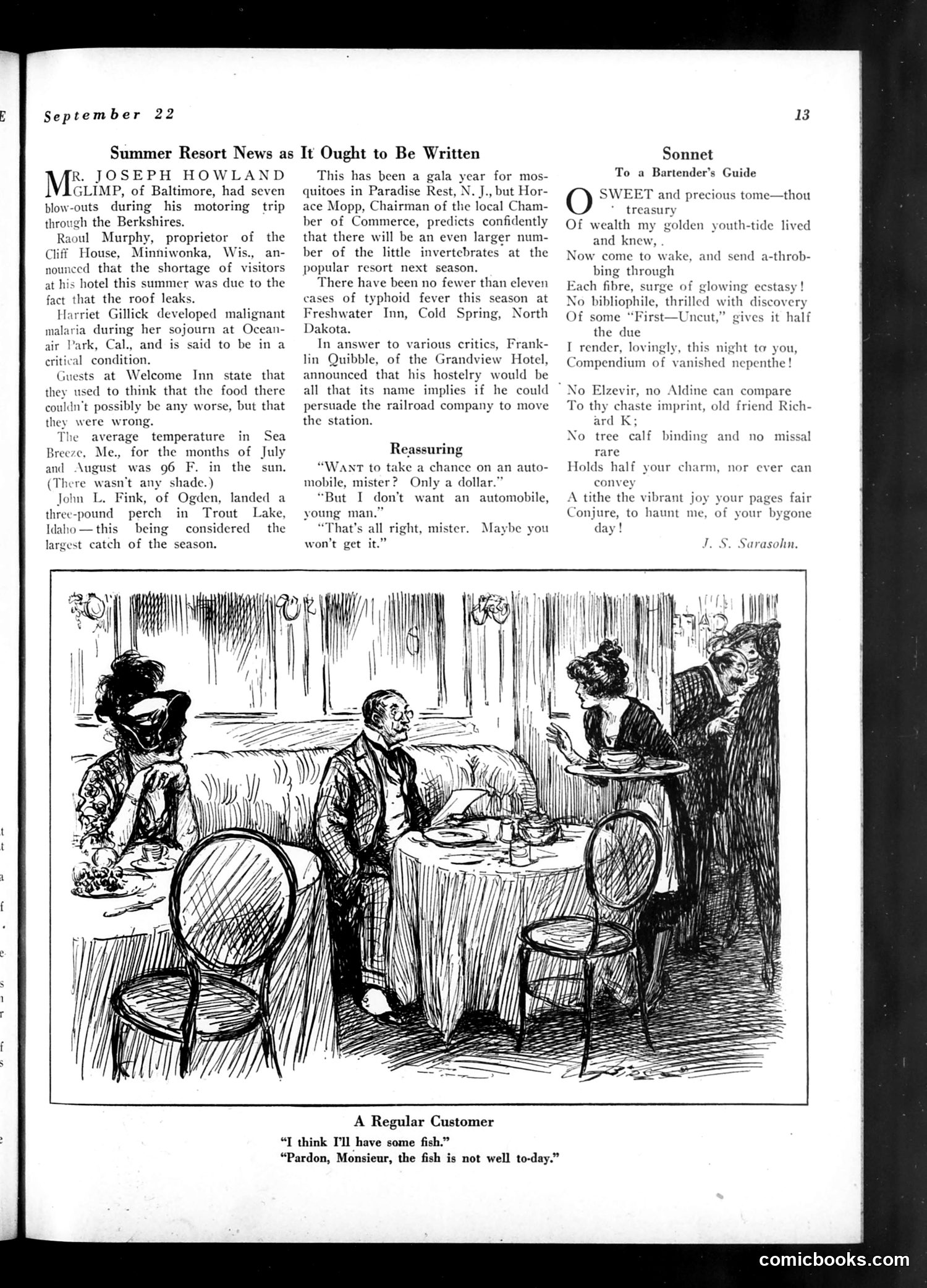
This cartoon satirizes a waiter's excuse-making at a restaurant. A diner requests fish, and the waiter responds that "the fish is not well to-day"—personifying the food as if it were a sick person rather than acknowledging genuine supply or quality issues. The joke mocks both the pretentious language of upscale dining establishments and servers who hide behind euphemistic explanations instead of being straightforward about unavailable dishes. The caption suggests this is a "regular customer," implying the establishment regularly makes such absurd excuses. This reflects early 20th-century satirical commentary on affectation in restaurant culture, where excessive formality masked poor service or limited actual offerings.
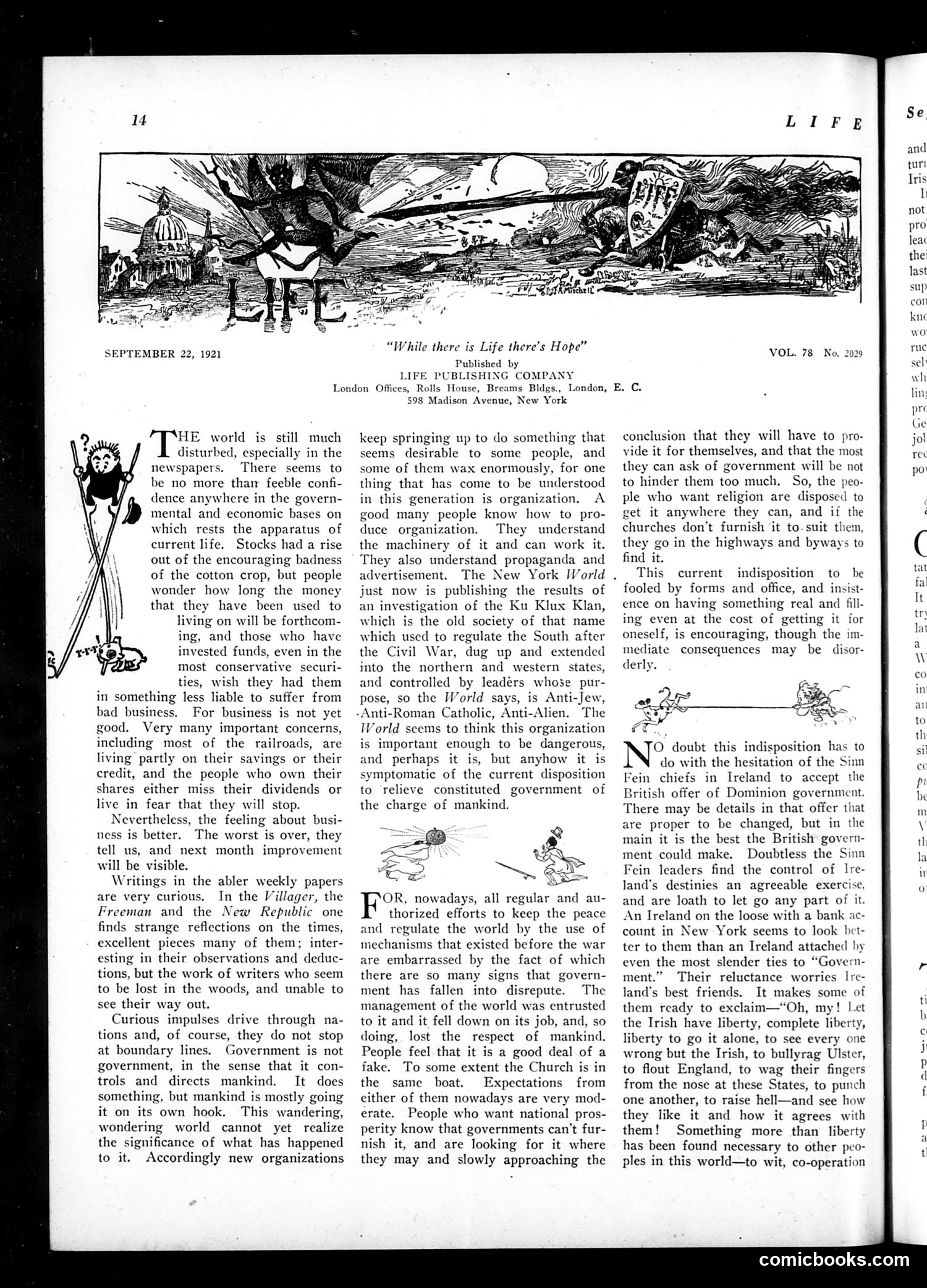
The masthead cartoon depicts a stylized figure labeled "LIFE" emerging from or intertwined with a tree branch, suggesting vitality and nature. The illustration's ornate, art nouveau style was characteristic of the magazine's visual identity. The editorial text discusses post-WWI economic and political unrest, referencing investigations into the Ku Klux Klan and concerns about government management. It critiques the "World" newspaper's anti-Jewish, anti-Roman Catholic, and anti-alien positions while discussing Irish independence movements and British governance. The overall tone reflects anxieties about 1920s American social divisions—religious prejudice, immigrant concerns, labor unrest, and questions about effective government—presented through the magazine's typical satirical lens.
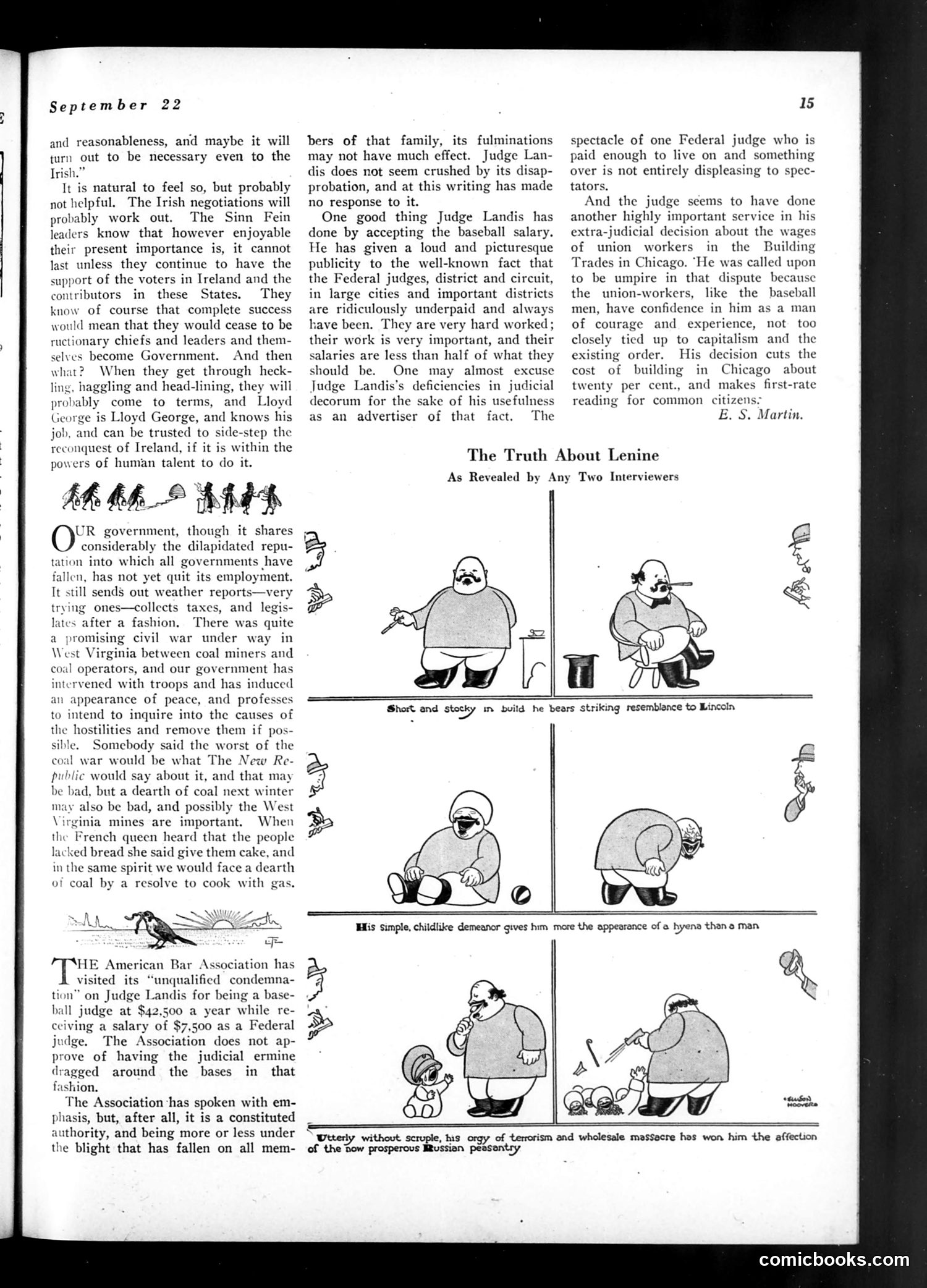
This page features a satirical multi-panel cartoon titled "The Truth About Lenin: As Revealed by Any Two Interviewers." The cartoon mocks the wildly contradictory accounts of Lenin circulating in Western media during the early Soviet period. Each panel depicts the same figure (Lenin) described in the captions with increasingly absurd and contradictory characterizations: first "short and stocky," then appearing as a child-like figure, then overweight, and finally engaged in violence. The captions underscore the joke—two interviewers can produce completely opposite descriptions of the same person. This reflects genuine 1920s confusion and propaganda about Lenin, whom most Americans had never seen. The cartoon satirizes how unreliable and sensationalized Western reporting about Soviet Russia was, with accounts varying wildly depending on the source's political bias. It's a critique of journalistic irresponsibility and the public's gullibility regarding foreign leaders during the "Red Scare" era.
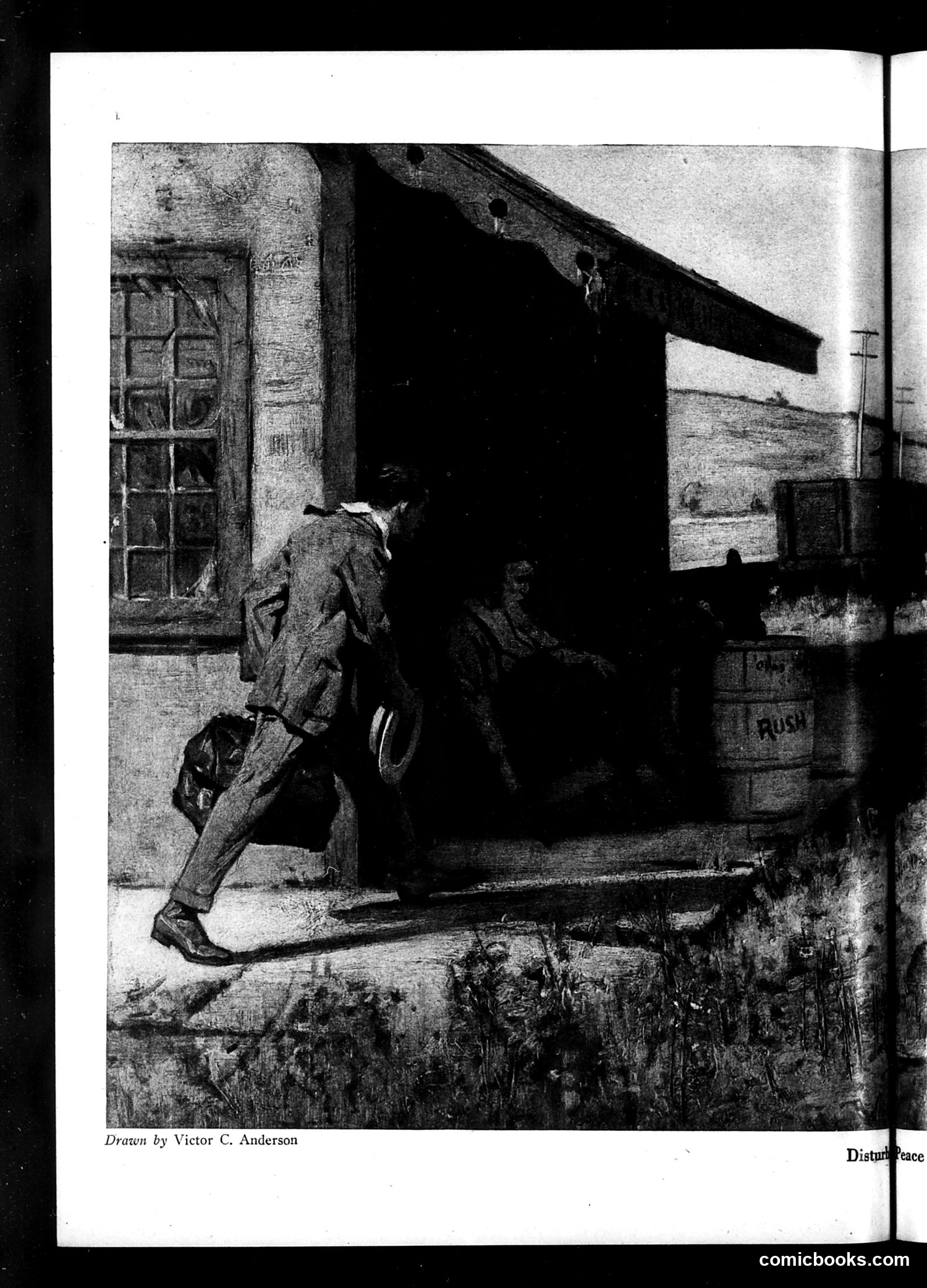
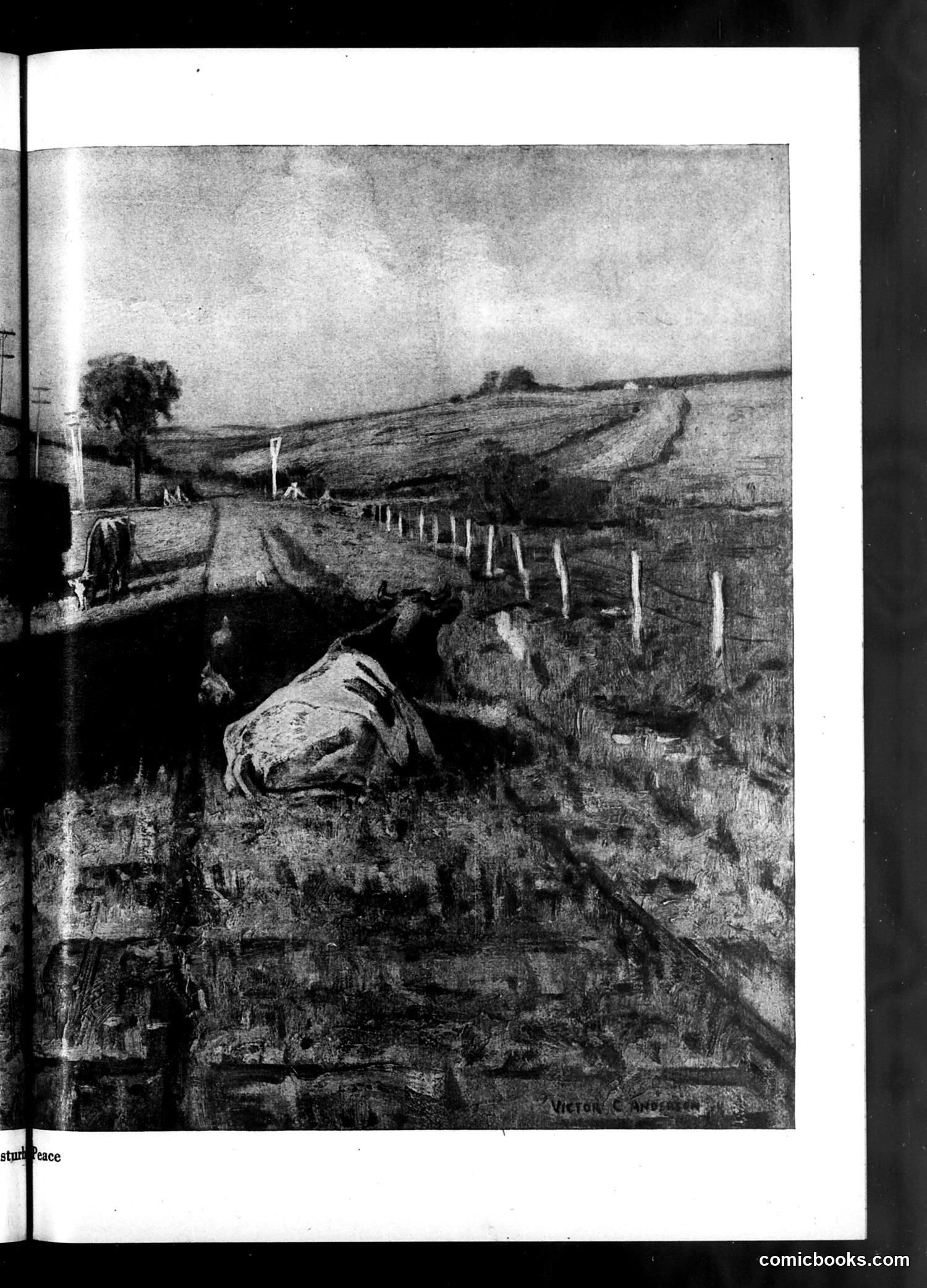
This is a black and white drawing titled "Drawen by Victor C. Anderson" depicting a man in business attire entering or exiting a dark doorway of what appears to be an industrial or warehouse building. A barrel marked "RUSH" is visible on the right side. The caption reads "Disturb Peace," though the full context of the satire is unclear from the visible text. The image appears to comment on industrial or commercial activity, possibly critiquing business practices or labor conditions. The figure's posture and the ominous dark interior suggest some form of illicit or problematic activity. Without additional page context or publication date, the specific political or social target remains uncertain.
This is a theater review page critiquing several Broadway productions. The author (Robert C. Benchley, based on the byline) uses satirical commentary to mock both the plays and their audiences. **Key targets:** - **"Hack Pay"** by Fannie Hurst: Benchley ridicules the adaptation of her short story, mocking how common Ohio townspeople deliver overly literary dialogue ("crépe de chine soul") with affected sophistication—an absurd mismatch between characters and language. - **"The Wheel"**: Despite producer endorsements (Goldin and Smith), Benchley dismisses it as forgettable, sarcastically suggesting they'll forget it within three years. - **"The Silver Fox"**: A predictable society infidelity play by Cosmo Hamilton that elicits polite rather than genuine laughter. Benchley criticizes affected acting styles, referencing outdated "ham" performance. - **"Daddy's Gone A-Hunting"**: Praised as genuinely sad (not derivative or pretentious). The satire targets theatrical pretension, particularly the gap between ambitious literary source material and shallow stage execution, and actors who mimic overwrought performance styles.
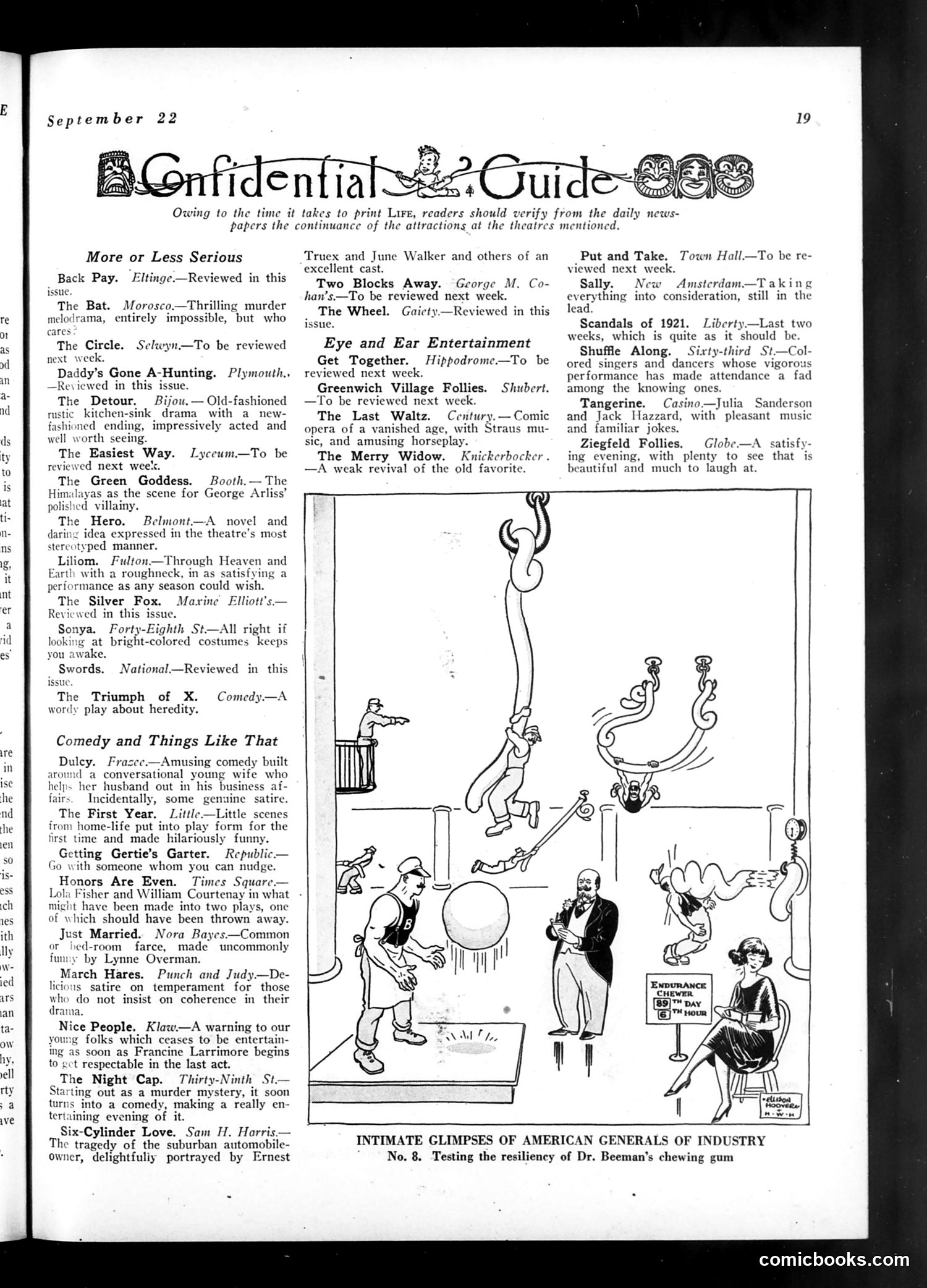
This is a **humorous advertisement disguised as editorial content** for Dr. Beeman's chewing gum. The cartoon depicts various acrobatic stunts and physical tests—people swinging from ropes, bouncing on large spheres, and performing gymnastics—all designed to showcase the gum's "resiliency" (elasticity and durability). The phrase "Generals of Industry" is satirical wordplay, jokingly elevating a chewing gum manufacturer to the status of powerful industrialists. By presenting the gum as capable of withstanding extreme physical punishment, the ad uses exaggerated, playful scenarios to claim superior product durability. This represents early 20th-century **advertising humor**: blending entertainment with product promotion. The cartoon style and Life magazine's satirical tone made such advertorial content acceptable and amusing to contemporary readers seeking both entertainment and consumer information.
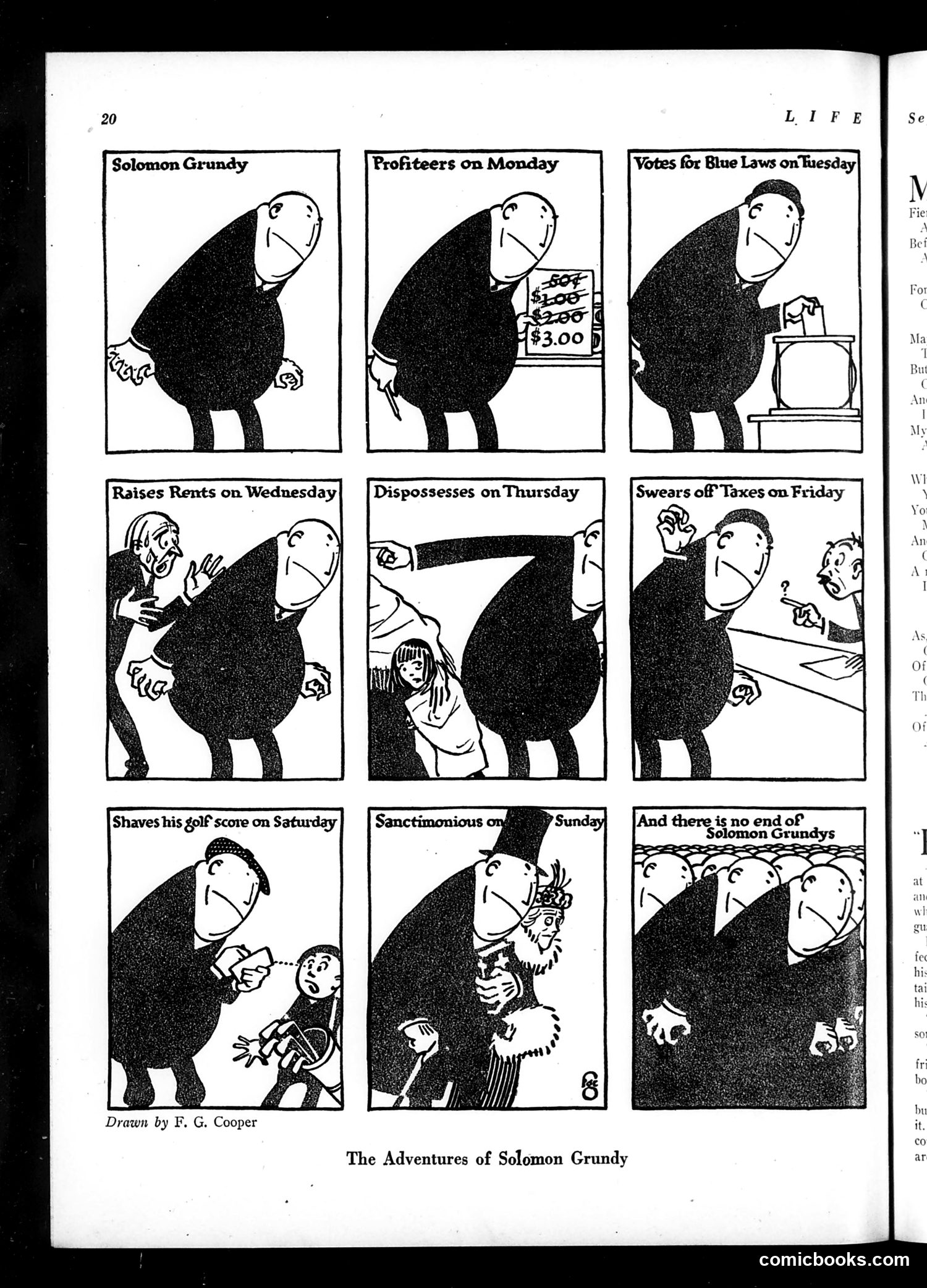
This is a satirical comic strip by F.G. Cooper that uses the nursery rhyme "Solomon Grundy" (born Monday, died Saturday) as a framework to mock unethical behavior and hypocrisy across the week. The strip depicts a rotund figure engaging in increasingly questionable activities: profiteering, voting for restrictive laws, raising rents, evicting tenants, tax evasion, cheating at golf, and sanctimonious behavior. The final panel suggests this cycle is endless—"no end of Solomon Grundys." The satire targets wealthy or powerful individuals who exploit the poor through rent-raising and evictions while maintaining moral pretense and participating in corrupt voting or profiteering. It's a critique of systemic inequality and the hypocrisy of the privileged classes.
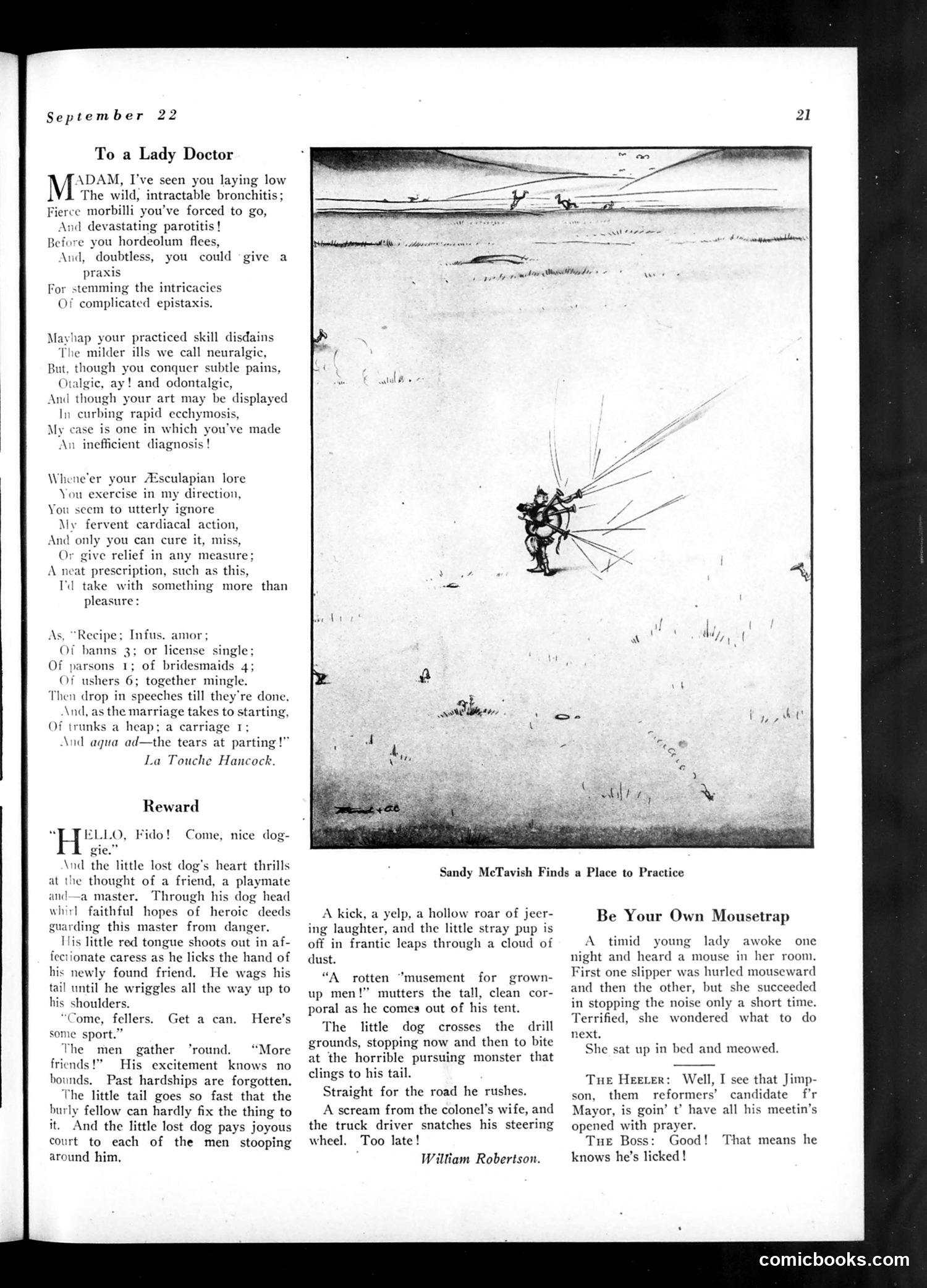
This page contains three distinct pieces of satirical content: **"To a Lady Doctor"** (poem): A romantic poem mocking a female physician. The speaker praises her medical competence with technical terminology (bronchitis, parotitis, etc.) but ultimately claims his real ailment is lovesickness—he needs her to prescribe marriage, complete with "banns," "parsons," "bridesmaids," and "ushers." The satire targets both the novelty of female doctors in this era and the persistence of romantic sentimentality. **"Reward"** (illustrated story): Soldiers find and befriend a stray dog, then attach a can to its tail and chase it for "sport." The moral condemnation is implicit—the story presents this cruelty as entertainment, highlighting callous military behavior. **"Be Your Own Mousetrap"**: A humorous anecdote where a frightened woman, unable to catch a mouse with her slippers, simply meows from bed—apparently effective. **The political dialogue** at bottom appears unrelated commentary on a mayoral candidate who opens meetings with prayer, suggesting skepticism about reformers' sincerity.
This page contains three separate film reviews from Life magazine's entertainment section, likely from the 1920s based on references to Douglas Fairbanks and silent cinema. **The Three Musketeers** review humorously suggests Alexandre Dumas wrote his novel specifically to provide material for actor Douglas Fairbanks's film adaptation. The critic praises Fairbanks's performance as D'Artagnan, comparing him favorably to famous stage actors Sothern and Waller. The review emphasizes Fairbanks's physical athleticism and emotional range, noting his distinctive smile and Chaplin-esque expressions. **Pilgrims of Love** receives a more mixed assessment—a typical spy story with stock characters (criminals, aristocrats, Scotland Yard agents). The critic mocks the title's disconnect from the plot and jokes about the film showing a British home without decorative potted plants, suggesting such props were standard movie set dressing. **Room and Board** begins discussing differences between Irish film and musical comedy, suggesting cinema's silence eliminates sung dialogue that stage tenors would perform. The page demonstrates period film criticism's tone: witty, somewhat condescending, yet engaging.
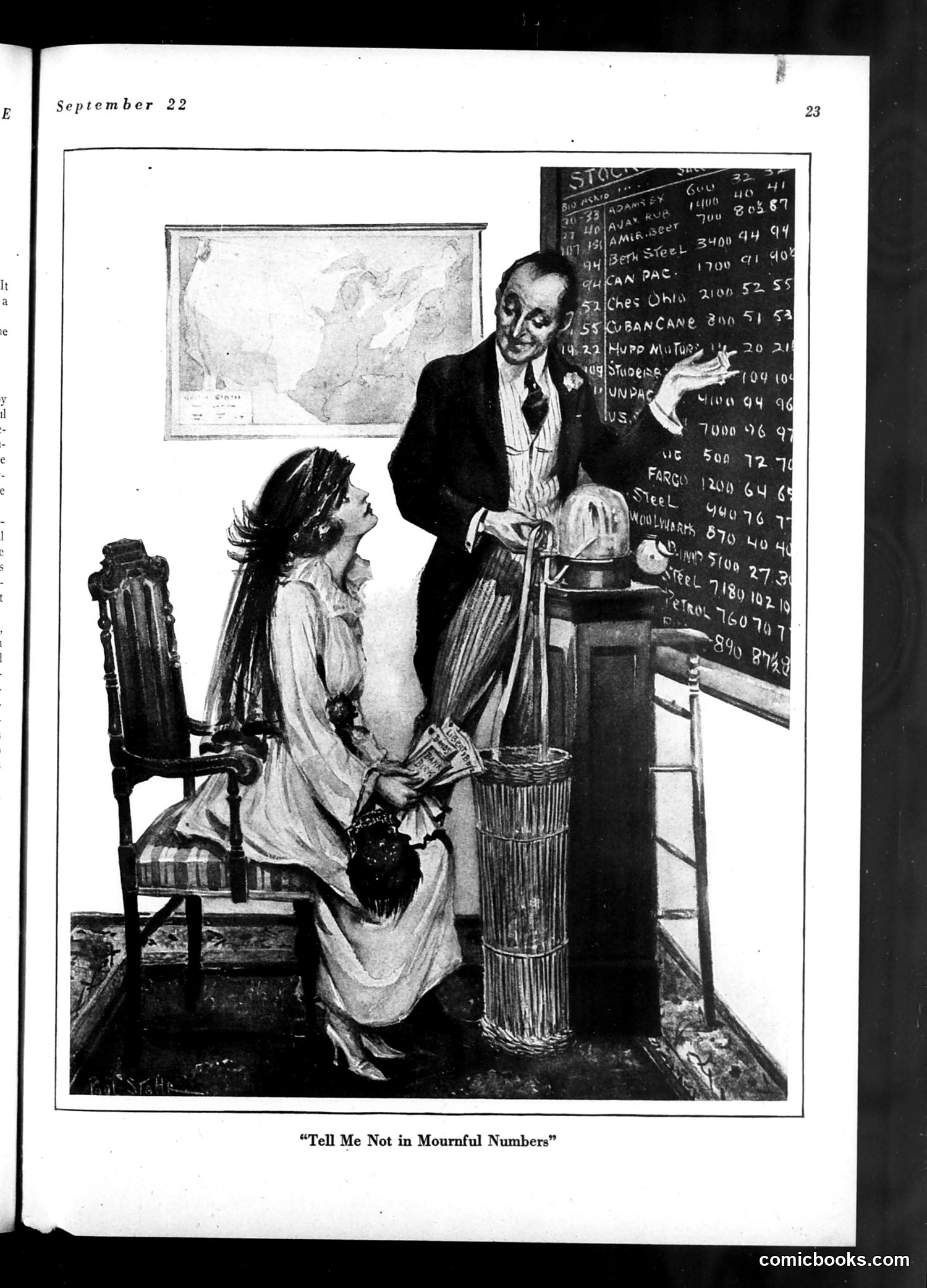
This illustration satirizes stock market speculation during what appears to be the 1920s boom era. A well-dressed man points to a stock ticker board displaying prices and company names (visible entries include "Beth Steel," "Can Pas," "Ches Ohio," "Cubancane," "Hupp Mtg," and others). A woman sits beside him, seemingly distressed or anxious. The caption "Tell Me Not in Mournful Numbers" is a literary reference—likely from Longfellow's "A Psalm of Life"—creating ironic contrast: the woman wants reassurance, but the man can only offer stock ticker numbers. The joke satirizes how investors obsess over financial quotations while ignoring human emotion and real concerns. This reflects contemporary anxiety about market volatility and the disconnect between abstract financial metrics and actual human welfare.
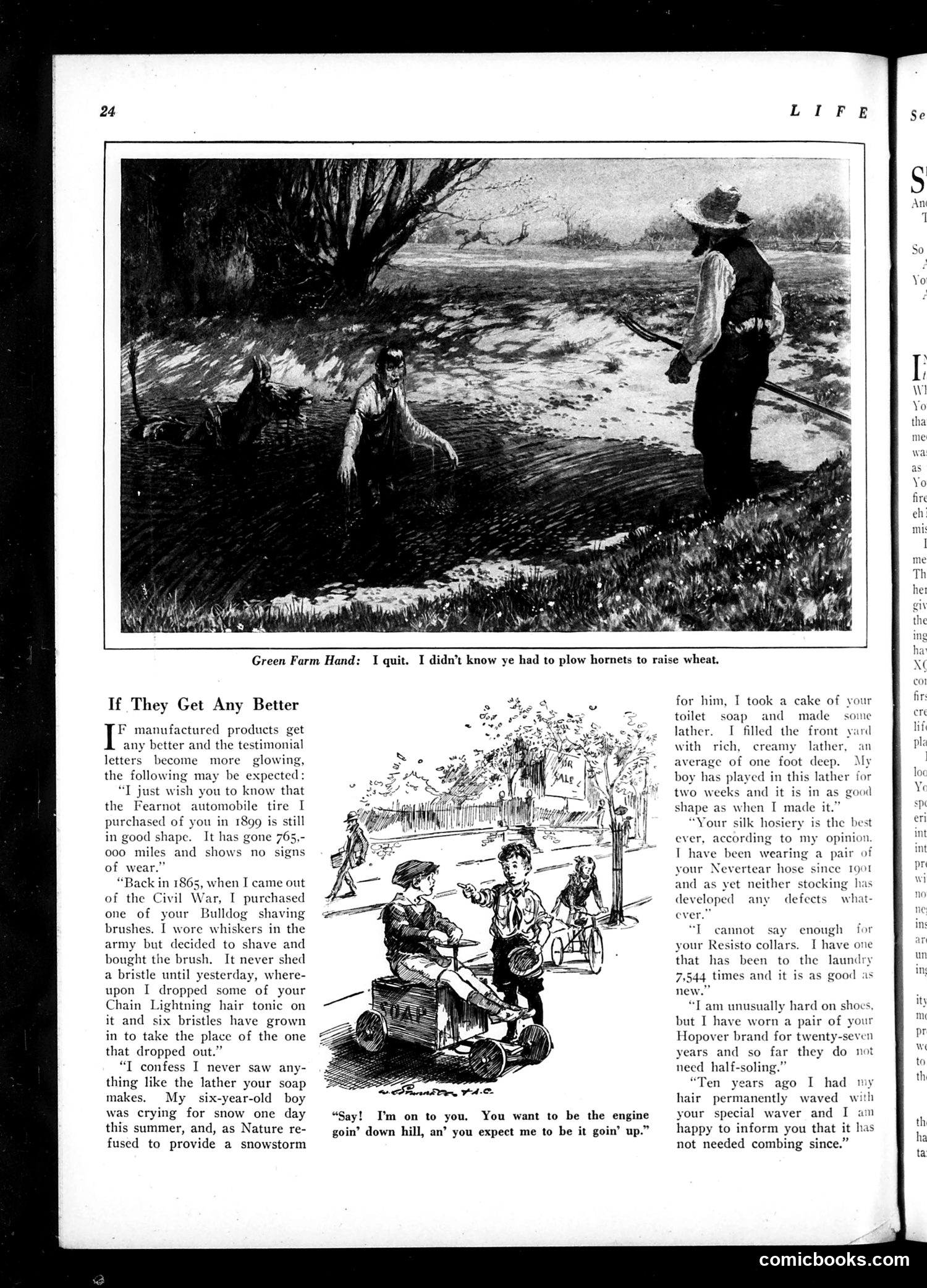
This page satirizes exaggerated product testimonials common in early 1900s advertising. The main article "If They Get Any Better" mocks absurdly unrealistic customer letters praising manufactured goods—a tire lasting 765,000 miles without wear, a shaving brush surviving since 1865, soap lather filling a yard to one-foot depth. The accompanying cartoon shows a child refusing to pull a wagon uphill, saying he'll be the "engine goin' down hill" while the adult goes up—a joke about fair division of labor that parallels the article's theme: as products become impossibly perfect, consumers' expectations become equally unrealistic and unfair. The top illustration depicts a farm worker quitting because he didn't know "ye had to plow hornets to raise wheat"—suggesting impossible or absurd labor demands, reinforcing the satirical point about unreasonable expectations in both product claims and working conditions.
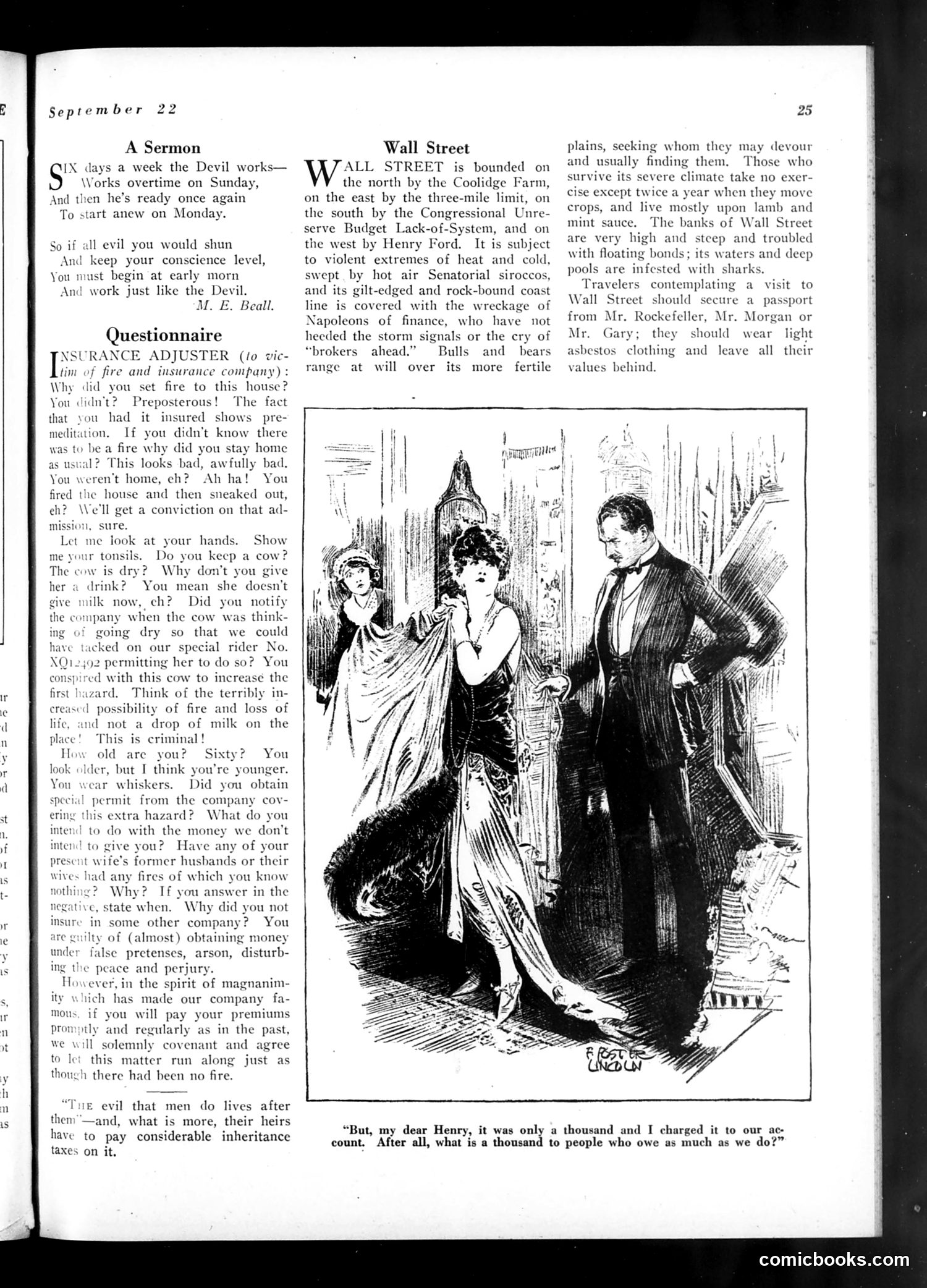
This page contains three satirical pieces from Life magazine (dated September 22, appears to be 1920s based on references). **"A Sermon"** is a short, cynical poem mocking the idea that hard work prevents evil—suggesting one must work "like the Devil" to stay moral. **"Questionnaire"** satirizes insurance adjusters' absurd interrogation tactics. An adjuster interrogates a fire victim with contradictory, gotcha questions designed to trap them into admissions of guilt regardless of their answers. The satire exposes how insurance companies use sophistry to deny claims or accuse policyholders of arson. **"Wall Street"** is a mock-geographic description treating the financial district as a dangerous, amoral landscape. It references real titans (Rockefeller, Morgan, Gary, Henry Ford, Coolidge) and uses harsh imagery—"wreckage of Napoleons of finance," "sharks"—to depict Wall Street as a predatory realm where the wealthy survive by ruthlessness. The cartoon illustration shows an elegantly dressed couple; the caption reveals the wife charged $1,000 to their account, dismissing it because "people who owe as much as we do" won't notice. This mocks wealthy indifference to debt.
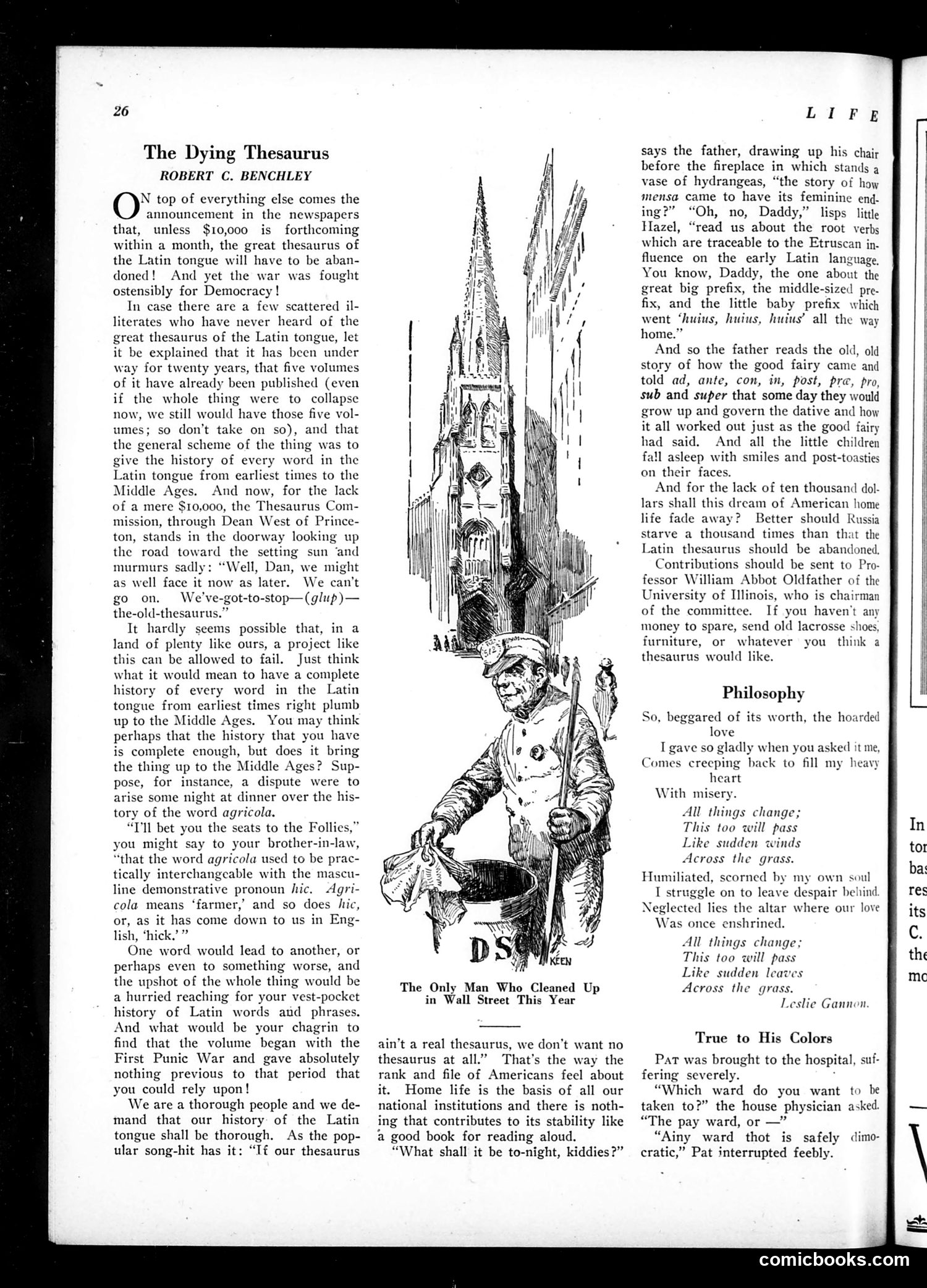
This is a satirical essay lamenting the threatened collapse of a major Latin linguistic project—a comprehensive thesaurus tracking Latin word usage from antiquity through the Middle Ages. The project requires only $10,000 to continue but faces abandonment. Benchley's satire is multilayered: he mocks American priorities (fighting WWI "for Democracy" while abandoning scholarship), uses absurdist humor (families reading Latin etymology aloud for bedtime stories), and criticizes the nation's failure to fund intellectual work. The cartoon depicts "the only man who cleaned up in Wall Street this year"—likely a wealthy financier—contrasting the ease of accumulating war profits against the difficulty of raising modest funds for academic pursuits. The piece satirizes both American anti-intellectualism and the disconnect between national resources and cultural investment during the post-WWI period.
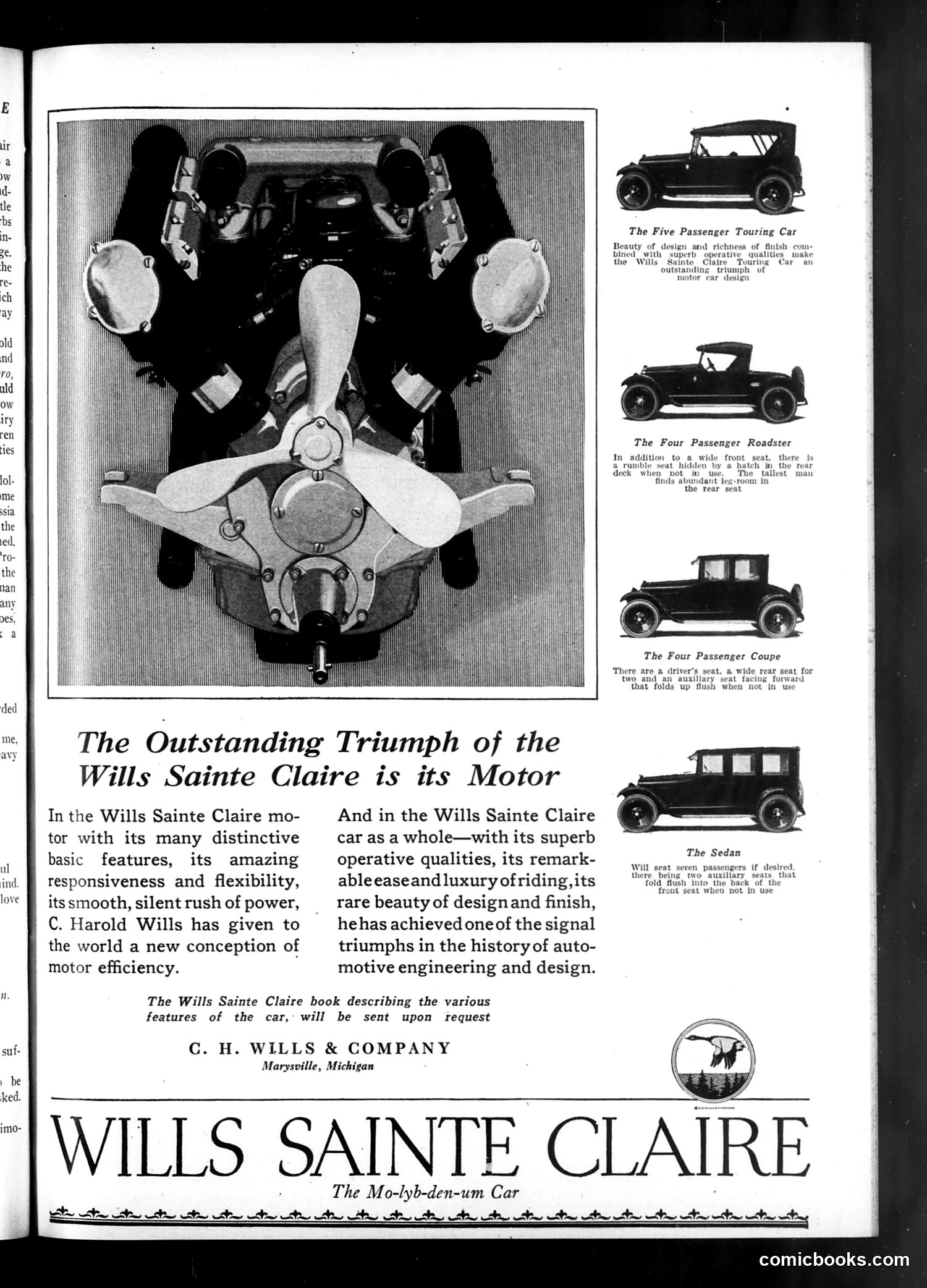
This is **not a satirical cartoon page**, but rather a **automobile advertisement** for the Wills Sainte Claire car, manufactured by C. H. Wills & Company in Marysville, Michigan. The large overhead photograph on the left shows the car's interior and mechanical components from above, designed to showcase the engineering. The right side displays four vehicle models: a Five Passenger Touring Car, Four Passenger Roadster, Four Passenger Coupe, and Sedan. The text praises the car's motor—emphasizing "responsiveness and flexibility," "smooth, silent rush of power," and "motor efficiency." The tagline "The Mo-lyb-den-um Car" refers to molybdenum, a metal alloy used in the engine, which was a selling point highlighting advanced metallurgy. This is a straightforward period advertisement aimed at wealthy buyers, not satire. The "triumph" referenced is literal—the car's engineering achievement—not ironic.
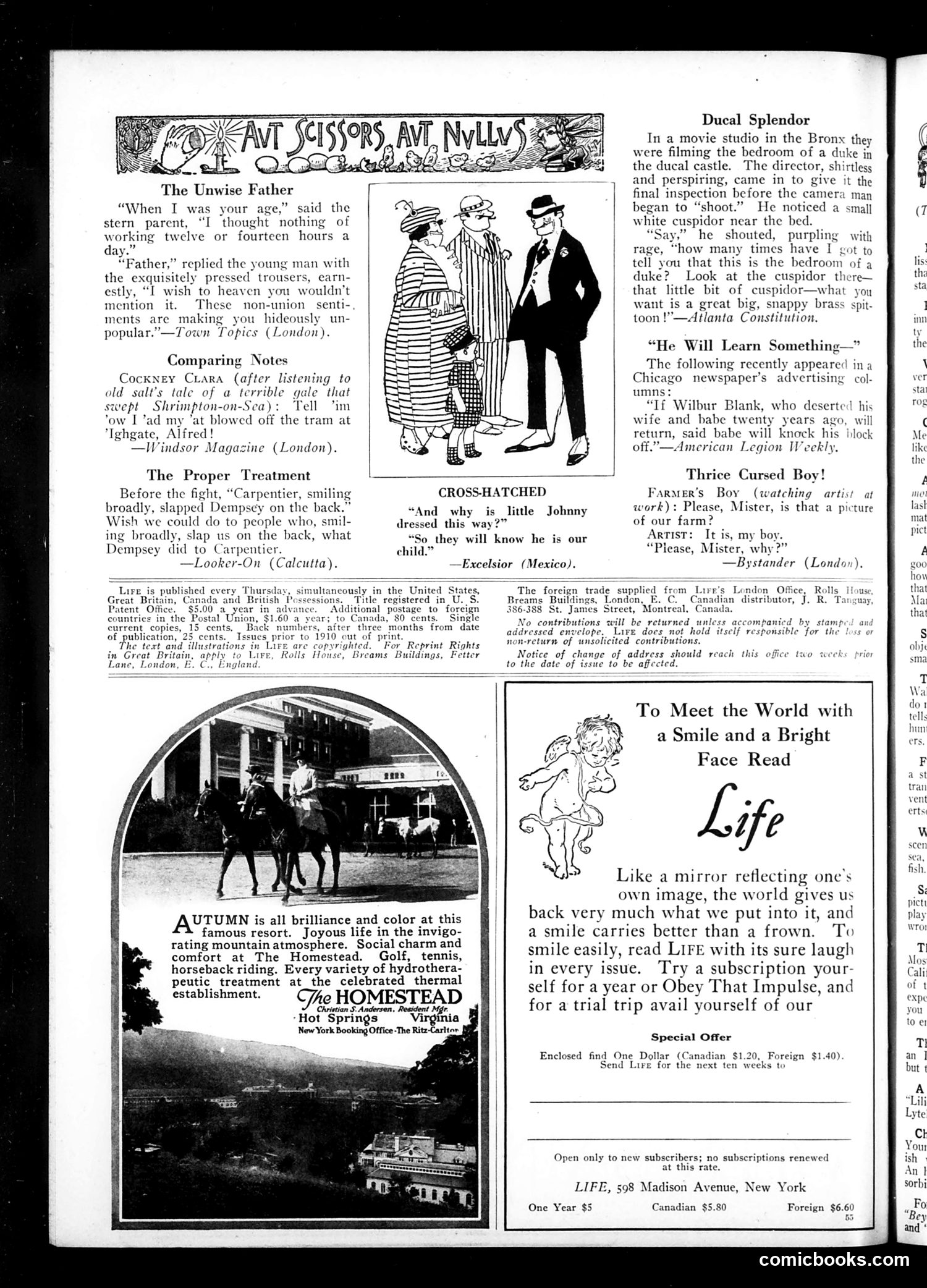
This page from *Life* magazine contains several short humorous anecdotes and cartoons typical of early 20th-century satirical humor: **"The Unwise Father"** mocks a young man who dismisses his father's work ethic as "hideously unpopular"—suggesting labor organizing sentiment had made traditional hard work seem unfashionable among fashionable youth. **"Comparing Notes"** features a working-class Cockney woman one-upping a sailor's storm tale with her own trivial mishap, a common "tall tale" joke format. **"Ducal Splendor"** satirizes Hollywood's artificiality: a movie director rages that a bedroom set lacks authenticity because it has a small cuspidor instead of a large one—the joke being the absurdity of this particular detail mattering. **"Cross-Hatched"** shows a child asking why he's dressed formally, with the answer being parental vanity. The page also includes advertisements for *Life* magazine subscriptions and The Homestead resort, plus publication details. The humor reflects concerns about labor politics, class pretension, and Hollywood's artificial glamour.
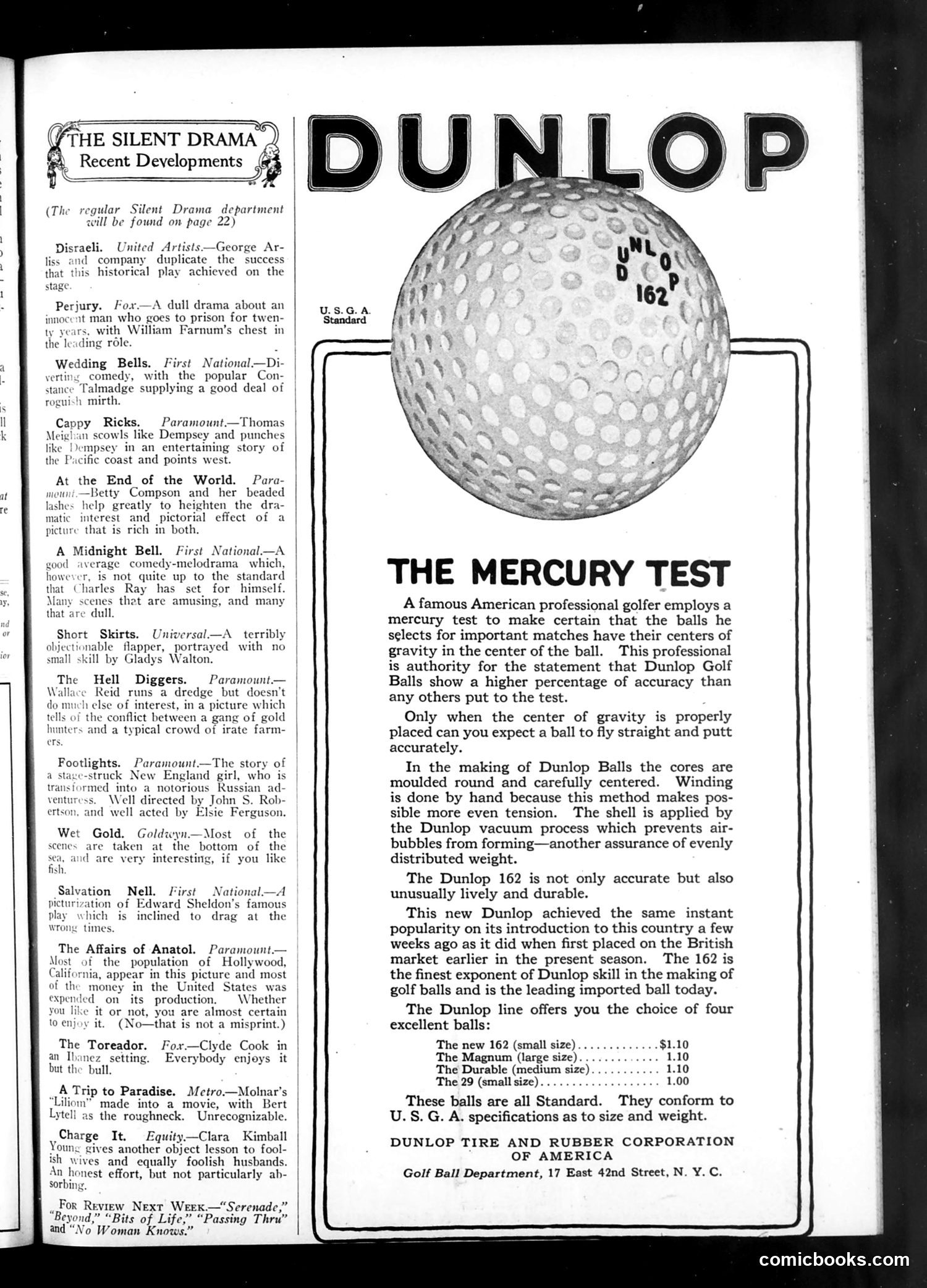
This page is **primarily advertising**, not satire or political commentary. The left column lists recent silent films with brief reviews—typical entertainment journalism of the era (appearing to be early 1920s based on references to actors like Constance Talmadge and Wallace Reid). The dominant right half is a **Dunlop Golf Balls advertisement** featuring a large photograph of a golf ball. The ad describes the "mercury test"—a quality-control method allegedly used by a famous (unnamed) professional golfer to verify that ball centers of gravity are properly aligned for accurate flight and putting. The advertisement emphasizes manufacturing precision: hand-wound cores, vacuum-applied shells to prevent air bubbles, and even tension distribution. It promotes the Dunlop 162 model as superior to competitors and notes its recent British market success. **There is no political cartoon or satire here.** This is straightforward product advertising dressed in technical/scientific language to convey quality and reliability to consumers.
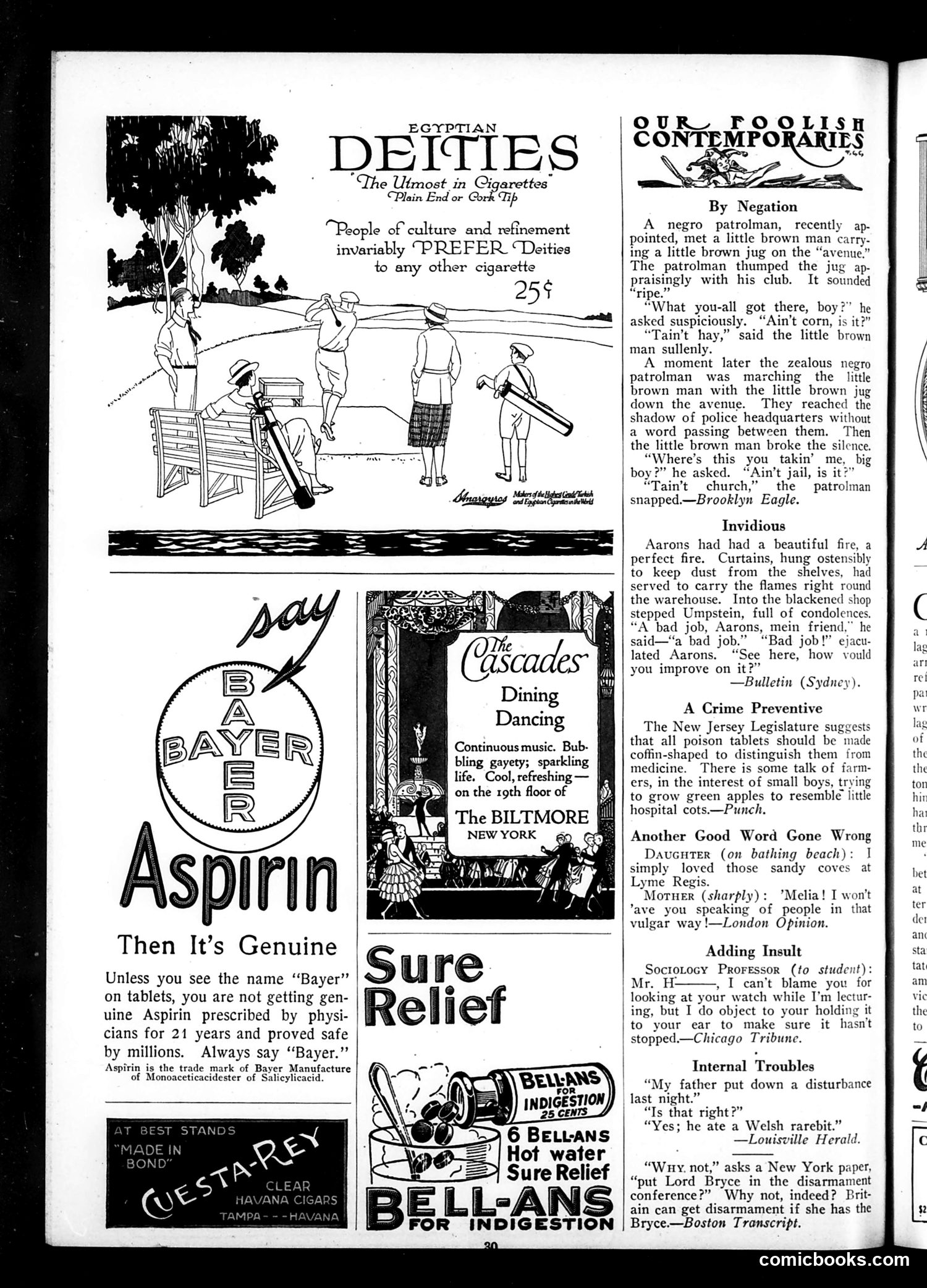
This page is primarily advertisements with a humor section titled "Our Foolish Contemporaries." The main cartoon satirizes racial stereotypes and early 20th-century police practices. **The Cartoon:** A newly appointed Black police officer stops a Black man carrying a jug, suspecting illegal alcohol (likely during Prohibition era). The humor relies on dialect and minstrel-show stereotypes—the officer uses exaggerated speech ("You-all"), and the arrested man deflects with non-answers ("Tain't hay"). The patrolman's zealousness backfires when the man sarcastically asks if they're going to jail or church, implying the officer is overeager. **The Satire:** The piece mocks both figures: the newly empowered Black officer displaying excessive authority, and the streetwise man's evasive responses. It reflects period attitudes about Prohibition enforcement and presents racial caricatures as humor fodder. The byline credits the *Brooklyn Eagle*. The page also contains other brief humorous anecdotes and vintage advertisements for cigarettes, aspirin, and indigestion remedies.

This page contains primarily **advertisements and humorous short fiction**, not political cartoons. The main story, "A Proper Restraint," is a joke about a Missouri merchant named J. H. West who refuses payment to wholesalers Gribble & Son. When the firm tries to collect through intimidation—contacting the railroad agent, bank president, and mayor for leverage—West reveals he *is* all three officials, plus the town's only lawyer and Methodist pastor. The humor relies on the rural conceit of one man holding every position of authority in a small village, making threats of legal action absurd. The advertisements include Pears' Soap, Cortez Cigars, and prominently the Valet AutoStrop Razor, which self-sharpens on a leather strop. Life also announces a "Life Liner" contest offering $100 quarterly for humorous short submissions. The satire is gentle Americana about small-town life, not political commentary.
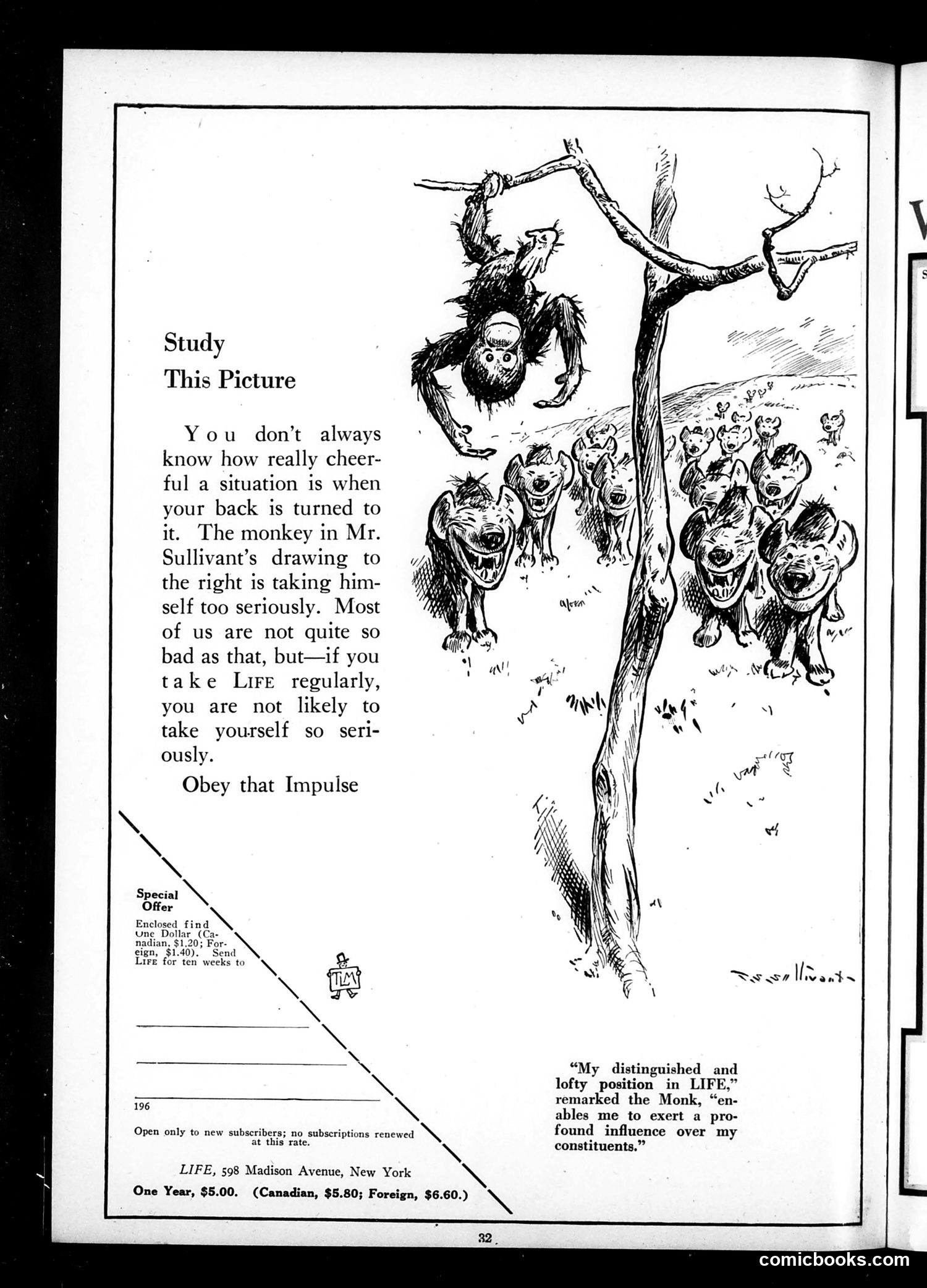
This page combines editorial commentary with a cartoon by artist Sullivant. The cartoon depicts a monkey hanging from a tree branch, taking itself seriously while surrounded by laughing hyenas below. The editorial uses this image to mock human self-importance: the monkey, like many people, fails to recognize how ridiculous it appears when others observe it. The joke's moral is that regular readers of *Life* magazine—known for satire and humor—develop perspective and avoid taking themselves too seriously, unlike the overly-dignified monkey. The accompanying caption adds satirical commentary: a monkey claims its "distinguished and lofty position in LIFE" gives it influence over constituents—mocking how people in positions of authority overestimate their own importance. The page also includes a subscription offer ($1 for ten weeks), suggesting the magazine's humor serves as an antidote to pomposity.