
Life, 1921-09-22 · page 16 of 34
Life — September 22, 1921 — page 16: what you’re looking at
What you’re looking at
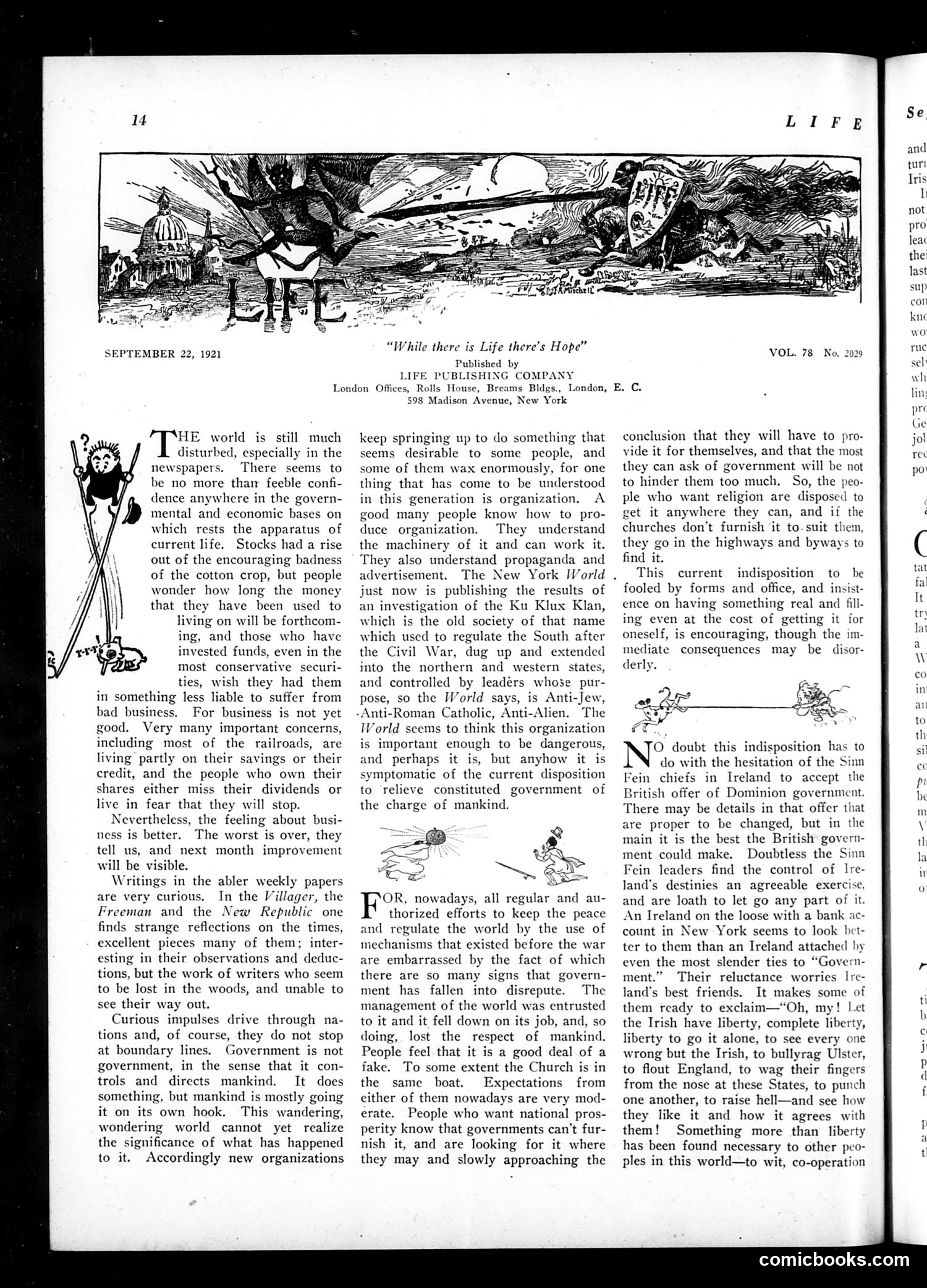
The masthead cartoon depicts a stylized figure labeled "LIFE" emerging from or intertwined with a tree branch, suggesting vitality and nature. The illustration's ornate, art nouveau style was characteristic of the magazine's visual identity. The editorial text discusses post-WWI economic and political unrest, referencing investigations into the Ku Klux Klan and concerns about government management. It critiques the "World" newspaper's anti-Jewish, anti-Roman Catholic, and anti-alien positions while discussing Irish independence movements and British governance. The overall tone reflects anxieties about 1920s American social divisions—religious prejudice, immigrant concerns, labor unrest, and questions about effective government—presented through the magazine's typical satirical lens.
📄 Transcribed text from this page (OCR, searchable)
Machine-transcribed from the original scan — historical spelling and the odd misread are preserved.
SEPTEMBER 22, 1921 London Offic HE world is still much disturbed, especially in the newspapers. There seems to be no more than feeble confi- dence anywhere in the govern- mental and economic bases on which rests the apparatus of current life. Stocks had a rise out of the encouraging badness of the cotton crop, but people wonder how long the money that they have been used to living on will be forthcom- ing, and those who have invested funds, even in the most conservative securi- ties, wish they had them in something less liable to suffer from bad business. For business is not yet good. Very many important concerns, including most of the railroads, are living partly on their savings or their credit, and the people who own their shares either miss their dividends or live in fear that they will stop. Nevertheless, the feeling about busi- ness is better. The worst is over, they tell us, and next month improvement will be visible. Writings in the abler weekly papers are very curious. In the Villager, the Freeman and the New Republic one finds strange reflections on the times, excellent pieces many of them; inter- esting in their observations and deduc- tions, but the work of writers who seem to be lost in the woods, and unable to see their way out. Curious impulses drive through na- tions and, of course, they do not stop at boundary lines. Government is not government, in the sense that it con- trols and directs mankind. It does something, but mankind is mostly going it on its own hook. This wandering, wondering world cannot yet realize the significance of what has happened to it. Accordingly new organizations “While there is Life there’s Hope” Published by LIFE PUBLISHID COMPANY Rolls House, Breams Bldgs., London, 598 Madison Avenue, New York keep springing up to do something that seems desirable to some people, and some of them wax enormously, for one thing that has come to be understood in this generation is organization. A good many people know how to pro- duce organization. They understand the machinery of it and can work it. They also understand propaganda and advertisement. just now is publishing the results of an investigation of the Ku Klux Klan, which is the old society of that name which used to regulate the South after the Civil War, dug up and extended into the northern and western states, and controlled by leadérs whose pur- pose, so the World says, is Anti-Jew, -Anti-Roman Catholic, Anti-Alien. The IVorld seems to think this organization is important enough to be dangerous, and perhaps it is, but anyhow it is symptomatic of the current disposition to relieve constituted government of the charge of mankind. For: nowadays, all regular and au- thorized efforts to keep the peace d regulate the world by the use of mechanisms that existed before the war are embarrassed by the fact of which there are so many signs that govern- ment has fallen into disrepute. The management of the world was entrusted to it and it fell down on its job, and, so doing, lost the respect of mankind. People feel that it is a good deal of a fake. To some extent the Church is in the same boat. Expectations from either of them nowadays are very mod- erate. People who want national pros- perity know that governments can’t fur- nish it, and are looking for it where they may and slowly approaching the The New York [World . VOL. 78 No. 2029 conclusion that they will have to pro- vide it for themselves, and that the most they can ask of government will be not to hinder them too much. So, the peo- ple who want religion are disposed to get it anywhere they can, and if the churches don’t furnish ‘it to. suit them, they go in the highways and byways to find it. This current indisposition to be fooled by forms and office, and insist- ence on having something real and fill- ing even at the cost of getting it for oneself, is encouraging, though the im- mediate consequences may be disor- derly. <a Aes Sec Sy ES, N° doubt this indisposition has to do with the hesitation of the Sinn ein chiefs in Ireland to accept the British offer of Dominion government. There may be details in that offer that are proper to be changed, but in the main it is the best the British govern- ment could make. Doubtless the Sinn Fein leaders find the control of Ire- land's destinies an agreeable exercise, and are loath to let go any part of it. An Ireland on the loose with a bank ac- count in New York seems to look bet- ter to them than an Ireland attached even the most slender ties to “Govern- ment.” Their reluctance worries | land’s best friends. It makes some of them ready to exclaim—“Oh, my! Let the Irish have liberty, complete liberty, liberty to go it alone, to see every one wrong but the Irish, to bullyrag Ulster, to flout England, to wag their fingers from the nose at these States, to punch one another, to raise hell—and see how they like it and how it agrees with them! Something more than liberty has been found necessary to other peo- ples in this world—to wit, co-operation comicbooks.com to