
Life, 1921-09-22 · page 28 of 34
Life — September 22, 1921 — page 28: what you’re looking at
What you’re looking at
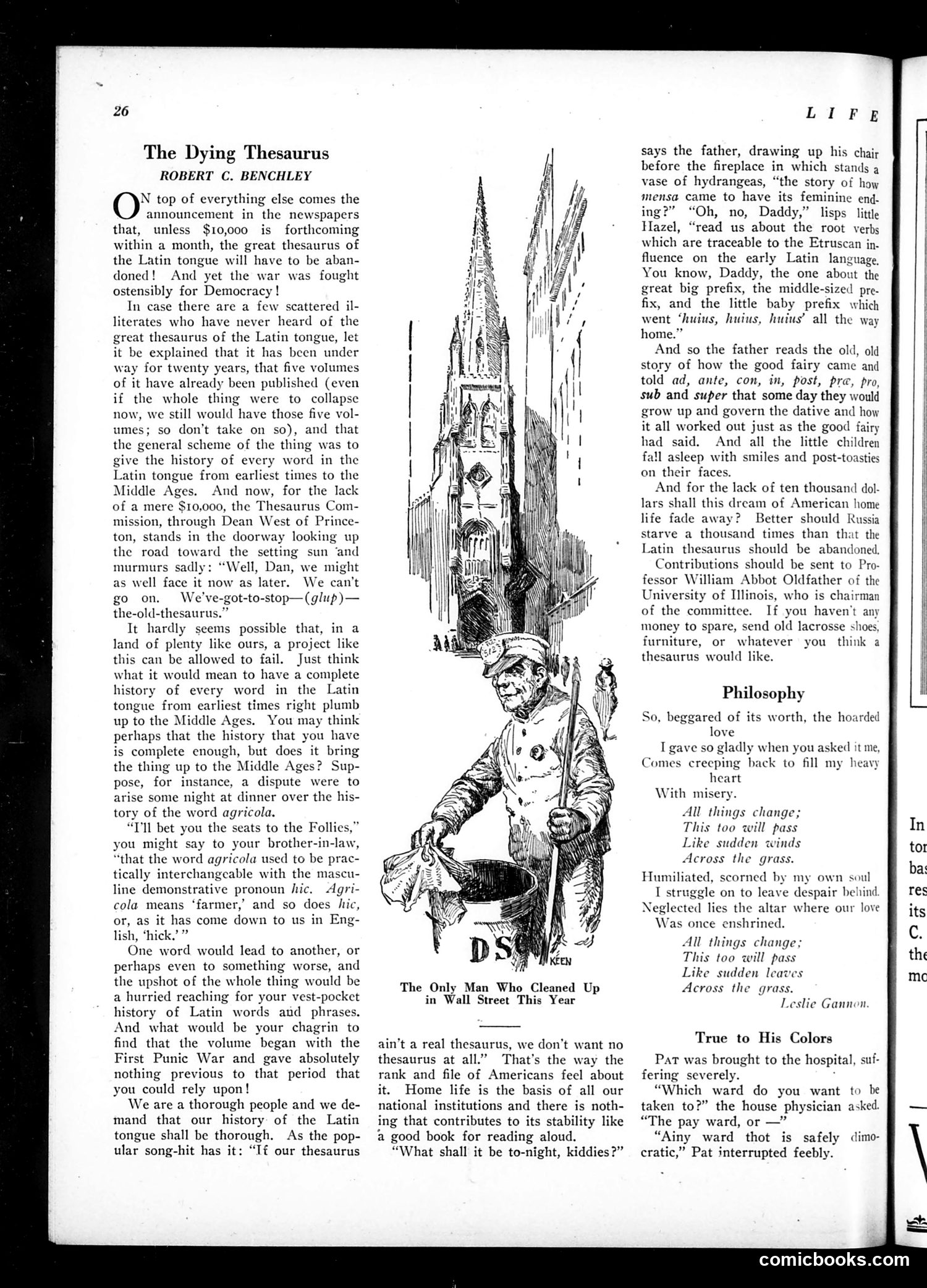
This is a satirical essay lamenting the threatened collapse of a major Latin linguistic project—a comprehensive thesaurus tracking Latin word usage from antiquity through the Middle Ages. The project requires only $10,000 to continue but faces abandonment. Benchley's satire is multilayered: he mocks American priorities (fighting WWI "for Democracy" while abandoning scholarship), uses absurdist humor (families reading Latin etymology aloud for bedtime stories), and criticizes the nation's failure to fund intellectual work. The cartoon depicts "the only man who cleaned up in Wall Street this year"—likely a wealthy financier—contrasting the ease of accumulating war profits against the difficulty of raising modest funds for academic pursuits. The piece satirizes both American anti-intellectualism and the disconnect between national resources and cultural investment during the post-WWI period.
📄 Transcribed text from this page (OCR, searchable)
Machine-transcribed from the original scan — historical spelling and the odd misread are preserved.
The Dying Thesaurus ROBERT C. BENCHLEY O top of everything else comes the announcement in the newspapers that, unless $10,000 is forthcoming within a month, the great thesaurus of the Latin tongue will have to be aban- doned! And yet the war was fought ostensibly for Democracy ! In case there are a few scattered il- literates who have never heard of the great thesaurus of the Latin tongue, let it be explained that it has been under way for twenty years, that five volumes of it have already been published (even if the whole thing were to collapse now, we still would have those five vol- umes; so don’t take on so), and that the general scheme of the thing was to give the history of every word in the Latin tongue from earliest times to the Middle Ages. And now, for the lack of a mere $10,000, the Thesaurus Com- mission, through Dean West of Prince- ton, stands in the doorway looking up the road toward the setting sun ‘and murmurs sadly Vell, Dan, we might as well face it now as later. We can't go on. We've-got-to-stop—(glup)— the-old-thesaurus, It hardly seems possible that, in a land of plenty like ours, a project like this can be allowed to fail. Just think what it would mean to have a complete history of every word in the Latin tongue from earliest times right plumb up to the Middle Ages. You may think perhaps that the history that you have is complete enough, but does it bring the thing up to the Middle Ages? Sup- pose, for instance, a dispute were to arise some night at dinner over the his- tory of the word agricola. “T'll bet you the seats to the Follies,” you might say to your brother-in-law, “that the word agricola used to be prac tically interchangeable with the ma: line demonstrative pronoun hic. Agri- cola means ‘farmer,’ and so does hic, or, as it has come down to us in Eng- lish, ‘hick.’ ” One word would lead to another, or perhaps even to something worse, and the upshot of the whole thing would be a hurried reaching for your vest-pocket history of Latin words and phrases. And what would be your chagrin to find that the volume began with the First Punic War and gave absolutely nothing previous to that period that you could rely upon! We are a thorough people and we de- mand that our history of the Latin tongue shall be thorough. As the pop- ular song-hit has it: “If our thesaurus The Only Man Who Cleaned Up in Wall Street This Year ain’t a real thesaurus, we don’t want no thesaurus at all.” That's the way the rank and file of Americans feel about it. Home life is the basis of all our national institutions and there is noth- ing that contributes to its stability like a good book for reading aloud. “What shall it be to-night, kiddies?” LIFE says the father, drawing up his chair before the fireplace in which stands a vase of hydrangeas, “the story of how mensa came to have its feminine end- ing?” “Oh, no, Daddy,” lisps little Hazel, “read us about the root verbs which are traceable to the Etruscan in. fluence on the early Latin language, You know, Daddy, the one about the great big prefix, the middle-sized pre. fix, and the little baby prefix which went ‘huius, huius, huius’ all the way home.” j And so the father reads the old, old story of how the good fairy came and told ad, ante, con, in, post, pre, pro, sub and super that some day they would grow up and govern the dative and how it all worked out just as the good fairy had said. And all the little children fall asleep with smiles and post-toasties on their faces. And for the lack of ten thousand dol- lars shall this dream of American home life fade away? Better should Russia starve a thousand times than that the Latin thesaurus should be abandoned, Contributions should be sent to Pro- fessor William Abbot Oldfather of the University of Illinois, who is chairman of the committee. If you haven't any money to spare, send old lacrosse shoes, furniture, or whatever you think a thesaurus would like. Philosophy So, beggared of its worth, the hoarded love I gave so gladly when you asked it me, Comes creeping back to fill my heavy heart With misery. All things change; This too will pass Like sudden winds Across the grass. Humiliated, scorned by my own soul I struggle on to leave despair behind. Neglected lies the altar where our love Was once enshrined. All things change; This too will pas. Like sudden leaves Across the grass. Leslie Gannon. True to His Colors Pat was brought to the hospital, suf- fering severely. i “Which ward do you want to be taken to?” the house physician asked. “The pay ward, or —” “Ainy ward thot is safely dimo- cratic,” Pat interrupted feebly. nt | 15. comicbooks.com