
Life, 1921-09-22 · page 24 of 34
Life — September 22, 1921 — page 24: what you’re looking at
What you’re looking at
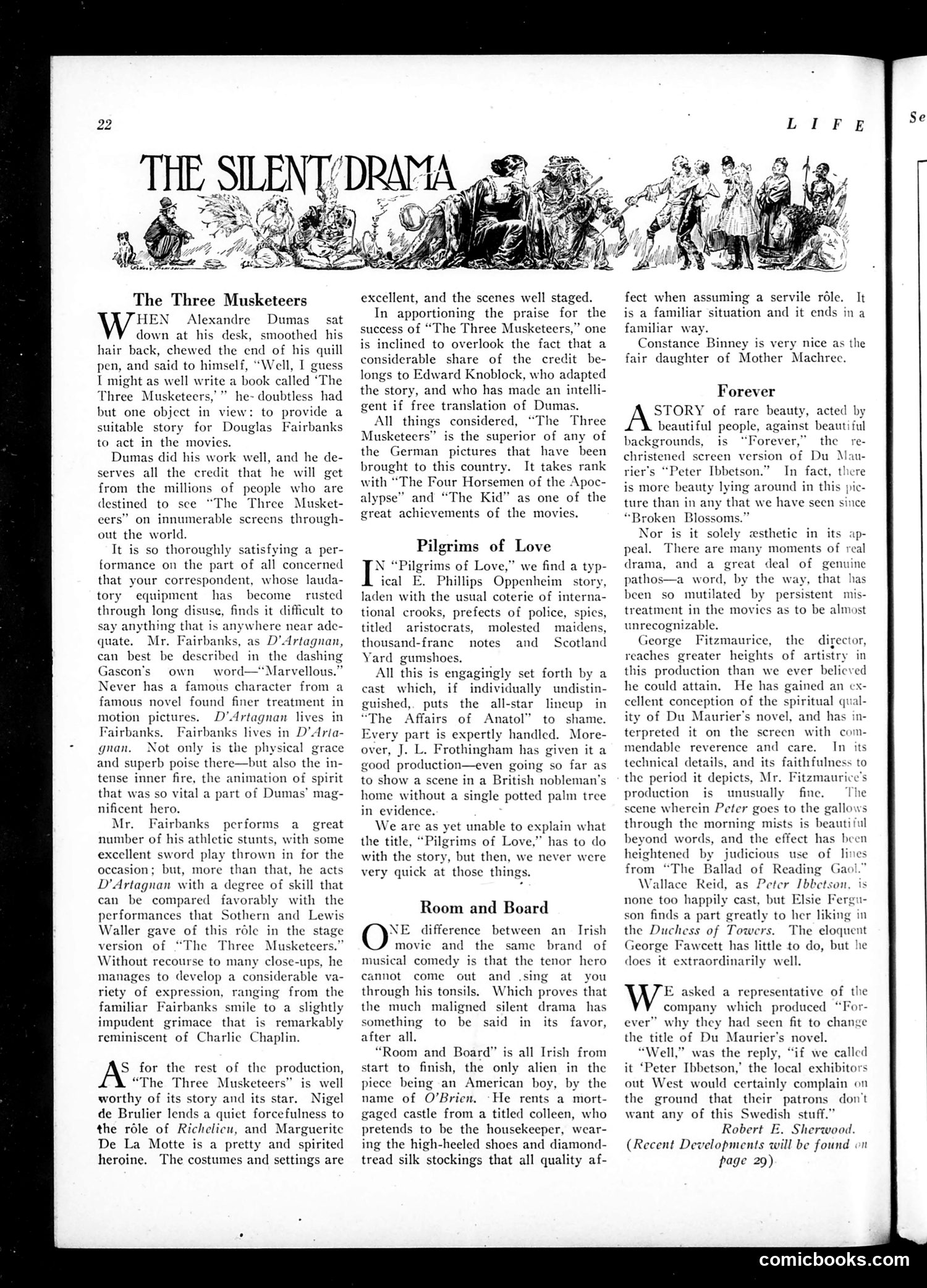
This page contains three separate film reviews from Life magazine's entertainment section, likely from the 1920s based on references to Douglas Fairbanks and silent cinema. **The Three Musketeers** review humorously suggests Alexandre Dumas wrote his novel specifically to provide material for actor Douglas Fairbanks's film adaptation. The critic praises Fairbanks's performance as D'Artagnan, comparing him favorably to famous stage actors Sothern and Waller. The review emphasizes Fairbanks's physical athleticism and emotional range, noting his distinctive smile and Chaplin-esque expressions. **Pilgrims of Love** receives a more mixed assessment—a typical spy story with stock characters (criminals, aristocrats, Scotland Yard agents). The critic mocks the title's disconnect from the plot and jokes about the film showing a British home without decorative potted plants, suggesting such props were standard movie set dressing. **Room and Board** begins discussing differences between Irish film and musical comedy, suggesting cinema's silence eliminates sung dialogue that stage tenors would perform. The page demonstrates period film criticism's tone: witty, somewhat condescending, yet engaging.
📄 Transcribed text from this page (OCR, searchable)
Machine-transcribed from the original scan — historical spelling and the odd misread are preserved.
The Three Musketeers HEN Alexandre Dumas - sat down at his desk, smoothed his hair back, chewed the end of his quill pen, and said to himself, “Well, I guess I might as well write a book called ‘The Three Musketeers,” he- doubtless had but one object in view: to provide a suitable story for Douglas Fairbanks to act in the movies. Dumas did his work well, and he de- serves all the credit that he will get from the millions of people who are destined to sce “The Three Musket- eers” on innumerable screens through- out the world. It is so thoroughly satisfying a per- formance on the part of all concerned that your correspondent, whose lauda- tory equipment has become rusted through long disuse, finds it difficult to say anything that is anywhere near ade- quate. Mr. Fairbanks, as D’Artagnan, can best be described in the dashing Gascon’s own word—*Marvellou Never has a famous character from a famous novel found finer treatment in motion pictur: D’Artagnan lives in Fairbanks. Fairbanks lives in D’Arta- gnan. Not only is the physical grace and superb poise there—but also the in- tense inner fire, the animation of spirit that was so vital a part of Dumas’ mag- nificent hero. Mr. Fairbanks performs a_ great number of his athletic stunts, with some excellent sword play thrown in for the occasion; but, more than that, he acts D’Artagnan with a degree of skill that can be compared favorably with the performances that Sothern and Lewis Waller gave of this role in the stag version of “The Three Musketeers. Without recourse to many close-ups, he manages to develop a considerable va- riety of expression, ranging from the familiar Fairbanks smile to a slightly impudent grimace that is remarkably reminiscent of Charlic Chaplin. for the rest of the production, “The Three Musketeers” is well worthy of its story and its star. gel de Brulier lends a quiet forcefulness to the role of Richelicu, and Marguerite De La Motte is a pretty and spirited heroine. The costumes and settings are excellent, and the scenes well staged. In apportioning the praise for the The Three Musketeers,” one is inclined to overlook the fact that a considerable share of the credit be- longs to Edward Knoblock, who adapted the story, and who has made an intelli- gent if free translation of Dumas. All things considered, “The Three Musketeers” is the superior of any of the German pictures that have been brought to this country. It takes rank with “The Four Horsemen of the Apoc- alypse” and “The Kid” as one of the great achievements of the movies. Pilgrims of Love N “Pilgrims of Love,” we find a typ- ical E. Phillips Oppenheim story, laden with the usual coterie of interna- tional crooks, prefects of police, spics, titled aristocrats, molested maidens, thousand-frane notes and Scotland Yard gumshoes. All this is engag' cast which, if individually undistin- guished,. puts the all-star lineup in he Affairs of Anatol” to shame. Every part is expertly handled. More- over, J. L. Frothingham has given it a good production—even going so far as to show a scene in a British nobleman’s home without a single potted palm tree in evidence. We are as yet unable to explain what the title, “Pilgrims of Love,” has to do with the story, but then, we never were very quick at those things. igly set forth by Room and Board NE difference between an Irish movie and the same brand of musical comedy is that the tenor hero cannot come out and .sing at you through his tonsils. Which proves that the much maligned silent drama has something to be said in its favor, after all. “Room and Board” is all Irish from start to finish, the only alien in the piece being an American boy, by the name of O’Brien. -He rents a mort- gaged castle from a titled colleen, who pretends to be the housekeeper, wear- ing the high-heeled shoes and diamond- tread silk stockings that all quality af- fect when assuming a servile réle. It is a familiar situation and it ends ina familiar way. Constance Binney is very nice as the fair daughter of Mother Machrec. Forever STORY of rare beauty, acted by beautiful people, against beautiful backgrounds, is “Forever,” the re- christened screen version of Du Mau- rier’s “Peter Ibbetson.” In fact, there is more beauty lying around in this pic- ture than in any that we have seen since “Broken Blossoms.” Nor is it solely zsthetic in its ap- peal. There are many moments of real drama, and a great deal of genuine pathos—a word, by the way, that has been so mutilated by persistent mis- treatment in the movics as to be almost unrecognizable. zmaurice, the director, reaches greater heights of artistry in this production than we ever believed he could attain. He has gained an cx cellent conception of the spiritual qi ity of Du Maurier’s novel, and has i terpreted it on the screen with co mendable reverence and care. In technical details, and its faithfulness to the period it depicts, Mr. Fitzmaurice’ production is unusually fine. Th scene wherein Peter goes to the gallows through the morning mists is beautiful beyond words, and the effect has been heightened by judicious use of lines from “The Ballad of Reading Gaol.” Wallace Reid, as Peter Ibbctson, is none too happily cast, but Elsie Fergu- son finds a part greatly to her liking in the Duchess of Towers. The eloquent George Fawcett has little to do, but he does it extraordinarily well. E asked a representative of the company which produced “For- ever” why they had seen fit to change the title of Du Maurier’s novel. “Well,” was the reply, “if we called it ‘Peter Ibbetson,’ the local exhibitors out West would certainly complain on the ground that their patrons don't want any of this Swedish stuff. Robert E. Sherwood. (Recent Developments will be found on page 29) comicbooks.com