
Life, 1921-09-22 · page 20 of 34
Life — September 22, 1921 — page 20: what you’re looking at
What you’re looking at
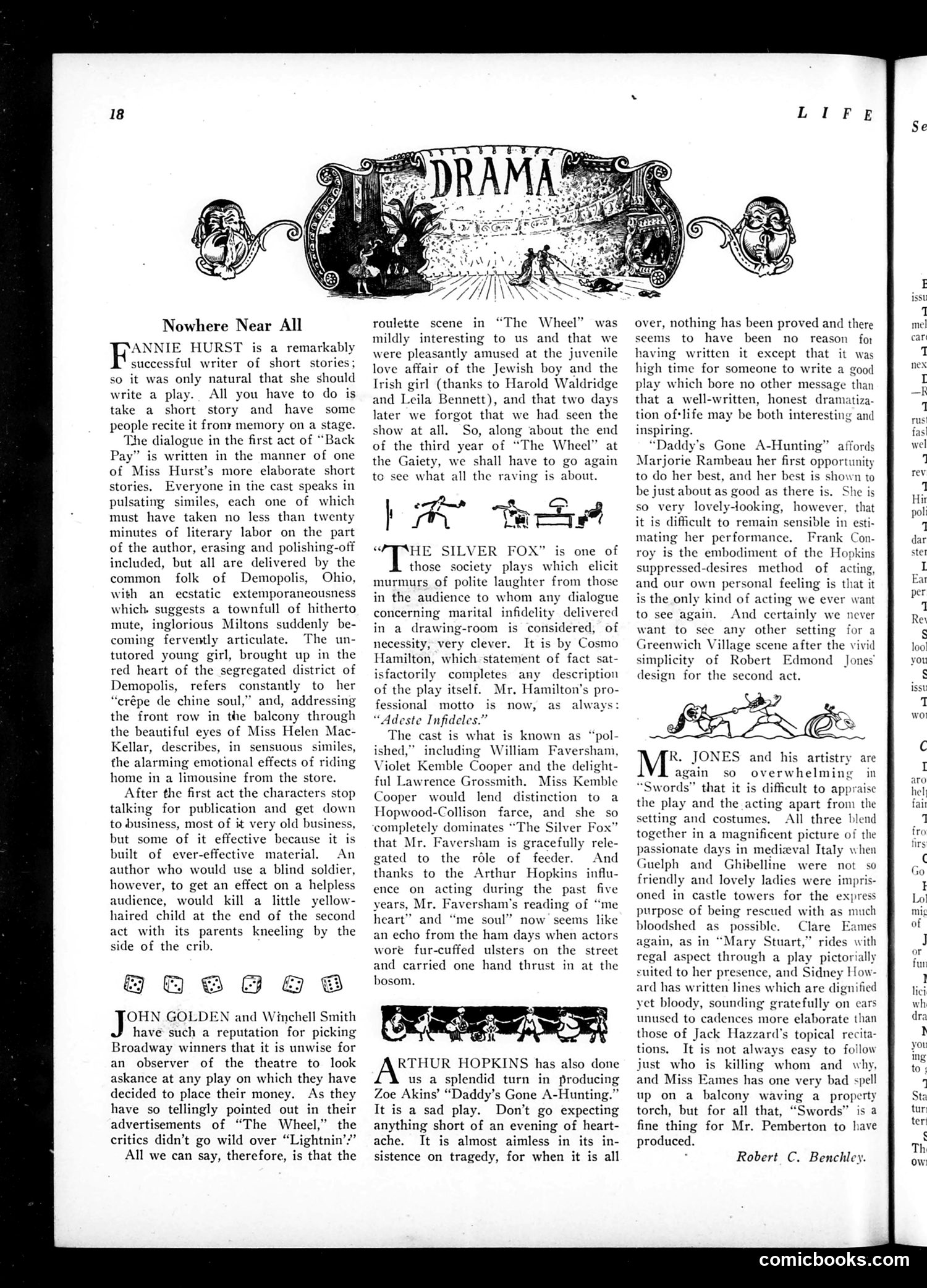
This is a theater review page critiquing several Broadway productions. The author (Robert C. Benchley, based on the byline) uses satirical commentary to mock both the plays and their audiences. **Key targets:** - **"Hack Pay"** by Fannie Hurst: Benchley ridicules the adaptation of her short story, mocking how common Ohio townspeople deliver overly literary dialogue ("crépe de chine soul") with affected sophistication—an absurd mismatch between characters and language. - **"The Wheel"**: Despite producer endorsements (Goldin and Smith), Benchley dismisses it as forgettable, sarcastically suggesting they'll forget it within three years. - **"The Silver Fox"**: A predictable society infidelity play by Cosmo Hamilton that elicits polite rather than genuine laughter. Benchley criticizes affected acting styles, referencing outdated "ham" performance. - **"Daddy's Gone A-Hunting"**: Praised as genuinely sad (not derivative or pretentious). The satire targets theatrical pretension, particularly the gap between ambitious literary source material and shallow stage execution, and actors who mimic overwrought performance styles.
📄 Transcribed text from this page (OCR, searchable)
Machine-transcribed from the original scan — historical spelling and the odd misread are preserved.
Nowhere Near All ANNIE HURST is a remarkably uccessful writer of short stories; so it was only natural that she should write a play. All you have to do is take a short story and have some people recite it fromm memory on a stage. The dialogue in the first act of “Ba Pay” is written in the manner of one of Miss Hurst’s more elaborate short stories. Everyone in the cast speaks in pulsating similes, each one of which must have taken no less than twenty minutes of literary labor on the part of the author, erasing and polishing-off included, but all are delivered by the common folk of Demopolis, Ohio, with an ecstatic extemporaneousness which. suggests a townfull of hitherto mute, inglorious Miltons suddenly be- coming fervently articulate. The un- tutored young girl, brought up in the red heart of the segregated district of Demopolis, refers constantly to her “crépe de chine soul,” and, addressing the front row in the balcony through the beautiful eyes of Miss Helen Mac- Kellar, describes, in sensuous similes, the alarming emotional effects of riding home in a limousine from the store. After the first act the characters stop talking for publication and get down to business, most of it very old business, but some of it effective because it is built of ever-effective material. An author who would use a blind soldier, however, to get an effect on a helpless audience, would kill a little yellow- haired child at the end of the second act with its parents kneeling by the side of the crib. 8 os ages and Winchell Smith fe GOLDEN have such a reputation for picking Broadway winners that it is unwise for an observer of the theatre to look askance at any play on which they have decided to place their money. As they have so tellingly pointed out in their advertisements of “The Wheel,” the critics didn’t go wild over “Lightnin’:” All we can say, therefore, is that the roulette scene in “The Wheel” was mildly interesting to us and that we were pleasantly amused at the juvenile love affair of the Jewish boy and the Irish girl (thanks to Harold Waldridge and Leila Bennett), and that two days later we forgot that we had seen the show at all. So, along about the end of the third year of “The Wheel” at the Gaiety, we shall have to go again to see what all the raving is about. ) re woe as HE SILV FOX” one of those society plays which elicit murmurs of polite laughter from those in the audience to whom any dialogue concerning marital infidelity delivered in a drawing-room is considered, of necessity, very clever. It is by Cosmo Hamilton, which statement of fact sat- isfactorily completes any description of the play itself. Mr. Hamilton's pro- fessional motto is now, as always: “Adeste Infideles.” The cast is what is known as “pol- ished,” including William Faversham, Violet Kemble Cooper and the delight- ful Lawrence Grossmith. Miss Kemble Cooper would lend distinction to a Hopwood-Collison farce, and she so completely dominates “The Silver Fox” that Mr. Faversham is gracefully rele- gated to the role of feeder. And thanks to the Arthur Hopkins influ- ence on acting during the past five years, Mr. Faversham’s reading of “me heart” and “me soul” now seems like an echo from the ham days when actors wore fur-cuffed ulsters on the street and carried one hand thrust in at the bosom. RTHUR HOPKINS has also done us a splendid turn in producing oe Akins’ “Daddy’s Gone A-Hunting.” It is a sad play. Don’t go expecting anything short of an evening of heart- ache. It is almost aimless in its in- sistence on tragedy, for when it is all over, nothing has been proved and there seems to have been no reason for having written it except that it was high time for someone to write a good play which bore no other message than that a well-written, honest dramatiza- tion of-life may be both interesting and inspiring. “Daddy's Gone A-Hunting” affords Marjorie Rambeau her first opportunity to do her best, and her best is shown to be just about as good as there is. She is so very lovely-looking, however, that it is difficult to remain sensible in esti- mating her performance. Frank Con- roy is the embodiment of the Hopkins suppressed-desires method of acting, and our own personal feeling is that it is the only kind of acting we ever want to see again. And certainly we never want to see any other setting for a Greenwich Village scene after the vivid simplicity of Robert mond Jones’ design for the second act. R. JONES and his artistry are again so overwhelming in Swords” that it is difficult to appraise the play and the acting apart from the setting and costumes. All three blend together in a magnificent picture of the passionate days in medieval Italy when Guelph and Ghibelline were not so friendly and lovely ladies were impris- oned in castle towers for the express purpose of being rescued with as much bloodshed as possible. Clare mes again, as in “Mary Stuart,” rides with regal aspect through a play pictorially suited to her presence, and Sidney How- ard has written lines which are dignified yet bloody, sounding gratefully on ears unused to cadences more elaborate than those of Jack Hazzard's topical recita- tions. It is not always easy to follow just who is killing whom and why, and Miss Eames has one very bad spell up on a balcony waving a_ property torch, but for all that, “Swords” is a fine thing for Mr. Pemberton to have produced. i Robert C. Benchley. comicbooks.com