
A complete issue · 35 pages · 1921
Life — September 1, 1921
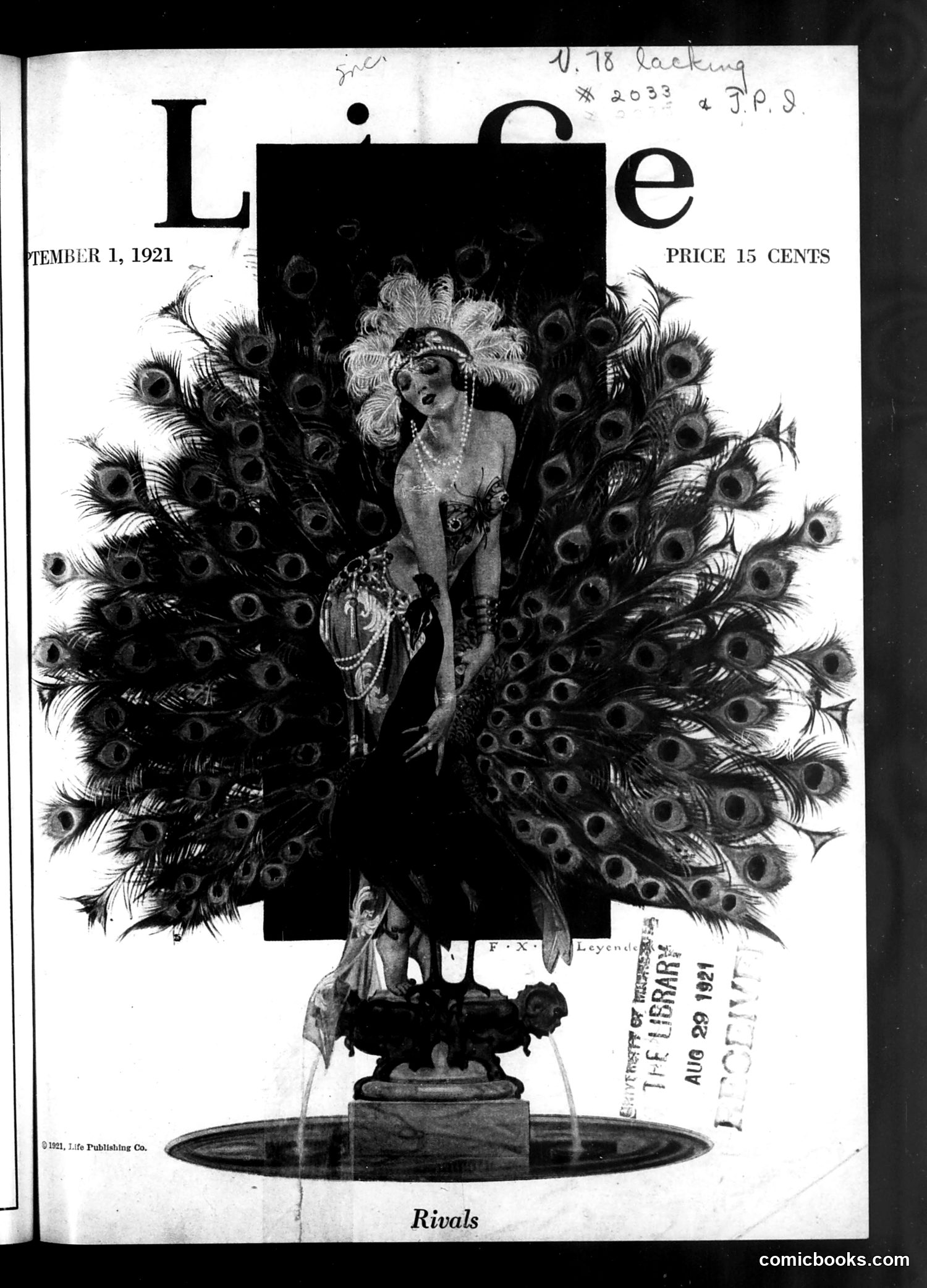
This cover depicts a woman in elaborate 1920s showgirl attire, adorned with an enormous peacock-feather headdress and pearls. She's posed on a pedestal in a theatrical stance. The satire appears to target the extravagance and artificiality of entertainment and celebrity culture during the Jazz Age. The title "Rivals" (visible at bottom) suggests commentary on competitive display or performance. The peacock imagery—traditionally representing vanity and ostentatious display—reinforces critique of superficiality. The 15-cent price and "Life Publishing Co." credit confirm this as the satirical *Life* magazine's cover commentary on contemporary entertainment excess and the performative nature of 1920s celebrity culture. The ornate costume represents the era's theatrical glamour, likely mocking its over-the-top aesthetics.
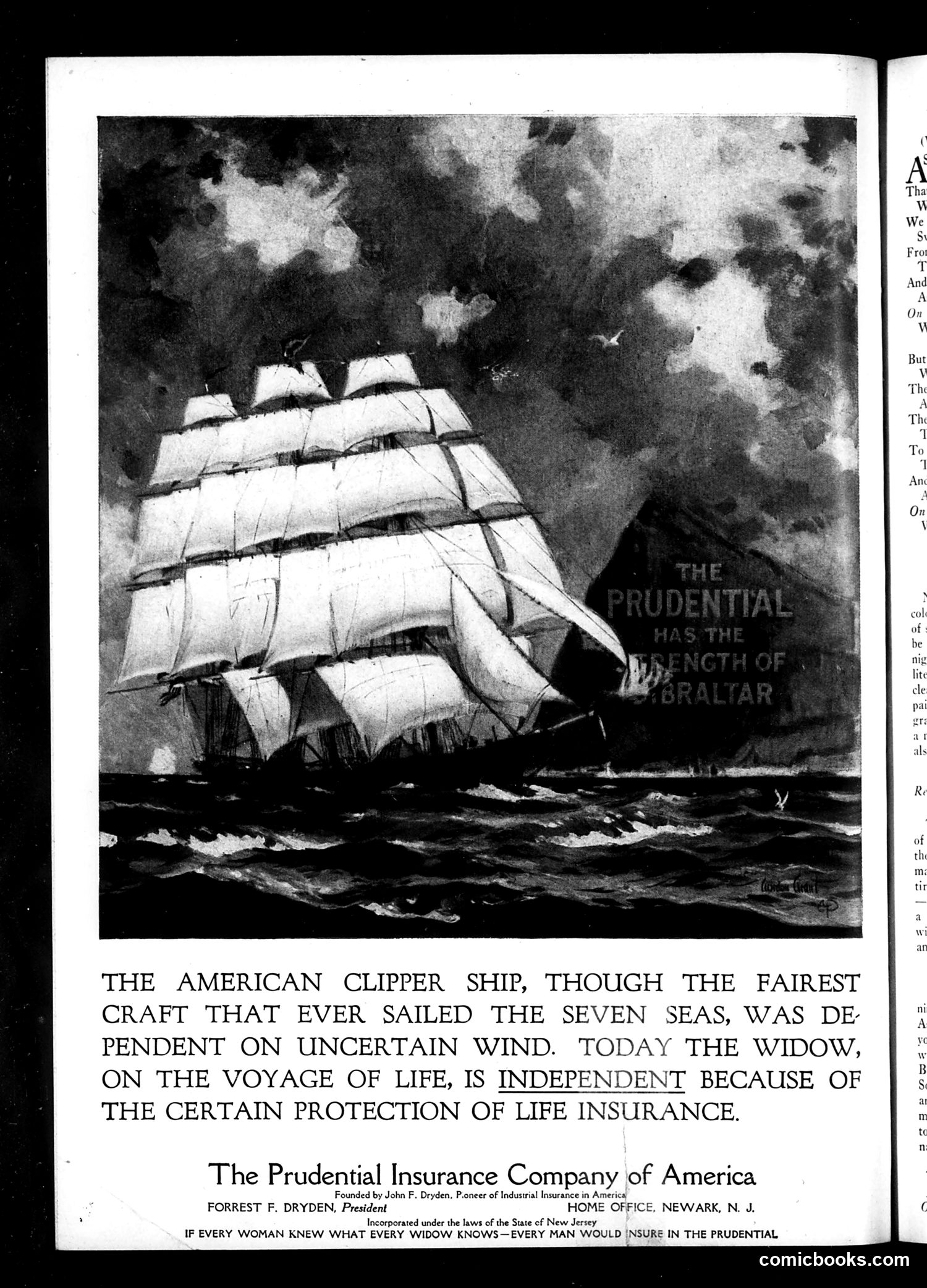
This is primarily **an advertisement**, not a cartoon or satirical editorial content. The Prudential Insurance Company uses a metaphorical image of an American clipper ship—a historically iconic vessel—to sell life insurance to widows. The ad's argument: Just as clipper ships were once dependent on unpredictable winds, widows today face uncertain futures. However, life insurance provides "certain protection," making them "independent" financially. The tagline—"IF EVERY WOMAN KNEW WHAT EVERY WIDOW KNOWS—EVERY MAN WOULD INSURE IN THE PRUDENTIAL"—targets male readers, urging them to buy policies to protect their wives after their deaths. This reflects early 20th-century attitudes about women's economic vulnerability and dependency, positioning insurance as the solution to widowhood's financial precarity.
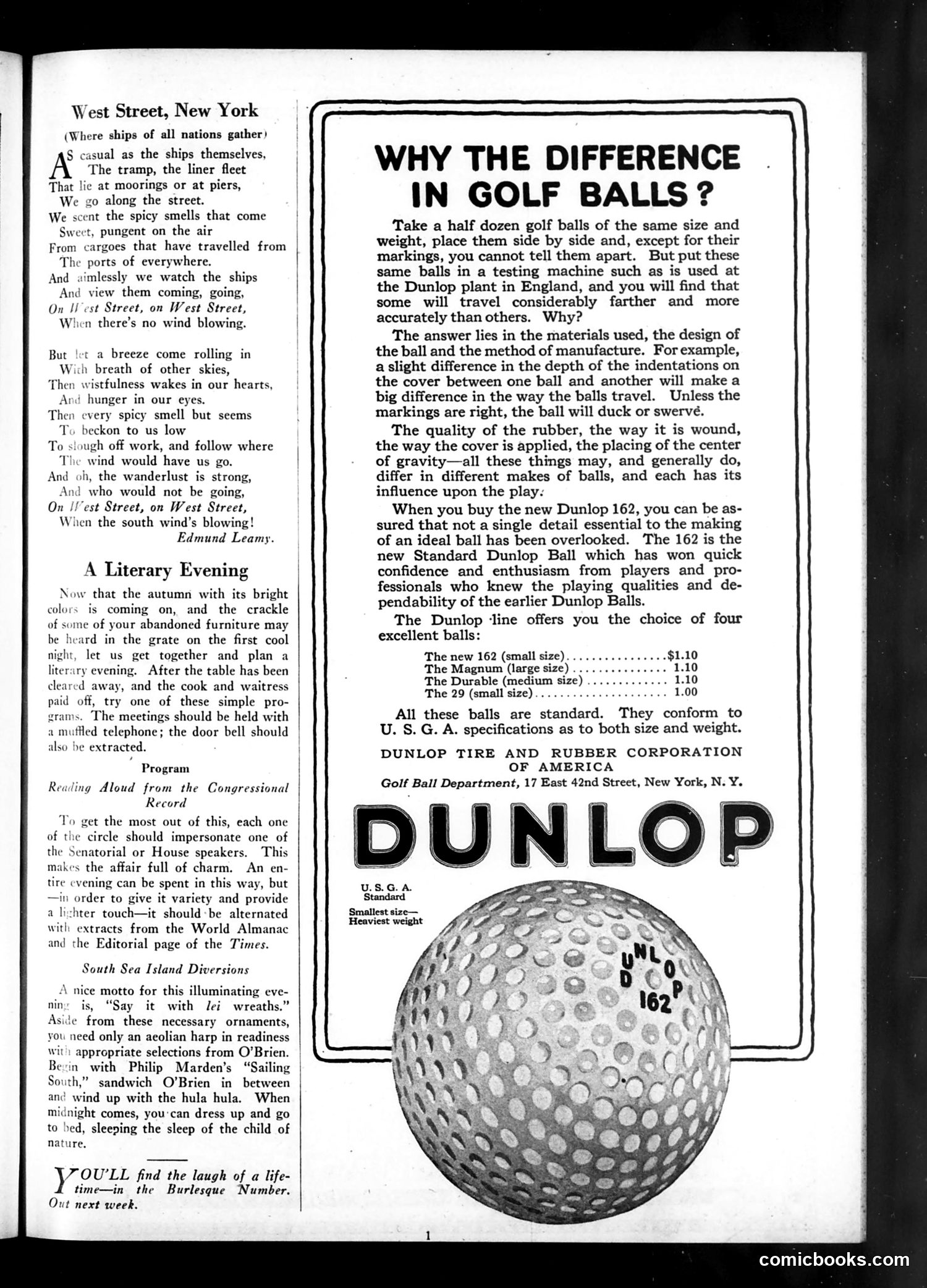
This page contains **no political cartoons or satire**. Instead, it features: 1. **"West Street, New York"** — a poem by Edmund Leamy celebrating the bustling maritime atmosphere of Manhattan's waterfront, with no satirical content. 2. **"A Literary Evening"** and **"South Sea Island Diversions"** — brief miscellaneous content suggestions for social gatherings. 3. **A large Dunlop golf ball advertisement** — the dominant feature. This is a straightforward commercial promoting four models of golf balls ($1.10–$1.00), emphasizing their conformity to U.S.G.A. specifications and explaining manufacturing differences affecting ball performance. The page is primarily **advertising and filler content**, not satirical commentary. Life magazine regularly interspersed such advertisements throughout its pages during this era.
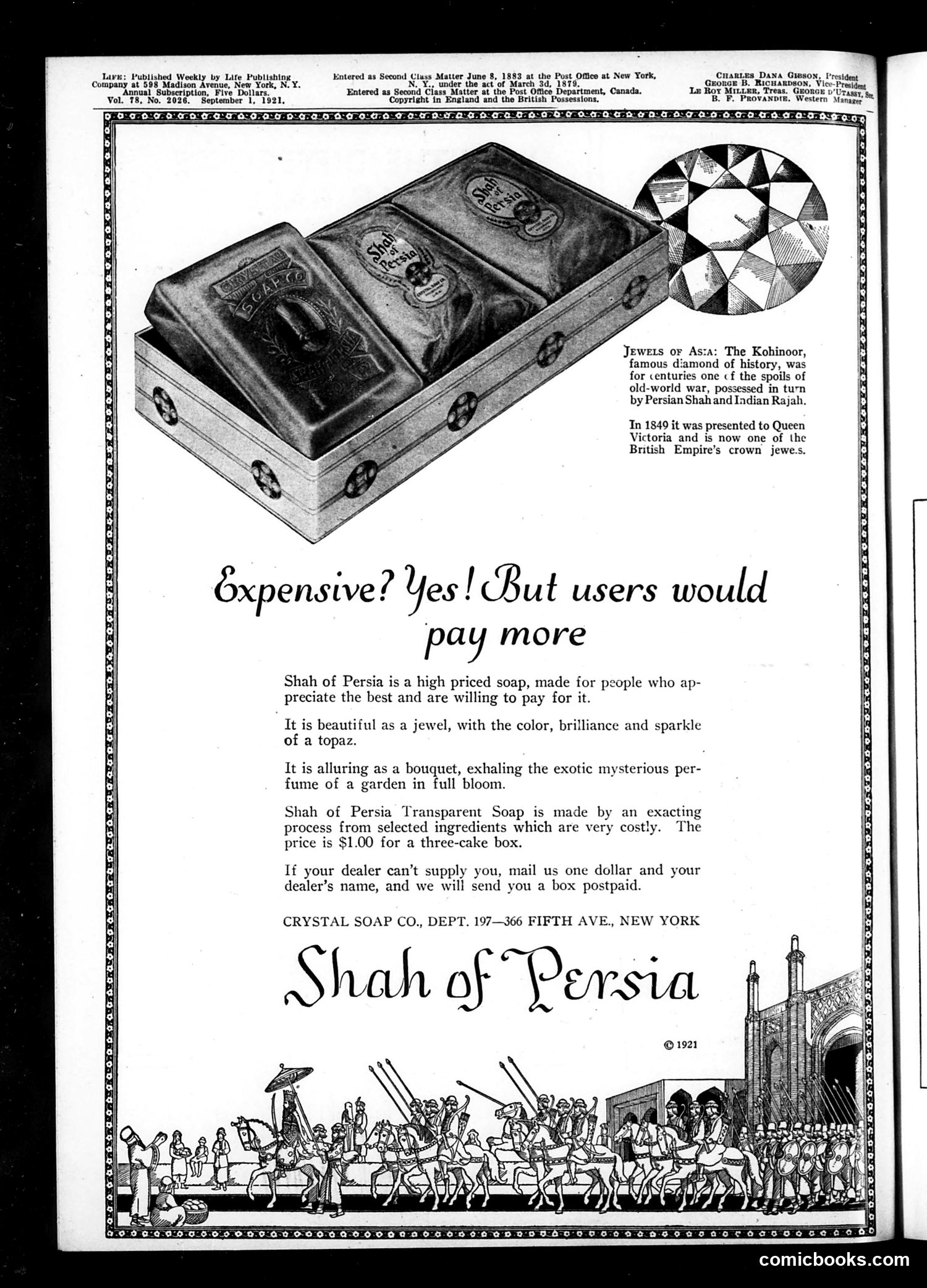
This is primarily a **luxury soap advertisement**, not political satire. The ad promotes "Shah of Persia Transparent Soap" by Crystal Soap Co., priced at $1.00 per three-cake box—expensive for 1921. The marketing strategy exploits **Orientalist appeal**: the product is positioned as exotic and precious, compared to jewels (specifically the Kohinoor diamond, noted in the sidebar). The copy emphasizes exclusivity for wealthy consumers willing to pay premium prices. The small illustration at bottom depicts a Persian court scene, reinforcing the "exotic luxury" brand identity rather than making any political statement. This reflects early 20th-century American marketing that capitalized on fascination with distant cultures and imperial imagery to sell high-end goods.
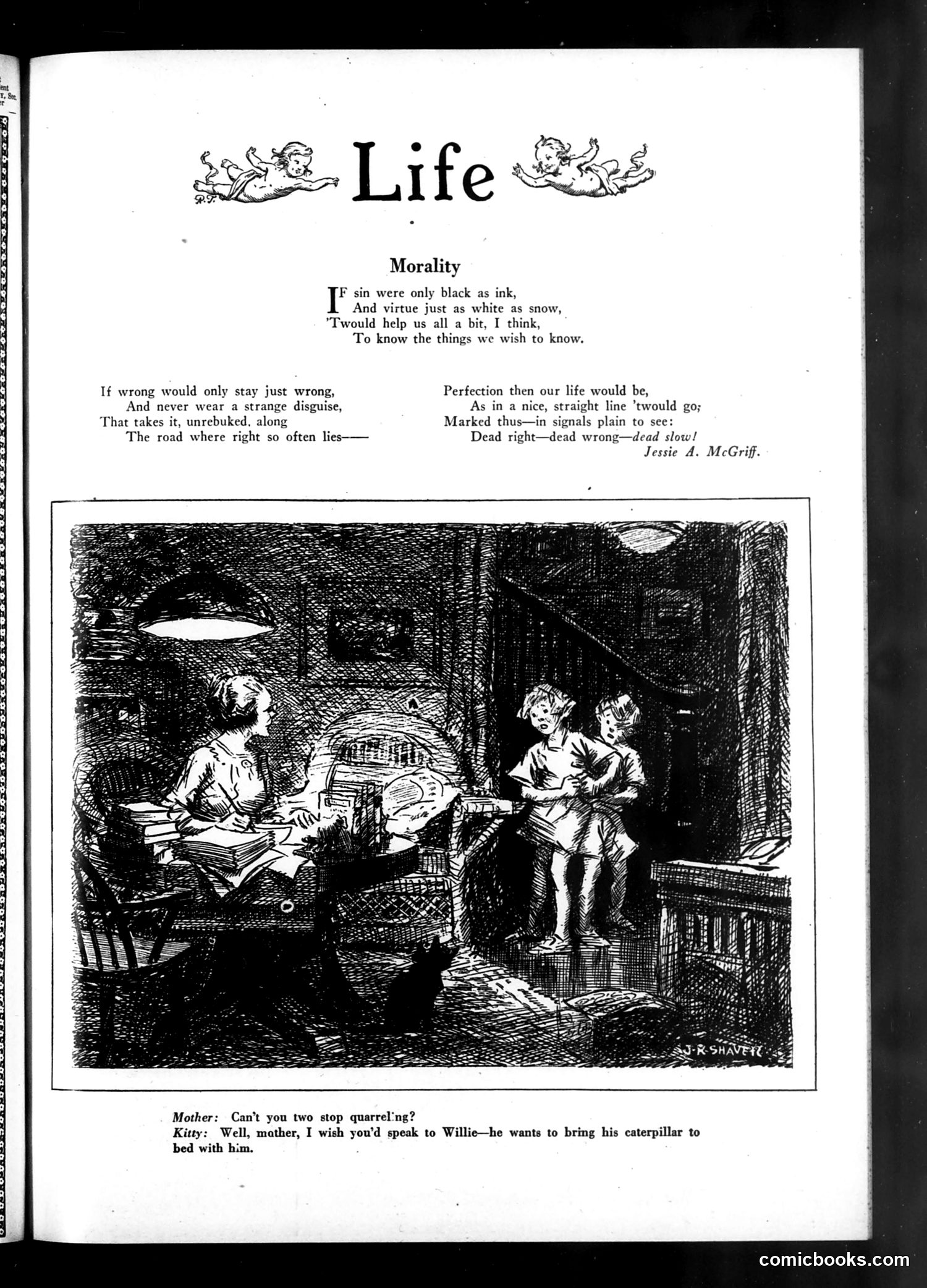
This page from *Life* magazine features a "Morality" section with philosophical verses about virtue and right conduct, accompanied by a domestic cartoon. The illustration depicts a mother and children in what appears to be a bedroom or nursery. The caption reveals the humor: the mother asks the children to stop quarreling, and the daughter (Kitty) responds that she wishes the mother would speak to Willie—who wants to bring his caterpillar to bed with him. The joke is a gentle domestic satire about sibling conflict and childhood logic. Rather than addressing the actual quarrel, the children redirect blame to Willie's eccentric desire to keep an insect as a bedtime companion. It's mundane family comedy reflecting early 20th-century domestic life, illustrating how children deflect responsibility—somewhat ironically placed beneath verses about morality and virtue.
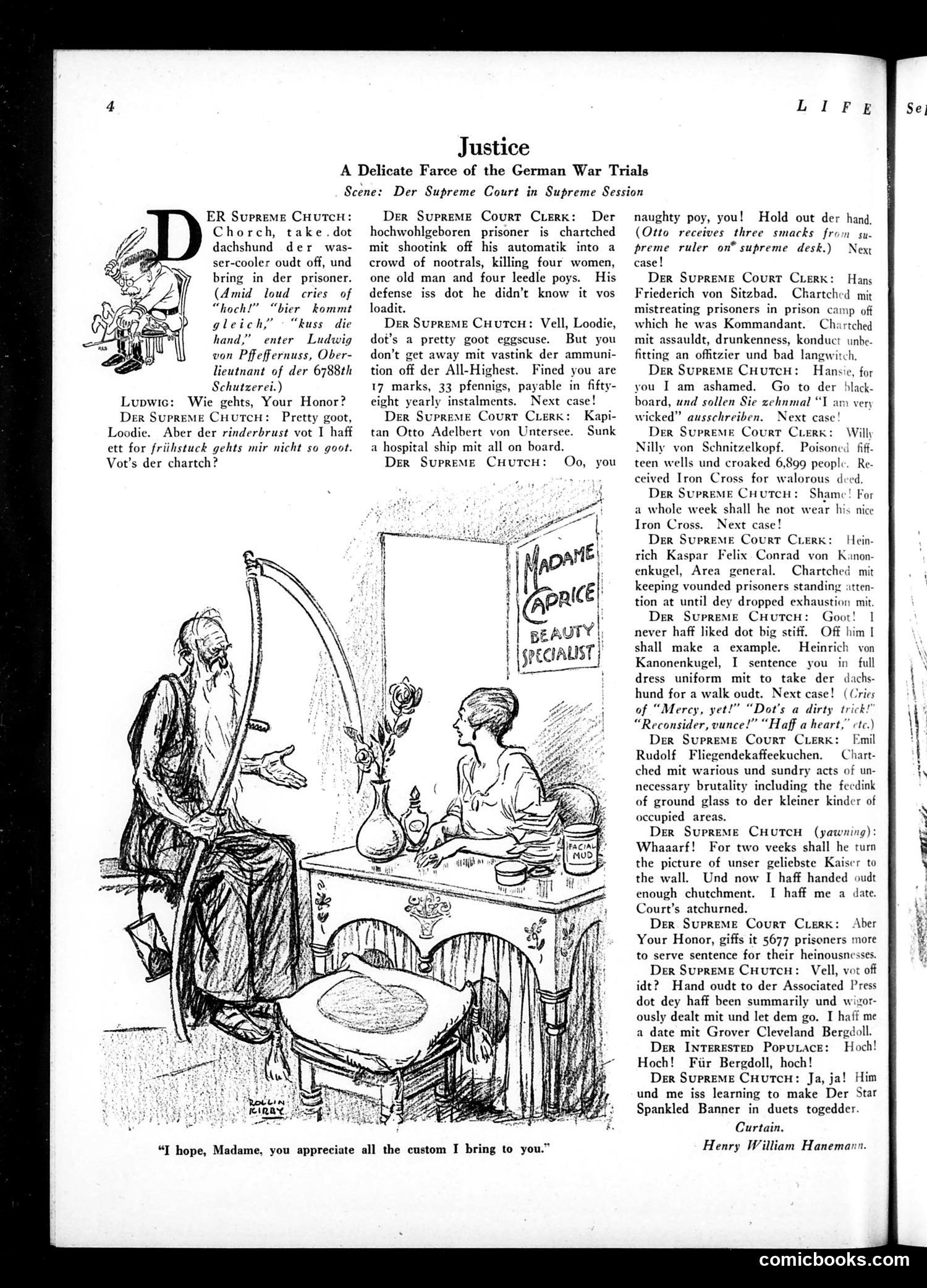
This satirical piece mocks the post-WWI German war crimes trials. The sketch shows Death (the skeletal figure with scythe, labeled as such in the visual) meeting with what appears to be a beauty specialist or cosmetic practitioner, suggesting the trials are merely superficial window-dressing rather than genuine justice. The dialogue lampoons judges issuing trivial punishments—fines in pennies, brief uniform-wearing requirements, week-long picture-hanging sentences—for serious crimes including prisoner abuse, assault, and violence. The satire argues these trials are performative theater that fails to address actual wartime atrocities. The title and "Madame Caprice Beauty Specialist" sign reinforce the critique: justice is being cosmetically applied rather than substantively administered.
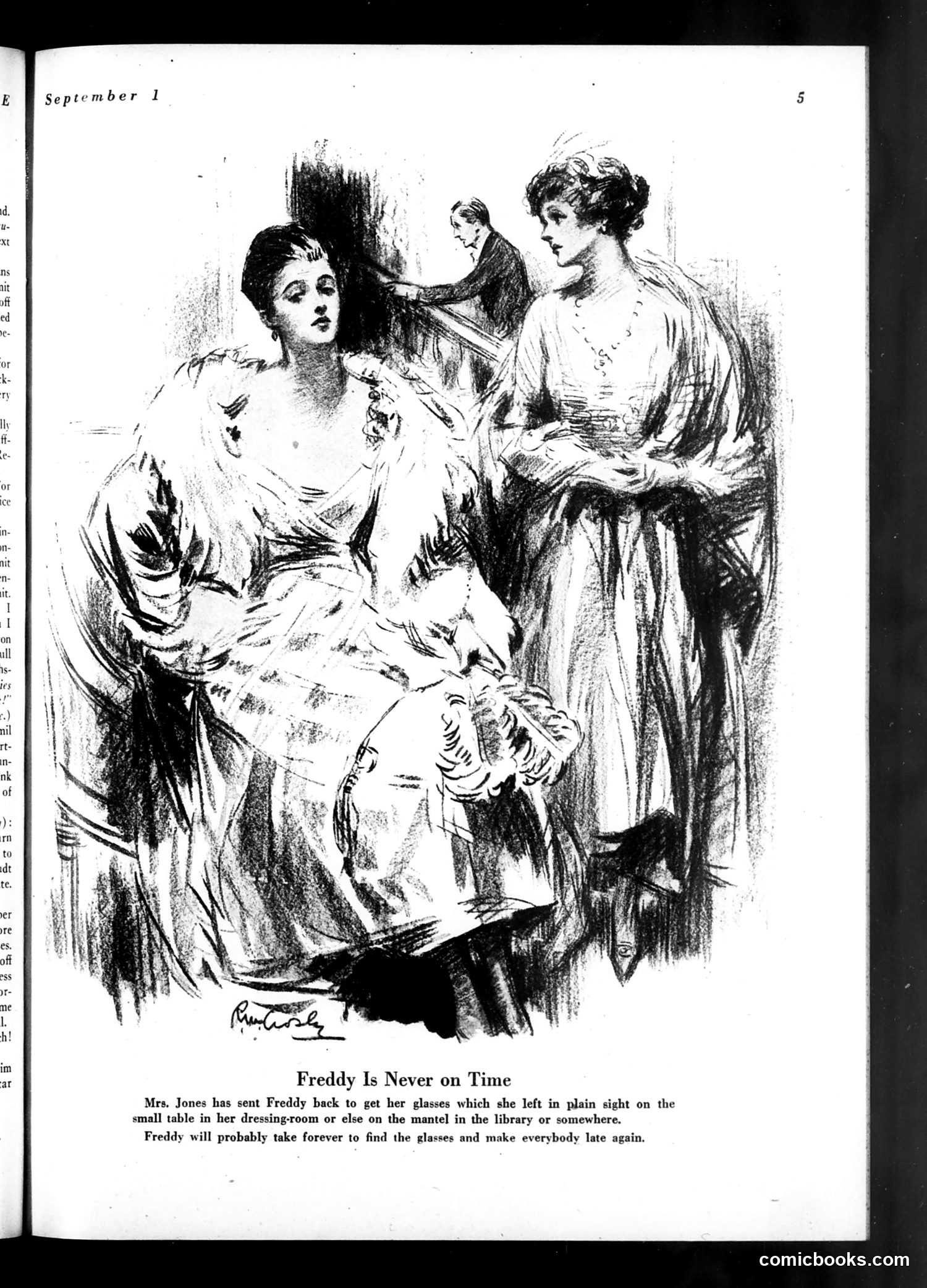
This is a domestic humor cartoon depicting a common household scenario. Mrs. Jones has sent someone named Freddy to retrieve her eyeglasses, which she left behind in her dressing room or library. The caption explains that Freddy "will probably take forever to find the glasses and make everybody late again." The cartoon satirizes chronic lateness—specifically, the frustration of someone tasked with a simple errand who nonetheless causes delays. The three figures (a seated woman, a standing woman, and a man in the background) appear to be waiting impatiently. This is gentle, relatable satire about everyday domestic annoyances rather than political commentary. The joke relies on readers recognizing the universal experience of being held up by someone's inefficiency.
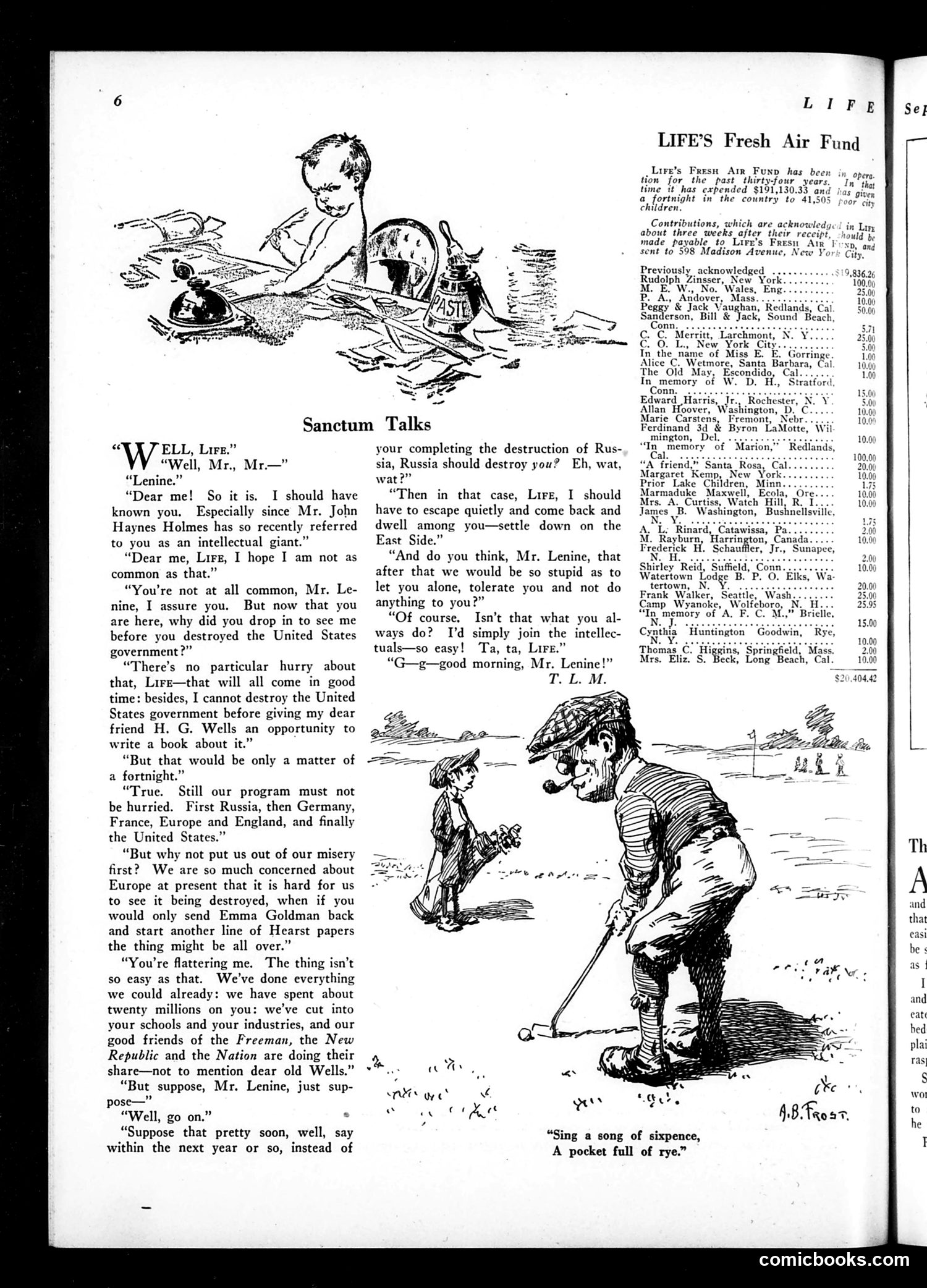
This page features a satirical dialogue between "Life" (the magazine personified) and "Lenin," the Russian Bolshevik leader. The cartoon mocks Lenin's revolutionary ambitions by having him boast about destroying Russia while Life questions the logic of his destructive political program. The satire critiques Lenin's willingness to demolish an entire nation's government and economy in pursuit of communist ideology. Life suggests this is foolish compared to more measured political reform. The accompanying illustration shows two figures in conversation, likely representing the abstract debate between revolutionary ideology and pragmatic Western capitalism. The "Fresh Air Fund" donation list indicates this was published when the Bolshevik Revolution was recent news to American readers (early 1920s).
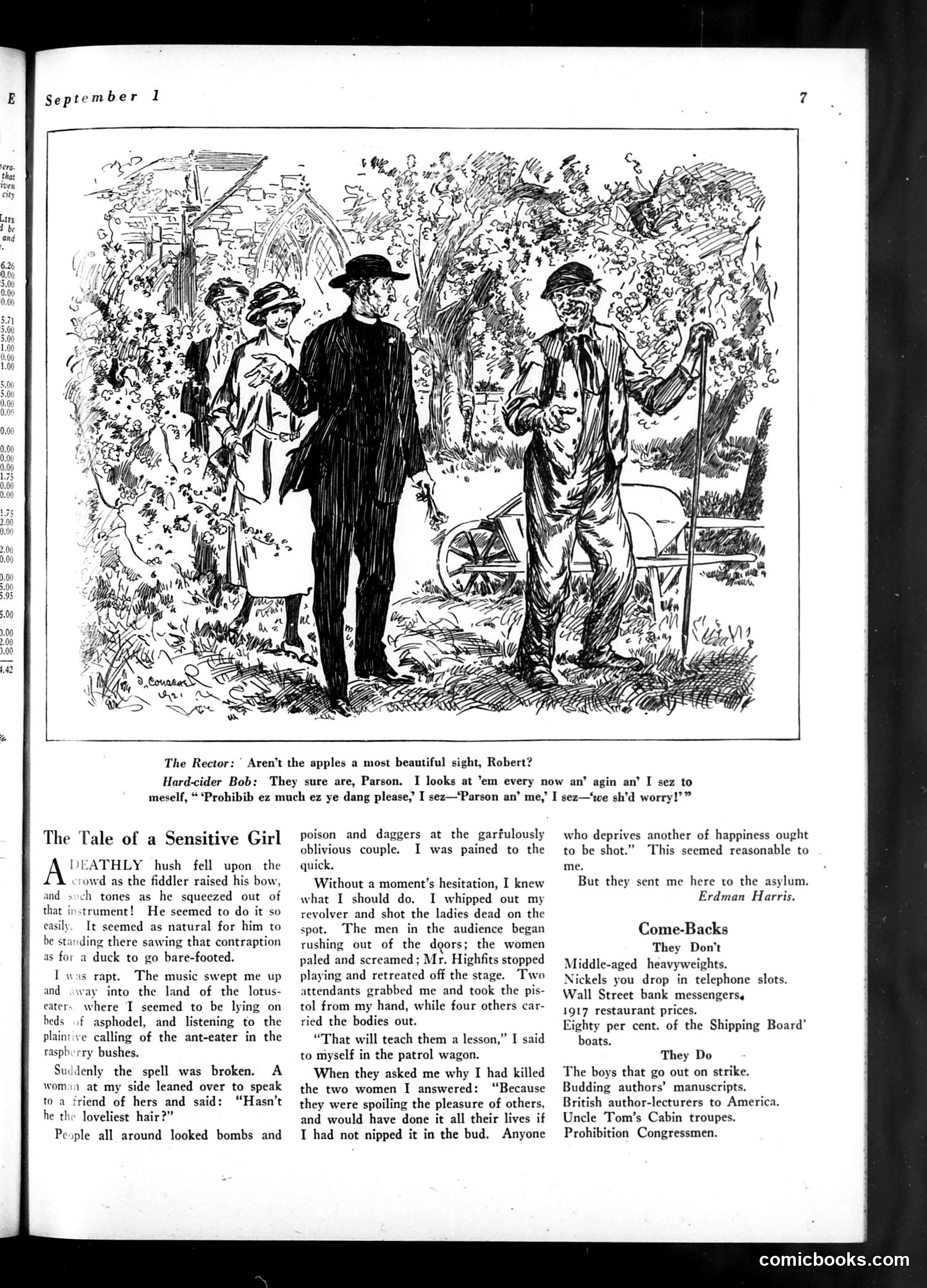
This page contains a narrative story titled "The Tale of a Sensitive Girl" by Erdman Harris, illustrated with a sketch showing five men in a rural setting—a parson, well-dressed gentleman, and laborers with a cart. The story concerns a man who shot two women dead during a theatrical performance, apparently to prevent them from "spoiling the pleasure of others." When questioned about killing them, he responds they were "oblivious" and undeserving of happiness. The authorities sent him to an asylum rather than prosecuting him criminally. The satire appears to mock misogyny and the tendency to excuse or minimize violence against women through claims of moral righteousness. The "sensitive girl" title is ironic—the real sensitivity belongs to the violent man who cannot tolerate women's presence.
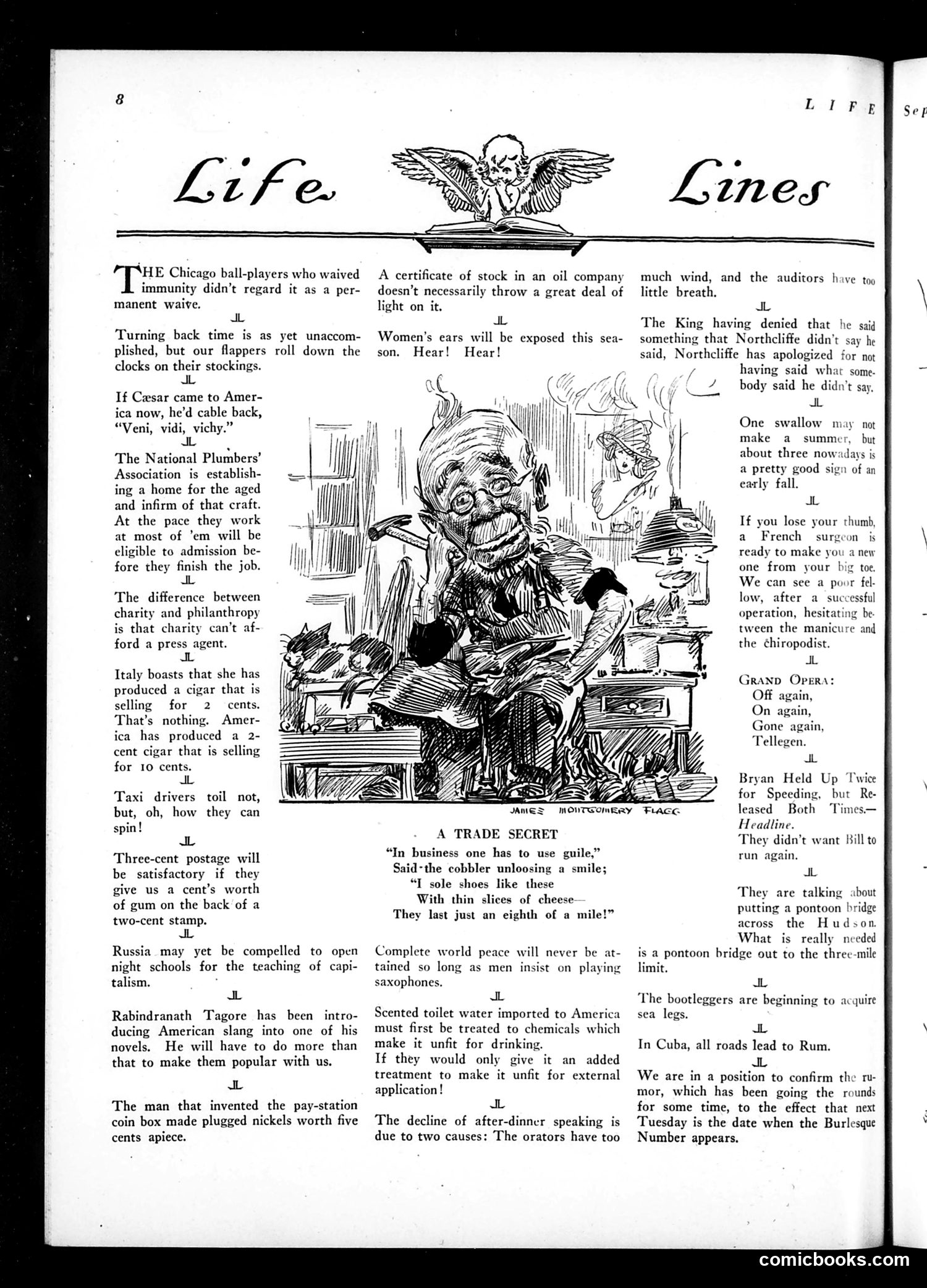
This page from *Life* magazine contains a collection of brief satirical observations and jokes rather than a single political cartoon. The central illustration depicts a cobbler at work, accompanying a joke about business practices and deception. The jokes target various contemporary subjects: Chicago baseball players' immunity claims, the National Plumbers' Association establishing retirement homes, Italy's cheap cigars, taxi drivers' spinning tales, and Russia's capitalist education. The cobbler illustration supports a quip about using "guile" in business—the cobbler "unlosing a smile" while selling cheap shoes as quality goods, suggesting commercial dishonesty was a recognized social problem worthy of satire. Overall, the page reflects early 20th-century concerns about commercial fraud, labor practices, and social hypocrisy through humor.
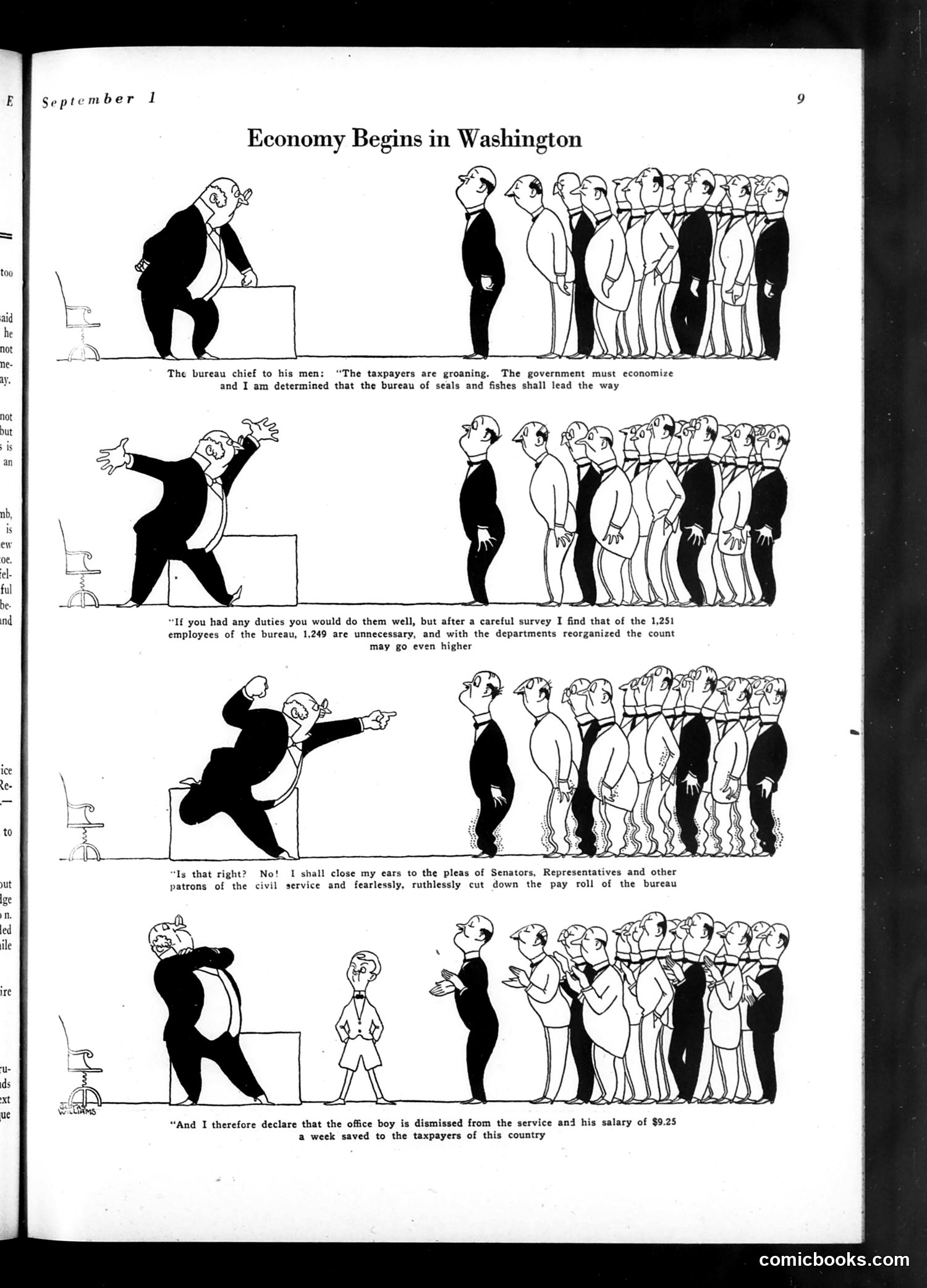
This satirical comic strip mocks a government official's (likely a bureau chief) contradictory actions regarding budget cuts. **The sequence:** The official declares to his staff that "taxpayers are groaning" and announces major downsizing—claiming 1,251 of 1,249 bureau employees are unnecessary. He then dramatically refuses to listen to Senators and Representatives pleading for mercy, vowing to "ruthlessly cut down the pay roll." **The punchline:** Despite his fierce rhetoric about economy, he dismisses only a single office boy, saving a mere $9.25 weekly—a trivial amount compared to his grand promises. **The satire:** This mocks politicians who grandstand about fiscal responsibility and government waste while taking minimal actual action, protecting their own bureaucratic interests while appearing to address taxpayer concerns.
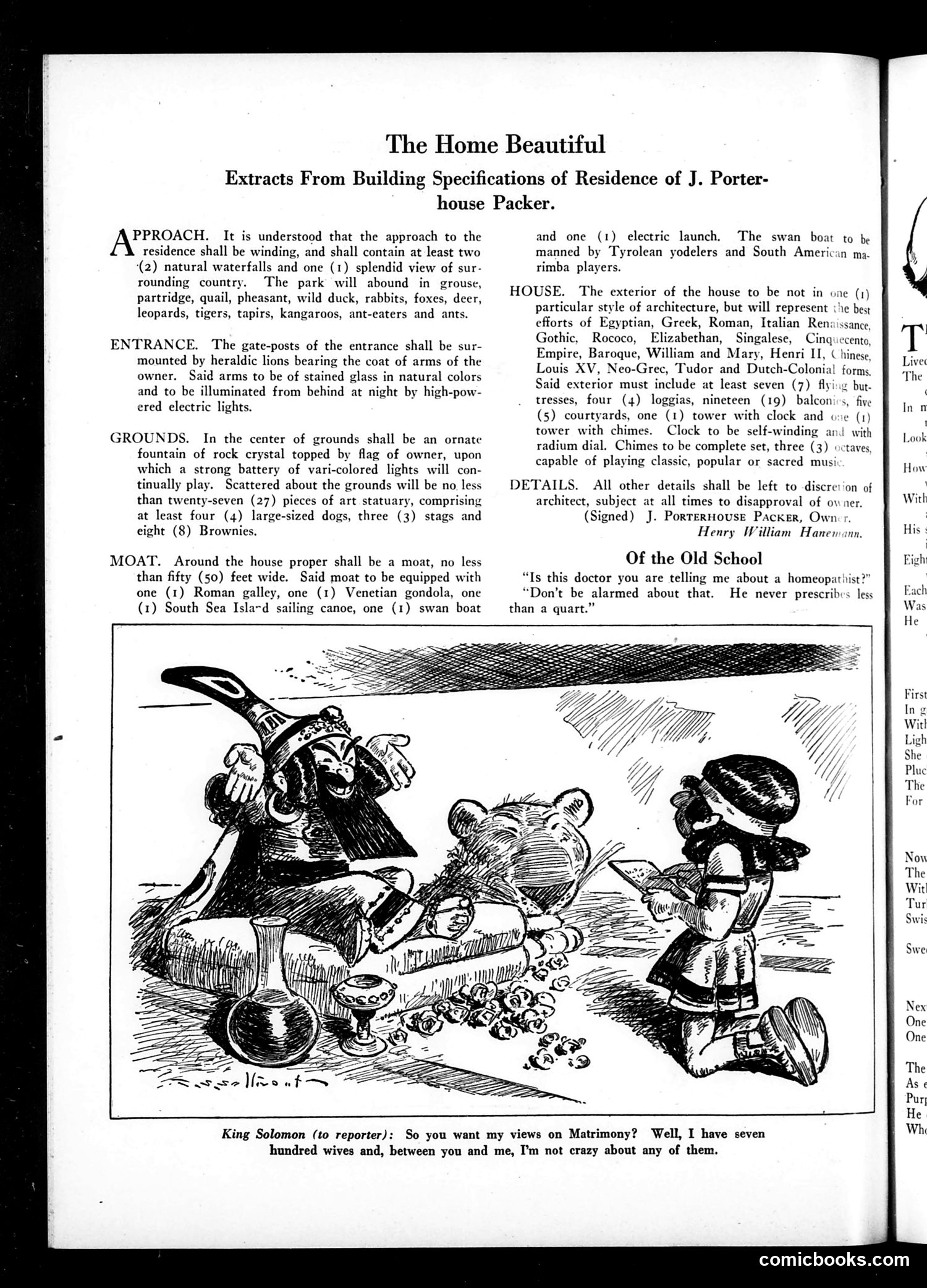
This page satirizes extreme luxury estate design through mock "building specifications" for an absurdly opulent residence. The specifications humorously describe outlandish features: a moat stocked with exotic vessels (Roman galleys, Venetian gondolas, swan boats), grounds containing art statuary and animal statuary (dogs, stags, Brownies), and architectural styles from every historical period simultaneously. The cartoon below depicts King Solomon, the biblical figure legendary for his vast wealth and numerous wives. A reporter asks for his views on matrimony; Solomon quips that with 700 wives, he's unbothered by marriage concerns. This references contemporary wealth inequality and satirizes how the ultra-rich live by different social rules than ordinary people. The humor lies in mocking both extravagant materialism and the casual amorality it enables.
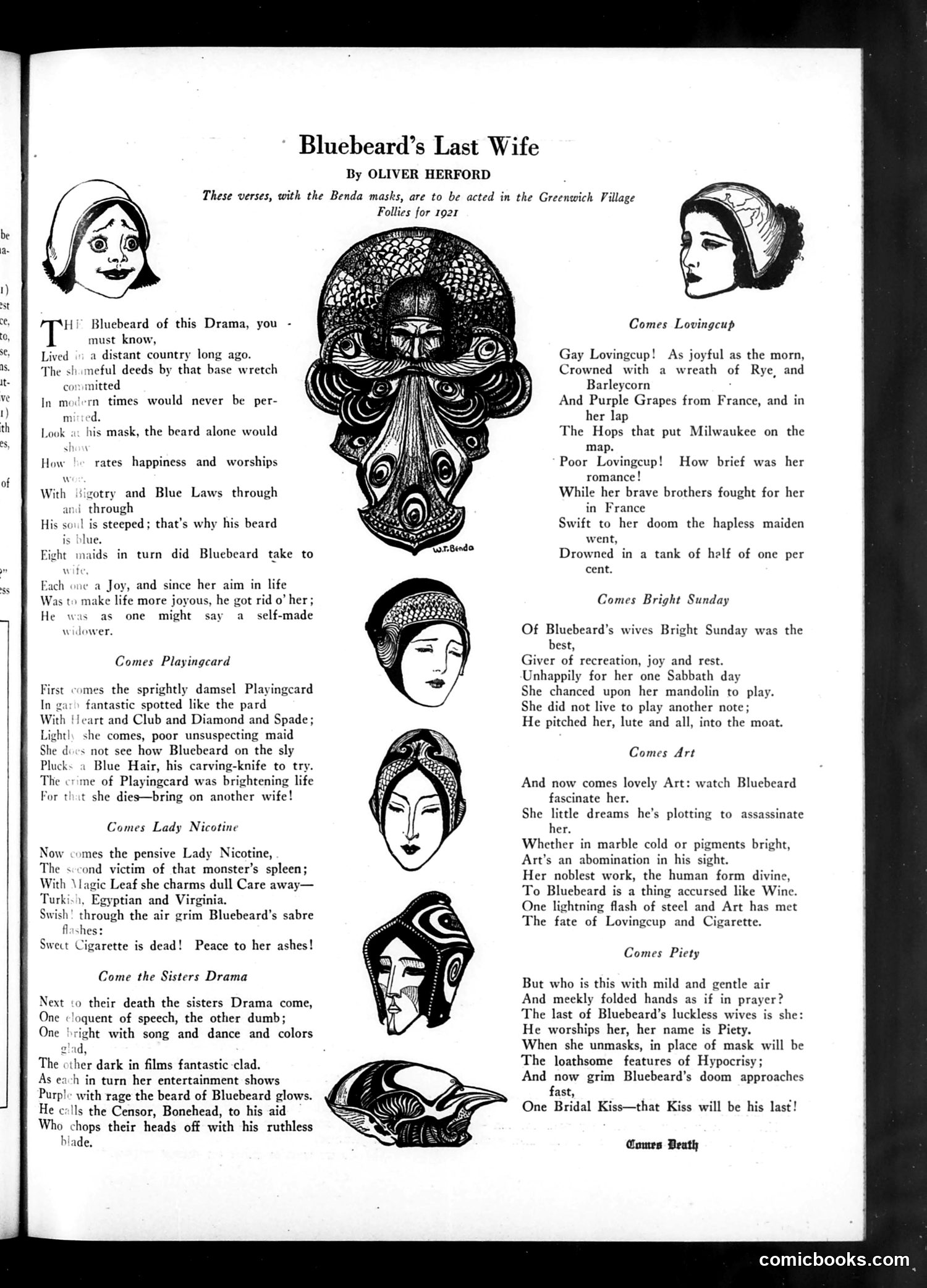
This is a satirical dramatic piece written by Oliver Herford for the 1921 Greenwich Village Follies. It reimagines the classic fairy tale of Bluebeard (a nobleman who murdered successive wives) as a stage production with various comic characters: Playingcard, Lady Nicotine, the Sisters Drama, Lovingcup, Bright Sunday, Art, and Piety. The satire appears to mock theatrical conventions and perhaps contemporary social types through these personified abstractions and stock characters. The ornate Brenda masks (theatrical design) suggest this is avant-garde theater. Without more context about the 1921 Follies or specific cultural references, the exact satirical targets remain unclear, though the tone is lighthearted and absurdist rather than politically pointed.
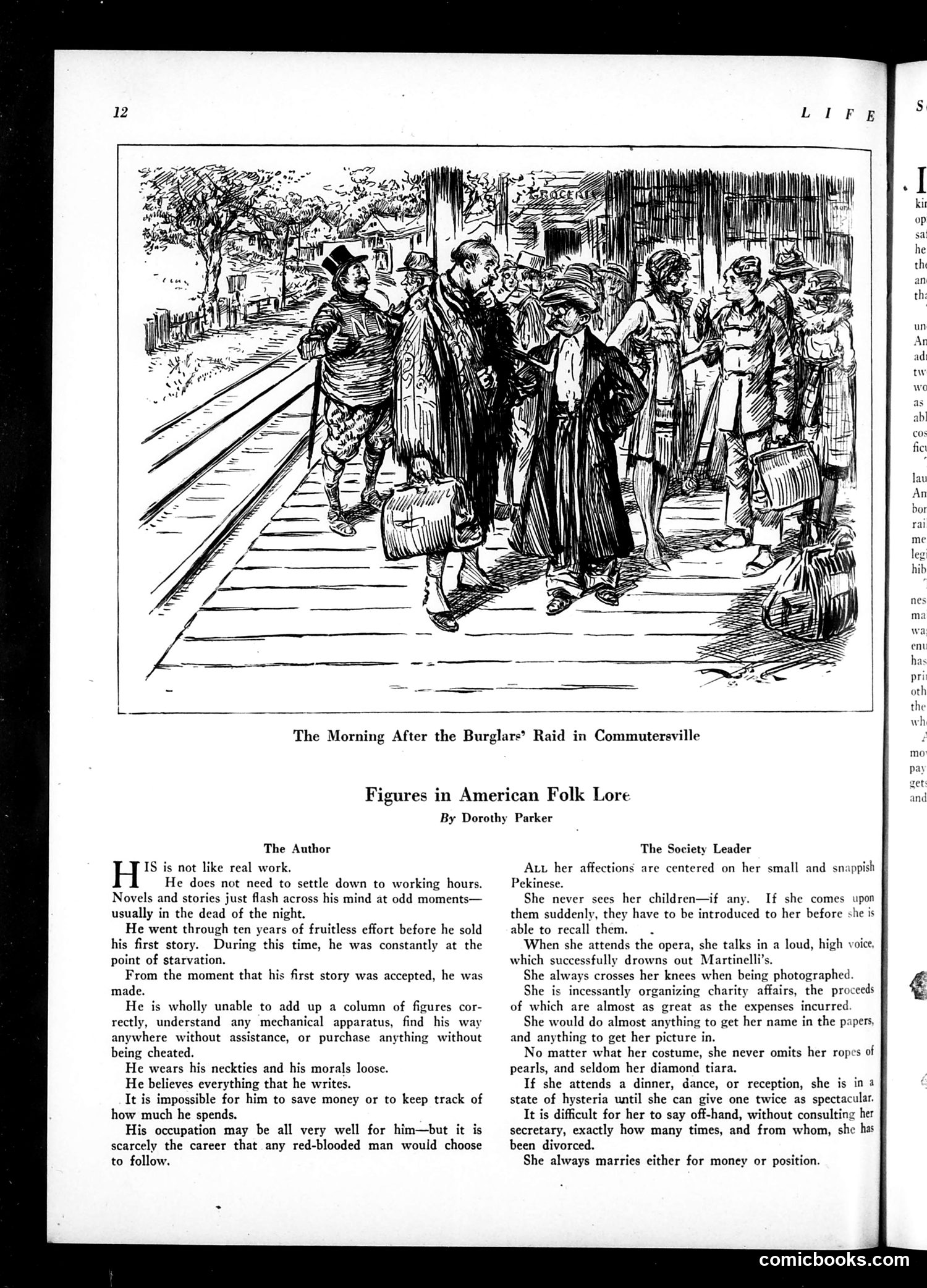
This page presents character sketches rather than a political cartoon. The illustration shows "The Morning After the Burgars' Raid in Commuterville"—depicting well-dressed commuters at a train station apparently reacting to a local crime. The two text columns offer satirical character portraits: "The Author" (a struggling writer) and "The Society Leader" (a wealthy woman obsessed with her Pekingese dog, charity galas, and jewelry). Parker's humor targets the pretensions and shallow concerns of these American social types—the author's financial incompetence and moral bankruptcy, the society woman's hysteria and serial marriages. These appear to be generic social commentary rather than references to specific public figures.
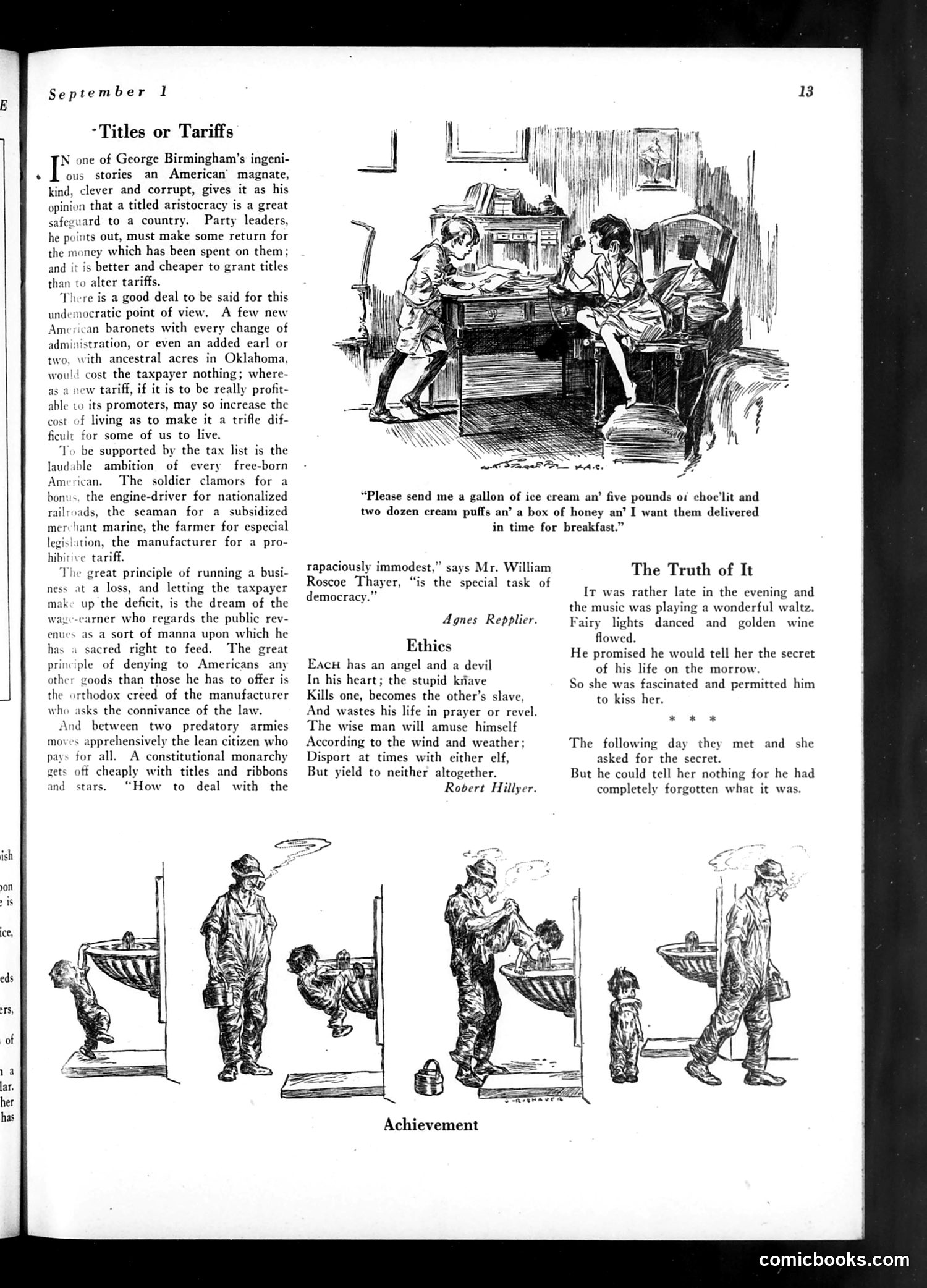
The main article argues that granting aristocratic titles is cheaper than raising tariffs—both are ways politicians reward supporters without direct taxpayer cost. The illustration shows someone ordering luxury goods (ice cream, chocolate, cream puffs, honey), satirizing how the wealthy make frivolous demands. The "Ethics" poem by Robert Hillyer offers moral advice about balance and temperance. "The Truth of It" tells a brief romantic anecdote where a man promises to reveal a secret but forgets it the next day—mocking the hollowness of romantic promises. Below is a comic strip titled "Achievement" showing a man and child at what appears to be a public fountain or water source, depicting working-class daily life through sequential panels.
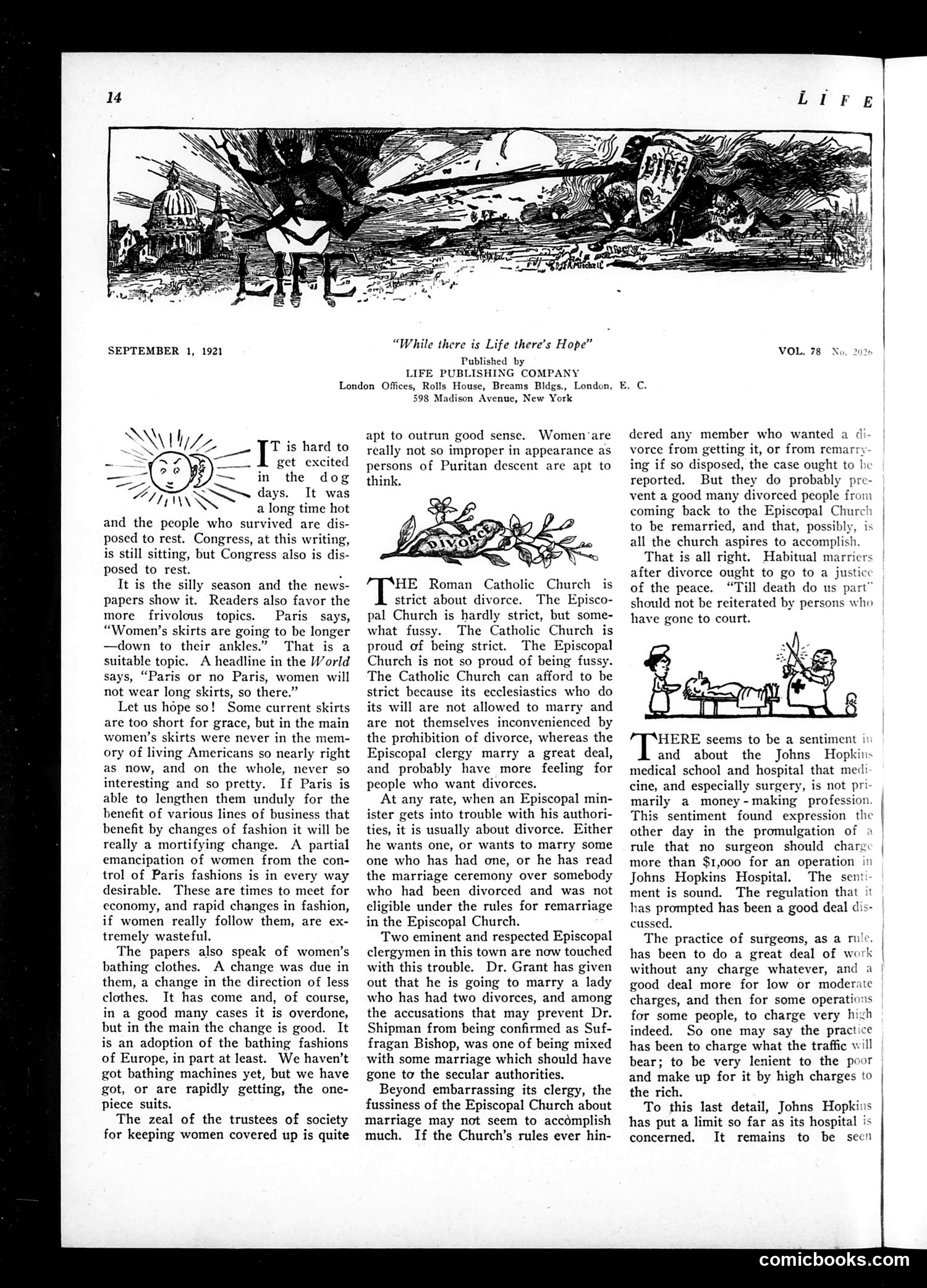
This page contains editorial commentary on contemporary social issues rather than political cartoons. The text discusses women's fashion trends (shorter skirts), divorce laws in different Christian denominations, and hospital practices. A small decorative illustration shows figures labeled "DIVORCE," satirizing the topic under discussion. The main satirical point critiques the inconsistency between Catholic and Episcopal church positions on divorce. The Catholic Church strictly forbade it while Episcopal clergy could marry despite having been divorced—a hypocrisy the author highlights. The piece also mocks the "silly season" of summer news coverage and debates the propriety of women wearing shorter skirts, suggesting such fashion changes reflect broader social anxiety about women's evolving roles and respectability in post-WWI America.
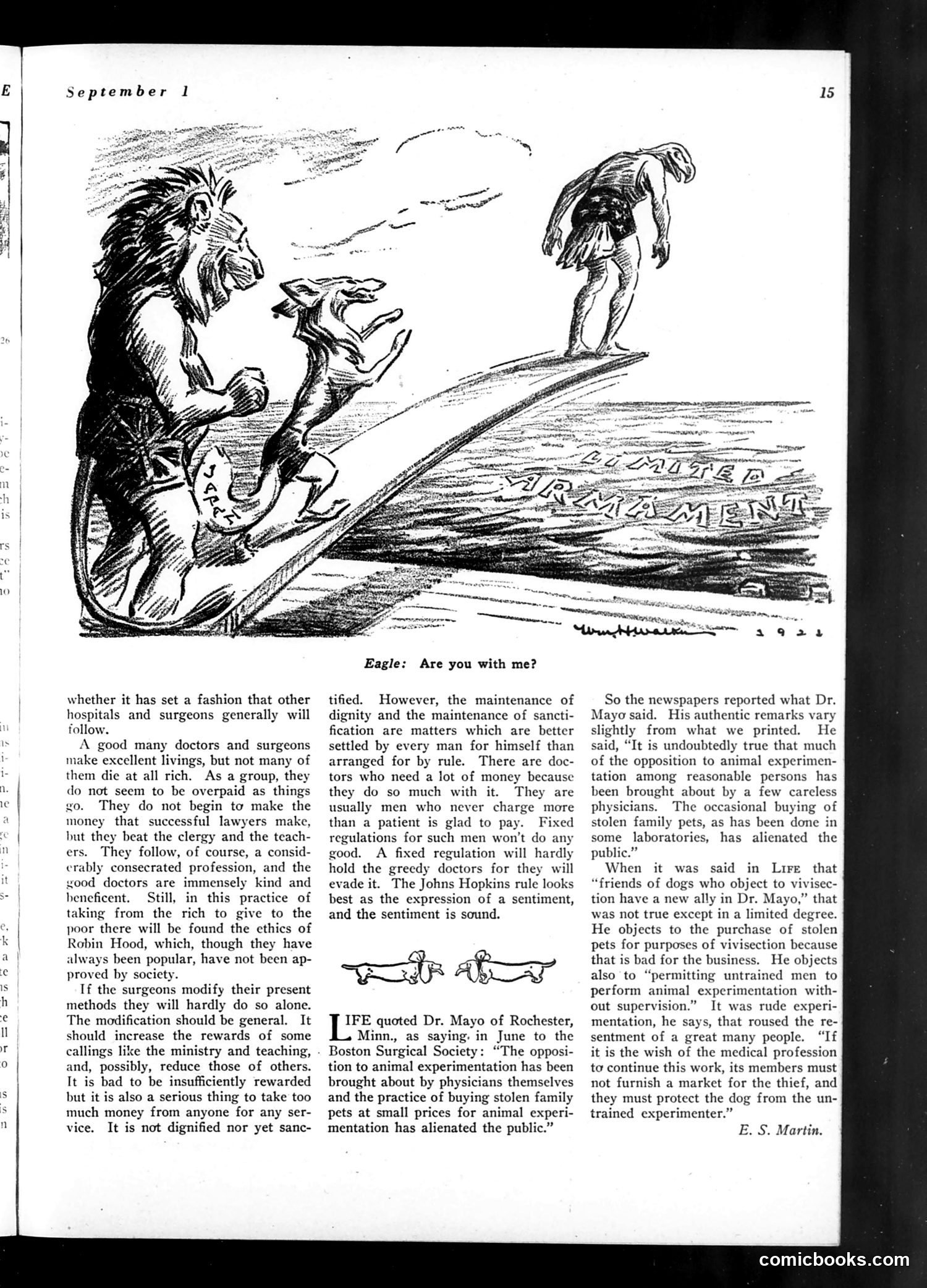
This cartoon depicts an eagle (symbolizing America or American values) questioning a hunched figure labeled "DILUTED AMUSEMENT" about their allegiance. The figure appears reluctant or evasive—positioned lower and turned away from the eagle's direct gaze. The accompanying text discusses medical ethics, particularly Dr. Mayo's criticisms of animal experimentation in laboratories. The magazine corrects its earlier misreporting of Mayo's position, clarifying that he opposes unethical practices—specifically buying stolen pets for vivisection and allowing untrained physicians to conduct experiments—rather than opposing animal research itself. The cartoon likely satirizes perceived hypocrisy or moral compromise: the "amusement" industry's willingness to ignore ethical concerns mirrors the medical profession's problematic practices. The eagle asks whether American institutions will maintain ethical standards or abandon them for profit.
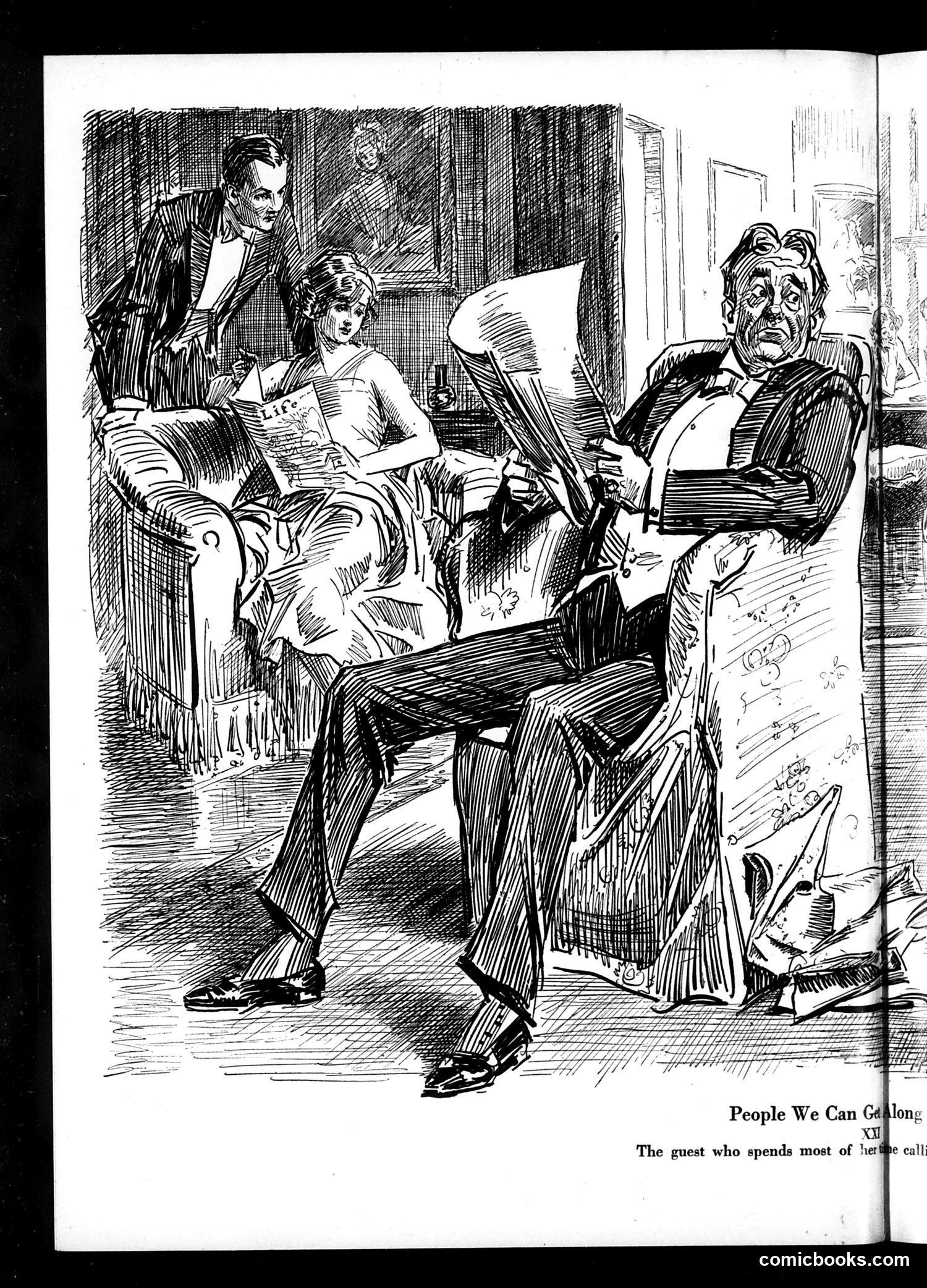
This is a satirical sketch from *Life* magazine titled "People We Can Get Along" (series XII). The cartoon depicts a social gathering where a woman seated on a sofa dominates the scene while three men stand awkwardly in the background. The caption suggests the satire targets a particular type of guest—a woman who spends excessive time making telephone calls during social visits, apparently monopolizing the host's phone. The men's uncomfortable postures and expressions indicate their annoyance at being neglected while she conducts her business. The joke reflects early-to-mid 20th century social anxiety about the telephone's intrusion into domestic life and etiquette, particularly satirizing guests who were inconsiderate about phone usage during social calls.
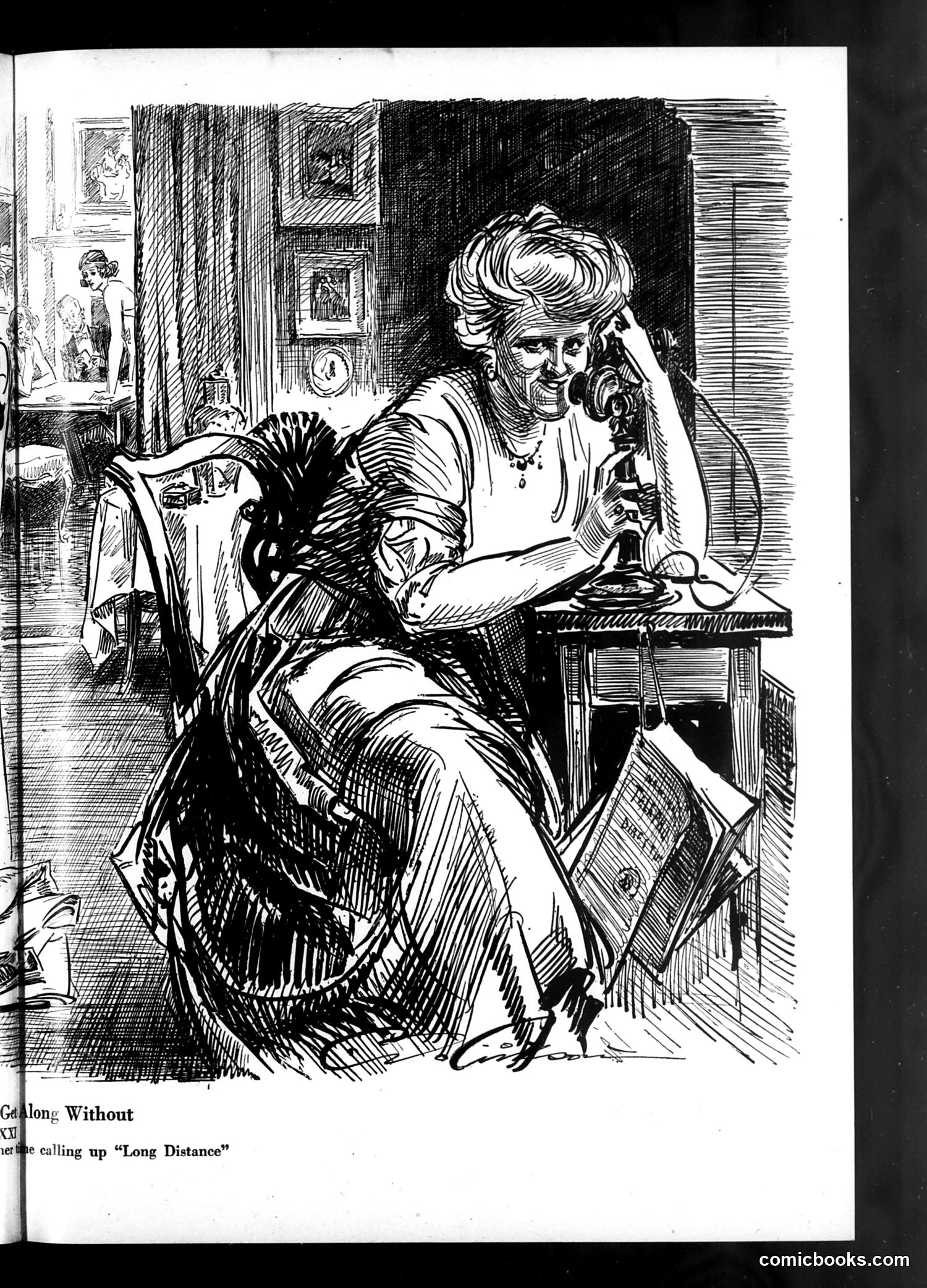
This illustration depicts a woman at a telephone, with the caption referencing "calling up 'Long Distance.'" The cartoon appears to satirize telephone technology and communication habits of the early 20th century. The woman, styled with period-appropriate hair and dress, sits at a small table with a rotary telephone. A man (visible in the background left) observes her. The satire likely comments on the novelty or expense of long-distance telephone calls during this era, or perhaps mocks social customs around women using telephones. The title "Calling Without" is unclear in meaning without additional context, though it may reference calling without proper introduction, payment, or permission—common social concerns of the period regarding new technology.
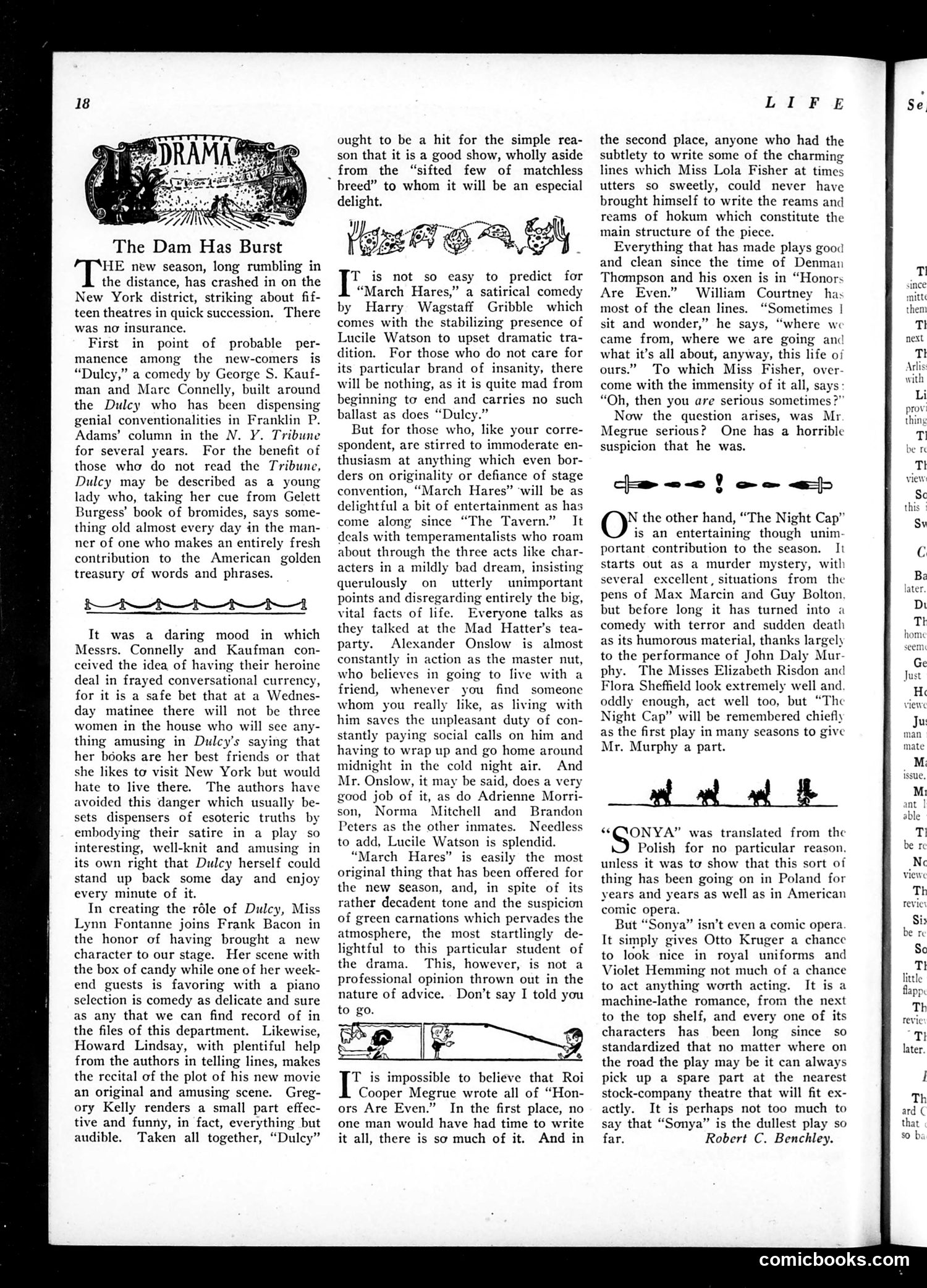
This is a theater criticism column reviewing several Broadway plays opening in the new season. The reviewer discusses three productions: **"Dulcy"** — A comedy by Kaufman and Connelly featuring Lynn Fontanne, based on a character from Franklin P. Adams' Tribune column. Dulcy is a woman who constantly repeats tired clichés ("bromides") as if they're original observations, yet the play itself is well-crafted and amusing enough to entertain even those who don't appreciate the satire on superficial conversation. **"March Hares"** — A satirical comedy described as deliberately absurd, featuring characters who behave like guests at the Mad Hatter's tea party from *Alice in Wonderland*—obsessing over trivial matters while ignoring important life facts. **"Sonya"** — A translated Polish play the reviewer dismisses as "the dullest play so far," criticizing it as machine-like and tedious despite featuring performers in attractive costumes. The column reflects 1920s theater culture and entertainment criticism conventions.
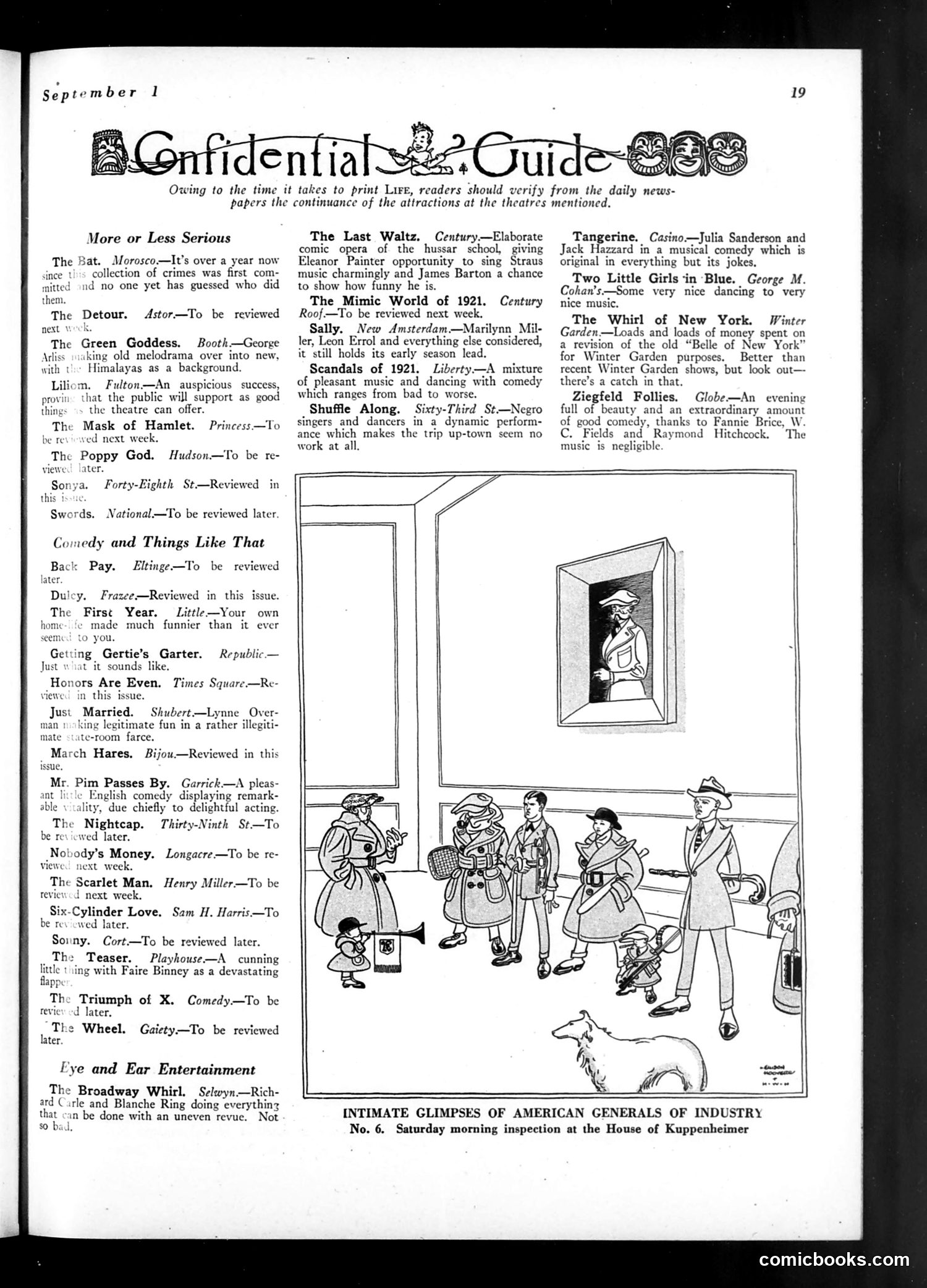
This page is primarily a **theater review column** listing Broadway shows opening that season, with brief critical assessments. The notable cartoon at bottom depicts "Intimate Glimpses of American Generals of Industry: Saturday morning inspection at the House of Kuppenheimer." The cartoon satirizes **industrial inspection practices** by depicting well-dressed businessmen touring what appears to be a factory floor, with one examining items through a window or display. The humor lies in treating corporate executives as military "generals" conducting formal inspections—a common satirical trope comparing industrial captains to military leadership. The reference to "Kuppenheimer" (a real clothing manufacturer) suggests this mocks the performative nature of factory inspections, possibly implying they were superficial or theatrical rather than substantive. The page itself reflects 1921 Broadway activity, including the notably integrated "Shuffle Along," described as featuring "Negro singers and dancers"—significant for the period, though the dated terminology reflects contemporary language.
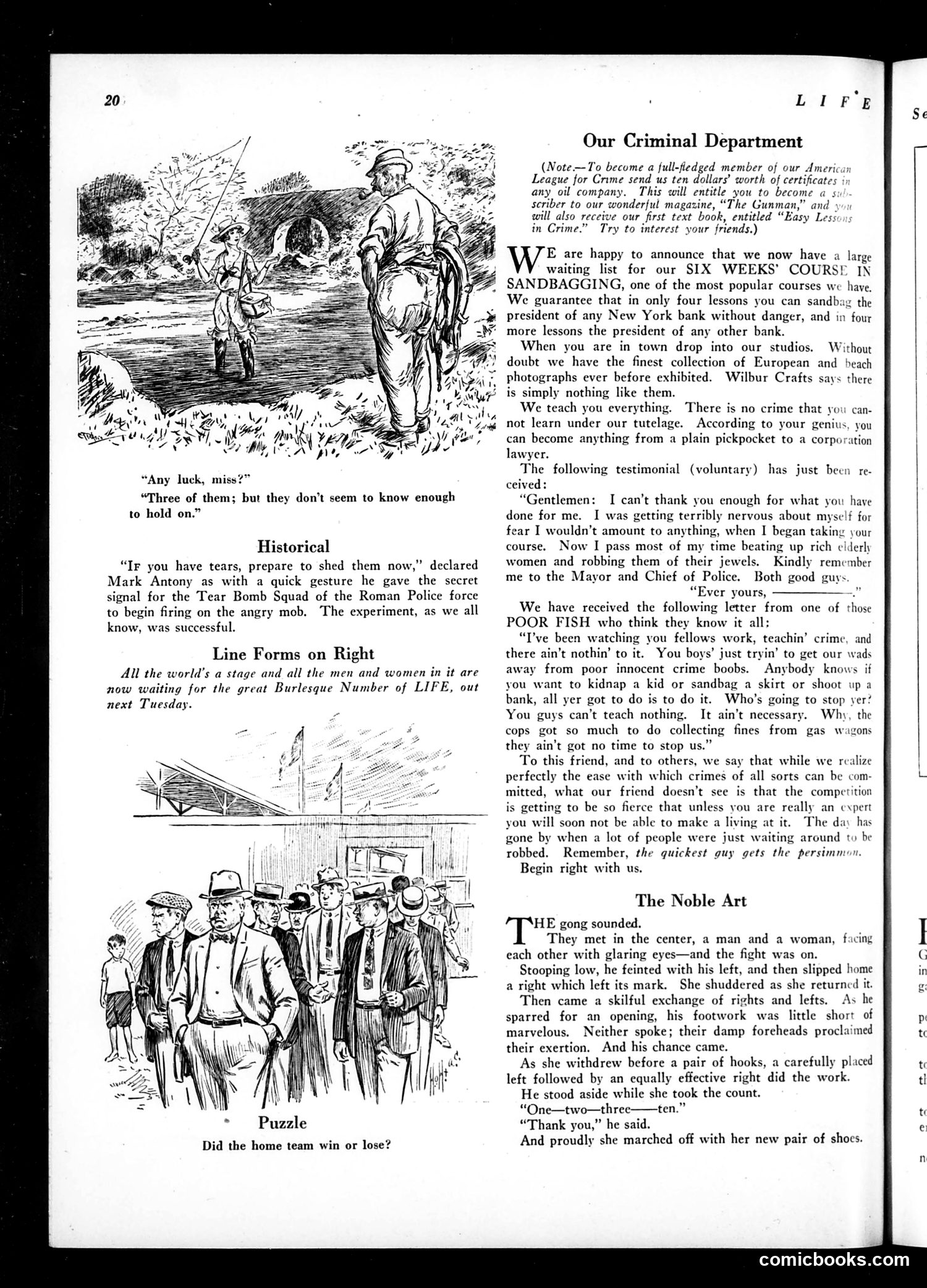
This page from *Life* magazine combines satire on crime and boxing. The **"Our Criminal Department"** section is mock-serious humor: *Life* advertises a fake "Six Weeks' Course in Sandbagging" (robbery by hitting victims with weighted bags), claiming it teaches crimes from pickpocketing to corporate law. The joke satirizes both criminal audacity and police incompetence—the magazine notes cops are too busy collecting traffic fines to stop actual crimes. A testimonial from a "student" boasts of robbing elderly women; a critical letter from a "poor fish" complains the course is unnecessary since crime is easy anyway. The **"Noble Art"** section describes a boxing match between a man and woman as if it were a serious sporting event, using elevated language ("skilful exchange of rights and lefts"). This appears to mock sensationalized reporting of women's boxing, treating a domestic or novelty fight with mock-heroic prose. The cartoons reinforce themes of street crime and violence characteristic of early 20th-century urban satire.
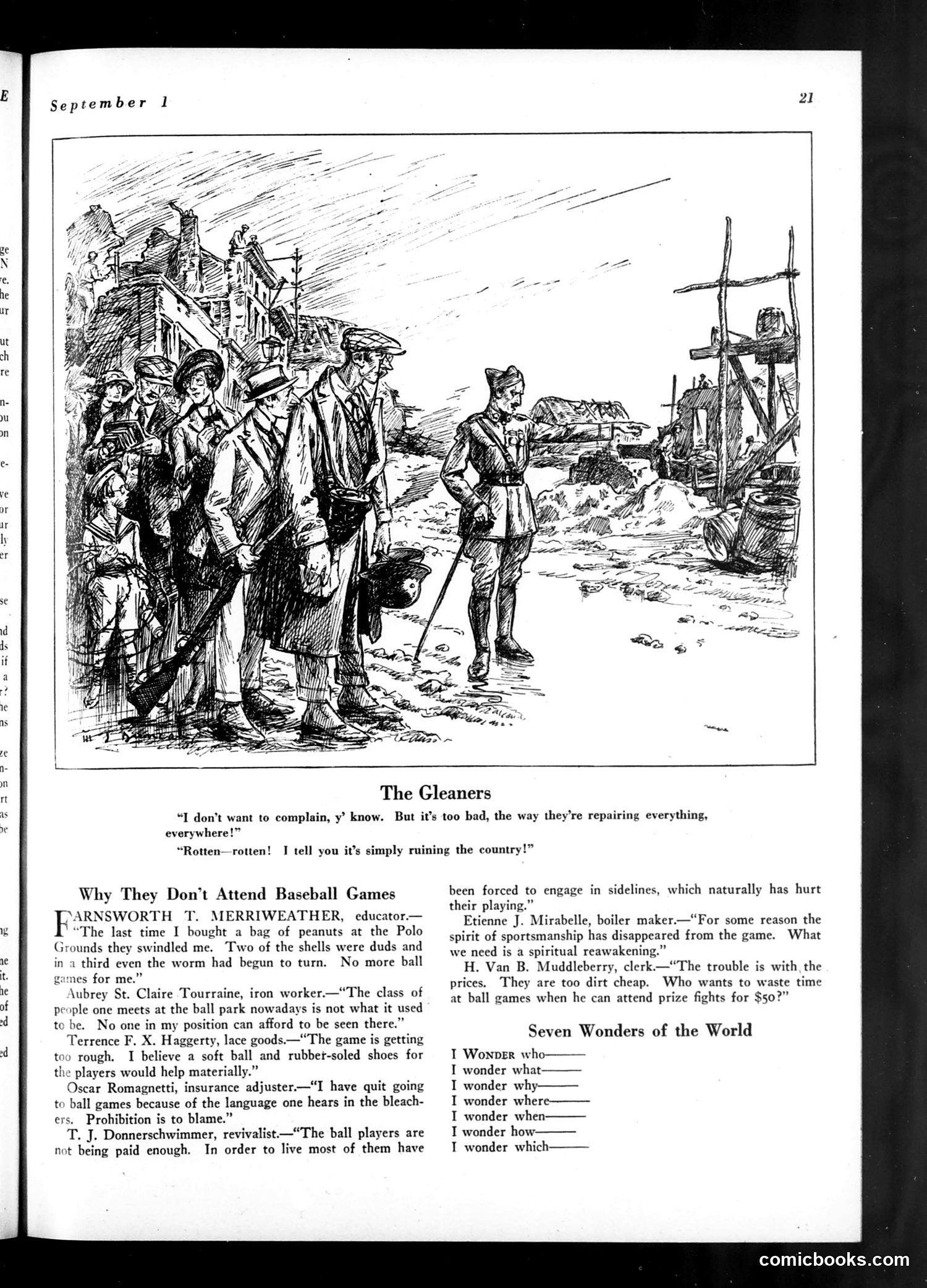
**The top cartoon** depicts workers criticizing repair efforts, with one complaining that constant infrastructure work is "ruining the country"—likely satirizing post-WWI concerns about government spending or management. **The main feature** is a humorous survey of various fictional characters explaining why they've stopped attending baseball games. Each represents a social type offering absurd or contradictory reasons: an educator complains about defective peanuts; a worker claims the crowd lacks class; a textile merchant wants softer balls; a baseball fan blames Prohibition for bad language; a revivalist says players need higher wages; a boiler maker wants spiritual renewal; and a clerk argues tickets are paradoxically *too cheap*. The satire mocks how people rationalize abandoning leisure activities with exaggerated grievances. The final complaint—that cheap admission means attending prize fights instead—reveals the joke's underlying absurdity. This reflects 1920s-era anxieties about changing entertainment and social values while poking fun at manufactured excuses and class pretension.
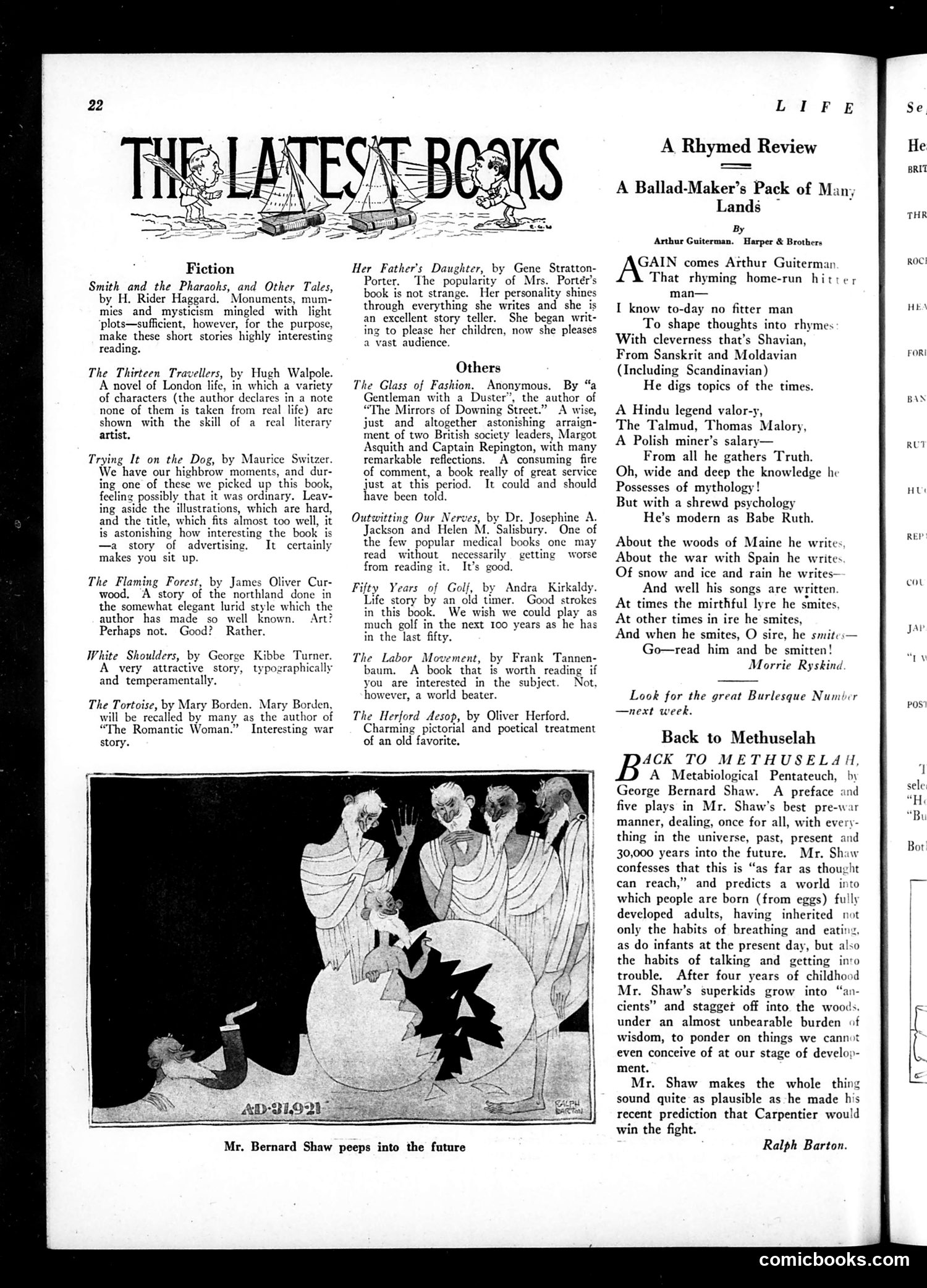
This page from *Life* magazine reviews recent fiction and Shaw's "Back to Methuselah." The central cartoon illustrates Shaw's play: an elderly figure peers into a crystal ball showing the distant future (marked "AD 31921"), while robed figures gesture dramatically around him. The satire targets Shaw's ambitious philosophical scope—his five-play cycle proposing that humanity could eventually evolve to live 300 years, developing into "ancients" who transcend ordinary concerns. The cartoon mocks the grandiosity of Shaw's metabiological speculation by depicting him literally gazing into futurity, visualizing his fantastical evolutionary vision. Below, Guiterman's rhymed review praises the playwright's versatility and intellectual range, calling him a "home-run hitter" of verse. The image suggests Shaw's audacious attempt to philosophize about humanity's distant destiny—presented as both ambitious and somewhat absurd.
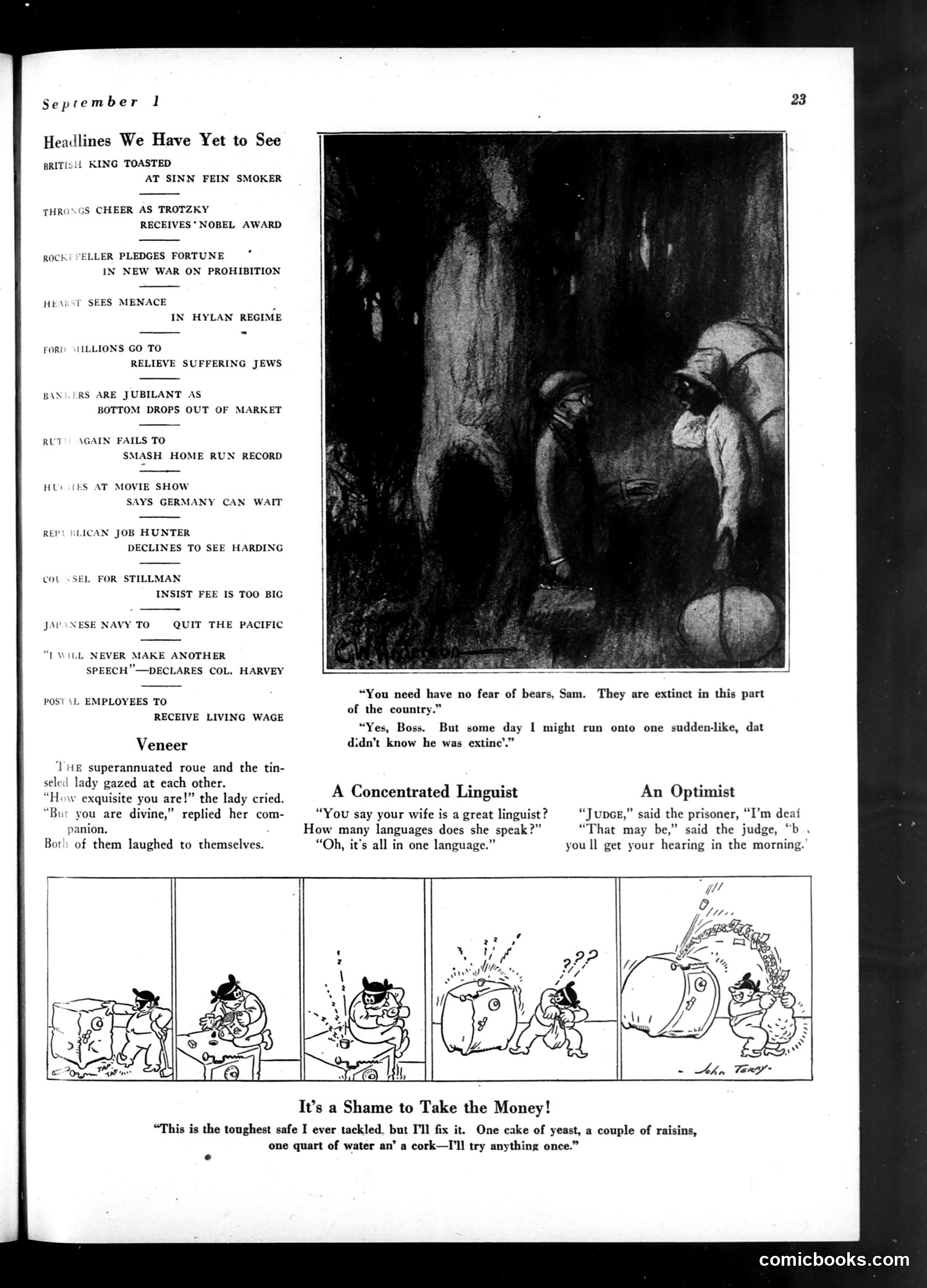
The page presents absurdist "Headlines We Have Yet to See"—impossibilities mocking contemporary politics and society. Examples include: a British king toasted at a Sinn Féin (Irish nationalist) gathering; Trotsky receiving a Nobel Award; Rockefeller pledging to fight Prohibition; and a Republican job-seeker declining to meet President Harding. Below are three brief humorous sketches: "Veneer" mocks shallow flattery between dissolute figures; "A Concentrated Linguist" jokes that a wife's multilingual skill amounts to speaking one language; and "An Optimist" presents a deaf prisoner assured he'll gain hearing at trial—a pun on legal proceedings. The comic strip "It's a Shame to Take the Money!" depicts a burglar attempting to crack a safe using yeast, raisins, water, and a cork—absurd ingredients suggesting he's unprepared or foolish. The satire targets political hypocrisy, social pretense, and general folly characteristic of early 1920s Life magazine humor.
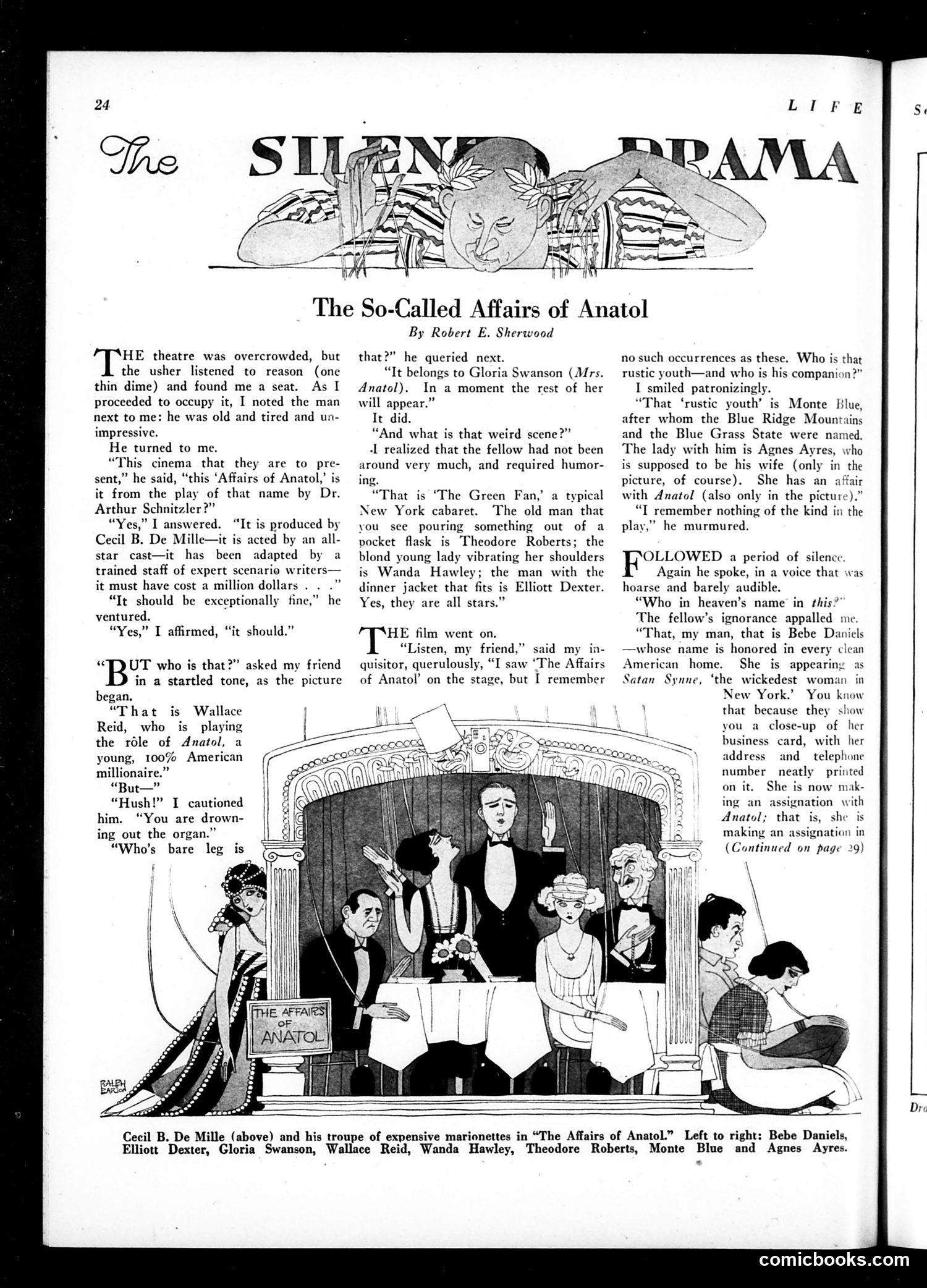
This article mocks Cecil B. De Mille's 1921 film adaptation of Arthur Schnitzler's play, sarcastically praising its lavish star-studded cast while revealing how the film butchers the source material. The author (Robert E. Sherwood) positions himself as a knowledgeable theater-goer explaining the film to an unsophisticated old man, but the joke targets De Mille's approach: substituting expensive Hollywood stars and melodramatic additions (cabaret scenes, Satan characters, close-ups of business cards) for the play's subtle psychological drama. The accompanying illustration labels the actors as "expensive marionettes"—puppets controlled by De Mille—suggesting they're interchangeable star vehicles rather than serious performances. The satire critiques early Hollywood's tendency to inflate productions with celebrity names and spectacle rather than artistic integrity, while the original play emphasized intimate character relationships and moral ambiguity.
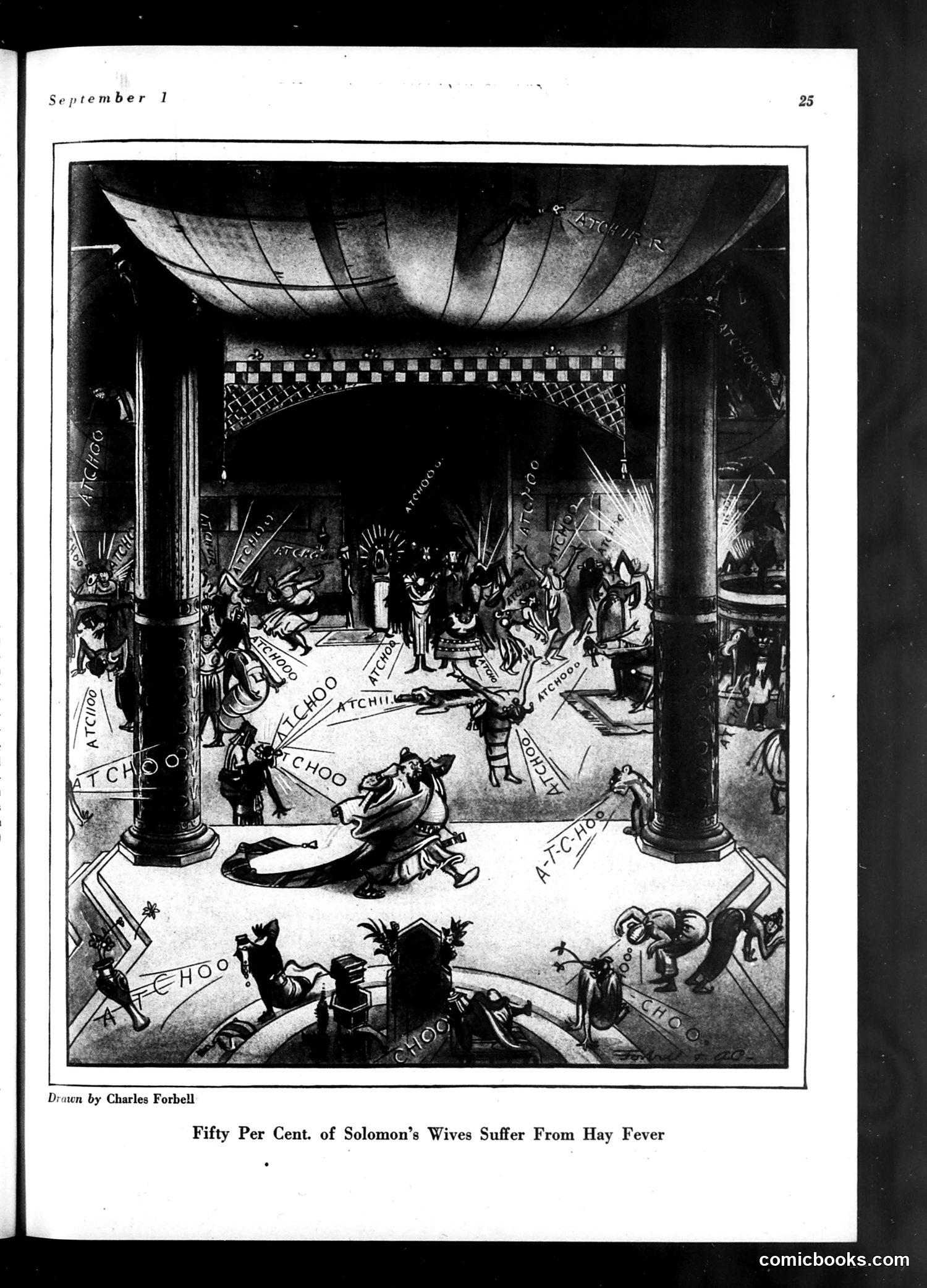
This satirical cartoon by Charles Forbell references the biblical King Solomon, famous for having numerous wives (traditionally numbered at 700). The joke is absurdist: it imagines that fifty percent of Solomon's wives suffer from hay fever—a seasonal allergic condition. The humor works on multiple levels: it treats an ancient biblical figure's polygamy as a modern medical problem, and uses specific statistics ("fifty per cent") to add ridiculous mock-seriousness. The chaotic scene shows figures in what appears to be a grand hall or court setting, likely depicting the comedic pandemonium of so many wives experiencing allergy symptoms simultaneously. This is pure nonsensical humor typical of early 20th-century satirical magazines, playing with the incongruity of ancient scripture meeting contemporary ailments.
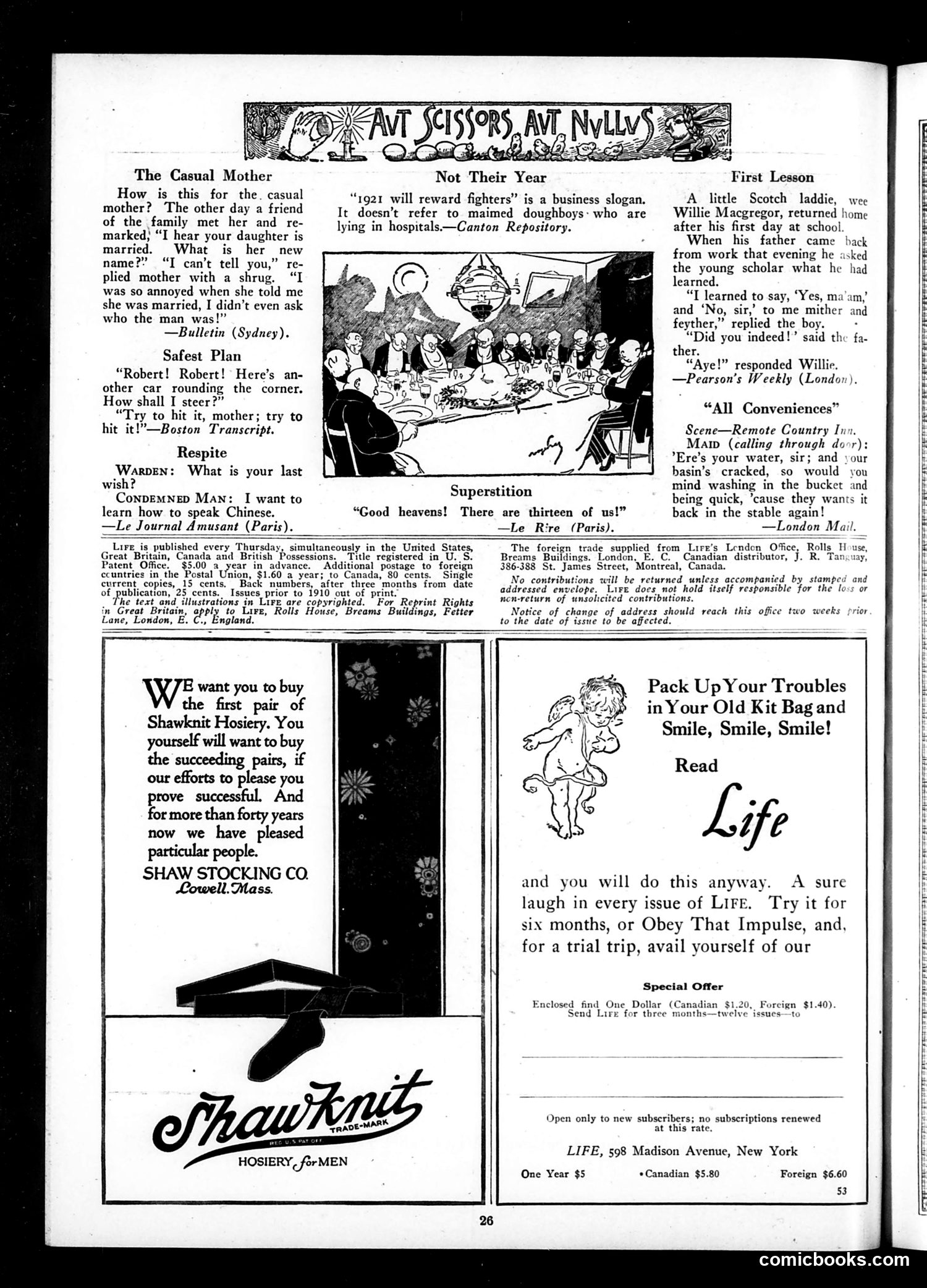
This page from *Life* magazine presents six brief humorous anecdotes typical of the publication's satirical style: **The jokes target everyday social absurdities:** - "The Casual Mother" mocks maternal indifference—a mother so unconcerned about her daughter's marriage she didn't even ask the groom's name - "Safest Plan" is dark humor: a condemned man's last wish is to learn Chinese; when asked his final request, he chooses something impossible - "Not Their Year" criticizes cynical 1921 business slogans promising reward to "fighters" while ignoring wounded WWI veterans in hospitals - "First Lesson" depicts a Scottish child learning only obedience formulas on his first school day - "All Conveniences" satirizes rural inn proprietors' indifference to broken amenities - "Superstition" presents a crowded table with thirteen diners The page also includes period advertisements for Shawknit hosiery and a subscription offer for *Life* itself, using the wartime phrase "Pack Up Your Troubles" as a sales hook. This reflects *Life*'s position as accessible, irreverent commentary on middle-class life and contemporary events.
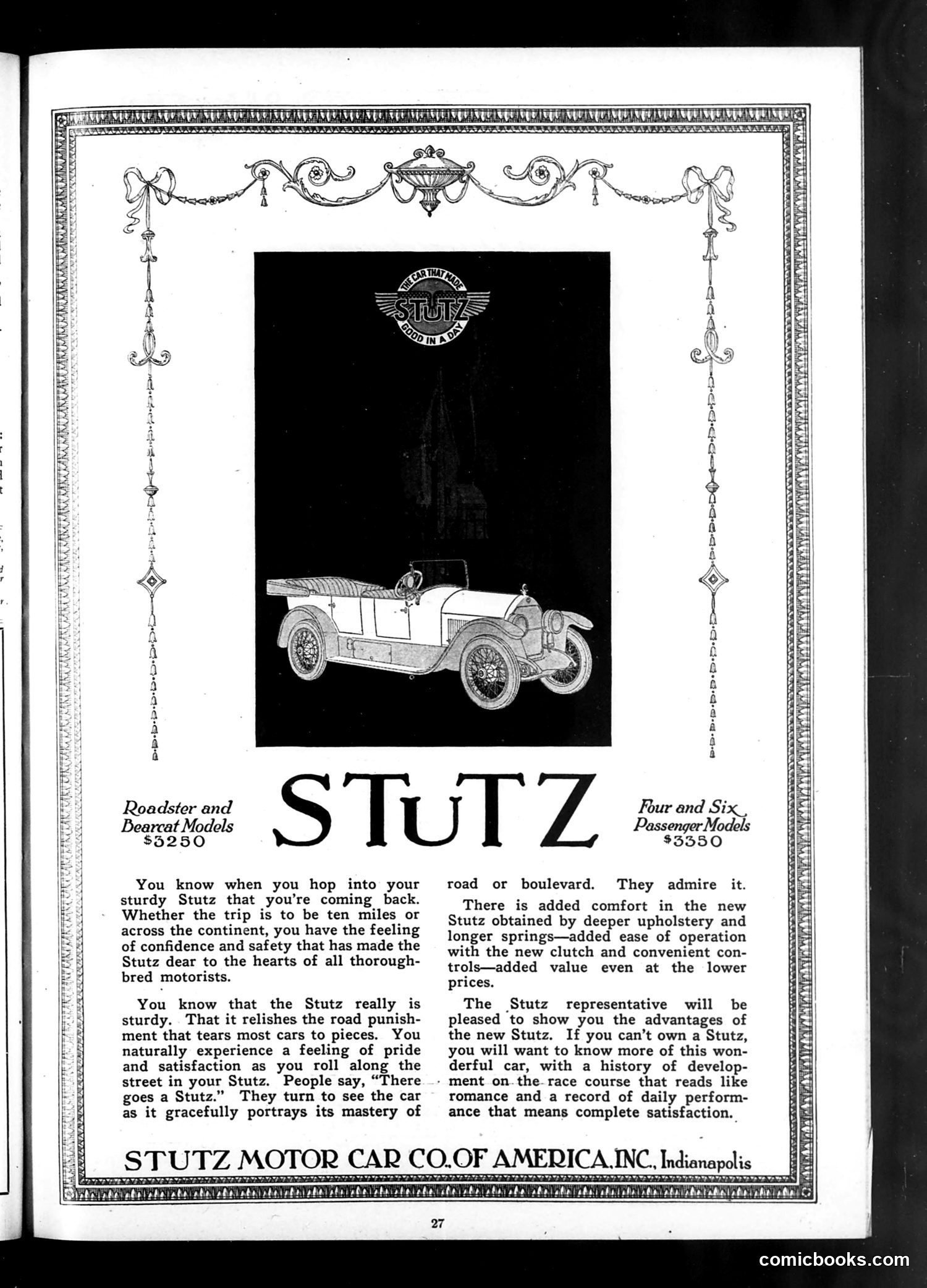
This is primarily a **automobile advertisement**, not a political cartoon. It promotes the Stutz Motor Car Company of Indianapolis, showcasing their Roadster, Bearcat, and passenger models priced at $3,250-$3,350. The page uses decorative Art Deco borders typical of 1920s design and features an illustration of an open-air automobile. The marketing copy emphasizes the Stutz brand's reputation for durability, safety, and prestige—appealing to "thoroughbred motorists" with language suggesting reliability ("comes back") and social status ("People say, 'There goes a Stutz'"). There is no satire or political commentary here. This represents straightforward early-automotive-era advertising highlighting the vehicle's engineering reputation and racing heritage to justify premium pricing during the era when automobiles were luxury goods for affluent buyers.
This page from *Life* magazine is primarily **advertising and humor content**, not political cartoons. The bulk consists of period product advertisements (dandruff remedy, saddles, indigestion pills) interspersed with short humorous anecdotes. The humor pieces mock contemporary absurdities: - **"Plain Sailing"**: A boatman's convoluted, confusing sailing instructions satirize overcomplication of simple tasks. - **"Perishable Currency"**: Hungary's inflation is so severe that printed money literally fades in heat—the joke is that currency has become physically fragile and worthless. - **"Misplacement"**: An admiral mocks an obese sailor whose medal hangs too low, implying he earned it for eating rather than valor. - **"All for Nothing"**: A mother's failed child-rearing efforts, darkly humorous. - **"No Longer Appropriate"**: An Indian man named "Man-Afraid-of-Nothing" requests a name change after marrying a white woman—the joke relies on period racial stereotypes. The section's title, "Our Foolish Contemporaries," frames these as observations of modern absurdity.
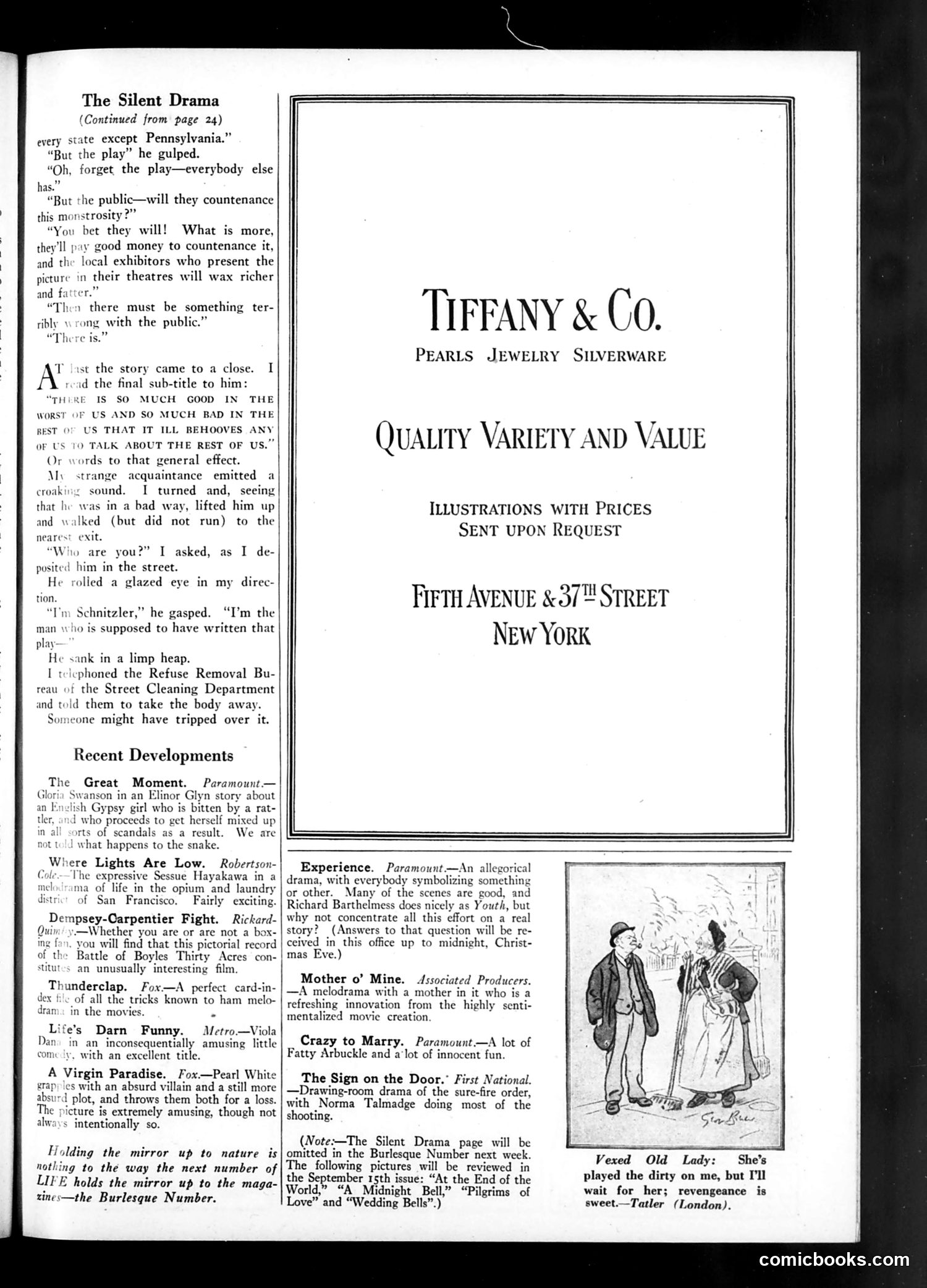
This page mixes a satirical story about cinema with film reviews and advertising. The main narrative is a darkly comic dialogue between the narrator and a mysterious man defending an unspecified scandalous play. The man argues that despite moral objections from "every state except Pennsylvania," the public will pay to see it, and theaters will profit—suggesting American audiences enjoy controversial entertainment regardless of quality or morality. The punchline reveals the man is "Schnitzler," supposedly the play's author, who then collapses. The narrator calls the Refuse Removal Bureau to remove his body—a morbid joke implying the playwright is worthless. The page mocks both cinema's low artistic standards and audiences' appetite for scandal. Below are film reviews of current releases, followed by a Tiffany & Co. advertisement. A small cartoon shows a vexed old lady plotting revenge, with no clear political reference.
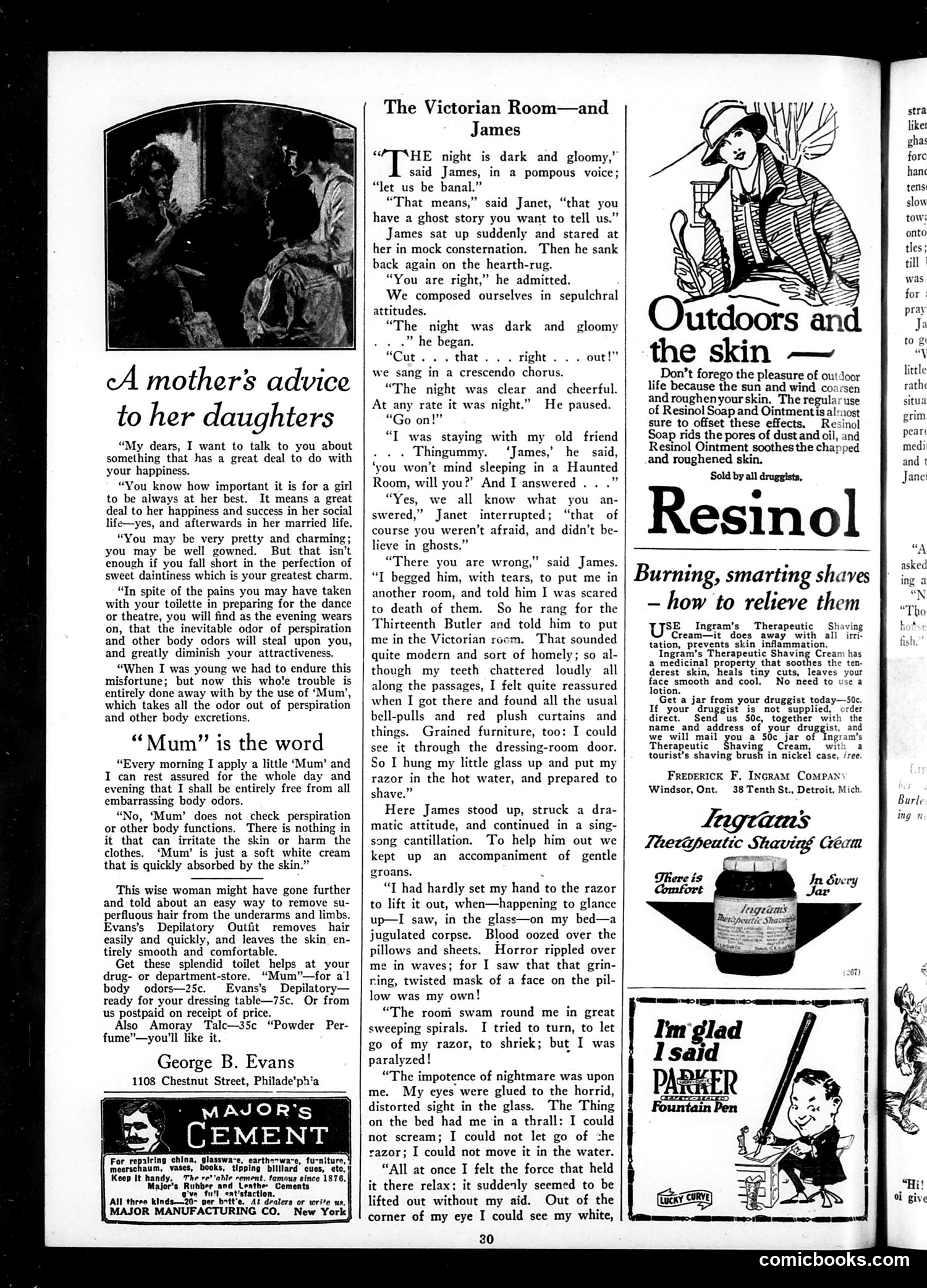
This is a humorous short story about a man recounting a ghost story to friends. James begins melodramatically describing a night spent in a "Haunted Room," but his friends constantly interrupt and mock his clichéd storytelling—they anticipate his every banal phrase ("the night is dark and gloomy") and sarcastically sing along. The joke satirizes overwrought Victorian ghost-story conventions: the pompous narrator, the sepulchral atmosphere, the predictable plot beats. When James finally reaches the climax—preparing to shave and apparently encountering something horrifying in the mirror—the story's absurdity peaks. The satire mocks both the tired tropes of supernatural fiction and the self-important manner in which people retell such tales. The page is primarily advertisements for toiletries (Mum deodorant, Evans's Depilatory, etc.), typical of Life magazine's content during this era.
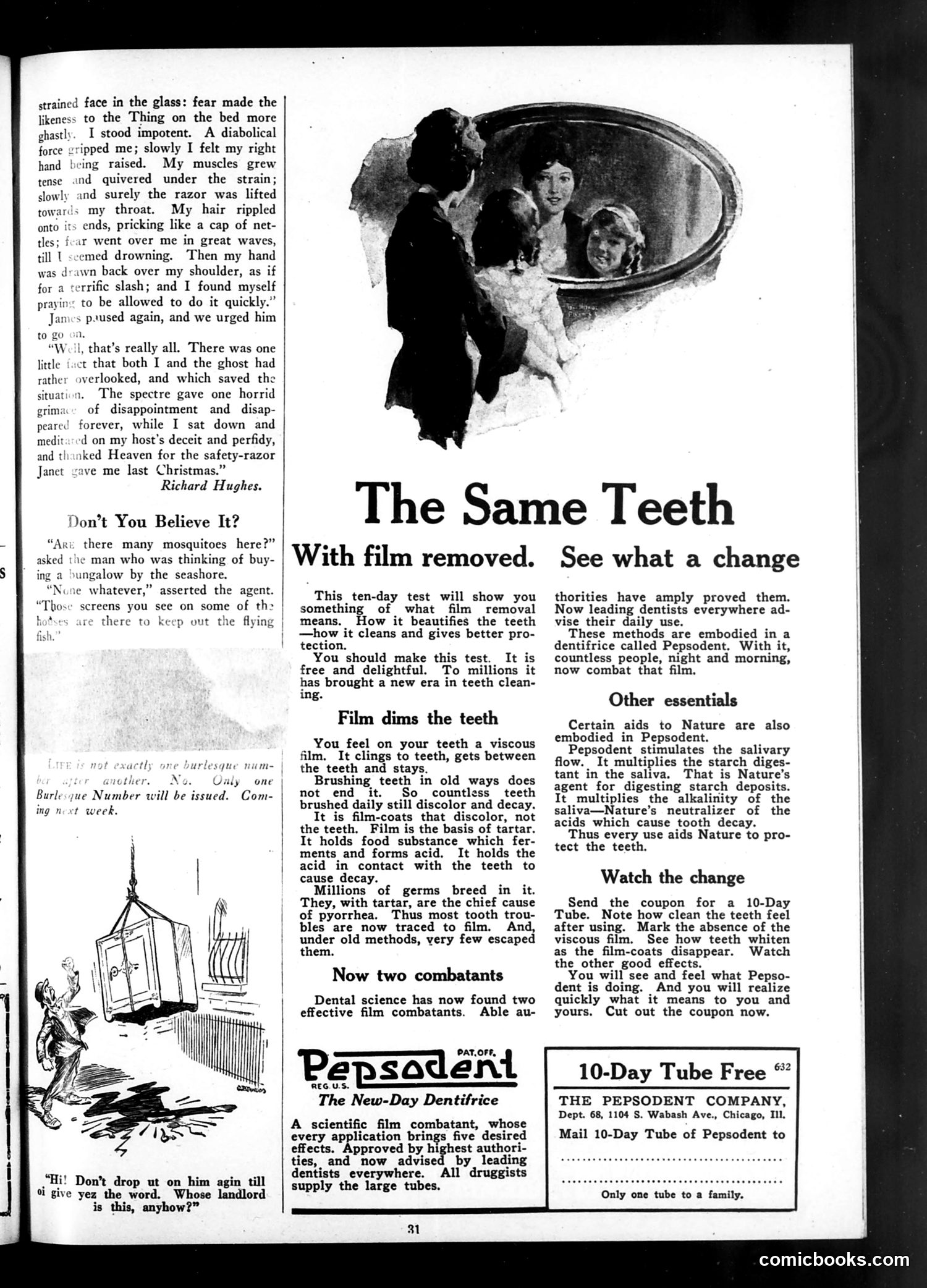
This page contains two distinct elements: **The Story Section** (top-left): A serialized supernatural tale by Richard Hughes about a man nearly forced by a ghost to cut his own throat with a razor—saved by the safety razor's dull design. This is period horror fiction, typical of Life magazine's literary content. **The Advertisement** (right side): A Pepsodent toothpaste ad employing early 20th-century dental pseudoscience. It claims an invisible "film" coats teeth, causing decay and discoloration, and that Pepsodent uniquely removes it through enzymes that stimulate saliva and alkalinity. The ad promises a dramatic 10-day transformation. **Historical Context**: The "film" theory was marketing mythology; modern dentistry recognizes plaque and tartar, not mystical "film." However, this ad was groundbreaking for popularizing daily toothbrushing as essential hygiene—previously uncommon. The coupon strategy and before-after claims represent early consumer advertising psychology. The juxtaposition is accidental—entertainment content paired with contemporary advertising reflecting 1920s-era beliefs about oral health.
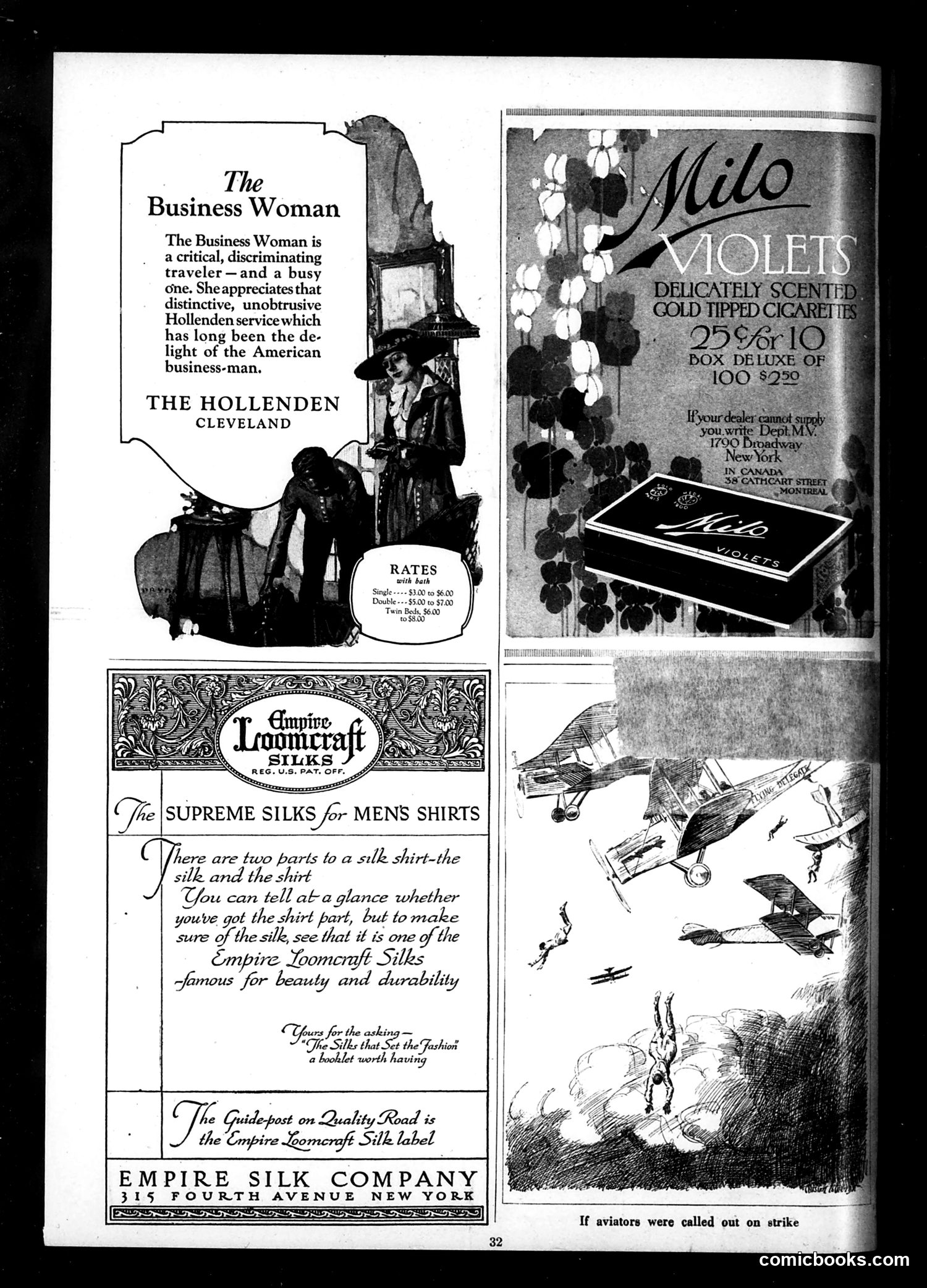
This page is **primarily advertising**, not political satire. It contains three distinct advertisements from what appears to be a 1920s-era Life magazine: 1. **The Hollenden Hotel** (Cleveland) — appeals to "the Business Woman," reflecting early 20th-century recognition of women entering the professional workforce. The ad emphasizes "distinctive, unobtrusive service," suggesting hotels were adapting to female travelers. 2. **Empire Loomcraft Silks** — a men's shirt fabric advertisement using decorative typography typical of the period. 3. **Milo Violets** — delicately scented, gold-tipped cigarettes marketed to women (note the floral design), reflecting an era when cigarette marketing to women was common and not yet restricted. The bottom caption, "If aviators were called out on strike," appears to reference labor disputes or aviation industry concerns, likely accompanying an adjacent cartoon (not fully visible), but the context is unclear without seeing that content.

I appreciate your detailed instructions, but I must be honest: this image is too degraded for me to read either the OCR text reliably or identify specific cartoon content with confidence. The page appears to be a historical scan from *Life* magazine, but the image is predominantly black with some faint grayscale patterns on the right side that might be illustrations or decorative elements. There's a marking "0" visible near the bottom. Without being able to clearly read the text or discern the cartoon figures and their details, I cannot accurately identify the political/social references, caricatures, or satire involved. I'd need a higher-quality or clearer version of this page to provide the accurate historical analysis you're requesting.