
Life, 1921-09-01 · page 3 of 35
Life — September 1, 1921 — page 3: what you’re looking at
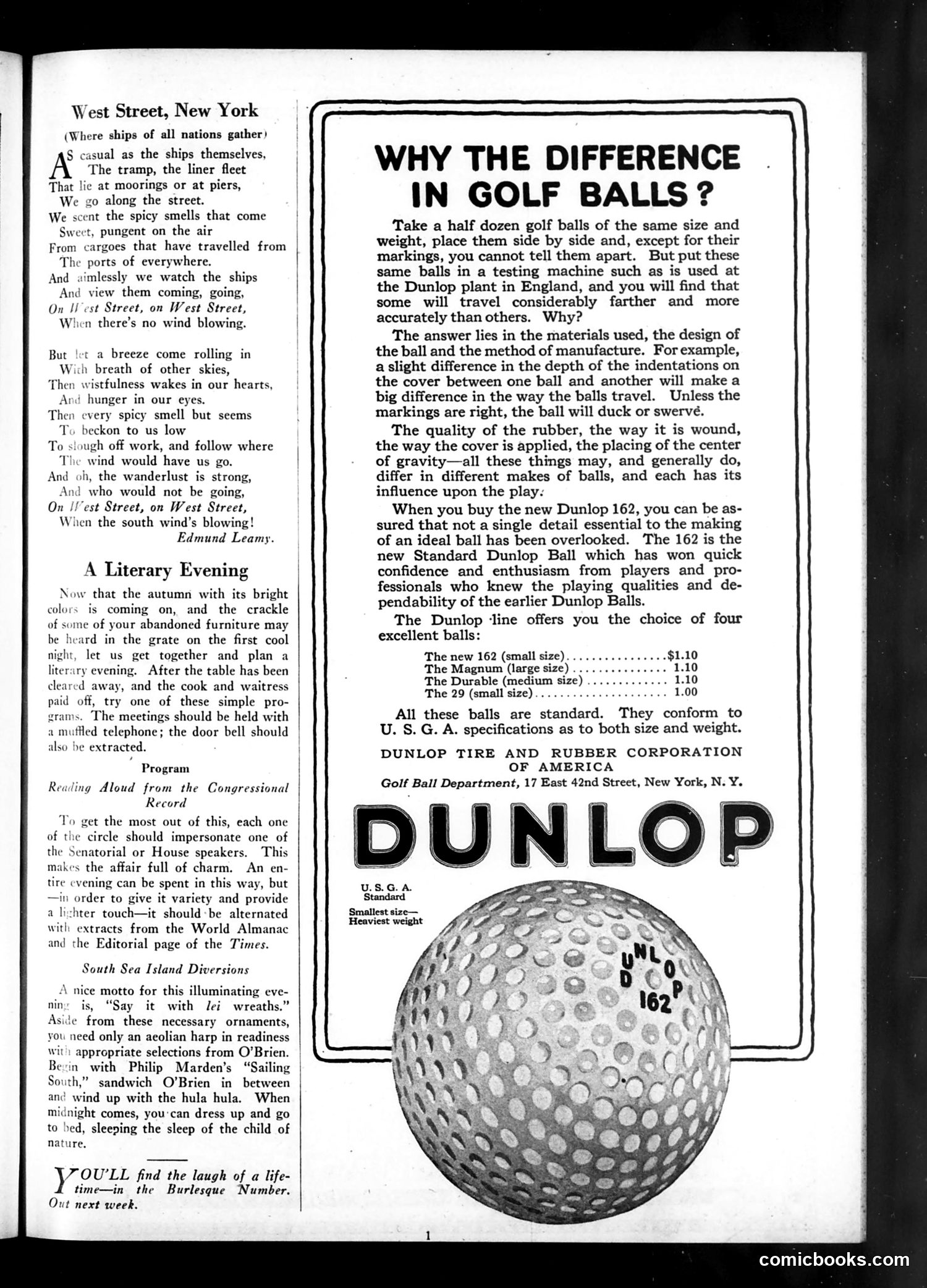
What you’re looking at
This page contains **no political cartoons or satire**. Instead, it features: 1. **"West Street, New York"** — a poem by Edmund Leamy celebrating the bustling maritime atmosphere of Manhattan's waterfront, with no satirical content. 2. **"A Literary Evening"** and **"South Sea Island Diversions"** — brief miscellaneous content suggestions for social gatherings. 3. **A large Dunlop golf ball advertisement** — the dominant feature. This is a straightforward commercial promoting four models of golf balls ($1.10–$1.00), emphasizing their conformity to U.S.G.A. specifications and explaining manufacturing differences affecting ball performance. The page is primarily **advertising and filler content**, not satirical commentary. Life magazine regularly interspersed such advertisements throughout its pages during this era.
📄 Transcribed text from this page (OCR, searchable)
Machine-transcribed from the original scan — historical spelling and the odd misread are preserved.
West Street, New York (Where ships of all nations gather) S casual as the ships themselves, The tramp, the liner fleet That lie at moorings or at piers, We go along the street. We scent the spicy smells that come s pungent on the air From cargoes that have travelled from The ports of everywhere. And aimlessly we watch the ships And view them coming, going, On I est Street, on West Street, Whicn there’s no wind blowing. t a breeze come rolling in ch breath of other skies, ) wistfulness wakes in our hearts, hunger in our eyes. very spicy smell but seems To beckon to us low lough off work, and follow where wind would have us go. »h, the wanderlust is strong, And who would not be going, On I!est Street, on West Street, When the south wind’s blowing! Edmund Leamy. A Literary Evening Now that the autumn with its bright colors is coming on, and the crackle of some of your abandoned furniture may be heard in the grate on the first cool night, let us get together and plan a literary evening. After the table has been cleared away, and the cook and waitress id off, try one of these simple pro- ims. The meetings should be held with a muffled telephone; the door bell should also be extracted. Program Reading Aloud from the Congressional Record To get the most out of this, each one of the circle should impersonate one of the Senatorial or House speakers. This makes the affair full of charm. An en- tire evening can be spent in this way, but —in order to give it variety and provide a lichter touch—it should -be alternated with extracts from the World Almanac and the Editorial page of the Times. South Sea Island Diversions A nice motto for this illuminating eve- nins is, “Say it with Jei wreaths.” Aside from these necessary ornaments, you need only an aeolian harp in readiness wit) appropriate selections from O’Brien. Becin with Philip Marden’s “Sailing | South,” sandwich O’Brien in between and wind up with the hula hula. When ight comes, you:can dress up and go to bed, sleeping the sleep of the child of nature, 7 OU’LL find the laugh of a life- time—in the Burlesque Number. Out next week. WHY THE DIFFERENCE IN GOLF BALLS ? Take a half dozen golf balls of the same size and weight, place them side by side and, except for their markings, you cannot tell them apart. But put these same balls in a testing machine such as is used at the Dunlop plant in England, and you will find that some will travel considerably farther and more accurately than others. Why? The answer lies in the materials used, the design of the ball and the method of manufacture. For example, a slight difference in the depth of the indentations on the cover between one ball and another will make a big difference in the way the balls travel. Unless the markings are right, the ball will duck or swerve. The quality of the rubber, the way it is wound, the way the cover is applied, the placing of the center of gravity—all these things may, and generally do, differ in different makes of balls, and each has its influence upon the play. When you buy the new Dunlop 162, you can be as- sured that not a single detail essential to the making of an ideal ball has been overlooked. The 162 is the new Standard Dunlop Ball which has won quick confidence and enthusiasm from players and pro- fessionals who knew the playing qualities and de- pendability of the earlier Dunlop Balls. The Dunlop ‘line offers you the choice of four excellent balls: The new 162 (small size). $1.10 The Magnum (large size) 1.10 The Durable (medium si: 1.10 The 29 (small size) 2 1.00 All these balls are standard. They conform to U. S. G. A. specifications as to both size and weight. DUNLOP TIRE AND RUBBER CORPORATION OF AMERICA Golf Ball Department, 17 East 42nd Street, New York, N. Y. Smallest size— Heaviest weight comicbooks.com