
Life, 1921-09-01 · page 9 of 35
Life — September 1, 1921 — page 9: what you’re looking at
What you’re looking at
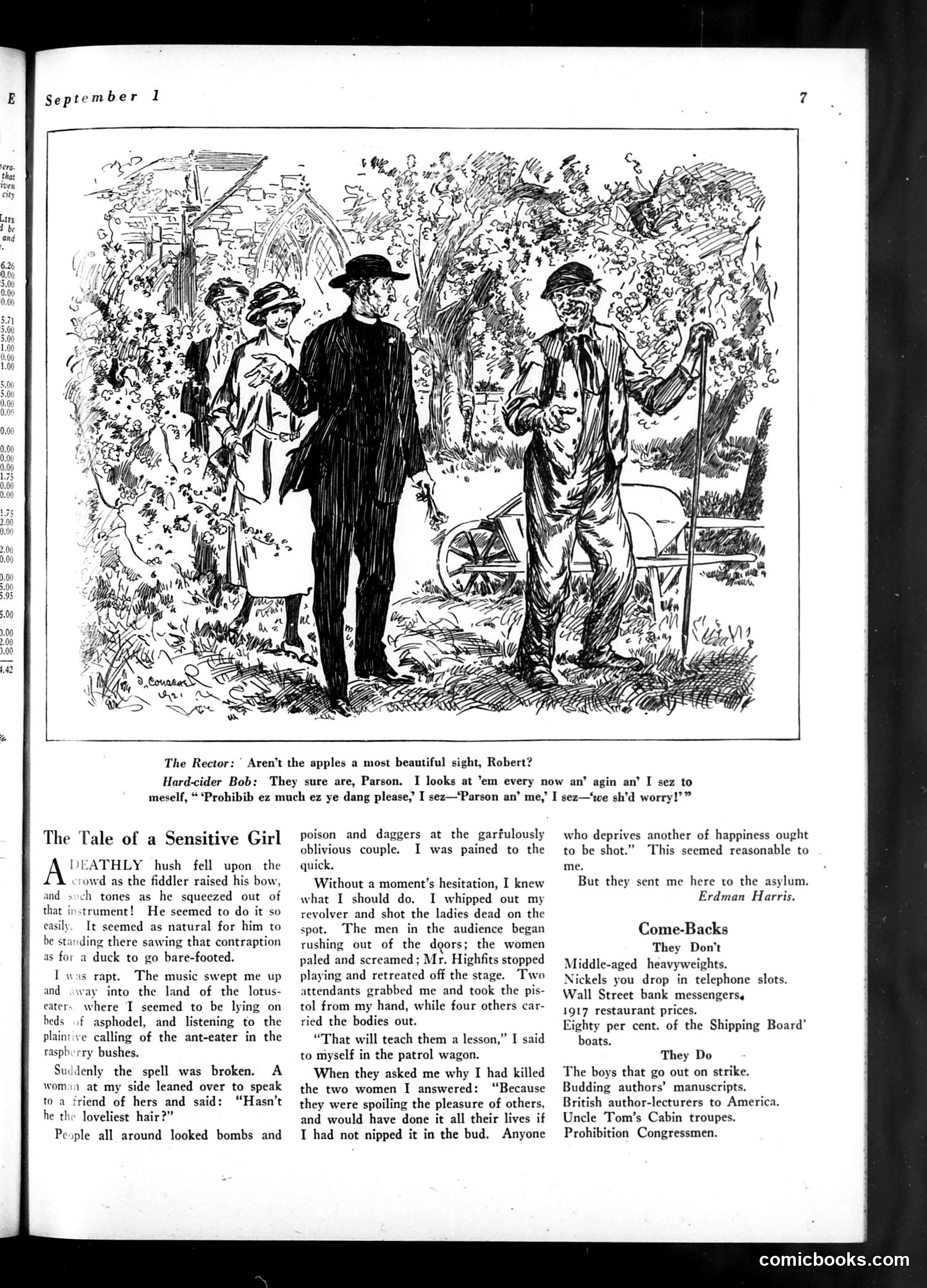
This page contains a narrative story titled "The Tale of a Sensitive Girl" by Erdman Harris, illustrated with a sketch showing five men in a rural setting—a parson, well-dressed gentleman, and laborers with a cart. The story concerns a man who shot two women dead during a theatrical performance, apparently to prevent them from "spoiling the pleasure of others." When questioned about killing them, he responds they were "oblivious" and undeserving of happiness. The authorities sent him to an asylum rather than prosecuting him criminally. The satire appears to mock misogyny and the tendency to excuse or minimize violence against women through claims of moral righteousness. The "sensitive girl" title is ironic—the real sensitivity belongs to the violent man who cannot tolerate women's presence.
📄 Transcribed text from this page (OCR, searchable)
Machine-transcribed from the original scan — historical spelling and the odd misread are preserved.
September 1 The Rector: Hard-cider Bob: They sure are, Parson. Aren’t the apples a most beautiful sight, Robert? I looks at "em every now an’ agin an’ I sez to meself, “‘Prohibib ez much ez ye dang please,’ I sez—‘Parson an’ me,’ I sez—‘we sh’d worry!” The Tale of a Sensitive Girl A UIATHLY hush fell upon the owd as the fiddler raised his bow, and such tones as he squeezed out of that instrument! He seemed to do it so easily. It seemed as natural for him to be standing there sawing that contraption as for a duck to go bare-footed. I was rapt. The music swept me up and into the land of the lotus- eaters where I seemed to be lying on beds of asphodel, and listening to the plaintive calling of the ant-eater in the raspberry bushes. Suddenly the spell was broken. A woman at my side leaned over to speak to a friend of hers and said: “Hasn't he the loveliest hair?” People all around looked bombs and poison and daggers at the garfulously oblivious couple. I was pained to the quick. Without a moment’s hesitation, I knew what I should do. I whipped out my revolver and shot the ladies dead on the spot. The men in the audience began rushing out of the dgors; the women paled and screamed ; Mr. Highfits stopped playing and retreated off the stage. Two attendants grabbed me and took the pis- tol from my hand, while four others car- ried the bodies out. “That will teach them a lesson,” I said to myself in the patrol wagon. When they asked me why I had killed the two women I answered: “Because they were spoiling the pleasure of others, and would have done it all their lives if I had not nipped it in the bud. Anyone who deprives another of happiness ought to be shot.” This seemed reasonable to me. But they sent me here to the asylum. Erdman Harris. Come-Backs They Don't Middle-aged heavyweights. Nickels you drop in telephone slots. Wall Street bank messengers, 1917 restaurant prices, Eighty per cent. of the Shipping Board’ boats. They Do The boys that go out on strike. Budding authors’ manuscripts. British author-lecturers to America. Uncle Tom’s Cabin troupes. Prohibition Congressmen. comicbooks.com