
Life, 1921-09-01 · page 16 of 35
Life — September 1, 1921 — page 16: what you’re looking at
What you’re looking at
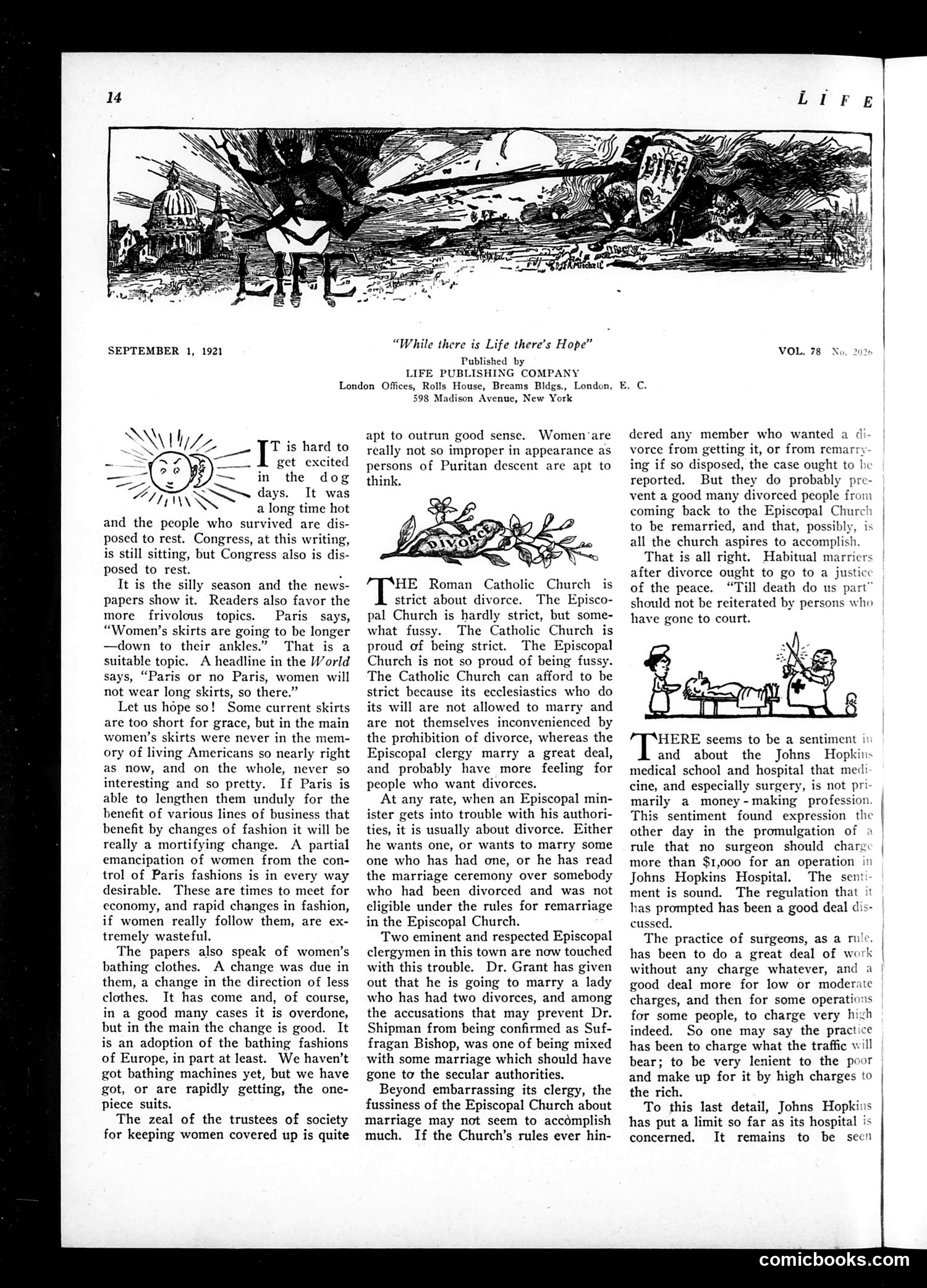
This page contains editorial commentary on contemporary social issues rather than political cartoons. The text discusses women's fashion trends (shorter skirts), divorce laws in different Christian denominations, and hospital practices. A small decorative illustration shows figures labeled "DIVORCE," satirizing the topic under discussion. The main satirical point critiques the inconsistency between Catholic and Episcopal church positions on divorce. The Catholic Church strictly forbade it while Episcopal clergy could marry despite having been divorced—a hypocrisy the author highlights. The piece also mocks the "silly season" of summer news coverage and debates the propriety of women wearing shorter skirts, suggesting such fashion changes reflect broader social anxiety about women's evolving roles and respectability in post-WWI America.
📄 Transcribed text from this page (OCR, searchable)
Machine-transcribed from the original scan — historical spelling and the odd misread are preserved.
SEPTEMBER 1, 1921 “While there is Life there’s Hope” Published by LIFE PUBLISHING COMPANY London Offices, Rolls House, Breams Bldgs., London, E. C. T is hard to WIZ —" ., s as get excited = ! a in the dog A/ <> days. It was 4 WN a long time hot and the people who survived are dis- posed to rest. Congress, at this writing, is still sitting, but Congress also is dis- posed to rest. . It is the silly season and the news- papers show it. Readers also favor the more frivolous topics. Paris says, “Women’s skirts are going to be longer —down to their ankles.” That is a suitable topic. A headline in the World says, “Paris or no Paris, women will not wear long skirts, so there.” Let us hope so! Some current skirts are too short for grace, but in the main women’s skirts were never in the mem- ory of living Americans so nearly right as now, and on the whole, never so interesting and so pretty. If Paris is able to lengthen them unduly for the benefit of various lines of business that benefit by changes of fashion it will be really a mortifying change. A partial emancipation of women from the con- trol of Paris fashions is in every way desirable. These are times to meet for economy, and rapid changes in fashion, if women really follow them, are ex- tremely wasteful. The papers also speak of women’s bathing clothes. A change was due in them, a change in the direction of less clothes. It has come and, of course, in a good many cases it is overdone, but in the main the change is good. It is an adoption of the bathing fashions of Europe, in part at least. We haven’t got bathing machines yet, but we have got, or are rapidly getting, the one- piece suits. The zeal of the trustees of society for keeping women covered up is quite 598 Madison Avenue, New York apt to outrun good sense. Women‘are really not so improper in appearance as persons of Puritan descent are apt to think. HE Roman strict about divorce. pal Church is hardly strict, but some- Catholic Church is The Episco- what fussy. The Catholic Church is proud of being strict. The Episcopal Church is not so proud of being fussy. The Catholic Church can afford to be strict because its ecclesiastics who do its will are not allowed to marry and are not themselves inconvenienced by the prohibition of divorce, whereas the Episcopal clergy marry a great deal, and probably have more feeling for people who want divorces. At any rate, when an Episcopal min- ister gets into trouble with his authori- ties, it is usually about divorce. Either he wants one, or wants to marry some one who has had one, or he has read the marriage ceremony over somebody who had been divorced and was not eligible under the rules for remarriage in the Episcopal Church. Two eminent and respected Episcopal clergymen in this town are now touched with this trouble. Dr. Grant has given out that he is going to marry a lady who has had two divorces, and among the accusations that may prevent Dr. Shipman from being confirmed as Suf- fragan Bishop, was one of being mixed with some marriage which should have gone to the secular authorities. Beyond embarrassing its clergy, the fussiness of the Episcopal Church about marriage may not seem to accomplish much. If the Church’s rules ever hin- dered any member who wanted a di- vorce from getting it, or from remarry ing if so disposed, the case ought to he reported. But they do probably pre- vent a good many divorced people fr: coming back to the Episcopal Chur to be remarried, and that, possibly, i all the church aspires to accomplish. That is all right. Habitual marriers after divorce ought to go to a justicc of the peace. “Till death do us part” should not be reiterated by persons who have gone to court. HERE seems to be a sentiment i and about the Johns Hopkins medical school and hospital that medi cine, and especially surgery, is not pri- marily a money-making profession This sentiment found expression the other day in the promulgation of rule that no surgeon should charg more than $1,000 for an operation in Johns Hopkins Hospital. The senti- ment is sound. The regulation that it has prompted has been a good deal dis- cussed. The practice of surgeons, as a rule, | has been to do a great deal of work | without any charge whatever, and a | good deal more for low or moderate charges, and then for some operations for some people, to charge very high indeed. So one may say the practice has been to charge what the traffic will bear; to be very lenient to the poor and make up for it by high charges to the rich. | To this last detail, Johns Hopkins has put a limit so far as its hospital is concerned. It remains to be secn comicbooks.com