
Life, 1921-09-01 · page 24 of 35
Life — September 1, 1921 — page 24: what you’re looking at
What you’re looking at
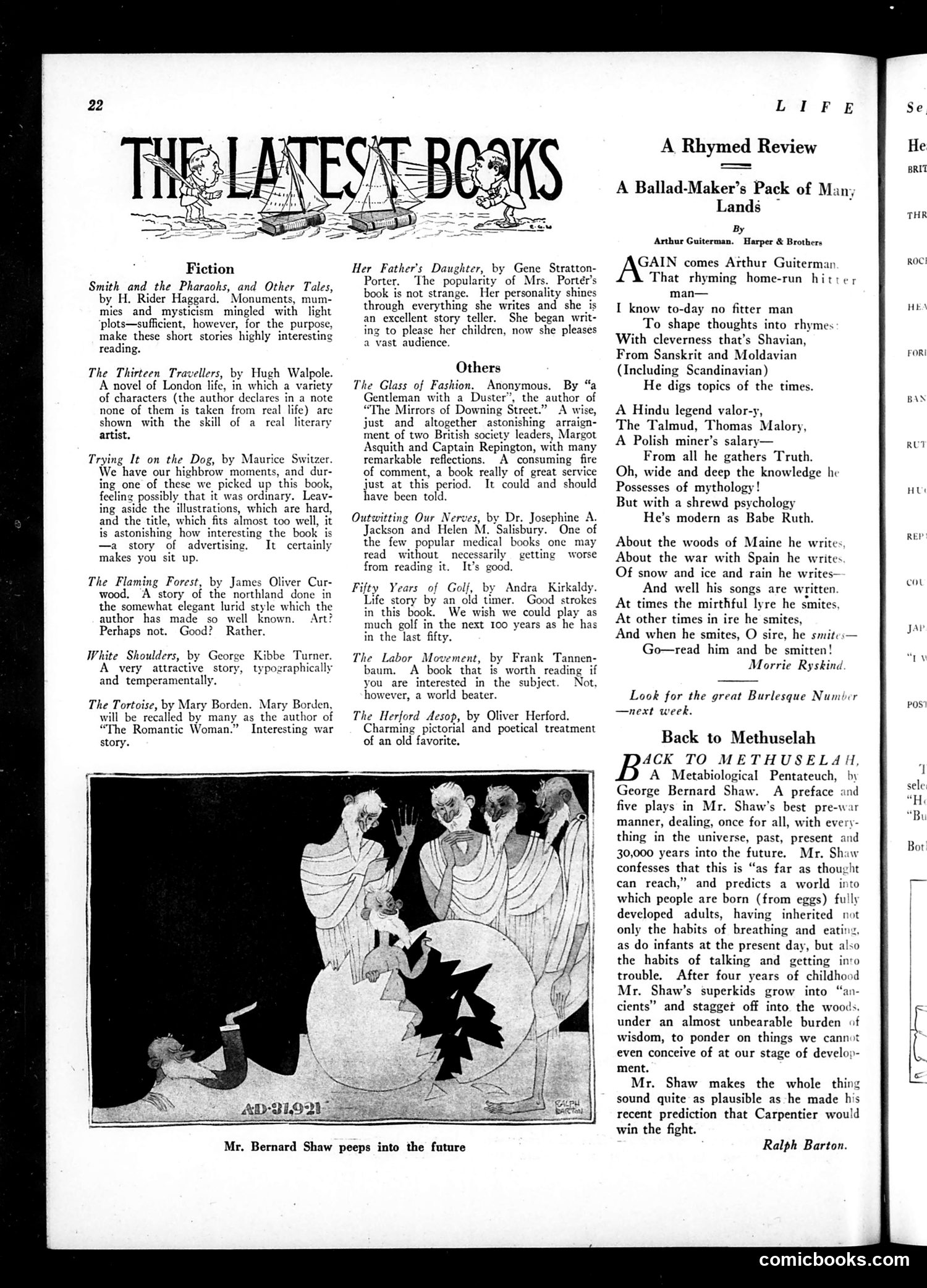
This page from *Life* magazine reviews recent fiction and Shaw's "Back to Methuselah." The central cartoon illustrates Shaw's play: an elderly figure peers into a crystal ball showing the distant future (marked "AD 31921"), while robed figures gesture dramatically around him. The satire targets Shaw's ambitious philosophical scope—his five-play cycle proposing that humanity could eventually evolve to live 300 years, developing into "ancients" who transcend ordinary concerns. The cartoon mocks the grandiosity of Shaw's metabiological speculation by depicting him literally gazing into futurity, visualizing his fantastical evolutionary vision. Below, Guiterman's rhymed review praises the playwright's versatility and intellectual range, calling him a "home-run hitter" of verse. The image suggests Shaw's audacious attempt to philosophize about humanity's distant destiny—presented as both ambitious and somewhat absurd.
📄 Transcribed text from this page (OCR, searchable)
Machine-transcribed from the original scan — historical spelling and the odd misread are preserved.
Fiction Smith and the Pharaohs, and Other Tales, y H. Rider Haggard. Monuments, mum- mies and mysticism mingled with light plots—sufficient, however, for the purpose, make these short stories highly interesting reading. The Thirteen Travellers, by Hugh Walpole. A novel of London life, in which a variety of characters (the author declares in a note none of them is taken from real life) are shown with the skill of a real literary artist. Trying It on the Dog, by Maurice Switzer. We have our highbrow moments, and dur- ing one of these we picked up ‘this book, feeling possibly that it was ordinary. Leav- ing aside the illustrations, which are hard, and the title, which fits almost too well, is astonishing how interesting the boo! —a story of advertising. It certainly makes you sit up. The Flaming Forest, by James Oliver Cur- wood, “A story of the northland done in the somewhat elegant lurid style which the author has made so well known. Art? Perhaps not. Good? Rather. White Shoulders, by George Kibbe Turner. A very attractive story, typographically and temperamentally, The Tortoise, by Mary Borden. Mary Borden, will be recalled by many as the author of “The Romantic Woman.” Interesting war story. Her Father's Daughter, by Gene Stratton- Porter. The popularity of Mrs. Portér’s book is not strange. Her personality shines through everything she writes and she is an excellent story teller. She began writ- ing to please her children, now she pleases a vast audience. Others The Glass of Fashion. Anonymous. By “a Gentleman with a Duster”, the author of “The Mirrors of Downing Street.” A wise, just and altogether astonishing arraign- ment of two British society leaders, Margot Asquith and Captain Repington, with many remarkable reflections. A consuming fire of comment, a book really of great service just at this period. It could and should have been told. Outwitting Our Nerves, by Dr. Josephine A Jackson and Helen M. Salisbury. the few popular medical book: read without from reading it. Fifty Years of Golf, by Andra Kirkaldy. Life story by an old timer. Good strokes in this book. We wish we could play as much golf in the next 100 years as he has in the last fifty. one an getting worse The Labor Movement, by Frank Tannen- baum. A book that is worth reading if you are interested in the subject. Not, however, a world beater. The Herford Aesop, by Oliver Herford. Charming pictorial and poetical treatment of an old favorite. Mr. Bernard Shaw peeps into the future LIFE A Rhymed Review A Ballad-Maker’s Pack of Man; Lands By Arthur Guiterman. Harper & Brothers GAIN comes Arthur Guiterman That rhyming home-run hitter man— I know to-day no fitter man To shape thoughts into rhymes With cleverness that’s Shavian, From Sanskrit and Moldavian (Including Scandinavian) He digs topics of the times. A Hindu legend valor-y, The Talmud, Thomas Malory, A Polish miner’s salary— From all he gathers Truth. Oh, wide and deep the knowledge hx Possesses of mythology! But with a shrewd psychology He’s modern as Babe Ruth. About the woods of Maine he writes, About the war with Spain he writes Of snow and ice and rain he writes- And well his songs are written. At times the mirthful lyre he smites At other times in ire he smites, And when he smites, O sire, he smites— Go—read him and be smitten! Morrie Ryskind Look for the great Burlesque Number —next week. Back to Methuselah ACK TO METHUSEL4AH, A Metabiological Pentateuch, by George Bernard Shaw. A preface and five plays in Mr. Shaw’s best pre-war manner, dealing, once for all, with every- thing in the universe, past, present and 30,000 years into the future. Mr. Shaw confesses that this is “as far as thought can reach,” and predicts a world into which people are born (from eggs) fully developed adults, having inherited not only the habits of breathing and eating, as do infants at the present day, but also the habits of talking and getting into trouble. After four years of childhood Mr. Shaw’s superkids grow into “an- cients” and stagger off into the woods. under an almost unbearable burden of wisdom, to ponder on things we cannot even conceive of at our stage of develop- ment. Mr. Shaw makes the whole thing sound quite as plausible as he made his recent prediction that Carpentier would win the fight. Ralph Barton. THR ROC! HEA FORI BAN RUT HU REP COL pos! comicbooks.com