
Life, 1921-09-01 · page 26 of 35
Life — September 1, 1921 — page 26: what you’re looking at
What you’re looking at
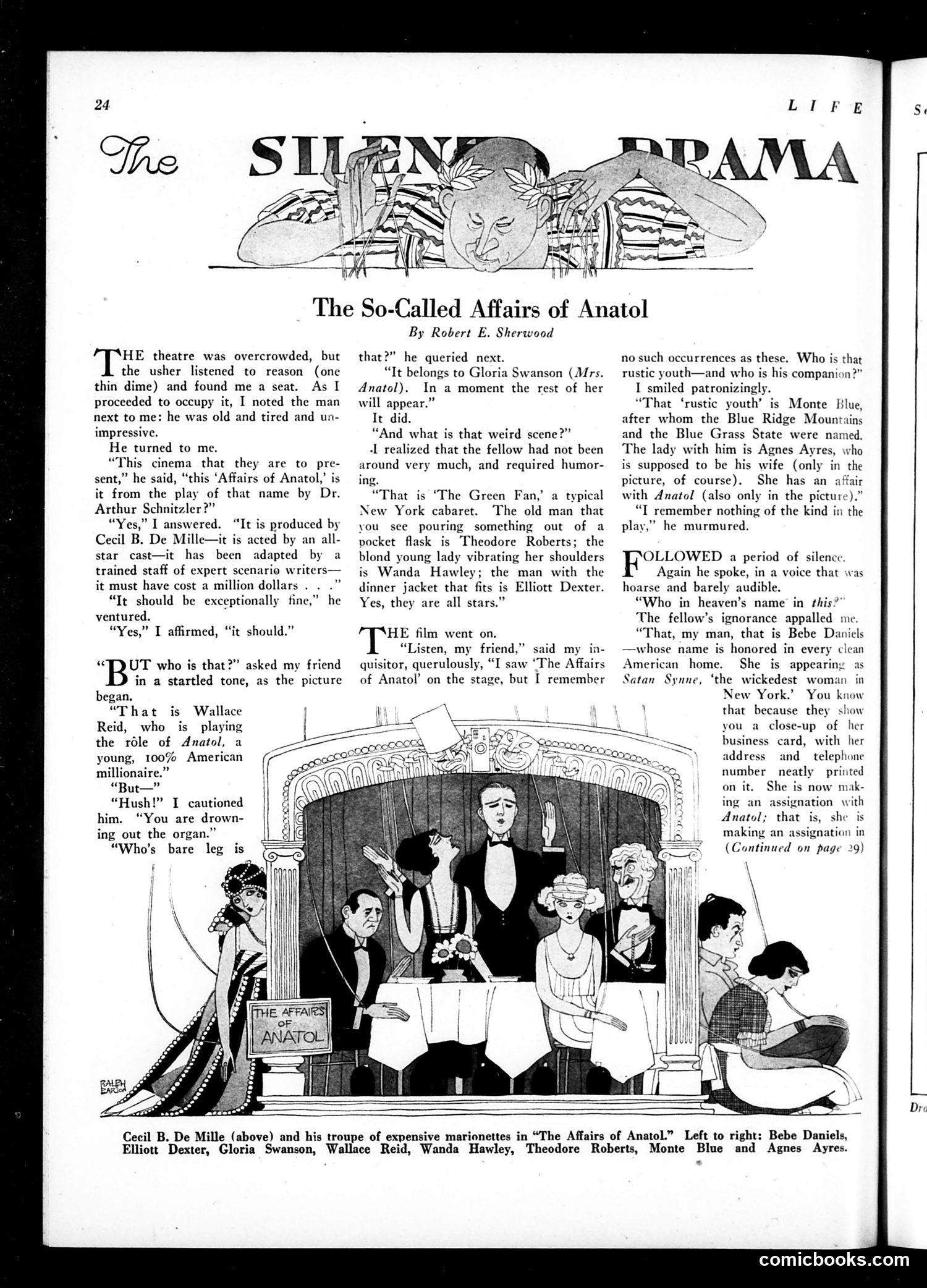
This article mocks Cecil B. De Mille's 1921 film adaptation of Arthur Schnitzler's play, sarcastically praising its lavish star-studded cast while revealing how the film butchers the source material. The author (Robert E. Sherwood) positions himself as a knowledgeable theater-goer explaining the film to an unsophisticated old man, but the joke targets De Mille's approach: substituting expensive Hollywood stars and melodramatic additions (cabaret scenes, Satan characters, close-ups of business cards) for the play's subtle psychological drama. The accompanying illustration labels the actors as "expensive marionettes"—puppets controlled by De Mille—suggesting they're interchangeable star vehicles rather than serious performances. The satire critiques early Hollywood's tendency to inflate productions with celebrity names and spectacle rather than artistic integrity, while the original play emphasized intimate character relationships and moral ambiguity.
📄 Transcribed text from this page (OCR, searchable)
Machine-transcribed from the original scan — historical spelling and the odd misread are preserved.
The So-Called Affairs of Anatol HE theatre was overcrowded, but the usher listened to reason (one thin dime) and found me a seat. As I proceeded to occupy it, I noted the man next to me: he was old and tired and un- impressive. He turned to me. “This cinema that they are to pre- sent,” he said, “this ‘Affairs of Anatol,’ is it from the play of that name by Dr. Arthur Schnitzler?” “Yes,” I answered. “It is produced by Cecil B. De Mille—it is acted by an all- star cast—it has been adapted by a trained staff of expert scenario writers— it must have cost a million dollars . . .” “It should be exceptionally tine,” he ventured. “Yes,” I affirmed, “it should.” “Be who is that?” asked my friend in a startled tone, as the picture began. “That is Wallace Reid, who is playing the réle of Anatol, a young, 100% American millionaire.” “But—” “Hush!” I cautioned him. “You are drown- ing out the organ.” “Who’s bare leg is By Robert E. Sherwood that?” he queried next. “Tt belongs to Gloria Swanson (Mrs. Anatol). In a moment the rest of her will appear.” Tt did. “And what is that weird scene?” ‘I realized that the fellow had not been around very much, and required humor- ing. “That is ‘The Green Fan,’ a typical New York cabaret. The old man that you see pouring something out of a pocket flask is Theodore Roberts; the blond young lady vibrating her shoulders is Wanda Hawley; the man with the dinner jacket that fits is Elliott Dexter. Yes, they are all stars.” HE film went on. “Listen, my friend,” said my in- quisitor, querulously, “I saw ‘The Affairs of Anatol’ on the stage, but I remember no such occurrences as these. Who is that rustic youth—and who is his companion?” I smiled patronizingly. “That ‘rustic youth’ is Monte Blue, after whom the Blue Ridge Mountains and the Blue Grass State were named. The lady with him is Agnes Ayres, who is supposed to be his wife (only in the picture, of course). She has an i with Anatol (also only in the picture).” “I remember nothing of the kind in the play,” he murmured. OLLOWED a period of silence Again he spoke, in a voice that was hoarse and barely audible. “Who in heaven’s name in this? The fellow’s ignorance appalled me. “That, my man, that is Bebe Daniels —whose name is honored in every clean American home. She is appearing as Satan Synne, ‘the wickedest woman in New York.’ You know that because they show a close-up of her ss card, with her address and telephone number neatly printed on it. She is now mak- ing an assignation with Anatol; that is, she is making an assignation in (Continued on page 29) Cecil B. De Mille (above) and his troupe of expensive marionettes in “The Affairs of Anatol.” Left to right: Bebe Daniels, Elliott Dexter, Gloria Swanson, Wallace Reid, Wanda Hawley, Theodore Roberts, Monte Blue and Agnes Ayres. comicbooks.com