
Life, 1921-09-01 · page 17 of 35
Life — September 1, 1921 — page 17: what you’re looking at
What you’re looking at
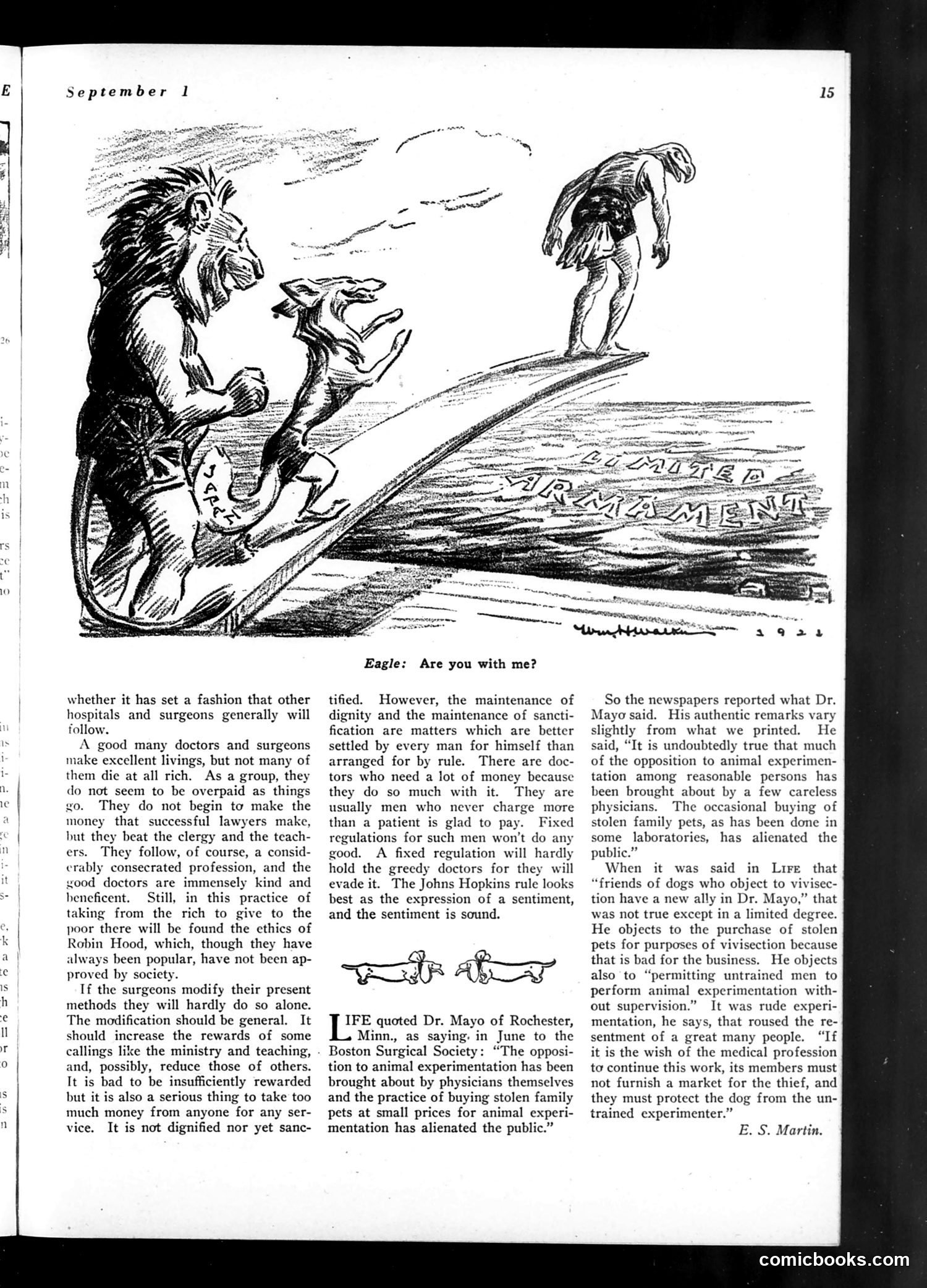
This cartoon depicts an eagle (symbolizing America or American values) questioning a hunched figure labeled "DILUTED AMUSEMENT" about their allegiance. The figure appears reluctant or evasive—positioned lower and turned away from the eagle's direct gaze. The accompanying text discusses medical ethics, particularly Dr. Mayo's criticisms of animal experimentation in laboratories. The magazine corrects its earlier misreporting of Mayo's position, clarifying that he opposes unethical practices—specifically buying stolen pets for vivisection and allowing untrained physicians to conduct experiments—rather than opposing animal research itself. The cartoon likely satirizes perceived hypocrisy or moral compromise: the "amusement" industry's willingness to ignore ethical concerns mirrors the medical profession's problematic practices. The eagle asks whether American institutions will maintain ethical standards or abandon them for profit.
📄 Transcribed text from this page (OCR, searchable)
Machine-transcribed from the original scan — historical spelling and the odd misread are preserved.
September 1 10 whether it has set a fashion that other hospitals and surgeons generally will follow. Is A good many doctors and surgeons 1 make excellent livings, but not many of i- them die at all rich. As a group, they n. do not seem to be overpaid as things ie go. They do not begin to make the money that successful lawyers make, ( but they beat the clergy and the teach- ers. They follow, of course, a consid- crably consecrated profession, and the good doctors are immensely kind and = beneficent. Still, in this practice of taking from the rich to give to the e. | poor there will be found the ethics of Robin Hood, which, though they have a always been popular, have not been ap- ec proved by society. Is If the surgeons modify their present h methods they will hardly do so alone. e The modification should be general. It ll should increase the rewards of some or callings like the ministry and teaching, and, possibly, reduce those of others. It is bad to be insufficiently rewarded but it is also a serious thing to take too much money from anyone for any ser- vice. It is not dignified nor yet sanc- Eagle: Are you with me? tified. However, the maintenance of dignity and the maintenance of sancti- fication are matters which are better settled by every man for himself than arranged for by rule. There are doc- tors who need a lot of money because they do so much with it. They are usually men who never charge more than a patient is glad to pay. Fixed regulations for such men won't do any good. A fixed regulation will hardly hold the greedy doctors for they will evade it. The Johns Hopkins rule looks best as the expression of a sentiment, and the sentiment is sound. ead afc IFE quoted Dr. Mayo of Rochester, Minn., as saying: in June to the Boston Surgical Society: “The opposi- tion to animal experimentation has been brought about by physicians themselves and the practice of buying stolen family pets at small prices for animal experi- mentation has alienated the public.” So the newspapers reported what Dr. Mayo said. His authentic remarks vary slightly from what we printed. He said, “It is undoubtedly true that much of the opposition to animal experimen- tation among reasonable persons has been brought about by a few careless physicians. The occasional buying of stolen family pets, as has been done in some laboratories, has alienated the public.” When it was said in Lire that “friends of dogs who object to vivisec- tion have a new ally in Dr. Mayo,” that was not true except in a limited degree. He objects to the purchase of stolen pets for purposes of vivisection because that is bad for the business. He objects also to “permitting untrained men to perform animal experimentation with- out supervision.” It was rude experi- mentation, he says, that roused the re- sentment of a great many people. “If it is the wish of the medical profession to continue this work, its members must not furnish a market for the thief, and they must protect the dog from the un- trained experimenter.” E. S. Martin. comicbooks.com