
Life, 1921-09-01 · page 20 of 35
Life — September 1, 1921 — page 20: what you’re looking at
What you’re looking at
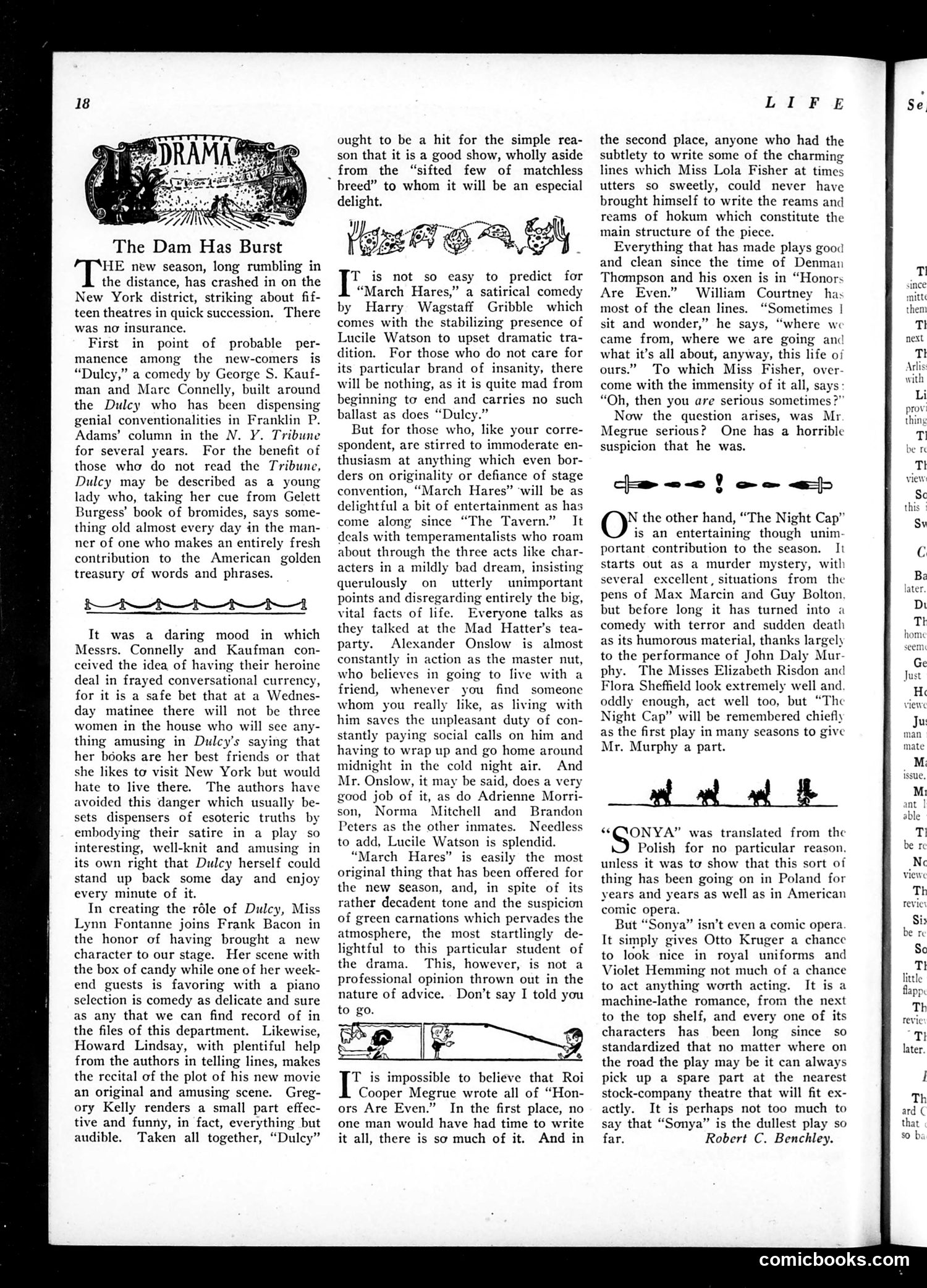
This is a theater criticism column reviewing several Broadway plays opening in the new season. The reviewer discusses three productions: **"Dulcy"** — A comedy by Kaufman and Connelly featuring Lynn Fontanne, based on a character from Franklin P. Adams' Tribune column. Dulcy is a woman who constantly repeats tired clichés ("bromides") as if they're original observations, yet the play itself is well-crafted and amusing enough to entertain even those who don't appreciate the satire on superficial conversation. **"March Hares"** — A satirical comedy described as deliberately absurd, featuring characters who behave like guests at the Mad Hatter's tea party from *Alice in Wonderland*—obsessing over trivial matters while ignoring important life facts. **"Sonya"** — A translated Polish play the reviewer dismisses as "the dullest play so far," criticizing it as machine-like and tedious despite featuring performers in attractive costumes. The column reflects 1920s theater culture and entertainment criticism conventions.
📄 Transcribed text from this page (OCR, searchable)
Machine-transcribed from the original scan — historical spelling and the odd misread are preserved.
The Dam Has Burst HE new season, long rumbling in the distance, has crashed in on the New York district, striking about fif- teen theatres in quick succession. There was no insurance. First in point of probable per- manence among the new-comers is “Dulcy,” a comedy by George S. Kauf- man and Marc Connelly, built around the Dulcy who has been dispensing genial conventionalities in Franklin P. Adams’ column in the N. Y. Tribune for several years. For the benefit of those who do not read the Tribune, Dulcy may be described as a young lady who, taking her cue from Gelett Burgess’ book of bromides, says some- thing old almost every day in the man- ner of one who makes an entirely fresh contribution to the American golden treasury of words and phrases. ih EEE It was a daring mood in which Messrs. Connelly and Kaufman con- ceived the idea of having their heroine deal in frayed conversational currency, for it is a safe bet that at a Wednes- day matinee there will not be three women in the house who will see any- thing amusing in Dulcy’s saying that her books are her best friends or that she likes to visit New York but would hate to live there. The authors have avoided this danger which usually be- sets dispensers of esoteric truths by embodying their satire in a play so interesting, well-knit and amusing in its own right that Dulcy herself could stand up back some day and enjoy every minute of it. In creating the rdle of Dulcy, Miss Lynn Fontanne joins Frank Bacon in the honor of having brought a new character to our stage. Her scene with the box of candy while one of her week- end guests is favoring with a piano selection is comedy as delicate and sure as any that we can find record of in the files of this department. Likewise, Howard Lindsay, with plentiful help from the authors in telling lines, makes the recital of the plot of his new movie an original and amusing scene. Greg- ory Kelly renders a small part effec- tive and funny, in fact, everything but audible. Taken all together, “Dulcy” ought to be a hit for the simple rea- son that it is a good show, wholly aside _from the “sifted few of matchless breed” to whom it will be an especial delight. T is not so easy to predict for “March Hares,” a satirical comedy by Harry Wagstaff Gribble which comes with the stabilizing presence of Lucile Watson to upset dramatic tra- dition. For those who do not care for its particular brand of insanity, there will be nothing, as it is quite mad from beginning to end and carries no such ballast as does “Dulcy.” But for those who, like your corre- spondent, are stirred to immoderate en- thusiasm at anything which even bor- ders on originality or defiance of stage convention, “March Hares” ‘will be as delightful a bit of entertainment as has come along since “The Tavern.” It deals with temperamentalists who roam about through the three acts like char- acters in a mildly bad dream, insisting querulously on utterly unimportant points and disregarding entirely the big, vital facts of life. Everyone talks as they talked at the Mad Hatter’s tea- party. Alexander Onslow is almost constantly in action as the master nut, who believes in going to live with a friend, whenever you find someone whom you really like, as living with him saves the unpleasant duty of con- stantly paying social calls on him and having to wrap up and go home around midnight in the cold night air. And Mr. Onslow, it may be said, does a very good job of it, as do Adrienne Morri- son, Norma Mitchell and Brandon Peters as the other inmates. Needless to add, Lucile Watson is splendid. “March Hares” is easily the most original thing that has been offered for the new season, and, in spite of its rather decadent tone and the suspicion of green carnations which pervades the atmosphere, the most startlingly de- lightful to this particular student of the drama. This, however, is not a professional opinion thrown out in the nature of advice. Don’t say I told you to go. T is impossible to believe that Roi Cooper Megrue wrote all of “Hon- ors Are Even.” In the first place, no one man would have had time to write it all, there is so much of it. And in LIFE the second place, anyone who had the subtlety to write some of the charming lines which Miss Lola Fisher at times utters so sweetly, could never have brought himself to write the reams and reams of hokum which constitute the main structure of the piece. Everything that has made plays good and clean since the time of Denman Thompson and his oxen is in “Honors Are Even.” William Courtney has most of the clean lines. “Sometimes | sit and wonder,” he says, “where w« came from, where we are going and what it’s all about, anyway, this life of ours.” To which Miss Fisher, over- come with the immensity of it all, say “Oh, then you are serious sometimes?’ Now the question arises, was Mr Megrue serious? One has a horrible suspicion that he was. cqe> —-- ? oom =) N the other hand, “The Night Cap” is an entertaining though unim portant contribution to the season. It starts out as a murder mystery, with several excellent, situations from the pens of Max Marcin and Guy Bolton, but before long it has turned into a comedy with terror and sudden death as its humorous material, thanks largely to the performance of John Daly Mur- phy. The Misses Elizabeth Risdon and Flora Sheffield look extremely well and oddly enough, act well too, but “Th¢ Night Cap” will be remembered chiefly as the first play in many seasons to give Mr. Murphy a part. wh wk nl **Q\ONYA” was translated from the Polish for no particular reason. unless it was to show that this sort of thing has been going on in Poland for years and years as well as in American comic opera. But “Sonya” isn’t even a comic opera. It simply gives Otto Kruger a chance to look nice in royal uniforms and Violet Hemming not much of a chance to act anything worth acting. It is a machine-lathe romance, from the next to the top shelf, and every one of its characters has been long since so standardized that no matter where on the road the play may be it can always pick up a spare part at the nearest stock-company theatre that will fit ex- actly. It is perhaps not too much to say that “Sonya” is the dullest play so far. Robert C. Benchley. Tl since mitt them Arlis with Li prov thing be re Nc viewe Th revie comicbooks.com