
A complete issue · 34 pages · 1921
Life — August 4, 1921
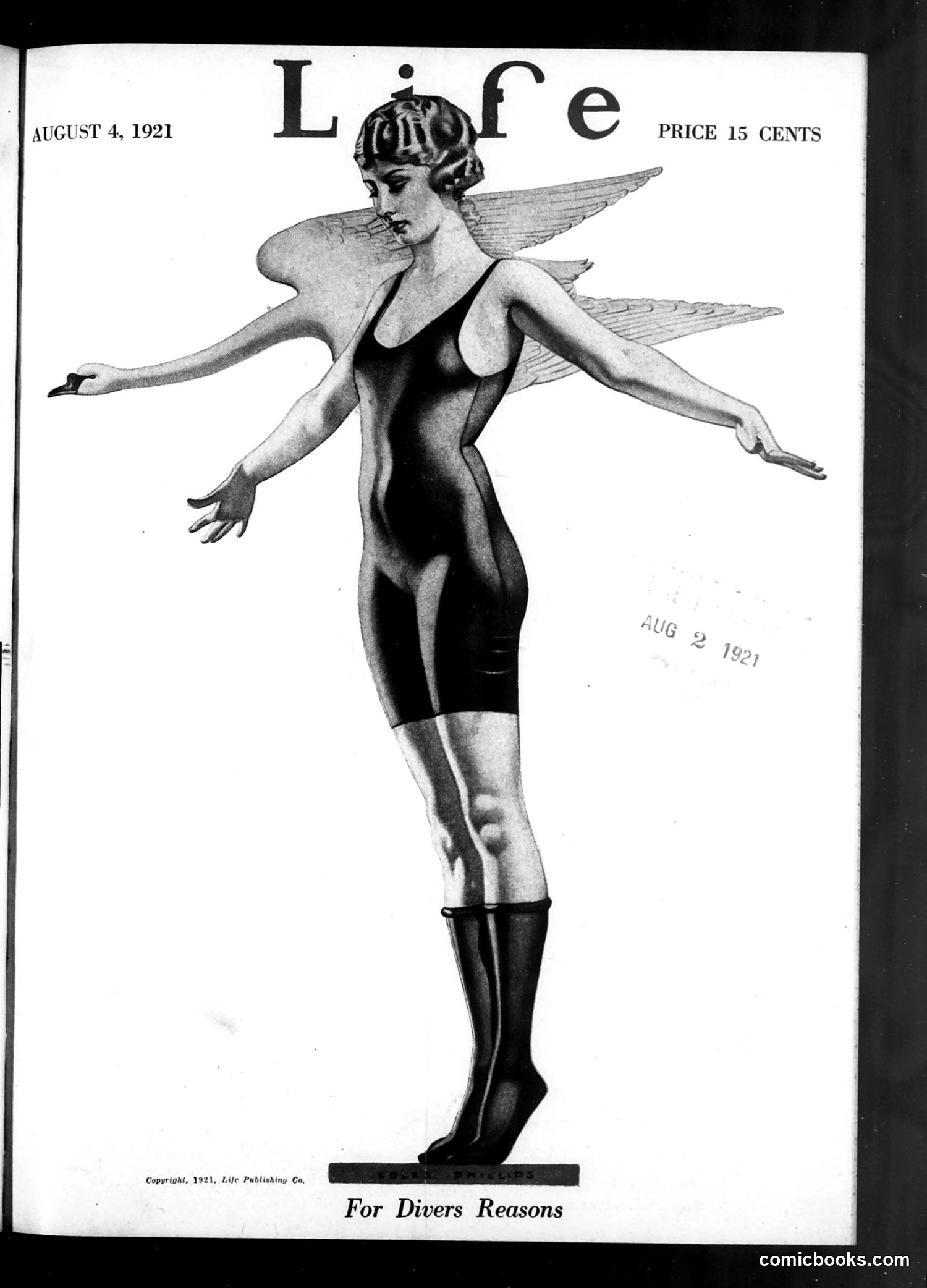
This cover features a stylized female figure with fairy wings in a bathing costume, captioned "For Divers Reasons." The play on words—"divers" (multiple reasons) versus "divers" (swimmers/diving)—suggests commentary on 1920s beach culture or swimwear fashion during the Jazz Age. The idealized, art deco-influenced nude or semi-nude depiction reflects the era's changing attitudes toward women's bodies and clothing, particularly the controversy surrounding shorter, more revealing bathing suits that scandalized conservative society. The magazine, priced at 15 cents, was known for satirizing contemporary social mores and fashion trends. The whimsical winged figure likely mocks both the romantic idealization of the "modern woman" and the actual practical concerns about women's increasing freedom and visibility in public spaces.
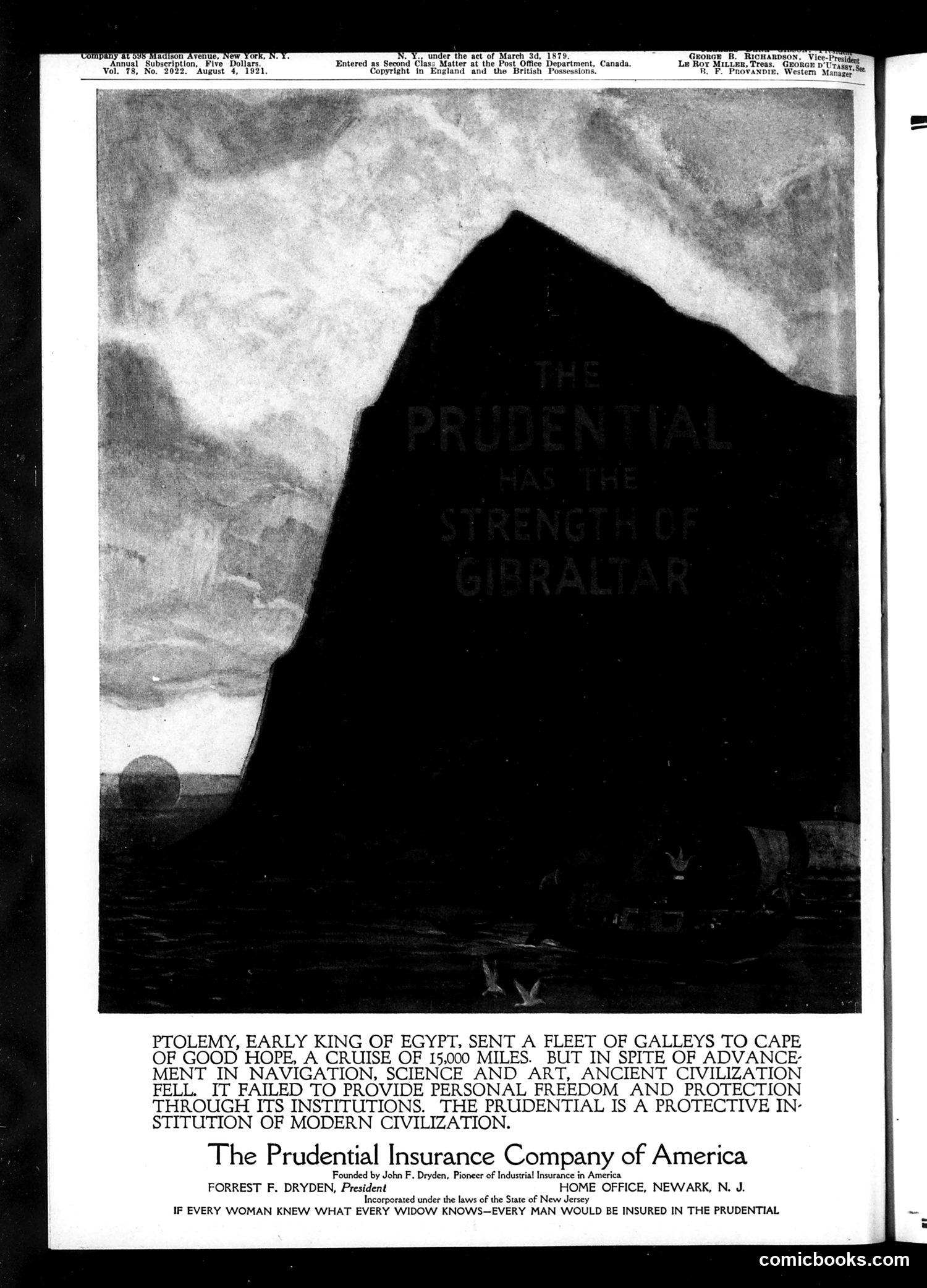
This page is primarily a **Prudential Insurance Company advertisement** from 1921, not political satire. The image shows the Rock of Gibraltar in silhouette against a dramatic sky. The ad uses a historical analogy: it compares Prudential's protective function to how ancient Egyptian King Ptolemy sent a fleet to Cape Good Hope, which failed to provide freedom and protection. The text argues that while ancient civilization lacked institutions for protection, **modern civilization depends on protective institutions like insurance**. The closing tagline—"IF EVERY WOMAN KNEW WHAT EVERY WIDOW KNOWS—EVERY MAN WOULD BE INSURED IN THE PRUDENTIAL"—is a sales pitch targeting men to buy life insurance, appealing to their sense of responsibility toward widows and families.
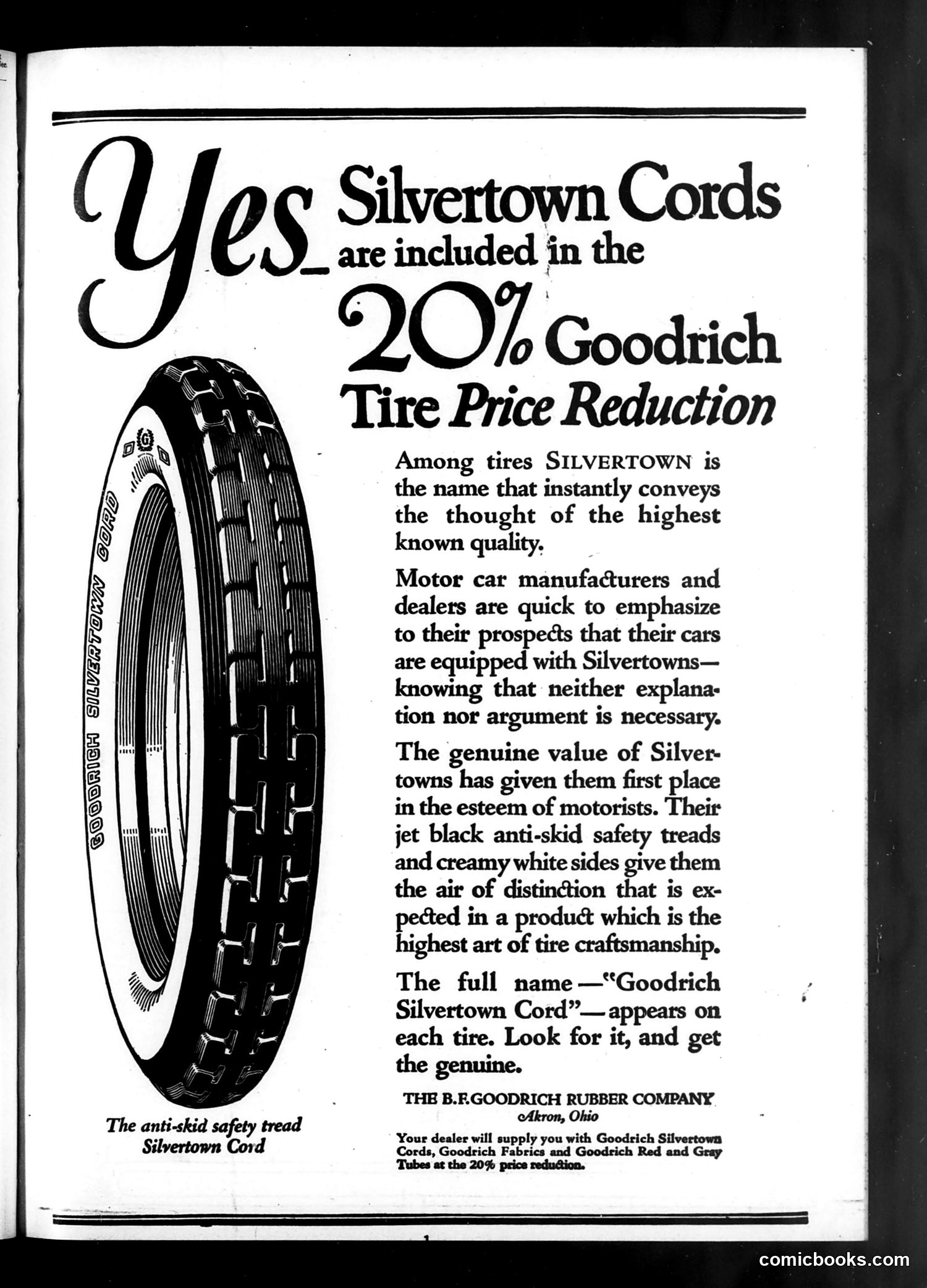
This is **not a cartoon or satire page** — it's a **straightforward advertisement** for Goodrich Silvertown Cord tires, published in *Life* magazine. The ad promotes Silvertown Cords' inclusion in a 20% price reduction by Goodrich. The text emphasizes the tire brand's reputation for quality among motorists and automobile manufacturers, highlighting their distinctive black anti-skid treads and cream-colored sidewalls as markers of superior craftsmanship. The single image shows a tire's profile with visible tread pattern and white-wall sidewall, labeled "The anti-skid safety tread Silvertown Cord." The ad concludes by directing consumers to look for the full name "Goodrich Silvertown Cord" when purchasing. There is no satirical content or political reference present.
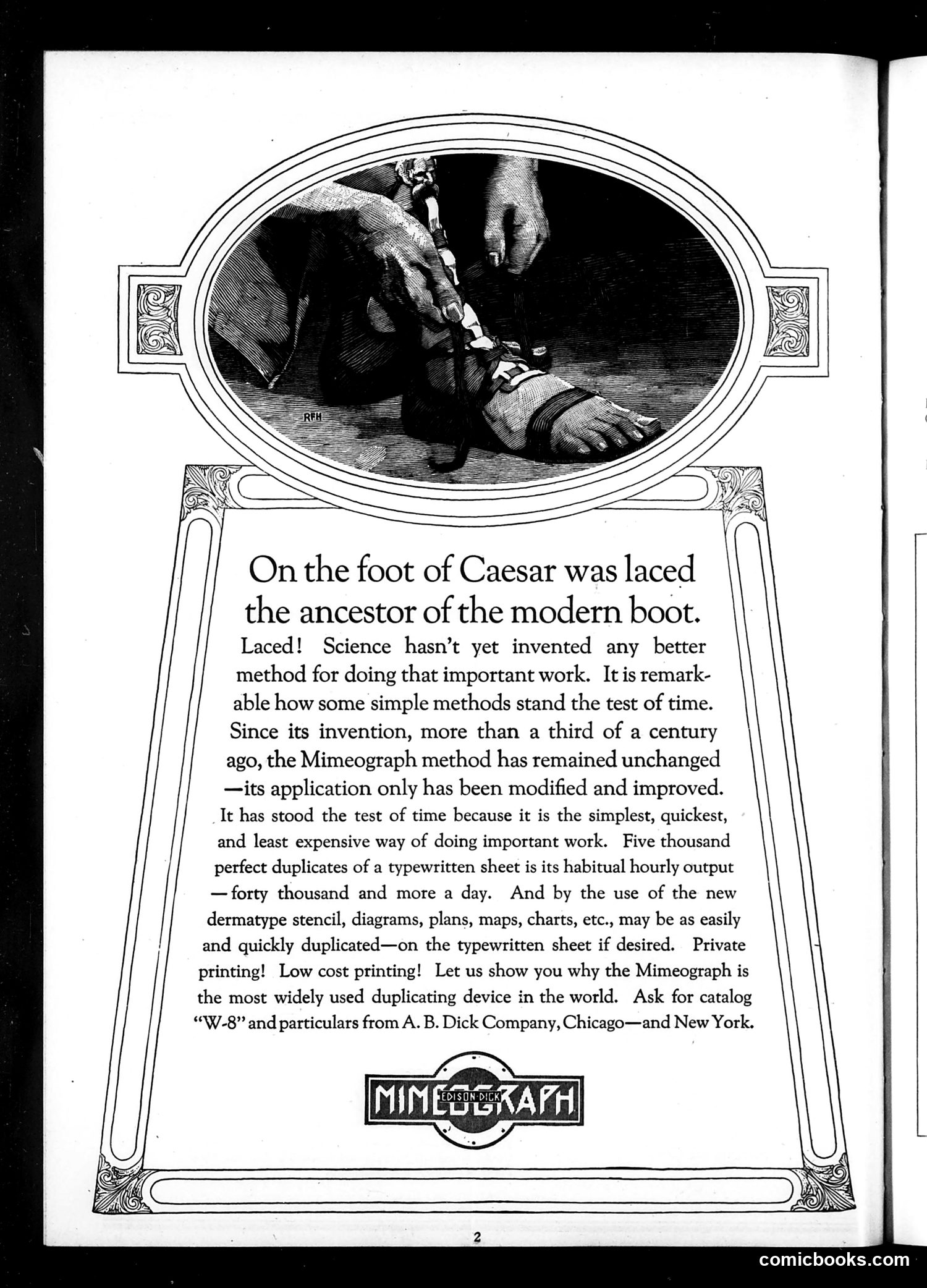
This is an **advertisement for the Mimeograph machine**, not political satire. The page uses a historical reference as a marketing hook: the caption claims that on Caesar's foot "was laced the ancestor of the modern boot," drawing a parallel between ancient innovations and the Mimeograph as a timeless, simple solution. The image shows hands lacing a boot, illustrating the "simple methods [that] stand the test of time." The ad emphasizes that the Mimeograph's core method hasn't changed in over a third-century—only applications improved. It boasts high output (5,000 duplicates hourly) and low cost, positioning the device as the world's most widely used duplicating technology. The A.B. Dick Company (Chicago and New York) solicits catalog inquiries.
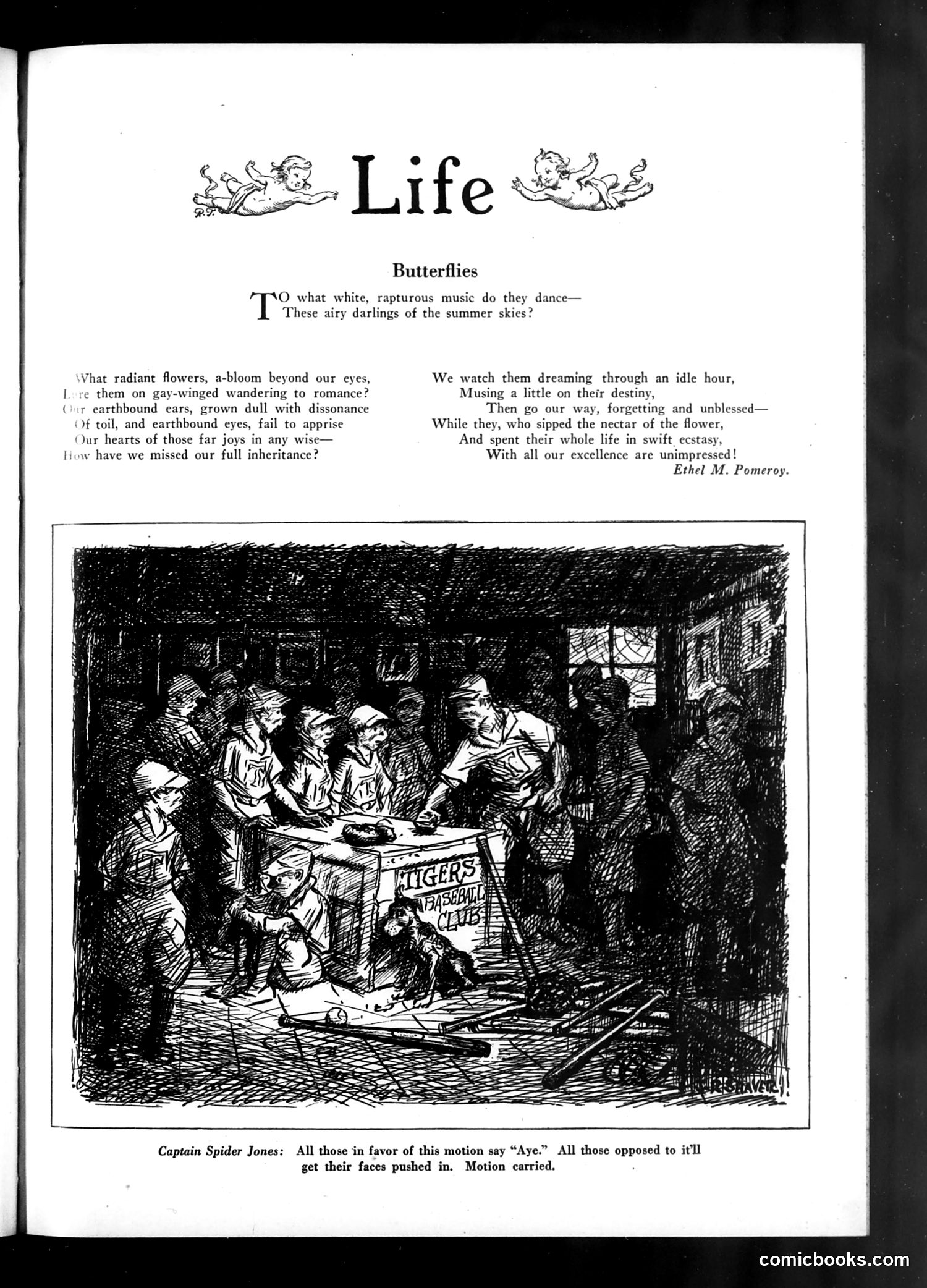
This page contains a poem by Ethel M. Pomeroy celebrating butterflies as carefree creatures, contrasting their simple pleasure with human ambitions and burdens. The cartoon below depicts what appears to be a street or basement scene with a "Tigers Baseball Club" sign. A figure labeled "Captain Spider Jones" moderates a motion or vote, with the humorous caption suggesting those voting "Aye" will have their faces pushed in, while opposition results in the same consequence—a joke about having no good options in a contentious decision. The specific context of this vote remains unclear from the image alone, but the satire targets either a sports club dispute or local political/social controversy of the era when Life was publishing such material.
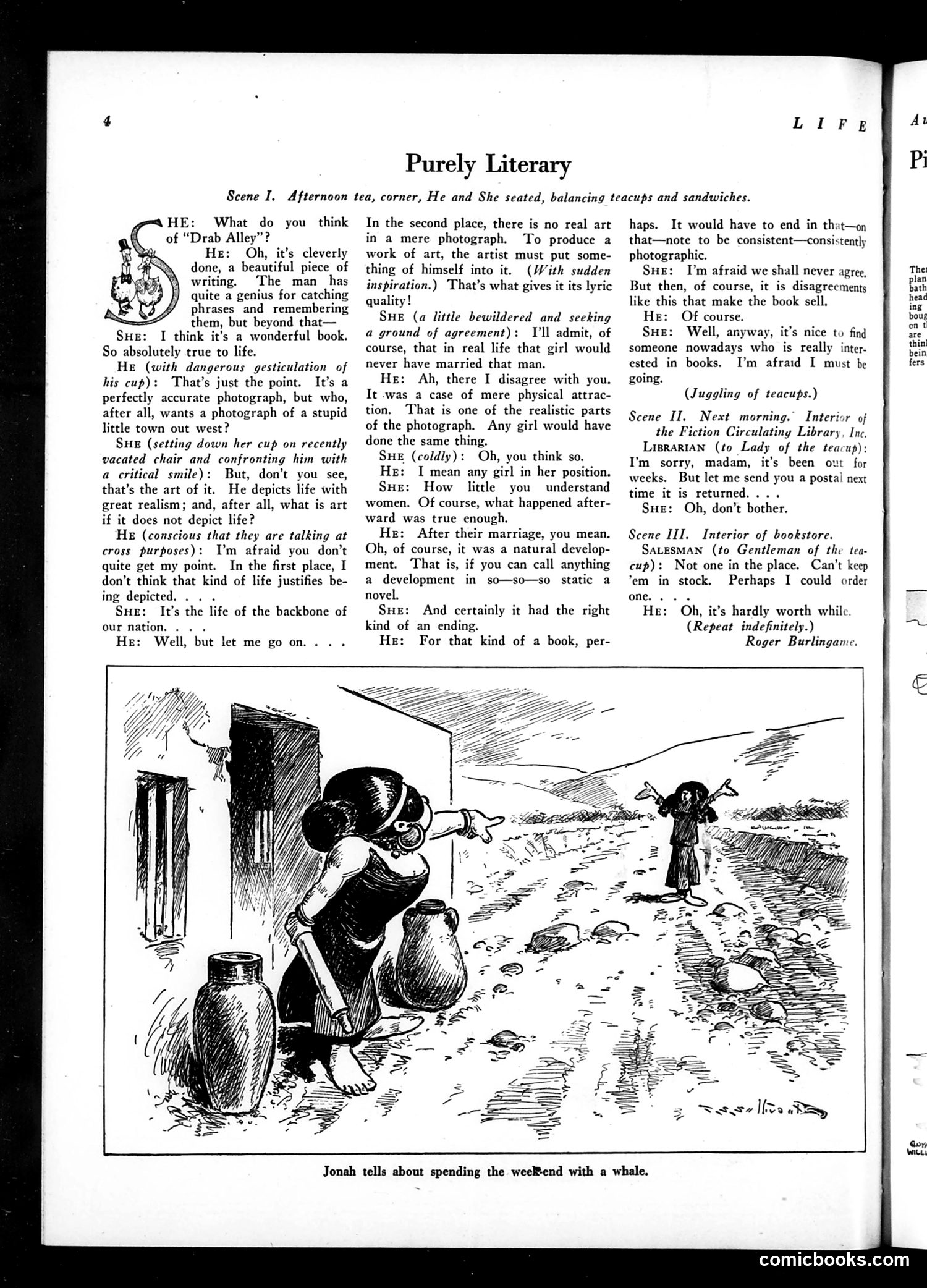
This page satirizes pretentious literary criticism and book discussions. The dialogue depicts a couple debating whether "Dream Alley" qualifies as art or mere photography. He defends it as literary genius with emotional depth; she counters that it's just realistic description without true artistic merit. The accompanying illustration shows a child telling an adult about "spending the weekend with a whale"—a visual punchline mocking the sort of fantastical, implausible narratives that might be defended as "literary" by overeager critics. The satire targets how people justify mediocre or unrealistic fiction as sophisticated art, and how literary snobs use aesthetic arguments to defend work that's simply implausible or poorly written. The scene at afternoon tea suggests this pretentiousness was common among educated social circles of the era.
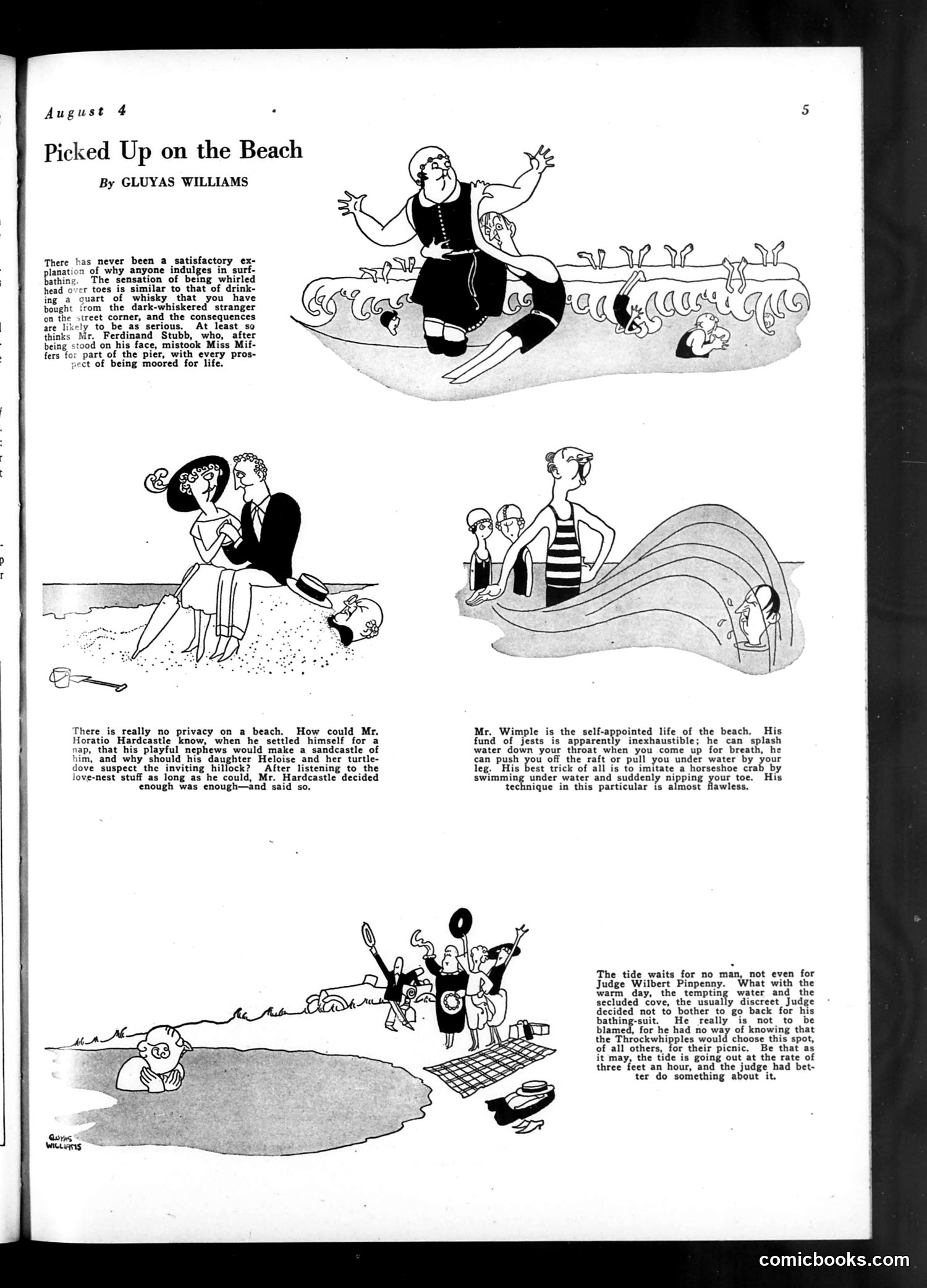
This satirical piece mocks various beach social situations and annoying characters. The cartoons depict: 1. **A woman in old-fashioned bathing attire** being knocked around by waves—commentary on dated swimming fashion or clumsy swimmers. 2. **A couple on the beach** with a man apparently making unwanted advances, satirizing inappropriate behavior. 3. **"Mr. Wimple"**—described as a self-appointed beach "life" who aggressively demonstrates water tricks, dunking people and showing off. 4. **Judge Wilbert Pippenny**—apparently a real local figure who abandons his bathing suit rather than retrieve it when the tide comes in. The humor targets recognizable beach personalities: the fashion-unconscious swimmer, the overeager show-off, and the dignified person humbled by circumstance.
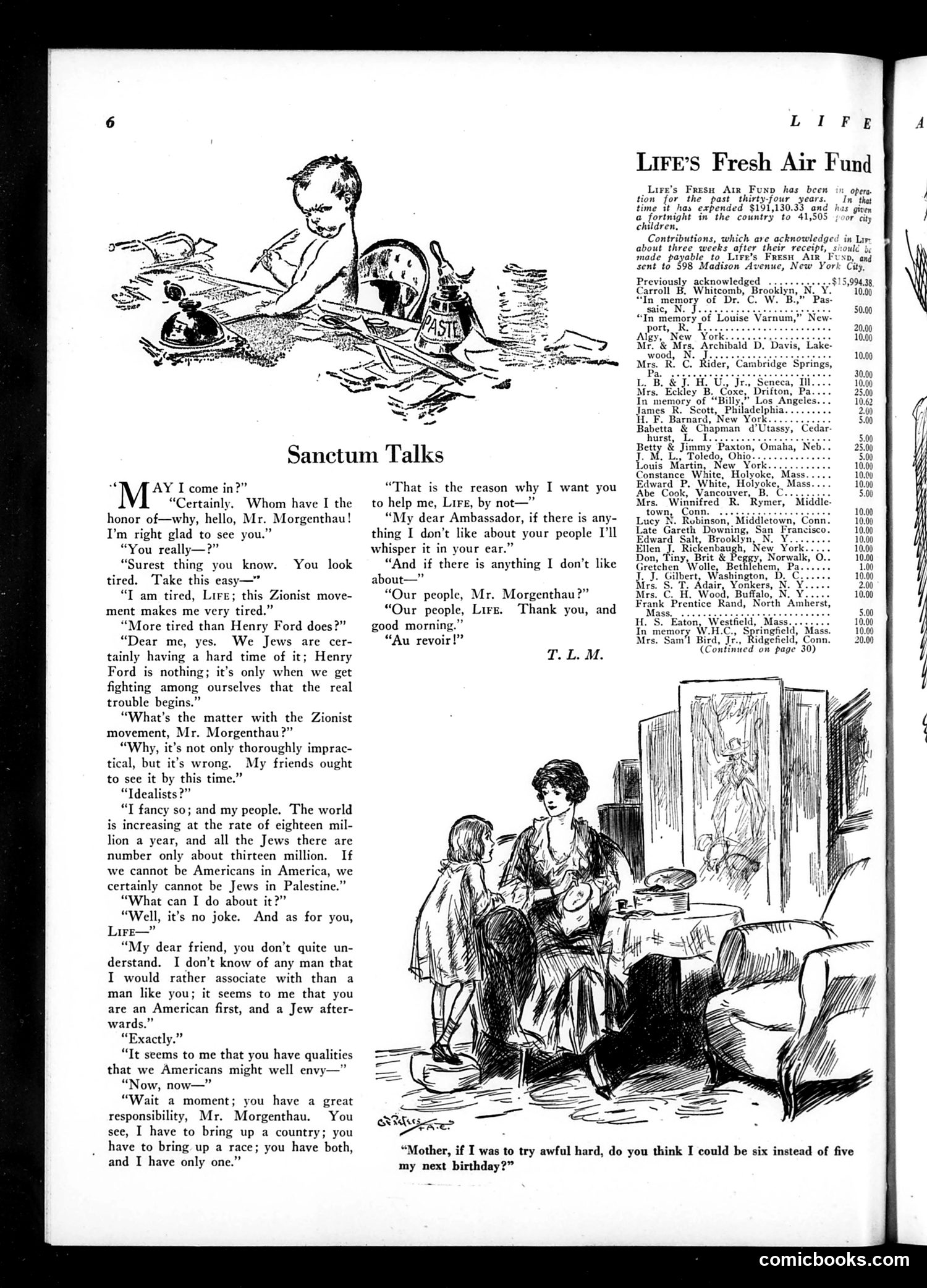
**"Sanctum Talks"** depicts a conversation between a man named Morgenthau and the magazine's editor ("LIFE"). The discussion concerns Jewish identity and American citizenship during what appears to be the early 20th century. Morgenthau expresses frustration with Zionism, arguing that Jews should prioritize American identity. He claims the movement is "impractical" and "wrong," and that Jews cannot simultaneously be fully American and Jewish. The editor counters that Morgenthau himself possesses admirable qualities while being Jewish-American, suggesting both identities can coexist. The cartoon addresses assimilation debates within Jewish-American communities—whether immigrants should fully abandon ethnic identity for American nationalism, a central tension in this era's immigration discourse. The accompanying illustration shows a domestic scene unrelated to this dialogue.
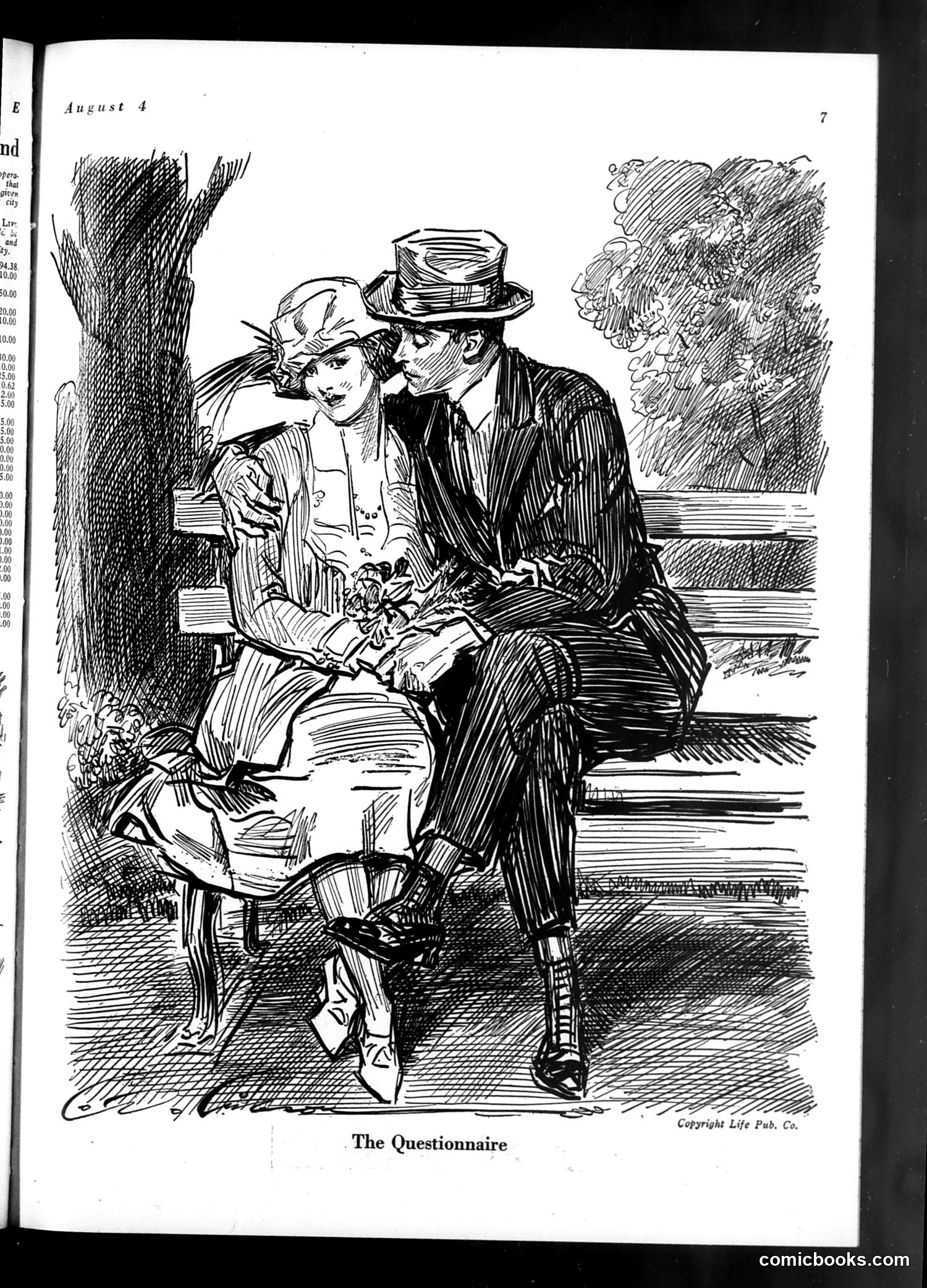
This illustration depicts a couple on a park bench—a woman in a hat and dress seated next to a man in a suit and fedora. The title "The Questionnaire" suggests a courtship or romantic scenario typical of early 20th-century Life magazine humor. The satire likely plays on social customs of dating and romantic inquiry—possibly mocking the formality or awkwardness of men asking women questions during courtship. The man's body language and positioning suggest he's engaged in conversation with the woman, who appears somewhat distracted or disengaged (adjusting her hat). Without additional context from surrounding text, the specific joke remains unclear, though it appears to satirize contemporary dating rituals or the questionnaires/surveys that were occasionally used in romantic contexts of the era.
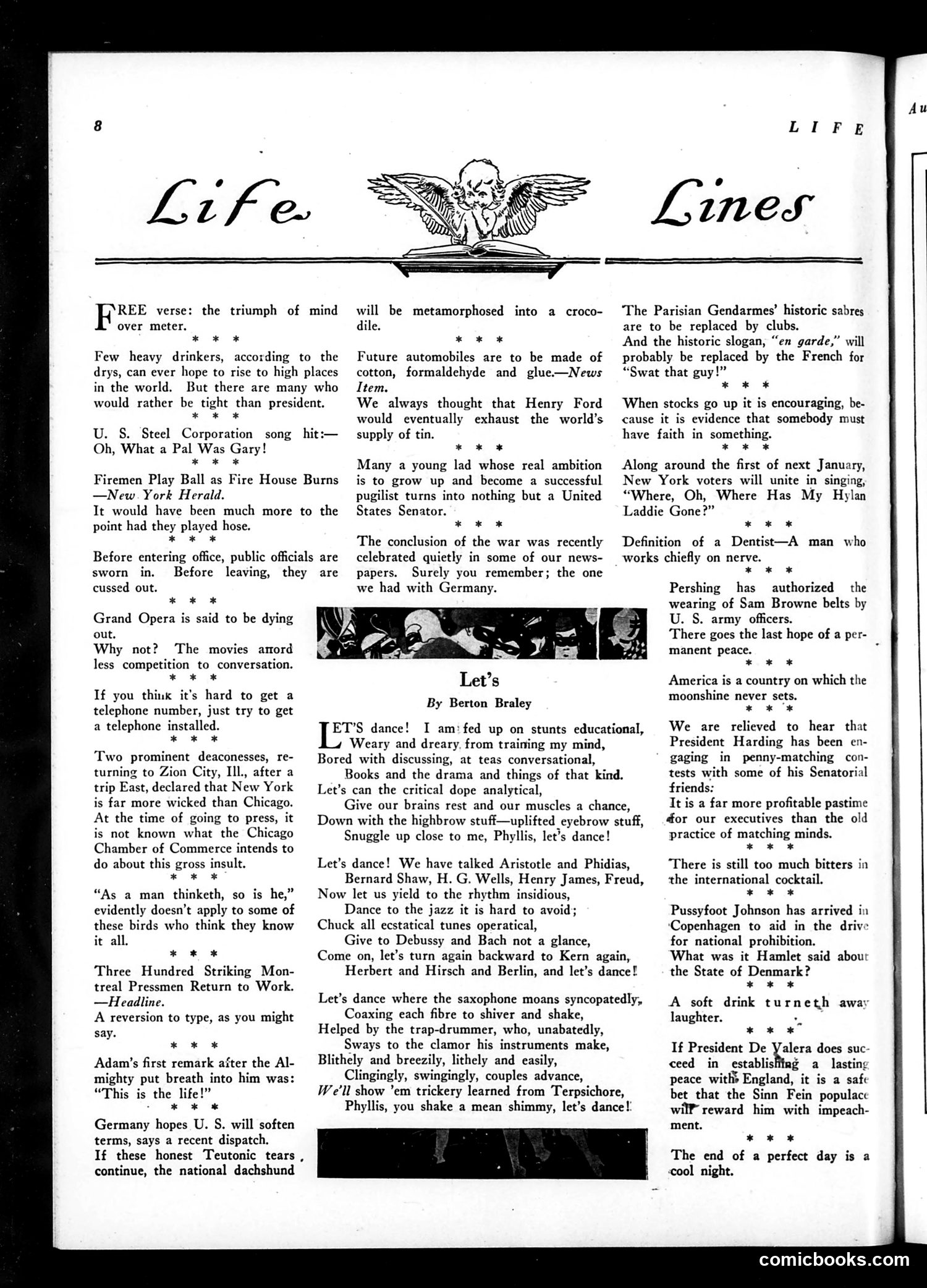
This page from *Life* magazine consists primarily of short satirical commentary and jokes ("Life Lines") rather than political cartoons. The content includes: **Social Commentary:** - Jabs at Henry Ford and automobile manufacturing - Criticism of public officials and corruption - Commentary on the Grand Opera's decline versus movies' popularity - Jokes about telephone installation difficulties **The Featured Piece:** Berton Braley's poem "Let's" advocates for dancing and pleasure-seeking, referencing figures like Aristotle, Phileas, Bernard Shaw, and H.G. Wells. It's a lighthearted call to abandon serious concerns and embrace jazz-age hedonism—typical 1920s satire of intellectual pretension versus living for the moment. **Overall Tone:** The page reflects post-WWI American social commentary: skepticism toward institutions, celebration of modern entertainment (jazz, dance), and witty dismissal of various establishment figures and practices.
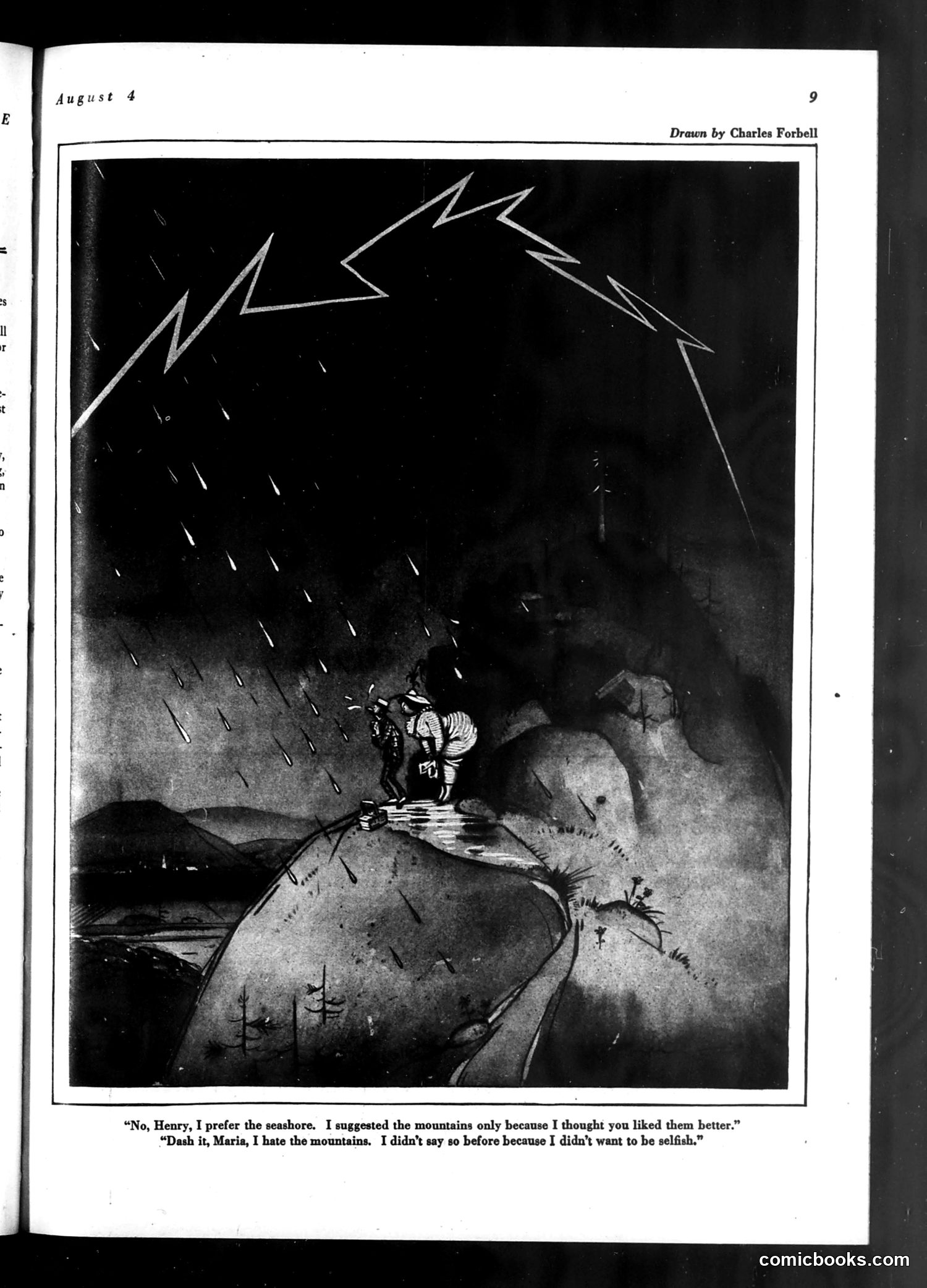
This illustration by Charles Forbell depicts a dramatic romantic scene. A man and woman sit together on a mountainous landscape during a thunderstorm, with lightning bolts streaking across a dark sky above them. The dialogue reveals the cartoon's humor: the woman (Maria) prefers the seashore, but the man (Henry) chose mountains, claiming he thought *she* preferred them. When Maria expresses her dislike of mountains, Henry admits he didn't want to seem selfish by choosing his own preference. The satire targets romantic compromise and masculine insecurity—the man's willingness to sacrifice his own desires to appear selfless, only to have his deception backfire. The storm literally and figuratively reflects the relationship tension created by this well-intentioned but ultimately dishonest gesture.
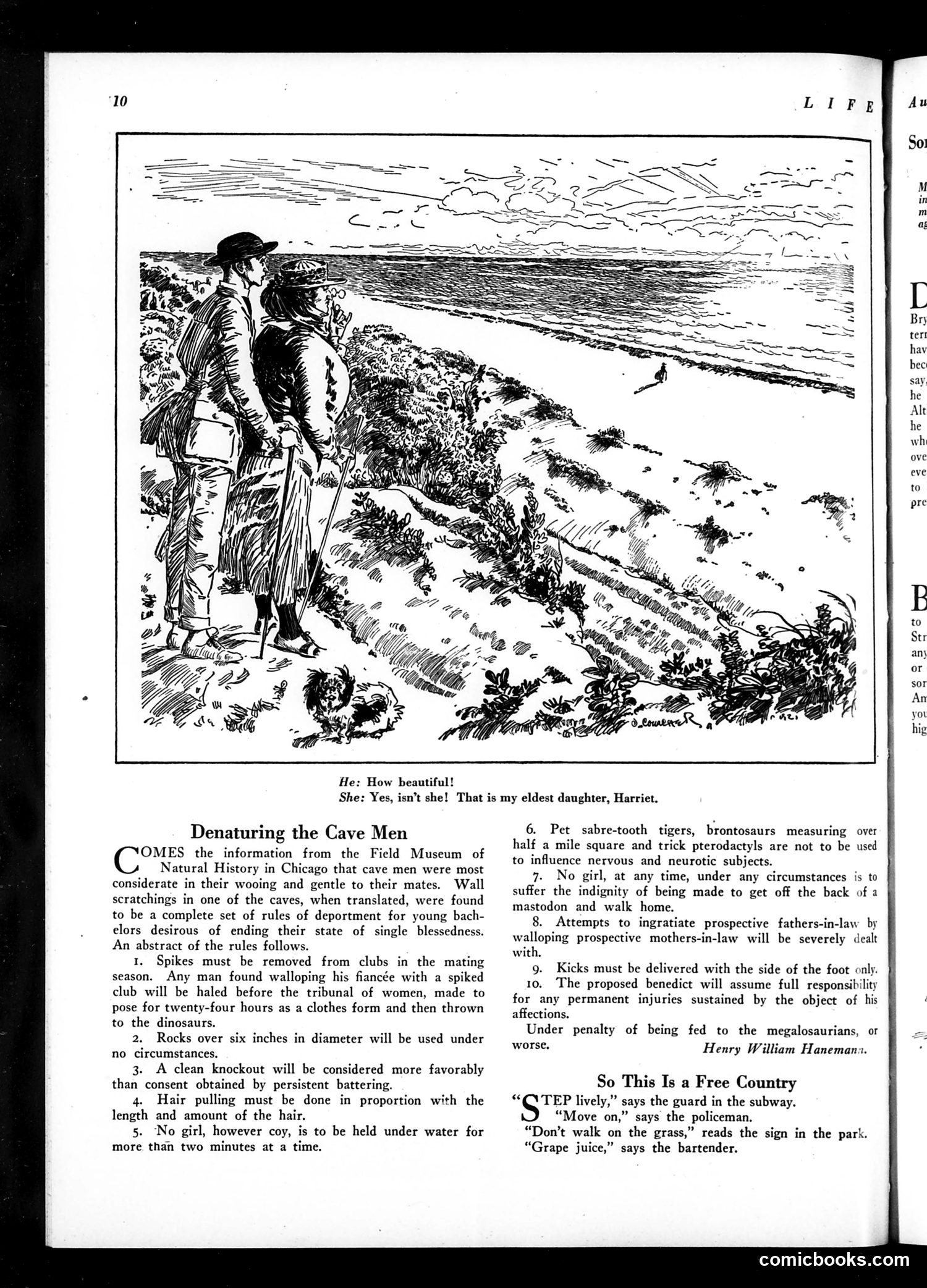
The main illustration shows a couple viewing a landscape with a body of water. The caption reads: "He: How beautiful! She: Yes, isn't she! That is my eldest daughter, Harriet." This is a visual joke playing on the double meaning of "she"—the man admires the scenery, but the woman interprets his compliment as directed toward her daughter, humorously suggesting maternal pride (or perhaps that the daughter resembles the landscape aesthetically). Below is a satirical piece titled "Denaturing the Cave Men," which lists humorous "rules" for modern courtship, mocking overly restrictive social regulations on young couples. It parodies how society attempts to control romantic behavior through elaborate restrictions. A brief comedy piece, "So This Is a Free Country," concludes the page with contradictory orders from various authority figures, ironically commenting on lack of personal freedom.
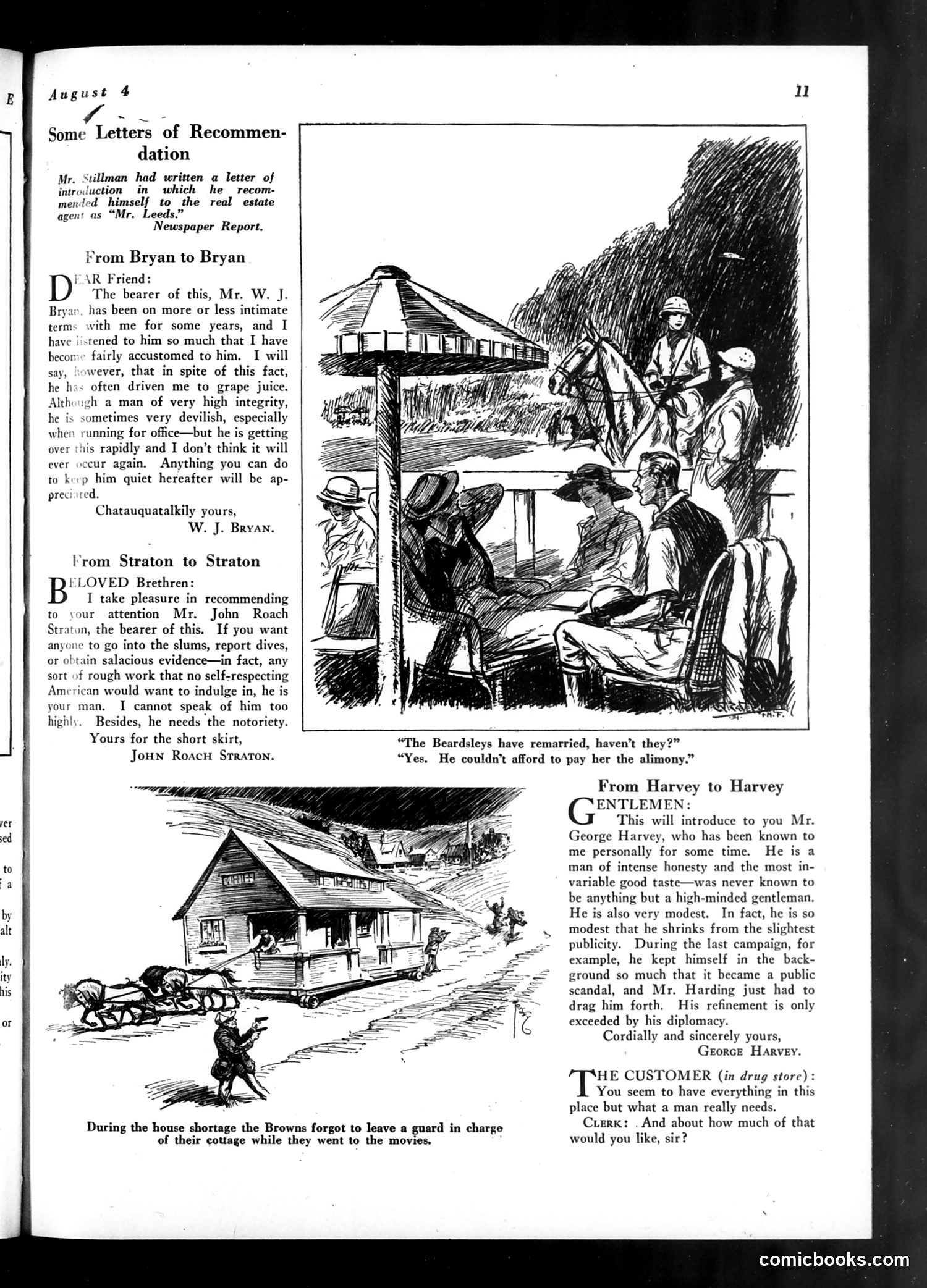
This page contains three letters of recommendation under the heading "Some Letters of Recommendation." The content is satirical social commentary rather than political cartooning. The letters mock contemporary figures by offering backhanded endorsements: Bryan recommends W.J. Bryan as "devilish" and disruptive; Straton recommends John Roach Straton for slum work; Harvey introduces George Harvey as so modest he avoids publicity. The accompanying illustrations show everyday American scenes—people under a gazebo, a cottage during a house shortage. The bottom joke depicts "The Beardsleys" remarrying, with the caption revealing the husband "couldn't afford to pay her alimony"—satirizing marriage, divorce, and economic hardship during what appears to be the 1920s. The humor targets prominent figures and social issues through ironic praise.
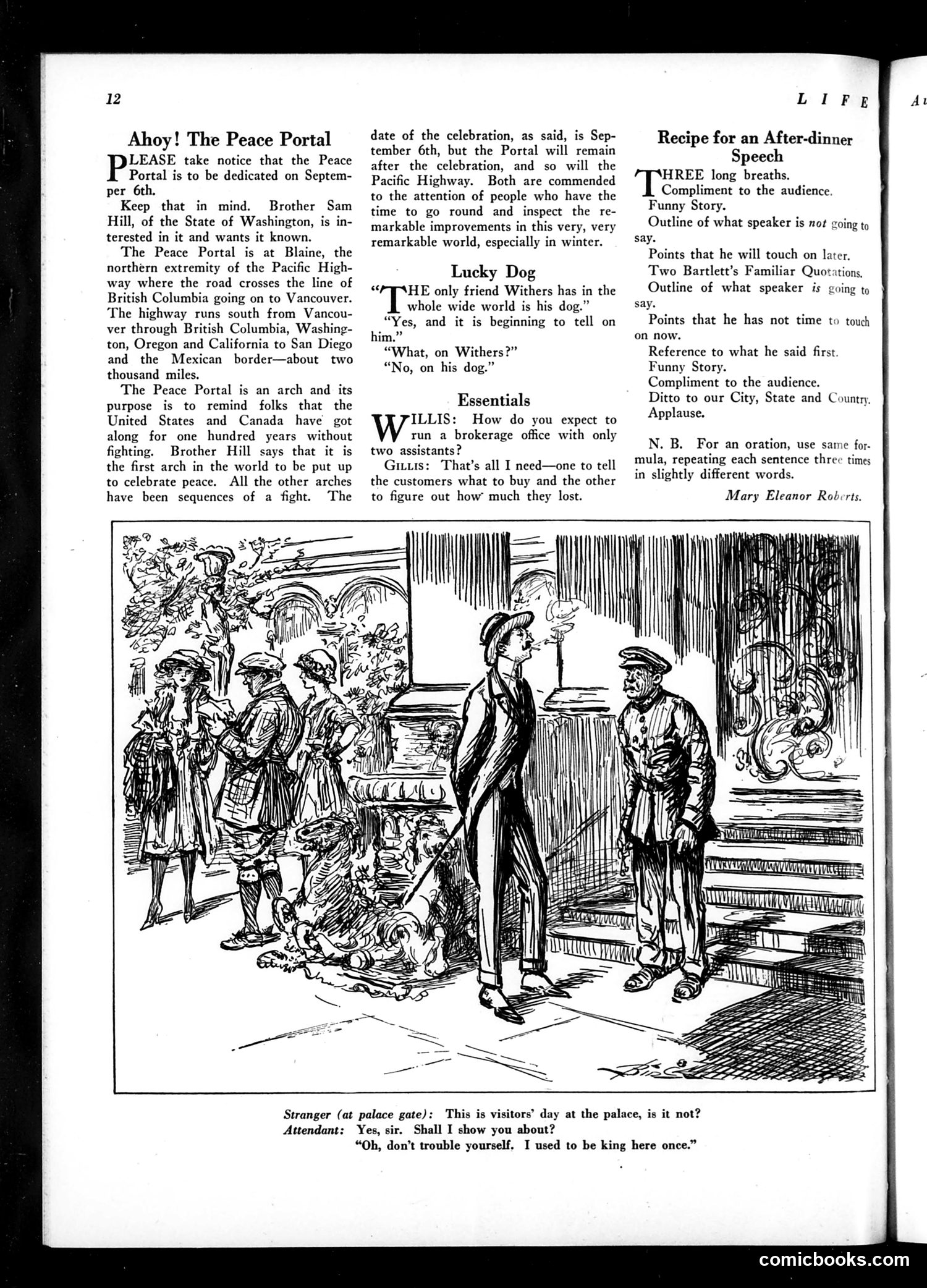
This single-panel cartoon depicts a humorous social commentary about class and memory. A well-dressed stranger at a palace gate tells an attendant he doesn't need a tour, claiming "I used to be king here." The joke satirizes social pretension and the vagaries of political fortune—a former monarch reduced to visiting his old residence as an ordinary tourist. The attendant's polite offer to show him around makes the deflation more poignant: the stranger's casual announcement of his lost status suggests he's either delusional or genuinely displaced royalty, possibly referencing post-WWI European monarchs exiled after the war. The accompanying text items about a Peace Portal dedication and a brokerage office anecdote are unrelated filler content typical of Life magazine's varied format.
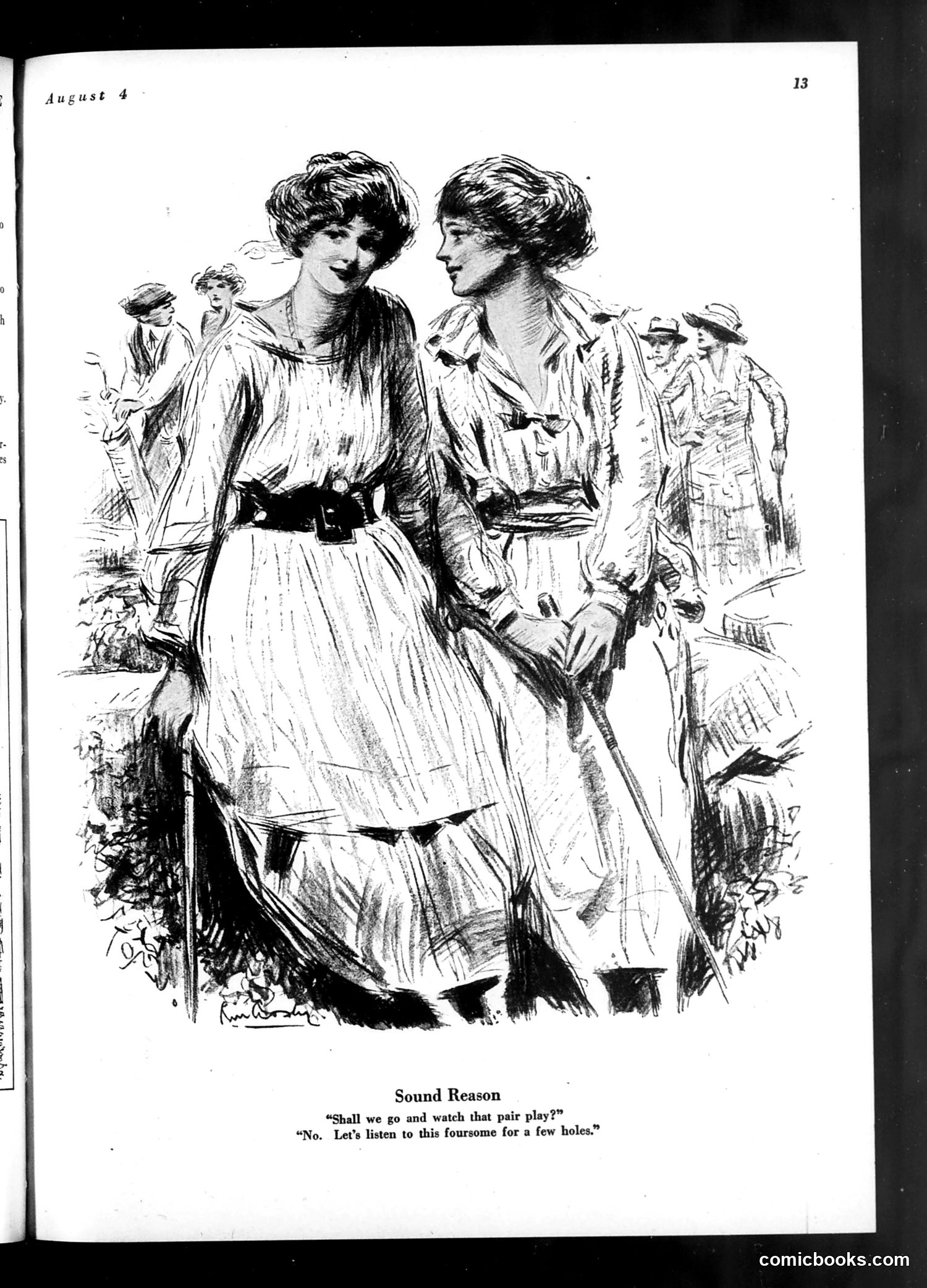
This cartoon depicts two women in conversation, with men visible in the background. The woman on the left asks, "Shall we go and watch that pair play?" The woman on the right responds, "No. Let's listen to this foursome for a few holes." The joke references golf, apparently satirizing early 20th-century social attitudes. The women are choosing to listen to men's conversation rather than watch the women golfers play. The satire likely targets either the relegation of women's golf to secondary importance, or women's own tendency to prioritize male company over female athletic achievement. The casual clothing and hairstyles suggest this dates to the 1910s-1920s era.
The page features an editorial by Hudson Maxim (identified in the byline) discussing post-WWI politics and peace. The small decorative illustration at top appears to be a landscape vignette, not a specific political cartoon. Maxim criticizes politicians as generally untrustworthy, arguing they pursue power rather than genuine peace. He discusses Ireland's political situation, suggesting Ulster's separation from Ireland and comparing the conflict to civil war. He also addresses Japan's expansion in the Pacific, arguing Japan—like other nations—cannot afford war and should avoid military ambition. The tone is pessimistic about politicians while advocating for peaceful resolution of international disputes. No specific named figures are caricatured on this page.
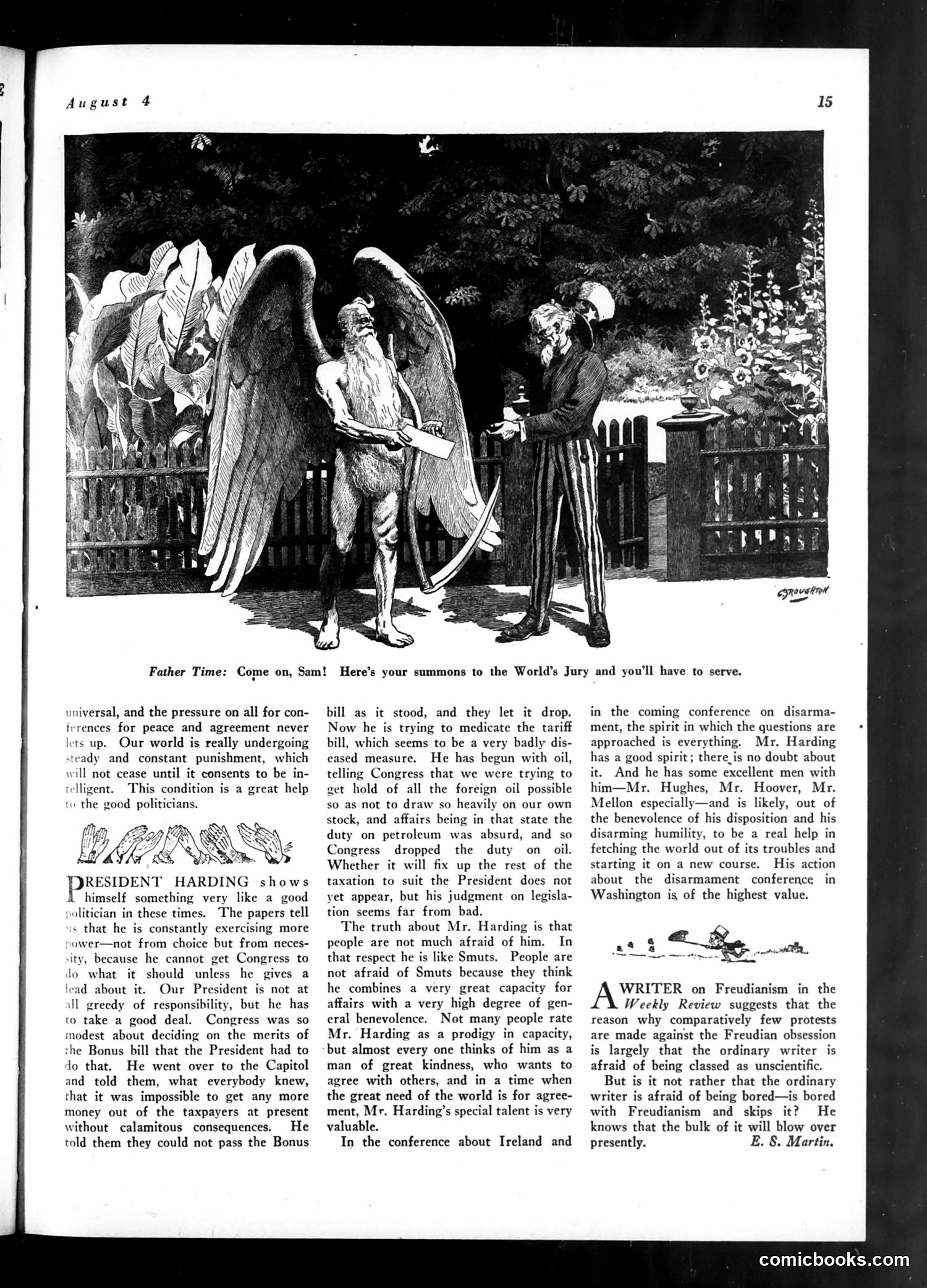
The cartoon depicts **Father Time** (the bearded winged figure) serving a summons to **Uncle Sam** (the tall figure in top hat), commanding him to serve on the "World's Jury." **Context:** This appears to address post-World War I America's reluctant entry into international affairs. The cartoon suggests America cannot avoid global responsibility—personified as jury duty—despite its isolationist preferences. Father Time represents inexorable historical forces compelling the nation toward engagement. **The accompanying article** praises President **Harding** for exercising executive power to push legislation (the Bonus Bill, tariff reform) through a reluctant Congress. It characterizes Harding as benevolent rather than ambitious, and values his cooperative spirit in upcoming international conferences on disarmament and Ireland. **The satire's point:** America must accept its role in world affairs, much as one cannot escape jury duty. Harding's gentle leadership style is presented as advantageous for this new global responsibility.
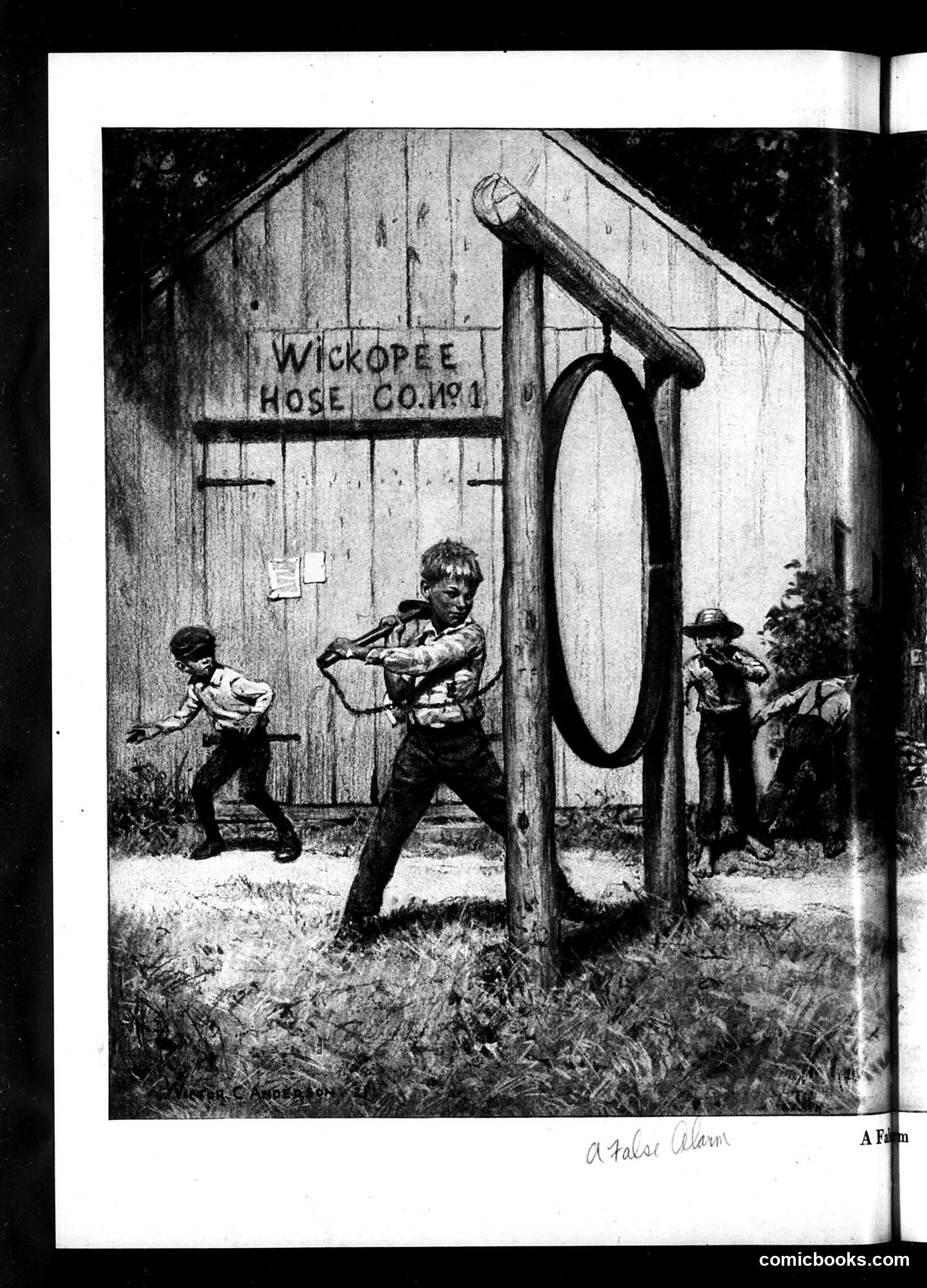
This appears to be a satirical image from *Life* magazine showing children playing with a large fire hose outside a building labeled "Wickopee Hose Co. No. 1." The handwritten caption reads "A False Alarm." The satire likely mocks either volunteer fire departments or false fire alarms—a common social nuisance in early American cities. The children's enthusiastic, somewhat chaotic handling of the hose suggests the humor: innocent youngsters mimicking firefighters, creating a "false alarm" through play rather than actual emergency. The wooden building's rustic appearance and the period clothing suggest this is from an era when such pranks were common enough to warrant satirical commentary in *Life*'s humor section. The joke targets both juvenile mischief and perhaps the unnecessary disruptions such false alarms caused communities.
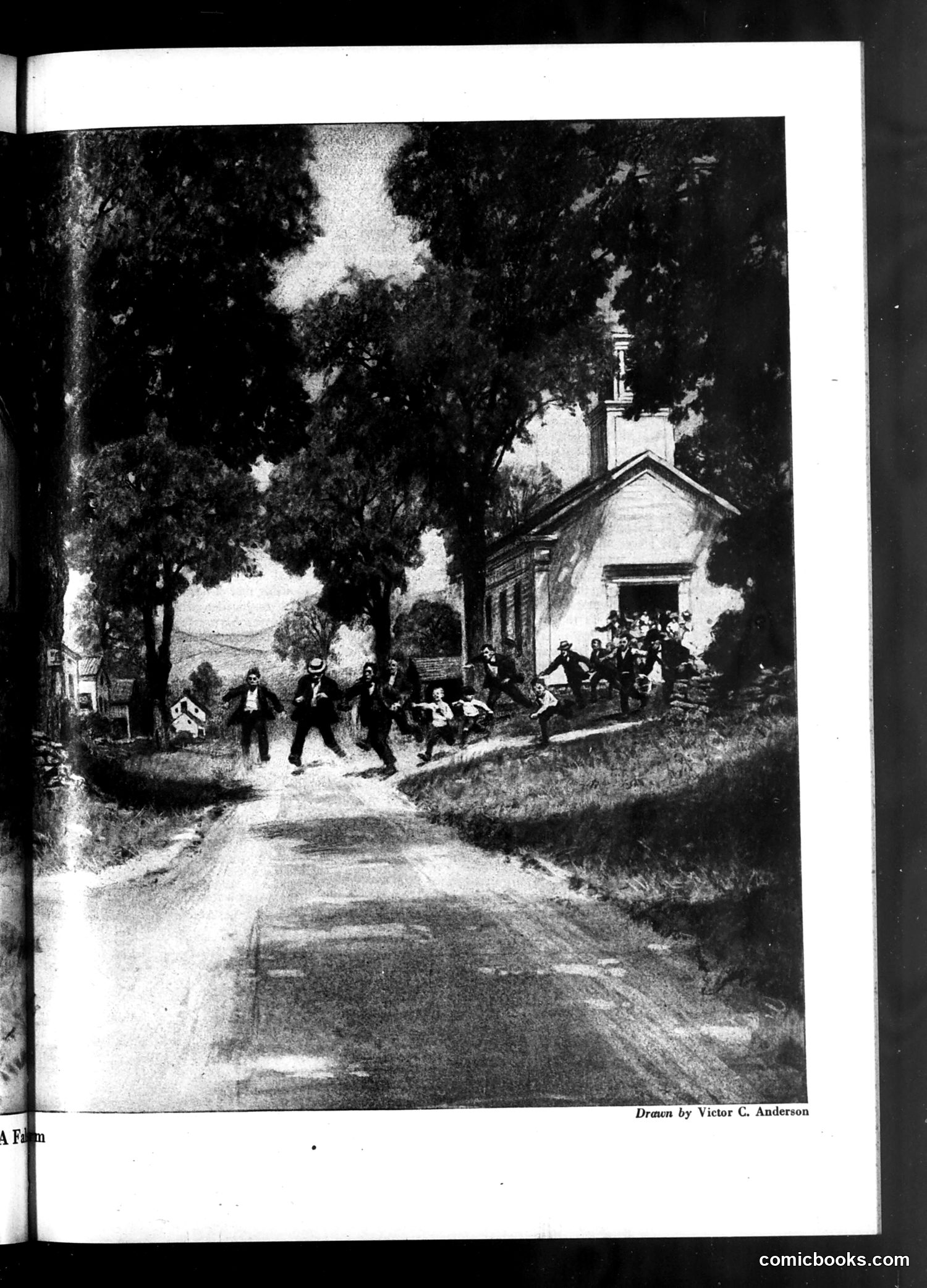
This appears to be an illustration rather than a political cartoon. The image, drawn by Victor C. Anderson, depicts a rural church scene with a dirt road approach and a gathering of people outside a small white chapel with a steeple. Large trees frame the composition. Without additional OCR text or caption visible on the page, the specific satirical point is unclear. The illustration could be commenting on rural American life, religious practice, or social gatherings of the period, but the exact subject and satire cannot be confidently identified from the image alone. The attribution to Life magazine suggests it carried social commentary, but that commentary's target remains uncertain without accompanying text.
This page critiques the 1920s theatrical industry through drama critic Robert C. Benchley's commentary. The main argument concerns a paradox: unemployed comedians performing together in an informal "All-Star Jamboree" at the Cort Theatre are funnier than employed actors stuck in scripted Broadway revues with mediocre material. Benchley identifies **George M. Cohan** as an exception—a manager who understands that spontaneous, "crazy" performance (what he calls "delightful lunacy") resonates with audiences. He contrasts this with unnamed managers who avoid such zaniness. The satire targets **Broadway's creative hierarchy**: authors and managers who write poor scripts limit actors' comedic potential. The piece argues that removing script constraints unleashes genuine talent. Benchley's examples—Cohan's murder-mystery burlesque "The Farrell Case" and Kalmar's intentionally bad card tricks performed while whistling—illustrate how audiences respond to authentic spontaneity over polished mediocrity. The critique reflects post-WWI theatrical frustration: talented performers were underemployed while inferior productions continued running.
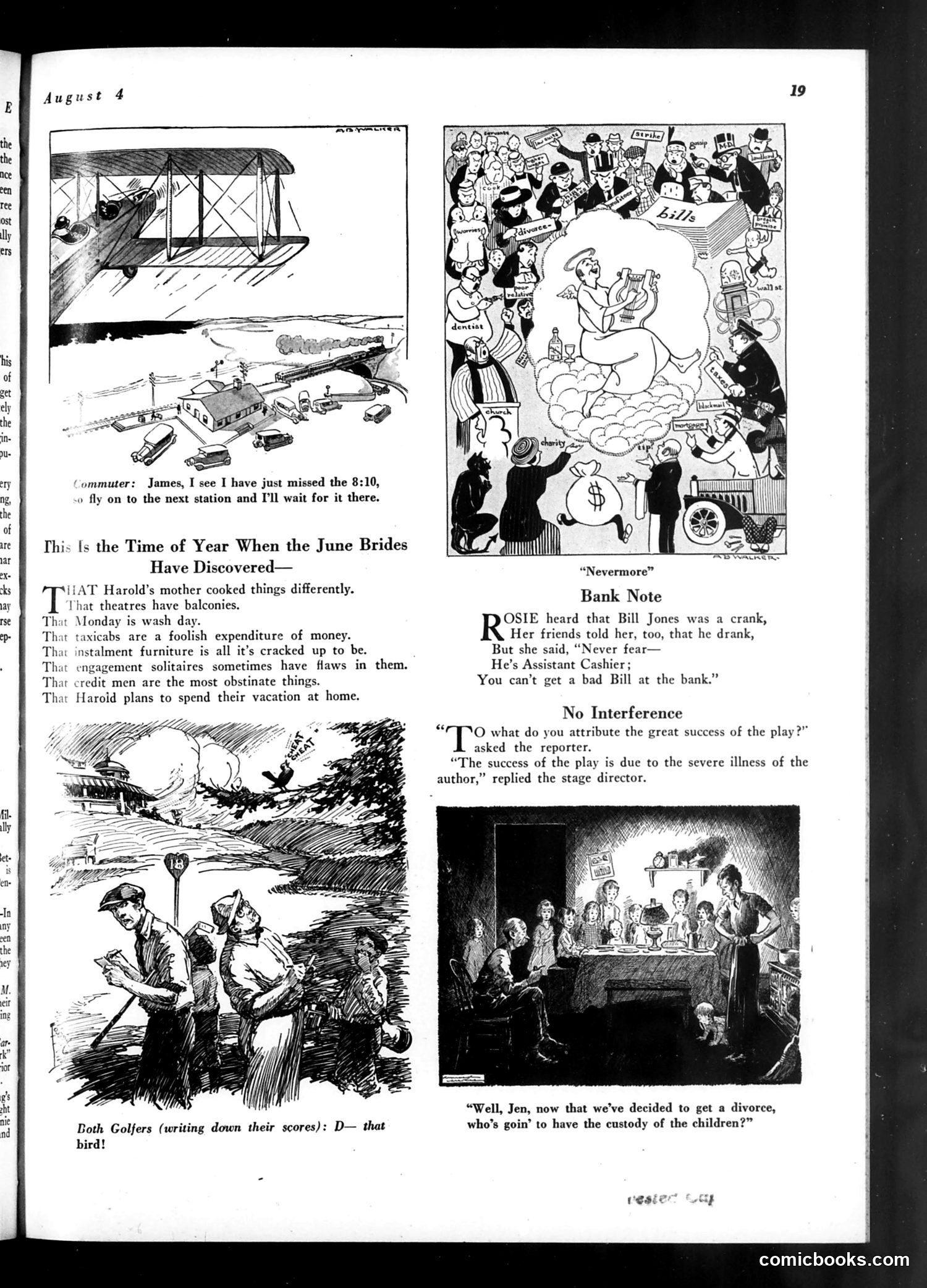
This page contains several unrelated humorous sketches and jokes typical of Life's satirical format: **"June Brides Have Discovered"** lists the disillusionment newlyweds face—mundane realities like laundry day, theater balconies, and installment furniture flaws replacing romantic expectations. **"Bank Note"** is a pun: a woman overlooks her boyfriend Bill's alcoholism because he's an assistant cashier, so "you can't get a bad Bill at the bank" (bad bill/bad boyfriend). **"No Interference"** jokes that a play's success stems from the author's severe illness keeping them away—implying the author was the problem. **"Both Golfers"** shows frustration over golf scoring, with the curse "D— that bird!" (likely a bird interfering with play). **The divorce cartoon** presents a cynical domestic scene where a separating couple immediately worries about child custody rather than reconciliation. The overall theme: satirizing marriage disappointments, workplace absurdities, and human nature's petty frustrations.
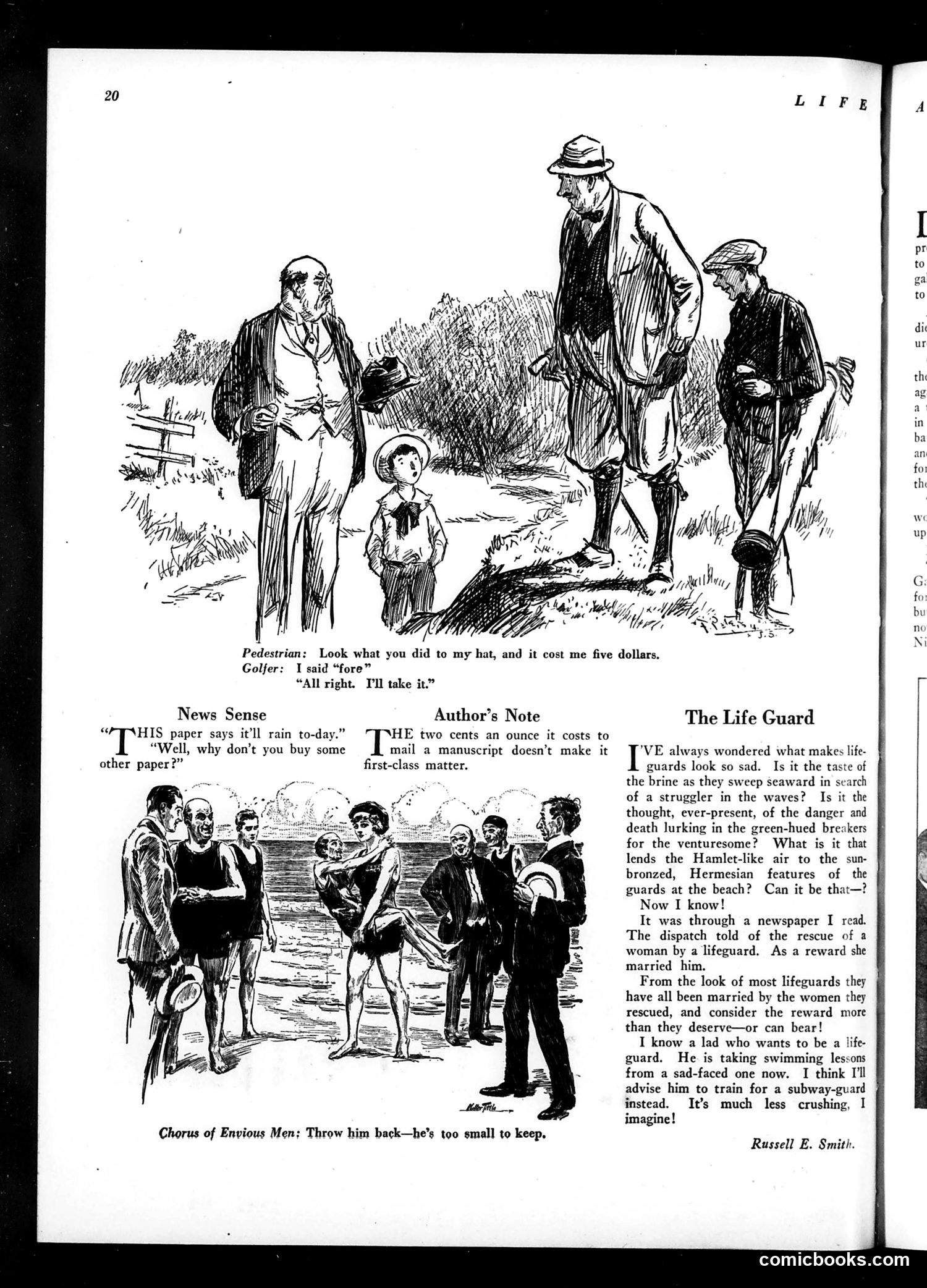
This page contains three separate humor pieces satirizing early 20th-century social situations: **Top cartoon**: A golfer accidentally hits a pedestrian's hat with a golf ball. The golfer says "fore" (the standard warning), but the pedestrian demands $5 compensation. The golfer agrees, treating it as a business transaction rather than an accident—satirizing both golfers' carelessness on public courses and the pedestrian's opportunistic complaint. **"News Sense"**: A joke about newspaper credibility. One person reads "it'll rain today" in one paper, so asks why not buy another paper instead—mocking newspapers' unreliability and the absurdity of consulting multiple sources for basic facts. **"The Life Guard"** by Russell E. Smith: A humorous essay wondering why lifeguards appear so melancholy. The author discovers through a newspaper that a lifeguard married a woman he rescued—implying lifeguards are trapped in unhappy marriages to women who feel obligated to them. The satire targets both the sentimentality of such rescue-marriage stories and men's apparent misery in matrimony.
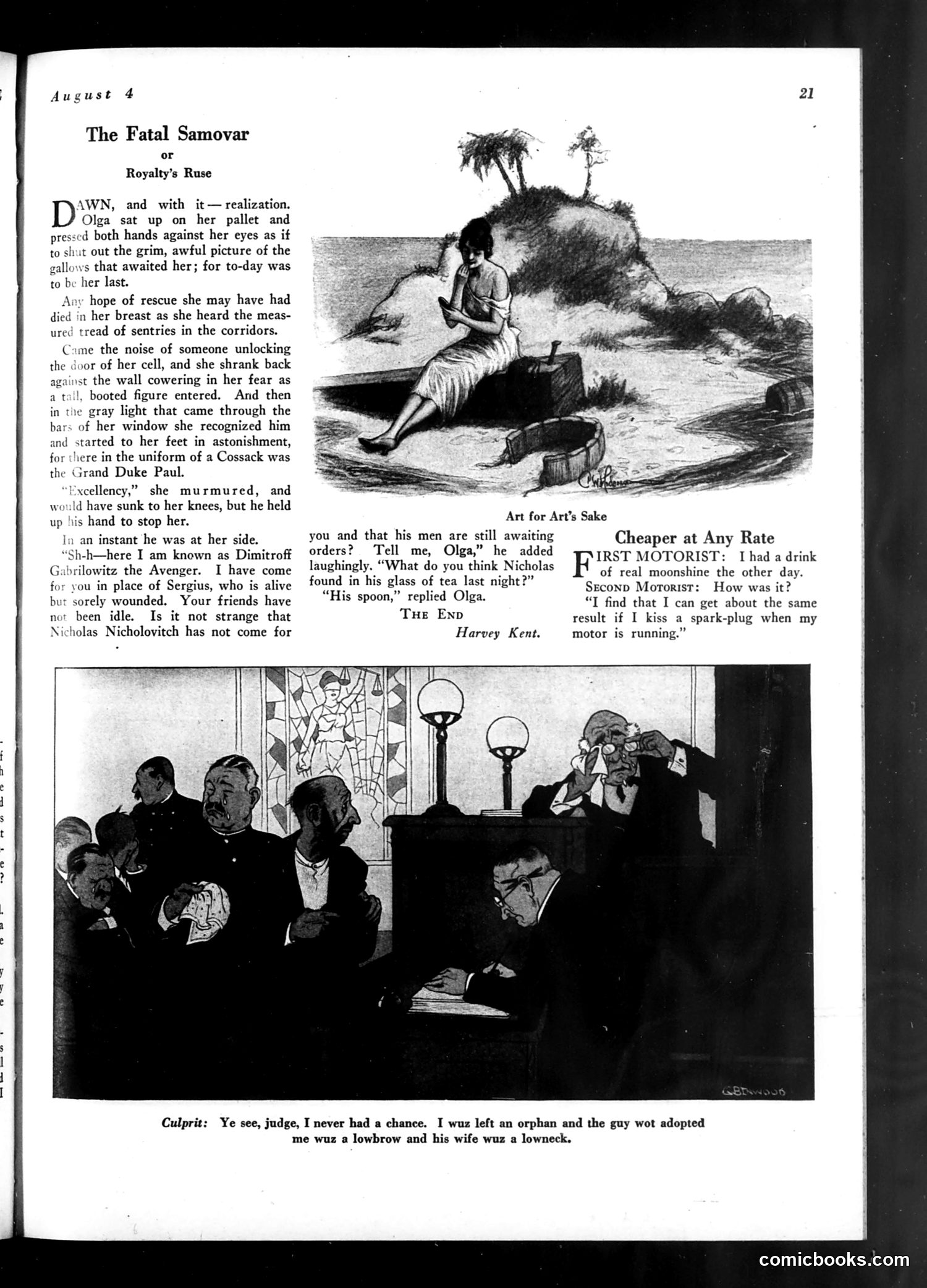
This page contains three distinct pieces of humor content: **"The Fatal Samovar"** (top): A serialized melodrama story by Harvey Kent about a woman named Olga facing execution. A mysterious figure in Cossack uniform—revealed to be Grand Duke Paul—rescues her from her cell. The story plays on Russian aristocratic intrigue and prison escape narratives popular in early 20th-century fiction. The samovar reference suggests a poisoning plot device. **"Cheaper at Any Rate"** (middle): A joke about Prohibition-era moonshine whiskey, comparing its effects to kissing a car's spark plug—both producing similar intoxication. This satirizes the poor quality of illegal alcohol during the 1920s. **Courtroom cartoon** (bottom): A defendant claims he had "no chance" because his adoptive parents were "lowbrow" and "lowneck" (working-class), using their social status as an excuse for his criminal behavior. This mocks class-based justifications for crime. All three pieces reflect 1920s American concerns: Russian politics, Prohibition enforcement, and class commentary.
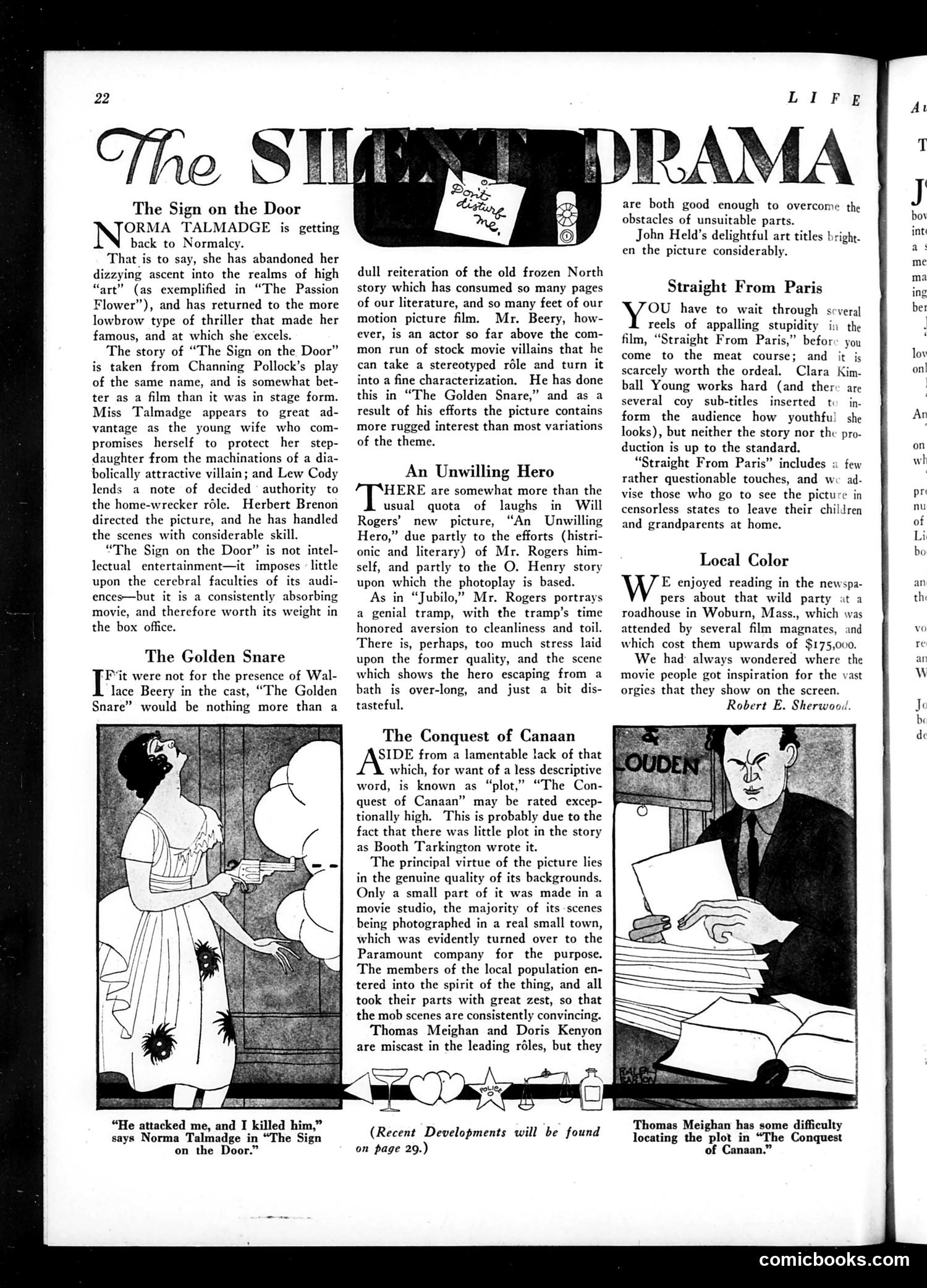
This page reviews several 1920s silent films. The main critique concerns **Norma Talmadge**, a major actress, returning to popular entertainment after attempting serious drama ("The Passion Flower"). Life satirizes this as "getting back to Normalcy"—a pun on Warren Harding's post-WWI political slogan—suggesting her artistic aspirations failed and she's retreating to lowbrow thrillers where she excels. The reviews assess other contemporaries: **Wallace Beery** and **Will Rogers** (famous for playing lovable tramps), plus **Thomas Meighan** and **Doris Kenyon** in "The Conquest of Canaan." Life praises authentic location filming over studio sets and John Held's art titles. The cartoons show dramatic scenes: Talmadge's character claiming self-defense ("He attacked me, and I killed him"), and Meighan struggling with plot. The tone is witty but not savage—typical of Life's urbane film criticism targeting middle-class moviegoers familiar with these stars.
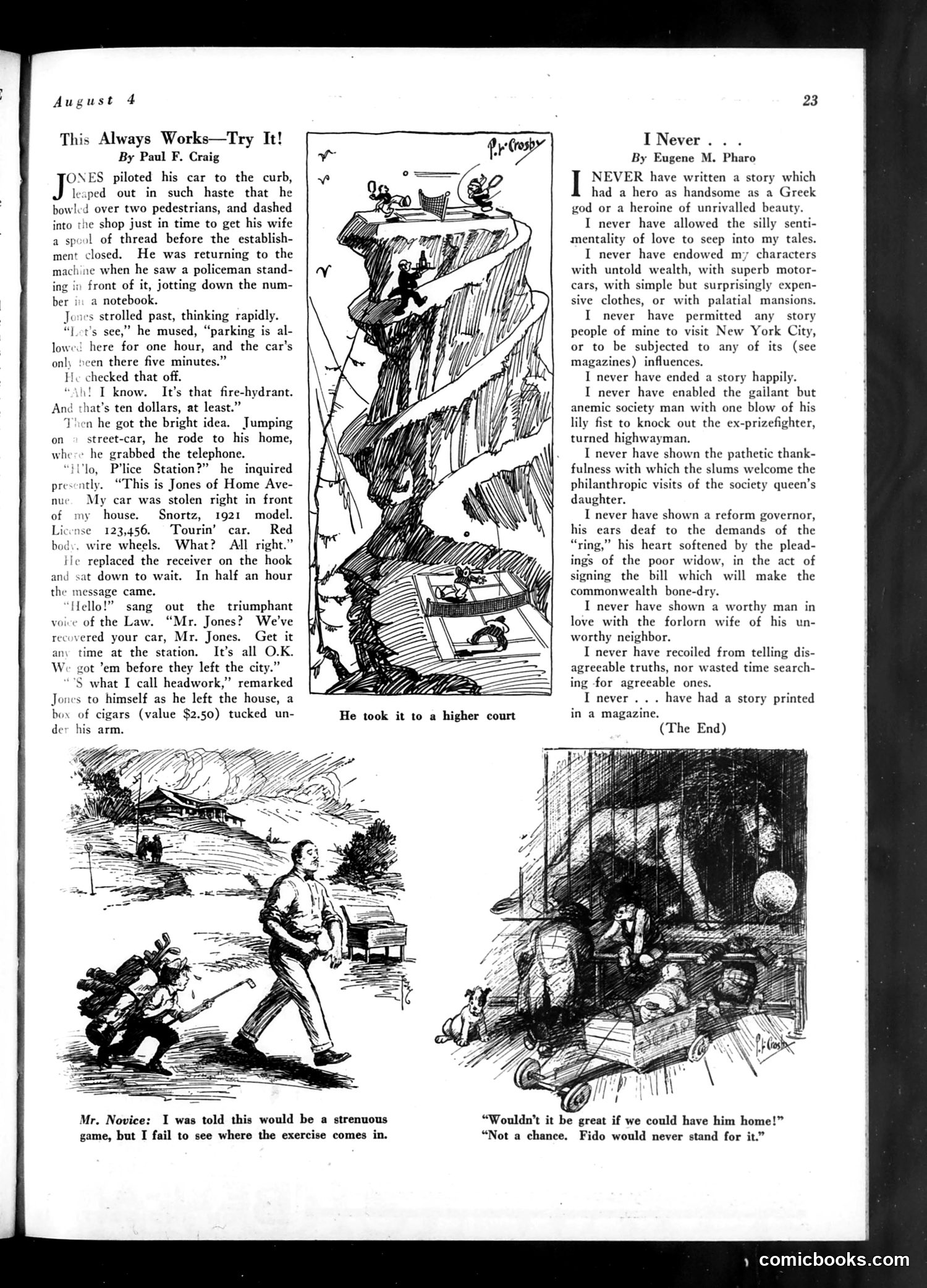
## "This Always Works—Try It!" A comedic short story by Paul F. Craig illustrating a clever (if ethically questionable) workaround. Jones parks illegally, sees a policeman writing a ticket, then calls the police station to report his car stolen. The police recover it from the station lot and return it to him—apparently erasing the parking violation in the process. The joke's appeal lies in the protagonist's quick thinking, though the satire subtly mocks both petty traffic enforcement and the ease of gaming the system through a simple phone call. ## "I Never..." A contrasting piece by Eugene M. Pharo listing all the literary clichés the author *hasn't* included in his stories—no Greek-god heroes, no wealth-obsessed characters, no New York settings, no happy endings, no saccharine philanthropy plots. The punchline: despite avoiding every magazine trope, he's never had a story published. The satire attacks both formulaic magazine fiction and the gatekeeping of publication.
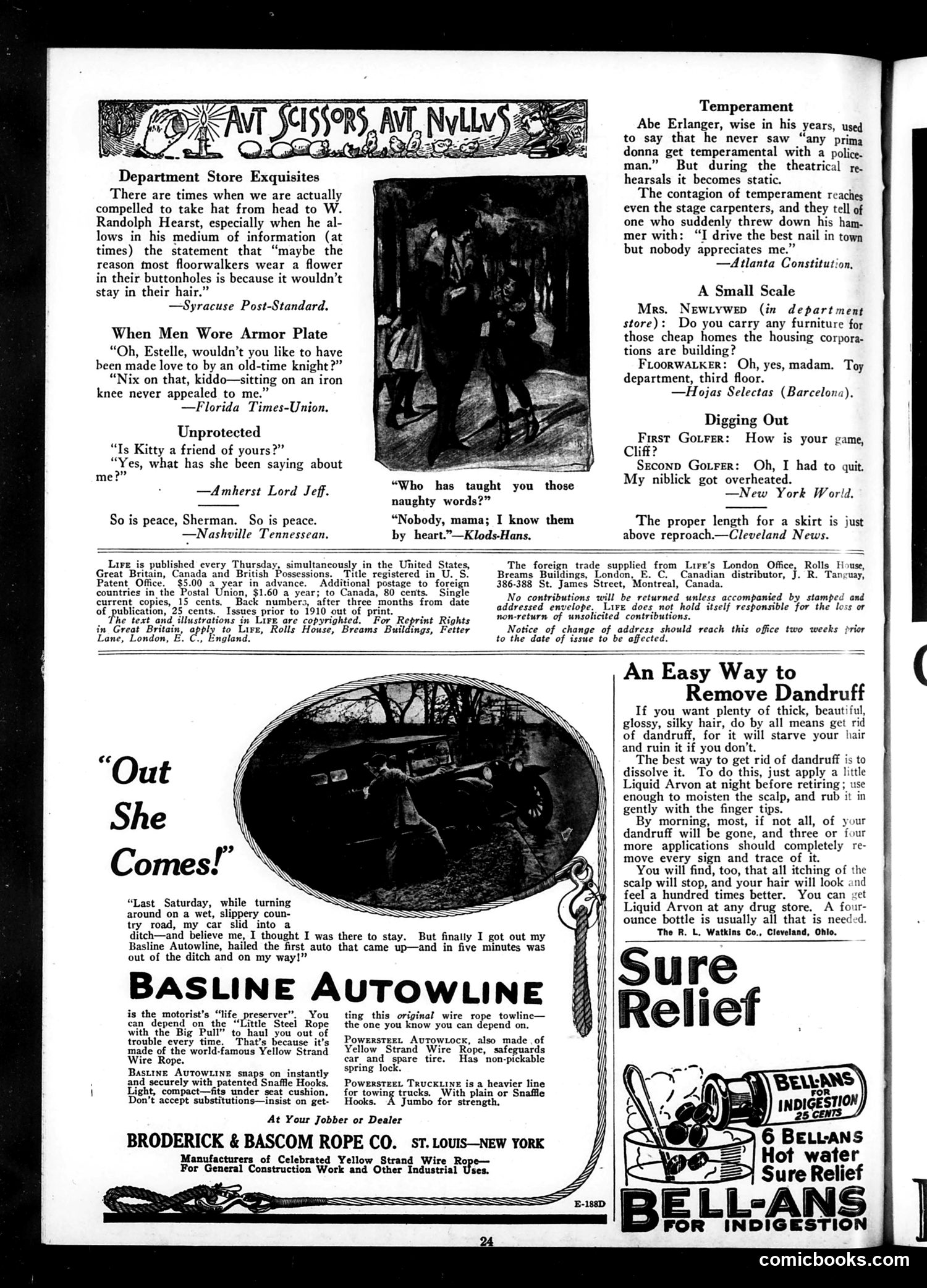
This page from Life magazine comprises **short humorous anecdotes and advertisements** rather than political cartoons. The jokes satirize early 20th-century social conventions: **Key humor pieces:** - A quip crediting publisher W.R. Hearst for noting that floorwalkers wear buttonholes because flowers won't stay in their hair—mocking both Hearst and department store pretension - Exchanges about romance, golf, and department stores that play on period manners (knights in armor, "toy department" furniture for cheap housing, overheated golf clubs) - A jab at theatrical prima donnas' temperament **Advertisement:** The Basline Autowline (a motorist's towing rope) occupies significant space, featuring a dramatic rescue narrative. The satire targets **social affectation, consumerism, and emerging middle-class anxieties**—particularly around department stores, theater culture, and new automobile ownership. Nothing requires specialized historical knowledge beyond recognizing early 1900s social conventions.
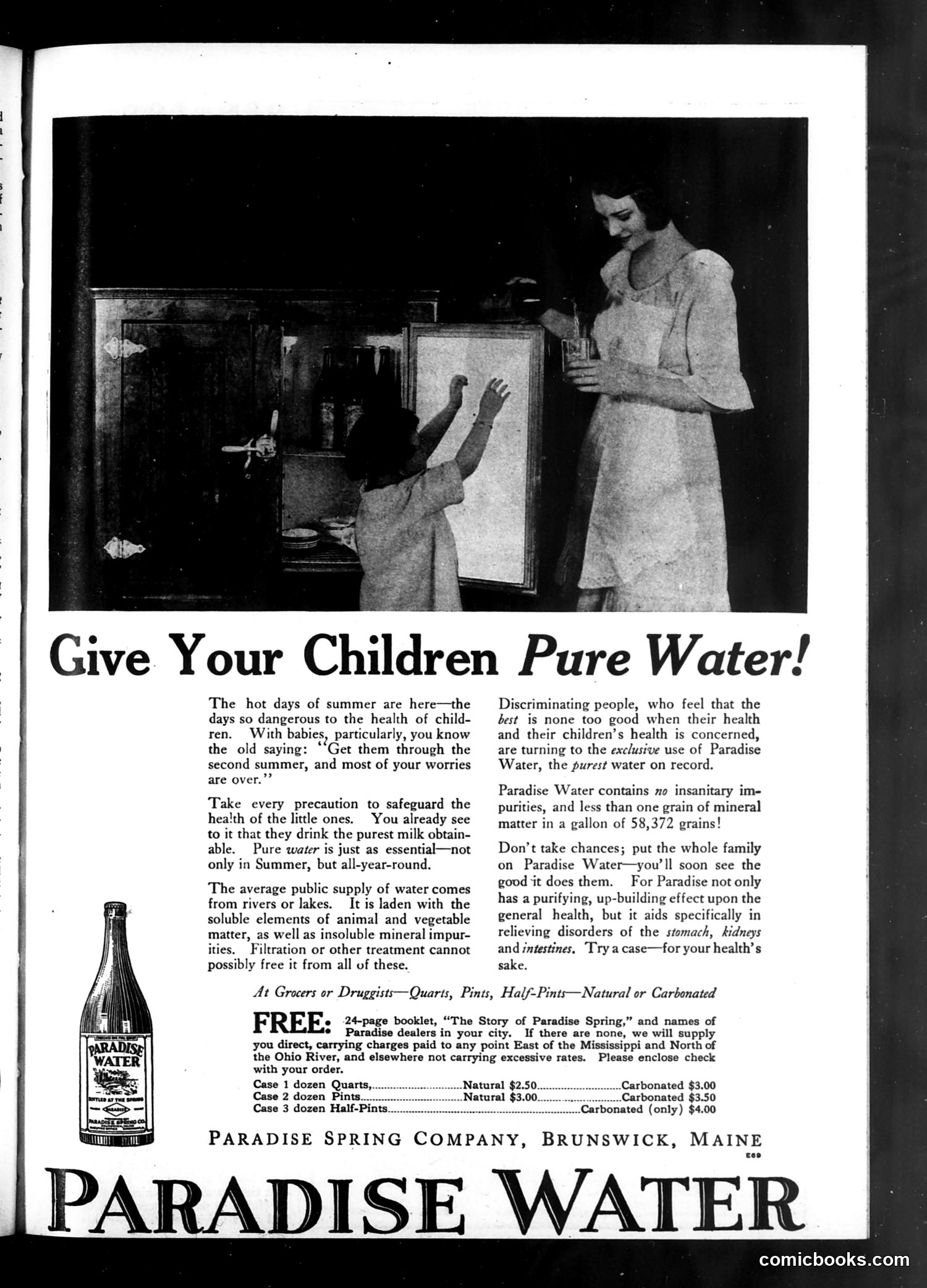
This is a **product advertisement**, not political satire. It promotes Paradise Spring Company's bottled water to American consumers, likely from the early 20th century. The ad targets mothers' anxieties about child health, particularly during summer when waterborne illness was a genuine public health concern. It argues that municipal water supplies—drawn from rivers and lakes—contain dangerous organic and mineral impurities that filtration cannot fully remove. The photograph shows a woman and child examining Paradise Water, reinforcing the message that pure water is essential maternal care, comparable to ensuring "the purest milk obtainable." The ad claims Paradise Water contains virtually no impurities (less than one grain of mineral matter per gallon) and promises health benefits for digestion and organ function. Pricing and ordering information suggest direct mail delivery was available beyond local retailers. This reflects genuine anxieties about water safety before modern municipal treatment standards were established.
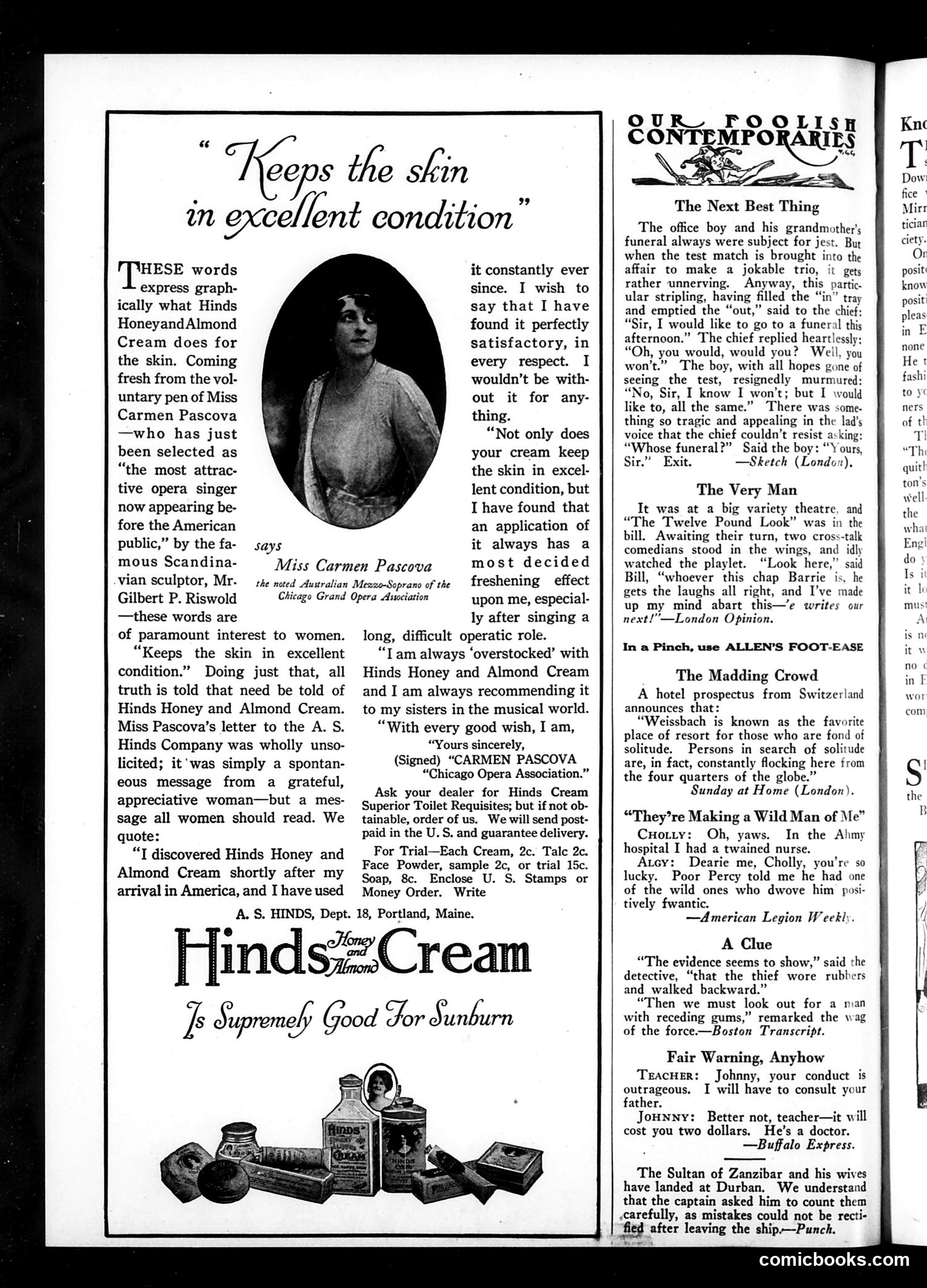
This page is primarily **advertising**, not political satire. The dominant content is a full-page Hinds Honey and Almond Cream advertisement featuring opera singer Carmen Pascova endorsing the skin cream. The testimonial claims the product "keeps the skin in excellent condition" and provides a "freshening effect," particularly after singing difficult operatic roles. The right column contains brief humorous anecdotes from *Life* magazine's "Our Foolish Contemporaries" section—short jokes about an office boy requesting time off for a funeral (to attend a cricket test match instead), theatrical comedians, a Swiss hotel's paradoxical marketing, and military nurses. These are light social humor rather than political commentary. There is **no political cartoon** on this page. The humor relies on everyday situations and wordplay typical of early 20th-century magazine comedy, with no apparent caricatures or political references.
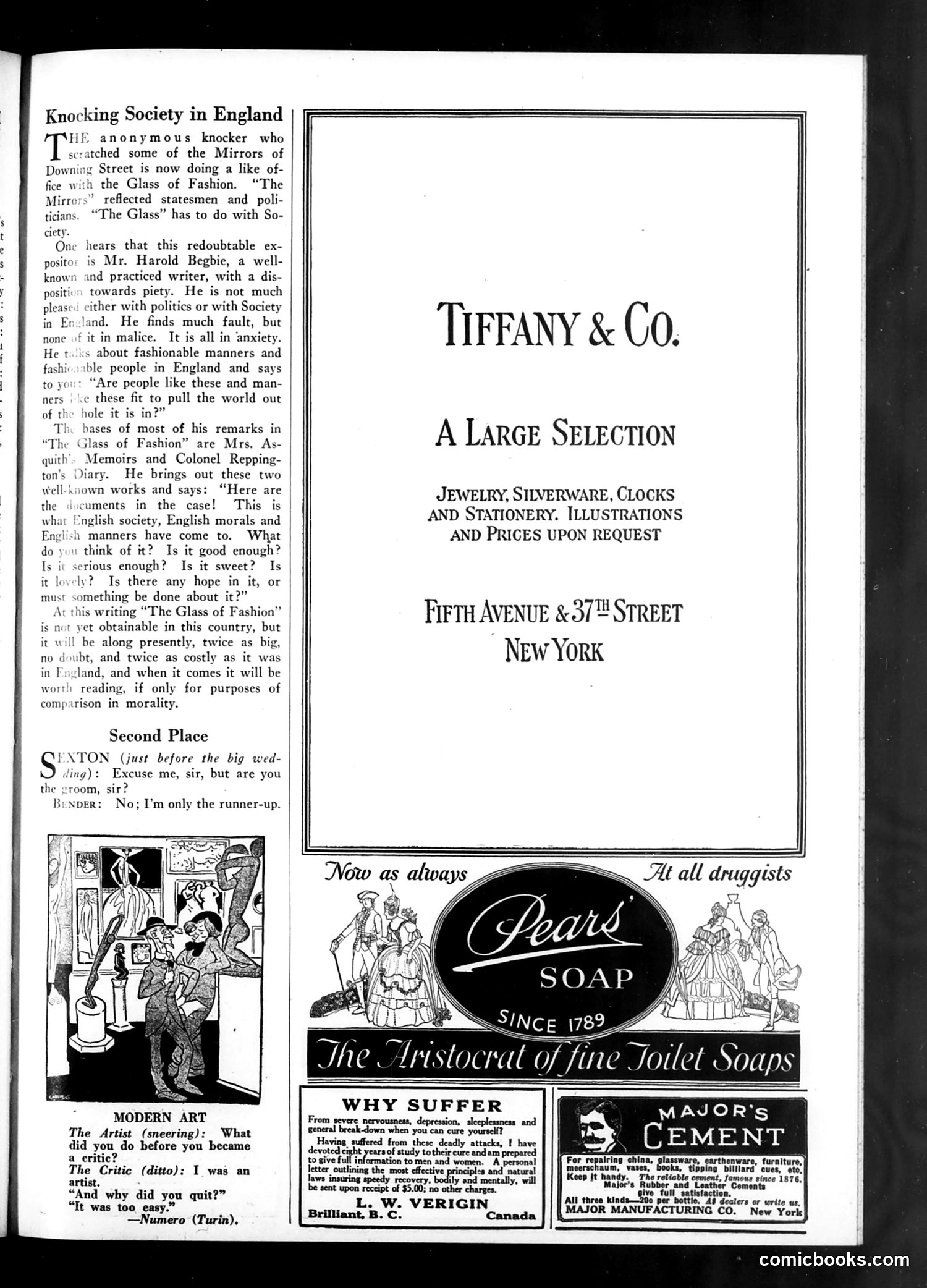
This page is primarily **advertising** with minimal editorial content. The advertisements include Tiffany & Co. (jewelry and stationery), Pears Soap ("Since 1789"), and Major's Cement. The only satirical content is a brief dialogue labeled "Second Place" featuring characters named **Saxton** and **Bender**. Saxton, about to enter a wedding, asks if Bender is the groom. Bender replies he's "only the runner-up"—a joke about being second choice at marriage, likely poking fun at wedding customs or relationship dynamics of the era. Above this is a short article titled "Knocking Society in England" criticizing an anonymous writer (possibly **Harold Begbie**) for satirizing English society and fashion in works like "The Glass of Fashion," questioning whether such criticism is effective social commentary.
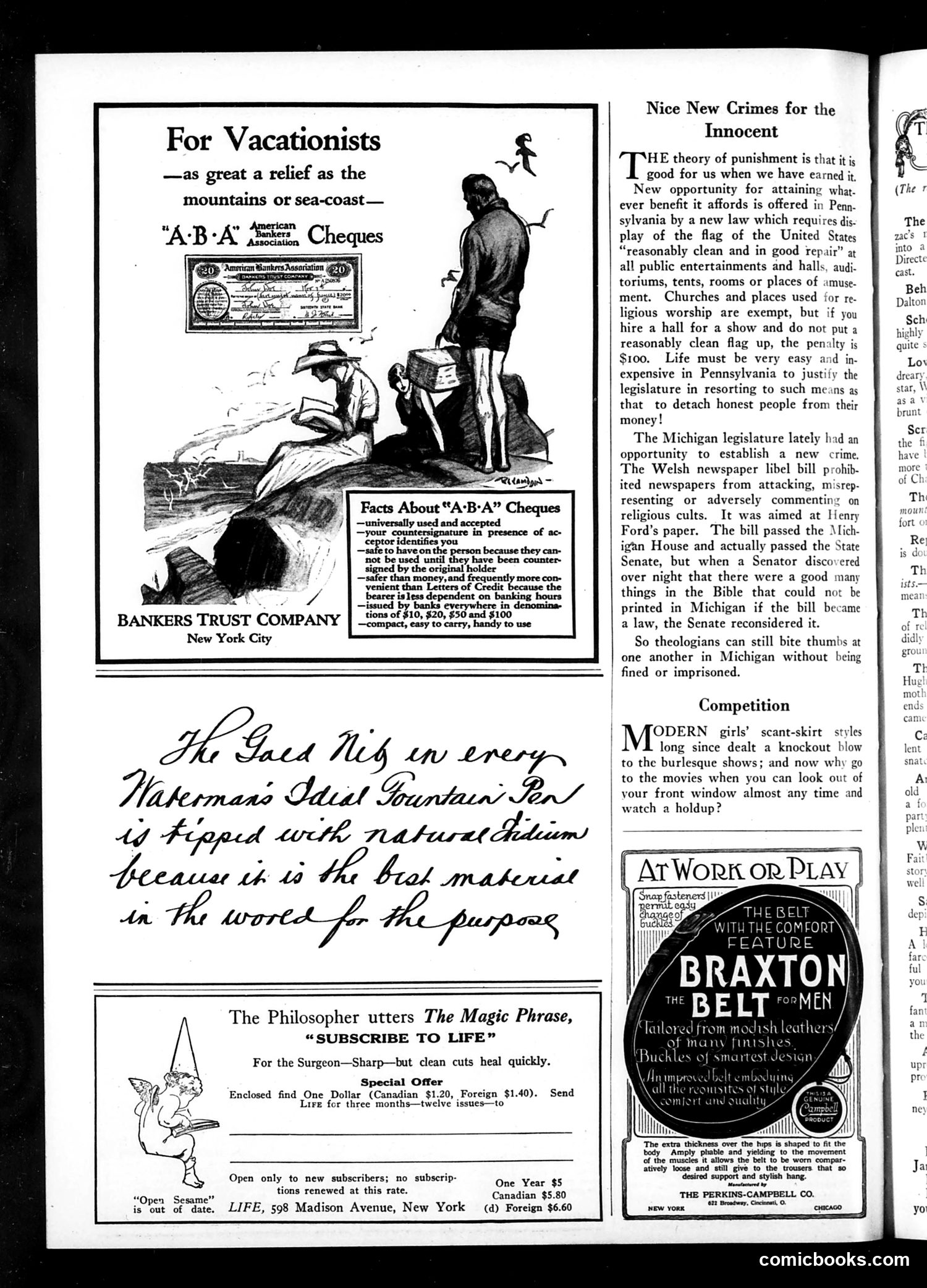
This page contains **satirical commentary on absurd new laws**, primarily two pieces: **"Nice New Crimes for the Innocent"** mocks legislation in Pennsylvania and Michigan: - Pennsylvania passed a law requiring flags at public entertainments to be "reasonably clean and in good repair," with $100 fines for violations. Life ridicules this as trivial lawmaking that punishes ordinary people over technicalities. - Michigan attempted a "newspaper libel bill" targeting Henry Ford's paper, designed to criminalize criticism of religious cults. The bill passed both House and Senate before a senator realized it would also criminalize quoting the Bible itself—forcing reconsideration. The satire's point: **legislators are criminalizing absurdities** while claiming moral purpose. The Pennsylvania flag law wastes enforcement resources; the Michigan bill would have made theology itself illegal. The advertisements for traveler's cheques, a pen, and Life magazine subscriptions are commercial content typical of the era.
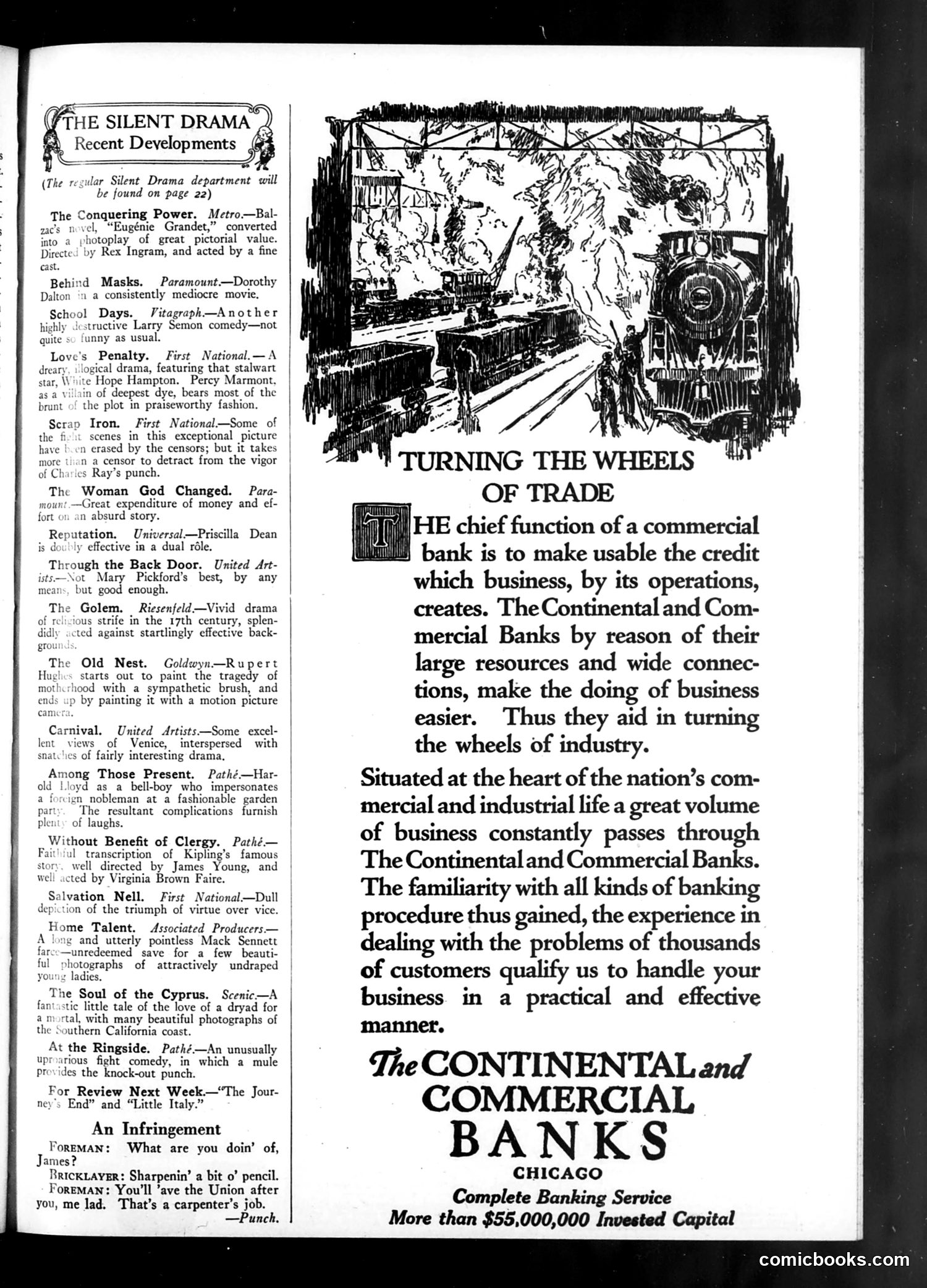
This page combines two distinct elements: a film review section and a bank advertisement. **"The Silent Drama" Section** (left column): Lists brief reviews of recent silent films from various studios (Metro, Paramount, Vitagraph, First National, Universal, etc.). The reviews are tersely critical—praising some productions for visual quality or performances while dismissing others as mediocre or pointless. This reflects Life magazine's role as a cultural arbiter commenting on popular entertainment. **"An Infringement" Joke** (bottom): A brief humor piece satirizing union labor protectionism. A foreman scolds a bricklayer for sharpening a pencil, claiming this violates union rules—that's a carpenter's job. The joke mocks rigid union job demarcations as absurdly restrictive. **Bank Advertisement** (right side): The Continental and Commercial Banks of Chicago advertises itself as essential to industrial commerce, emphasizing their large capital and experience managing thousands of customers' banking needs. The page is primarily advertising with supplementary entertainment content—typical of early 20th-century magazine layouts.
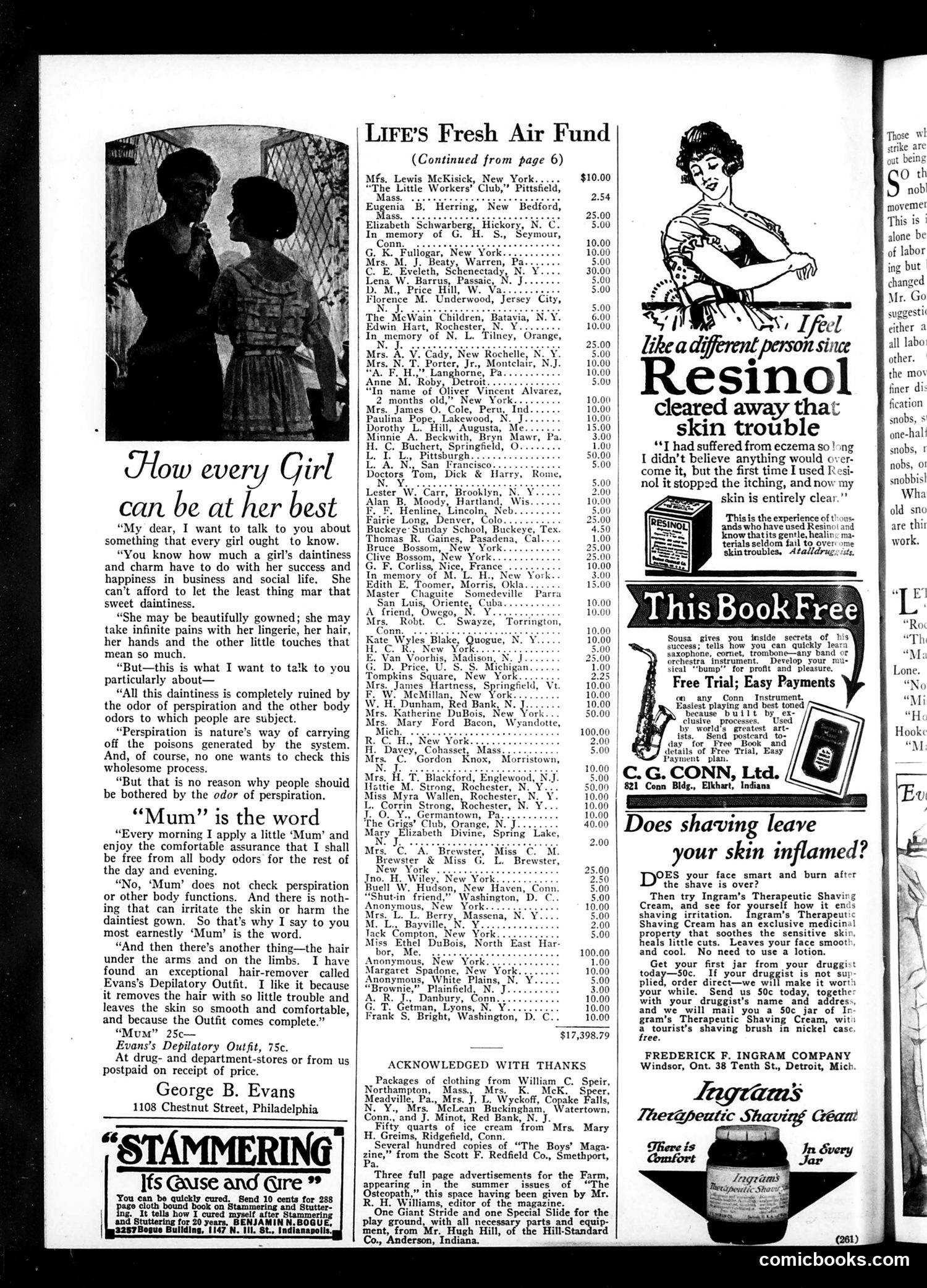
This page combines **advertising and charity listings** rather than political cartoons. The main editorial content is Life's "Fresh Air Fund"—a charity drive listing donors' contributions for sending poor urban children to the countryside for health benefits. This reflects early 20th-century Progressive Era concerns about child welfare and urban poverty. The advertisements reveal period anxieties about **feminine hygiene and acceptability**: - **"Mum" deodorant** and **Evans's Depilatory Outfit** ads emphasize that women's body odors and underarm hair jeopardize their social and professional success—a marketing strategy exploiting shame about natural bodily functions. - A **Resinol skin cream ad** promises transformation from social embarrassment. - **Ingram's Shaving Cream** targets men with similar anxiety about appearance. These ads reflect strict early-1900s beauty standards and gender expectations: women especially faced pressure to eliminate any trace of their bodies' "natural" processes to remain "dainty" and marriageable. The juxtaposition with charitable giving shows the era's mixed progressive and conservative impulses.
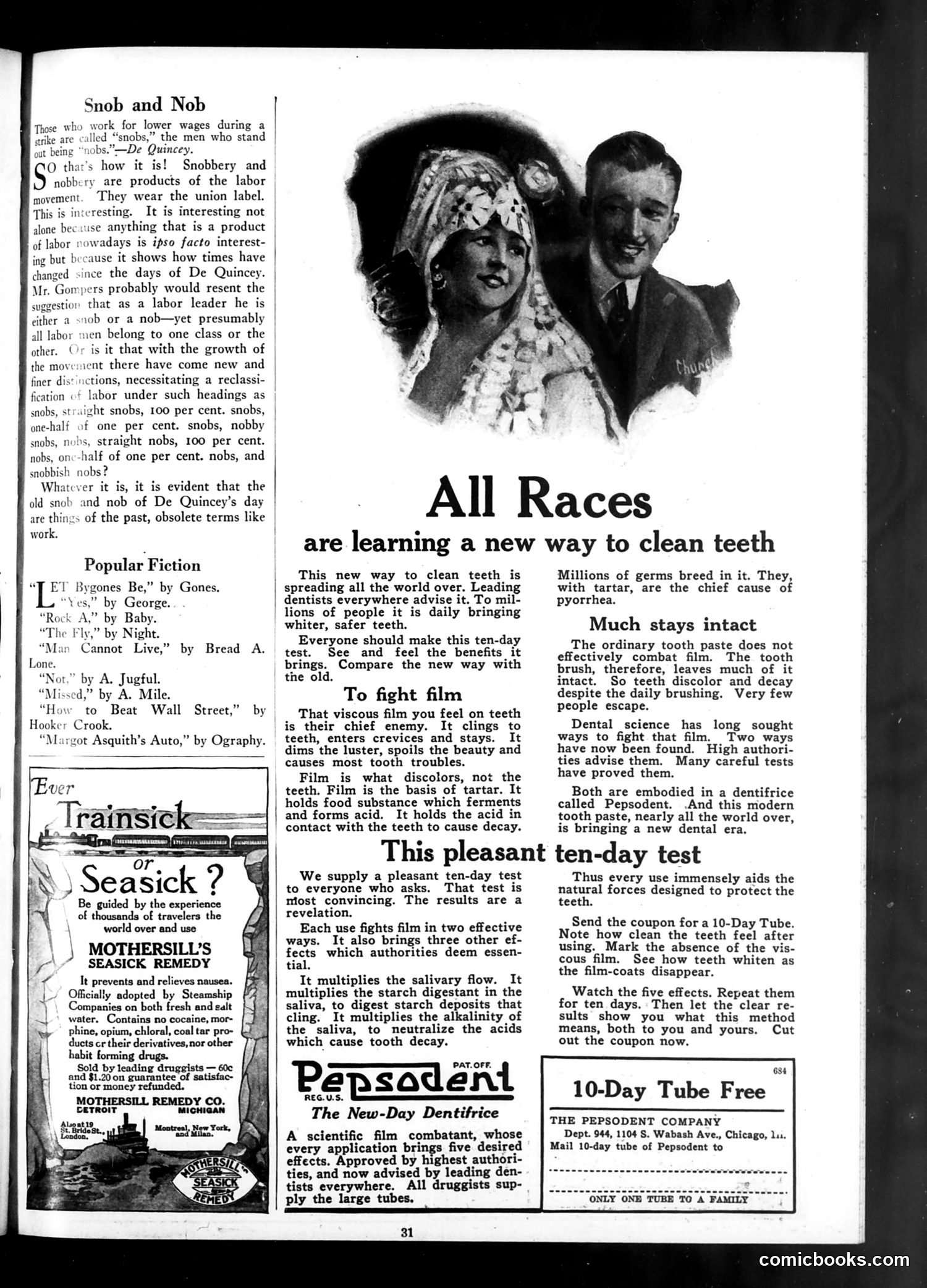
The article satirizes class distinctions within the labor movement. It references De Quincey's historical term "nobs" (strike-breakers working below union wages) and argues that modern labor unions have created new hierarchical categories among workers—"snobs," "nobby snobs," and "nobs"—contradicting the movement's egalitarian ideals. The piece appears critical of Samuel Gompers (likely the "Mr. Gompers" mentioned), suggesting that even labor leaders cannot escape these class divisions. The satire points out the irony: the labor movement, which fought class exploitation, has paradoxically recreated class distinctions within its own ranks based on union membership status and wage levels. The tone is mocking—Life's editors find it absurd that workers fighting for equality have replicated the very class system they opposed, creating an elaborate new vocabulary of labor stratification.
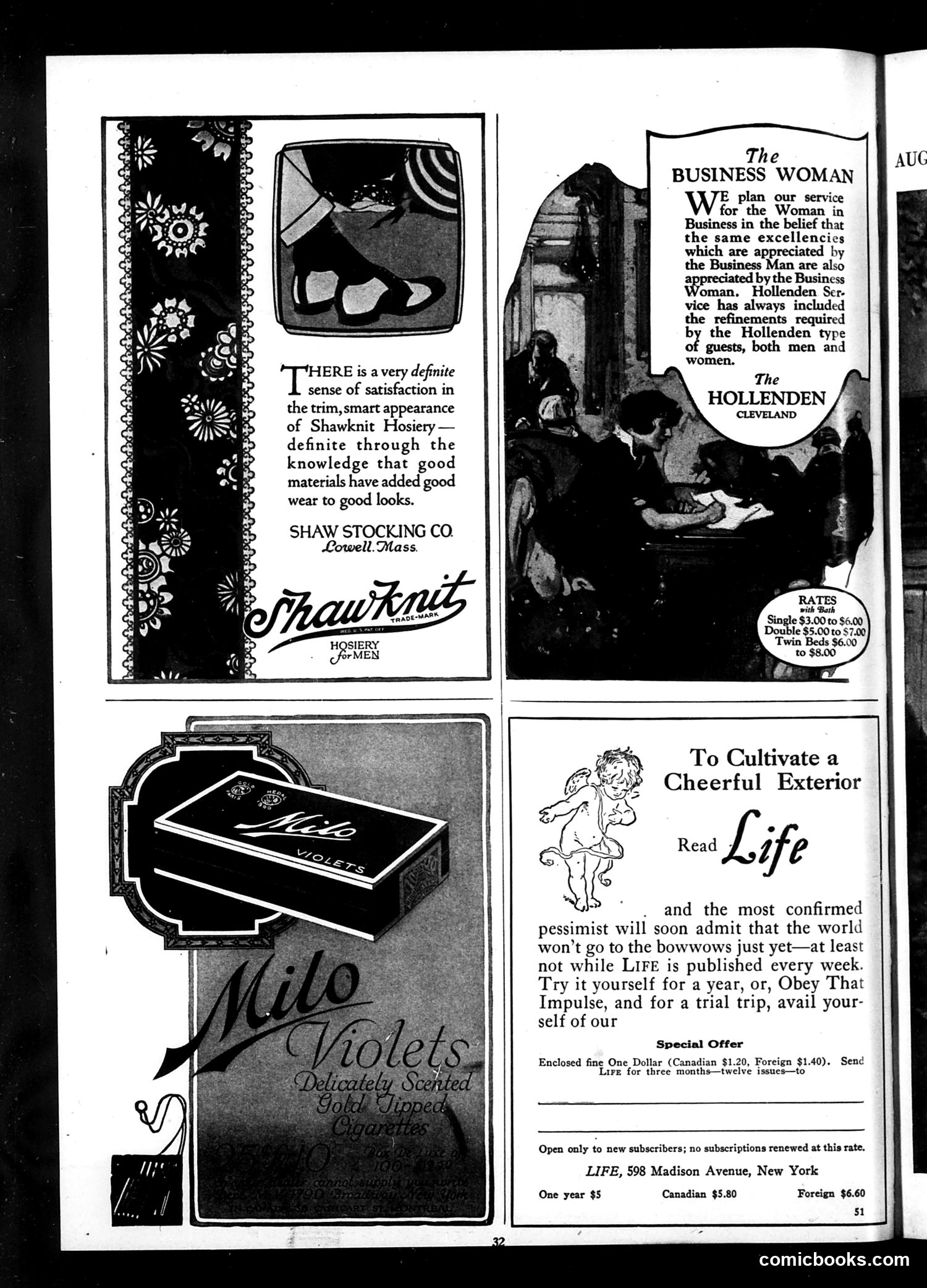
This page is primarily **advertising**, not political satire. It contains four distinct advertisements from circa 1920s America: 1. **Shawknit Hosiery** (top left): Promotes men's socks, emphasizing quality materials and durability through smart appearance. 2. **Hollenden Hotel** (top right): Markets upscale lodging in Cleveland, specifically appealing to "business women"—notable as it explicitly targets female professionals as a distinct customer segment worthy of refined service. 3. **Milo Violets Cigarettes** (bottom left): Advertises scented cigarettes in decorative packaging. 4. **Life Magazine** (bottom right): Promotes subscriptions with the tagline that reading Life prevents pessimism, framing the magazine as essential cheerfulness for modern times. The Hollenden ad is historically significant for acknowledging businesswomen as a legitimate market category, reflecting 1920s social changes following women's suffrage and increased workforce participation.