
Life, 1921-08-04 · page 24 of 34
Life — August 4, 1921 — page 24: what you’re looking at
What you’re looking at
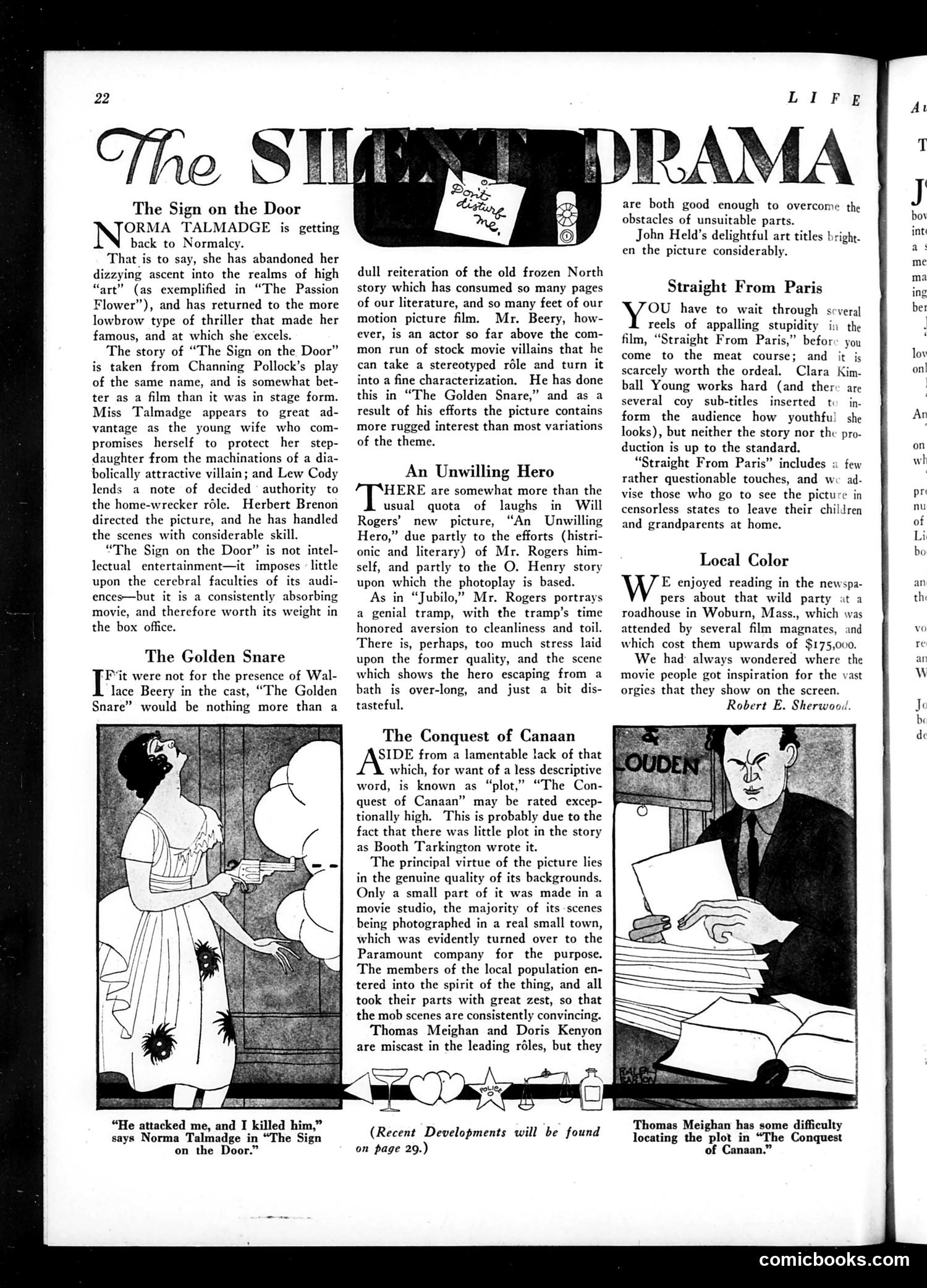
This page reviews several 1920s silent films. The main critique concerns **Norma Talmadge**, a major actress, returning to popular entertainment after attempting serious drama ("The Passion Flower"). Life satirizes this as "getting back to Normalcy"—a pun on Warren Harding's post-WWI political slogan—suggesting her artistic aspirations failed and she's retreating to lowbrow thrillers where she excels. The reviews assess other contemporaries: **Wallace Beery** and **Will Rogers** (famous for playing lovable tramps), plus **Thomas Meighan** and **Doris Kenyon** in "The Conquest of Canaan." Life praises authentic location filming over studio sets and John Held's art titles. The cartoons show dramatic scenes: Talmadge's character claiming self-defense ("He attacked me, and I killed him"), and Meighan struggling with plot. The tone is witty but not savage—typical of Life's urbane film criticism targeting middle-class moviegoers familiar with these stars.
📄 Transcribed text from this page (OCR, searchable)
Machine-transcribed from the original scan — historical spelling and the odd misread are preserved.
The Sign on the Door ORMA TALMADGE is getting back to Normalcy. That is to say, she has abandoned her dizzying ascent into the realms of high “art” (as exemplified in “The Passion Flower”), and has returned to the more lowbrow type of thriller that made her famous, and at which she excels. The story of “The Sign on the Door” is taken from Channing Pollock’s play of the same name, and is somewhat bet- ter as a film than it was in stage form. Miss Talmadge appears to great ad- vantage as the young wife who com- promises herself to protect her step- daughter from the machinations of a dia- bolically attractive villain; and Lew Cody lends a note of decided authority to the home-wrecker rdle. Herbert Brenon directed the picture, and he has handled the scenes with considerable skill. “The Sign on the Door” is not intel- lectual entertainment—it imposes : little upon the cerebral faculties of its audi- ences—but it is a consistently absorbing movie, and therefore worth its weight in the box office. The Golden Snare Fit were not for the presence of Wal- lace Beery in the cast, “The Golden Snare” would be nothing more than a “He attacked me, and I killed him,” says Norma Talmadge in “The Sign on the Door.” dull reiteration of the old frozen North story which has consumed so many pages of our literature, and so many feet of our motion picture film. Mr. Beery, how- ever, is an actor so far above the com- mon run of stock movie villains that he can take a stereotyped réle and turn it into a fine characterization. He has done this in “The Golden Snare,” and as a result of his efforts the picture contains more rugged interest than most variations of the theme. An Unwilling Hero HERE are somewhat more than the usual quota of laughs in Will Rogers’ new picture, “An Unwilling Hero,” due partly to the efforts (histri- onic and literary) of Mr. Rogers him- self, and partly to the O. Henry story upon which the photoplay is based. As in “Jubilo,” Mr. Rogers portrays a genial tramp, with the tramp’s time honored aversion to cleanliness and toil. There is, perhaps, too much stress laid upon the former quality, and the scene which shows the hero escaping from a bath is over-long, and just a bit dis- tasteful, The Conquest of Canaan SIDE from a lamentable tack of that which, for want of a less descriptive word, is known as “plot,” “The Con- quest of Canaan” may be rated excep- tionally high. This is probably due to the fact that there was little plot in the story as Booth Tarkington wrote it. The principal virtue of the picture lies in the genuine quality of its backgrounds. Only a small part of it was made in a movie studio, the majority of its scenes being photographed in a real small town, which was evidently turned over to the Paramount company for the purpose. The members of the local population en- tered into the spirit of the thing, and all took their parts with great zest, so that the mob scenes are consistently convincing. Thomas Meighan and Doris Kenyon are miscast in the leading réles, but they (Recent Developments will be found on page 29.) are both good enough to overcome the obstacles of unsuitable parts. John Held’s delightful art titles bright. en the picture considerably. Straight From Paris OU have to wait through several reels of appalling stupidity in the film, “Straight From Paris,” before you come to the meat course; and it is scarcely worth the ordeal. Clara Kim- ball Young works hard (and there are several coy sub-titles inserted to in- form the audience how youthful she looks), but neither the story nor the pro- duction is up to the standard. “Straight From Paris” includes « few rather questionable touches, and we ad- vise those who go to see the picture in censorless states to leave their children and grandparents at home. Local Color E enjoyed reading in the newspa- pers about that wild party at a roadhouse in Woburn, Mass., which was attended by several film magnates, and which cost them upwards of $175,000. We had: always wondered where the movie people got inspiration for the vast orgies that they show on the screen. Robert E. Sherwood. Thomas Meighan has some difficulty locating the plot in “The Conquest of Canaan.” comicbooks.com