
Life, 1921-08-04 · page 16 of 34
Life — August 4, 1921 — page 16: what you’re looking at
What you’re looking at
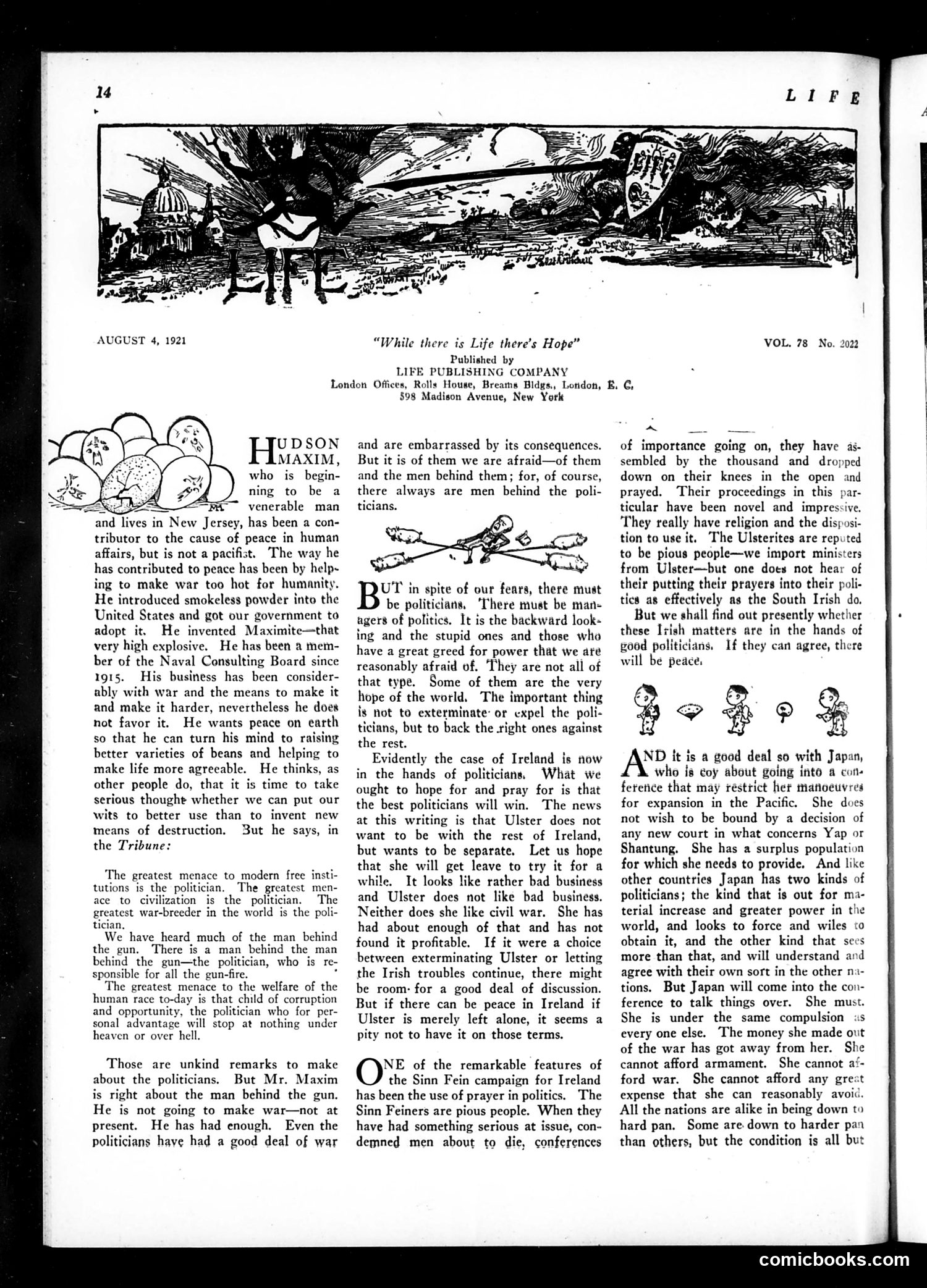
The page features an editorial by Hudson Maxim (identified in the byline) discussing post-WWI politics and peace. The small decorative illustration at top appears to be a landscape vignette, not a specific political cartoon. Maxim criticizes politicians as generally untrustworthy, arguing they pursue power rather than genuine peace. He discusses Ireland's political situation, suggesting Ulster's separation from Ireland and comparing the conflict to civil war. He also addresses Japan's expansion in the Pacific, arguing Japan—like other nations—cannot afford war and should avoid military ambition. The tone is pessimistic about politicians while advocating for peaceful resolution of international disputes. No specific named figures are caricatured on this page.
📄 Transcribed text from this page (OCR, searchable)
Machine-transcribed from the original scan — historical spelling and the odd misread are preserved.
AUGUST 4, 1921 “While there is Life there’s Hope” Published by LIFE PUBLISHING COMPANY London Offices, Rolls House, Breamns Bldgs., London, UDSON MAXIM, who is begin- ning to be a ya venerable man and lives in New Jersey, has been a con- tributor to the cause of peace in human affairs, but is not a pacifist. The way he has contributed to peace has been by help- ing to make war too hot for humanity. He introduced smokeless powder into the United States and got our government to adopt it. He invented Maximite—that very high explosive. He has been a mem- ber of the Naval Consulting Board since 1915. His business has been consider- ably with war and the means to make it and make it harder, nevertheless he does not favor it. He wants peace on earth so that he can turn his mind to raising better varieties of beans and helping to make life more agreeable. He thinks, as other people do, that it is time to take serious thought whether we can put our wits to better use than to invent new means of destruction. 3ut he says, in the Tribune: The greatest menace to modern free insti- tutions is the politician. The greatest men- ace to civilization is the politician. The greatest war-breeder in the world is the poli- tician, We have heard much of the man behind the gun. There is a man behind the man behind the gun—the politician, who is re- sponsible for all the gun-fire. . The greatest menace to the welfare of the human race to-day is that child of corruption and opportunity, the politician who for per- sonal advantage will stop at nothing under heaven or over hell. Those are unkind remarks to make about the politicians. But Mr. Maxim is right about the man behind the gun. He is not going to make war—not at present. He has had enough. Even the politicians have had a good deal of war 598 Madison Avenue, New York and are embarrassed by its consequences. But it is of them we are afraid—of them and the men behind them; for, of course, there always are men behind the poli- ticians. UT in spite of our fears, there must be politicians, ‘There must be man- agers of politics. It is the backward look- ing and the stupid ones and those who have a great greed for power that we are reasonably afraid of. They are not all of that type. Some of them are the very hope of the world. The important thing is not to exterminate: or expel the poli- ticians, but to back the right ones against the rest. Evidently the case of Ireland is now in the hands of politicians. What we ought to hope for and pray for is that the best politicians will win. The news at this writing is that Ulster does not want to be with the rest of Ireland, but wants to be separate. Let us hope that she will get leave to try it for a while. It looks like rather bad business and Ulster does not like bad business. Neither does she like civil war. She has had about enough of that and has not found it profitable. If it were a choice between exterminating Ulster or letting the Irish troubles continue, there might be room: for a good deal of discussion. But if there can be peace in Ireland if Ulster is merely left alone, it seems a pity not to have it on those terms. NE of the remarkable features of the Sinn Fein campaign for Ireland has been the use of prayer in politics. The Sinn Feiners are pious people. When they have had something serious at issue, con- demned men about to die, conferences VOL. 78 No. 2022 ~ — of importance going on, they have as- sembled by the thousand and dropped down on their knees in the open and prayed. Their proceedings in this ticular have been novel and impressive. They really have religion and the disposi- tion to use it. The Ulsterites are reputed to be pious people—we import ministers from Ulster—but one does not hear of their putting their prayers into their poli- tics as effectively as the South Irish do. But we shall find out presently whether these Irish matters are in the hands of good politicians, If they can agree, there will be peace. ND it is a good deal so with Japan, who is coy about going into a con- ference that may résttict her manoeuvres for expansion in the Pacific. She does not wish to be bound by a decision of any new court in what concerns Yap or Shantung. She has a surplus population for which she needs to provide. And like other countries Japan has two kinds of politicians; the kind that is out for ma- terial increase and greater power in the world, and looks to force and wiles to obtain it, and the other kind that sees more than that, and will understand and agree with their own sort in the other na- tions. But Japan will come into the con- ference to talk things over. She must. She is under the same compulsion «s every one else. The money she made out of the war has got away from her. She cannot afford armament. She cannot af- ford war. She cannot afford any great expense that she can reasonably avoid. All the nations are alike in being down to hard pan. Some are down to harder pan than others, but the condition is all but comicbooks.com