
Life, 1921-08-04 · page 25 of 34
Life — August 4, 1921 — page 25: what you’re looking at
What you’re looking at
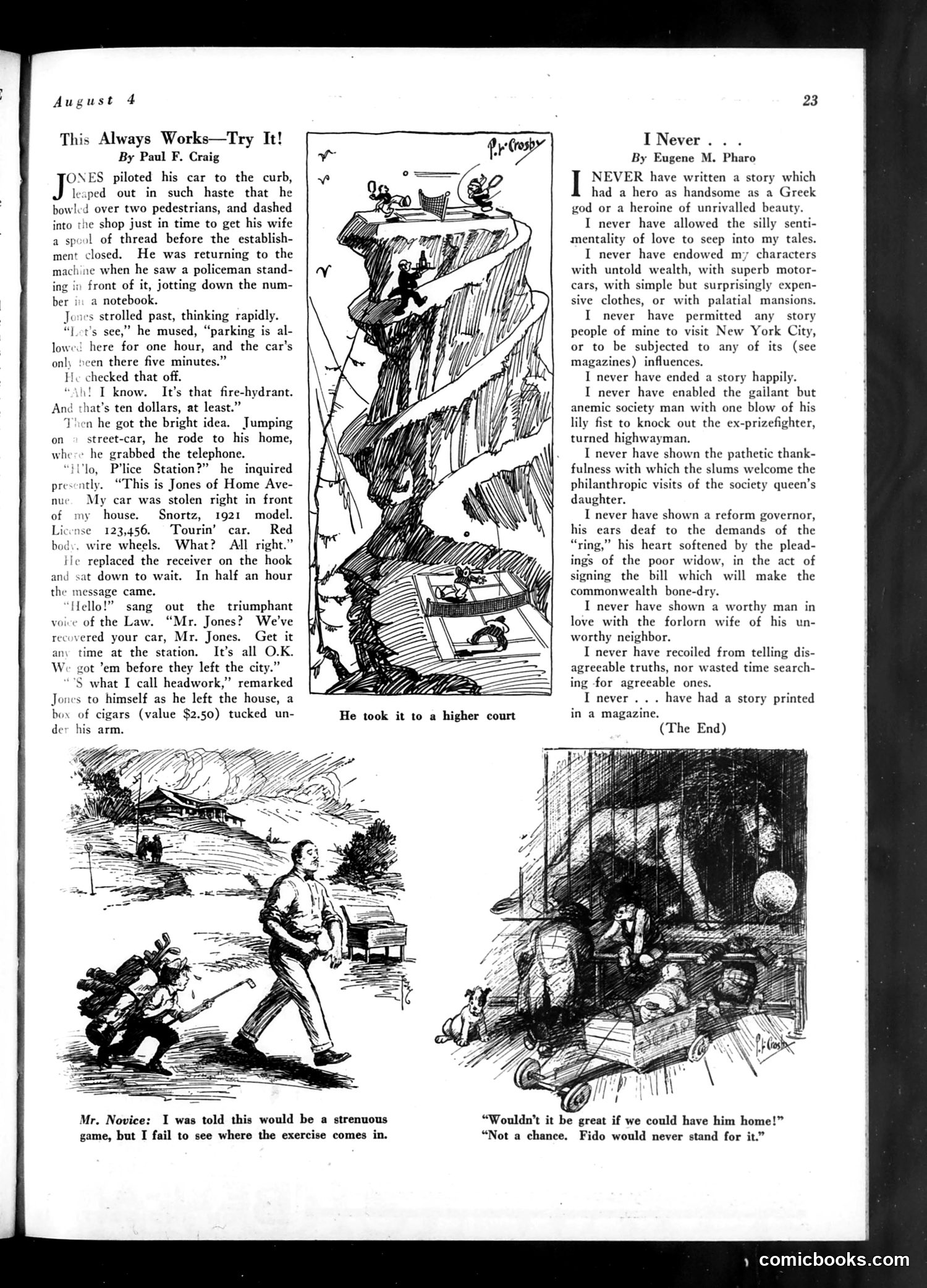
## "This Always Works—Try It!" A comedic short story by Paul F. Craig illustrating a clever (if ethically questionable) workaround. Jones parks illegally, sees a policeman writing a ticket, then calls the police station to report his car stolen. The police recover it from the station lot and return it to him—apparently erasing the parking violation in the process. The joke's appeal lies in the protagonist's quick thinking, though the satire subtly mocks both petty traffic enforcement and the ease of gaming the system through a simple phone call. ## "I Never..." A contrasting piece by Eugene M. Pharo listing all the literary clichés the author *hasn't* included in his stories—no Greek-god heroes, no wealth-obsessed characters, no New York settings, no happy endings, no saccharine philanthropy plots. The punchline: despite avoiding every magazine trope, he's never had a story published. The satire attacks both formulaic magazine fiction and the gatekeeping of publication.
📄 Transcribed text from this page (OCR, searchable)
Machine-transcribed from the original scan — historical spelling and the odd misread are preserved.
August 4 This Always Works—Try It! By Paul F. Craig ONES piloted his car to the curb, leaped out in such haste that he bowled over two pedestrians, and dashed into rhe shop just in time to get his wife a spool of thread before the establish- ment closed. He was returning to the machine when he saw a policeman stand- in front of it, jotting down the num- a notebook. Jones strolled past, thinking rapidly. “Lot's see,” he mused, “parking is al- lowe! here for one hour, and the car's onl) cen there five minutes.” He checked that off. ‘ It’s that fire-hydrant. And that’s ten dollars, at least.” Then he got the bright idea. Jumping on © street-car, he rode to his home, whee he grabbed the telephone. “iUlo, P’lice Station?” he inquired presently. “This is Jones of Home Ave- nue. My car was stolen right in front Snortz, 1921 model. ! I know. of my house. License 123,456. body. wire wheels. ile replaced the receiver on the hook and sat down to wait. In half an hour the message came. “Hello!” sang voive of the Law. recovered your car, Mr. Jones. Get it any time at the station. It’s all O.K. We got ’em before they left the city.” S what I call headwork,” remarked Tourin’ car. Red What? All right.” out the triumphant “Mr. Jones? We've Jones to himself as he left the house, a box of cigars (value $2.50) tucked un- der his arm. I Never... By Eugene M. Pharo NEVER have written a story which had a hero as handsome as a Greek god or a heroine of unrivalled beauty. I never have allowed the silly senti- mentality of love to seep into my tales. I never have endowed my characters with untold wealth, with superb motor- cars, with simple but surprisingly expen- sive clothes, or with palatial mansions. I never have permitted any story people of mine to visit New York City, or to be subjected to any of its (see magazines) influences. I never have ended a story happily. I never have enabled the gailant but anemic society man with one blow of his lily fist to knock out the ex-prizefighter, turned highwayman. I never have shown the pathetic thank- fulness with which the slums welcome the philanthropic visits of the society queen’s daughter. I never have shown a reform governor, his ears deaf to the demands of the “ring,” his heart softened by the plead- ings of the poor widow, in the act of signing the bill which will make the commonwealth bone-dry. I never have shown a worthy man in love with the forlorn wife of his un- worthy neighbor. I never have recoiled from telling dis- agreeable truths, nor wasted time search- ing for agreeable ones. I never . . . have had a story printed in a magazine. (The End) “Wouldn’t it be great if we could have him home!” “Not a chance. Fido would never stand for it.” Mr. Novice: I was told this would be a strenuous game, but I fail to see where the exercise comes in. » comicbooks.com