
Life, 1921-08-04 · page 20 of 34
Life — August 4, 1921 — page 20: what you’re looking at
What you’re looking at
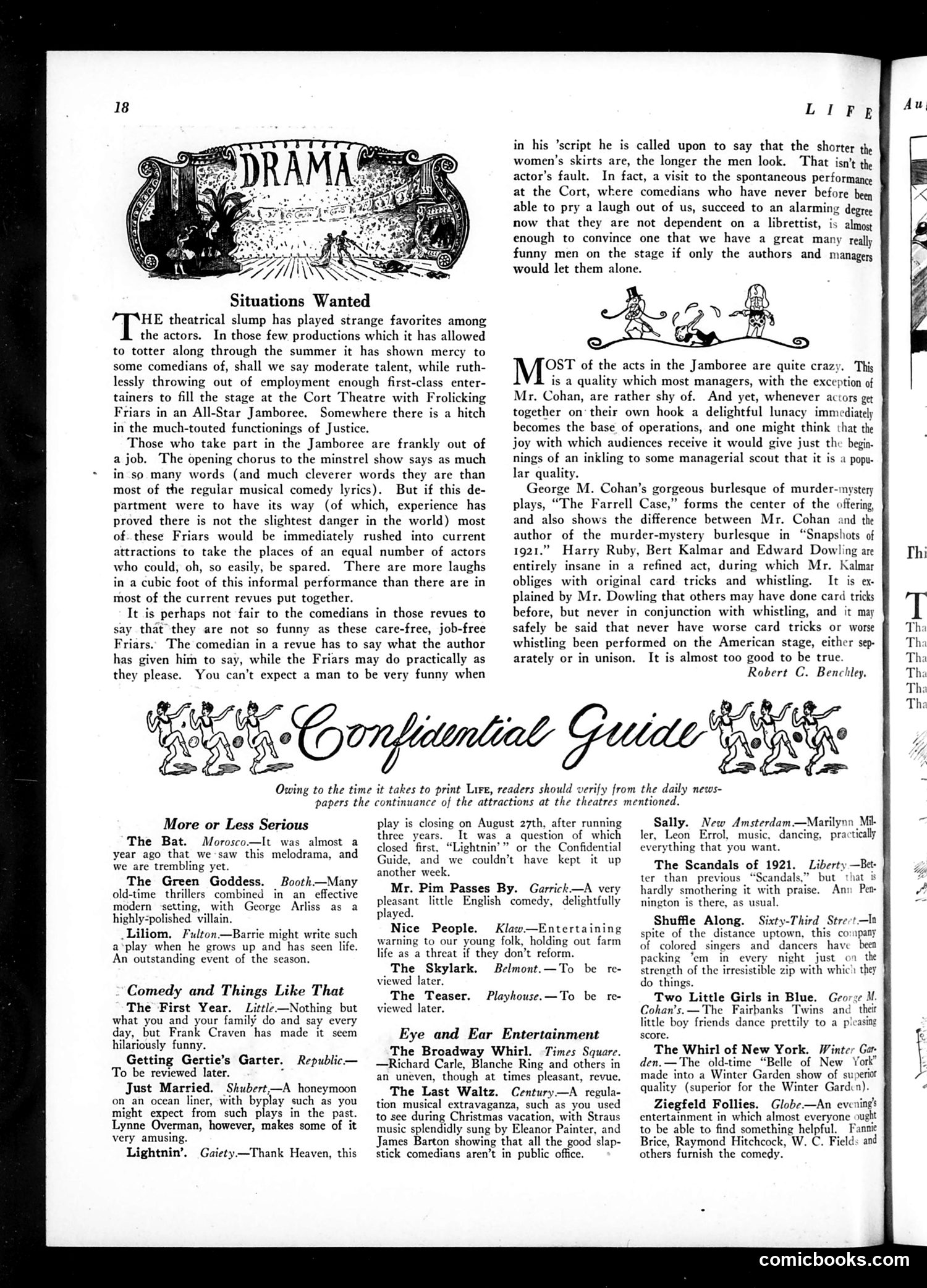
This page critiques the 1920s theatrical industry through drama critic Robert C. Benchley's commentary. The main argument concerns a paradox: unemployed comedians performing together in an informal "All-Star Jamboree" at the Cort Theatre are funnier than employed actors stuck in scripted Broadway revues with mediocre material. Benchley identifies **George M. Cohan** as an exception—a manager who understands that spontaneous, "crazy" performance (what he calls "delightful lunacy") resonates with audiences. He contrasts this with unnamed managers who avoid such zaniness. The satire targets **Broadway's creative hierarchy**: authors and managers who write poor scripts limit actors' comedic potential. The piece argues that removing script constraints unleashes genuine talent. Benchley's examples—Cohan's murder-mystery burlesque "The Farrell Case" and Kalmar's intentionally bad card tricks performed while whistling—illustrate how audiences respond to authentic spontaneity over polished mediocrity. The critique reflects post-WWI theatrical frustration: talented performers were underemployed while inferior productions continued running.
📄 Transcribed text from this page (OCR, searchable)
Machine-transcribed from the original scan — historical spelling and the odd misread are preserved.
Situations Wanted HE theatrical slump has played strange favorites among the actors. In those few productions which it has allowed to totter along through the summer it has shown mercy to some comedians of, shall we say moderate talent, while ruth- lessly throwing out of employment enough first-class enter- tainers to fill the stage at the Cort Theatre with Frolicking Friars in an All-Star Jamboree. Somewhere there is a hitch in the much-touted functionings of Justice. Those who take part in the Jamboree are frankly out of a job. The opening chorus to the minstrel show says as much in so many words (and much cleverer words they are than most of the regular musical comedy lyrics). But if this de- partment were to have its way (of which, experience has proved there is not the slightest danger in the world) most ofthese Friars would be immediately rushed into current attractions to take the places of an equal number of actors who could, oh, so easily, be spared. There are more laughs in a cubic foot of this informal performance than there are in most of the current revues put together. It is perhaps not fair to the comedians in those revues to say that they are not so funny as these care-free, job-free Friars. The comedian in a revue has to say what the author has given him to say, while the Friars may do practically as they please. You can’t expect a man to be very funny when LIFE: in his ’script he is called upon to say that the shorter the women’s skirts are, the longer the men look. That isn’t the actor's fault. In fact, a visit to the spontaneous Performance at the Cort, where comedians who have never before been able to pry a laugh out of us, succeed to an alarming degree now that they are not dependent on a librettist, is almost enough to convince one that we have a great many really funny men on the stage if only the authors and managers would let them alone. OST of the acts in the Jamboree are quite crazy. This is a quality which most managers, with the exception of Mr. Cohan, are rather shy of. And yet, whenever actors get together on their own hook a delightful lunacy immediately becomes the base of operations, and one might think that the joy with which audiences receive it would give just the begin. nings of an inkling to some managerial scout that it is a popu. lar quality. George M. Cohan’s gorgeous burlesque of murder-mystery plays, “The Farrell Case,” forms the center of the offering, and also shows the difference between Mr. Cohan and the author of the murder-mystery burlesque in “Snapshots of 1921.” Harry Ruby, Bert Kalmar and Edward Dowling are entirely insane in a refined act, during which Mr. Kalmar obliges with original card tricks and whistling. It is ex- plained by Mr. Dowling that others may have done card tricks before, but never in conjunction with whistling, and it may safely be said that never have worse card tricks or worse whistling been performed on the American stage, either sep- arately or in unison. It is almost too good to be true. Robert C. Benchley, Weg Co refitnliat Fedate SO Owing to the time it takes to print Lire, readers should verify from the daily news- papers the continuance of the attractions at the theatres mentioned. More or Less Serious The Bat. Morosco—It was almost a year ago that we saw this melodrama, and we are trembling yet. The Green Goddess. Booth—Many old-time thrillers combined in an_ effective modern setting, with George Arliss as a highly-polished villain. .Liliom. Fulton —Barrie might write such a‘play when he grows up and has seen life. An outstanding event of the season. Comedy and Things Like That The First Year. Little—Nothing but what you and your family do and say every day, but Frank Craven has made it seem hilariously funny. Getting Gertie’s Garter. Republic— To be reviewed later. 5 Just Married. Shubert—A honeymoon on’ an ocean liner, with byplay such as you might expect from such plays in the past. Lynne Overman, however, makes some of it very amusing. Lightnin’. Gaiety—Thank Heaven, this play is closing on August 27th, after running three years. It was a question of which closed first, “Lightnin’” or the Confidential Guide, and we couldn’t have kept it up another week. Mr. Pim Passes By. Garrick—A very pleasant little English comedy, delightfully played. Nice People. Klaw—Entertaining warning to our young folk, holding out farm life as a threat if they don’t reform. The Skylark. Belmont.—To be re- viewed later. The Teaser. viewed later. Playhouse.—To be re- Eye and Ear Entertainment The Broadway Whirl. Times Square. —Richard Carle, Blanche Ring and others in an uneven, though at times pleasant, revue. The Last Waltz. Century—A regula- tion musical extravaganza, such as you used to see during Christmas vacation, with Straus music splendidly sung by Eleanor Painter, and James Barton showing that all the good slap- stick comedians aren’t in public office. Sally. New Amsterdam ler, Leon Errol, music, dai everything that you want. The Scandals of 1921. Liberty —Bet- ter than previous ‘andals,” but hardly smothering it with praise. Ann Pen nington is there, as usual. Shuffle Along. Sixty-Third Street —In spite of the distance uptown, this co:npany of colored singers and dancers have beet packing “em in every night just on the strength of the irresistible zip with whic) they do things. Two Little Girls in Blue. Geore M. Cohan’s.—The Fairbanks Twins and thet little boy friends dance prettily to a pleasing score. The Whirl of New York. Winter Gar. den.—The old-time “Belle of New York made into a Winter Garden show of superiot quality (superior for the Winter Gard n). Ziegfeld Follies. Globe—An evening’ entertainment in which almost everyone ought to be able to find something helpful. Fannie Brice, Raymond Hitchcock, W. C. Fields and others furnish the comedy. Marilynn Mil. ng, practically Au. comicbooks.com