
Life, 1921-08-04 · page 17 of 34
Life — August 4, 1921 — page 17: what you’re looking at
What you’re looking at
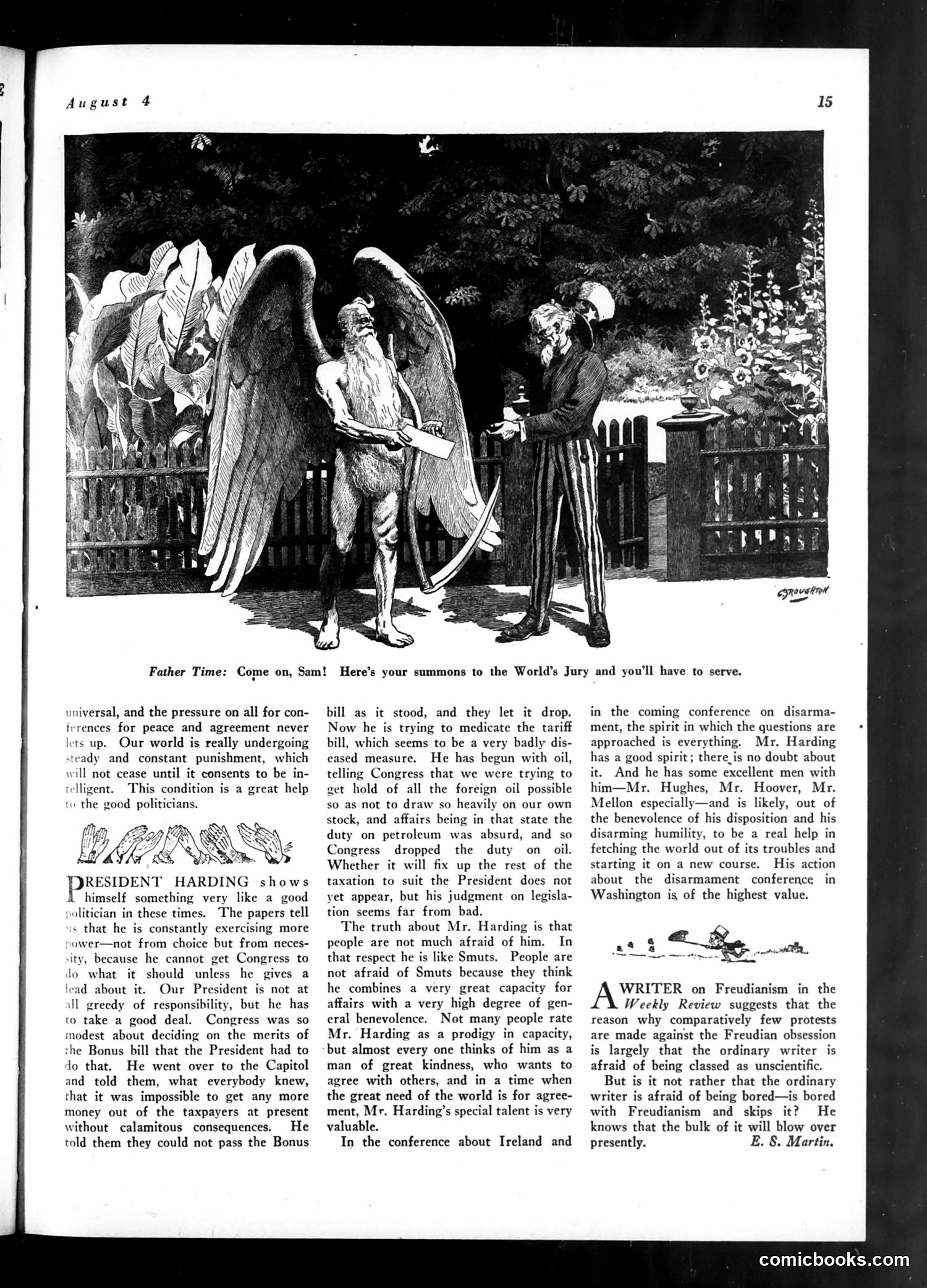
The cartoon depicts **Father Time** (the bearded winged figure) serving a summons to **Uncle Sam** (the tall figure in top hat), commanding him to serve on the "World's Jury." **Context:** This appears to address post-World War I America's reluctant entry into international affairs. The cartoon suggests America cannot avoid global responsibility—personified as jury duty—despite its isolationist preferences. Father Time represents inexorable historical forces compelling the nation toward engagement. **The accompanying article** praises President **Harding** for exercising executive power to push legislation (the Bonus Bill, tariff reform) through a reluctant Congress. It characterizes Harding as benevolent rather than ambitious, and values his cooperative spirit in upcoming international conferences on disarmament and Ireland. **The satire's point:** America must accept its role in world affairs, much as one cannot escape jury duty. Harding's gentle leadership style is presented as advantageous for this new global responsibility.
📄 Transcribed text from this page (OCR, searchable)
Machine-transcribed from the original scan — historical spelling and the odd misread are preserved.
August 4 Father Time: Come on, Sam! Here’s your summons to the World’s Jury and you'll have to serve. universal, and the pressure on all for con- ferences for peace and agreement never lets up. Our world is really undergoing steady and constant punishment, which will not cease until it consents to be in- telligent. This condition is a great help to the good politicians. RESIDENT HARDING shows himself something very like a good litician in these times. The papers tell s that he is constantly exercising more ower—not from choice but from neces- ity, because he cannot get Congress to lo what it should unless he gives a tead about it. Our President is not at ull greedy of responsibility, but he has to take a good deal. Congress was so modest about deciding on the merits of she Bonus bill that the President had to Jo that. He went over to the Capitol and told them, what everybody knew, that it was impossible to get any more money out of the taxpayers at present without calamitous consequences. He told them they could not pass the Bonus bill as it stood, and they let it drop. Now he is trying to medicate the tariff bill, which seems to be a very badly dis- eased measure. He has begun with oil, telling Congress that we were trying to get hold of all the foreign oil possible so as not to draw so heavily on our own stock, and affairs being in that state the duty on petroleum was absurd, and so Congress dropped the duty on oil. Whether it will fix up the rest of the taxation to suit the President does not yet appear, but his judgment on legisla- tion seems far from bad. The truth about Mr. Harding is that people are not much afraid of him. In that respect he is like Smuts. People are not afraid of Smuts because they think he combines a very great capacity for affairs with a very high degree of gen- eral benevolence. Not many people rate Mr. Harding as a prodigy in capacity, but almost every one thinks of him as a man of great kindness, who wants to agree with others, and in a time when the great need of the world is for agree- ment, Mr. Harding’s special talent is very valuable. In the conference about Ireland and in the coming conference on disarma- ment, the spirit in which the questions are approached is everything. Mr. Harding has a good spirit; there_is no doubt about it. And he has some excellent men with him—Mr. Hughes, Mr. Hoover, Mr. Mellon especially—and is likely, out of the benevolence of his disposition and his disarming humility, to be a real help in fetching the world out of its troubles and starting it on a new course. His action about the disarmament conference in Washington is of the highest value. WRITER on Freudianism in the Weekly Review suggests that the reason why comparatively few protests are made against the Freudian obsession is largely that the ordinary writer is afraid of being classed as unscientific. But is it not rather that the ordinary writer is afraid of being bored—is bored with Freudianism and skips it? He knows that the bulk of it will blow over presently. E. 8. Martin. comicbooks.com