
Life, 1921-08-04 · page 6 of 34
Life — August 4, 1921 — page 6: what you’re looking at
What you’re looking at
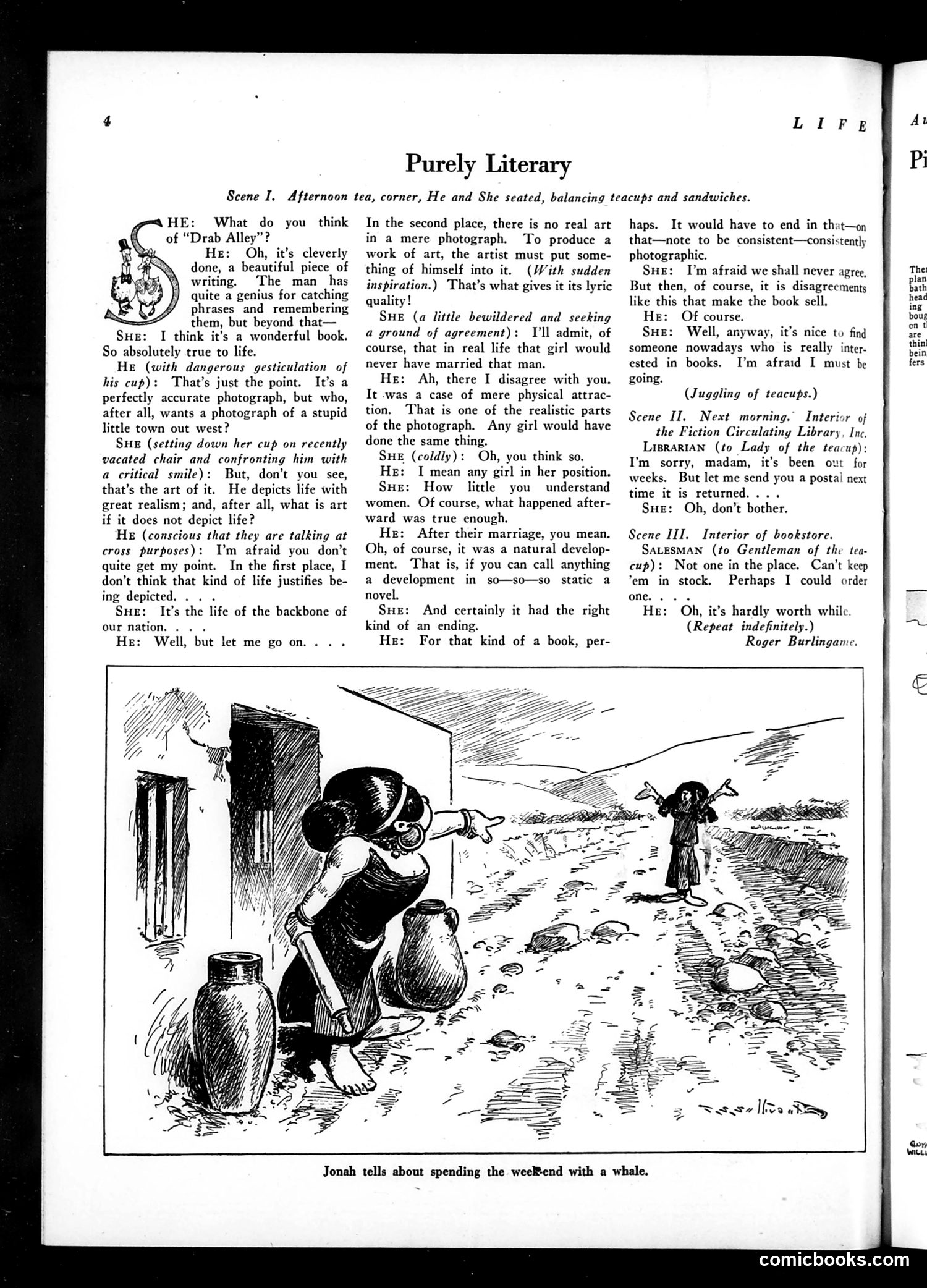
This page satirizes pretentious literary criticism and book discussions. The dialogue depicts a couple debating whether "Dream Alley" qualifies as art or mere photography. He defends it as literary genius with emotional depth; she counters that it's just realistic description without true artistic merit. The accompanying illustration shows a child telling an adult about "spending the weekend with a whale"—a visual punchline mocking the sort of fantastical, implausible narratives that might be defended as "literary" by overeager critics. The satire targets how people justify mediocre or unrealistic fiction as sophisticated art, and how literary snobs use aesthetic arguments to defend work that's simply implausible or poorly written. The scene at afternoon tea suggests this pretentiousness was common among educated social circles of the era.
📄 Transcribed text from this page (OCR, searchable)
Machine-transcribed from the original scan — historical spelling and the odd misread are preserved.
Purely Literary Scene I. Afternoon tea, corner, He and She seated, balancing teacups and sandwiches. HE: What do you think of “Drab Alley”? He: Oh, it’s cleverly done, a beautiful piece of writing. The man_ has quite a genius for catching phrases and remembering them, but beyond that— I think it’s a wonderful book. So absolutely true to life. HE (with dangerous gesticulation of his cup): That’s just the point. It’s a perfectly accurate photograph, but who, after all, wants a photograph of a stupid little town out west? SHE (setting down her cup on recently vacated chair and confronting him with a critical smile): But, don’t you see, that’s the art of it. He depicts life with great realism; and, after all, what is art if it does not depict life? HE (conscious that they are talking at cross purposes): I’m afraid you don’t quite get my point. In the first place, I don’t think that kind of life justifies be- ing depicted. . . . Sue: It’s the life of the backbone of our nation. . . . He: Well, but let me go on.. . In the second place, there is no real art in a mere photograph. To produce a work of art, the artist must put some- thing of himself into it. (With sudden inspiration.) That’s what gives it its lyric quality! SHE (a little bewildered and seeking a ground of agreement): I'll admit, of course, that in real life that girl would never have married that man. He: Ah, there I disagree with you. It was a case of mere physical attrac- tion. That is one of the realistic parts of the photograph. Any girl would have done the same thing. SHE (coldly): Oh, you think so. He: I mean any girl in her position. Sue: How little you understand women. Of course, what happened after- ward was true enough. He: After their marriage, you mean. Oh, of course, it was a natural develop- ment. That is, if you can call anything a development in so—so—so static a novel. Sue: And certainly it had the right kind of an ending. He: For that kind of a book, per- haps. It would have to end in that—on that—note to be consistent—consistently photographic. Sue: I’m afraid we shall never agree, But then, of course, it is disagreements like this that make the book sell. He: Of course. SHE: Well, anyway, it’s nice to find someone nowadays who is really inter- ested in books. I’m afraid I must be going. (Juggling of teacups.) Scene II. Next morning. Interior of the Fiction Circulating Library, Inc. Liprartan (to Lady of the teacup): I’m sorry, madam, it’s been ovt for weeks. But let me send you a postal next time it is returned... . SHE: Oh, don’t bother. Scene III. Interior of bookstore. SALESMAN (to Gentleman of the tea- cup): Not one in the place. Can't keep ‘em in stock. Perhaps I could order one... He: Oh, it’s hardly worth while. (Repeat indefinitely.) Roger Burlingame. Ts Iles SN Jonah tells about spending the wee®end with a whale. Thei lan bath head ing boug ont are thin bein fers Gor, wien comicbooks.com