
A complete issue · 41 pages · 1921
Life — June 30, 1921
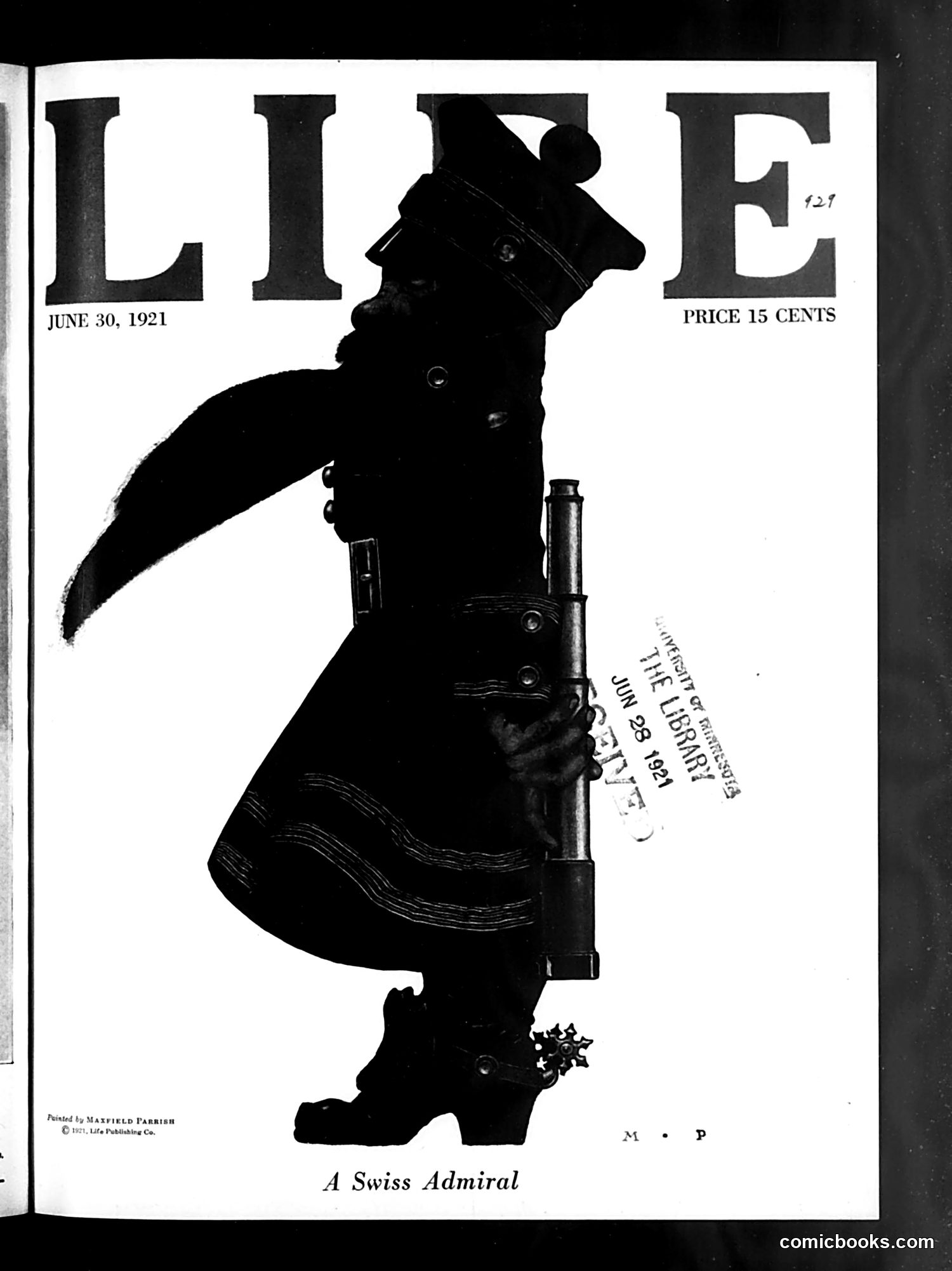
This is a satirical silhouette depicting a figure in military dress holding a revolver, captioned "A Swiss Admiral." The joke relies on absurdist humor: Switzerland is landlocked and has no navy, making a "Swiss Admiral" inherently ridiculous. The exaggerated military uniform, aggressive pose with weapon, and formal presentation mock the pretension of someone holding a title that shouldn't exist in that context. The silhouette style was popular in early 20th-century satirical magazines. Without additional context from the page's text or surrounding content, the specific person or event being mocked remains unclear, though the satire likely targets either Swiss military overreach or international politics of the post-WWI period.
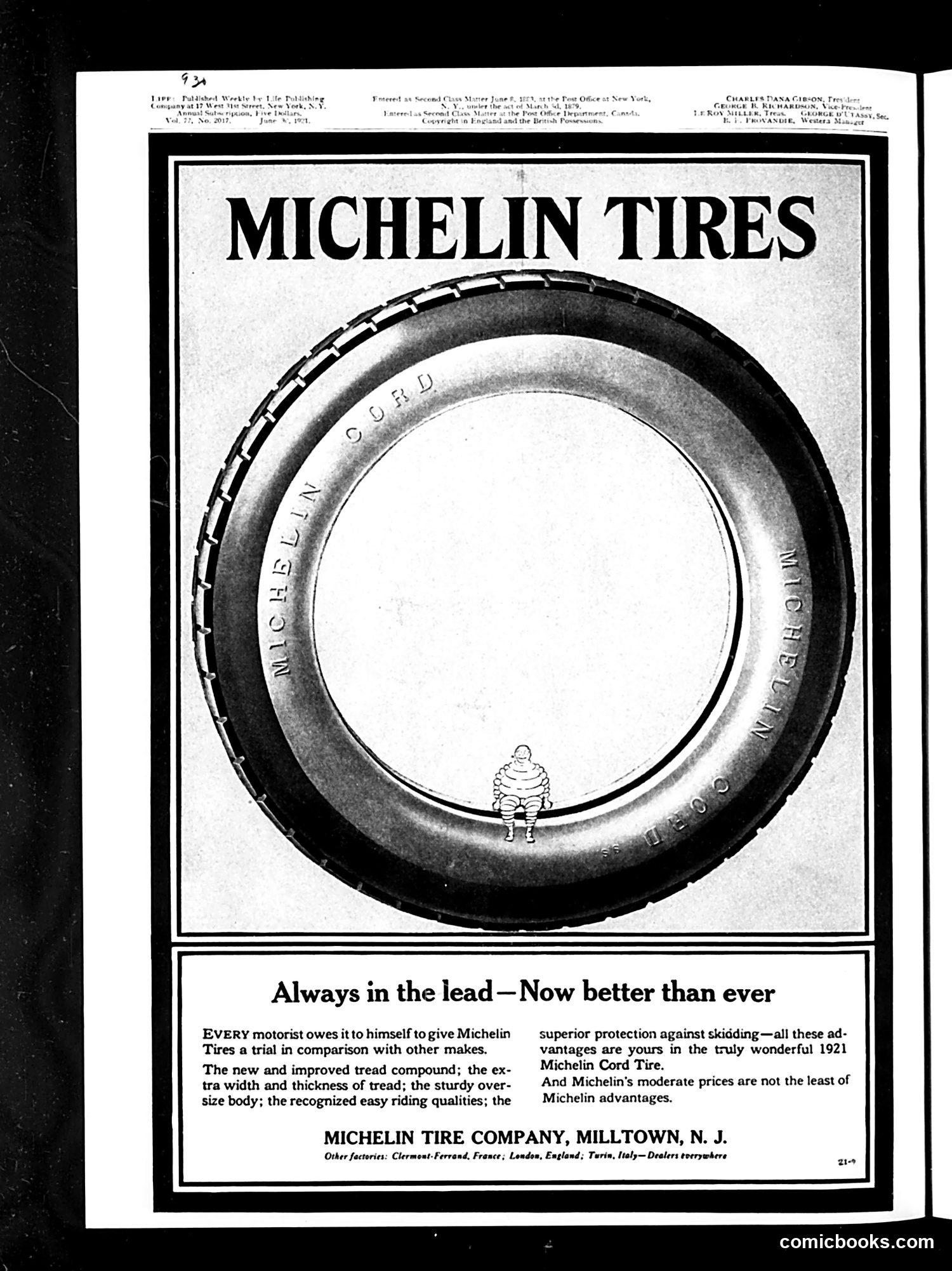
This page is primarily a **commercial advertisement** for Michelin tires, not political satire. The image shows a cross-section of a tire with the Michelin mascot (Bibendum, the rotund "Michelin Man" made of tire rings) positioned at the bottom for scale. The advertisement emphasizes the tire's superior tread design and durability compared to competitors. The tagline "Always in the lead—Now better than ever" positions Michelin as the market leader. The text highlights improvements for 1921: new tread compounds, wider tires, and protection against skidding. The company address is listed as Milltown, New Jersey, with international factories noted. This represents straightforward early-20th-century automotive marketing in *Life* magazine.
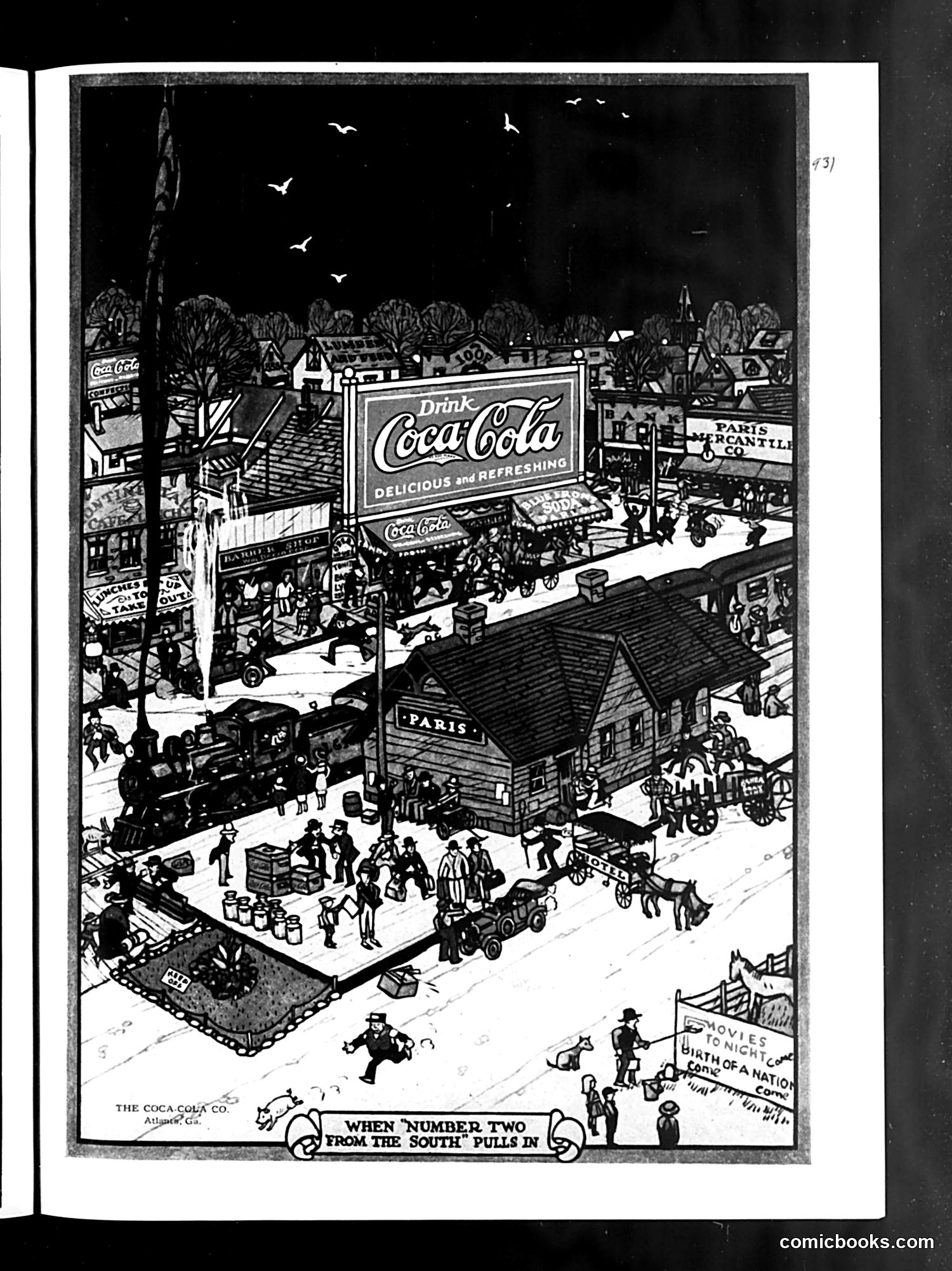
This is primarily a **Coca-Cola advertisement** rather than political satire. The illustration depicts an elaborate fair or exposition scene in Paris, showing the brand's prominent pavilion with its large "Drink Coca-Cola - Delicious and Refreshing" sign dominating the composition. The caption reads "When 'Number Two From the South' Pulls In," likely referencing a train or parade float bearing Coca-Cola products. The scene shows bustling crowds, a steam locomotive, horse-drawn wagons, and various fair attendees gathered around the central Coca-Cola display. The "Paris Exposition" branding visible on buildings confirms this depicts a world's fair setting, used as a marketing vehicle to showcase American products to an international audience. The detailed, crowded composition emphasizes Coca-Cola's prominence and popular appeal at such major cultural events.
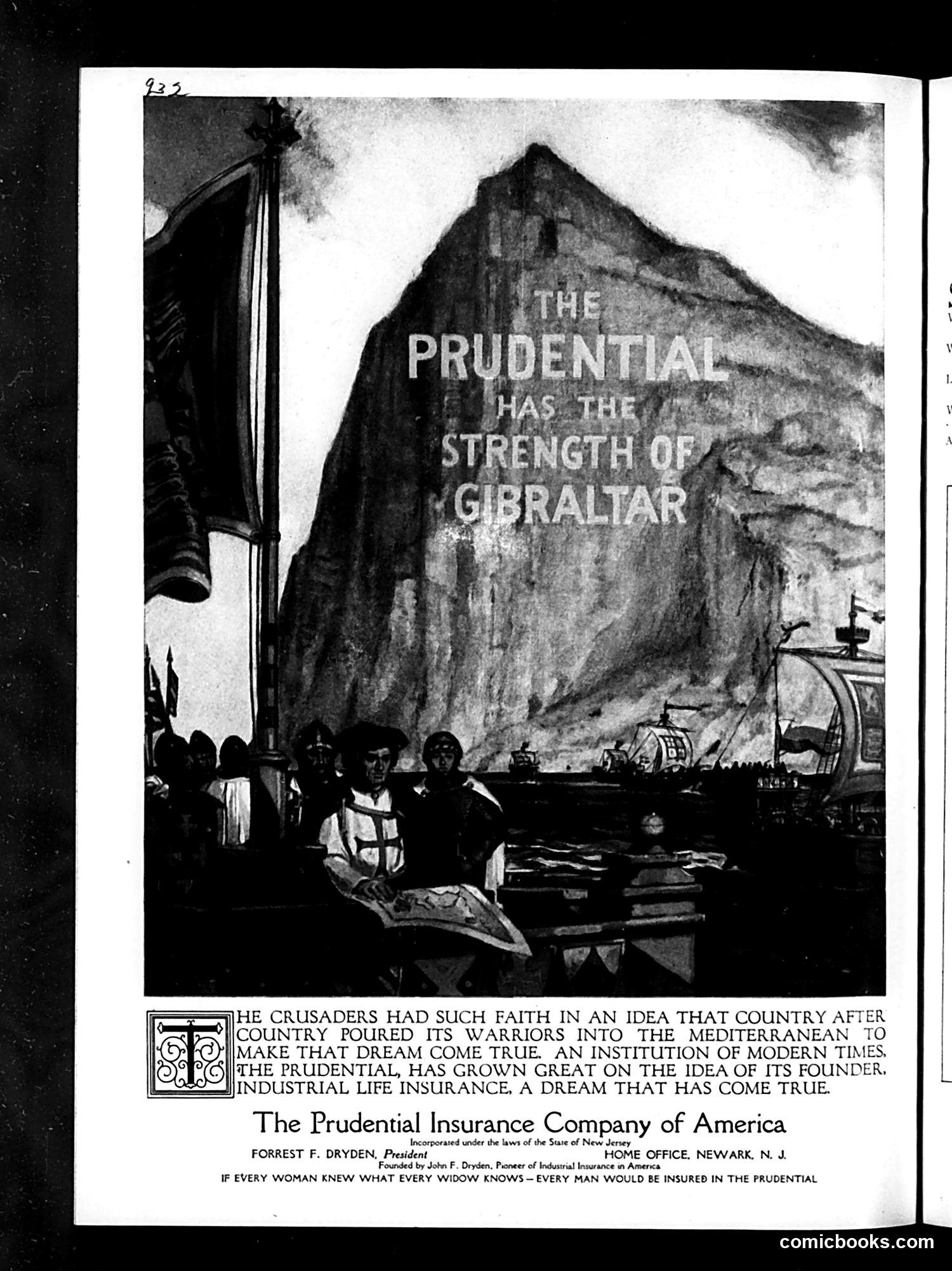
This is an advertisement, not satire or political commentary. The Prudential Insurance Company uses an evocative historical metaphor: comparing their company's foundational strength to Gibraltar's legendary fortifications. The image shows a ship near the Rock of Gibraltar, with the headline "THE PRUDENTIAL HAS THE STRENGTH OF GIBRALTAR." The accompanying text draws a parallel between medieval Crusaders' faith in their mission and modern confidence in Prudential's industrial life insurance product. The advertisement targets male breadwinners, suggesting that just as the Crusaders had unwavering conviction, men should have absolute faith in Prudential to protect their families' financial security. The closing line—"If every woman knew what every widow knows"—appeals to wives' anxieties about surviving without income. This represents early 20th-century insurance marketing through historical romanticization and emotional appeal to masculine duty.
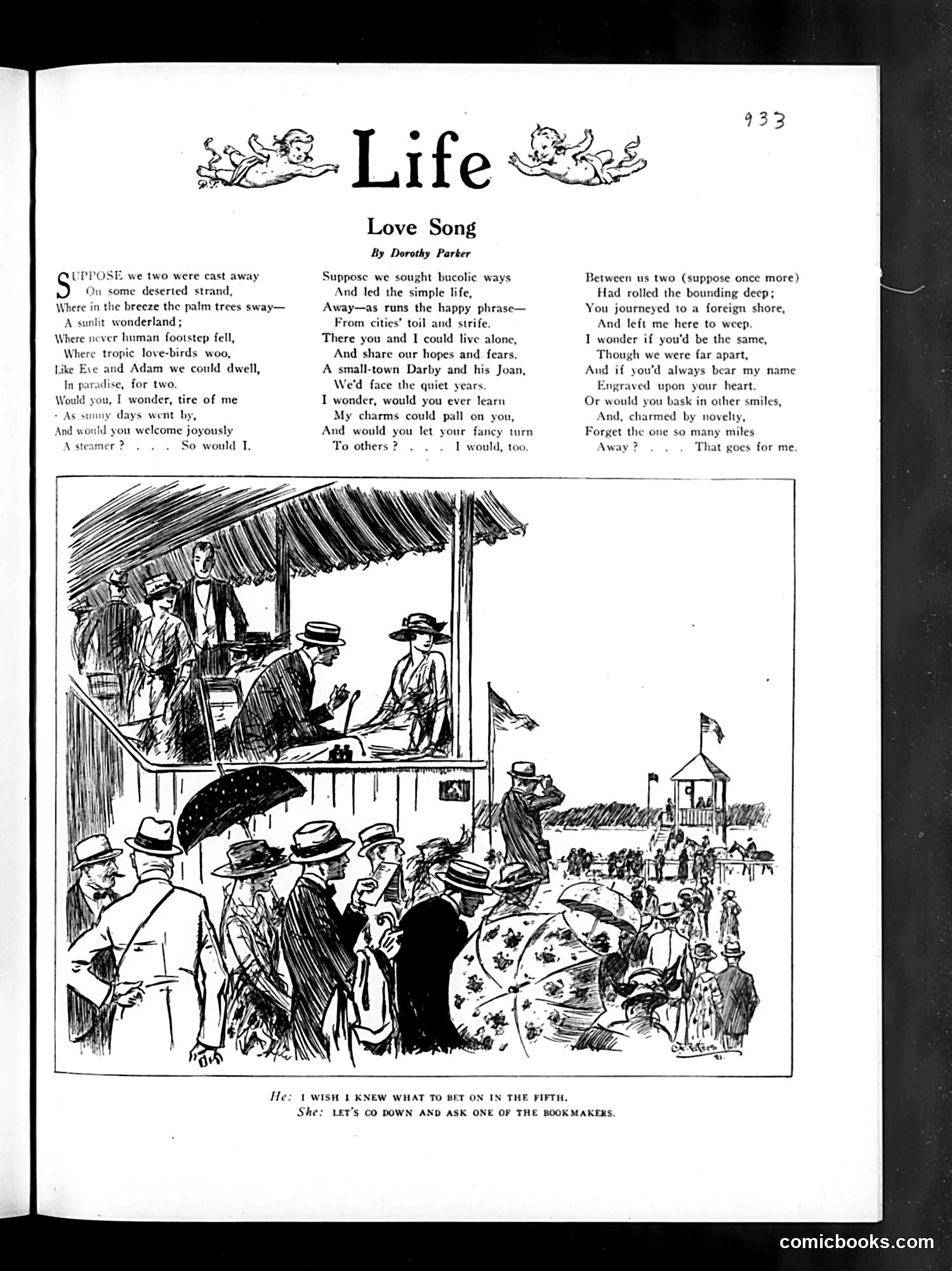
This page combines a melancholic poem with a satirical cartoon about horse racing. Parker's poem explores romantic uncertainty—wondering if a lover would remain faithful if separated, whether they'd forget you for others' attention. The cartoon below depicts a crowded racetrack scene where a man tells a woman: "I wish I knew what to bet on in the fifth." She replies: "Let's go down and ask one of the bookmakers." The joke plays on "betting" as both literal wagering on horses and metaphorical relationship risk. Just as he's uncertain about which horse to back, lovers face uncertainty about romantic commitments—echoing Parker's poem's themes of doubt and the gamble inherent in love and trust.
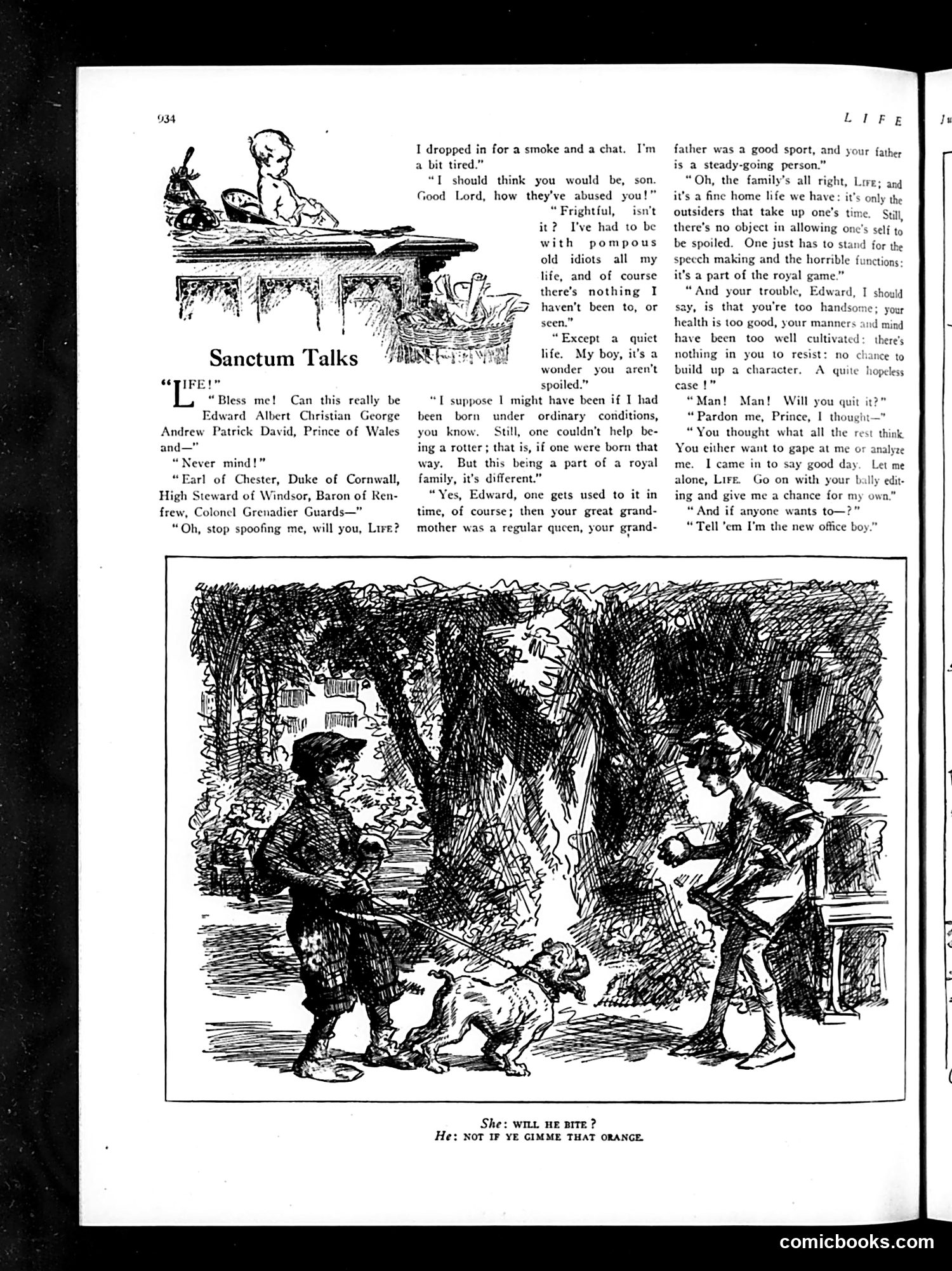
This page presents a satirical dialogue titled "LIFE!" featuring references to British royal figures, including **Andrew Patrick David, Prince of Wales** and the **Earl of Chester, Duke of Cornwall**. The discussion mocks aristocratic privilege and complaints about being "spoiled" and "abused," with the unnamed speaker (likely Edward, based on context) defending his position while being criticized for lacking character-building hardship. The lower illustration depicts a social scene where a woman warns a man about a dog with the caption: "She: WILL HE BITE? / He: NOT IF YE GIMME THAT ORANGE." This appears to be a simple jest about distraction and animal behavior. The satire targets British nobility's self-pitying attitudes and entitlement during what appears to be an era of social critique regarding their lifestyle and responsibilities.
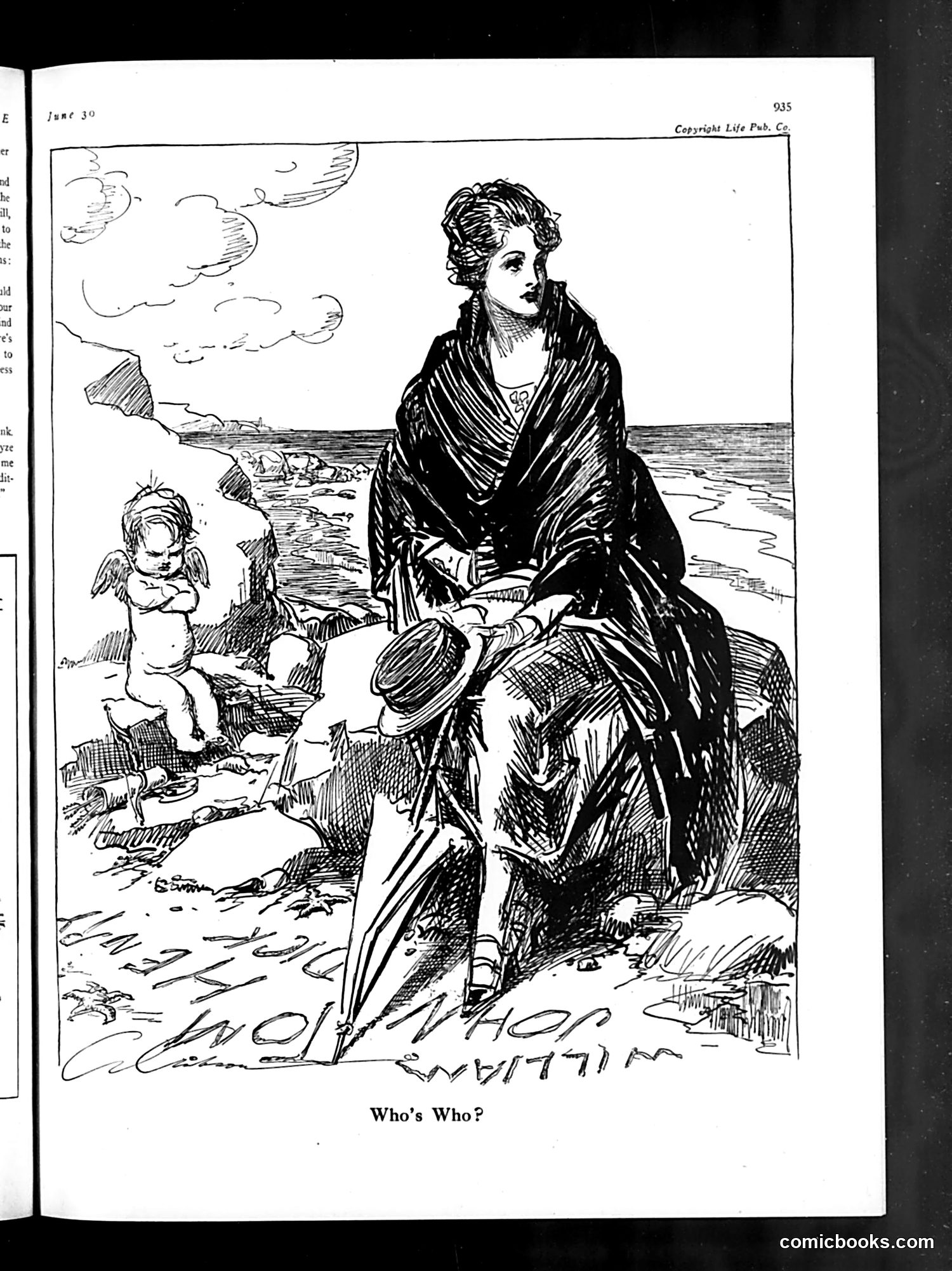
This is a satirical illustration from *Life* magazine (dated June 30, 1935, based on the page header). The cartoon depicts a fashionably dressed woman at a beach with a cherub/cupid figure and a young child, captioned "Who's Who?" The satire likely plays on ambiguous social relationships or scandals—a common *Life* magazine theme. The title's interrogative suggests confusion about the actual relationships between the figures: the woman's relationship to the child and cherub (representing love/romance) is deliberately unclear. This appears to mock contemporary social pretense or questionable family arrangements that Victorian-era readers would find scandalous, using the beach setting and classical cupid imagery to heighten the ironic tone. The precise social reference remains unclear without additional historical context.
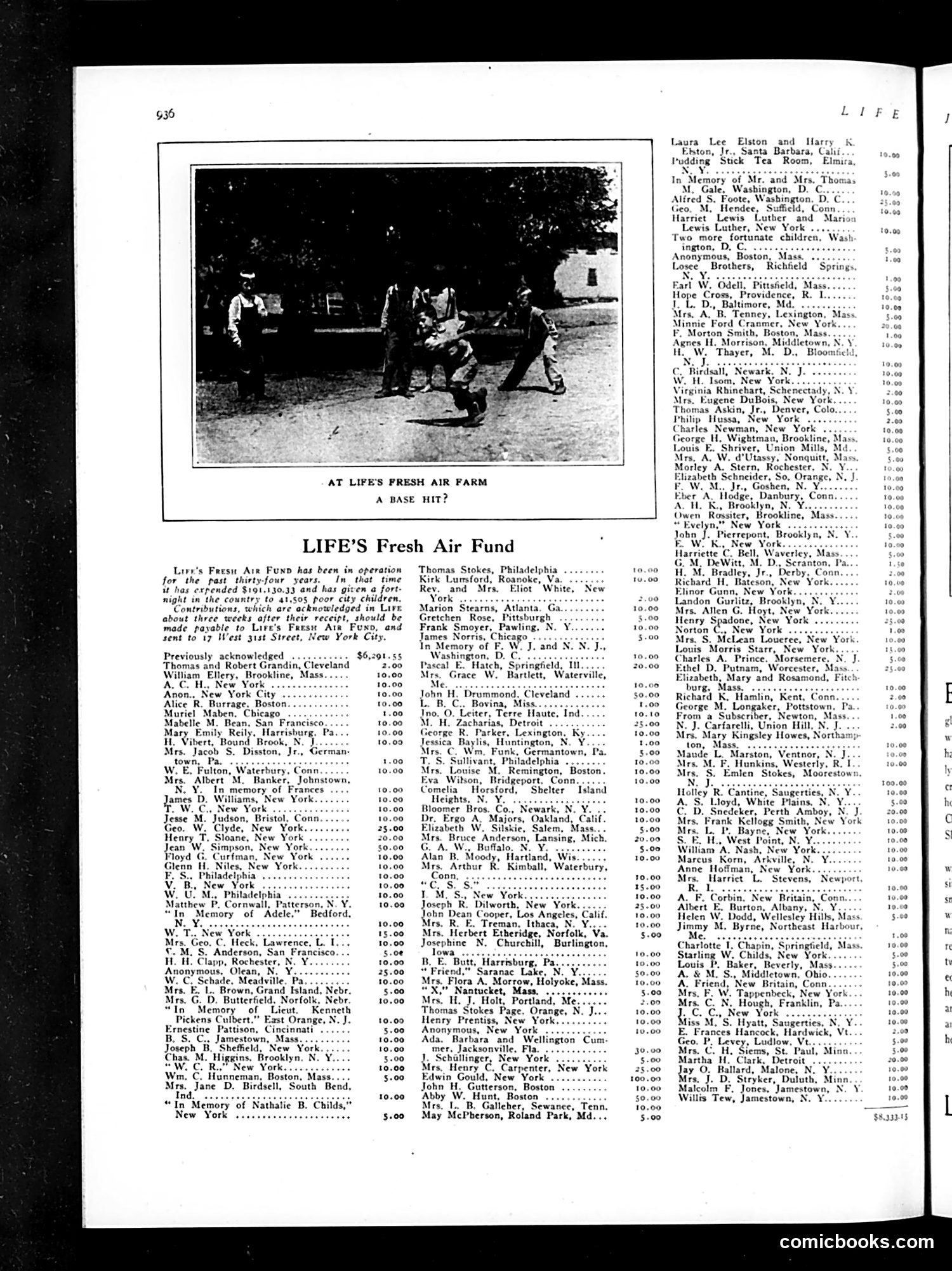
This page is primarily a **donor list for Life's Fresh Air Fund**, a charitable initiative providing relief for poor children in urban areas. The fund had been operating since 1895 and raised money to send underprivileged kids to the countryside for health and recuperation. The photograph at top shows children at "Life's Fresh Air Farm" - apparently a recreational or recuperative facility. The extensive list below documents individual and organizational contributors with donation amounts (typically $10.00). This is **not political satire** but rather evidence of *Life* magazine's civic engagement in Progressive Era philanthropy. The Fresh Air Fund was a genuine charitable program addressing urban poverty and child welfare - concerns typical of early 20th-century American reformism. The page functions as public acknowledgment of donors' generosity.
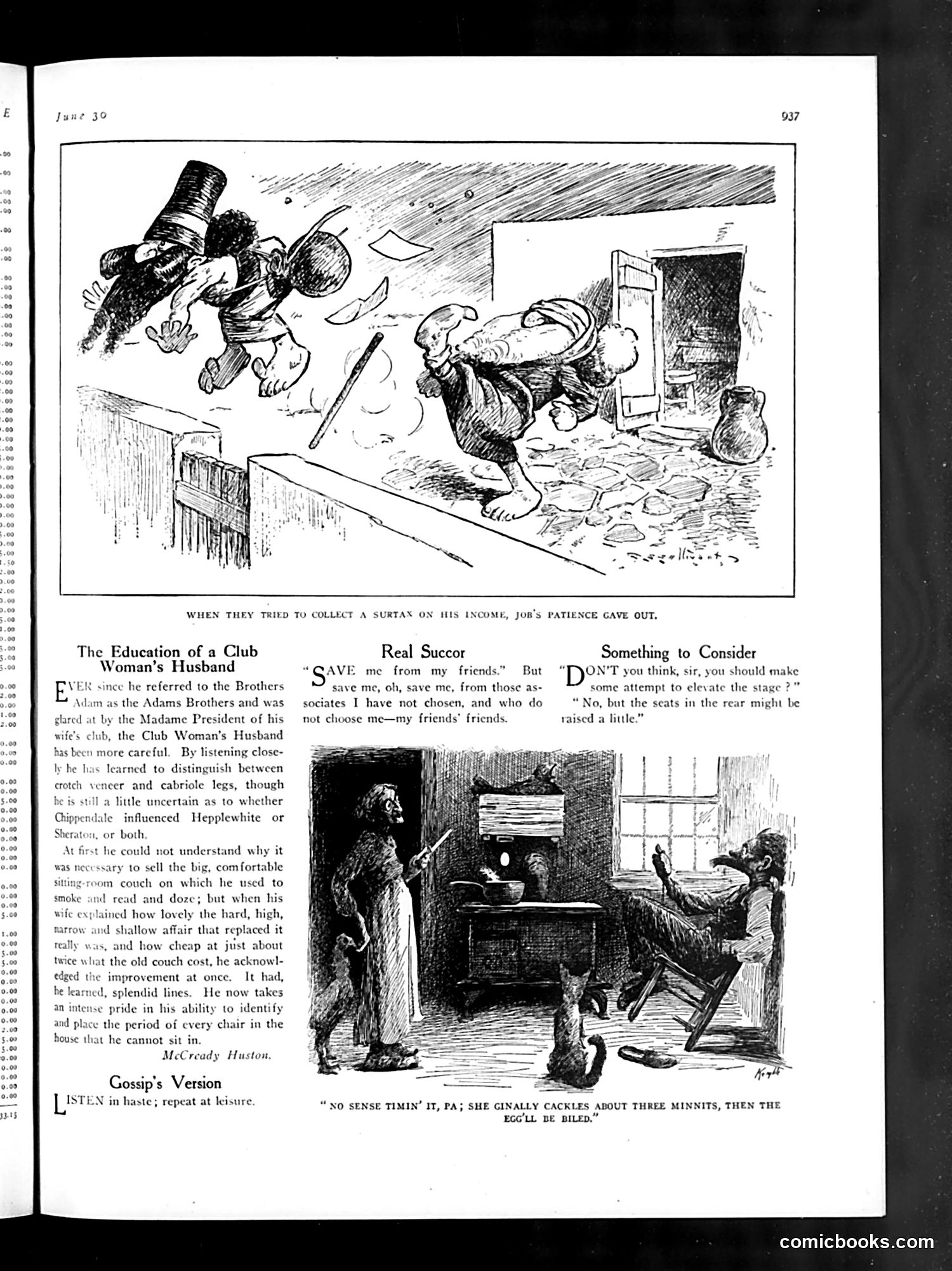
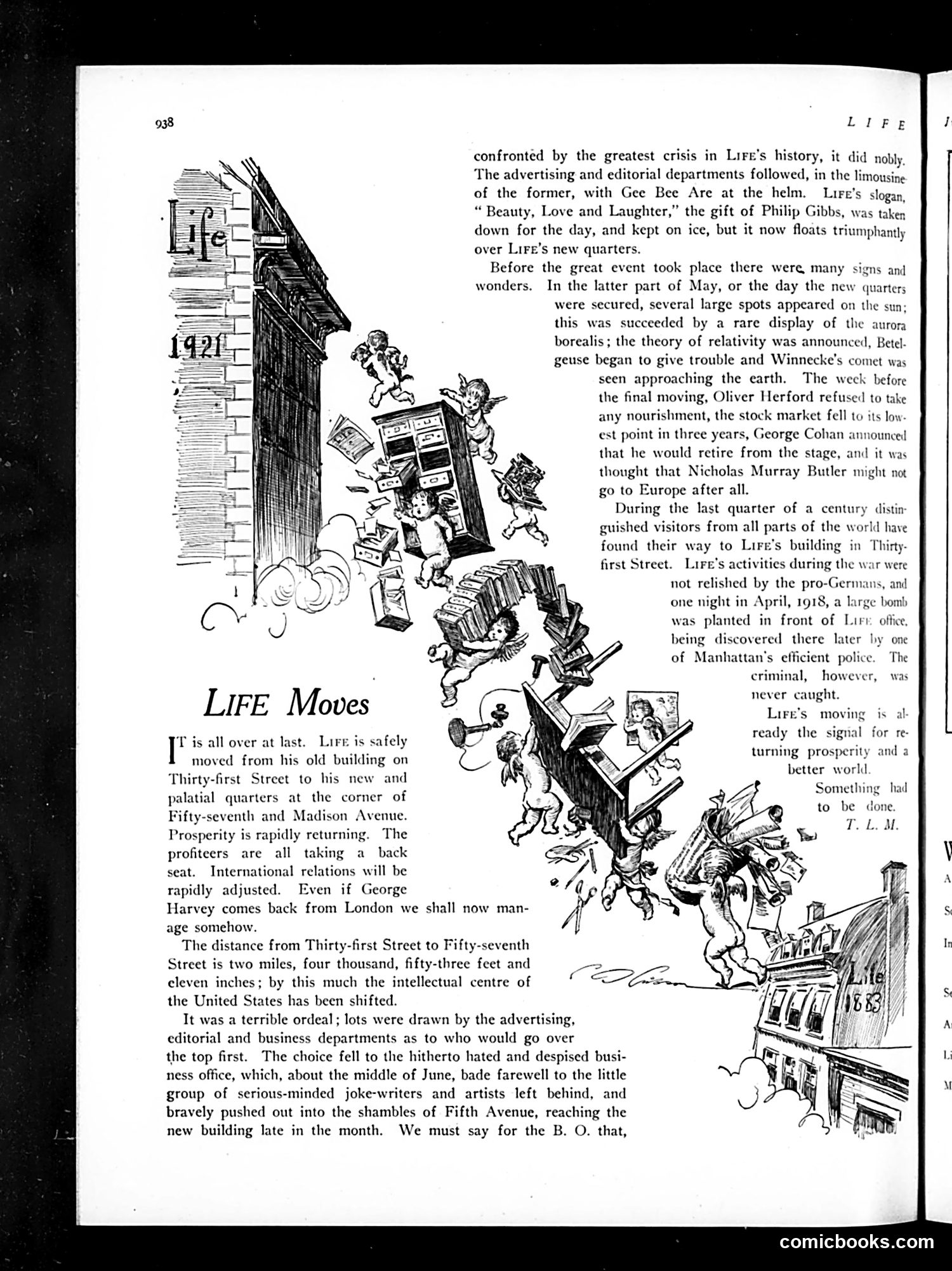
This page announces LIFE magazine's move from Thirty-first Street to a new building at Fifty-seventh and Madison Avenue. The satirical illustration depicts the chaotic move, with cherubs and figures tumbling from the old building (marked "1921") while papers and materials scatter. The text humorously describes the upheaval: departments debated who would move first, the business office was "hated and despised," and joke-writers and artists were pushed out to "shambles" on Fifth Avenue. The piece notes pre-war disruptions—including a bomb planted at LIFE's office in April 1918 (never solved)—before celebrating the move as signaling "returning prosperity and a better world." The cartoon satirizes institutional chaos and growing pains during America's post-war economic recovery.
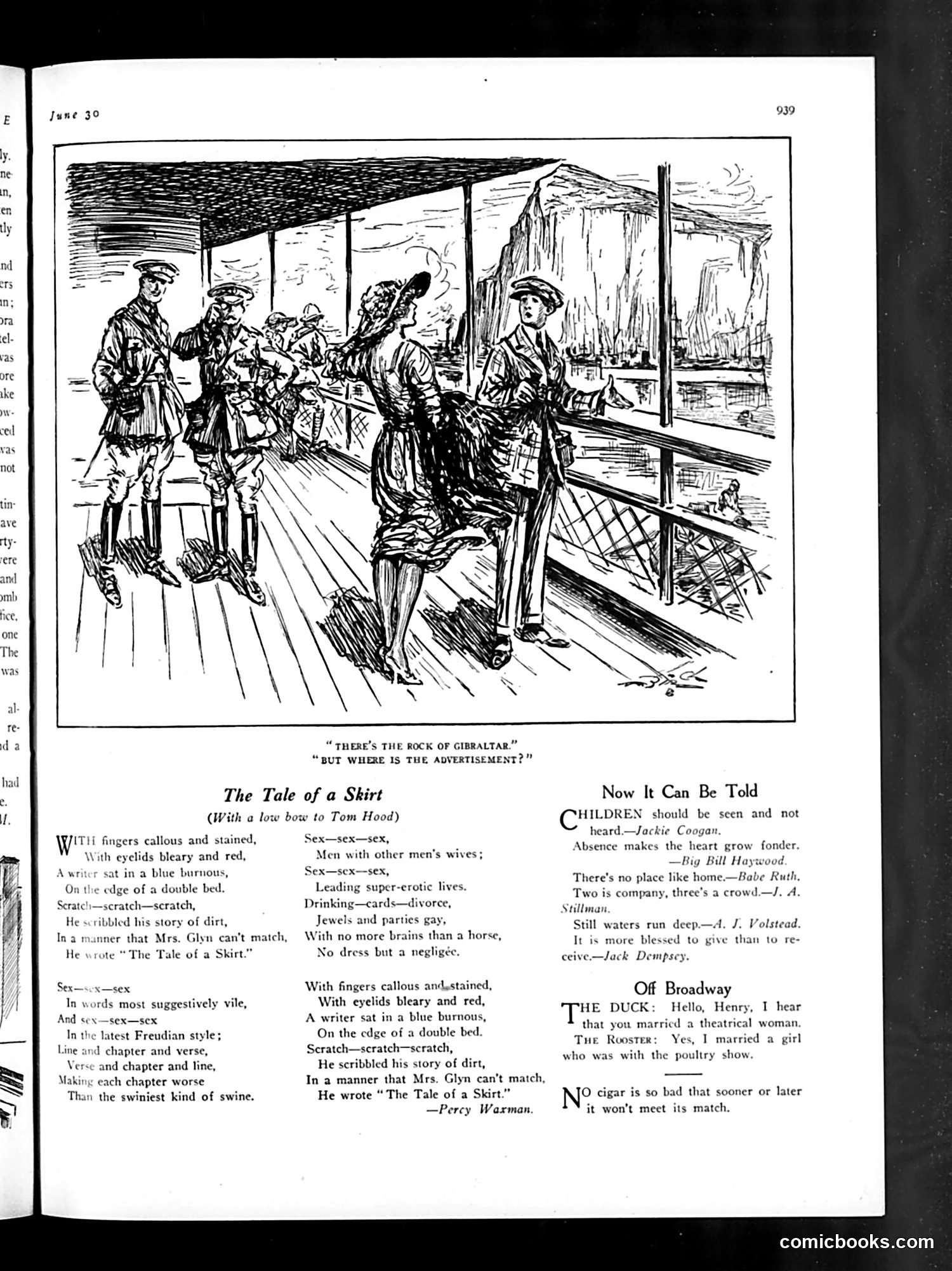
The top illustration depicts military or naval officers on a ship's deck encountering a woman, with the caption: "There's the Rock of Gibraltar—But where is the advertisement?" This appears to be satirizing the era's ubiquitous advertising culture. The joke suggests that even iconic landmarks like Gibraltar couldn't escape commercialization—implying advertisers had colonized every possible space, even natural wonders and travel destinations. The woman's question humorously inverts expectations: instead of admiring the famous rock formation, she notices the *absence* of an advertisement, suggesting advertising had become so pervasive that its absence was noteworthy. Below are poems and literary pieces, including "The Tale of a Shirt" and various social commentary verses, typical of Life's satirical content targeting contemporary society and manners.
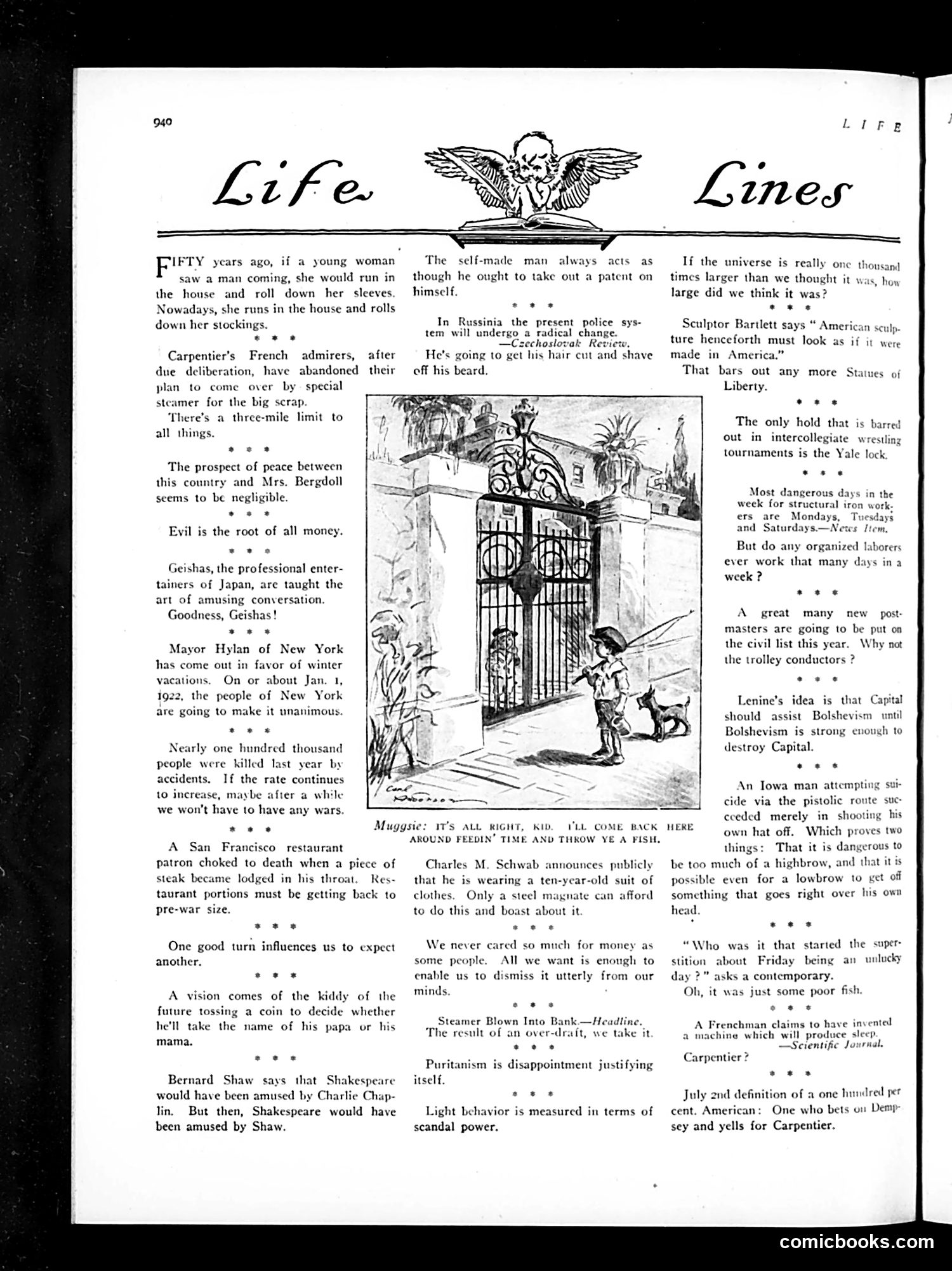
This page from *Life* magazine contains a satirical cartoon and brief commentary pieces ("Life Lines"). The central cartoon depicts a street scene with a ornate gate, where a child holds a fish while an adult figure (possibly a parent or authority figure) stands nearby. The caption reads: "It's all right, kid. I'll come back here around feedin' time and throw ye a fish." The satire appears to mock wealth inequality and condescending charity—suggesting the wealthy throw scraps to the poor as one would feed animals, rather than addressing systemic need. The accompanying text snippets cover various social topics: labor safety, Russian politics, capitalism versus Bolshevism, and New York civic matters. The overall tone is critical of contemporary social and political conditions.
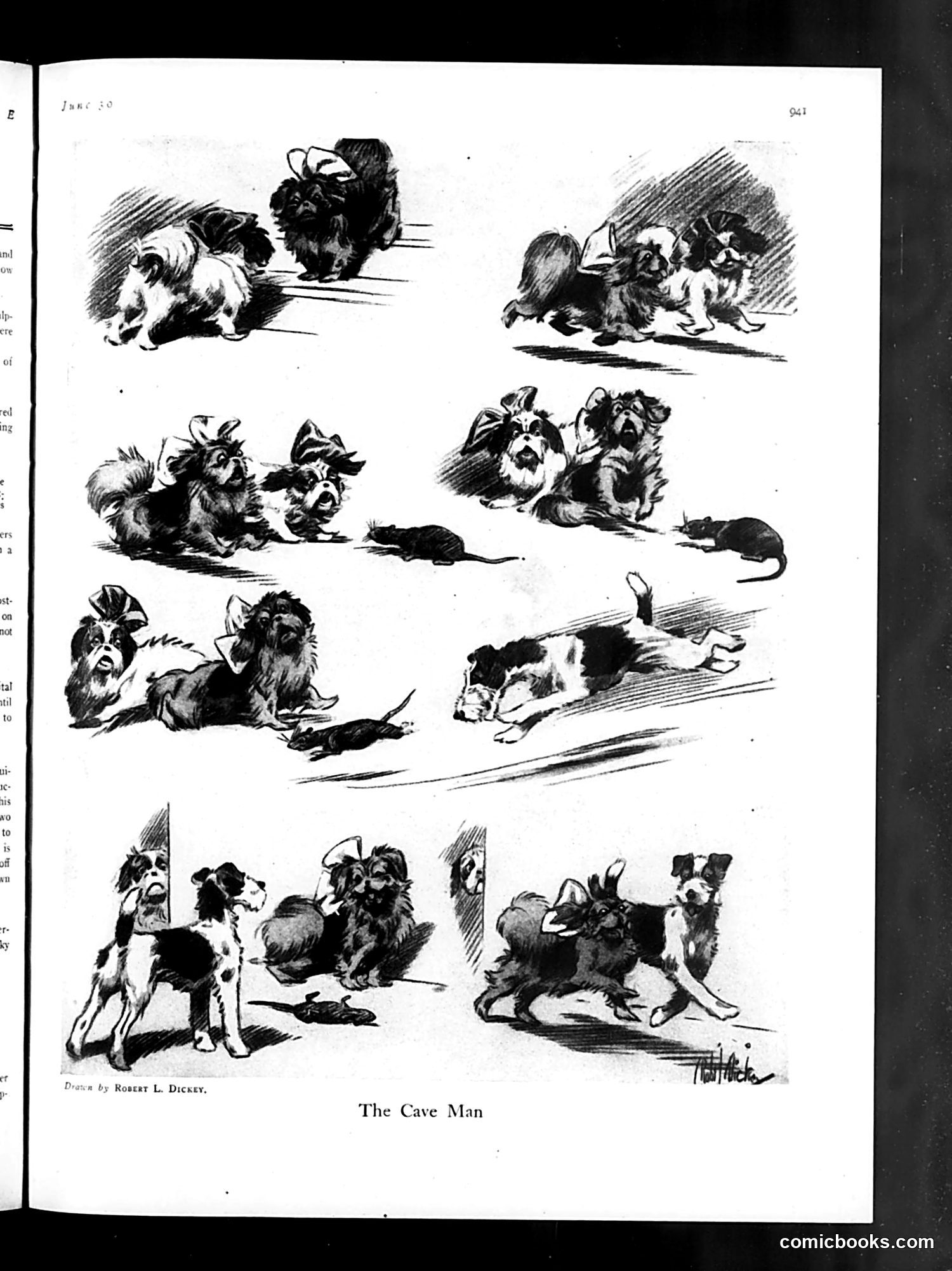
This page of illustrations by Robert L. Dickey depicts small dogs (appears to be Pekingese or similar lap breeds) in various scenes with mice. The title "The Cave Man" suggests a humorous parallel between primitive human behavior and dog behavior. The satire likely mocks either: 1. Contemporary men behaving like "cave men" (crude, aggressive) 2. The fashion for lap dogs among wealthy urbanites, contrasting refined society ladies' pets with "primitive" hunting instincts The repeated scenarios of dogs chasing or interacting with mice humorously reduce civilized pet ownership to base predatory instinct. The cartoonist suggests these pampered, bow-adorned companion animals retain ancestral hunting drives despite their domesticated, decorative role in upper-class homes. The joke plays on the gap between appearance (refined lap dog) and nature (hunter).
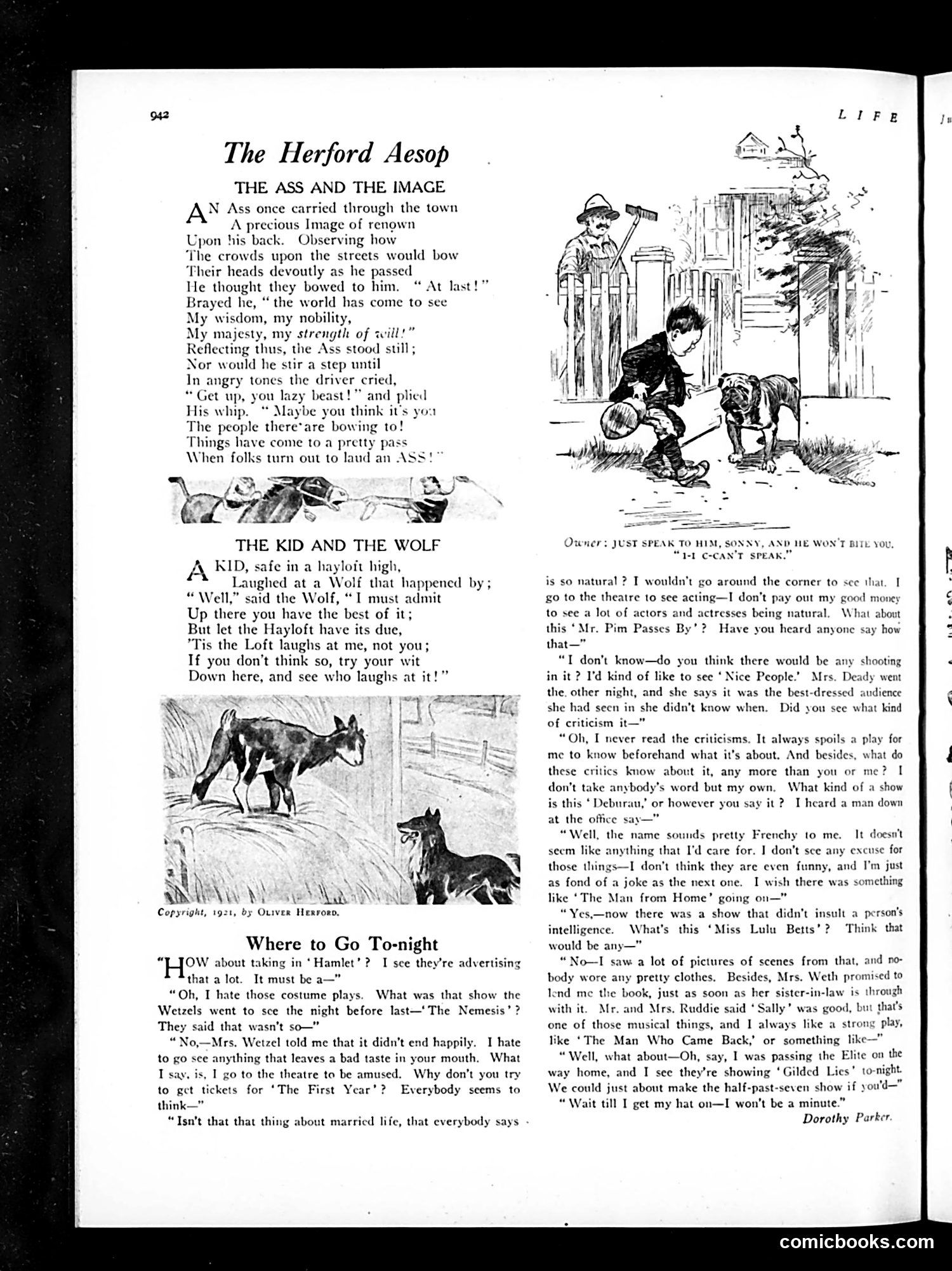
This page contains three Aesop's fables rendered as text and illustration: 1. **"The Ass and the Image"**: An ass carries a precious religious image through town. Citizens bow respectfully, but the ass mistakenly believes they're honoring *him*. The moral: foolish pride from receiving undeserved respect. 2. **"The Kid and the Wolf"**: A young goat mocks a wolf from a hayloft, then boasts he'd laugh at the wolf on level ground. The moral: false bravery when safe; cowardice when facing real danger. 3. **"Where to Go To-night"**: A conversational piece about theater-going, with characters debating which plays to see, referencing specific shows like "Hamlet" and "The First Year." These classical fables teach timeless lessons about vanity, false courage, and human nature—relevant to any era.
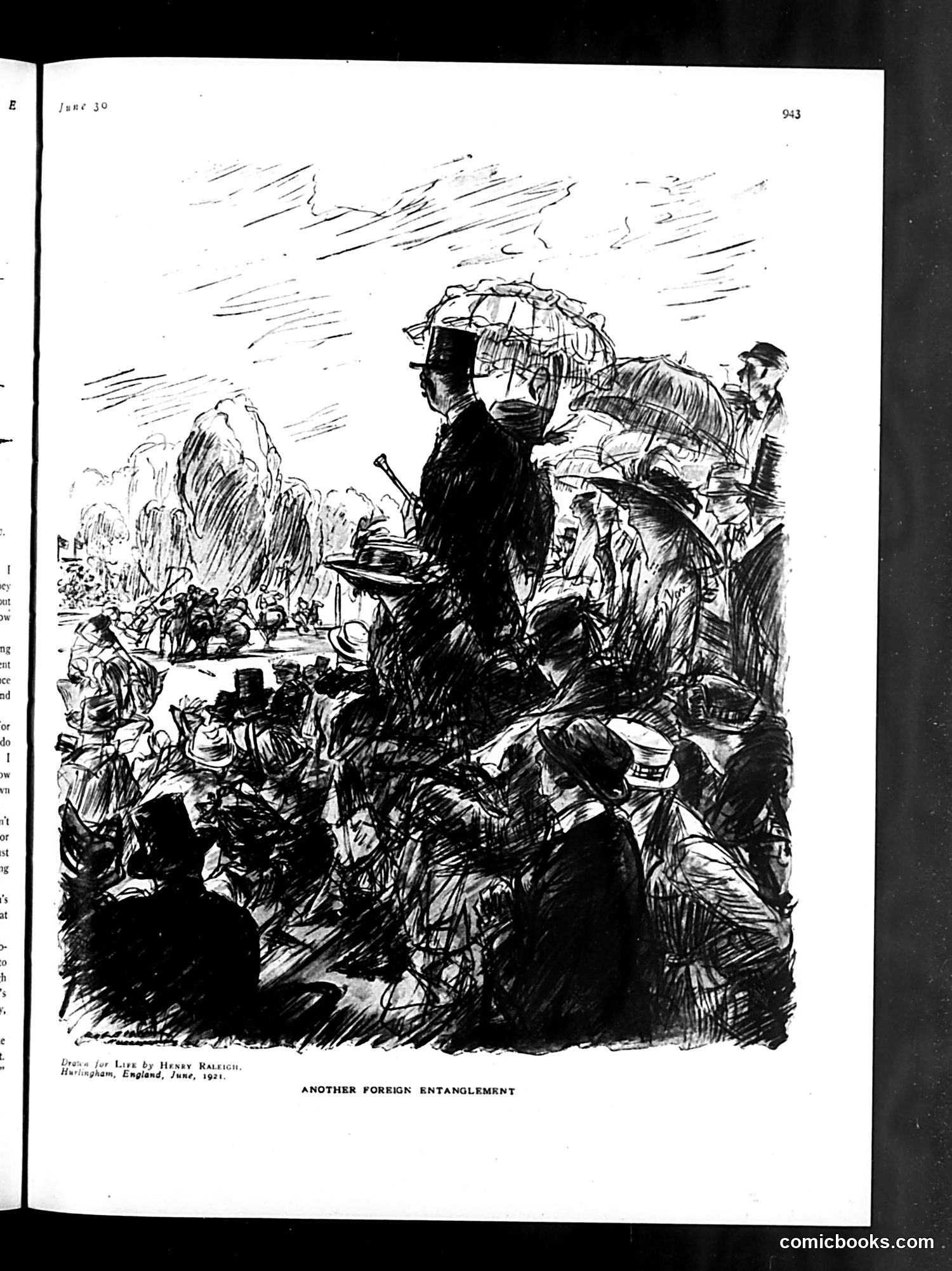
This 1921 sketch by Henry Raleigh depicts a chaotic scene of diplomatic confusion. A large, somewhat grotesque figure dominates the center—likely representing a foreign power or diplomatic complication—surrounded by smaller figures in formal dress (politicians and diplomats) who appear bewildered or struggling to manage the situation. The title "Another Foreign Entanglement" suggests post-WWI American anxiety about international involvement. The satirical point appears to be that American leaders are becoming entangled in messy foreign affairs they don't fully understand or control, depicted through the visual chaos and the looming, unmanageable central figure. This reflects 1920s debates over American isolationism versus international engagement following World War I.
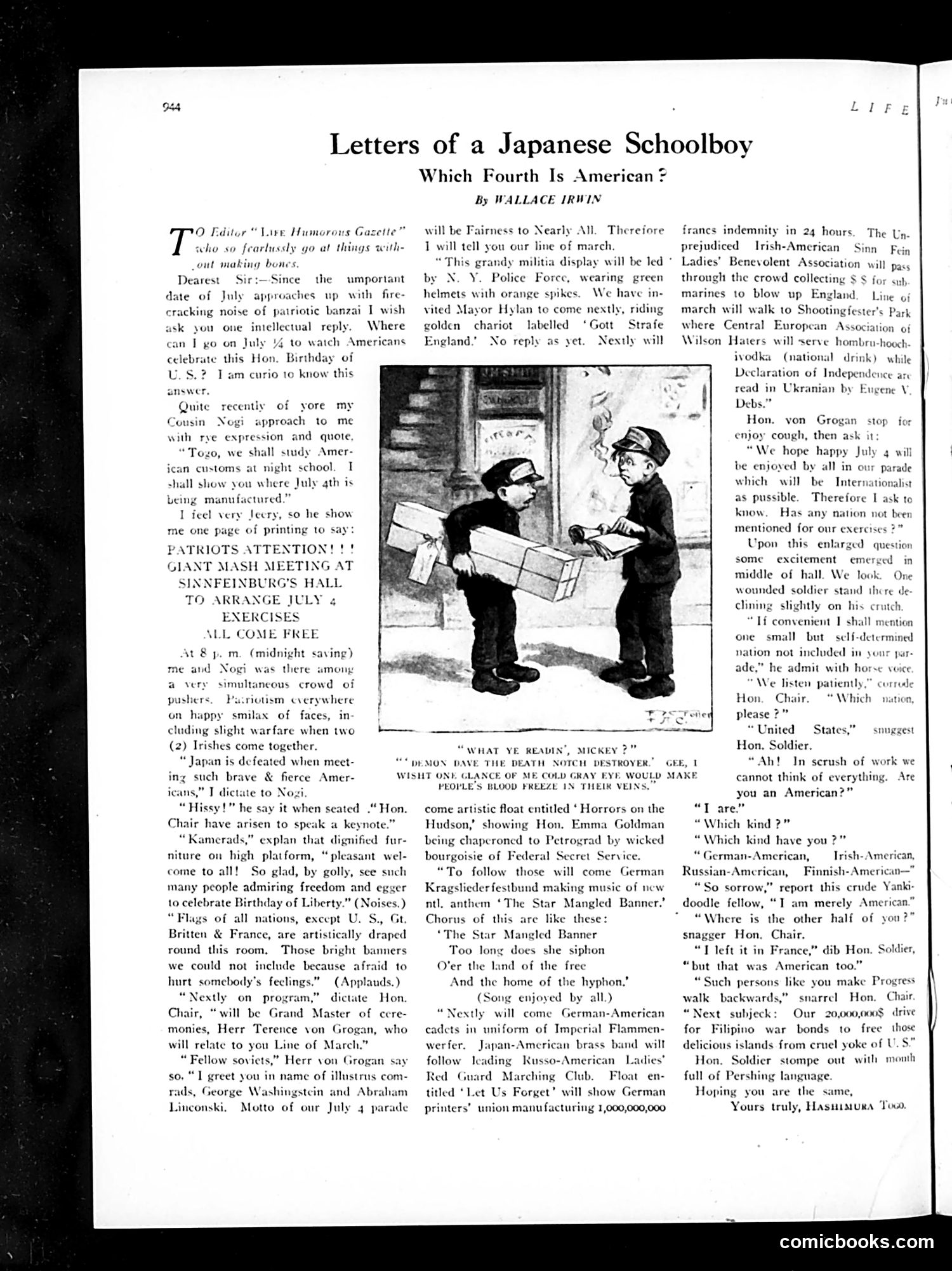
This satirical piece uses a Japanese schoolboy's letters to mock American patriotism and identity around Independence Day celebrations. The accompanying cartoon shows two boys exchanging a large wrapped package labeled "What ye reckon, Mickey?"—likely referencing commercial excess or cultural confusion during Fourth of July festivities. The humor hinges on the schoolboy naively questioning which nationality represents "American" identity, given America's immigrant diversity. Characters listed include German-American, Russian-American, Finnish-American, and Irish-American citizens, satirizing the melting-pot reality versus idealized patriotic rhetoric. The piece gently critiques how early-20th-century Americans constructed national identity amid rapid immigration, suggesting that "American" was increasingly a complicated, hyphenated designation rather than a singular cultural category.
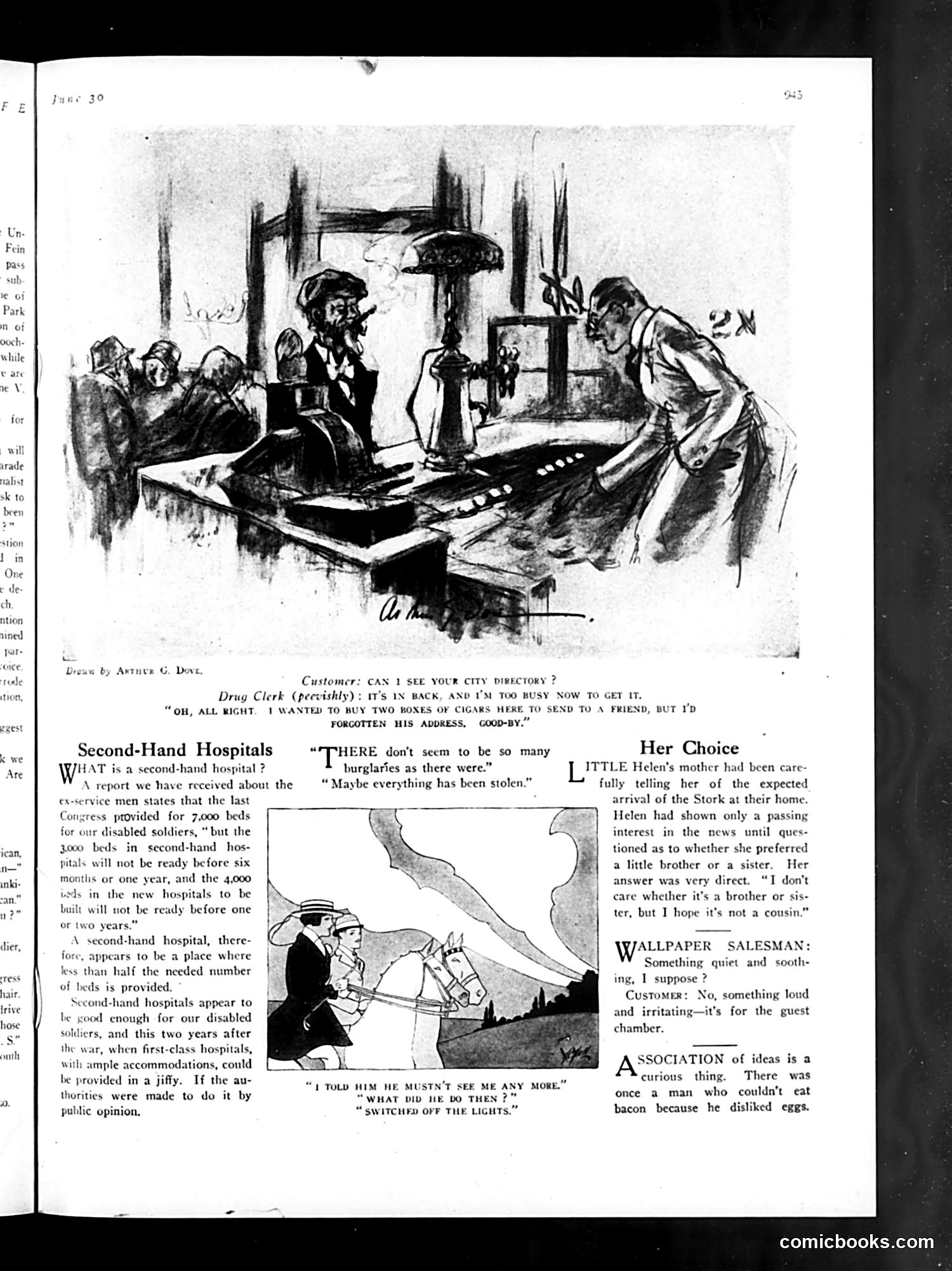
This page contains three satirical pieces critiquing post-WWI American conditions: **Top cartoon** ("Customer: Can I See Your City Directory?"): A drug clerk's rudeness backfires—a customer abandons a cigar purchase because the clerk won't help find an address. The satire targets poor customer service and indifference in retail establishments. **"Second-Hand Hospitals"**: A scathing critique of inadequate veteran care. Congress allocated beds for disabled soldiers, but many facilities are "second-hand" (repurposed, inferior), with incomplete capacity and delayed openings. The satire condemns government failure to provide first-class hospitals promptly after WWI, suggesting disabled veterans receive substandard treatment. **Middle cartoon**: Depicts a man switching off lights after being told to do something; the humor plays on misunderstanding. **"Her Choice"** and **"Wallpaper Salesman"**: Brief humorous anecdotes about preference and association of ideas—lighter fare balancing the heavier veteran critique. The page's dominant theme criticizes post-war neglect of American soldiers.
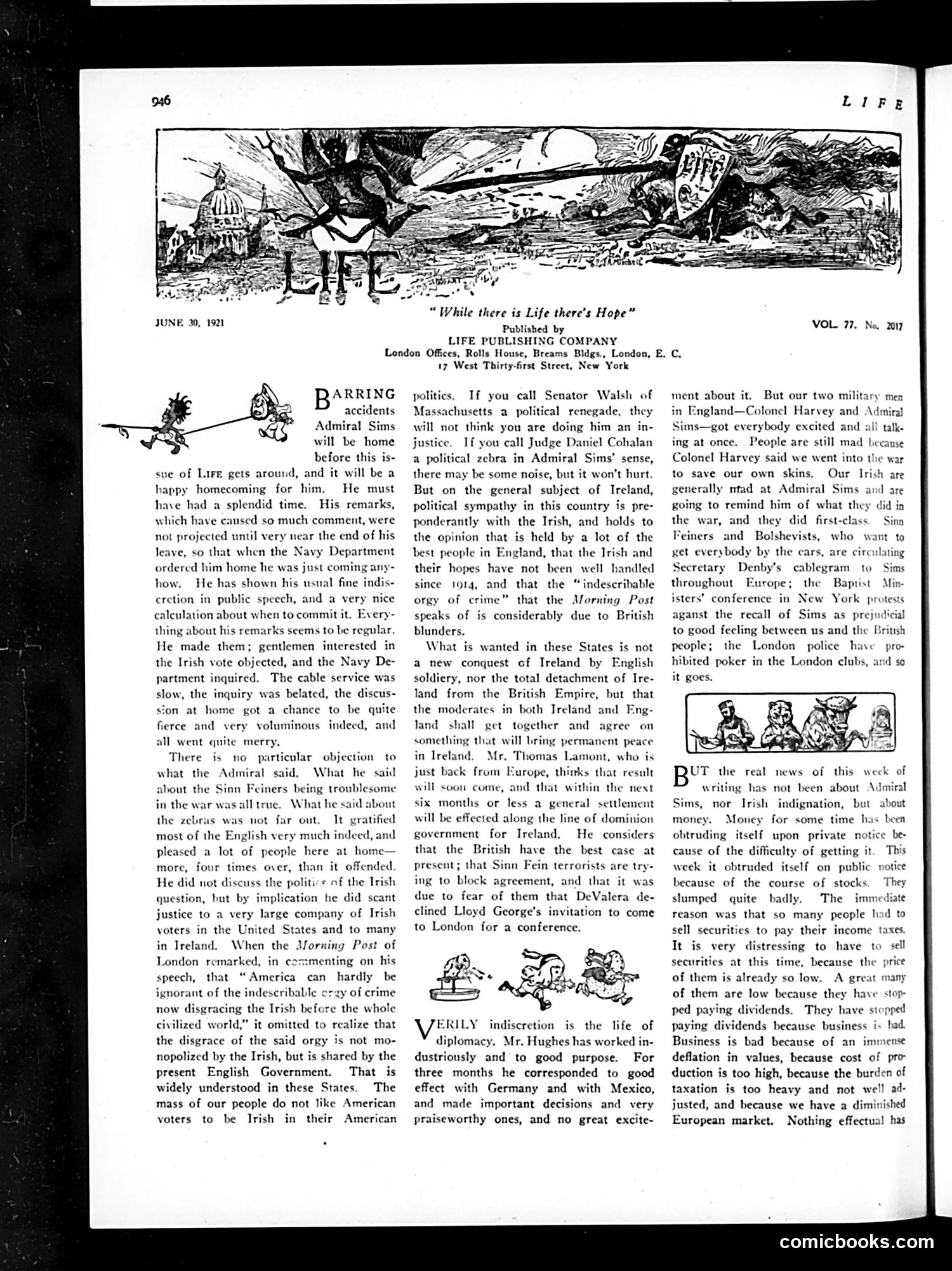
This editorial discusses Admiral William Sims's controversial remarks about Irish independence activists (Sinn Féiners) during his naval service. The piece defends Sims's factual observations while criticizing the political fallout, particularly regarding Irish-American voters and British-Irish relations. The cartoon (top) appears satirical but is difficult to parse from the image alone—it seems to comment on hope amid chaos, matching the tagline "While there is Life there's Hope." The key point: *Life* argues that while Sims's comments were accurate, they stirred unnecessary political controversy. The magazine advocates for moderate Irish independence (dominion status) as a compromise, criticizing both Sinn Féin "terrorists" and British mismanagement. The editorial suggests American politicians shouldn't be judged solely by their ethnic appeals to Irish voters. This reflects post-WWI tensions over Irish independence and the significant Irish-American political influence in 1921.
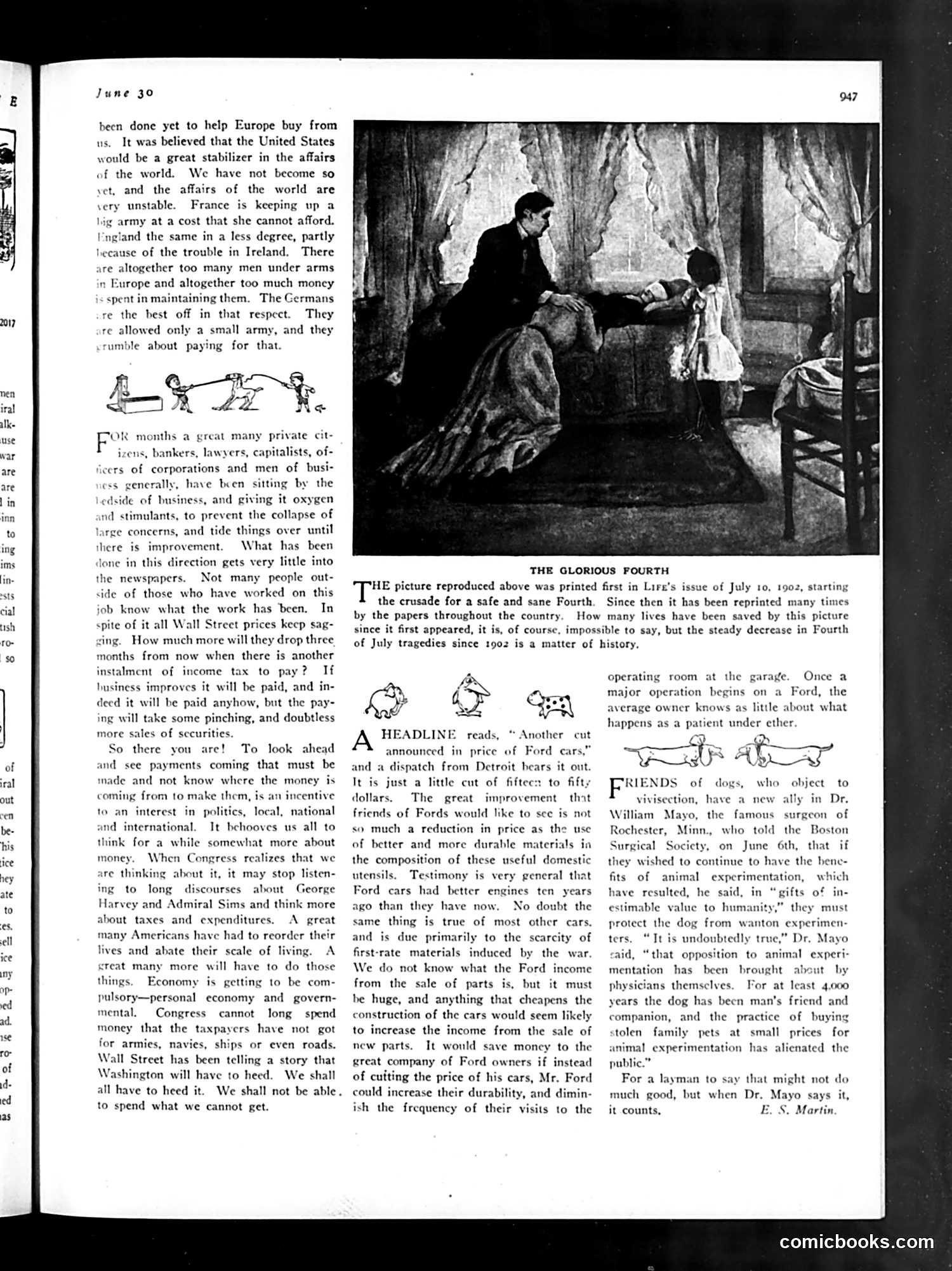
## Main Political Commentary The left column discusses post-WWI economic instability in Europe and America's failure to stabilize world affairs. It criticizes France and England for maintaining expensive militaries they cannot afford, and expresses anxiety about the upcoming income tax installment and Wall Street's declining prices. The author urges Congress to prioritize fiscal responsibility and taxation over military spending. ## "The Glorious Fourth" Section The photograph shows what appears to be a child injury—consistent with the accompanying text about the magazine's 1902 crusade for "safe and sane" Fourth of July celebrations. The piece credits Life with helping reduce July 4th casualties through repeated publication of this sobering image, positioning the magazine as a public health advocate. ## Ford Motors Discussion The final section discusses minor price cuts on Ford automobiles, arguing the real improvement needed is better materials—particularly engines—which have deteriorated due to WWI material scarcity. This reflects post-war manufacturing concerns about quality degradation from wartime resource constraints.
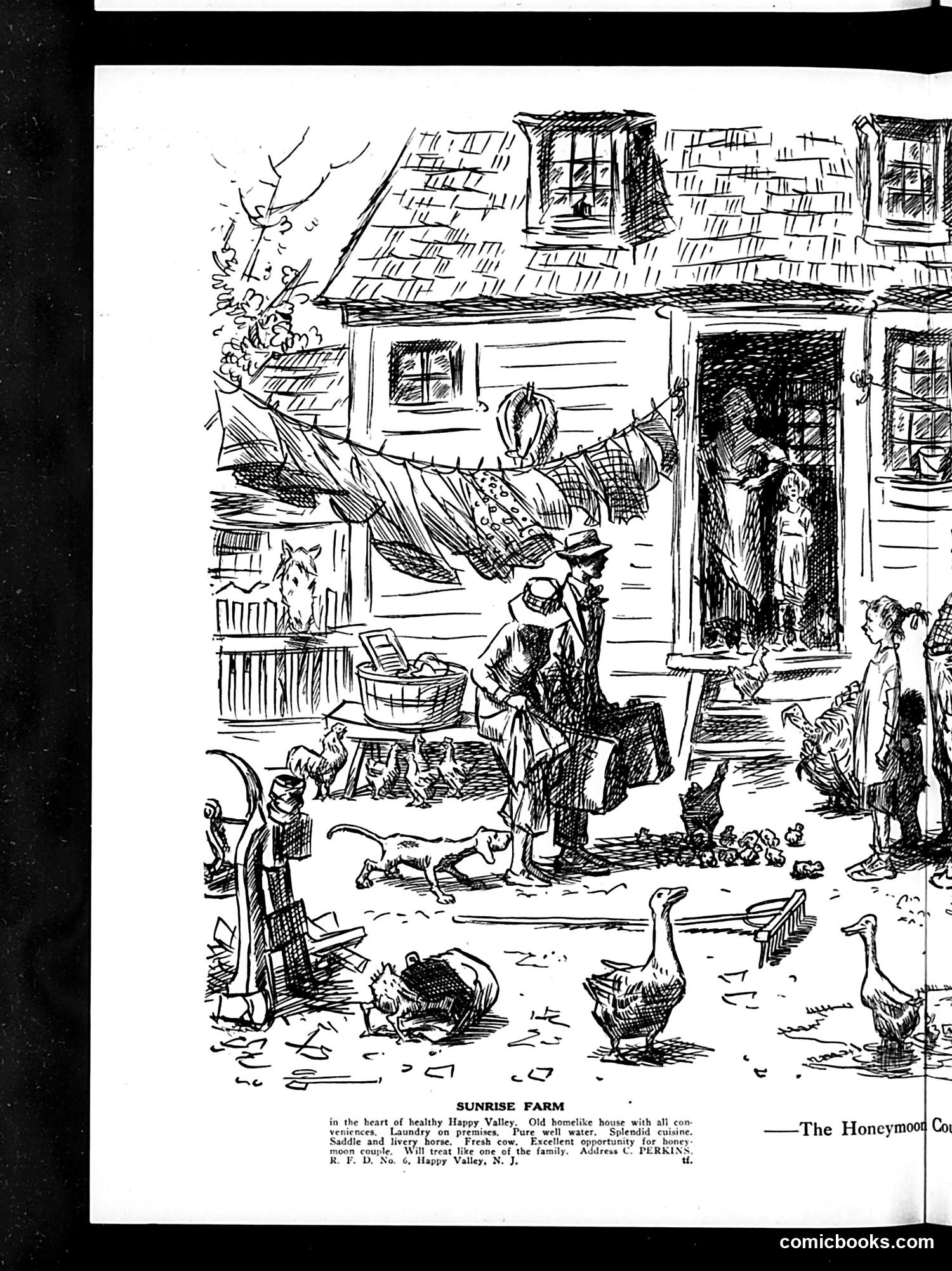
This is a farm advertisement rather than political satire. "Sunrise Farm" advertises itself as an idyllic honeymoon destination in Happy Valley, New Jersey, owned by C. Perkins. The accompanying illustration depicts a rustic farmyard scene with a couple, various farm animals (geese, ducks, chickens), children, laundry, and a horse—presenting a romanticized vision of rural domestic life. The ad emphasizes homey comforts: pure well water, good food, riding horses, and friendly hospitality. This reflects early 20th-century American advertising that marketed rural farms as charming retreats for city couples seeking wholesome leisure. The illustration supports the text's appeal to honeymoon couples wanting an authentic, family-like farm experience.
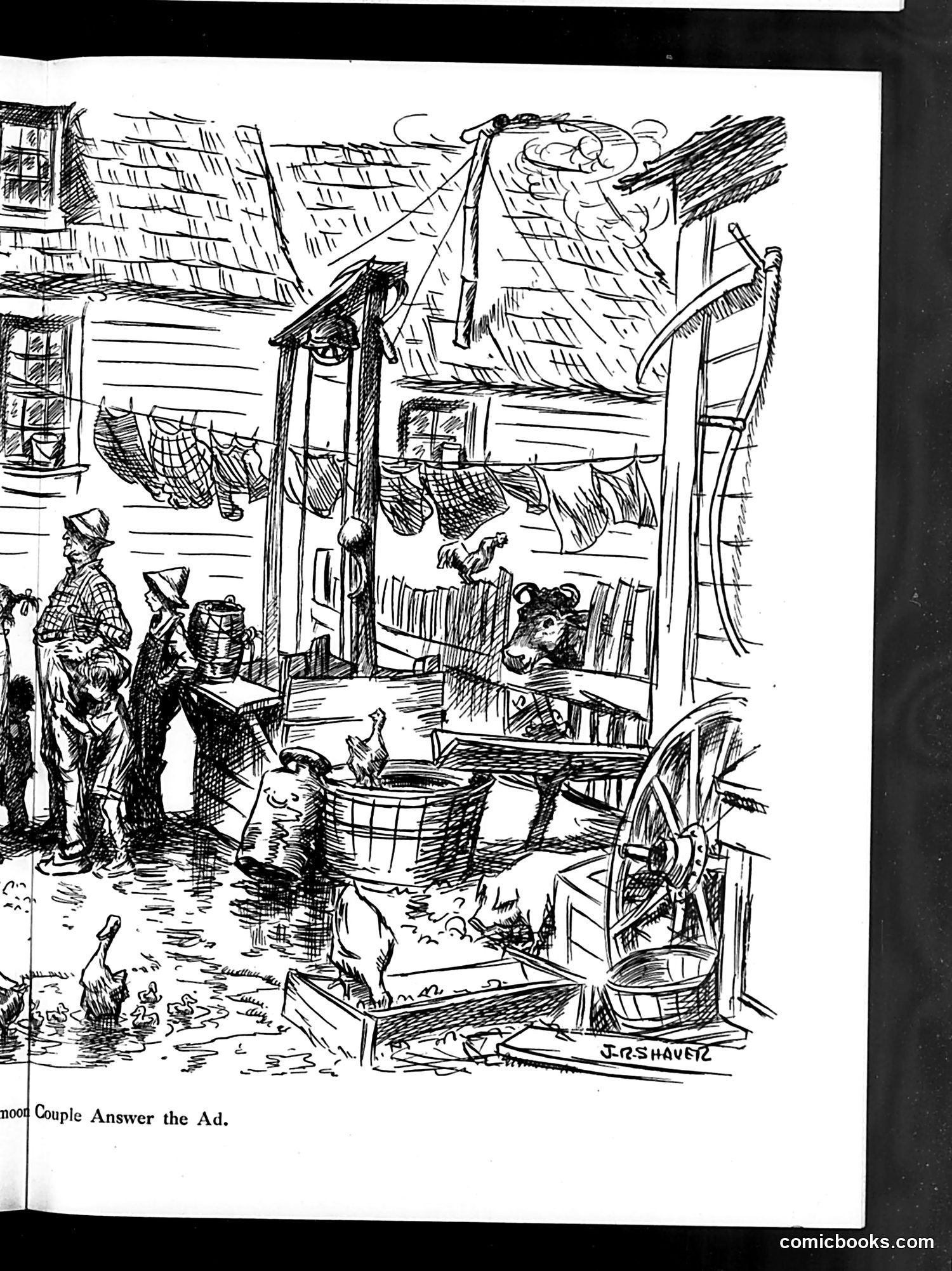
This cartoon depicts a rural or working-class scene where a couple appears to be responding to a classified advertisement. The sketch shows a farmyard setting with laundry hanging, wooden structures, and various domestic animals. The humor likely stems from the contrast between what the advertisement promised and the couple's actual circumstances or living conditions—a common satirical theme. The "ad" they're answering to is not visible, leaving readers to infer what opportunity or product they're responding to, with the implication that their situation makes their response somewhat absurd or pathetic. The cartoon is signed by J.R. Shuetz and represents typical early-to-mid 20th century Life magazine social commentary about working-class American life.
This page reviews two Broadway musicals with "Whirl" in their titles—*The Whirl of New York* and *The Broadway Whirl*—reflecting a summer 1912 fashion trend where "whirl" replaced "girl" in musical-show titles. The main satire targets audience members who attended the original *Belle of New York* production (from the 1890s) and now loudly hum along during performances, annoying fellow patrons. The critic warns such nostalgic "old-timers" with mock-serious language and threatens metaphorical violence. The reviews themselves are lukewarm. *The Whirl of New York* is called "unimpressive" despite lavish production values. The critic particularly dismisses Louis Mann's limited stage time as "almost as good as not having him." The critique uses Hugh Cameron's sardonic summary—"Not bad! No: good—but not bad"—to capture the shows' mediocrity.
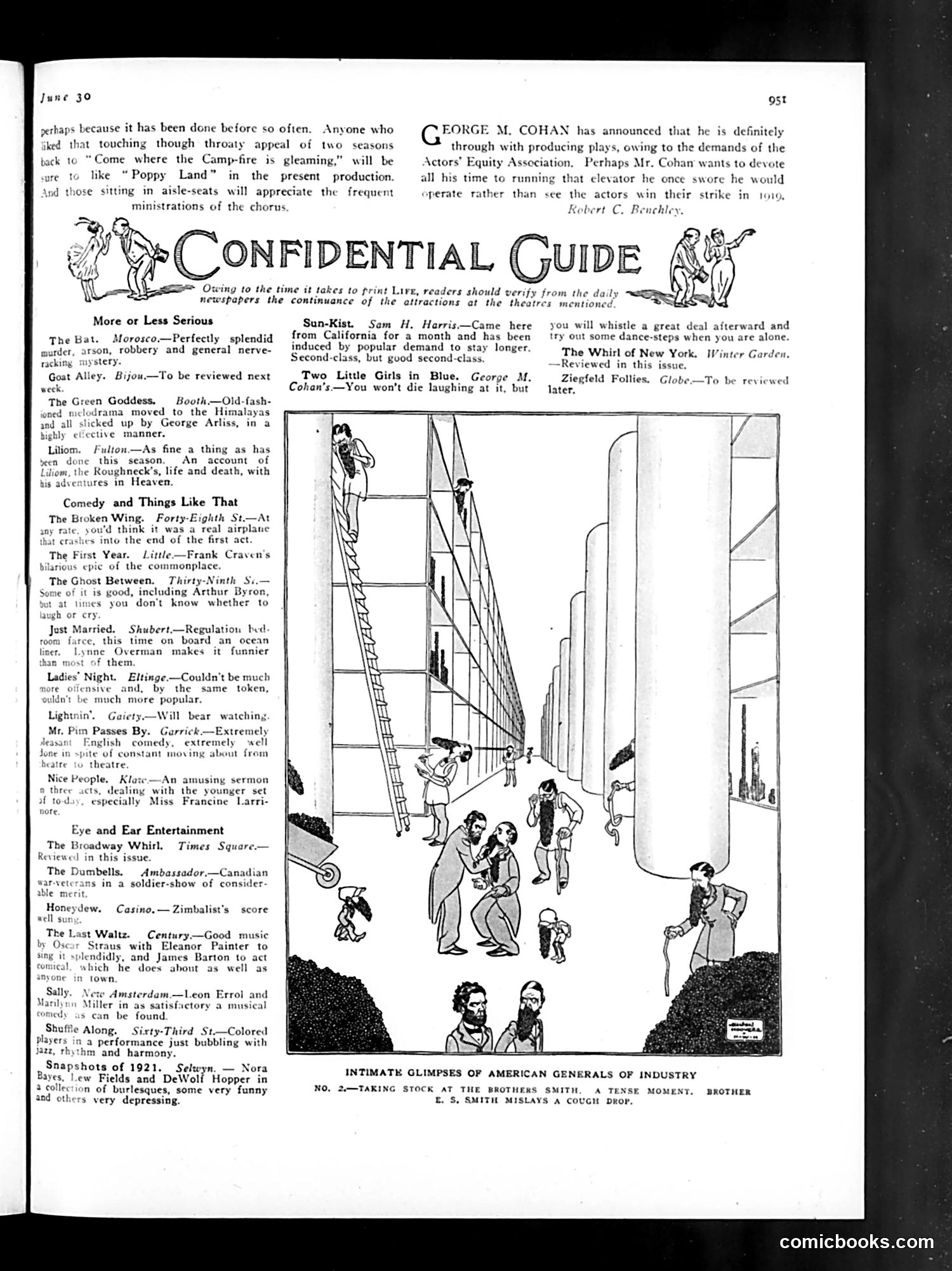
This cartoon satirizes wealthy industrialists through a domestic scene. The image shows well-dressed businessmen ("generals of industry") conducting serious business negotiations in what appears to be a modest tenement or working-class building—incongruously accessed by fire escapes and ladders. The caption references "the Brothers Smith" taking stock and one brother having mislaid a cough drop, treating a trivial domestic loss with exaggerated gravity. The satire's point: these powerful industrial figures, despite their immense wealth and importance, fuss over minor personal matters like ordinary people. It deflates their supposed superiority by showing them engaged in commonplace concerns. The juxtaposition of grand "generals of industry" language with humble, cramped surroundings and petty worries creates the humor—mocking both their pretensions and the absurdity of how seriously the wealthy treat minor inconveniences.
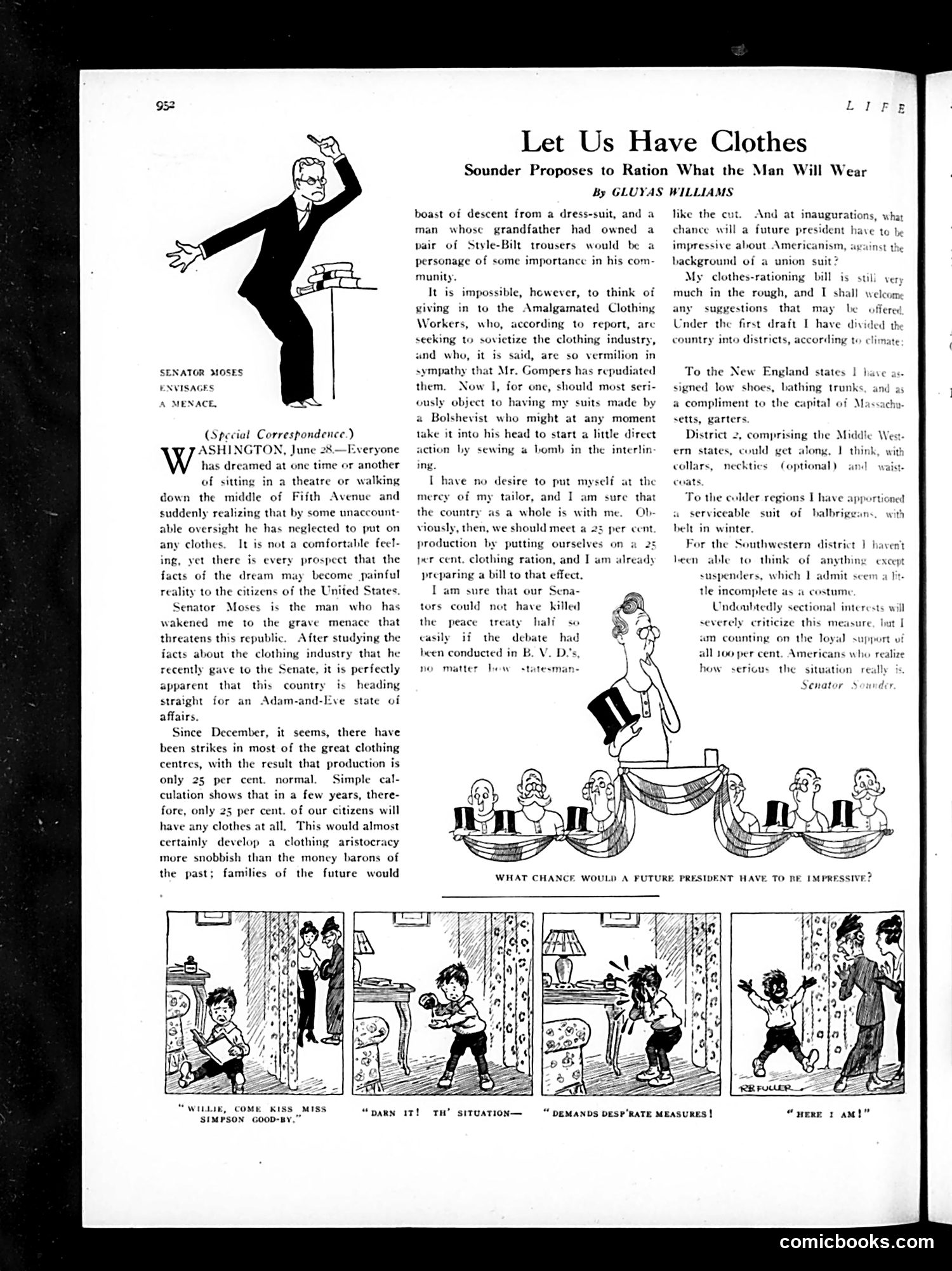
This 1920s satire mocks Senator Moses's proposal to ration clothing due to labor strikes. The joke: strikes in clothing factories have reduced production to 25%, leading him to absurdly predict that soon only the wealthy will own clothes, creating a "clothing aristocracy" based on suit ownership. Senator Moses proposes dividing the country into districts with different clothing rations (New England gets bathing trunks; the Southwest gets only suspenders, etc.)—a ridiculous solution presented as serious policy. The satire targets: - **Labor anxiety**: Post-WWI fears of Bolshevism and union power (he mentions "Bolshevists" and garment workers' unions) - **Political absurdity**: Treating a labor dispute as a crisis requiring government rationing - **Anti-union sentiment**: Mocking sympathy for striking workers while suggesting their demands threaten civilization The bottom comic strip shows a child's mischief, contrasting with the article's mock-serious tone. The overall message ridicules both labor unrest and overwrought political responses to it.
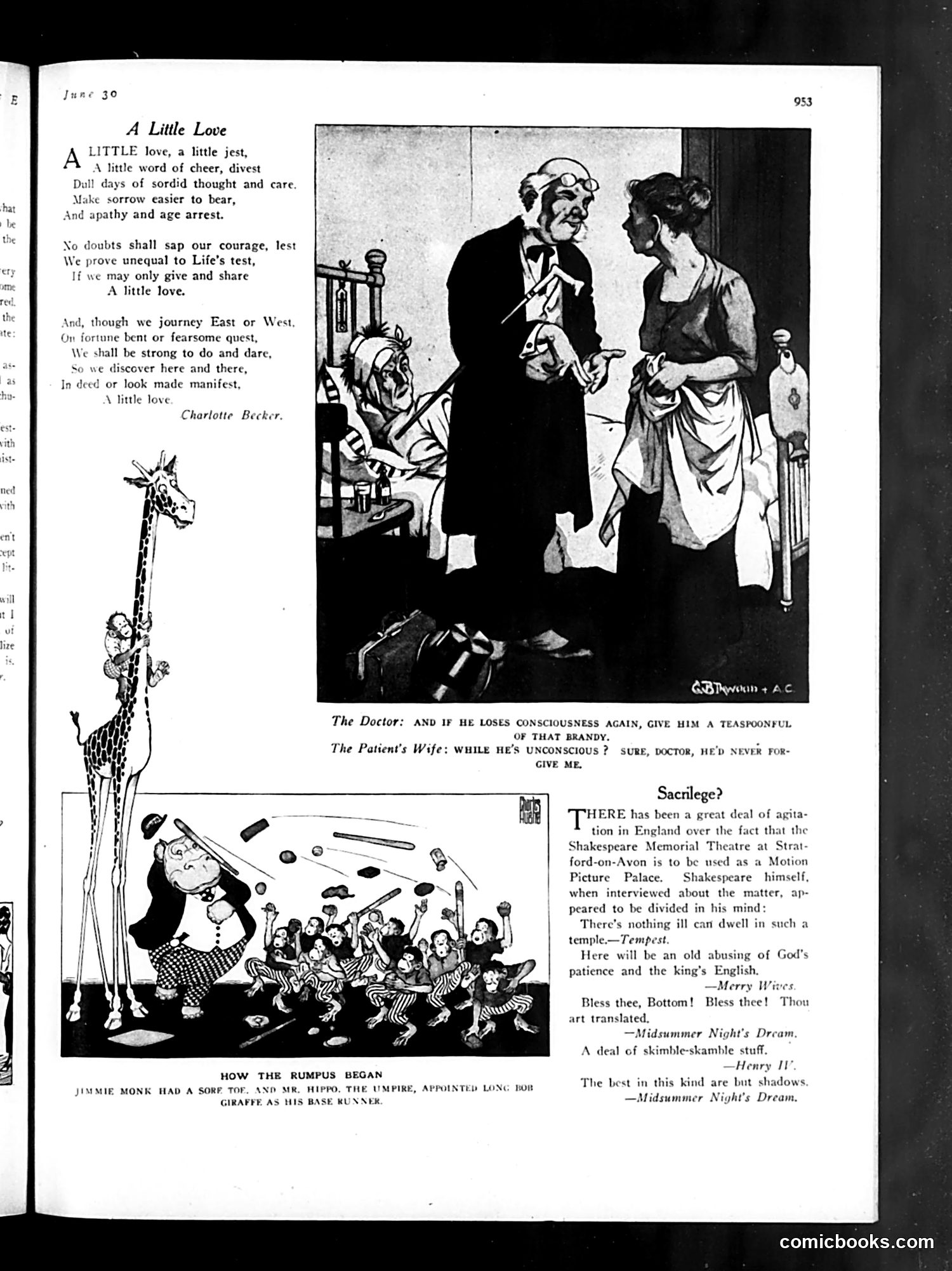
This page contains three distinct items: **"A Little Love" (poem):** A sentimental verse by Charlotte Becker about kindness and compassion easing life's hardships. The accompanying illustration of a giraffe is decorative, not satirical. **"The Doctor" cartoon:** A domestic humor joke about a patient's wife. The doctor prescribes brandy to revive an unconscious patient, but the wife hesitates—while he's unconscious, he won't notice her drinking it herself. The satire targets both marital infidelity and Prohibition-era alcohol consumption. **"Sacrilege?" article:** Commentary on English controversy over converting the Shakespeare Memorial Theatre in Stratford-on-Avon into a movie palace. The piece presents Shakespeare's supposed "divided" opinions using actual quotes from his plays—a clever literary joke suggesting the Bard himself would object to commercializing his legacy. The lower cartoon ("How the Rumpus Began") appears to be humorous nonsense about animals at a sports event, unrelated to other content.
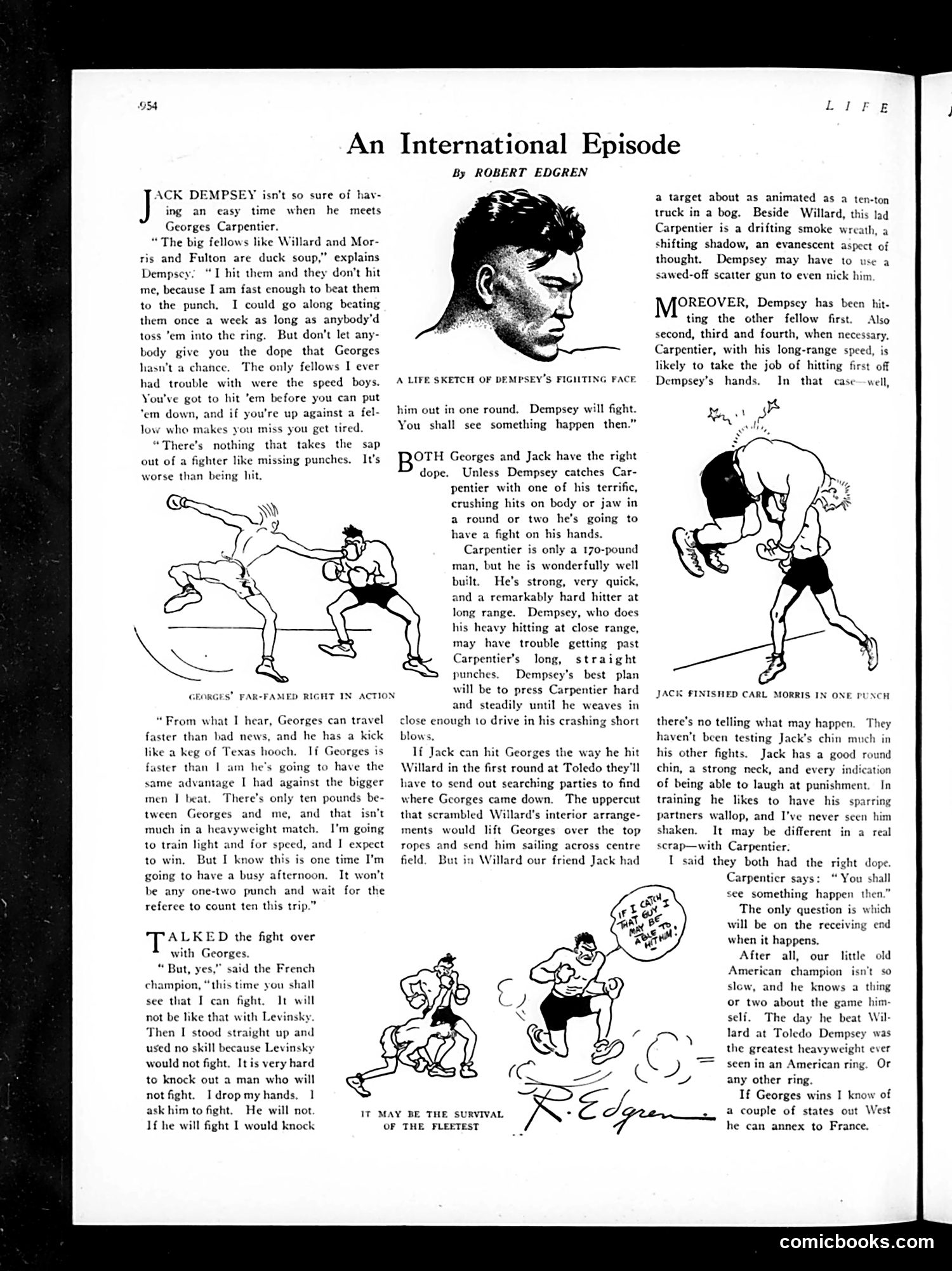
This article analyzes an upcoming heavyweight boxing match between American champion Jack Dempsey and French challenger Georges Carpentier. Written by Robert Edgren, it presents interviews with both fighters discussing their strategies. Dempsey expresses cautious respect for Carpentier, acknowledging that unlike his previous opponents (Willard, Morris, Fulton), the Frenchman possesses speed—a quality that troubles Dempsey. Carpentier, meanwhile, confidently asserts he will fight aggressively, contrasting himself with Levinsky (apparently someone who avoided engagement). The article analyzes their fighting styles: Carpentier's long-range striking versus Dempsey's close-range power. The accompanying sketches illustrate their techniques in action. The "international" angle reflects post-WWI interest in Franco-American sporting competition. This appears to be advance promotion for a significant match, treating it as consequential enough for serious tactical discussion.
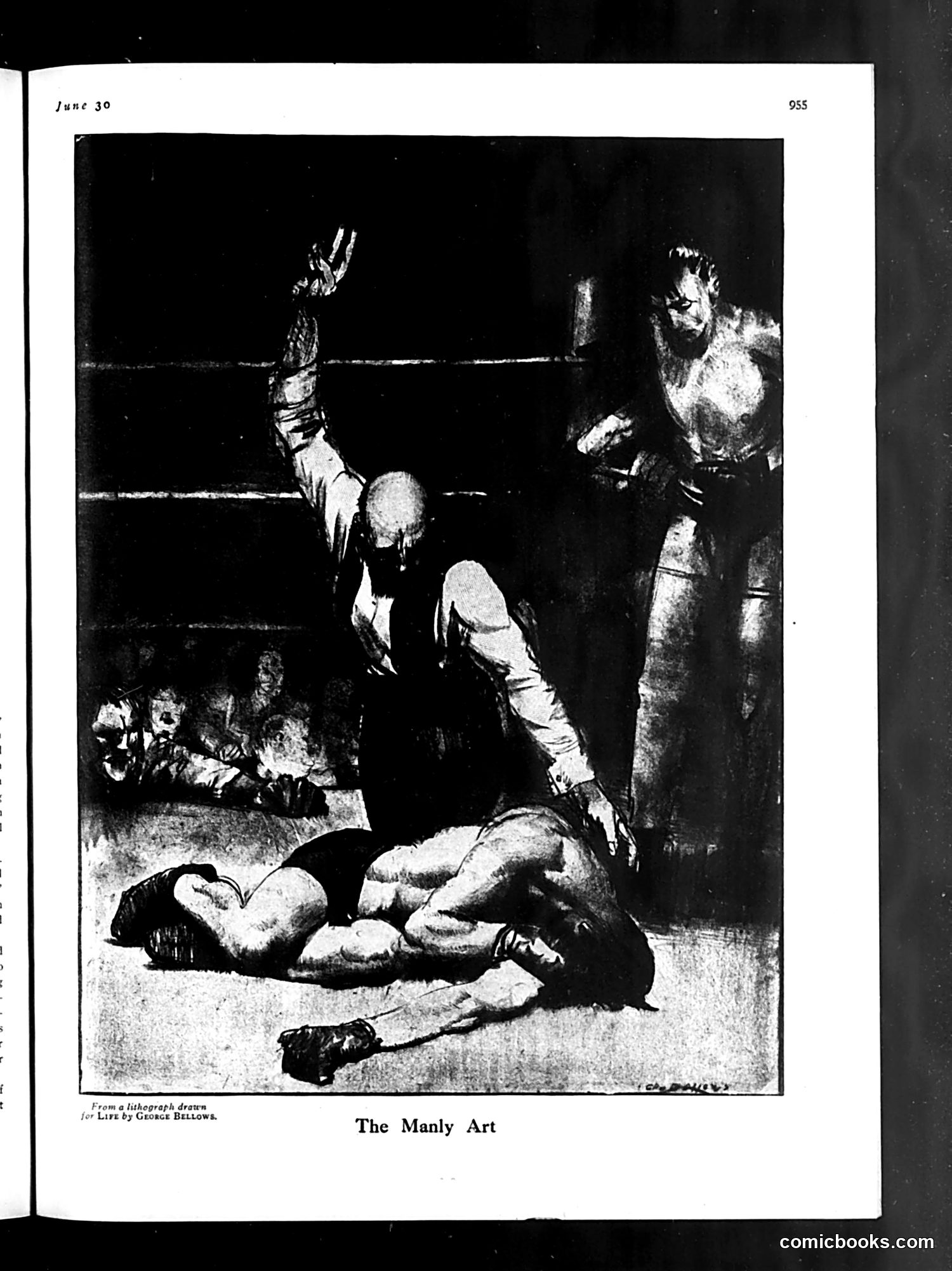
This illustration, credited to artist George Bellows, depicts a boxing match scene titled "The Manly Art." The image shows a shirtless boxer lying prone on the canvas while referees and other figures stand over him in a boxing ring. The dramatic lighting and composition emphasize the violence of the sport. The satire likely critiques boxing as a brutal spectacle dressed up with euphemistic language—calling it "the manly art" when it's fundamentally about inflicting physical harm. By showing a fallen fighter in such stark detail, Bellows appears to be commenting on the disconnect between boxing's romanticized reputation and its actual violent reality. This reflects early 20th-century debates about whether boxing was legitimate sport or mere barbarism.
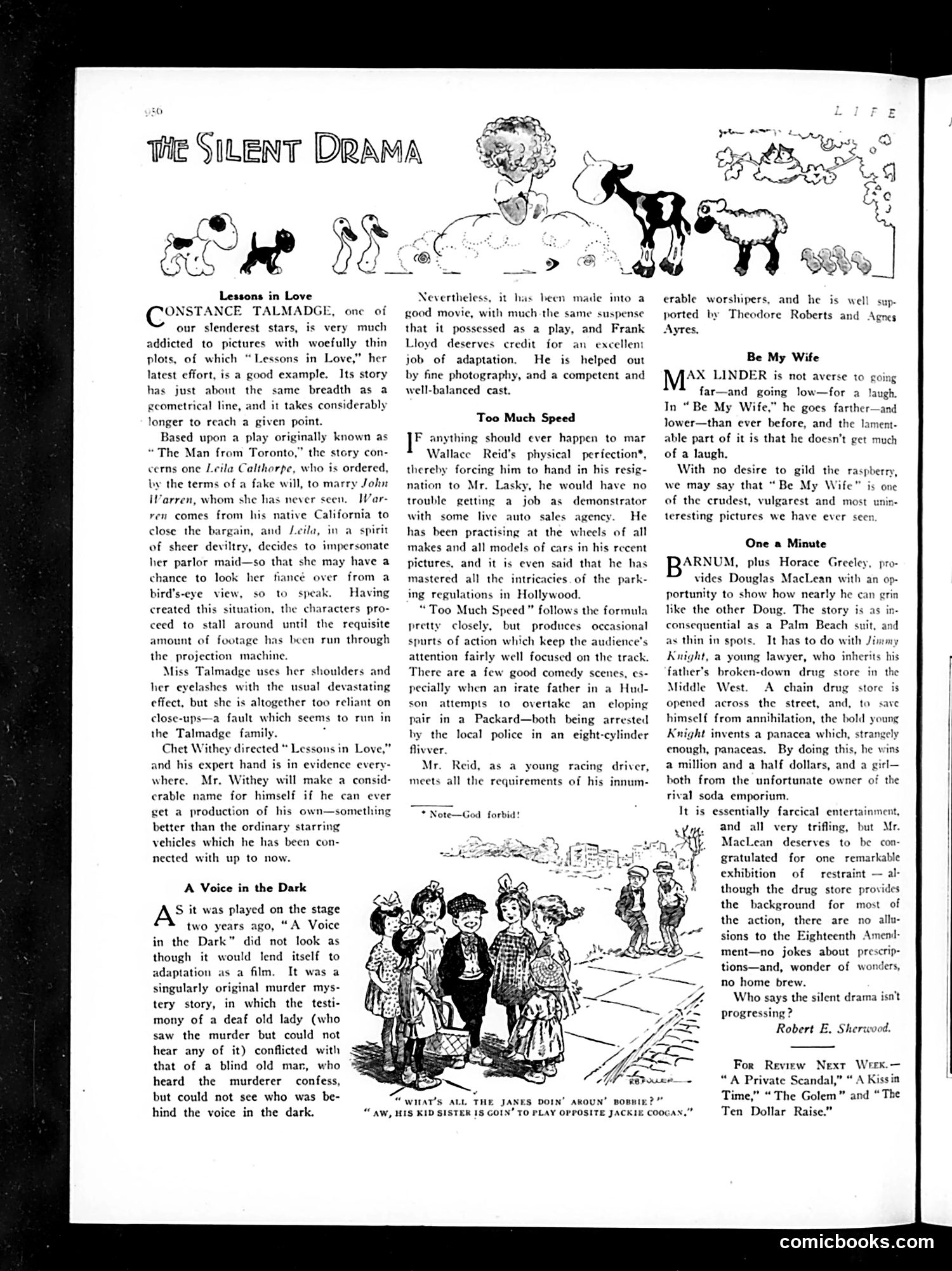
This page reviews several silent films (note the title references cinema without sound). The cartoons at top illustrate plot scenarios from the reviewed movies. **Key content:** The reviews critique 1920s silent films starring major stars like Constance Talmadge, Wallace Reid, and Max Linder. The satire is gentle—the critic mocks thin plots ("breadth as a geometrical line"), over-reliance on close-ups, and crude humor rather than attacking serious targets. Notable: A footnote quipping "God forbid!" about Reid's physical perfection suggests contemporary concern with Hollywood stars' vanity. The review of "Be My Wife" is notably harsh, calling it "crudest, vulgarest" entertainment—indicating Life's satirical stance as arbiter of taste against lowbrow comedy. The illustration at bottom depicts a street scene, likely from one of the reviewed films. This reflects Life's role as a magazine for educated audiences commenting on popular entertainment's quality and morality during the silent film era.
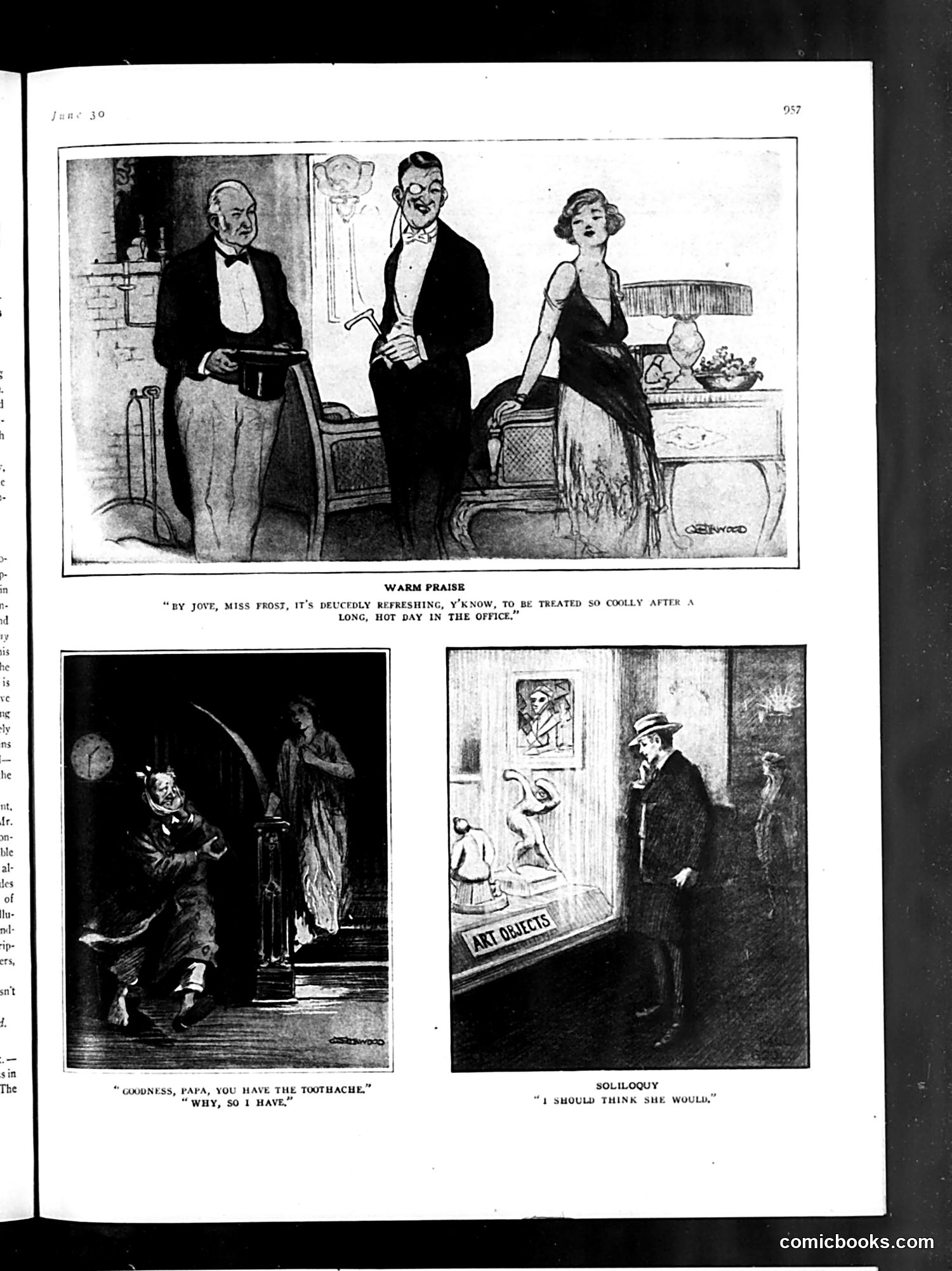
This page contains three separate cartoons satirizing early 20th-century social conventions: **Top cartoon ("Warm Praise")**: A man praises a woman (Miss Frost) for treating him "coolly"—the humor derives from the double meaning. After a hot day at the office, he appreciates her literal coolness, but the joke plays on the era's dating customs where "cool" behavior from a woman was considered desirable. **Bottom left ("Goodness, Papa")**: A man with a toothache encounters what appears to be a person in costume or theatrical dress. The humor is situational—his toothache complaint meets an absurd response. **Bottom right ("Soliloquy")**: A man gazes at an "Art Objects" shop window display, with the caption suggesting he's thinking the female mannequin/artwork should behave a certain way—satirizing men's expectations of women as decorative objects rather than people. The page collectively mocks gender relations and masculine assumptions of the period.
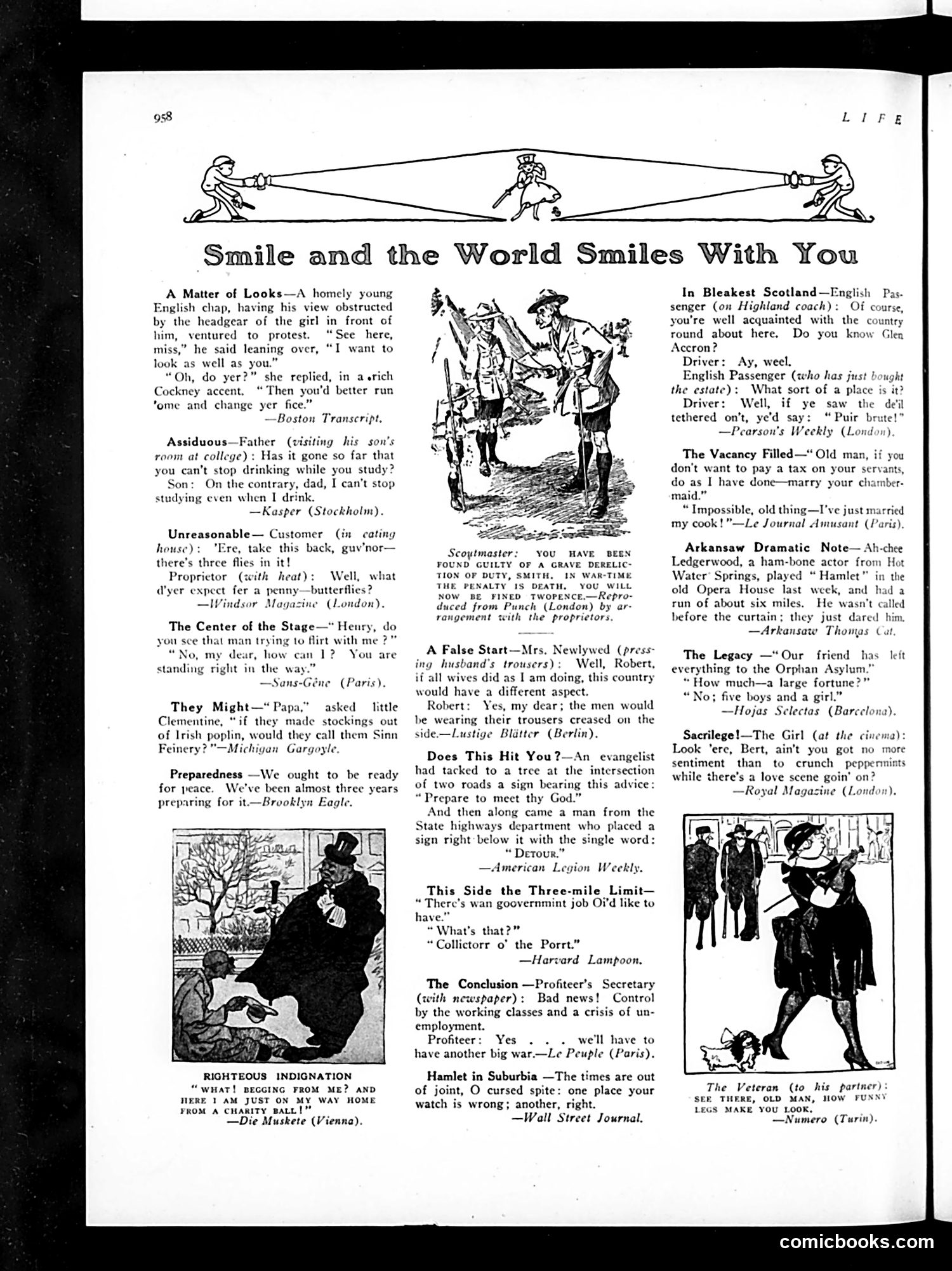
This page collects brief humorous anecdotes and jokes from various international sources, primarily satirizing social pretensions and wartime concerns circa WWI era. **Key themes:** **Class and appearance mockery**: Multiple jokes target vanity and social climbing—a homely man complaining about a woman's hat, a newlywed wife pressing her husband's trousers to "improve the country," and a beggar confronting a charity ball attendee. **War-related satire**: References to "preparedness" (three years of war preparation), Scout duty penalties, and a profiteer anticipating another war to solve economic problems reflect wartime anxieties. **Bureaucratic absurdity**: An evangelist's "Prepare to meet thy God" sign is undercut by a State highways department's "Detour" sign below it—mocking institutional indifference to spiritual matters. **International sourcing**: Credits to Punch, Le Peuple, Harvard Lampoon, and others show Life's cosmopolitan humor borrowing, typical of the era's magazine culture. The overall tone is lighthearted social criticism targeting pretension, hypocrisy, and wartime profiteering.
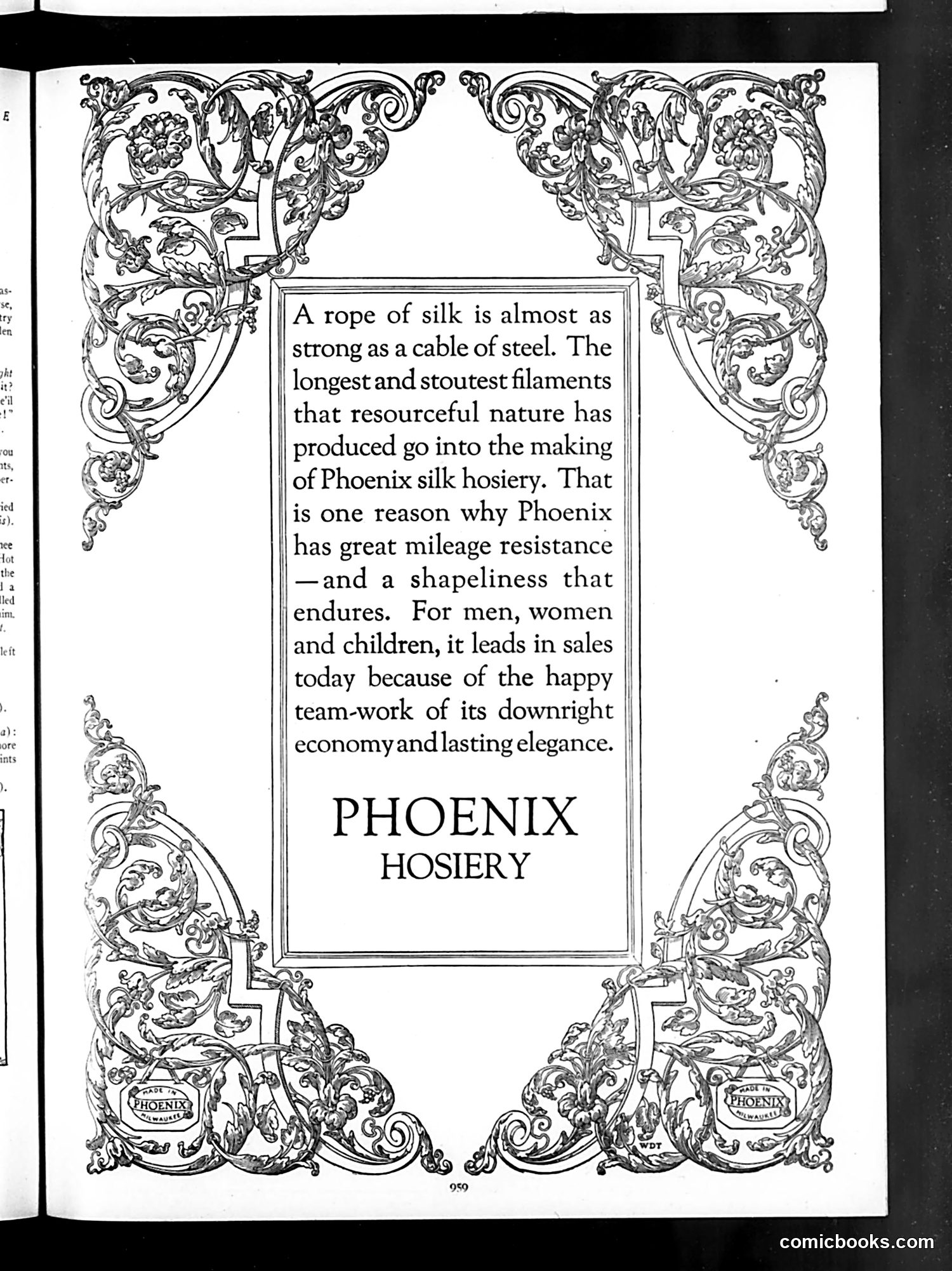
This is a **full-page advertisement**, not a cartoon or satire. It promotes Phoenix brand silk hosiery using ornate Art Nouveau decorative borders typical of early 20th-century magazine advertising. The ad makes commercial claims about silk's strength—comparing it to steel cable—to market hosiery for "men, women and children." The appeal emphasizes durability ("mileage resistance"), aesthetic appeal ("shapeliness"), and value ("economy and lasting elegance"). There is no political satire or social commentary here. The decorative flourishes and formal typography reflect period advertising aesthetics meant to convey luxury and quality. Modern readers would note the era's approach to hosiery as a significant consumer good worthy of premium positioning, and the inclusive marketing across gender and age categories.
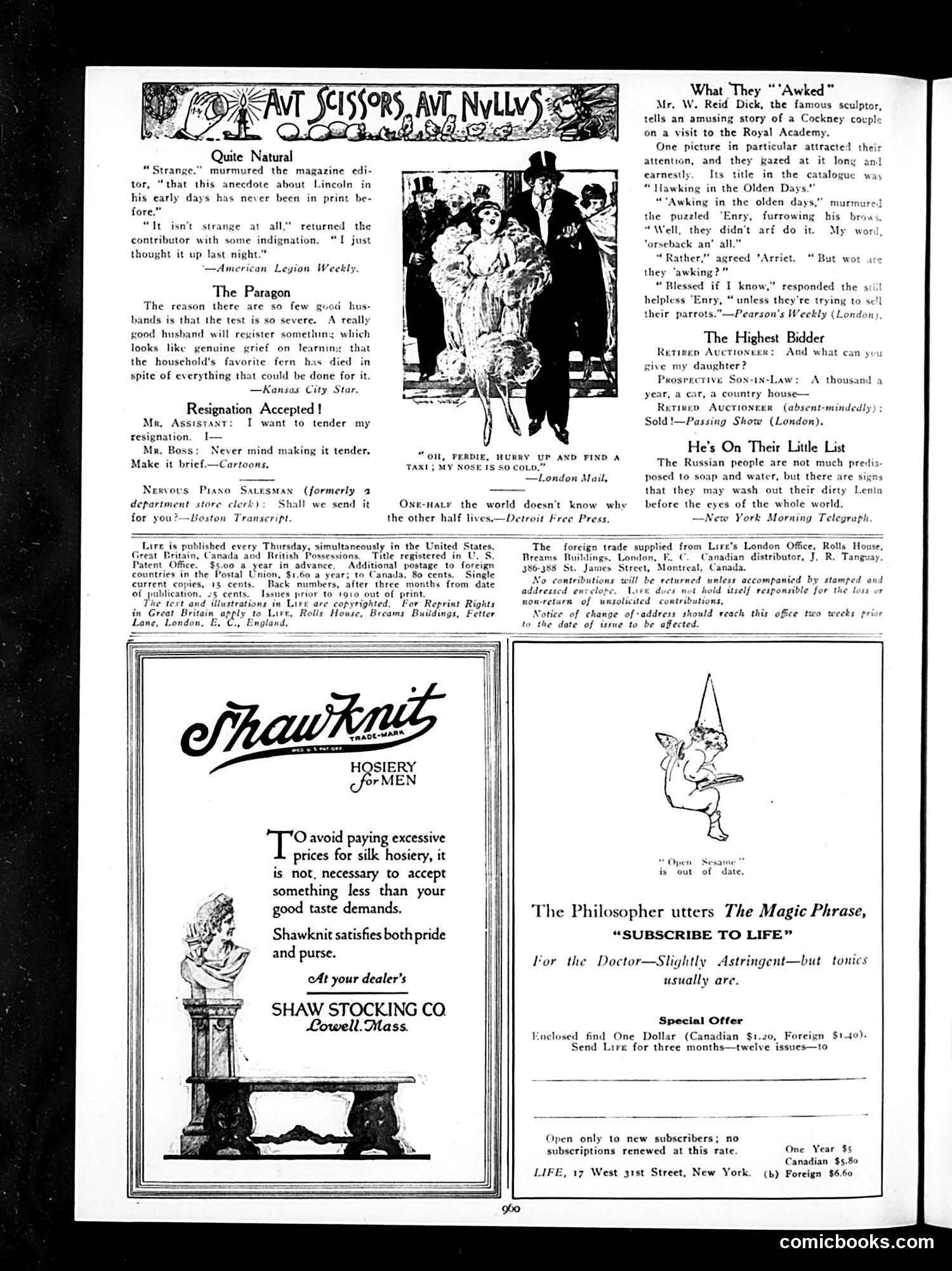
This page contains several short humorous items typical of early 20th-century American satirical magazines: **"Quite Natural"** mocks magazine editors who present old anecdotes as historical discoveries, when contributors simply invent them. **"The Paragon"** jokes that a truly good husband would show genuine grief over a houseplant's death—satirizing both sentimental domestic culture and the low bar for male behavior. **"What They 'Awked'"** presents a Cockney couple (represented through working-class dialect: 'Enry and 'Arriet) misunderstanding the painting title "Hawking in the Olden Days." They assume "hawking" means selling parrots from horseback, rather than the aristocratic hunting sport. The humor relies on class-based stereotypes about working-class ignorance of upper-class pursuits. The remaining items are brief jokes about resignation letters, piano salesmen, and poverty. The page is primarily **advertising** (Shawknit hosiery, Life magazine subscriptions) with these short comedic pieces interspersed throughout.
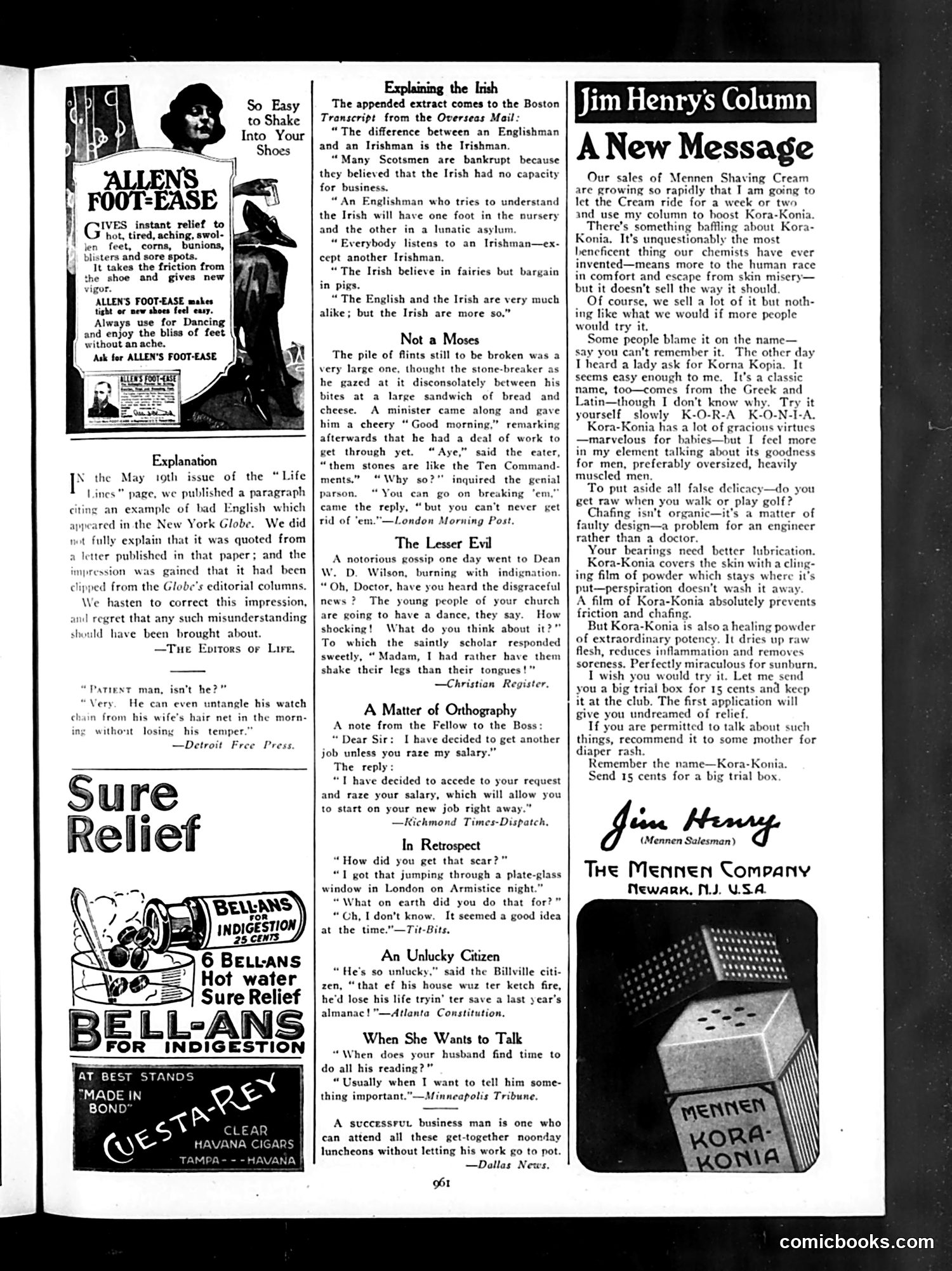
This page combines humor pieces with advertisements. The main content consists of brief anecdotes and jokes organized by topic—"Not a Moses," "The Lesser Evil," "A Matter of Orthography," etc.—typical of Life's satirical format from the early 20th century. The jokes target various social absurdities: a gossip's complaint about church dancing (which a dean cleverly deflects by suggesting gossip is worse), a worker comparing endless stone-breaking to the Ten Commandments, and miscommunications about salary raises. One piece references Armistice night (WWI's end in 1918), suggesting this is from that era. The left side features period advertisements for foot powder and digestive relief remedies. Jim Henry's column on the right promotes Mennen shaving cream. The page's humor relies on wordplay, class observations, and situations recognizable to contemporary readers—nothing explicitly political, but reflecting everyday anxieties and social commentary typical of the magazine's satirical approach.
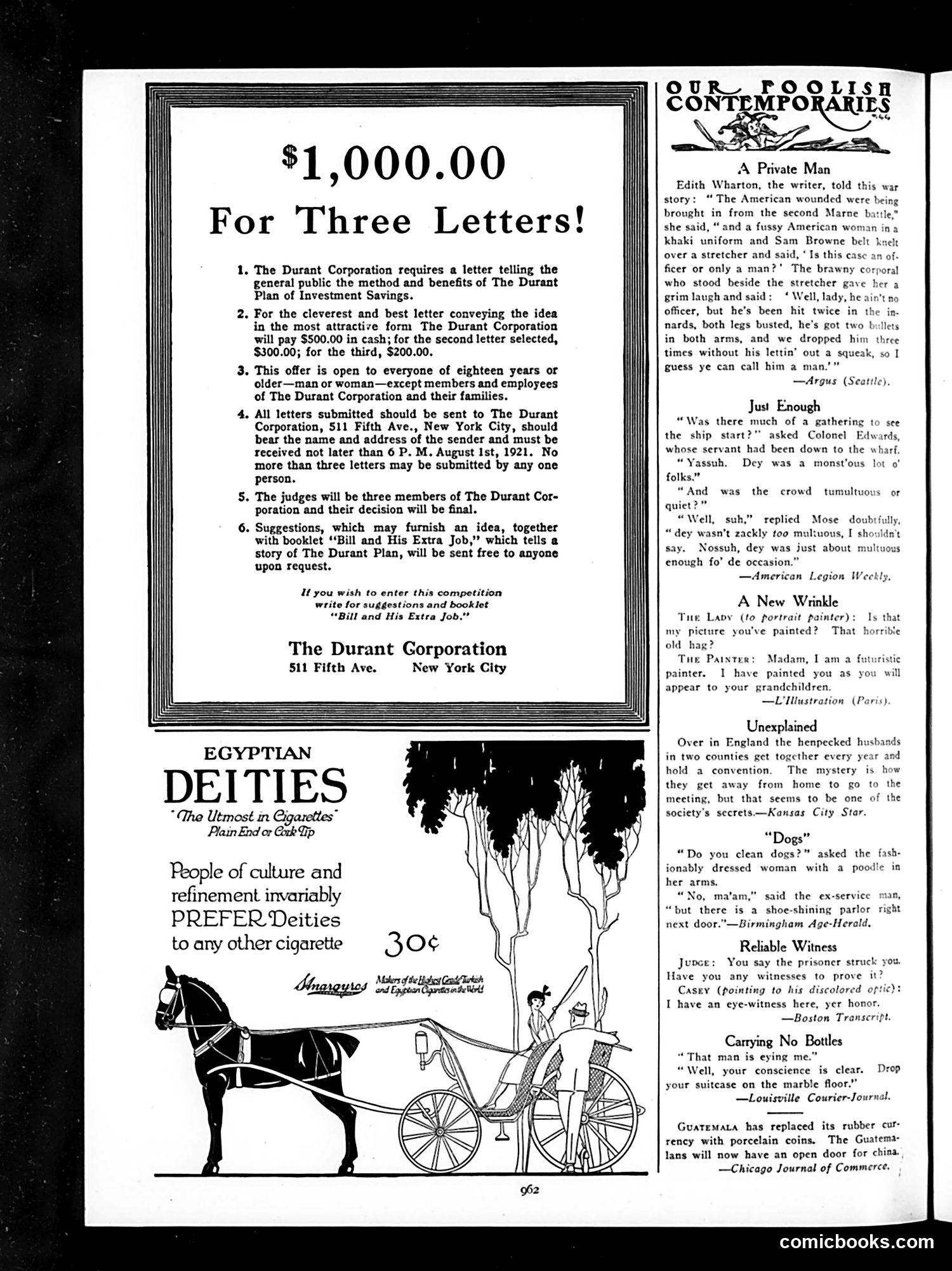
This Life magazine page mixes advertising with satirical humor content typical of the publication's format. The main advertisement promotes a **Durant Corporation letter-writing contest** offering $1,000 total in prizes (1921). The Durant Plan was an investment savings scheme; the contest asks readers to write persuasive letters about its "benefits." The right side features **"Our Foolish Contemporaries,"** Life's signature humor section reprinting jokes and anecdotes from other publications. These include: - A WWI story (attributed to writer Edith Wharton) contrasting a fussy officer's wife questioning a wounded soldier's manhood with the corporal's grim assessment of his injuries - Various brief comedic pieces about social absurdities: henpecked husbands' conventions, misunderstandings about dog-cleaning, courtroom testimony featuring a black eye as witness The **Egyptian Deities cigarette ad** uses pseudo-sophisticated messaging ("people of culture and refinement") to market cigarettes at 30¢, with imagery of an Egyptian chariot. The humor relies on period attitudes—class distinctions, racial dialect humor, and WWI references—reflecting 1921 American sensibilities.
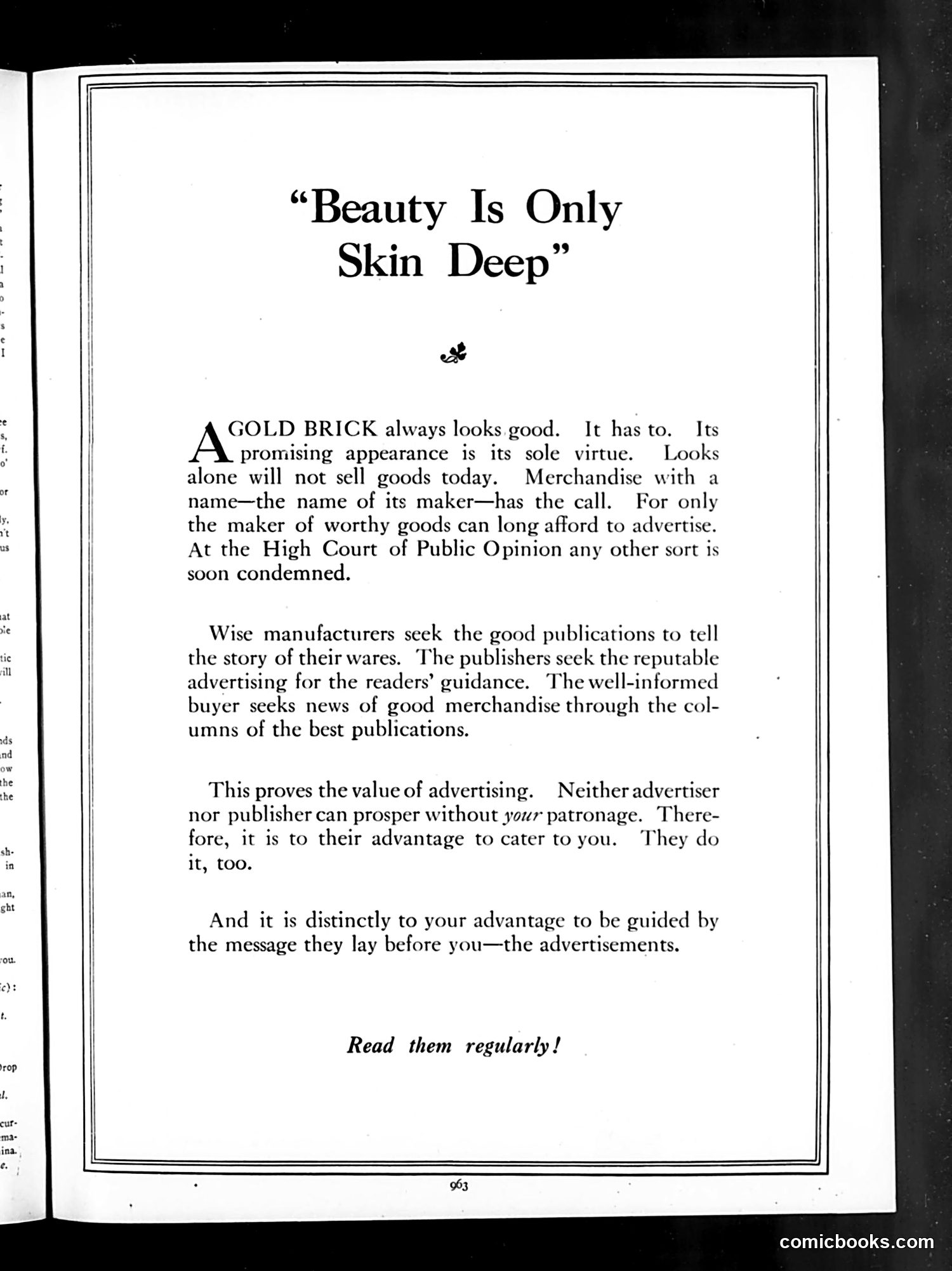
This is not a cartoon but rather a **full-page advertisement or editorial** promoting the value of advertising itself—a meta-advertisement appearing in *Life* magazine. The piece uses the phrase "Beauty Is Only Skin Deep" to argue against superficial marketing. It contrasts a "gold brick" (a con or fraudulent product with only attractive appearance) with legitimate merchandise backed by reputable manufacturers' names. The central argument: **only makers of genuinely worthy goods can afford sustained advertising** in quality publications. Therefore, readers should trust advertisements as a reliable guide—advertisers and publishers mutually benefit from maintaining credibility, creating alignment between consumer and advertiser interests. The satire appears gentle and self-serving: *Life* essentially tells readers that reading advertisements regularly is in their interest because the economic incentives naturally ensure only good products are advertised. This reflects early-20th-century advertising philosophy that positioned ads as consumer guidance rather than manipulation. The piece serves *Life's* business interests by legitimizing advertising as trustworthy editorial content.
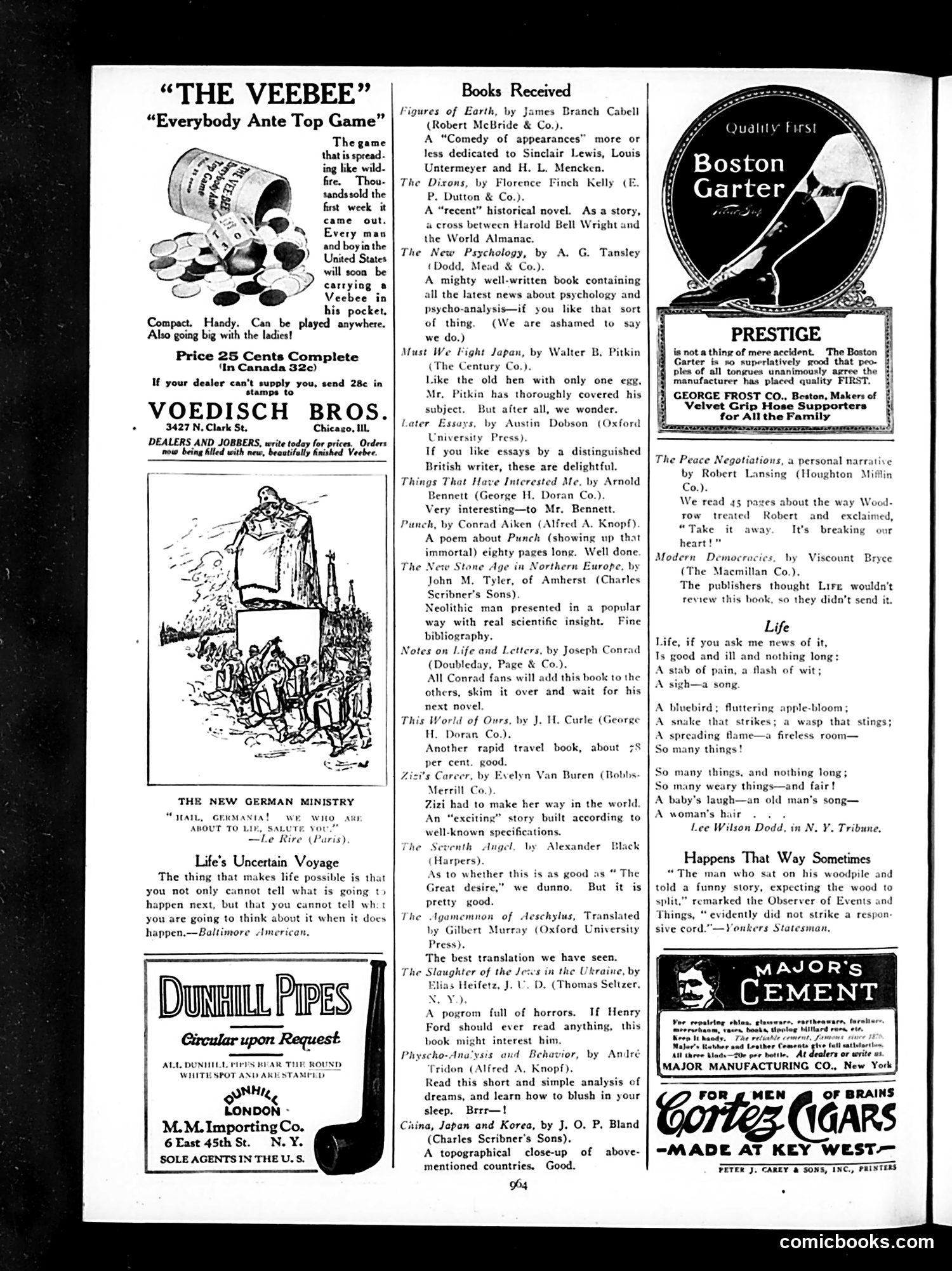
This page is primarily **advertising and book reviews** from Life magazine, with one small political cartoon. The cartoon titled **"The New German Ministry"** appears in the lower left. It shows a figure in military uniform addressing a crowd, with a caption quoting a French source (*Le Rire*): "Hail, Germania! We who are about to die salute you!" This is a **post-WWI satire** mocking Germany's new government (likely the Weimar Republic, established 1919). The joke invokes the Roman gladiators' famous phrase before combat, sarcastically suggesting Germany's new civilian leadership is as doomed or ineffectual as condemned men—a cynical European commentary on Germany's political instability and weakness following their WWI defeat. The rest of the page consists of **product advertisements** (Veebee game, Dunhill pipes, Boston Garter, Major's Cement, Cortes Cigars) and **book reviews** of contemporary literary works by authors like Joseph Conrad and James Branch Cabell.
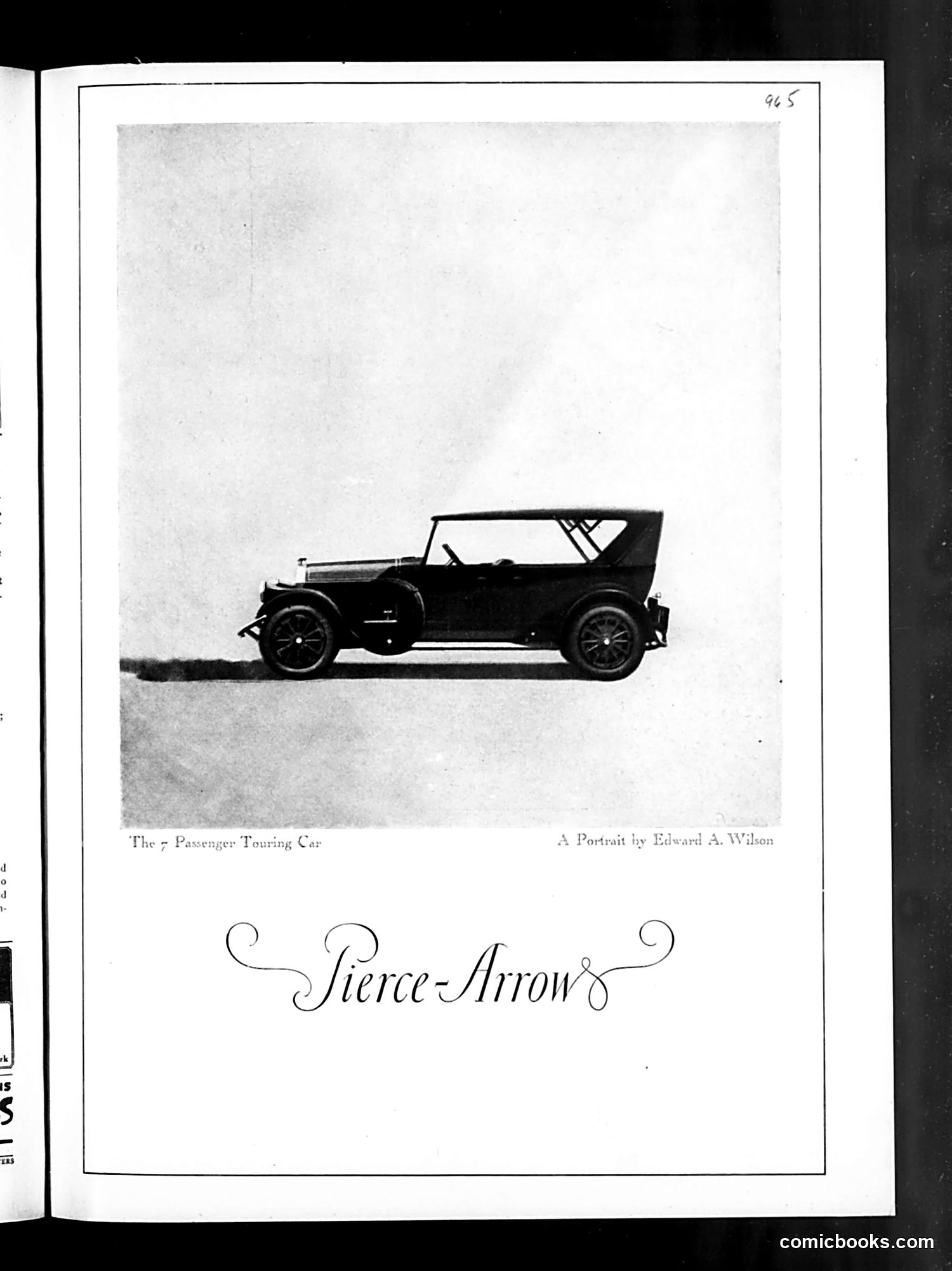
This is a **product advertisement**, not a political cartoon. The page features a silhouette illustration of a 7-passenger touring car, credited as "A Portrait by Edward A. Wilson." The car is identified as a **Pierce-Arrow**, a luxury American automobile brand popular in the early 20th century. The elegant styling of the vehicle—with its open-air touring body and refined proportions—emphasizes the car's status as a premium product. The artistic presentation, rather than mechanical specifications, appeals to affluent consumers by suggesting sophistication and prestige. This type of aspirational advertising was typical for luxury goods in *Life* magazine, which catered to middle and upper-class readers.
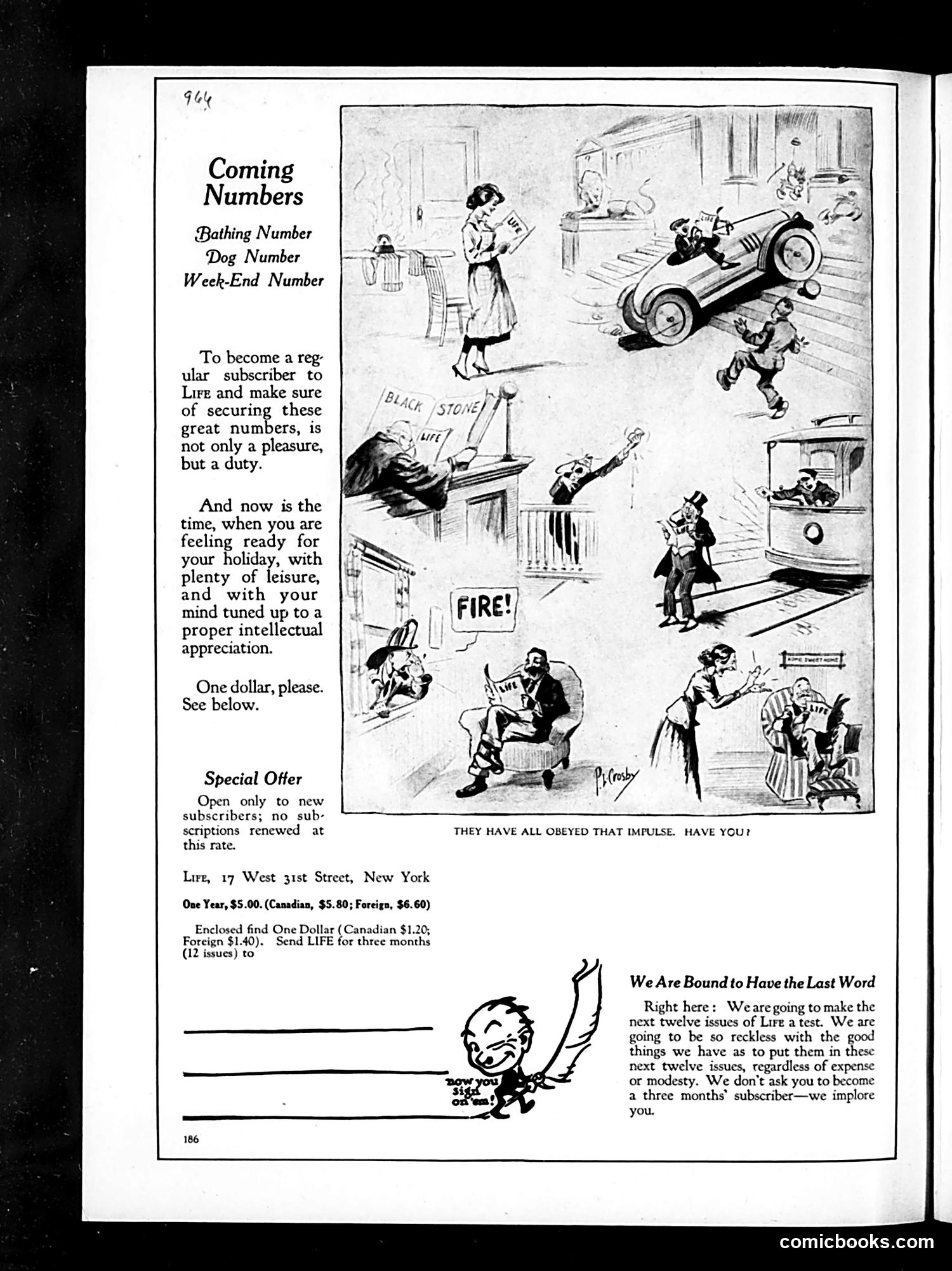
This is primarily a **subscription advertisement** for *Life* magazine, a satirical publication. The right-hand cartoon depicts various people impulsively responding to Life's appeal—showing a woman with a "LIFE" sign, children playing, people in cars, and others enjoying leisure activities. The caption "THEY HAVE ALL OBEYED THAT IMPULSE. HAVE YOU?" encourages readers to subscribe. The ad targets holiday-minded readers with leisure time and intellectual interests, offering special introductory rates ($1 for three months). The accompanying text mockingly claims the magazine will be "reckless with the good things" in its next twelve issues "regardless of expense or modesty," presenting subscription as a patriotic or cultural duty. The small winged cherub figure at bottom appears to be *Life*'s mascot, reinforcing the magazine's humorous tone.
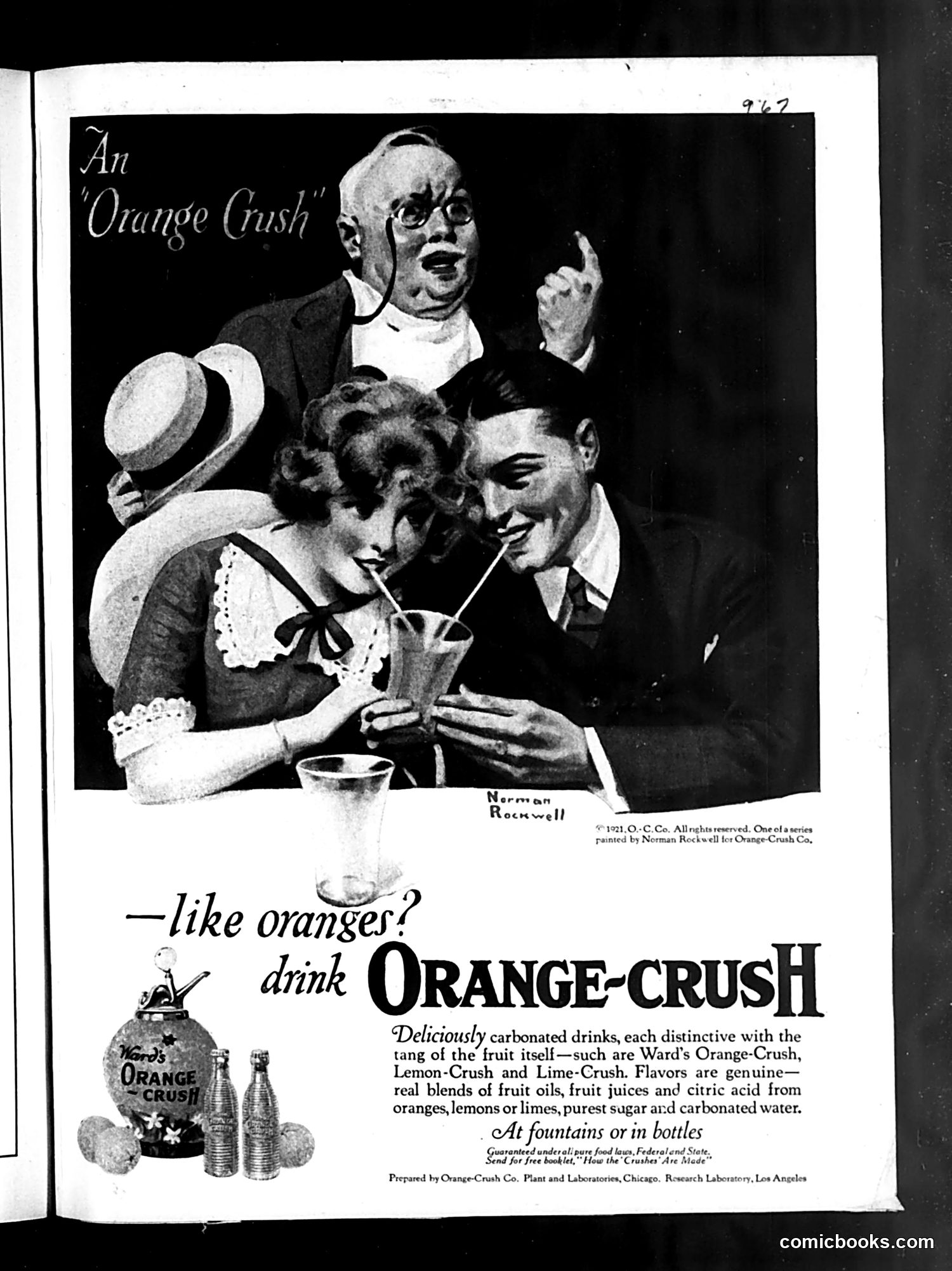
This is a **commercial advertisement**, not political satire. Norman Rockwell painted it for Orange-Crush soda. The image shows three people enjoying drinks with straws at what appears to be a soda fountain, while an elderly gentleman in the background reacts with exaggerated surprise or delight. The caption "—like oranges? drink ORANGE-CRUSH" plays on a simple premise: if you like oranges, you'll enjoy this carbonated fruit drink. The humor is gentle and domestic rather than satirical. Rockwell's illustration emphasizes the product's appeal across generations and social settings. The ad highlights that Orange-Crush flavors use genuine fruit ingredients—a selling point emphasizing quality and authenticity to consumers concerned about pure food standards (the Pure Food and Drug Act had passed in 1906). This represents early 20th-century beverage marketing using wholesome Americana imagery and celebrity artist endorsement.
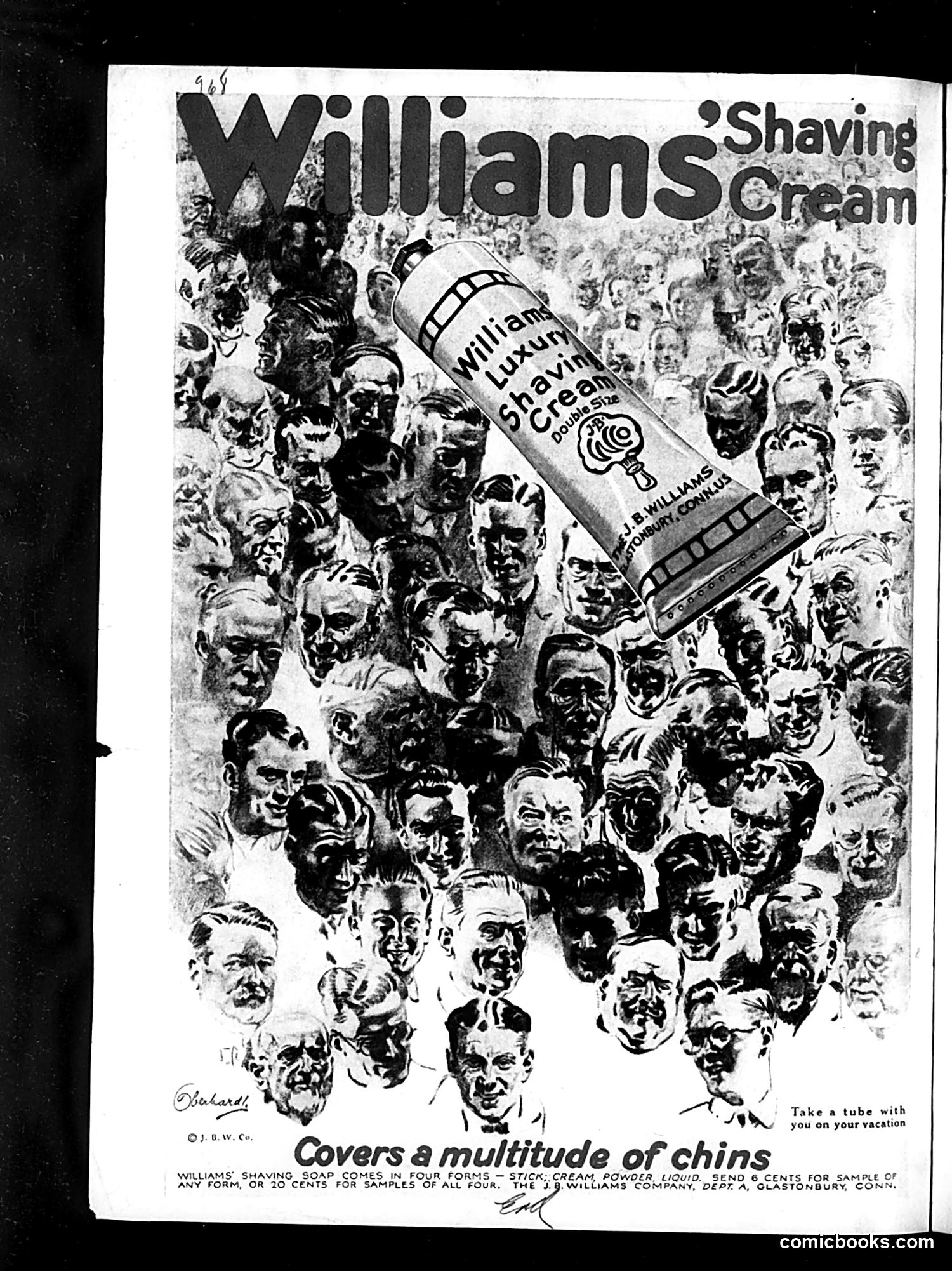
This is a **product advertisement**, not political satire. It promotes Williams' Shaving Soap by playing on a pun: "Covers a multitude of chins." The image shows dozens of illustrated male faces with various chin shapes and facial hair styles—the "multitude of chins" referenced in the headline. The joke is that the shaving cream works for all these different face types. A large tube of the product floats above the crowd of faces. The advertisement emphasizes that Williams' soap comes in four forms (stick, cream, powder, liquid) and invites consumers to purchase sample sizes before traveling ("Take a tube with you on your vacation"). This represents typical early-to-mid 20th century advertising strategy: using humor and visual density to capture attention in magazines, while promoting product versatility to potential customers.
I can see this is a mostly blank page from Life magazine, with only minimal text visible at the bottom ("comicbooks.com"). The page appears to be either: 1. A blank or nearly blank interior page from the original publication 2. A title page or section divider 3. A page where the primary content (cartoon or illustration) has not scanned clearly Without visible cartoon imagery, caricatures, or substantive text content, I cannot identify specific political figures, social references, or satirical commentary. The page does not provide sufficient visual or textual information to analyze as a historical political cartoon or satirical content. To properly assess this page's meaning and context, a clearer image or additional pages would be necessary.