
Life, 1921-06-30 · page 22 of 41
Life — June 30, 1921 — page 22: what you’re looking at
What you’re looking at
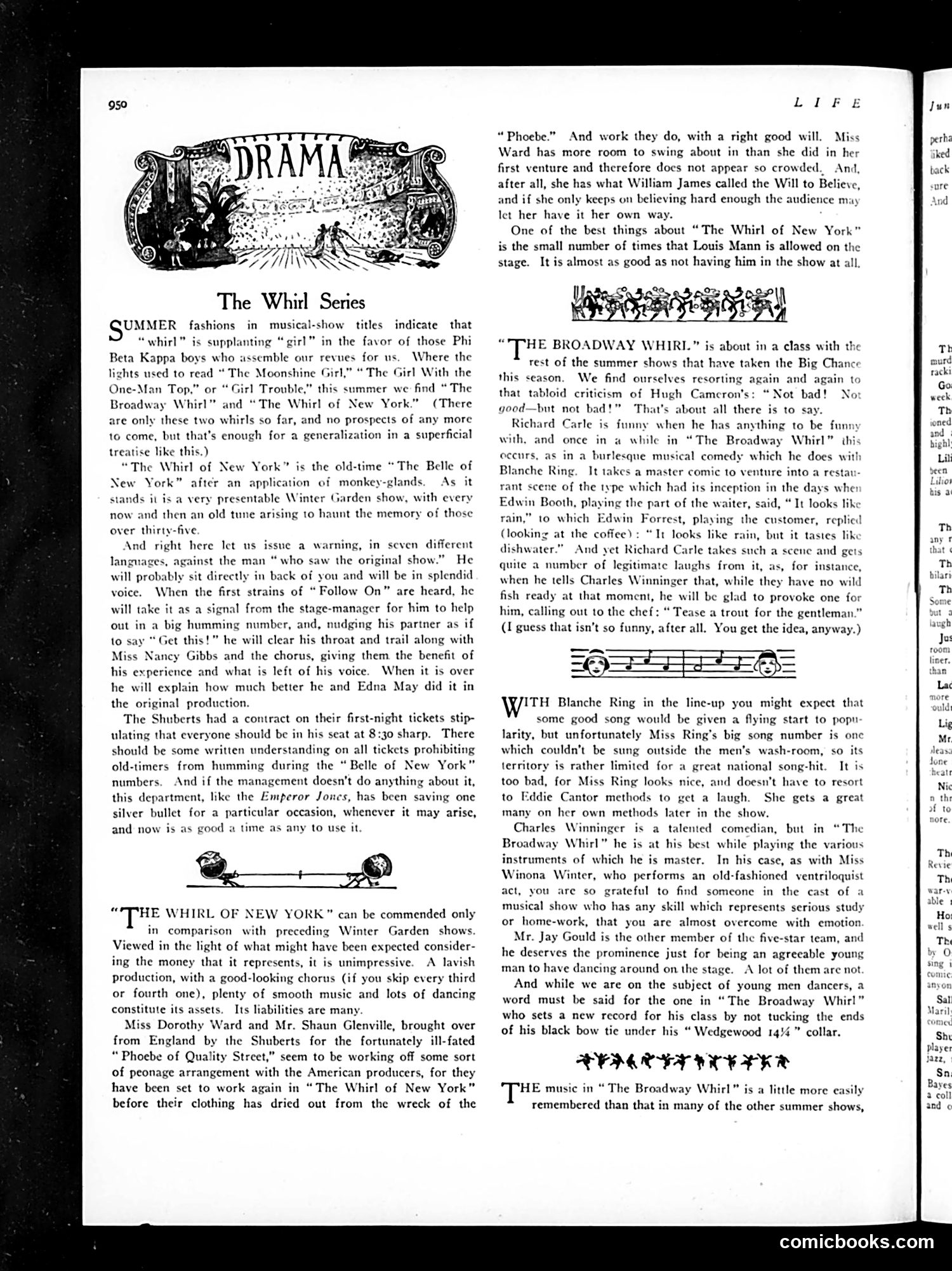
This page reviews two Broadway musicals with "Whirl" in their titles—*The Whirl of New York* and *The Broadway Whirl*—reflecting a summer 1912 fashion trend where "whirl" replaced "girl" in musical-show titles. The main satire targets audience members who attended the original *Belle of New York* production (from the 1890s) and now loudly hum along during performances, annoying fellow patrons. The critic warns such nostalgic "old-timers" with mock-serious language and threatens metaphorical violence. The reviews themselves are lukewarm. *The Whirl of New York* is called "unimpressive" despite lavish production values. The critic particularly dismisses Louis Mann's limited stage time as "almost as good as not having him." The critique uses Hugh Cameron's sardonic summary—"Not bad! No: good—but not bad"—to capture the shows' mediocrity.
📄 Transcribed text from this page (OCR, searchable)
Machine-transcribed from the original scan — historical spelling and the odd misread are preserved.
The Whirl Series titles indicate that “whirl” is supplanting “girl” in the favor of those Phi Beta Kappa boys who assemble our revues for us, Where the lights used to read “ The Moonshine Girl,” “ The Girl With the One-Man Top,” or “Girl Trouble,” this summer we find “ The Broadway Whirl” and “The Whirl of New York.” (There are only these two whirls so far, and no prospects of any more to come, but that's enough for a generalization in a superficial treatise like this.) “The Whirl of New York” is the old-time “ New York” after an application of monkey UMMER fashions in musical-show stands it is a very presentable Winter Garden show, with every now and then an old tune arising to haunt the memory of those over thirty-five. And right here let us issue a warning, in seven different languages, against the man “who saw the original show.” He will probably sit directly in back of you and will be in splendid voice. When the first strains of “Follow On” are heard, he will take it as a signal from the stage-manager for him to help out in a big humming number, and, nudging his partner as if to say “Get this!” he will clear his throat and trail along with Miss Nancy Gibbs and the chorus, giving them the benefit of his experience and what is left of his voice. When it is over he will explain how much better he and Edna May did it in the original production. The Shuberts had a contract on their first-night tickets stip- ulating that everyone should be in his seat at 8:30 sharp. There should be some written understanding on all tickets prohibiting old-timers from humming during the “Belle of New York” numbers. And if the management doesn’t do anything about it, this department, like the Emperor Jones, has been saving one silver bullet for a particular occasion, whenever it may arise, and now is as good a time as any to use it “CHE WHIRL OF NEW YORK” can be commended only in comparison with preceding Winter Garden shows. Viewed in the light of what might have been expected consider- ing the money that it represents, it is unimpressive. A lavish production, with a good-looking chorus (if you skip every third or fourth one), plenty of smooth music and lots of dancing constitute its assets. Its liabilities are many Miss Dorothy Ward and Mr. Shaun Glenville, brought over from England by the Shuberts for the fortunately ill-fated “Phoebe of Quality Street,” seem to be working off some sort of peonage arrangement with the American producers, for they have been set to work again in “The Whirl of New York” before their clothing has dried out from the wreck of the LIFE “Phoebe.” And work they do, with a right good will. Miss Ward has more room to swing about in than she did in her first venture and therefore docs not appear so crowded, And, after all, she has what William James called the Will to Believe, and if she only keeps on believing hard enough the audience may let her have it her own way. One of the best things about “The Whirl of New York” is the small number of times that Louis Mann is allowed on the stage. It is almost as good as not having him in the show at all, “ THE BROADWAY WHIRL” is about in a class with the rest of the summer shows that have taken the Big Cha this season. We find ourselves resorting again and again to that tabloid criticism of Hugh Cameron's: “Not bad! No: good—but not bad That's about all there is to say. Richard Carle is funny when he has anything to be funny with, and once in « while in “The Broadway Whirl” ihis occurs, as in a burlesque music: Blanche Ring. comedy which he does It takes a master comic to venture into a restau- rant scene of the type which had its inception in the days wher Edwin Booth, playing the part of the waiter, said, “It looks lik rain,” to which Edwin Forrest, playing the customer, replied (looking at the coffee): “It looks like rain, but it tastes like dishwater.” And yet Richard Carle takes such a scene and gets quite a number of legitimate laughs from it, as, for instance, when he tells Charles Winninger that, while they have no wild fish ready at that moment, he will be glad to provoke one for him, calling out to the chef: “ Tease a trout for the gentleman.” (I guess that isn’t so funny, after all. You get the idea, anyway.) 2O=- EEE ITH Blanche Ring in the line-up you might expect that some good song would be given a flying start to popu larity, but unfortunately Miss Ring’s big song number is one which couldn’t be sung outside the men’s wash-room, so its territory is rather limited for a great national song-hit. It is too bad, for Miss Ring looks nice, and doesn’t have to resort to Eddie Cantor methods to get a laugh. She gets a great many on her own methods later in the show. Charles Winninger is a talented comedian, but in “The Broadway Whirl” he is at his best while playing the various instruments of which he is master. In his case, as with Miss Winona Winter, who performs an old-fashioned ventriloquist act, you are so grateful to find someone in the cast of a musical show who has any skill which represents serious study or home-work, that you are almost overcome with emotion. Mr. Jay Gould is the other member of the five-star team, and he deserves the prominence just for being an agreeable young man to have dancing around on the s: A lot of them are not And while we are on the subject of young men dancers, a word must be said for the one in “The Broadway Whirl” who sets a new record for his class by not tucking the ends of his black bow tie under his “ Wedgewood 14% ” collar. REPRE ATH EKR 'HE music in “ The Broadway Whirl” is a little more easily remembered than that in many of the other summer shows, comicbooks.com