
Life, 1921-06-30 · page 18 of 41
Life — June 30, 1921 — page 18: what you’re looking at
What you’re looking at
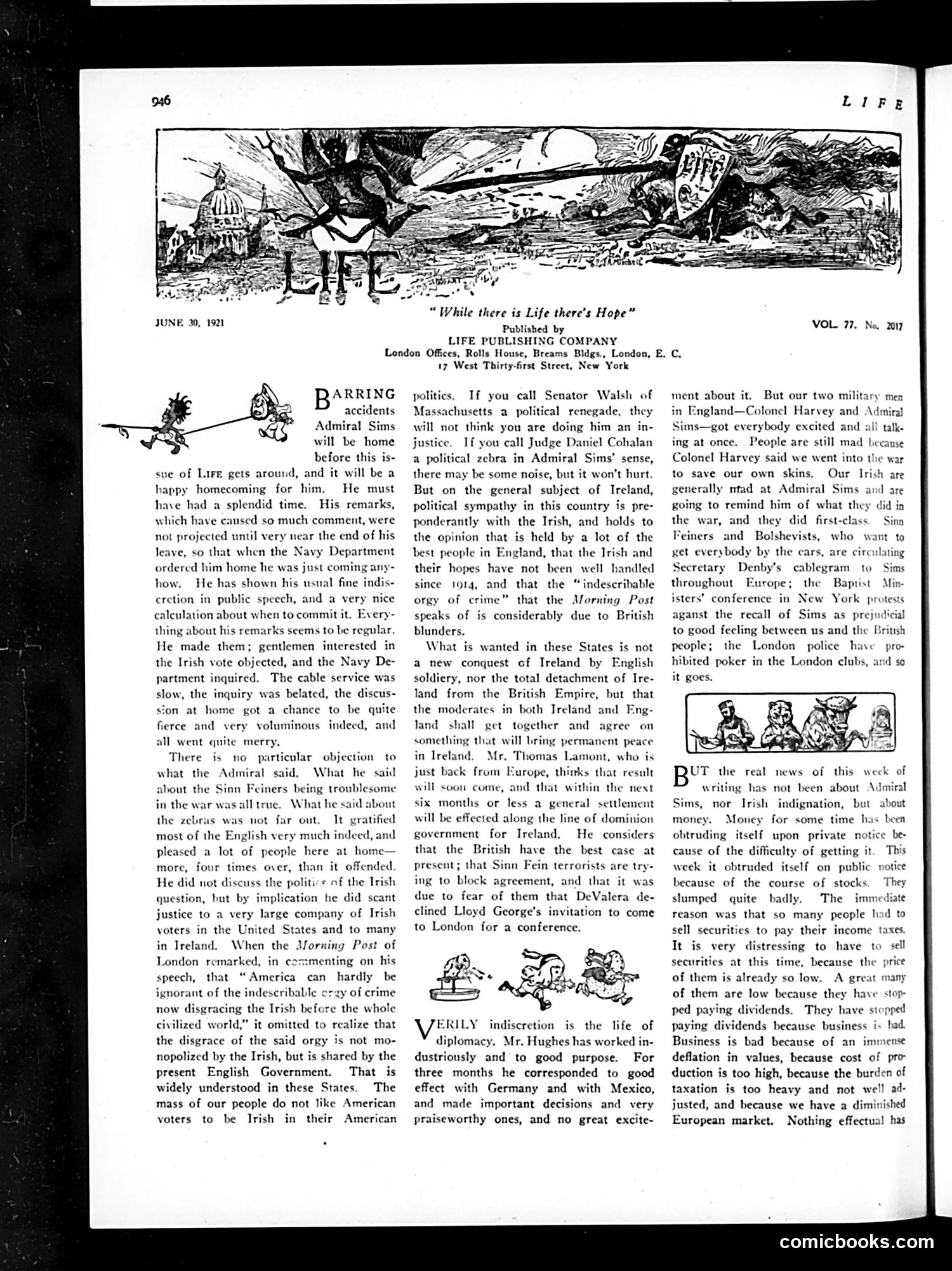
This editorial discusses Admiral William Sims's controversial remarks about Irish independence activists (Sinn Féiners) during his naval service. The piece defends Sims's factual observations while criticizing the political fallout, particularly regarding Irish-American voters and British-Irish relations. The cartoon (top) appears satirical but is difficult to parse from the image alone—it seems to comment on hope amid chaos, matching the tagline "While there is Life there's Hope." The key point: *Life* argues that while Sims's comments were accurate, they stirred unnecessary political controversy. The magazine advocates for moderate Irish independence (dominion status) as a compromise, criticizing both Sinn Féin "terrorists" and British mismanagement. The editorial suggests American politicians shouldn't be judged solely by their ethnic appeals to Irish voters. This reflects post-WWI tensions over Irish independence and the significant Irish-American political influence in 1921.
📄 Transcribed text from this page (OCR, searchable)
Machine-transcribed from the original scan — historical spelling and the odd misread are preserved.
JUNE, 30, 1921 “While there is Life there's Hope” Published by LIFE PUBLISHING COMPANY VOL. 77. No, 2017 London Offices, Rolls House, Breams Bldgs., London, E. C, B ARRING accidents Admiral Sims will be home before this is- sue of Lire gets around, and it will be a happy homecoming for him. He must have had a splendid time. His remarks, which have caused so much comment, were not projected until very near the end of his leave, so that when the Navy Department ordered him home he was just coming any- how. He has shown his usual fine indis- erction in public speech, and a very nice calculation about when to commit it. Every- thing about his remarks seems to be regular. He made them; gentlemen interested in the Irish vote objected, and the Navy De- partment inquired. The cable service was slow, the inquiry was belated, the discus- sion at home got a chance to be quite fierce and very voluminous indeed, and all went quite merry, There is no particular objection to what the Admiral said. What he said about the Sinn Feiners being troublesome in the war was all true. What he said about ified most of the English very much indeed, and the zebras was not far out, It pleased a lot of people here at home— more, four times over, than it offended. He did not discuss the politics of the Irish question, but by implication he did scant justice to a very large company of Irish voters in the United States and to many in Ireland. When the Morning Post of menting on his hardly be of crime now disgracing the Irish before the whole civilized world,” it omitted to realize that the disgrace of the said orgy is not mo- nopolized by the Irish, but is shared by the present English Government. That is widely understood in these States. The mass of our people do not like American voters to be Irish in their American London remarked, in ce: speech, that “America can ignorant of the indescribable 17 West Thirty-first Street, New York politics. If you call Senator Walsh of Massachusetts a political renegade, they will not think you are doing him an in- justice. If you call Judge Daniel Cohalan a pol zebra in Admiral Sims’ sense, there may be some noise, but it won't hurt. But on the general subject of Ireland, political sympathy in this country is pre- ponderantly with the Irish, and holds to the opinion that is held by a lot of the best people in England, that the Irish and their hopes have not been well handled since 1914, and that the “indescribable orgy of crime” that the Morning Post speaks of is considerably due to British blunders. What is wanted in these States is not a new conquest of Ireland by English soldiery, nor the total detachment of Ire- land from the British Empire, but that the moderates in both Ireland and Eng- land shall get together and agree on something that will bring permanent peace in Ireland. Mr. Thomas Lamont, who is just back from Europe, thinks that result will soon come, and that within the next six months or less a general settlement will be effected along the line of dominion government for Ireland, He considers that the British have the best case at present; that Sinn Fein terrorists are try- ing to block agreement, and that it was due to fear of them that DeValera de- clined Lloyd George’s invitation to come to London for a conference. Es 1. Ree & RILY indiscretion is the life of diplomacy. Mr. Hughes has worked in- dustriously and to good purpose. For three months he corresponded to good effect with Germany and with Mexico, and made important decisions and very praiseworthy ones, and no great excite- Vv. ment about it. But our two military men in England—Colonel Harvey and Admiral Sims—got everybody excited and all talk. ing at once. People are still mad because Colonel Harvey said we went into the war to save our own skins. Our Irish are generally mtad at Admiral Sims and going to remind him of what they did in the war, and they did first-class Bolshevists, get everybody by the cars, are circulating Secretary Denby’s cablegram to Sims throughout Europ: the Baptist Min- isters’ conference in New York protests aganst the recall of Sims as pre; al to good feeling between us and the British people; the London police have pro- hibited poker in the London clubs, and so it goes. Sinn Feiners and who w to week of Admiral about real news of Bt the this writing has not been about Sims, nor Irish indignation, but money. Money for some time has been obtruding itself upon private notice be cause of the difficulty of getting it. Th week it obtruded itself on public notice because of the course of stocks. They slumped quite badly. The immediate reason was that so many people had to sell securities to pay their income taxes. It very distressing to have to sell securities at this time, because the price of them is already so low. A great many of them are low because they have stop- ped paying dividends. They have stopped paying dividends because business is bad. Business is bad because of an immense deflation in values, because cost of pro duction is too high, because the burden of taxation is too heavy and not well ad- justed, and because we have a diminished European market. Nothing effectual has comicbooks.com