
Life, 1921-06-30 · page 19 of 41
Life — June 30, 1921 — page 19: what you’re looking at
What you’re looking at
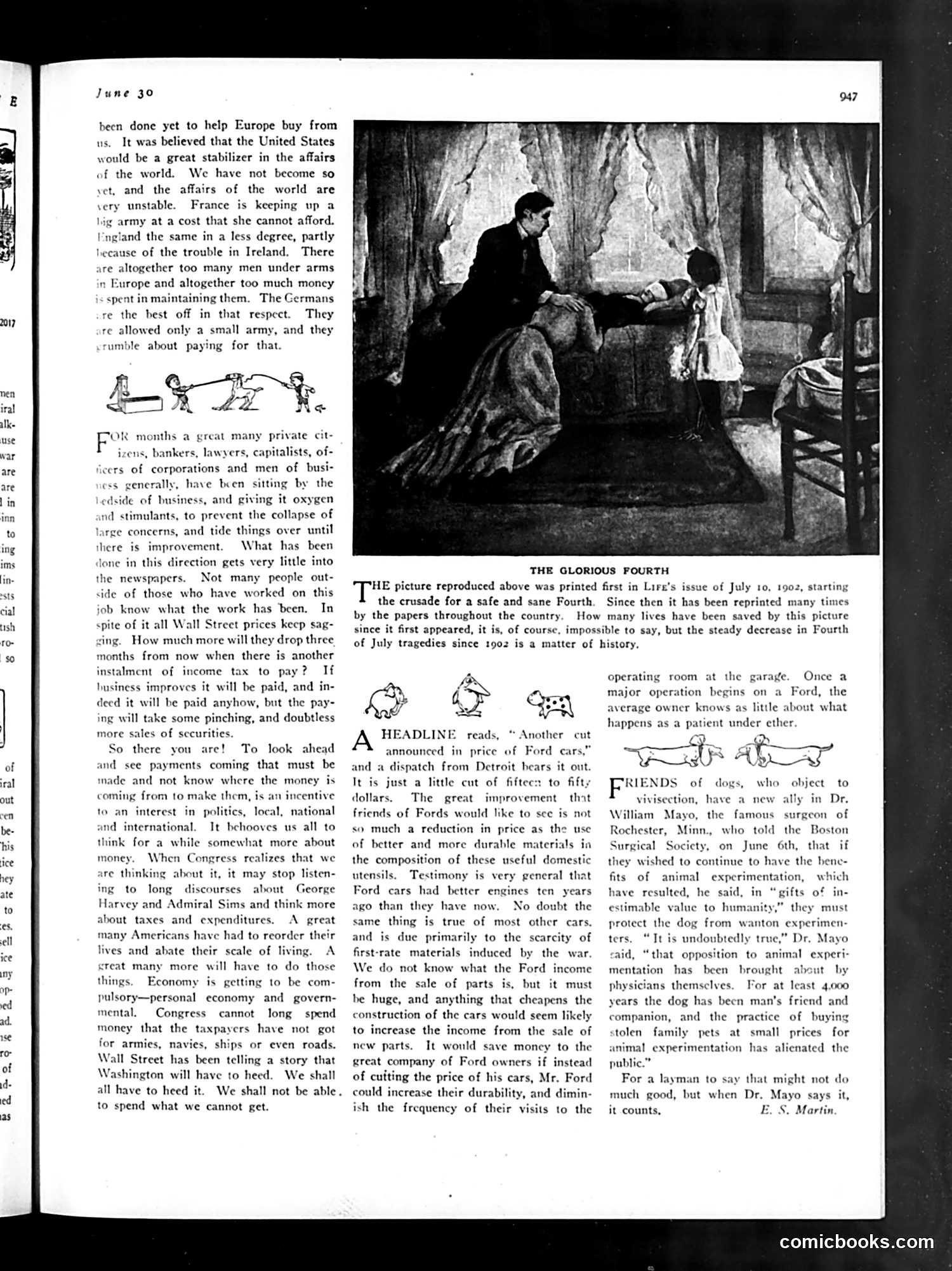
## Main Political Commentary The left column discusses post-WWI economic instability in Europe and America's failure to stabilize world affairs. It criticizes France and England for maintaining expensive militaries they cannot afford, and expresses anxiety about the upcoming income tax installment and Wall Street's declining prices. The author urges Congress to prioritize fiscal responsibility and taxation over military spending. ## "The Glorious Fourth" Section The photograph shows what appears to be a child injury—consistent with the accompanying text about the magazine's 1902 crusade for "safe and sane" Fourth of July celebrations. The piece credits Life with helping reduce July 4th casualties through repeated publication of this sobering image, positioning the magazine as a public health advocate. ## Ford Motors Discussion The final section discusses minor price cuts on Ford automobiles, arguing the real improvement needed is better materials—particularly engines—which have deteriorated due to WWI material scarcity. This reflects post-war manufacturing concerns about quality degradation from wartime resource constraints.
📄 Transcribed text from this page (OCR, searchable)
Machine-transcribed from the original scan — historical spelling and the odd misread are preserved.
June 30 been done yet to help Europe buy from us. It was believed that the United States would be a great stabilizer in the affairs of the world. We have not become so yet, and the affairs of the world are very unstable. France is keeping up a hig army at a cost that she cannot afford. England the same in a less degree, partly hecause of the trouble in Ireland. There are altogether too many men under arms n Europe and altogether too much moncy s spent in maintaining them. The Germans re the best off in that respect. They re allowed only a small army, and they rumble about paying for that. Fok months a great many private cit- izens, bankers, lawyers, capitalists, of- ficers of corporations and men of busi- css generally, have been sitting by the side of business, and giving it oxygen stimulants, to prevent the collapse of large concerns, and tide things over until here is improvement. What has been done in this direction gets very little into the newspapers. Not many people out- side of those who have worked on this job know what the work has been. In spite of it all Wall Street prices keep sag- ng. How much more will they drop three months from now when there is another instalment of to pay? If business improves it will be paid, and in- income tax deed it will be paid anyhow, but the pay- ing will take some pinching, and doubtless more sales of securities. So there To look ahead and see payments coming that must be you are! made and not know where the money is coming from to make them, is an incentive to an interest in politics, local, national and international. It behooves us all to think for a while somewhat more about When Congress realizes that we are thinking about it, it may stop listen- ing to Harvey and Admiral Sims and think more about taxes and expenditures. A great many Americans have had to reorder their lives and abate their scale of living. A great many things. money. long discourses about George more will have to do those Economy is getting to be com- pulsory—personal economy and govern- mental. Congress long spend money that the taxpayers have not got for armies, navies, ships or even roads. Wall Street has been telling a story that Washington will have to heed. We shall all have to heed it. to spend what we cannot get. cannot We shall not be able. THE GLORIOUS FOURTH HE picture reproduced above was printed first in Lire’s issue of July 10, 1902, starting the crusade for a safe and sane Fourth. by the papers throughout the country Since then it has been reprinted many times How many lives have been saved by this picture since it first appeared, it is, of course, impossible to say, but the steady decrease in Fourth of July tragedies since 1902 is a matter of history, ‘> HEADLINE reads, announced in price of Ford car and a dispatch from Detroit hears it out. It is just a little cut of fifteen to fifty dollars. The great improvement that friends of Fords would like to see is not so much a reduction in price as the use of better and more durable materials in the composition of these useful domestic utensils. “Another cut Testimony is very general that Ford cars had better engines ten years ago than they have now. No doubt the same thing is true of most other cars, and is due primarily to the scarcity of first-rate materials induced by the war. We do not know what the Ford income from the sale of parts is, but it must be huge, and anything that cheapens the construction of the cars would seem likely to increase the income from the sale of new ts. It would save money to the great company of Ford owners if instead of cutting the price of his cars, Mr. Ford could increase their durability, ish the frequency of their v and dimin- sits to the Once a major ope a Ford, the average owner knows as little about what happens as a patient under ether. fa) - “Fad ADL RIENDS of who vivisection, have a new ally in Dr. William Mayo, the famous surgeon of Rochester, Minn., told the Boston Surgical Society, on June 6th, that if they wished to continue to have the bene- fits of animal experimentation, which have resulted, he said, in “gifts of in- estimable value to humanity,” th operating room at the garage. ation begins on dogs, object to who y must protect the dog from wanton experimen- “Tris undoubtedly true,” Dr. Mayo aid, “that opposition to animal experi- mentation has been brought about by For at least 4,000 years the dog has becn man's friend and ters. physicians themselves. companion, and the practice of buying stolen family pets at small prices for imal experimentation has alienated the publ For a layman to say that might not much good, but when Dr, Mayo says it, it counts, E. S. Martin comicbooks.com