
Life, 1921-06-30 · page 28 of 41
Life — June 30, 1921 — page 28: what you’re looking at
What you’re looking at
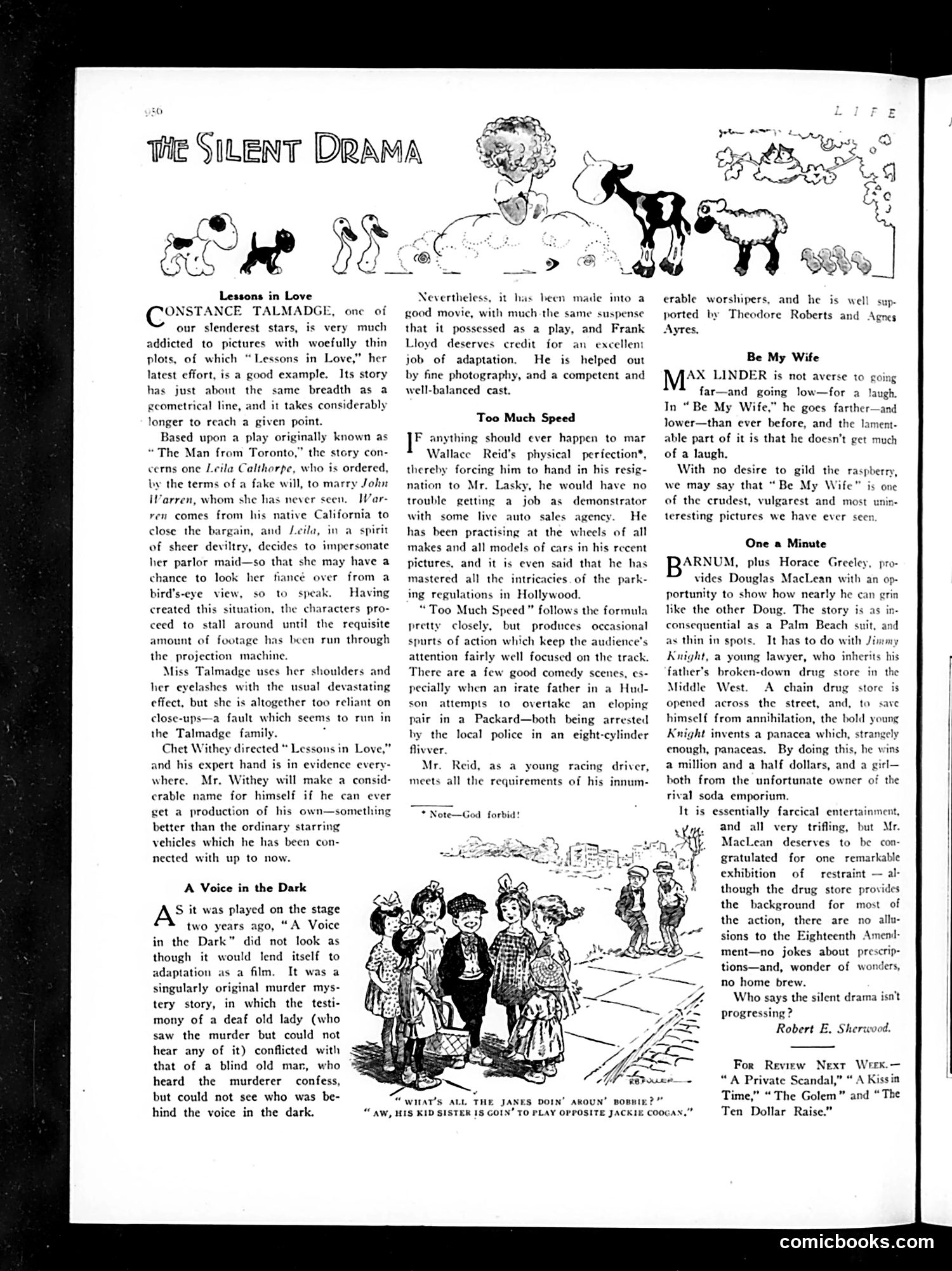
This page reviews several silent films (note the title references cinema without sound). The cartoons at top illustrate plot scenarios from the reviewed movies. **Key content:** The reviews critique 1920s silent films starring major stars like Constance Talmadge, Wallace Reid, and Max Linder. The satire is gentle—the critic mocks thin plots ("breadth as a geometrical line"), over-reliance on close-ups, and crude humor rather than attacking serious targets. Notable: A footnote quipping "God forbid!" about Reid's physical perfection suggests contemporary concern with Hollywood stars' vanity. The review of "Be My Wife" is notably harsh, calling it "crudest, vulgarest" entertainment—indicating Life's satirical stance as arbiter of taste against lowbrow comedy. The illustration at bottom depicts a street scene, likely from one of the reviewed films. This reflects Life's role as a magazine for educated audiences commenting on popular entertainment's quality and morality during the silent film era.
📄 Transcribed text from this page (OCR, searchable)
Machine-transcribed from the original scan — historical spelling and the odd misread are preserved.
20 Tie SILENT DRAMA Lessons in Love ONSTANCE TALMADGE, onc of our slenderest stars, is very much addicted to pictures with woefully thin plots, of which “Lessons in Love,” her latest effort, is a good example. Its story just about the same breadth as a geometrical line, and it takes considerably longer to reach a given point. Based upon a play originally known as “The Man from Toronto,” the story con- cerns one Leila Calthorpe, who is ordered, ly the terms of a fake will, to marry John War- ren comes from his native California to close the bargain, and Leila, in a. spirit has IVarren, whom she has never seen. of sheer deviltry, decides to impersonate her parlor maid—so that she may have a over from a speak. Having created this situation, the characters pro- ceed to stall around until the requisite chance to look her fian bird's-eye view, so to amount of footage has been run through the projection machine. Miss Talmadge uses her shoulders and ler eyelashes with the usual devastating effect, but she is altogether too reliant on close-ups—a fault which seems to run in the Talmadge family . Chet Withey directed * onsin Lot and his expert hand is in evidence every- where. Mr. Withey will make a consid- erable name for himself if he can ever get a production of his own—something better than the ordinary starring vehicles which he has been con- nected with up to now. A Voice in the Dark AS it was played on the stage two years ago, “A Voice in the Dark” did not look as though it would lend itself to adaptation as a film, It was a singularly original murder mys- tery story, in which the testi- mony of a deaf old lady (who saw the murder but could not hear any of it) conflicted with that of a blind old mar, who heard the murderer confess, but could not see who was be- hind the voice in the dark. Nevertheless, it has been made into a good movie, with much the same suspense that it possessed as a play, and Frank Lloyd deserves credit for an excellent job of adaptation. He is helped out by fine photography, and a competent and well-balanced cast. Too Much Speed ]F anything should ever happen to mar Wallace Reid’s physical perfection*, thereby forcing him to hand in his resig- nation to Mr. Lasky, he would have no trouble getting a job as demonstrator with some live auto sales agency. He has been practising at the wheels of all makes and all models of cars in his recent pictures, and it is even said that he has mastered all the intricacies. of the park- ing regulations in Hollywood. “Too Much Speed” follows the formula pretty but produces occasional spurts of action which keep the audience's attention fairly well focused on the track. There are a few good comedy scenes, es- pecially when an irate father in a Huw son attempts to overtake an eloping pair in a Packard—both being arrested hy the local police in an eight-cylinder flivver. Mr. Reid, as a young racing driver, meets all the requirements of his innum- closely, * Note—God forbid! pee any erable worshipers, and he is ported by Ayres, well sup- Theodore Roberts and Agnes Be My Wife X LINDER is not averse to going far—and going low—for a laugh. In “Be My Wife,” he goes farther—and lower—than ever before, and the lament- able part of it is that he doesn’t get much of a laugh, With no desire to gild the raspberry, we may say that “Be My Wife” is one of the crudest, vulgarest and most unin- teresting pictures we have ever seen One a Minute BARNUM. plus Horace Greeley, pro- vides Douglas MacLean with an op- portunity to show how nearly he can grin like the other Doug. The story is as consequential as a Palm Beach suit, and as thin in spots. It has to do with Jimmy Knight, a young lawyer, who inherits his father’s broken-down drug store in the Middle West. A chain drug store is opened across the street, and, to save himself from annihilation, the bold young Knight invents a panacea which, strangely enough, panaceas. By doing this, he wins a million and a half dollars, and a girl— both from the unfortunate owner of the rival soda emporium. It is essentially farcical entertainment, and all very trifling, but Mr. MacLean deserves to gratulated for one remarkable exhibition of restraint — al- though the drug store provides the background for the action, there are no allu- sions to the Eighteenth Amend ment—no jokes about prescrip- tions—and, wonder of wor no home brew. Who says the silent drama isn’t Progressing ? Robert E. Sherwood. be con- most of For Review Next Weex.— “A Private Scandal,” “ A Kissin Time,” “The Golem” and “The WHATS ALL THE J “ AW, MIS KID SISTER 1S GOL $ DOIN’ AKOUN’ Bonnin?” TO PLAY OPPOSITE JACKIE COOGAN,” Ten Dollar Raise.” comicbooks.com