
Life, 1921-06-30 · page 35 of 41
Life — June 30, 1921 — page 35: what you’re looking at
What you’re looking at
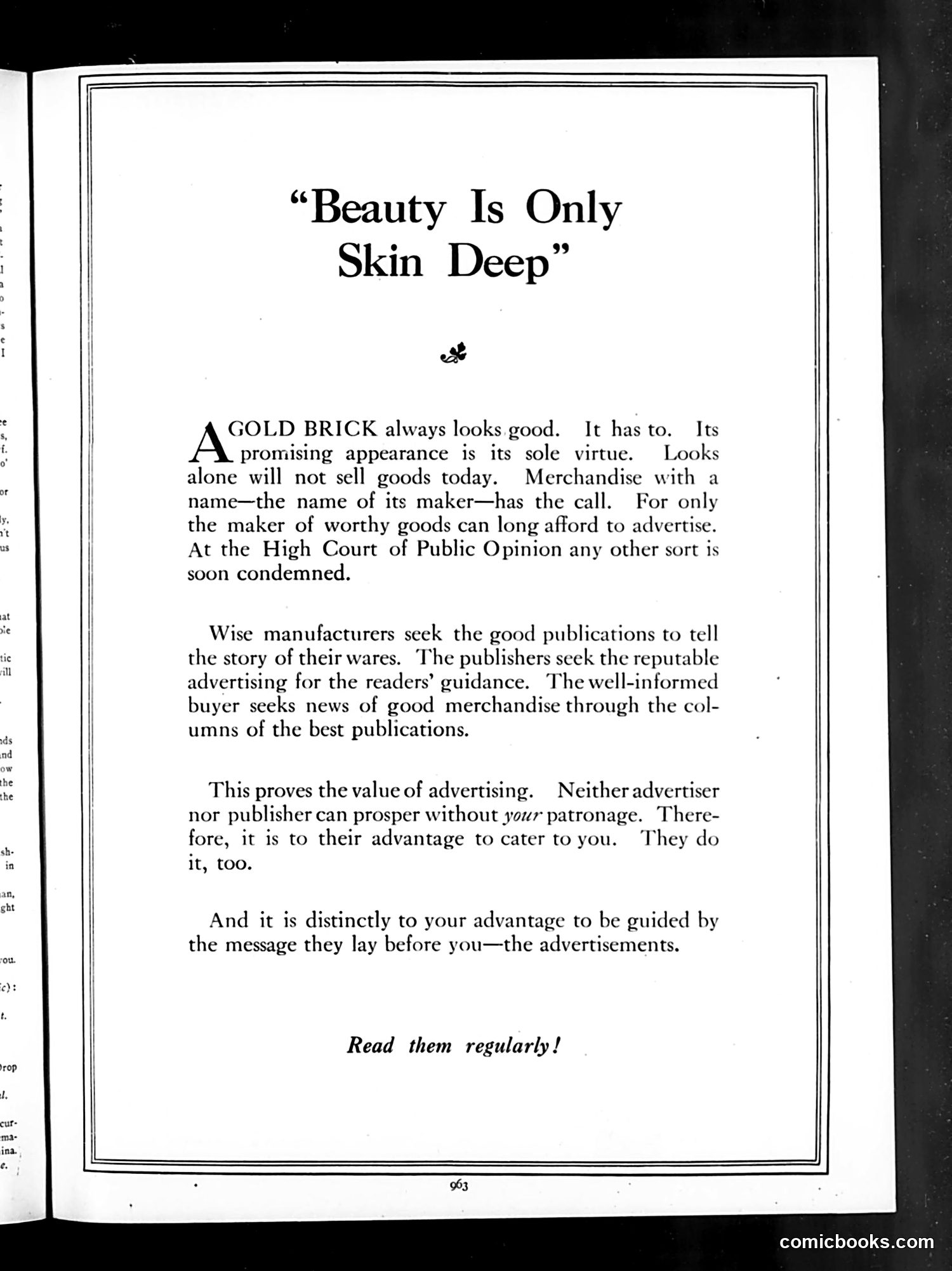
This is not a cartoon but rather a **full-page advertisement or editorial** promoting the value of advertising itself—a meta-advertisement appearing in *Life* magazine. The piece uses the phrase "Beauty Is Only Skin Deep" to argue against superficial marketing. It contrasts a "gold brick" (a con or fraudulent product with only attractive appearance) with legitimate merchandise backed by reputable manufacturers' names. The central argument: **only makers of genuinely worthy goods can afford sustained advertising** in quality publications. Therefore, readers should trust advertisements as a reliable guide—advertisers and publishers mutually benefit from maintaining credibility, creating alignment between consumer and advertiser interests. The satire appears gentle and self-serving: *Life* essentially tells readers that reading advertisements regularly is in their interest because the economic incentives naturally ensure only good products are advertised. This reflects early-20th-century advertising philosophy that positioned ads as consumer guidance rather than manipulation. The piece serves *Life's* business interests by legitimizing advertising as trustworthy editorial content.
📄 Transcribed text from this page (OCR, searchable)
Machine-transcribed from the original scan — historical spelling and the odd misread are preserved.
“Beauty Is Only Skin Deep” & GOLD BRICK always looks.good. It has to. _ Its promising appearance is its sole virtue. Looks alone will not sell goods today. Merchandise with a name—the name of its maker—has the call. For only the maker of worthy goods can long afford to advertise. At the High Court of Public Opinion any other sort is soon condemned. Wise manufacturers seek the good publications to tell the story of their wares. The publishers seek the reputable advertising for the readers’ guidance. The well-informed buyer seeks news of good merchandise through the col- umns of the best publications. This proves the value of advertising. Neither advertiser nor publisher can prosper without your patronage. There- fore, it is to their advantage to cater to you. They do it, too. And it is distinctly to your advantage to be guided by the message they lay before you—the advertisements. Read them regularly! ea ihe I ake comicbooks.com