
A complete issue · 36 pages · 1921
Life — January 27, 1921
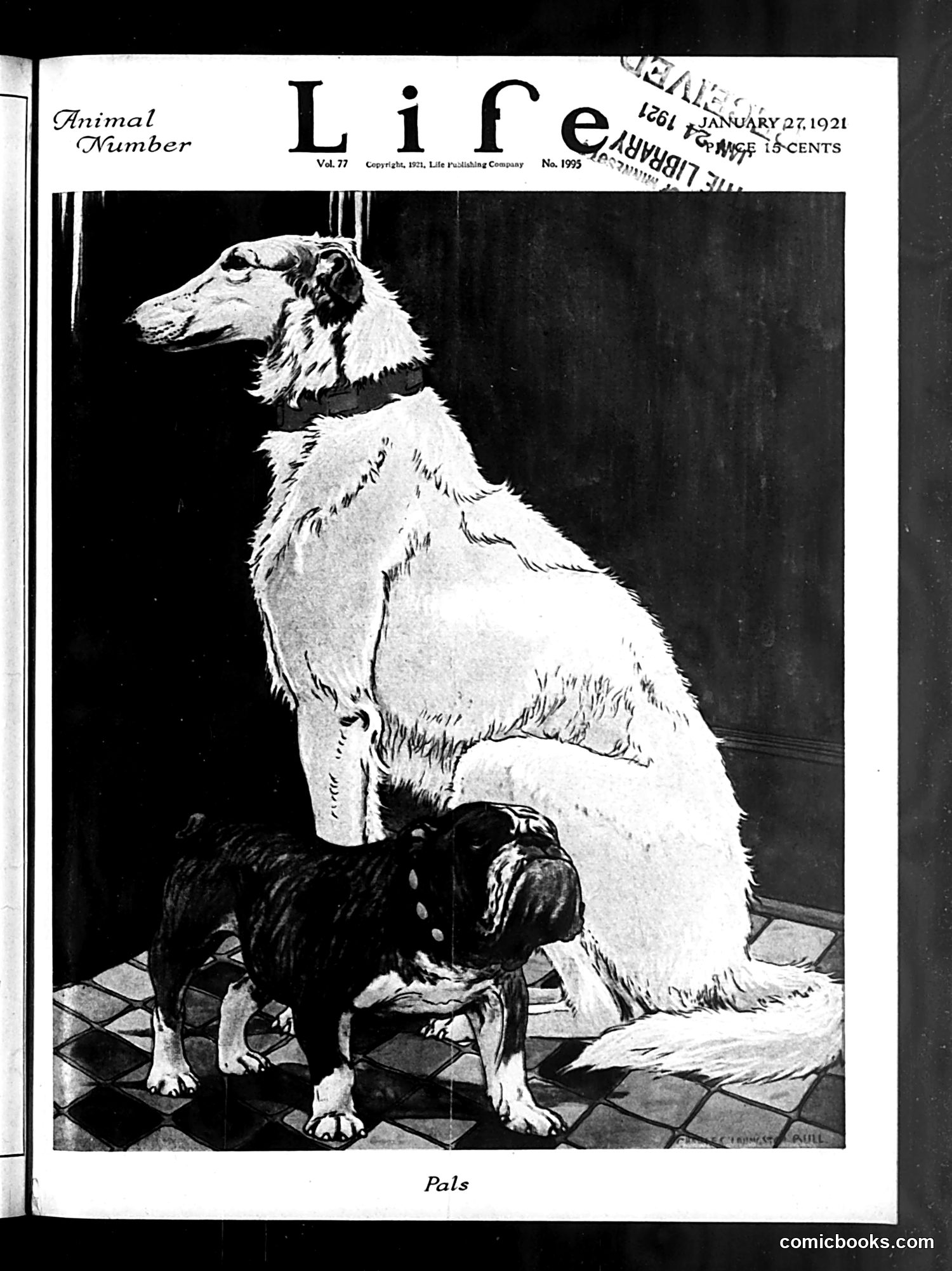
This page features an illustration titled "Pals" depicting two dogs of contrasting sizes and appearance. A large, light-colored dog (possibly a greyhound or similar breed) sits upright in a dignified pose, while a small, dark dog stands beside it. The juxtaposition appears to be satirical commentary on social hierarchy or class differences, using canine companionship as metaphor. The "pals" label suggests an unlikely or ironic friendship between creatures of vastly different status or appearance—a common satirical device in 1920s humor. Without additional context from the magazine's text or surrounding content, the specific social or political target remains unclear, though the image likely references contemporary social divisions or relationships of the post-WWI era.
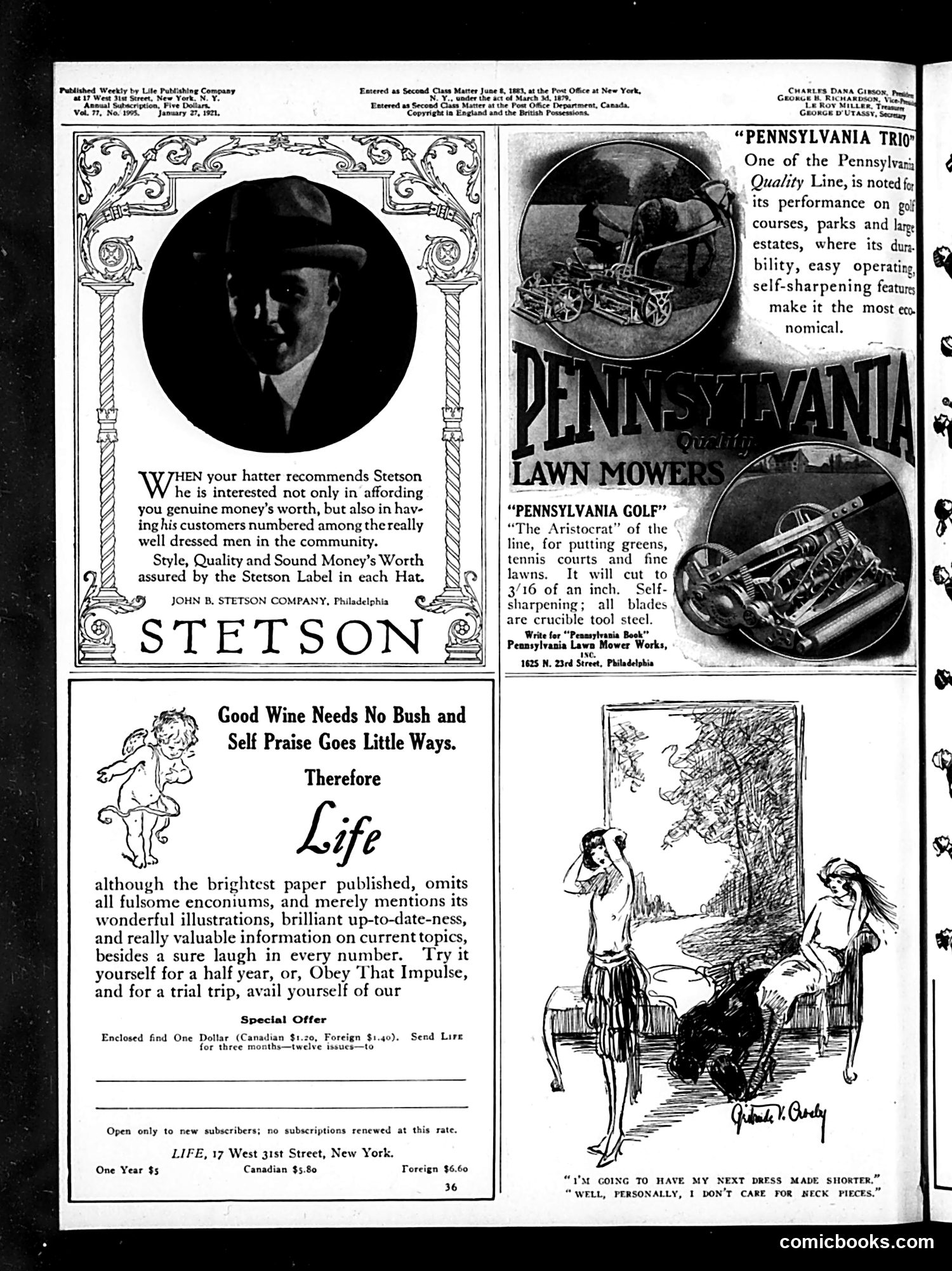
This page is primarily **advertising**, not political satire. It contains three distinct ads: 1. **Stetson hats**: Features a portrait of a well-dressed man, emphasizing that Stetson's reputation ensures quality and style among "really well dressed men." 2. **Pennsylvania lawn mowers**: Two product images showcasing the "Pennsylvania Golf" and "Pennsylvania Trio" models, highlighting self-sharpening blades and durability. 3. **Life magazine subscription**: A humorous cartoon showing two women, one saying she'll have her next dress made shorter, with the other replying she doesn't care for "Rick pieces." The joke plays on fashion trends of the era (likely 1920s, given the flapper-style clothing). The page demonstrates early 20th-century advertising strategy, mixing aspirational lifestyle messaging with product features and editorial humor to attract readers.
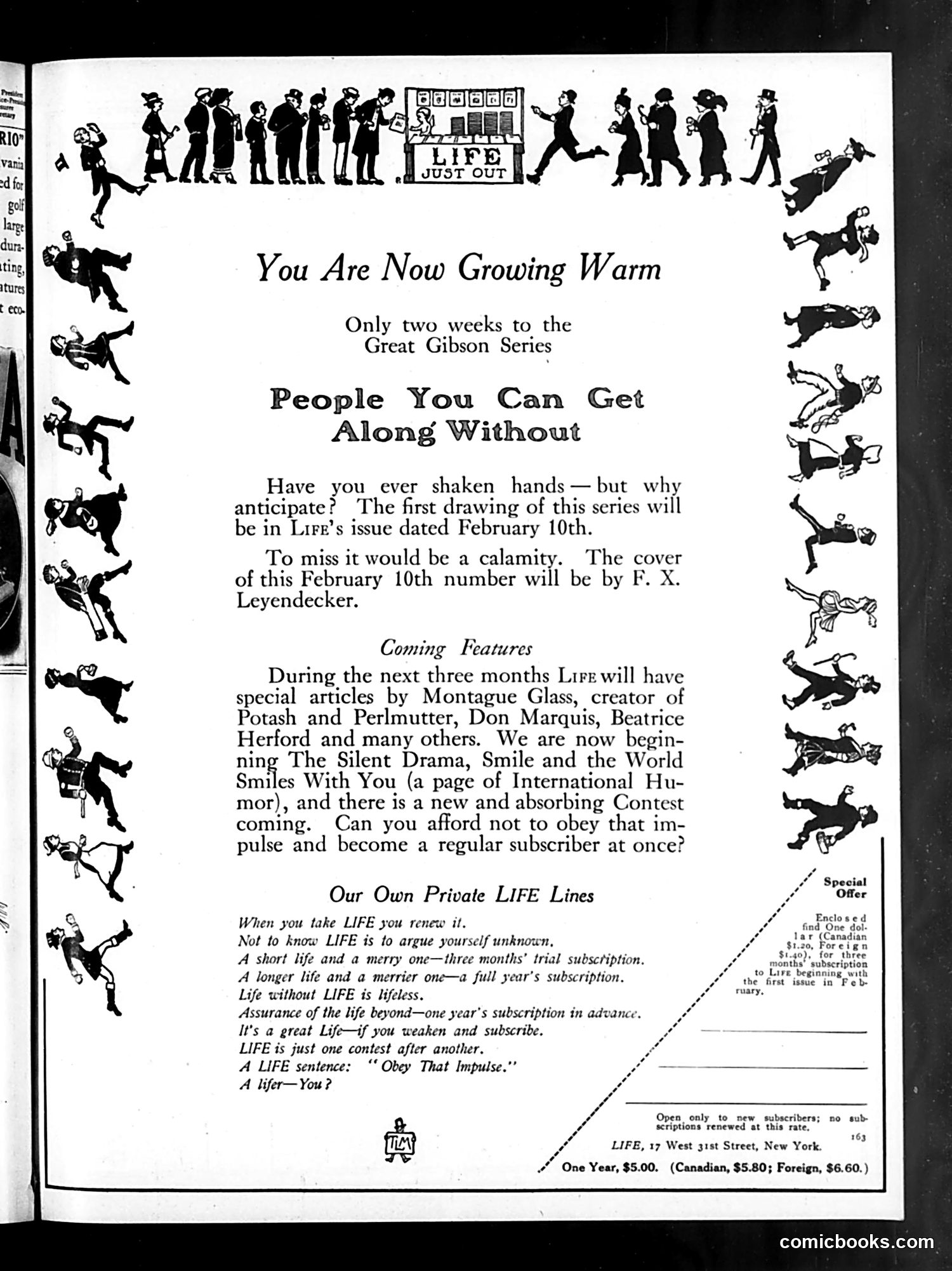
This is primarily a **subscription advertisement** for *Life* magazine, not a political cartoon. The decorative border features silhouettes of people in various comedic poses and situations—appearing to show everyday social interactions and physical comedy scenarios. The ad promotes an upcoming "Great Gibson Series" (likely referencing Charles Dana Gibson's famous "Gibson Girl" illustrations) debuting February 10th, with cover art by F.X. Leyendecker. The text emphasizes forthcoming content: articles by Montague Glass, Don Marquis, and Beatrice Herford, plus new humor features like "The Silent Drama" and "Smiles With You." The subscription rates listed ($5.00 for one year) and special offer suggest this is from the early 20th century. This is essentially a marketing page designed to attract new subscribers through promises of quality entertainment and satire.
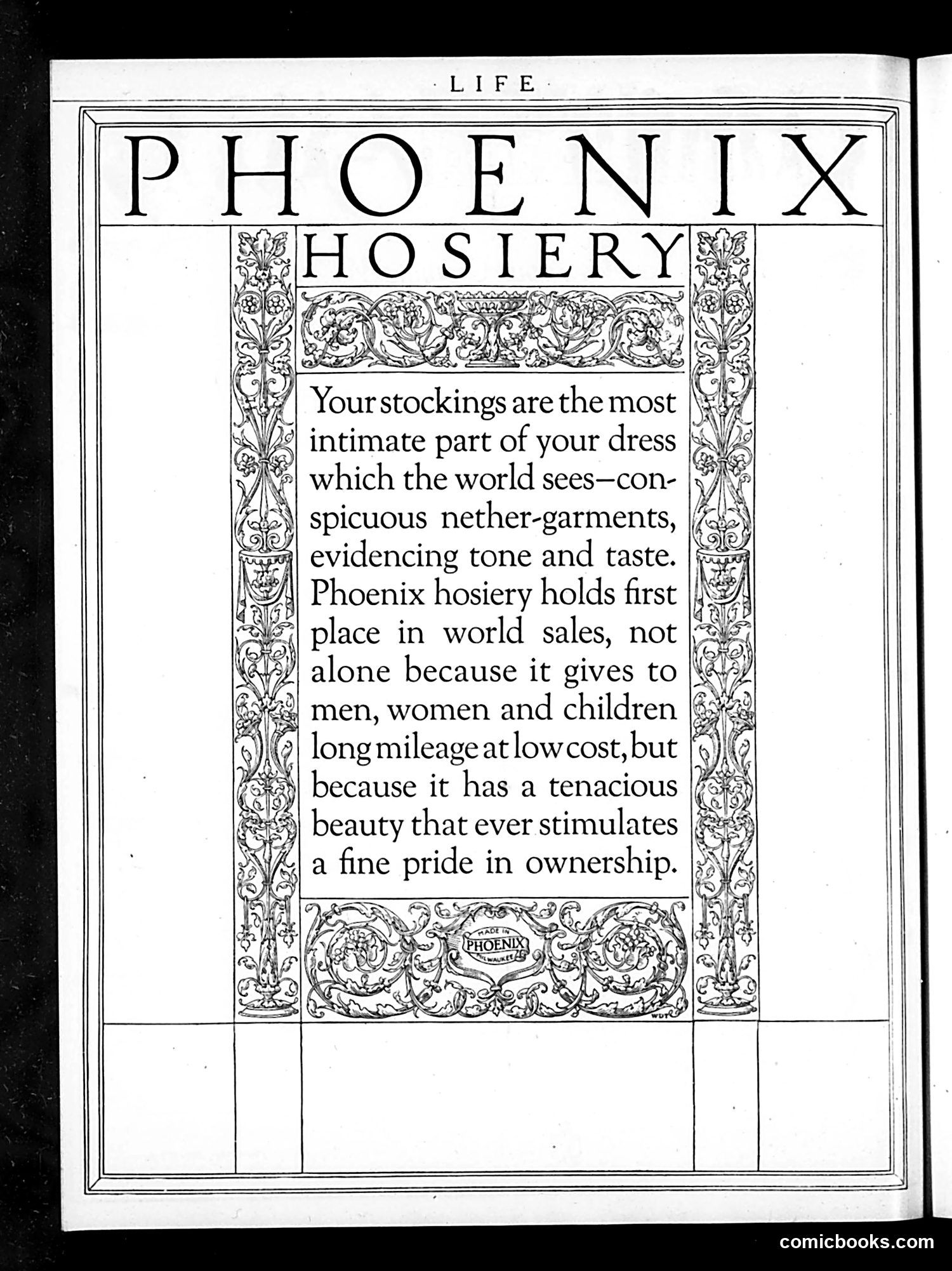
This is a **Phoenix Hosiery advertisement**, not a political cartoon. The page features ornate Art Nouveau-style decorative borders and typography typical of early 20th-century magazine advertising. The ad emphasizes that stockings are an intimate, visible garment that communicates taste and refinement. It argues Phoenix hosiery dominates world sales due to two factors: practical value (durability at low cost) and aesthetic appeal that creates owner pride. This reflects early 1900s gender norms where women's stockings were fashionable status symbols, carefully chosen to signal respectability and good taste. The advertisement appeals to women's desire for quality products that enhance their social standing through refined appearance. The page contains no political satire—it's straightforward consumer marketing from Life magazine's advertising section.
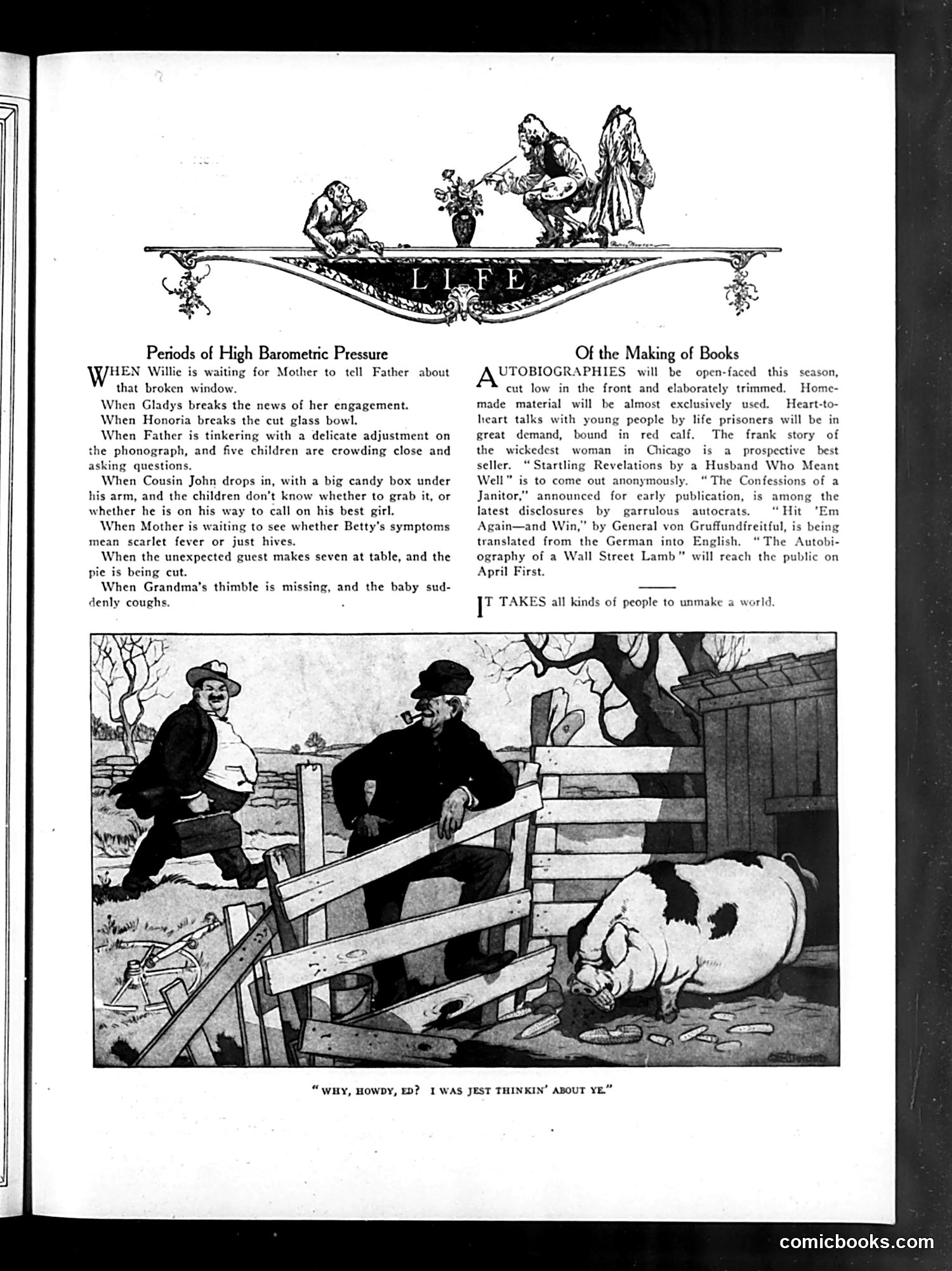
**Top Section ("Periods of High Barometric Pressure"):** This column humorously catalogs domestic domestic crises that cause family anxiety—broken windows, engagements, cut glass bowls, phonograph malfunctions, and missing thimbles. The satire targets the overwrought emotional responses of bourgeois households to minor inconveniences, suggesting Victorian/early-20th-century middle-class families treated trivial incidents as major dramas. **Bottom Cartoon:** Two men in hats lean on a fence watching a pig. One says "Why, howdy, Ed? I was jest thinkin' about ye." The humor relies on rural vernacular and the implication that the pig—not the human—prompted the speaker's thoughts, suggesting the pig resembles or reminds him of his acquaintance. This is mild, rustic humor about appearance-based insults. **Right Column ("Of the Making of Books"):** Book advertisements for spring publications, noting upcoming autobiographies and confessional works gaining market appeal.
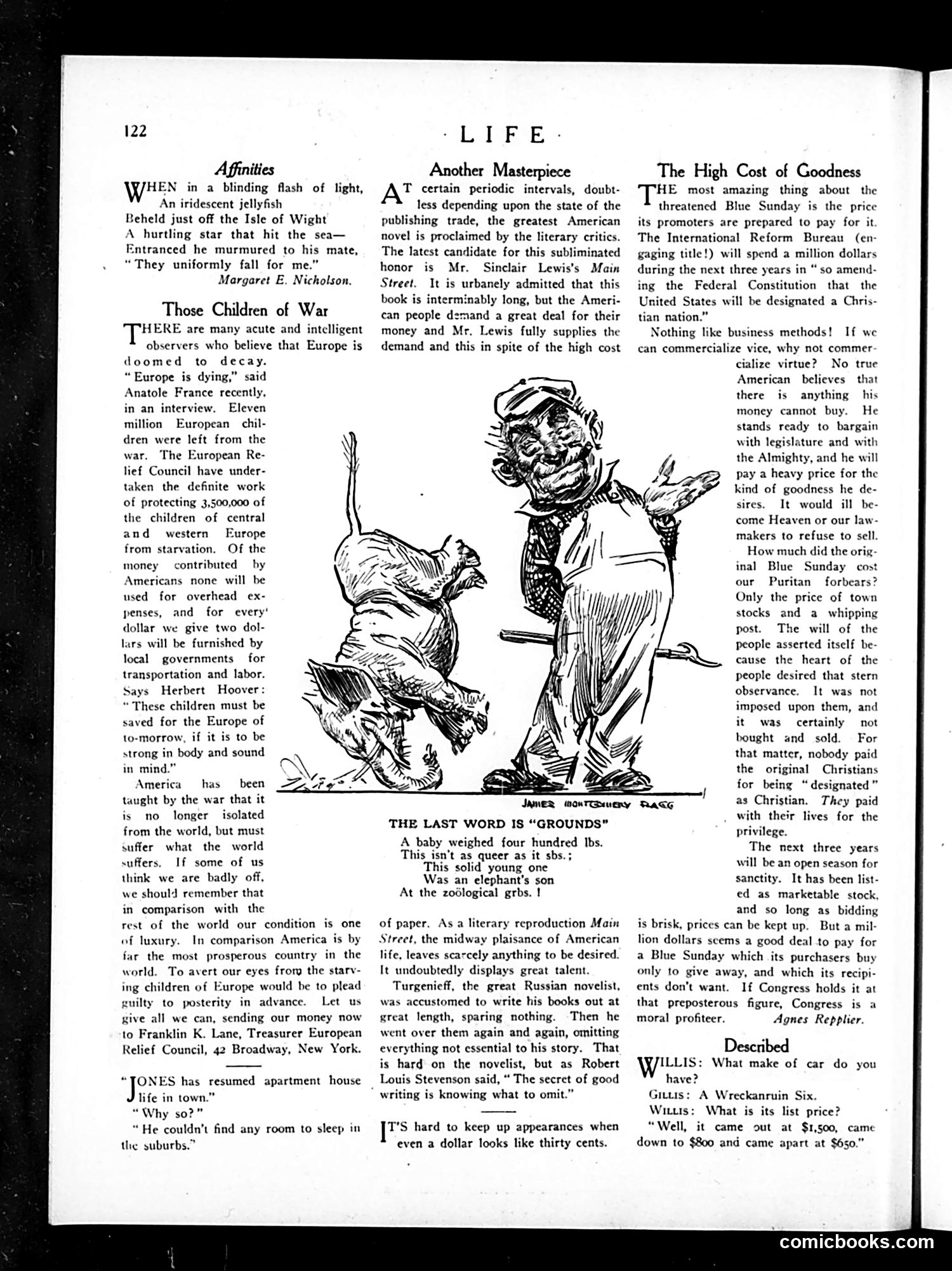
This cartoon by James Montgomery Flagg depicts two figures in what appears to be a confrontational scene, with the caption "THE LAST WORD IS 'GROUNDS.'" The accompanying text suggests this is commentary on a literary dispute. It references Sinclair Lewis's *Main Street* as "the greatest American novel" and discusses literary criticism. The phrase "grounds" likely contains a double meaning—both the literal coffee grounds visible in the cartoon and the figurative "grounds" (basis/justification) for an argument. The cartoon appears to satirize a disagreement between literary figures or critics, though the specific individuals are unclear from the image alone. The humor seems to rest on this wordplay about having "grounds" for one's position.
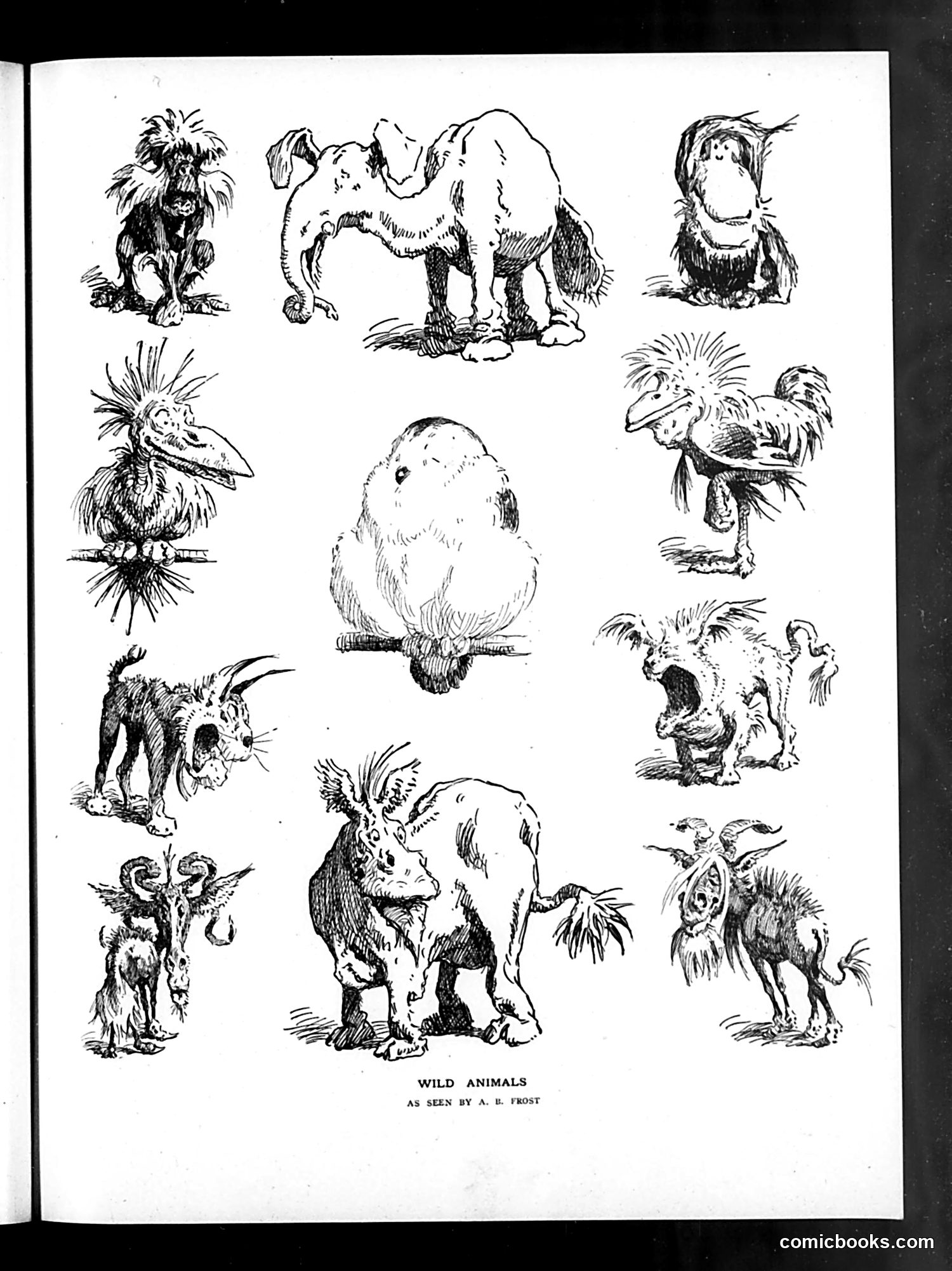
This is a humorous illustration page by cartoonist A.B. Frost showing anthropomorphized animals with exaggerated, grotesque features. The creatures appear intentionally ugly and absurd—featuring prominent teeth, wild hair, distorted proportions, and ungainly postures. The satire likely comments on how artists or satirists distort reality for comic effect, or possibly mocks contemporary social figures by depicting them as these ridiculous "wild animals." The title suggests Frost is offering his particular, unflattering perspective on nature or perhaps on human society portrayed through animal caricature. The heavy inking and deliberate ugliness indicate this is satirical commentary rather than naturalistic illustration, though the specific targets remain unclear without additional historical context about the magazine's contemporary issues.
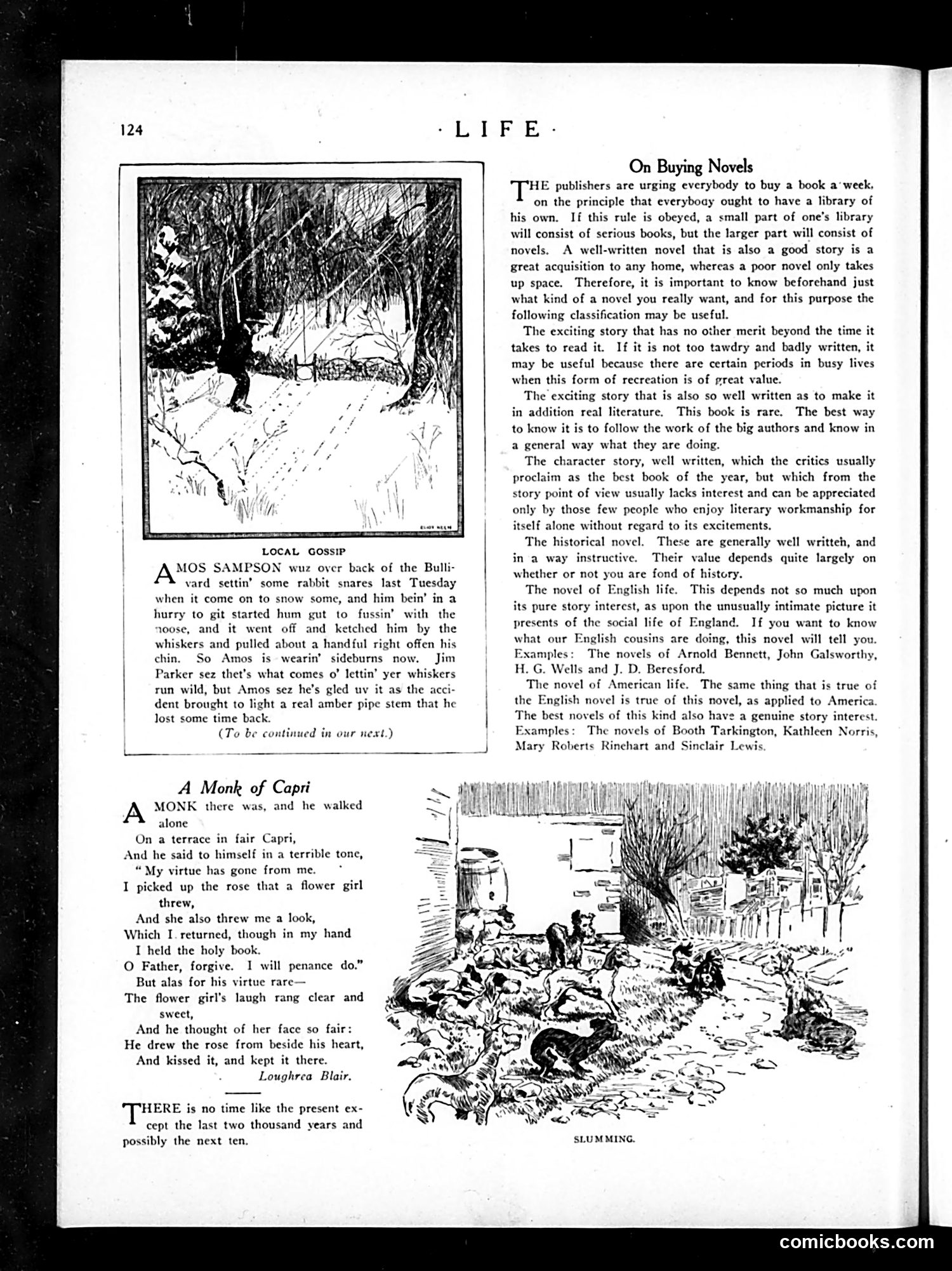
This page contains two distinct sections: **"Local Gossip"** (top left): A sketch-cartoon showing a man in snowy woods discovering what appears to be a discarded pipe stem. The accompanying text humorously recounts Amos Sampson's discovery and speculation about the pipe's origin—gossip-column style humor about small-town life and trivial incidents. **"A Monk of Capri"** (bottom): A poem about a monk in Capri who discards a rose after encountering a flower girl, only to retrieve it later with romantic intent. The accompanying illustration depicts what appears to be a Mediterranean coastal settlement. This is sentimental literary content rather than satire. The page primarily showcases Life magazine's mix of humor, literary content, and illustration rather than overt political commentary.
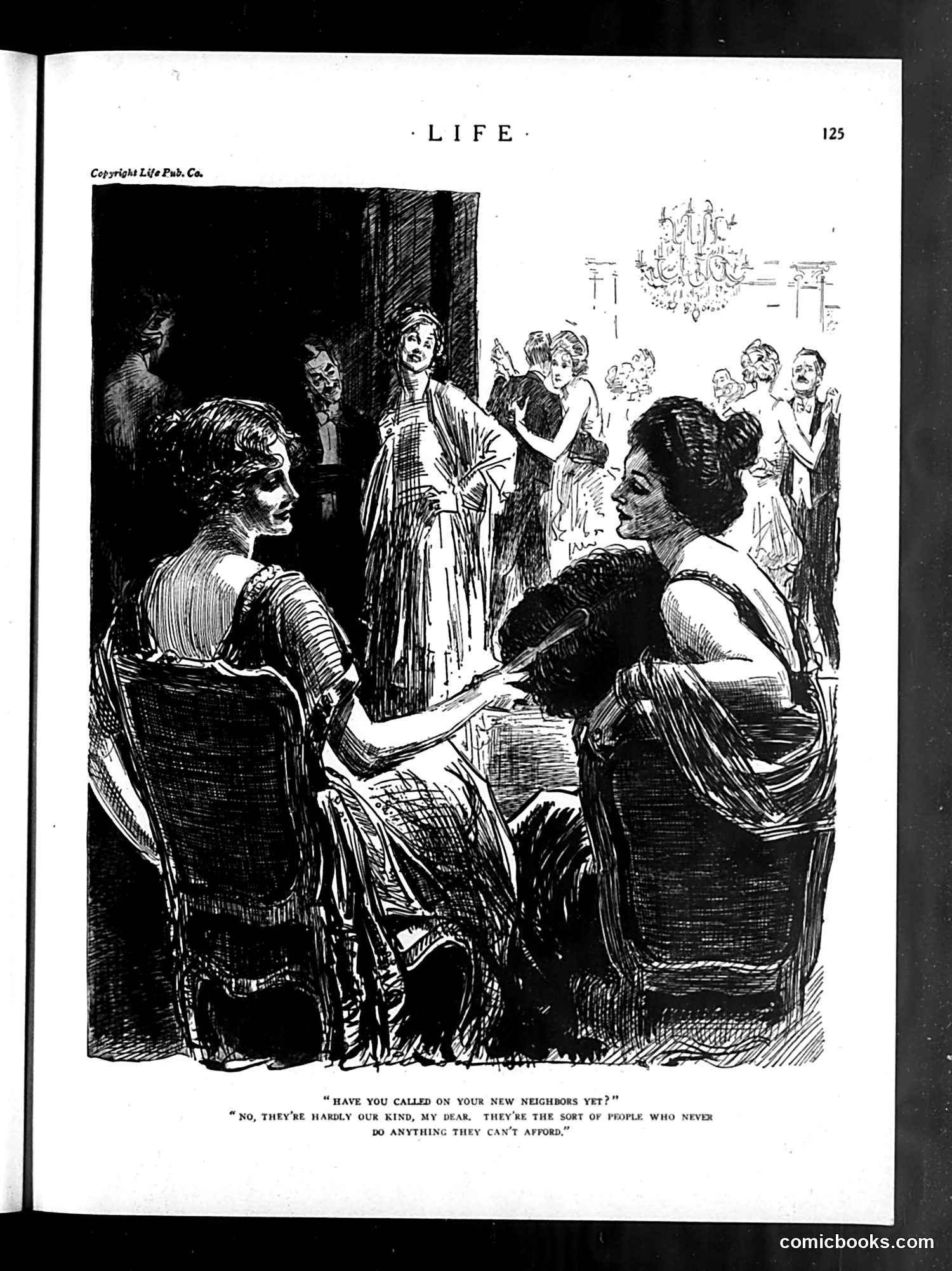
This is a satirical cartoon from *Life* magazine depicting a social scene at what appears to be an upper-class gathering. Two seated women are conversing while other figures mingle in the background, including a chandelier visible above. The caption reveals the satire's target: class anxiety among the wealthy. One woman asks if the other has called on "new neighbors yet," and receives a dismissive response: they're "hardly our kind" because they're "the sort of people who never do anything they can't afford." The joke mocks wealthy pretension—specifically how the rich look down on those who live within their actual means rather than performing conspicuous consumption. It's social satire about hypocrisy within the upper classes, suggesting that old-money families criticize nouveaux riches not for having less money, but for the scandal of financial restraint.
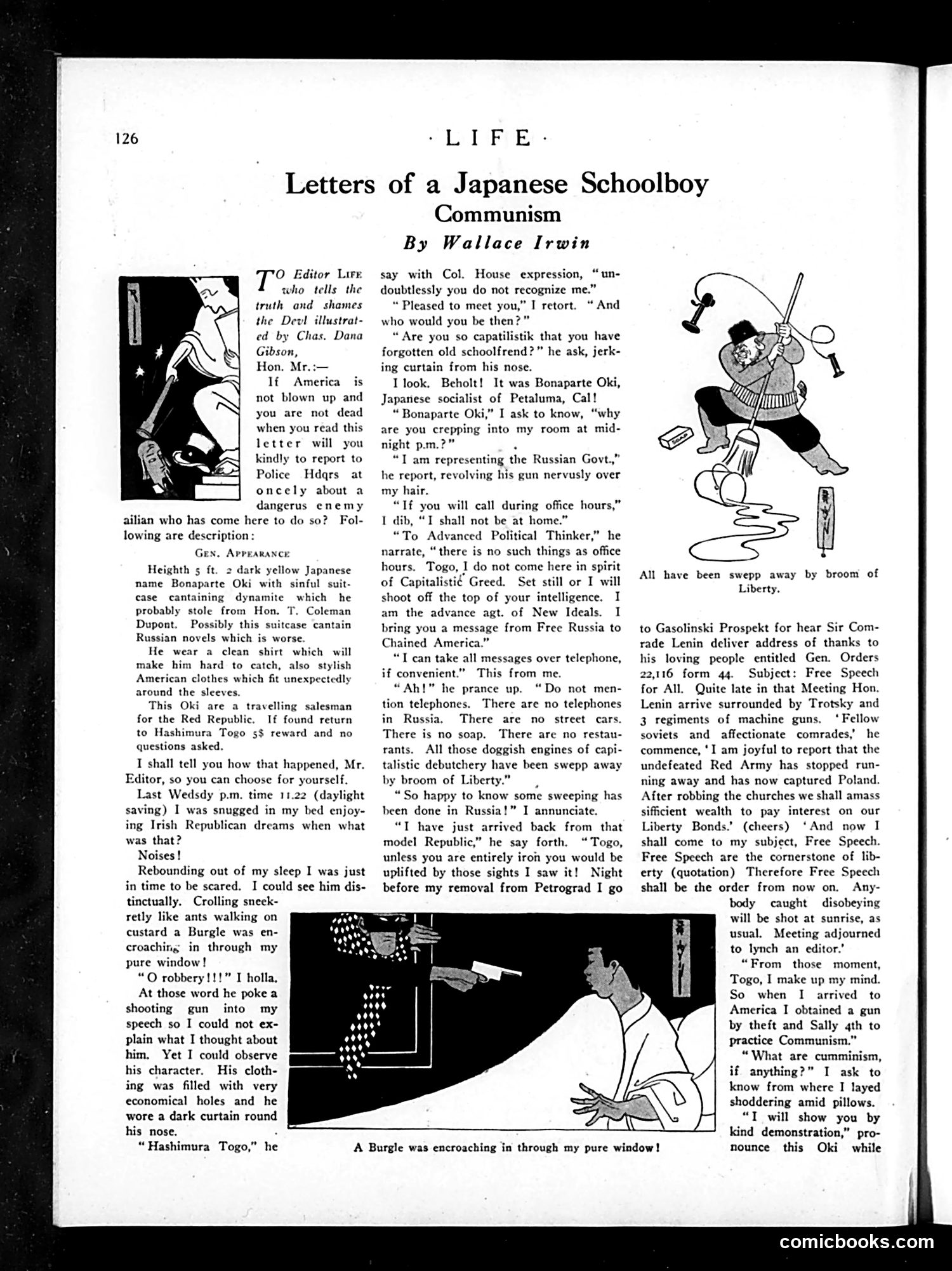
This satirical piece by Wallace Irwin presents a Japanese character (Bonaparte Oki) writing letters to Life's editor. The caricature employs racial stereotypes common to 1910s-20s American satire, depicting a Japanese socialist attempting to infiltrate America. The cartoon mocks early communist/socialist rhetoric by having Oki describe removing telephones, street cars, and soap from Russia—absurd "improvements" under communism. The illustrations show comedic scenes: one depicts a burglar breaking in, another shows destruction. The satire targets both Japanese immigration anxieties and Red Scare fears about communist agitators. The piece uses exaggerated broken English and buffoonish characterization to ridicule both the foreign "threat" and communist ideology as laughably incompetent and destructive.
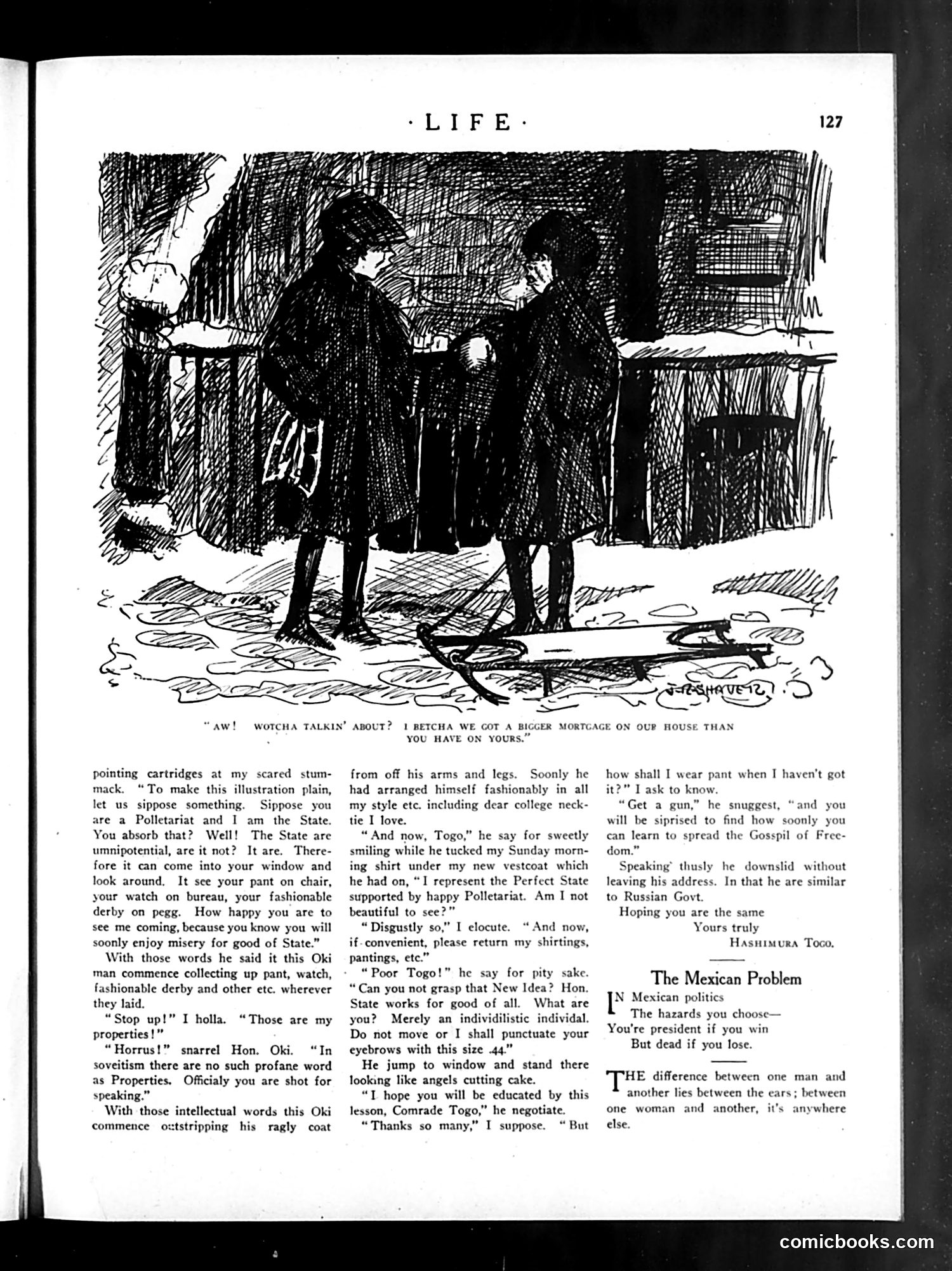
The cartoon depicts two women in coats standing outdoors, with one saying to the other: "Aw! Wotcha talkin' about? I betcha we got a bigger mortgage on our house than you have on yours." This is satirical commentary on **American consumer culture and class anxiety**. The joke targets working and middle-class women who measure their social status through debt and material possessions rather than actual wealth. The dialect ("Wotcha") suggests working-class characters, yet they're comparing mortgages as a status symbol—essentially bragging about how much debt they've accumulated. The satire mocks the paradox of measuring prosperity through liabilities, reflecting post-WWI American economic attitudes where consumer credit was expanding and debt was becoming normalized as a marker of aspiration and status.
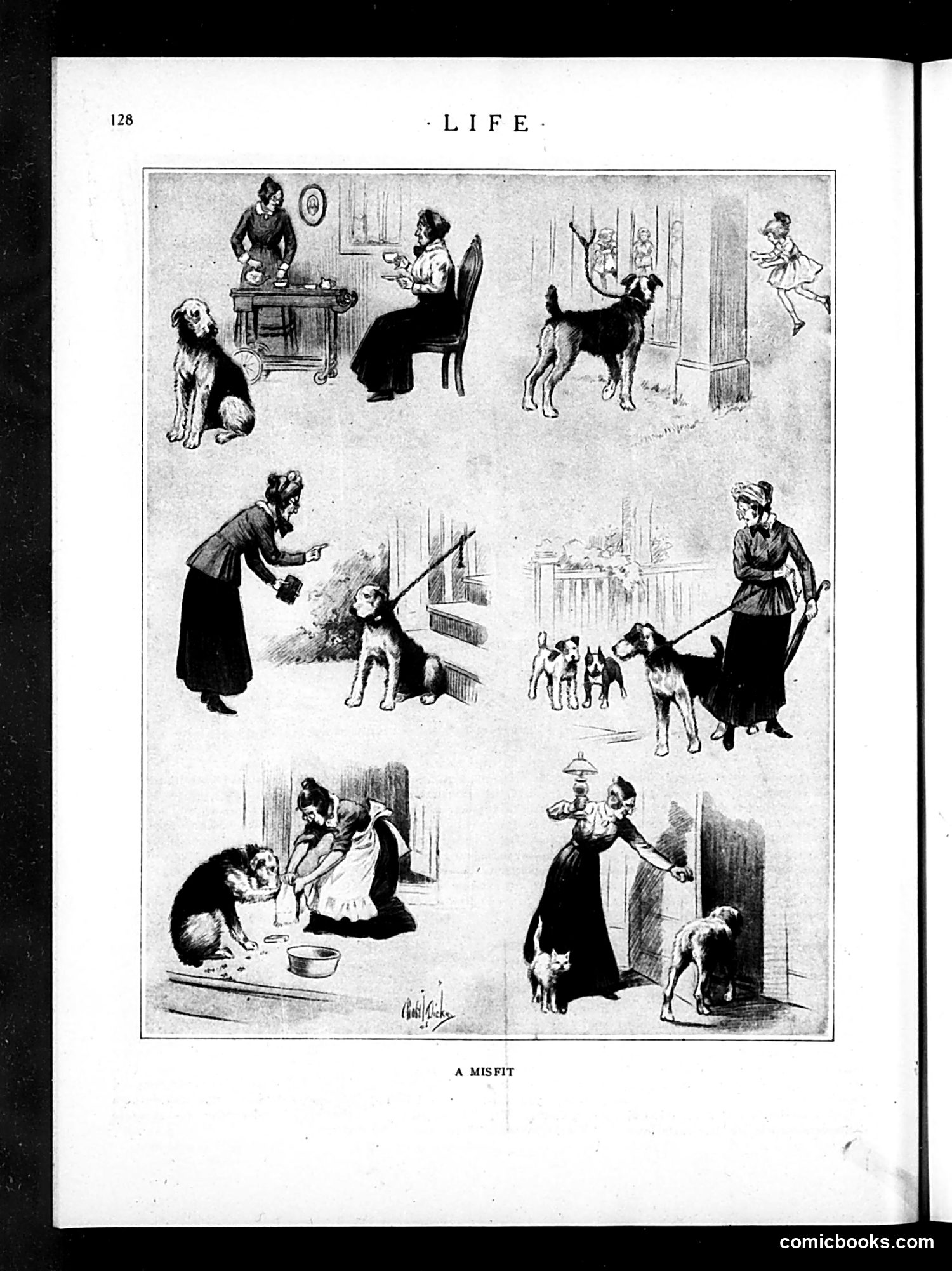
This cartoon series depicts a dog that doesn't fit into human society. Through nine vignettes, we see the dog failing at or disrupting various domestic situations: a woman at a desk ignores it, a seated man's presence confuses it, it chases children indoors, it disrupts a woman walking outside, women scold it for misbehavior, and it generally causes chaos in homes and streets. The satirical point appears to be social commentary about individuals—possibly immigrants, the working class, or social outsiders—who don't conform to middle-class domestic expectations and propriety. The dog represents someone perceived as incompatible with "civilized" society, unable or unwilling to follow social rules. It's satire of Victorian-era social rigidity and prejudice toward those deemed "unfit."
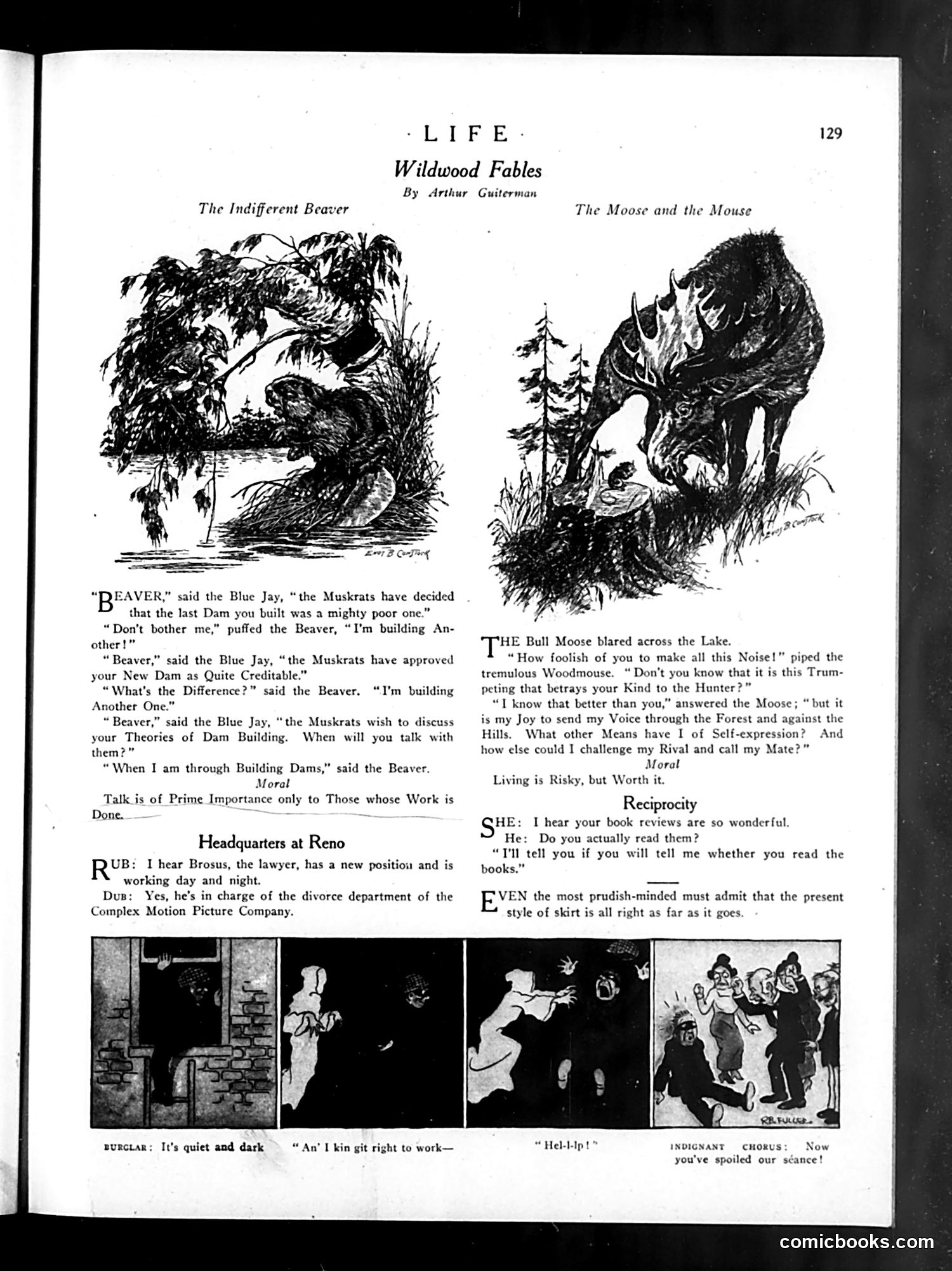
This page from *Life* magazine contains three separate satirical pieces: **"The Indifferent Beaver"** and **"The Moose and the Mouse"** are animal fables by Arthur Guiterman offering moral lessons. The beaver story criticizes someone who ignores others' opinions about his work ("I'm building Another One"), with the moral that talk matters only when work is complete. The moose/mouse tale contrasts self-expression with humility, suggesting living involves risk. **"Headquarters at Reno"** is a brief joke about a lawyer's new position in "the divorce department" of a film company—likely satirizing Hollywood's high divorce rates. The bottom panel shows four film stills from what appears to be a burglary or crime scene comedy, captioned with dialogue and labeled "INDIGNANT CHORUS." The overall tone is light satire typical of 1920s *Life* magazine humor.
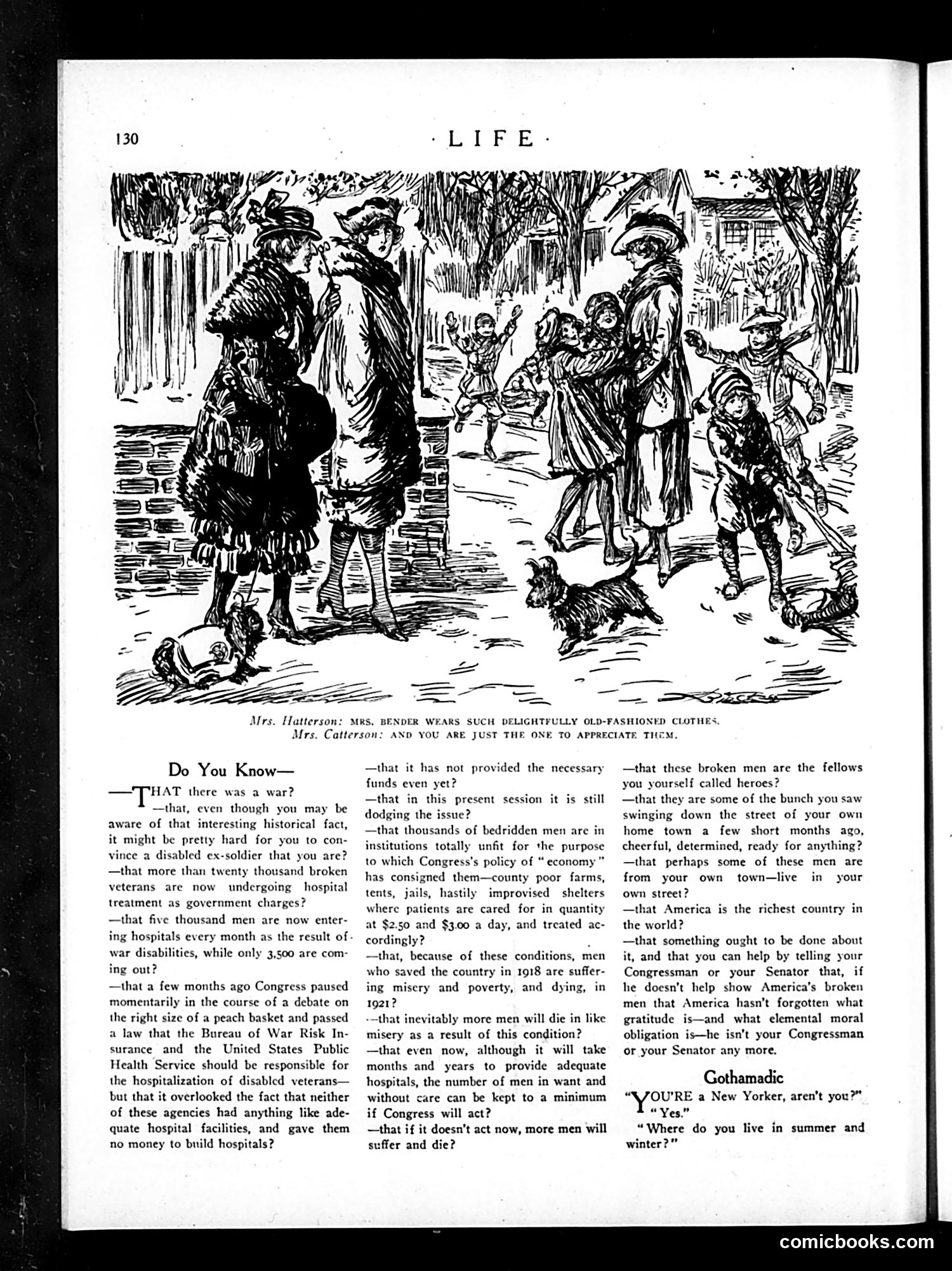
This page contains a satirical cartoon and accompanying editorial commentary about American treatment of disabled war veterans following World War I. The cartoon depicts a street scene where Mrs. Hatterson compliments Mrs. Catterson's "old-fashioned clothes," while children and a dog surround them. The accompanying text reveals the satire's target: Congress's failure to adequately fund hospitals and care for disabled soldiers. The "Do You Know" section lists damning facts—only 3,500 of 20,000 disabled veterans are hospitalized; Congress debates funding while men suffer; broken veterans are warehoused in inadequate facilities costing $2-3 daily. The satire is bitter: while Americans concern themselves with fashion, disabled war heroes—described as "some of the bunch you saw swinging down the street"—languish without proper care, exposing America's failure to honor its obligations to veterans.
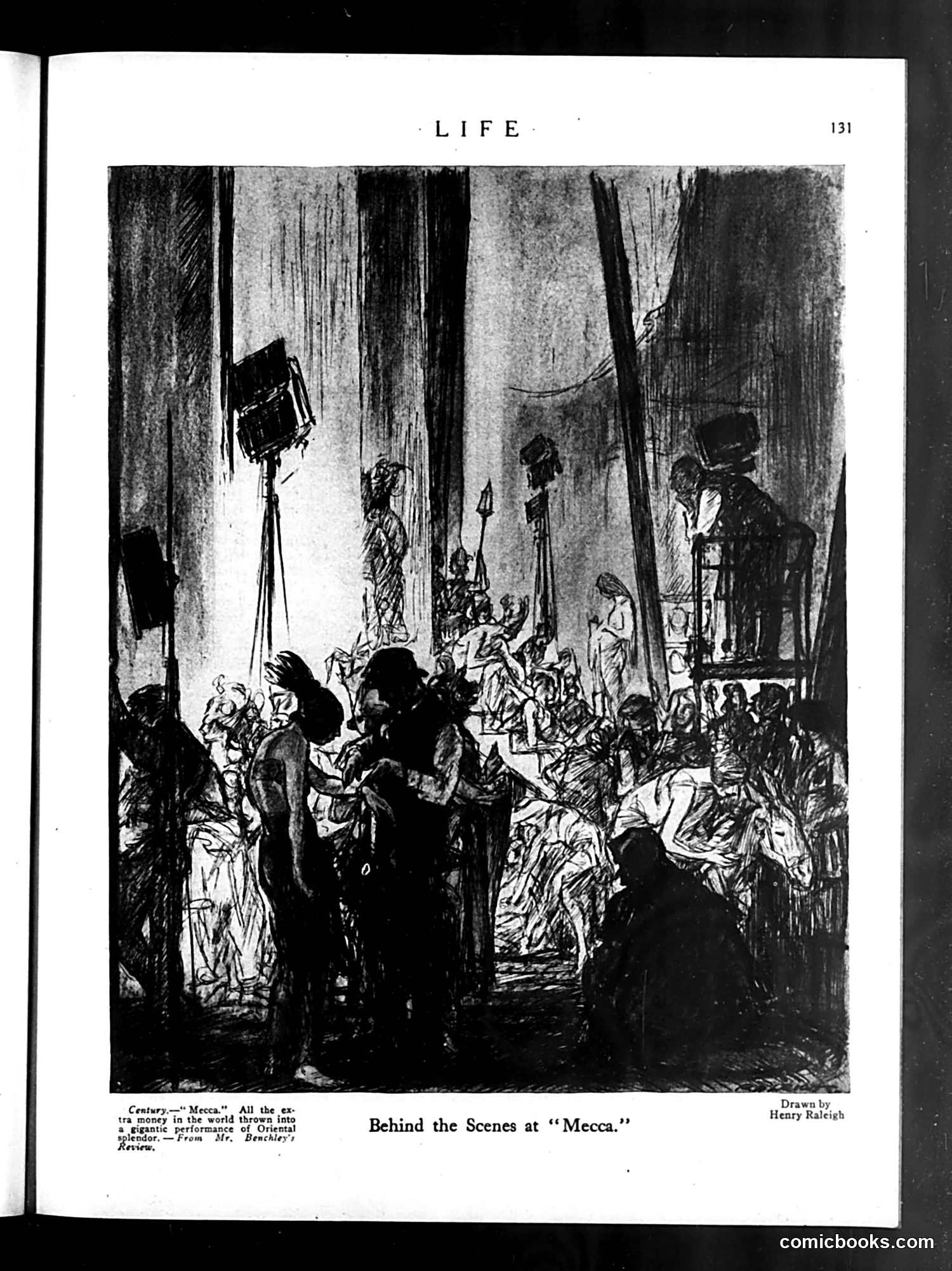
This is a theatrical illustration by Henry Raleigh depicting a scene from the play "Mecca." According to the caption, it shows "all the extra ordinary scenic and electrical effects of this gigantic performance of Oriental splendour." The drawing portrays a crowded theatrical backstage or stage scene with numerous figures in period/Oriental costume amid elaborate staging elements—tall poles, props, and architectural set pieces suggesting an exotic setting. The composition emphasizes the visual spectacle and production complexity required for this apparently lavish theatrical production. The illustration appears designed to showcase the behind-the-scenes complexity and technical ambition of Broadway theatrical production in this era, rather than to offer political satire.
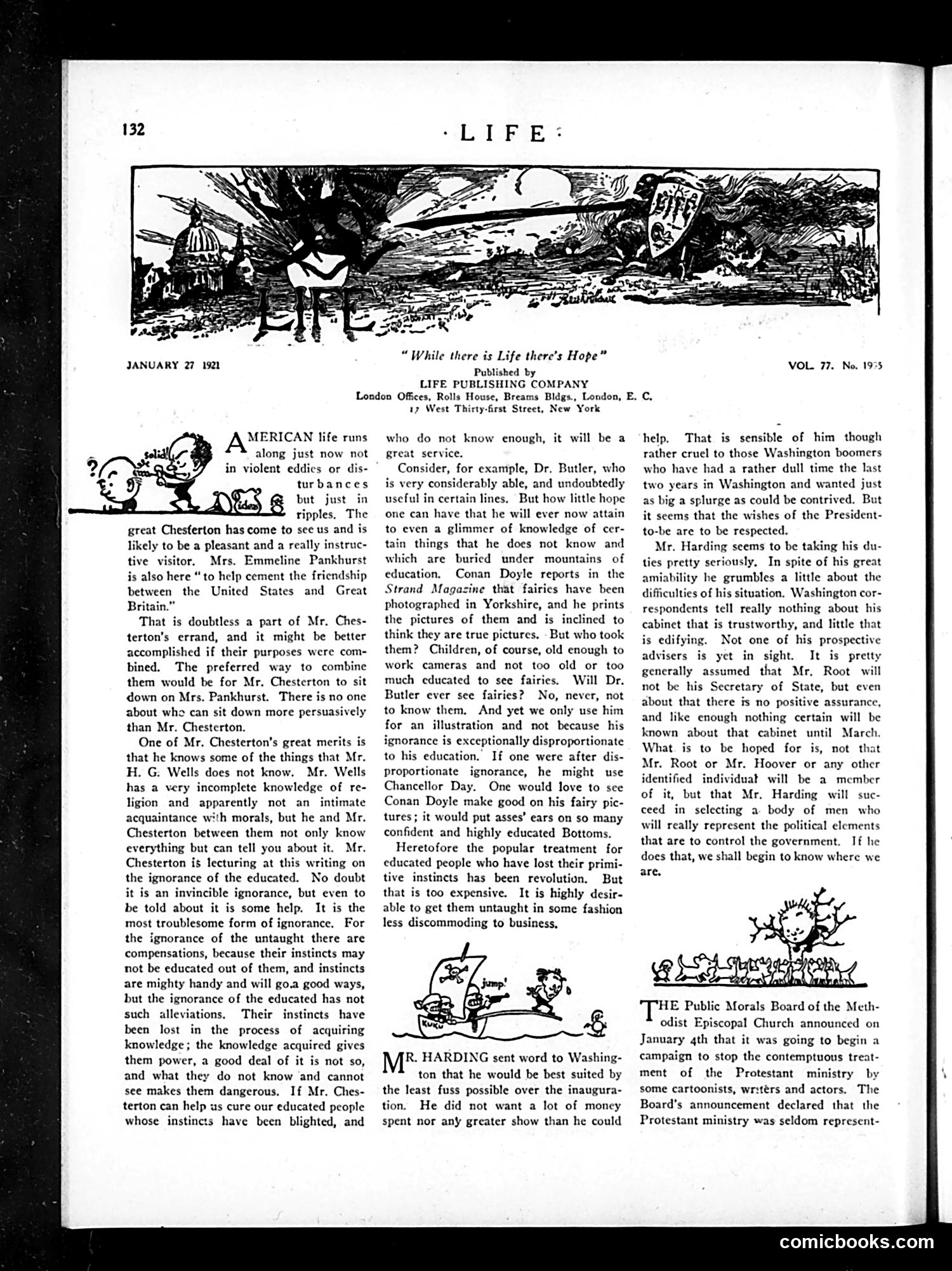
This page contains editorial commentary on American politics and social issues rather than traditional political cartoons. The main article discusses **President Harding's cabinet appointments**, specifically praising **Dr. Butler** as capable while criticizing the general lack of knowledge among Washington officials. The writer argues that educated people should help inform government policy. A secondary piece announces the **Methodist Episcopal Church's Public Morals Board** campaign against "contemptuous treatment of the Protestant ministry by some cartoonists, writers and actors." The small illustrations appear decorative rather than satirical—showing figures and scenes but lacking the sharp caricature typical of Life's political cartoons. The page reflects post-WWI anxieties about government competence and the cultural authority of religious institutions.
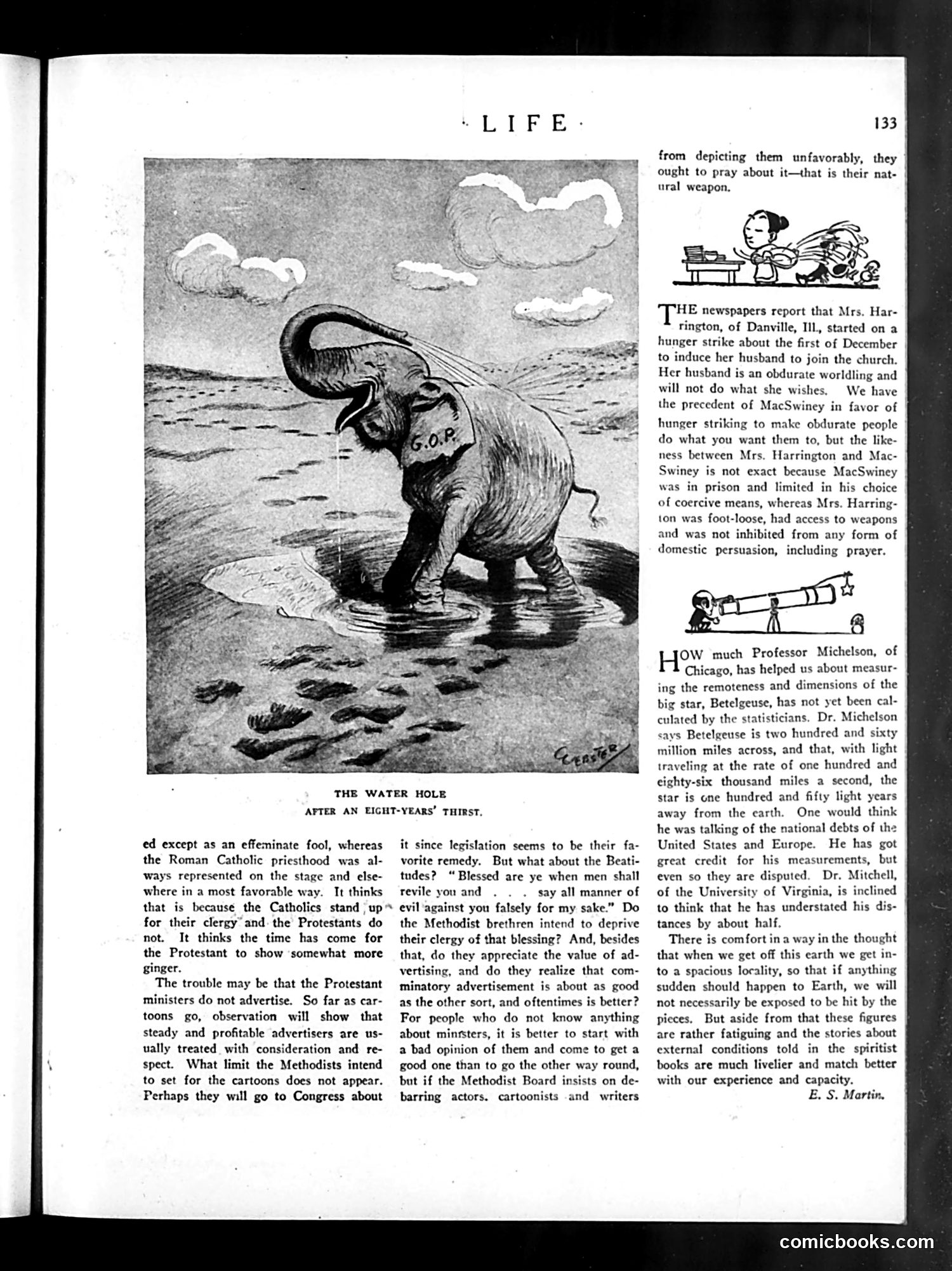
The cartoon depicts an elephant labeled "G.O.P." (Republican Party) at a watering hole, apparently after a prolonged drought. This satirizes the Republican Party's situation following eight years out of power—likely referencing the end of Theodore Roosevelt's presidency in 1909 or the period leading to a Republican electoral drought. The accompanying text discusses Methodist complaints about unfavorable theatrical depictions of Protestant clergy versus favorable Catholic priest portrayals. The author sarcastically suggests Methodists should "pray about it" rather than lobby Congress, arguing that even negative publicity is valuable advertising. The piece questions whether religious groups should expect favorable treatment in satire. The cartoon and text together mock both Republican political circumstances and Protestant institutional sensitivity to criticism.
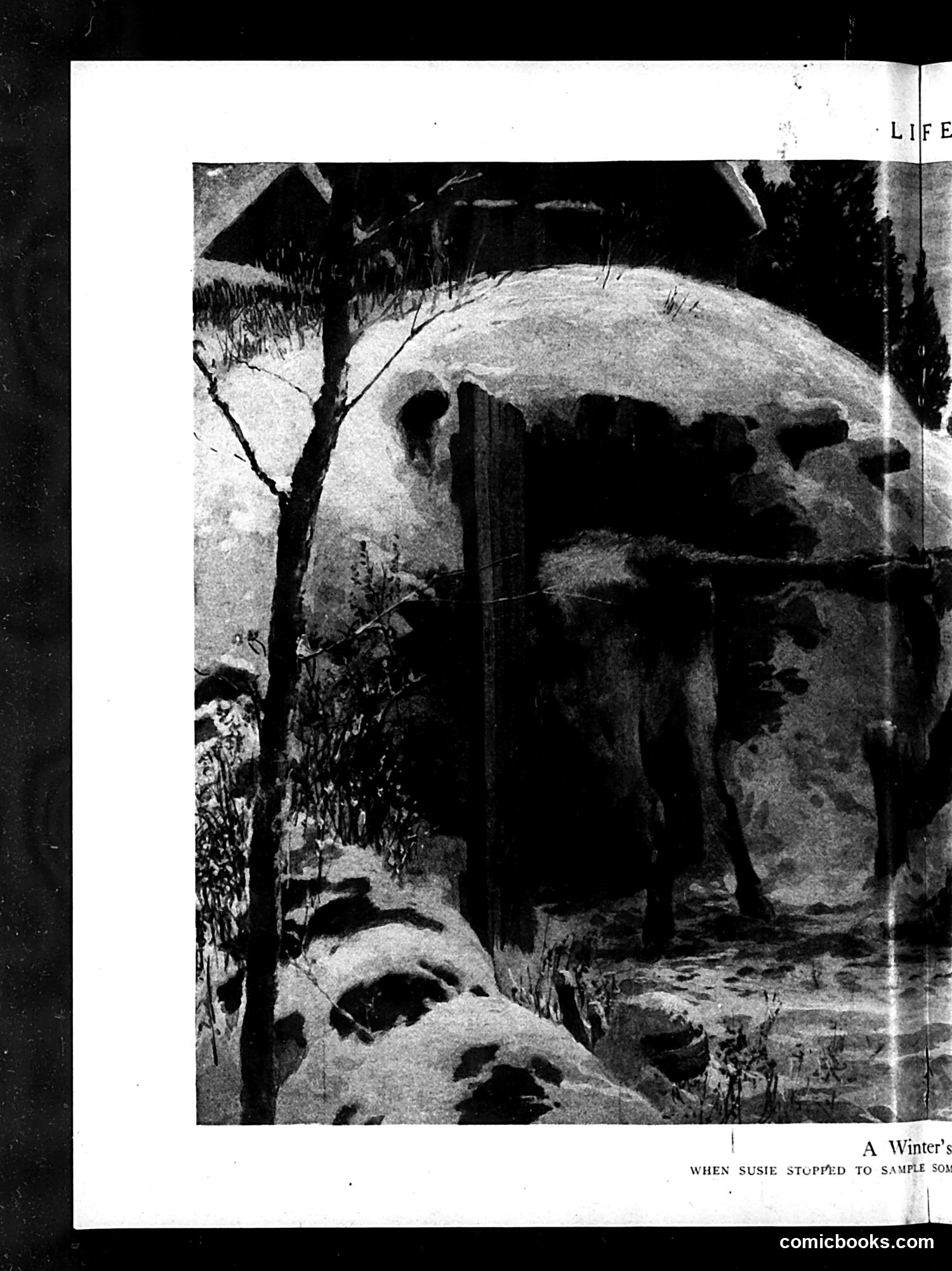
This appears to be a page from Life magazine featuring a winter-themed illustration or photograph. The image shows a snowy outdoor scene with what looks like a snow-covered structure or shelter, bare trees, and natural winter landscape elements. The caption text is incomplete and partially illegible in the OCR ("WHEN SUSIE STOPPED TO SAMPLE SOM..."), making it difficult to determine the full satirical point or subject matter. The reference to "Susie" suggests this may be a narrative comic or illustrated story rather than a political cartoon. Without the complete caption or additional context, I cannot accurately identify the specific social commentary, historical reference, or joke intended. The image alone shows a winter scene but lacks sufficient textual information to explain its meaning to a modern reader.
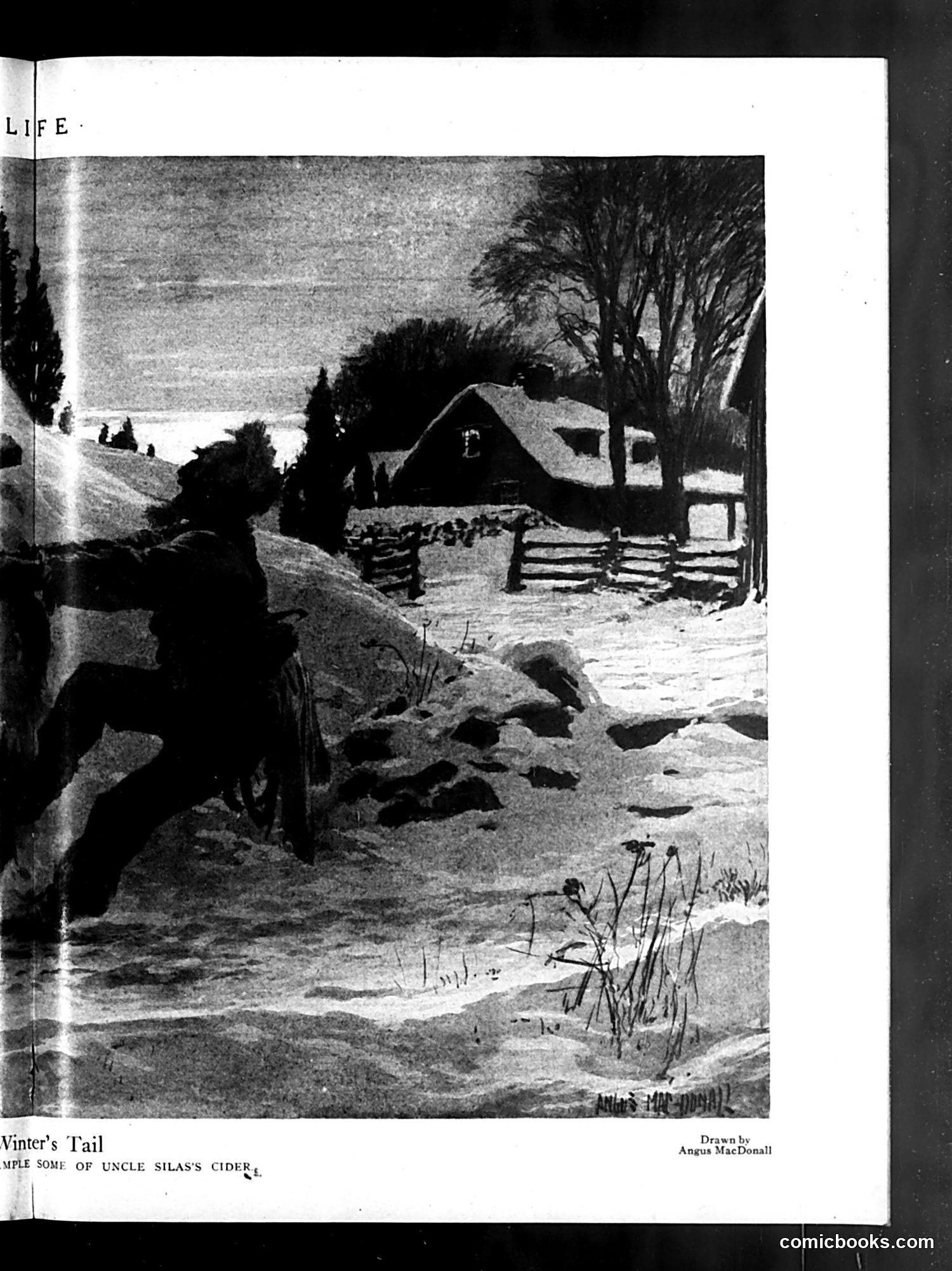
This appears to be an illustrated story or comic by Angus MacDonall titled "Winter's Tail," with the subtitle suggesting it relates to "Uncle Silas's Cider." The black-and-white illustration depicts a rural winter scene with a farmhouse, wooden fences, bare trees, and what appears to be a stream or water feature in the foreground with some vegetation. The composition is pastoral and nostalgic, typical of early-to-mid 20th century Life magazine illustrations. Without the complete OCR text (which appears cut off), the exact satirical or humorous point remains unclear. However, the rural setting and cider reference suggest this may be a folk tale or humorous story about country life, possibly playing on themes of rural simplicity or rustic characters.
This page contains theater reviews of three plays. The critic discusses J.M. Barrie's work (likely "Mary Rose"), noting that audiences interpret it differently based on their emotional engagement—some seek deep symbolism, others find it nonsensical, while sentimentalists are moved to tears regardless of plot coherence. "Transplanting Jean," a French comedy translated into English, receives praise for actors Arthur Byron and Margaret Lawrence, who elevate somewhat awkward translation work. The critic notes the play contains mildly risqué material about a middle-aged Parisian man settling down, but the performers' propriety prevents embarrassment except among easily-shocked parents. Finally, a brief mention of "The Beggar's Opera" revival credits its historical importance—the 1728 original established comedy conventions (marriage jokes, affairs) still used in contemporary revues. The reviews emphasize performer quality over material.
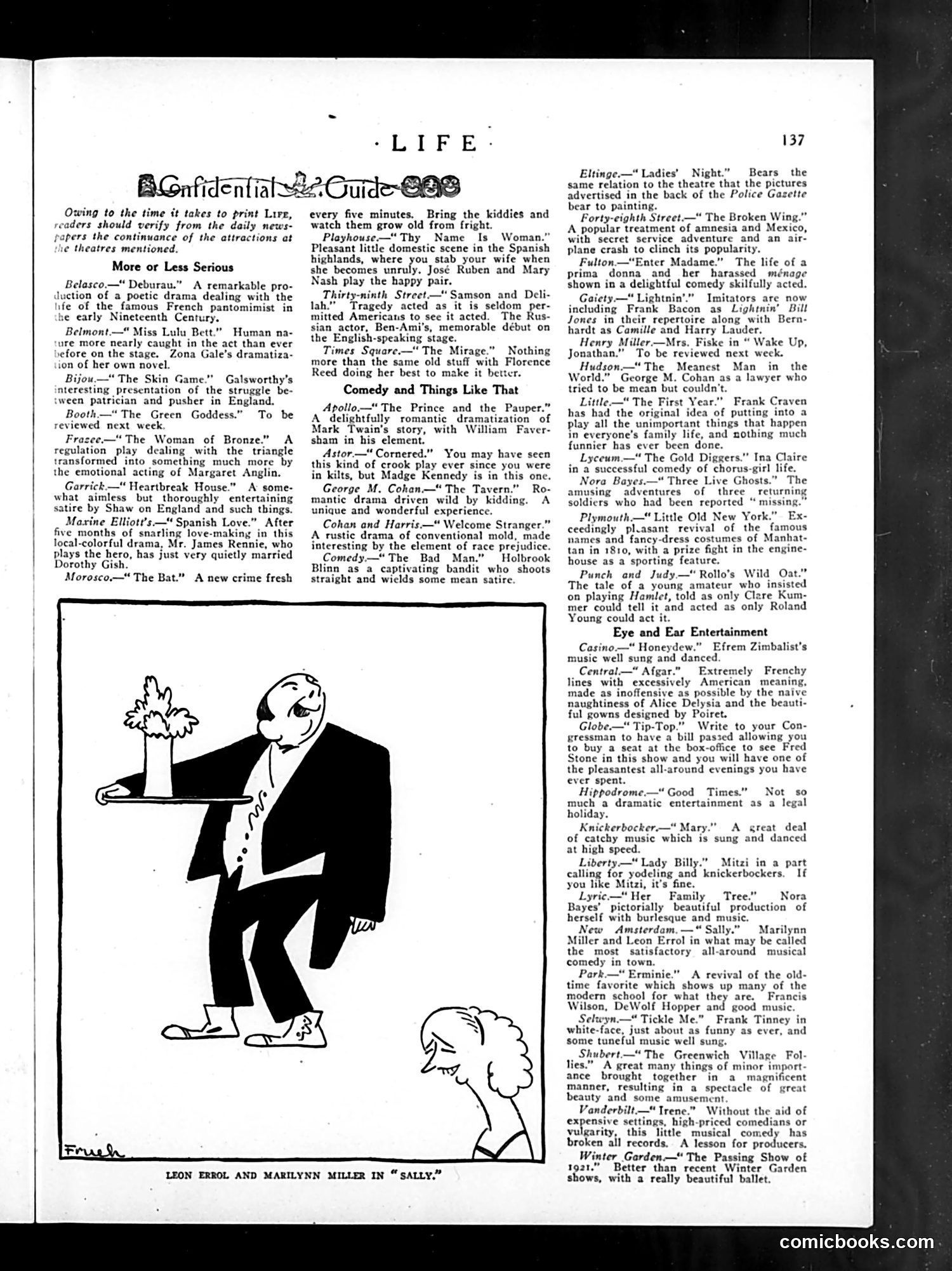
This page from Life magazine (circa 1921, based on the theatrical references) is primarily a **theater guide and review section**, not a political cartoon. The illustration shows a **waiter or server** carrying a tray with a flower, depicted in an exaggerated comic style typical of the era's satirical humor. The main content lists Broadway shows with brief, witty descriptions. Life's commentary is **satirical and snobbish**: it mocks popular entertainment ("Ladies' Night" bears relation to Police Gazette pictures like pornography), dismisses conventional plots, and praises experimental or literary works. The tone reflects an educated, elite perspective judging theatrical taste. The illustration appears to be decorative filler—a generic serving-related cartoon—rather than commentary on any specific show or political issue. This page represents Life's role as a **cultural arbiter** for sophisticated readers, dispensing theatrical criticism with pointed humor about what counted as serious art versus mass entertainment.
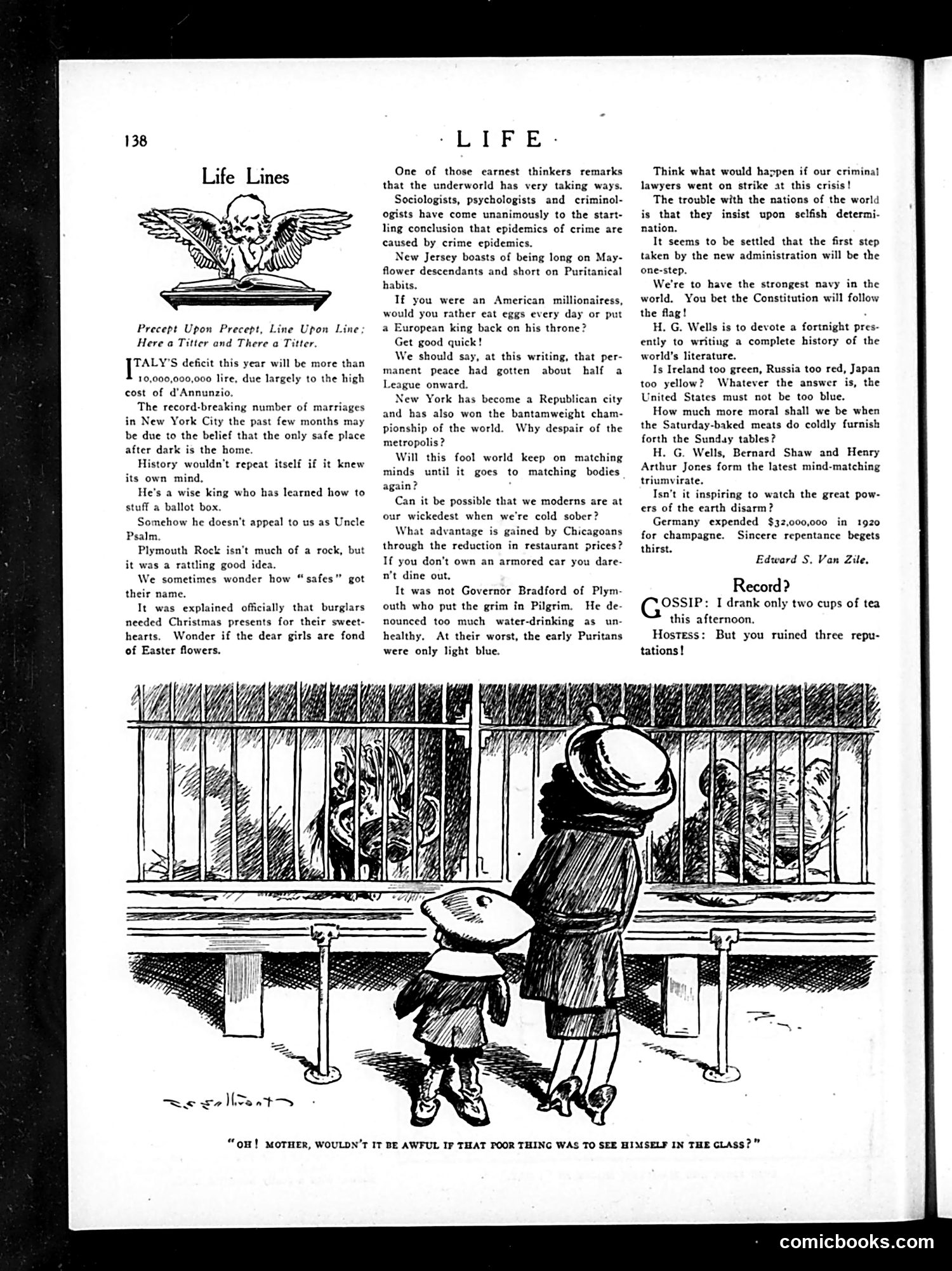
This page from *Life* magazine consists primarily of **"Life Lines,"** a humor column of brief satirical quips on contemporary topics, plus one cartoon at the bottom. **The Main Cartoon:** Shows a well-dressed woman and child viewing what appears to be a zoo or animal enclosure. The child expresses sympathy for an animal seeing its own reflection, with the mother responding it would be "awful" for the creature. This is likely social satire mocking vanity and self-awareness—the joke may critique human hypocrisy about appearance and self-perception. **The Humor Column** targets early 1920s American issues: Italy's financial crisis under d'Annunzio, New York crime and marriage rates, Prohibition-era concerns, Governor Bradford and Puritan history, the League of Nations' failure, New York Republican politics, armed car ownership (suggesting gangster violence), and disarmament discussions. **Key context:** References to "the new administration" suggest this is from 1921 (Harding's presidency). The tone is cynical about politics, crime, morality, and international affairs—typical of *Life's* satirical voice during this turbulent post-WWI period.
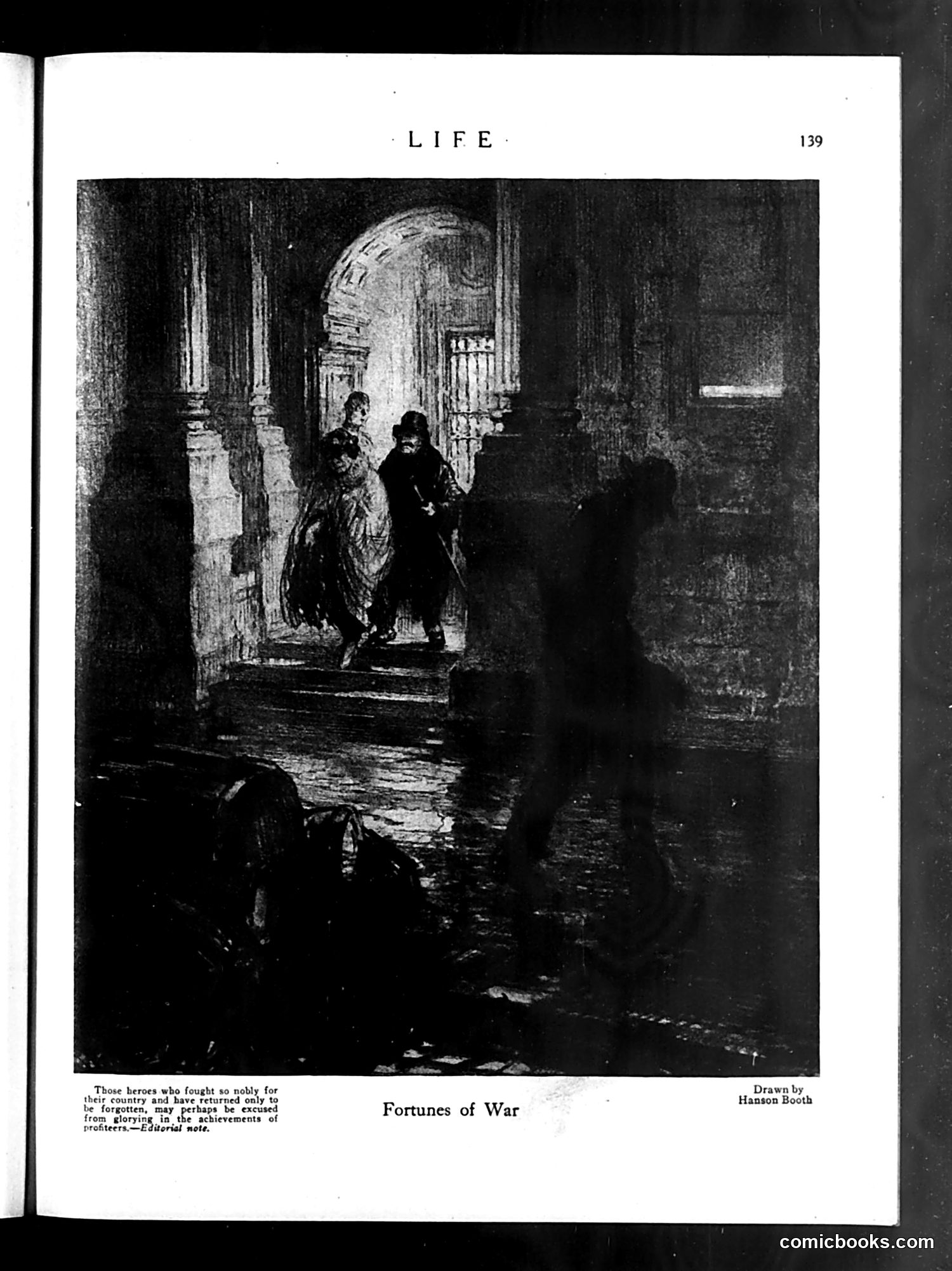
This illustration depicts a dark, architectural interior where shadowy figures appear to be conducting business or making transactions. The accompanying editorial note criticizes the contrast between soldiers who fought and sacrificed for their country versus war profiteers who grew wealthy during the conflict. The satire suggests that while veterans returned home forgotten and struggling, unscrupulous businessmen accumulated fortunes from wartime production and sales. The dimly-lit, somewhat sinister tone of the drawing reinforces the editorial's moral disapproval—these financial dealings are presented as occurring in shadows, implying dishonesty or moral corruption. This reflects post-WWI American sentiment about munitions manufacturers and defense contractors who profited while soldiers faced hardship and neglect.
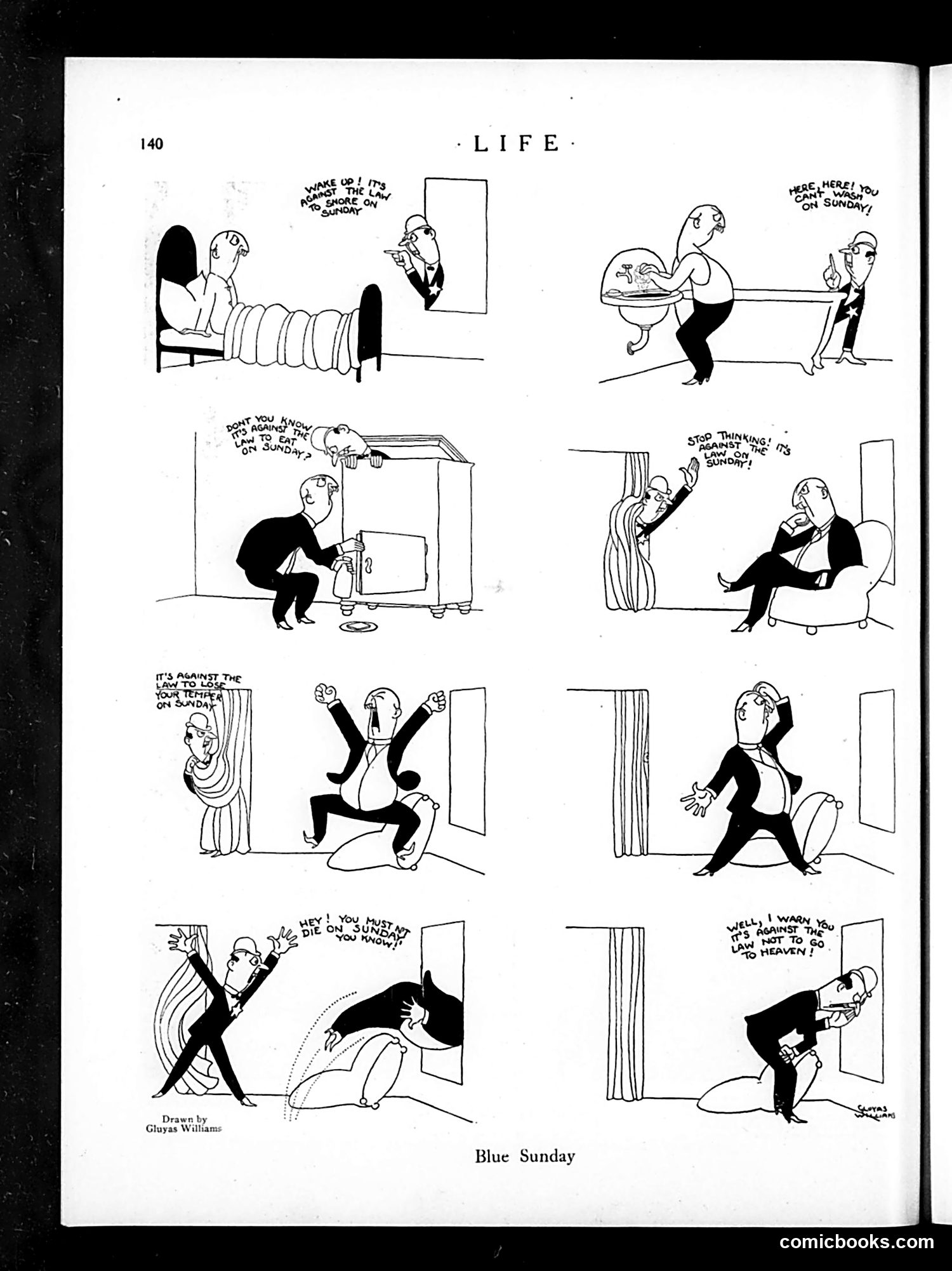
This satirical comic depicts a man's increasingly frantic attempts to keep his wife indoors on Sunday, citing various prohibitions—"against the law," "it's a sin," "against the law on Sunday." The humor stems from his escalating desperation as she repeatedly tries to leave, ultimately physically restraining her with curtains and ropes. The satire targets Blue Laws—religious restrictions that prohibited certain activities on Sundays. The cartoon mocks both the absurdity of such laws and the domestic discord they could create. The man's exaggerated, almost violent resistance to his wife's Sunday activities reflects the rigid moral enforcement some communities imposed, treating minor transgressions as serious violations. Williams uses physical comedy to emphasize how unreasonable these restrictions seem when taken to their logical extreme.
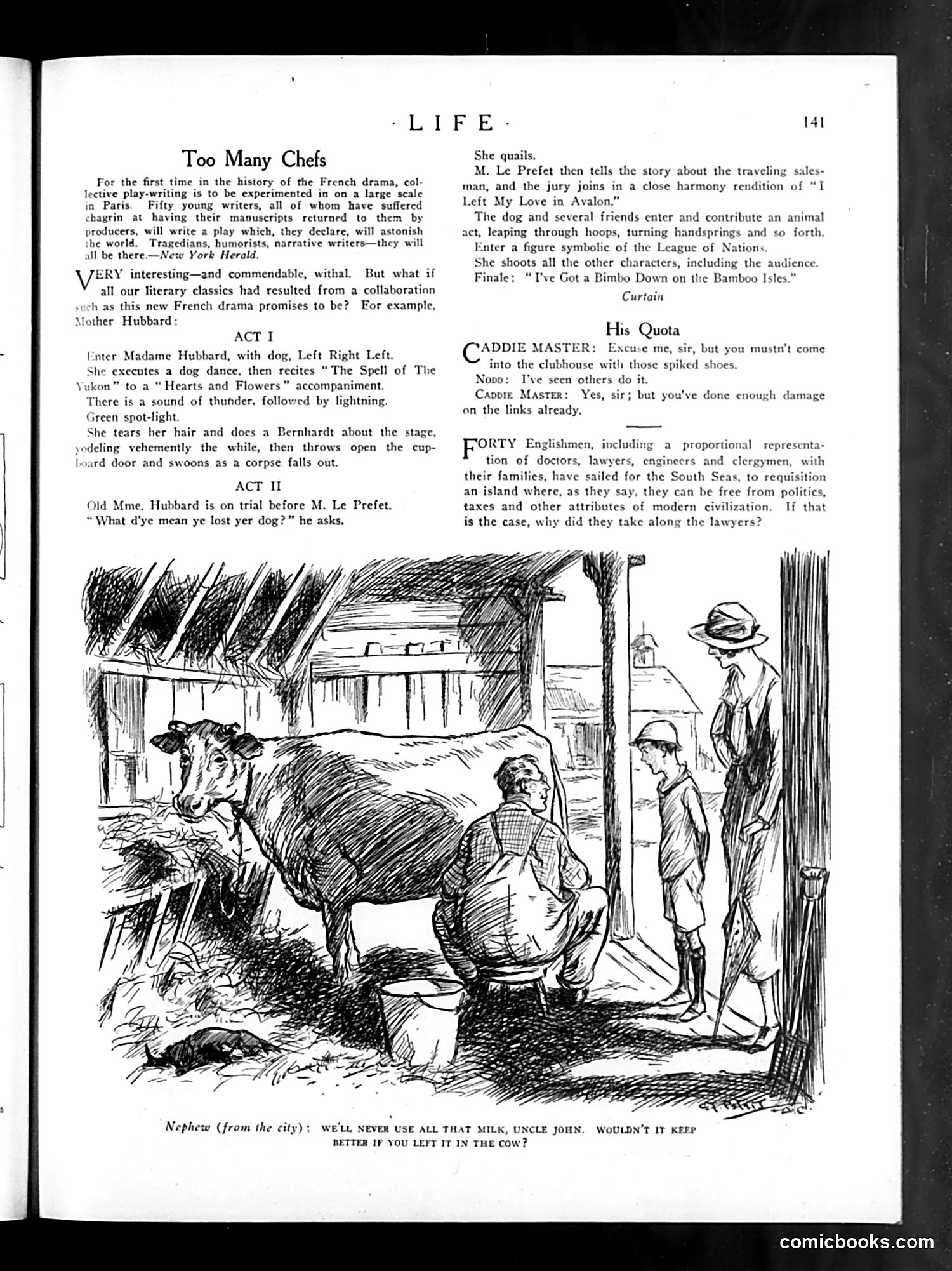
**"Too Many Chefs"** satirizes a reported French theatrical experiment where fifty rejected screenwriters collaborated on a single play. The piece mocks this by imagining if classic literature resulted from such committee writing. The parody of "Mother Hubbard" absurdly layers in incompatible theatrical styles—dramatic monologues, vaudeville dog acts, Sarah Bernhardt-style melodrama, comic relief, and topical references (League of Nations). The joke: too many writers with different sensibilities produce incoherent, overwrought chaos rather than compelling drama. **"His Quota"** and the bottom cartoon are brief gag items unrelated to the main piece. The first puns on golf etiquette; the second jokes about urban ignorance—a city nephew doesn't understand that leaving milk in a cow keeps it fresh longer than storing separated milk. The page demonstrates Life's characteristic style: witty social commentary through exaggeration and parody, targeting both European theatrical pretension and contemporary American absurdities.
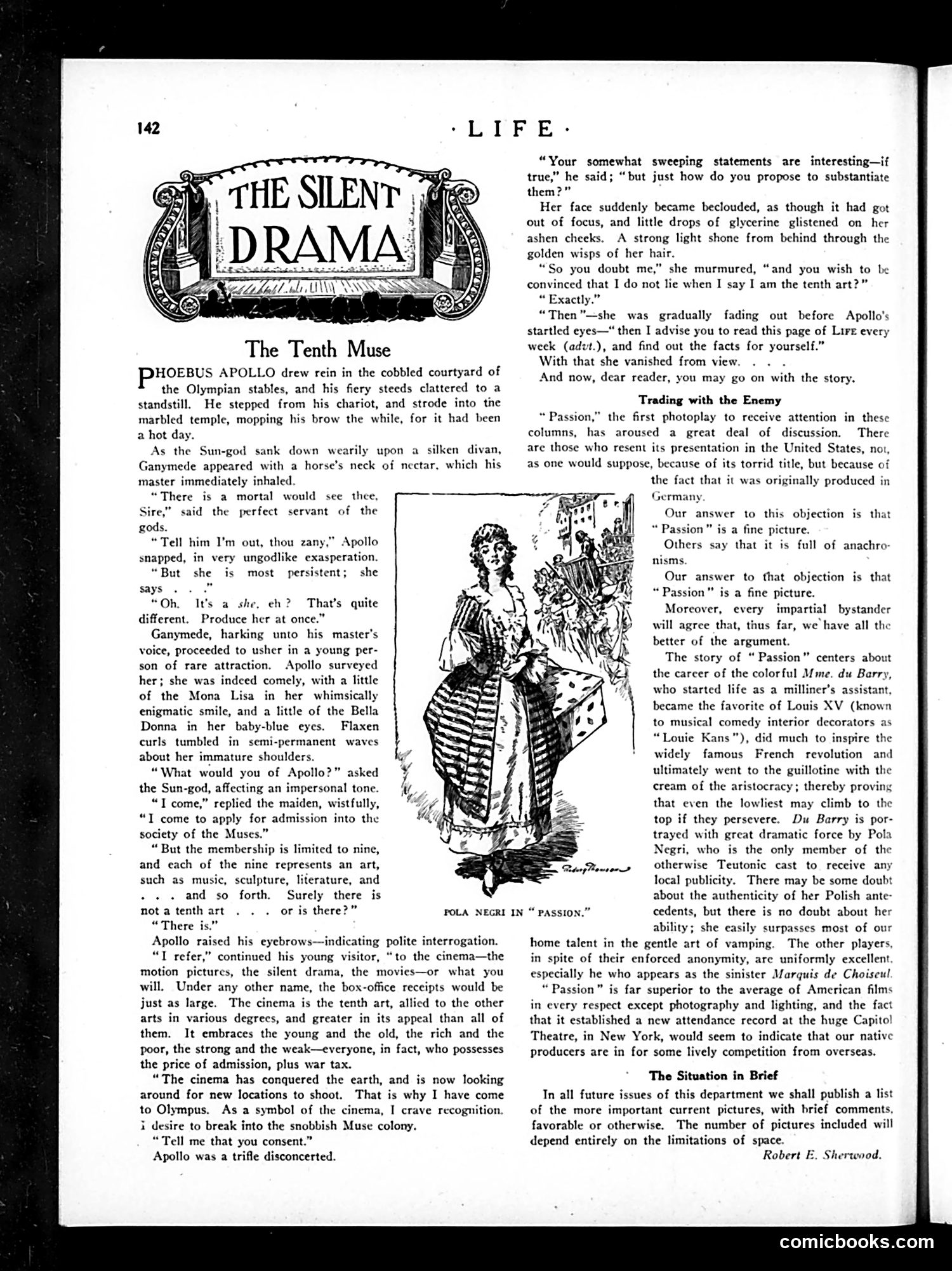
This page presents a fanciful dialogue where a young woman petitions Apollo to recognize cinema as the "tenth art" among the traditional Muses. The satire argues for motion pictures' cultural legitimacy: cinema "embraces the young and the old, the rich and the poor...everyone...who possesses the price of admission." The accompanying section, "Trading with the Enemy," defends the German film *Passion* against American objections. Critics complained it was produced in Germany (likely post-WWI sentiment) or contained historical inaccuracies. Life dismisses both objections, insisting "*Passion* is a fine picture." The featured image shows Polish actress Pola Negri in the film. The satire's point: cinema deserves artistic respect equal to traditional arts, and quality transcends national origin—a progressive stance for the early 1920s.
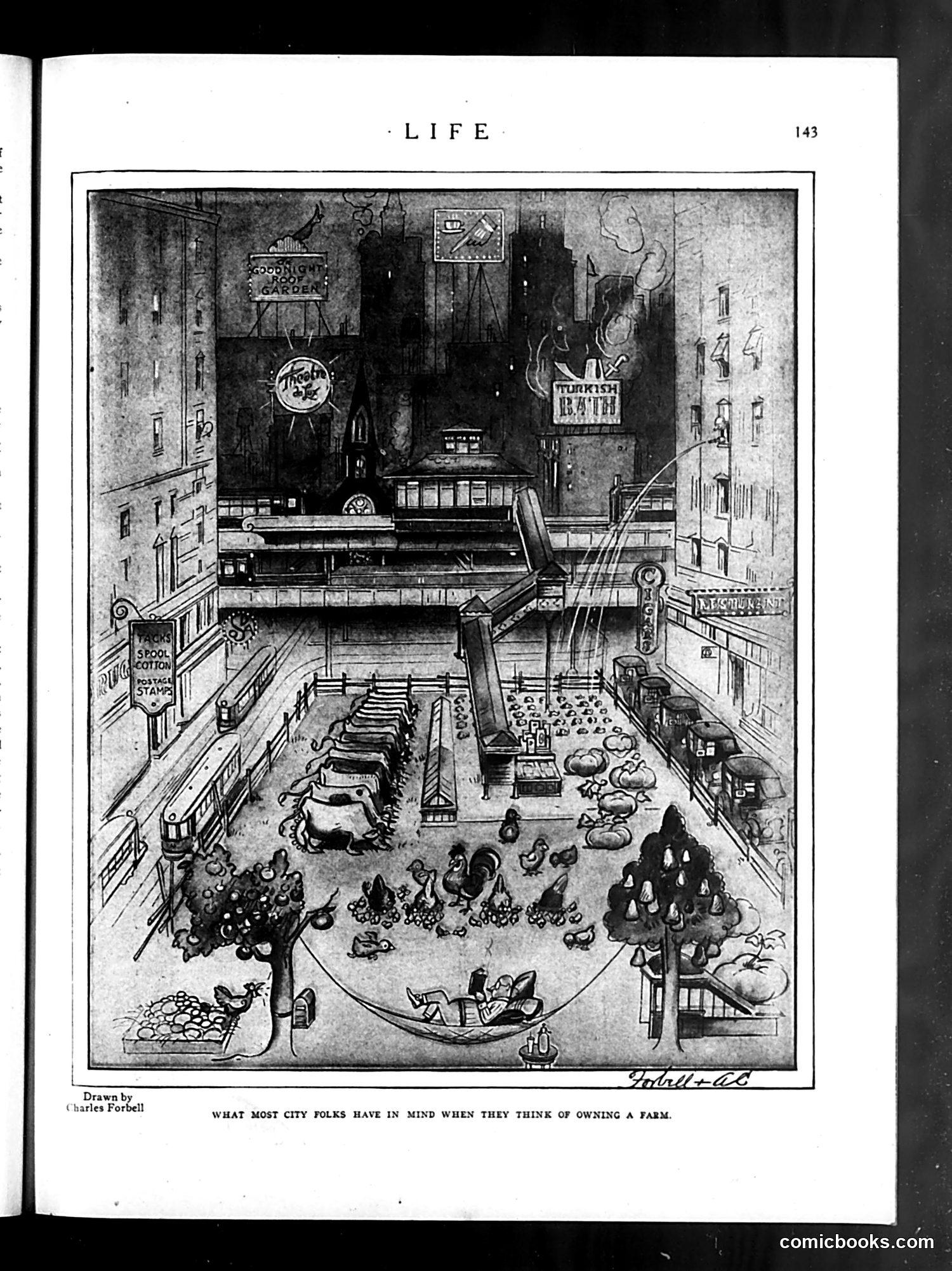
This Charles Forbeil cartoon satirizes urban Americans' naive fantasies about farm ownership. The caption—"What Most City Folks Have in Mind When They Think of Owning a Farm"—introduces the joke. The image shows a cramped city courtyard transformed into an absurdly overcrowded "farm." City dwellers inhabit tiny spaces surrounded by farm animals (cows, chickens, pigs), playground equipment, trees, and garden plots—all impossibly squeezed together. Visible are leisure activities (hammocks, stool for fishing) alongside farm work. The satire targets the romanticized, impractical vision many urbanites held about rural life, particularly the notion that farming could be a relaxing hobby in minimal space. This likely reflects 1920s-era enthusiasm for back-to-nature movements or "gentleman farming" among city residents unfamiliar with agricultural realities.
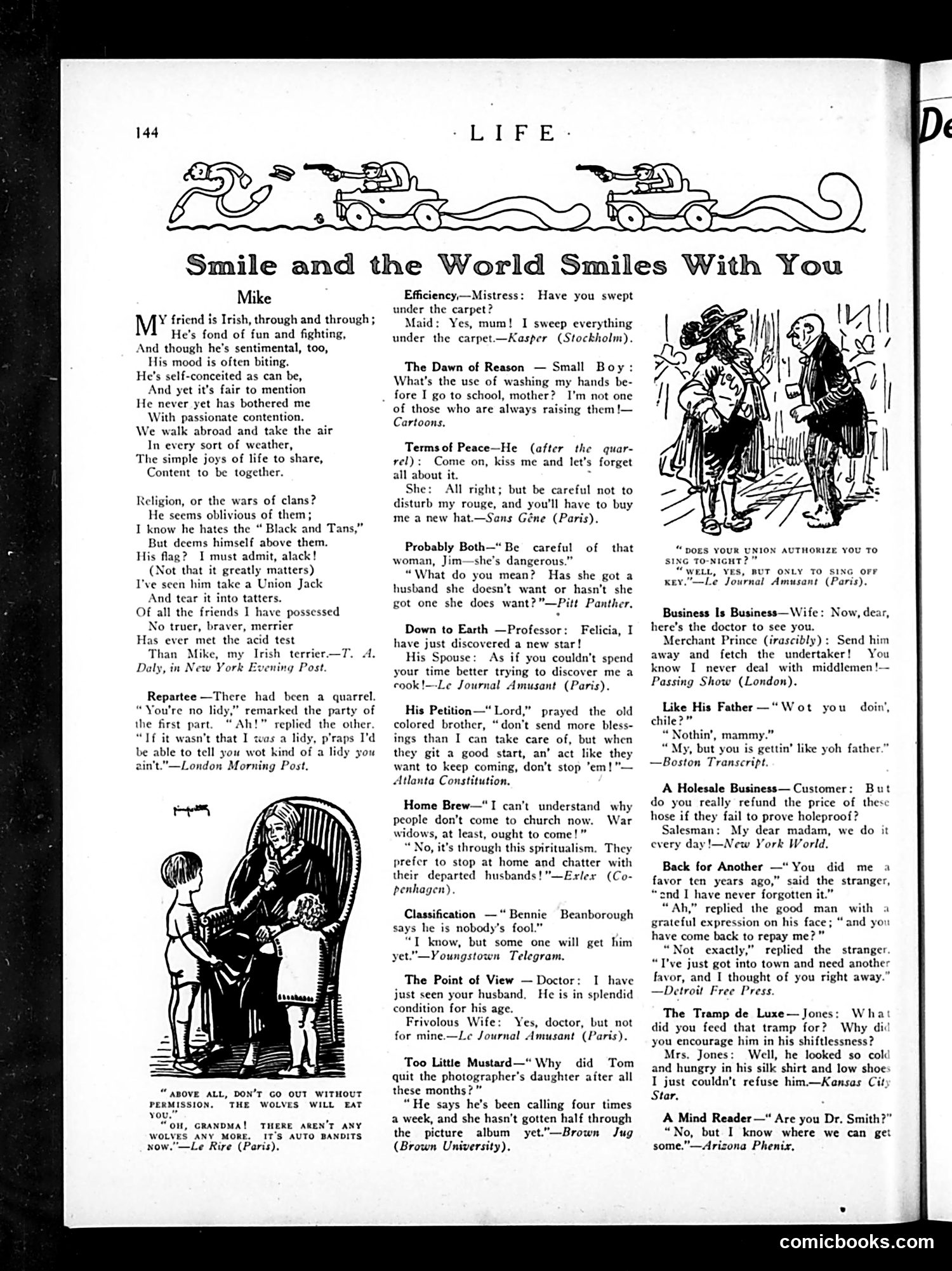
This page presents **humorous short jokes and anecdotes** drawn from various international publications, rather than political cartoons. The content reflects early 20th-century social satire. Key themes include: **"Mike"** celebrates an Irish terrier as a loyal friend, with a subtle jab at Irish nationalism—the dog tears up a Union Jack but "deems himself above" political conflict. **Auto-related humor** reflects newly widespread automobile anxiety; a grandmother's warning about wolves is outdated when the real danger is "auto bandits." **Gender dynamics** appear repeatedly: a wife demanding rouge and hats as peace terms, a "frivolous wife" concerned with beauty over age, and women portrayed as demanding or superficial. **Class commentary** includes a merchant prince refusing a doctor (a middleman), and efficiency jokes about servants. **Post-WWI references** mention "war widows" and spiritualism, suggesting the page dates to the 1920s when séances became popular among bereaved families. The overall tone is lighthearted and international, republishing jokes from European humor magazines.
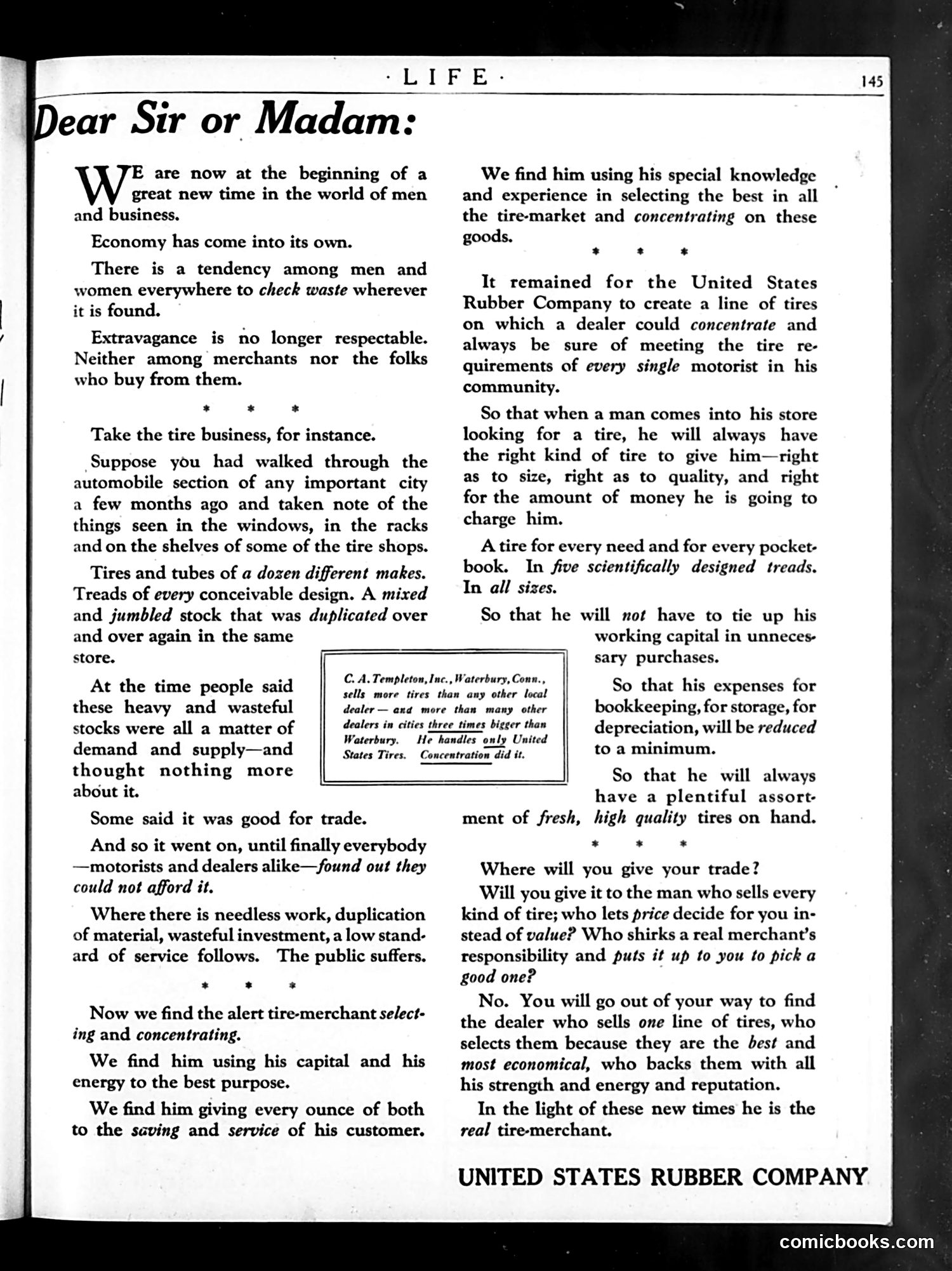
This is **not a cartoon or satire page**, but rather a **U.S. Rubber Company advertisement** disguised as editorial content in the "Dear Sir or Madam" format typical of Life magazine. The ad argues that post-WWI economic efficiency demands business consolidation. It uses a tire dealer example to criticize wasteful inventory practices: shops once stocked dozens of tire brands with overlapping designs, duplicating effort and tying up capital. The solution presented is **concentration**—dealers should sell one exclusive line (United States Tires). The accompanying testimonial from C.A. Templeton, Inc. in Waterbury, Connecticut claims this dealer outsells competitors by handling only U.S. Tires. The messaging reflects 1920s-era business ideology emphasizing "economy" and eliminating waste as patriotic virtues. It's a pitch for exclusive dealership arrangements, framed as modern business wisdom rather than commercial self-interest. This is **advertising**, not satire or cartooning.
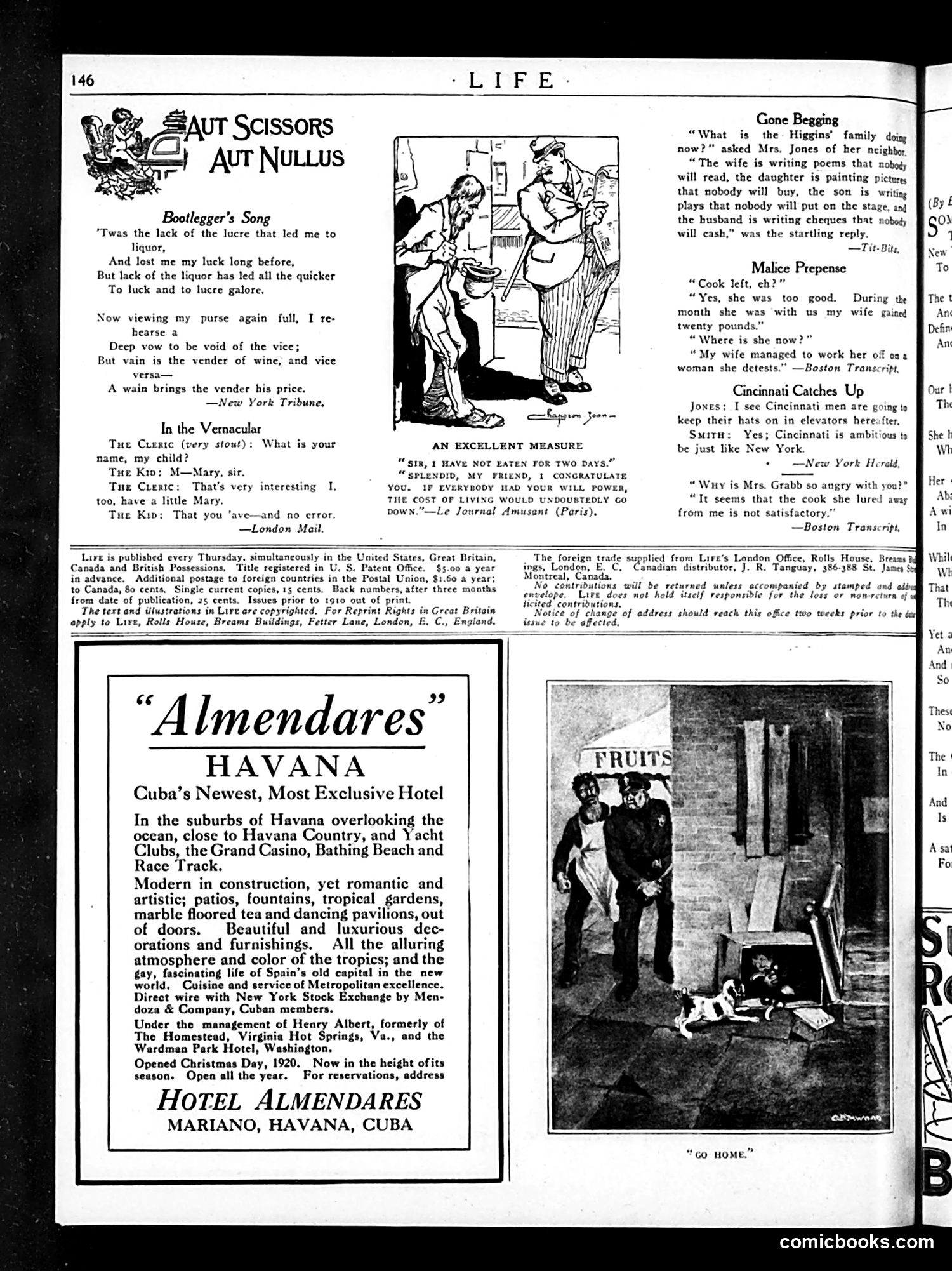
This page contains satirical humor pieces and advertisements typical of Life's format in the 1920s. The main content includes: **Satirical Jokes:** - "Bootlegger's Song" mocks Prohibition-era contradictions: a bootlegger profits from illegal alcohol while claiming to reform - "An Excellent Measure" sardonically congratulates a starving man on his "willpower"—dark humor about poverty - "Gone Begging" jokes that an artist family produces worthless output (unpublished poems, unsold paintings, unperformed plays, uncashable checks) - "Malice Prepense" and "Cincinnati Catches Up" use domestic/social observations for humor **The cartoon** (top center) appears to show working-class figures in a domestic interior scene, though specific identities aren't clear from the image alone. **Advertisements** dominate the lower half, promoting Cuba's Hotel Almendares as an exclusive tropical resort—reflecting the 1920s leisure travel boom among wealthy Americans. The page reflects pre-Depression American concerns: Prohibition's failures, economic inequality, and aspirational advertising.
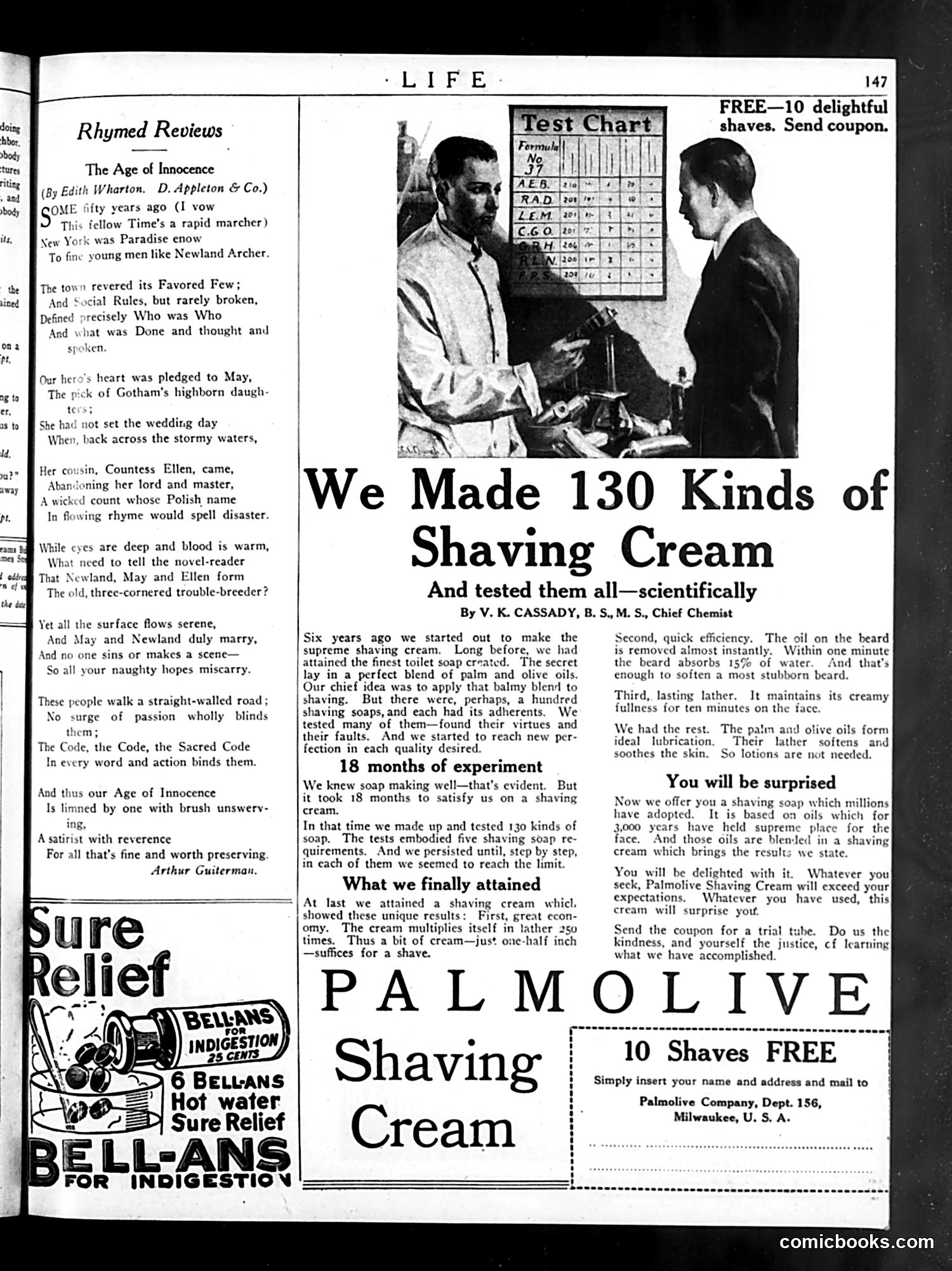
This page mixes literary content with advertising. The upper section features Arthur Guiterman's rhymed review of Edith Wharton's *The Age of Innocence*, a novel about 1870s New York society constrained by rigid social codes. The reviewer uses gentle satire: he notes the protagonist Newland Archer faces a classic love triangle (with his fiancée May and visiting Countess Ellen), yet propriety prevents scandal—"no one sins or makes a scene." The review praises Wharton's satirical yet reverent treatment of aristocratic restraint. The dominant content is a full-page Palmolive Shaving Cream advertisement featuring two men examining a "test chart." The ad claims the company tested 130 cream formulations over 18 months, emphasizing scientific rigor and superior results: quick efficiency, lasting lather, and lubrication from palm and olive oils. It concludes with a promotional offer: 10 free shaves by mail. This represents typical early-20th-century advertising strategy: establishing credibility through pseudo-scientific claims and product testing.
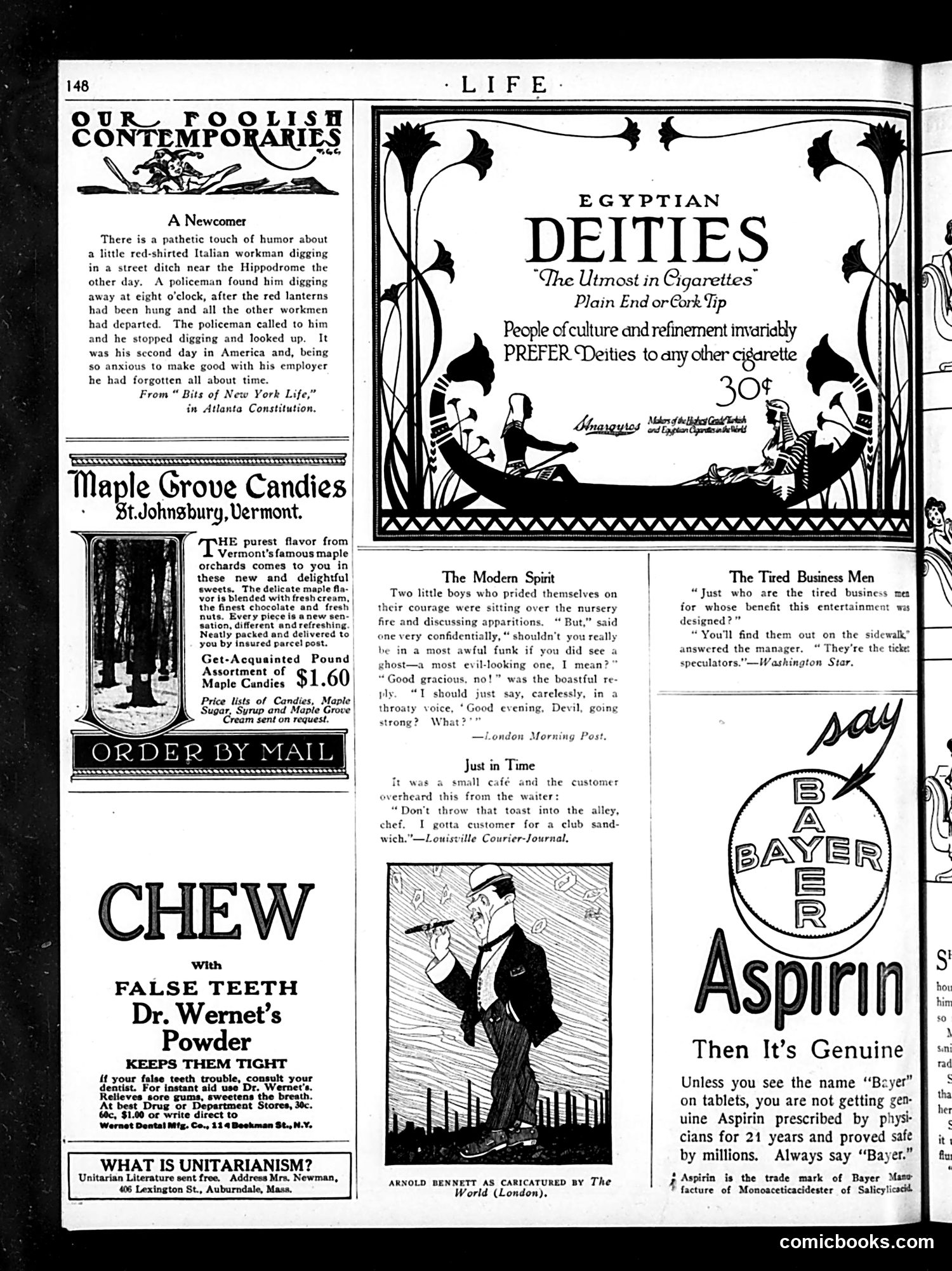
This page is primarily **advertising** with several brief humorous anecdotes interspersed. The main content includes: **Advertisements**: Egyptian Deities cigarettes (30¢), Maple Grove Candies, Dr. Wernet's denture powder, and Bayer Aspirin dominate the layout. **Humor sections** ("Our Foolish Contemporaries"): - A story about an Italian immigrant workman so eager to please his American employer that he forgets about time - "The Modern Spirit": Children dismissing fear of ghosts with casual bravado - "Just in Time": A café waiter's pragmatic reuse of burnt toast - "The Tired Business Men": A joke about ticket speculators **Illustration**: A caricature of Arnold Bennett (English author/dramatist), labeled as drawn by *The World* (London newspaper). The page reflects early-20th-century attitudes: immigrant work ethic, children's precocious modernity, and cynicism about urban commerce. The advertising emphasizes "culture and refinement"—typical Life magazine appeals to middle-class readers.
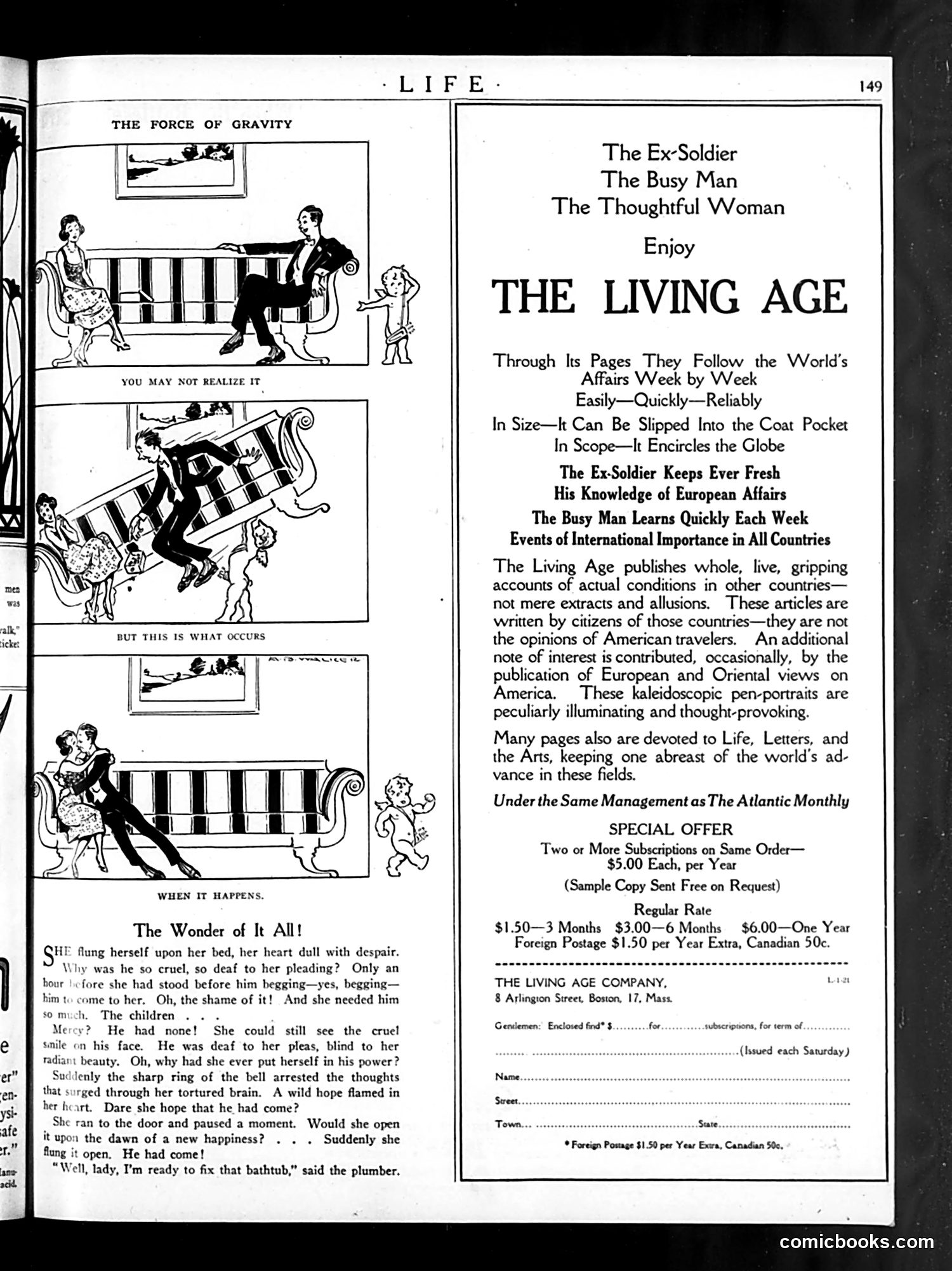
This three-panel visual gag satirizes melodramatic romance fiction. The sequence shows a woman in emotional turmoil—abandoned, heartbroken, desperately hoping for her lover's return. The dramatic buildup ("Would she open it upon the dawn of a new happiness?") mimics overwrought pulp fiction tropes. The punchline reveals the absurdity: the man at the door is merely a plumber, come to fix her bathtub. The title "The Force of Gravity" appears to refer to how reality comes crashing down on her romantic fantasies—literal gravity (illustrated by the couple tumbling off furniture in panels 2-3) deflates her emotional idealism. The cartoon mocks both sentimental fiction conventions and women's supposed susceptibility to melodrama, presenting the gap between romantic expectation and mundane domestic reality as inherently comic.
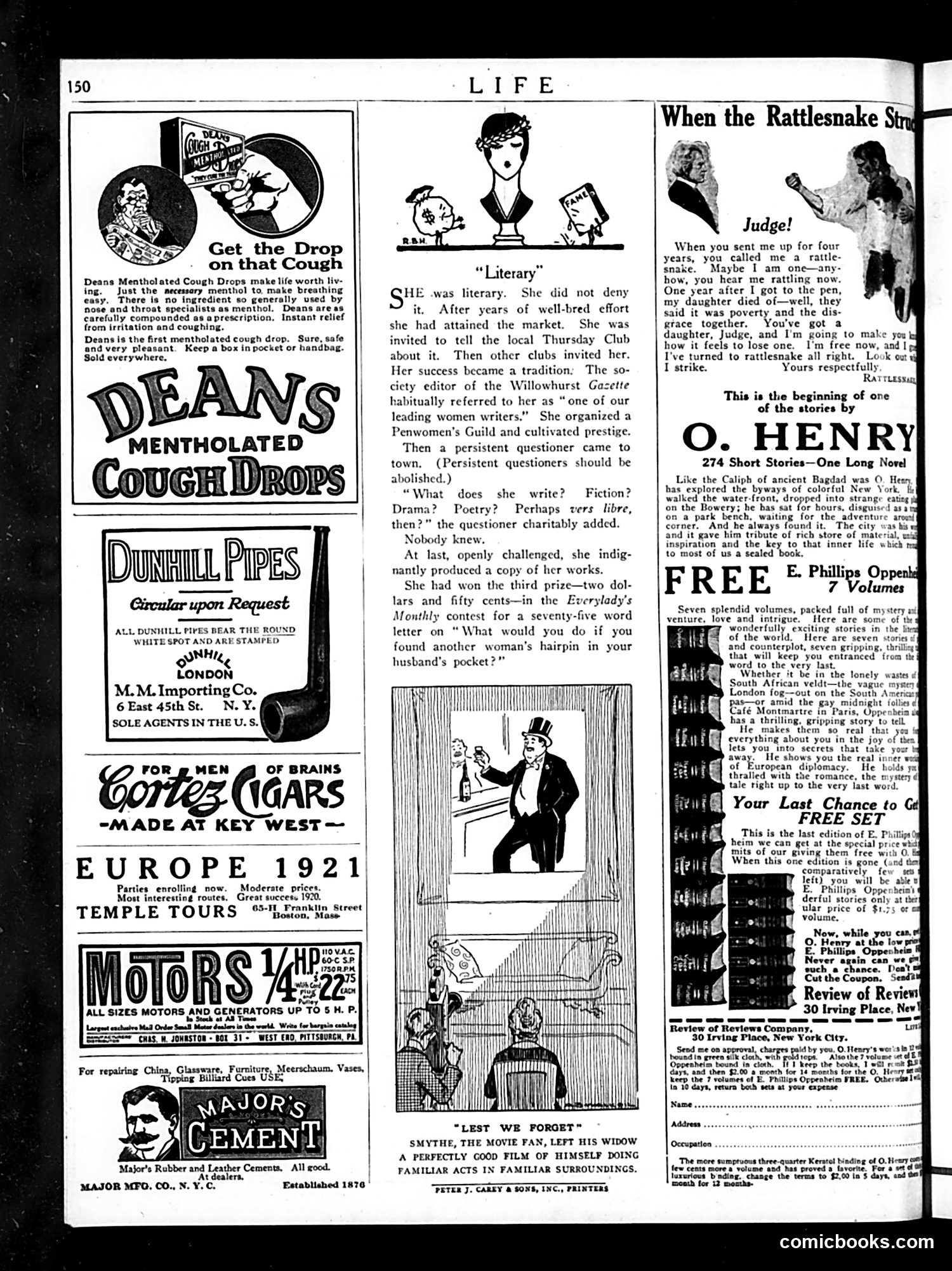
This page is primarily **advertisements** with one notable satirical story titled **"Literary."** The main satire mocks a woman who has cultivated a prestigious reputation as a "leading woman writer" in her town through social clubs and prestige-building, yet when finally challenged to name what she actually writes, she reveals her only published work is a **seventy-five-word letter that won third prize in a domestic magazine contest**—about finding another woman's hairpin in a husband's pocket. The joke targets **literary pretension and status-seeking** in small-town society. She had built an entire reputation on vague association with "writing" without producing substantive work. The satire exposes how social performance, networking (the "Penwomen's Guild"), and careful image management could substitute for actual accomplishment in early 20th-century social circles. The page otherwise features period advertisements for cough drops, pipes, cigars, and European tours.
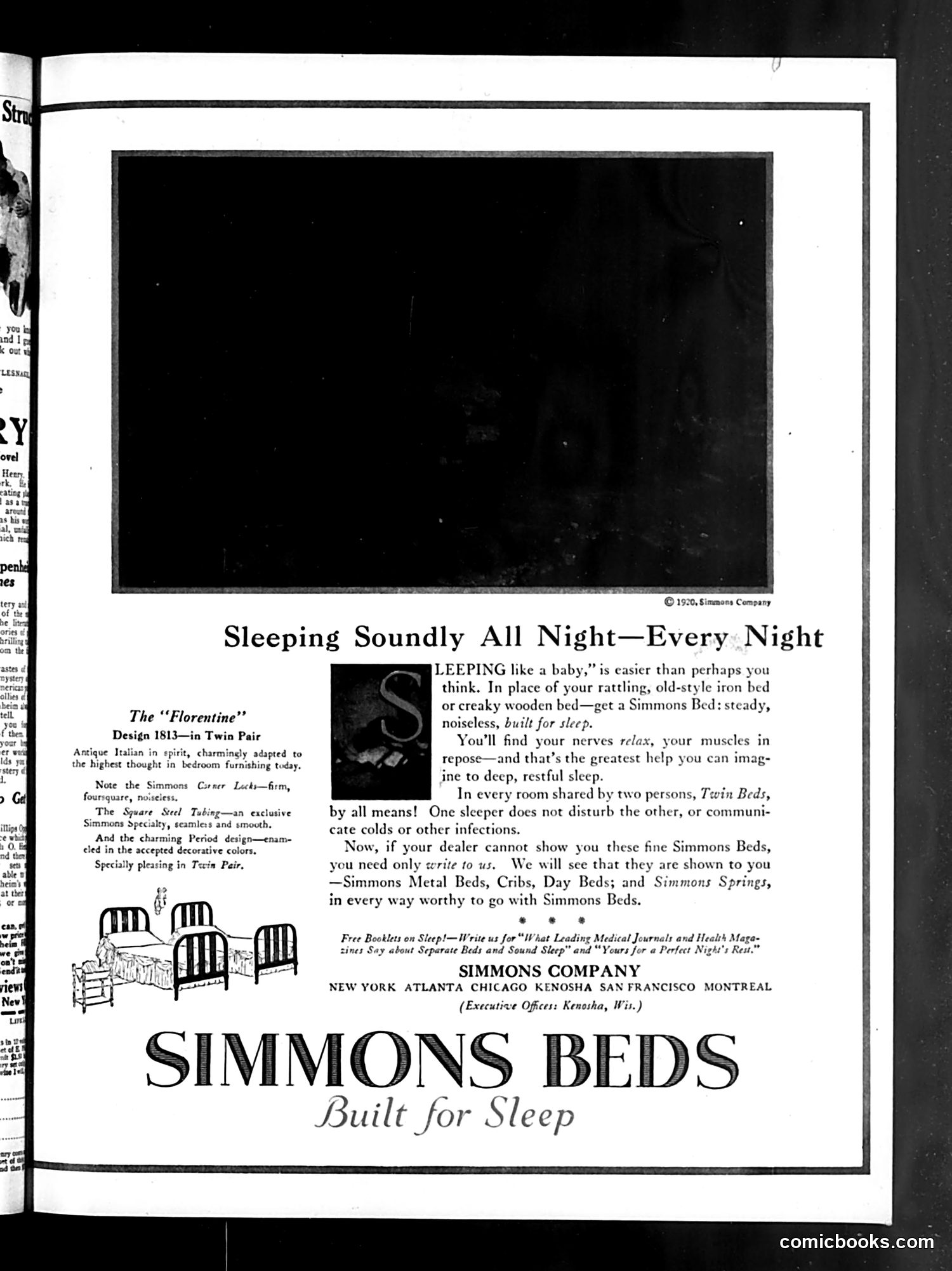
This is not a cartoon or satirical content—it's a **full-page advertisement** for Simmons Beds from 1920. The page features the "Florentine" bed design in twin-pair configuration, with marketing copy emphasizing sleep quality. The ad's main selling points reflect early 20th-century concerns: it promotes sturdy, noiseless beds as superior to older "rattling, old-style iron" or "creaky wooden" alternatives. Notably, it heavily advertises **twin beds** for shared rooms, claiming one sleeper won't disturb the other or "communicate colds or other infections"—addressing health anxieties of the era. The reference to "separate beds and sound sleep" suggests the ad capitalizes on emerging bedroom trends, possibly reflecting changing attitudes toward marital sleeping arrangements. The ad includes a dark photograph of the bed (reproduction quality poor) and encourages readers to contact dealers or request free booklets citing medical journals about sleep. No political satire is present—this is purely commercial marketing from the Simmons Company.
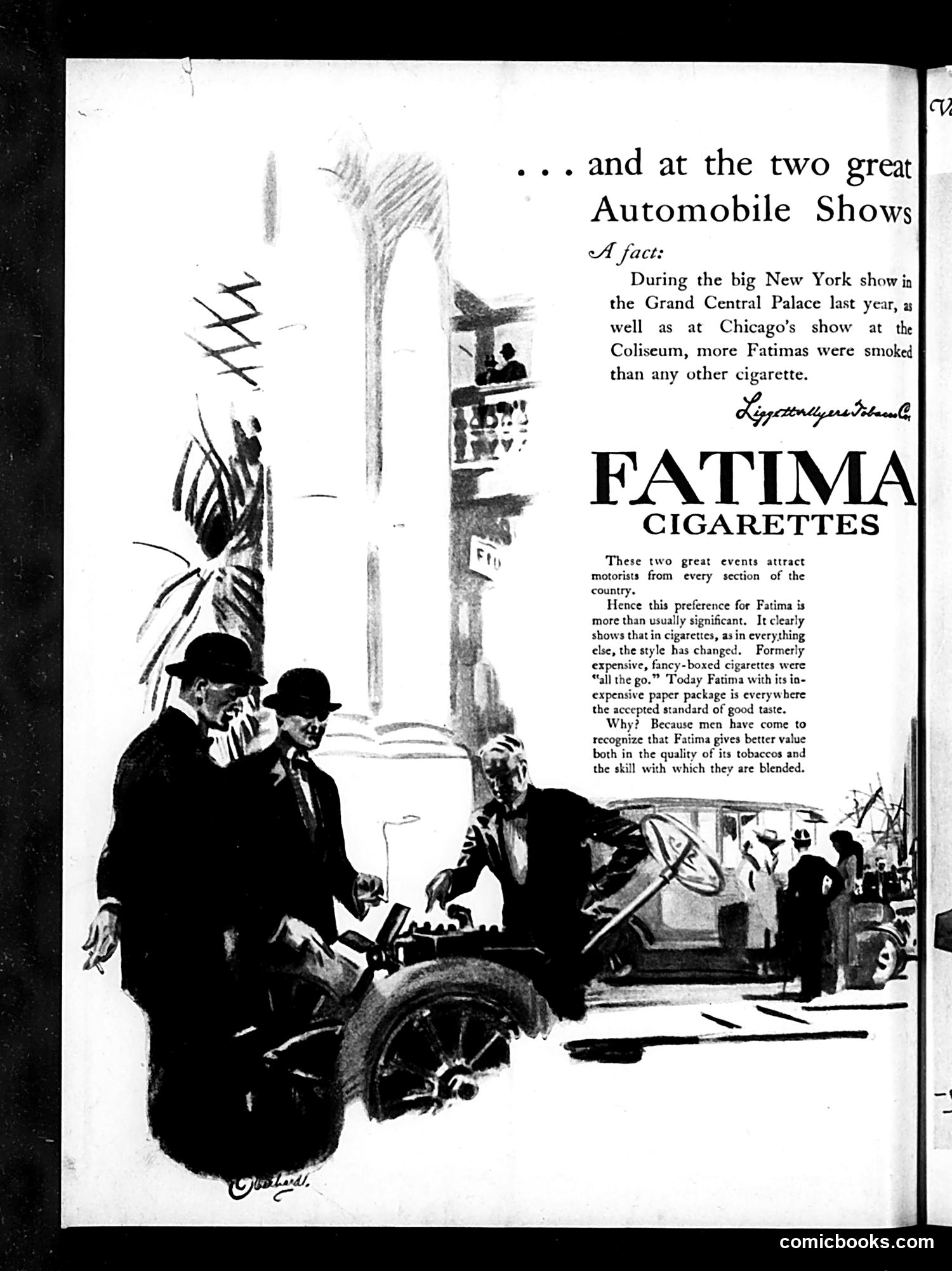
This is **not a cartoon or satire** — it's a **cigarette advertisement** for Fatima brand. The page features an illustration of men in bowler hats examining an automobile at what appears to be an auto show (likely the Grand Central Palace in New York or Chicago's Coliseum). The ad claims that Fatima cigarettes were the most-smoked brand at these two major automobile shows. The advertising argument: Fatima's popularity proves that consumer taste has shifted from expensive, fancy-packaged cigarettes toward simpler, inexpensive paper-packaged ones that offer better value through superior tobacco quality and blending. This reflects early 20th-century marketing positioning Fatima as democratically accessible while maintaining quality — contrasting with previously elite cigarette brands.