
Life, 1921-01-27 · page 14 of 36
Life — January 27, 1921 — page 14: what you’re looking at
What you’re looking at
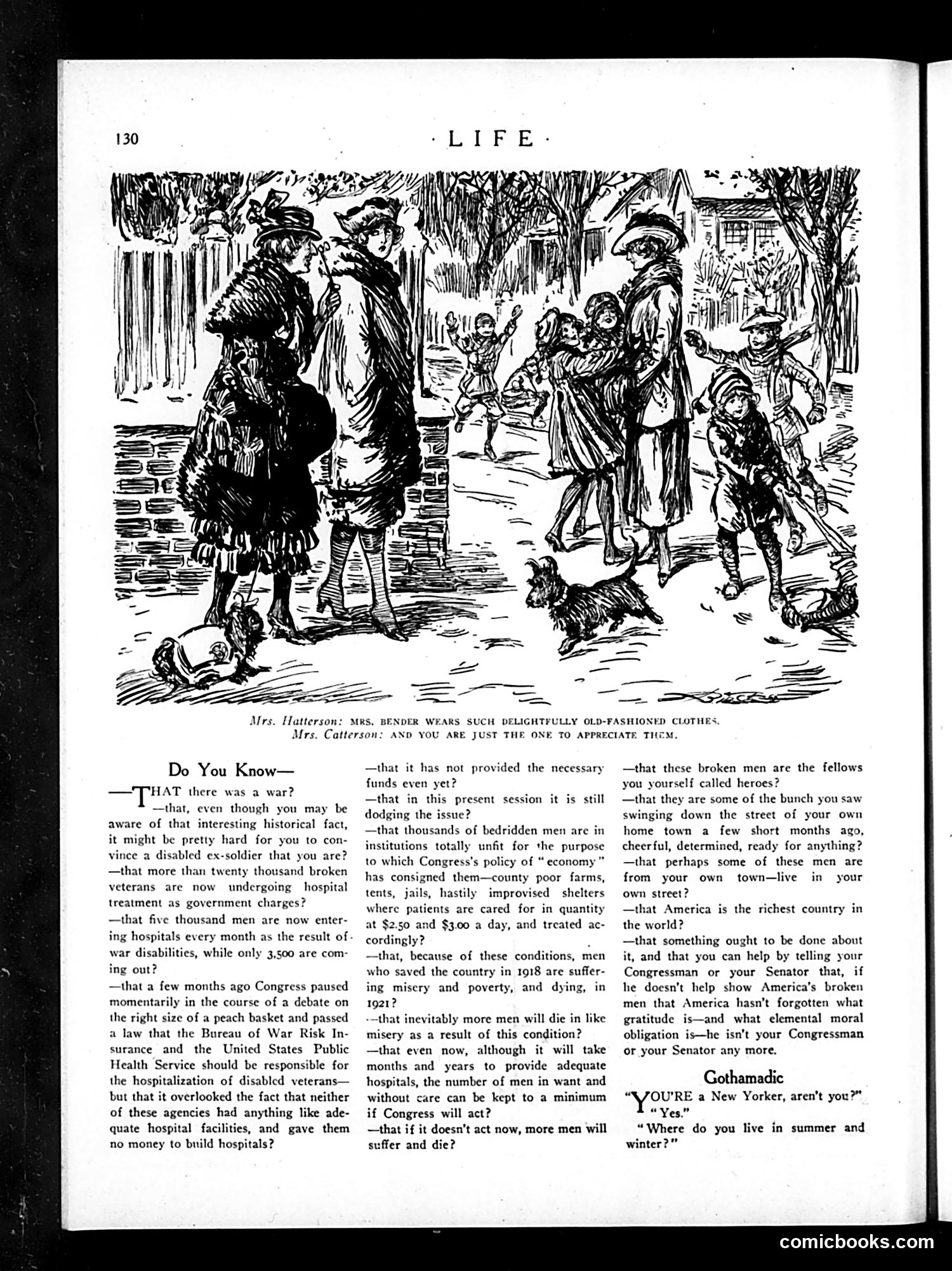
This page contains a satirical cartoon and accompanying editorial commentary about American treatment of disabled war veterans following World War I. The cartoon depicts a street scene where Mrs. Hatterson compliments Mrs. Catterson's "old-fashioned clothes," while children and a dog surround them. The accompanying text reveals the satire's target: Congress's failure to adequately fund hospitals and care for disabled soldiers. The "Do You Know" section lists damning facts—only 3,500 of 20,000 disabled veterans are hospitalized; Congress debates funding while men suffer; broken veterans are warehoused in inadequate facilities costing $2-3 daily. The satire is bitter: while Americans concern themselves with fashion, disabled war heroes—described as "some of the bunch you saw swinging down the street"—languish without proper care, exposing America's failure to honor its obligations to veterans.
📄 Transcribed text from this page (OCR, searchable)
Machine-transcribed from the original scan — historical spelling and the odd misread are preserved.
Mrs. Hatterson: M&S, BENDER WEARS SUCH DELIGHTFULLY OLD-FASHIONED CLOTHES, Mrs. Catterson: AND YOU ARE JUST THE ONE TO APPRECIATE THEM. Do You Know— —THAT there was a war? —that, even though you may be aware of that interesting historical fact, it might be pretty hard for you to con- vince a disabled ex-soldier that you are? —that more than twenty thousand broken veterans are now undergoing hospital treatment as government charges? —that five thousand men are now enter- ing hospitals every month as the result of- war disabilities, while only 3,500 are com- ing out? —that a few months ago Congress paused momentarily in the course of a debate on the right size of a peach basket and passed a law that the Bureau of War Risk In- surance and the United States Public Health Service should be responsible for the hospitalization of disabled veterans— but that it overlooked the fact that neither of these agencies had anything like ade- quate hospital facilities, and gave them no money to build hospitals? —that it has not provided the necessary funds even yet? —that in this present session it is still dodging the issue? —that thousands of bedridden men are in institutions totally unfit for the purpose to which Congress's policy of “ economy” has consigned them—county poor farms, tents, jails, hastily improvised shelters where patients are cared for in quantity at $2.50 and $3.00 a day, and treated ac- cordingly? . —that, because of these conditions, men who saved the country in 1918 are suffer- ing misery and poverty, and dying, in 1921? -—that inevitably more men will die in like misery as a result of this condition? —that even now, although it will take months and years to provide adequate hospitals, the number of men in want and without care can be kept to a minimum if Congress will act? —that if it doesn’t act now, more men will suffer and die? —that these broken men are the fellows you yourself called heroes? —that they are some of the bunch you saw swinging down the street of your own home town a few short months ago, cheerful, determined, ready for anything? —that perhaps some of these men are from your own town—live in your own street? —that America is the richest country in the world? —that something ought to be done about it, and that you can help by telling your Congressman or your Senator that, if he doesn’t help show America’s broken men that America hasn’t forgotten what gratitude is—and what elemental moral obligation is—he isn’t your Congressman or your Senator any more. Gothamadic “\VOU'RE a New Yorker, aren't you?” “Yes.” “Where do you live in summer and winter?” comicbooks.com