
Life, 1921-01-27 · page 20 of 36
Life — January 27, 1921 — page 20: what you’re looking at
What you’re looking at
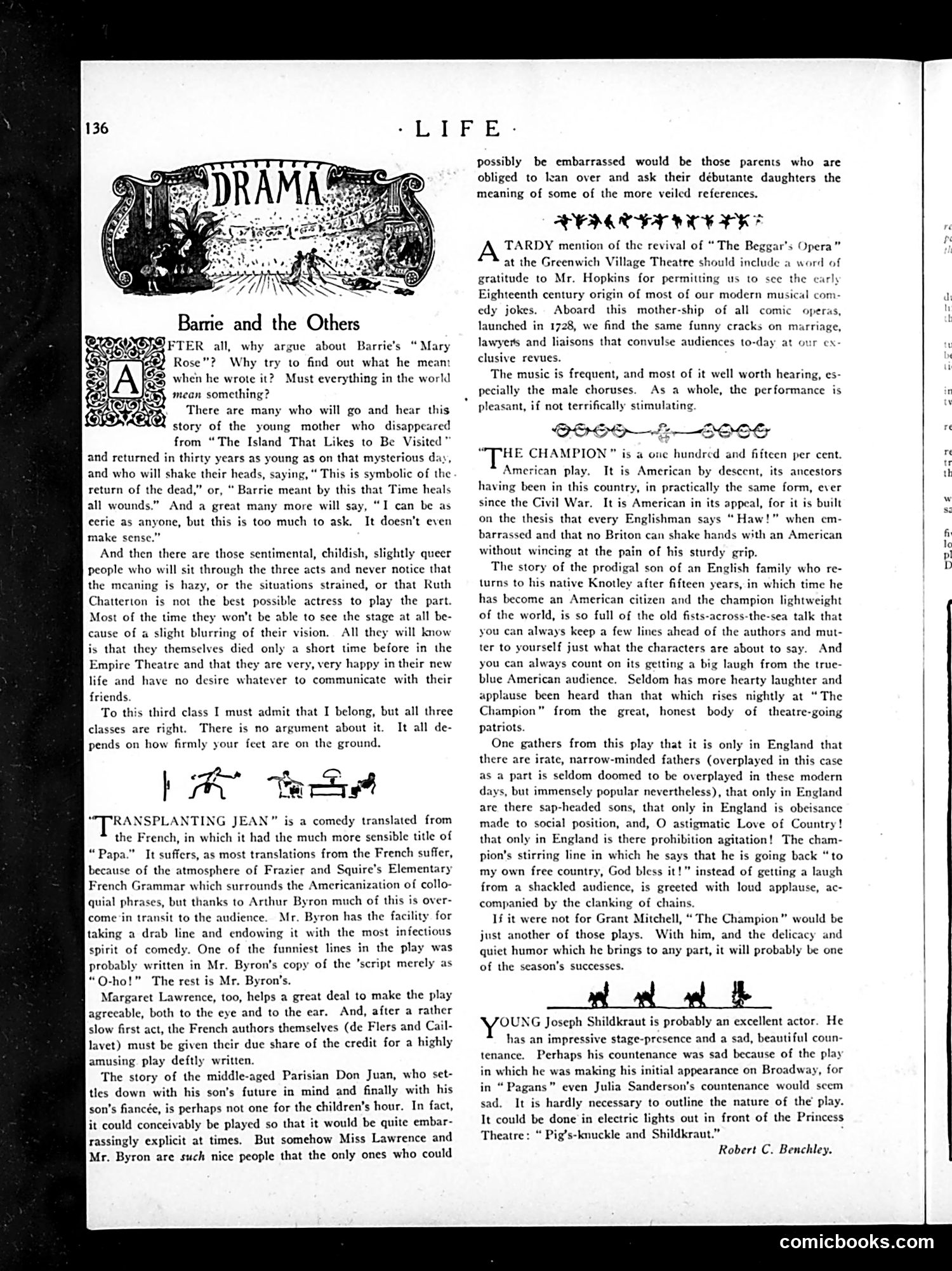
This page contains theater reviews of three plays. The critic discusses J.M. Barrie's work (likely "Mary Rose"), noting that audiences interpret it differently based on their emotional engagement—some seek deep symbolism, others find it nonsensical, while sentimentalists are moved to tears regardless of plot coherence. "Transplanting Jean," a French comedy translated into English, receives praise for actors Arthur Byron and Margaret Lawrence, who elevate somewhat awkward translation work. The critic notes the play contains mildly risqué material about a middle-aged Parisian man settling down, but the performers' propriety prevents embarrassment except among easily-shocked parents. Finally, a brief mention of "The Beggar's Opera" revival credits its historical importance—the 1728 original established comedy conventions (marriage jokes, affairs) still used in contemporary revues. The reviews emphasize performer quality over material.
📄 Transcribed text from this page (OCR, searchable)
Machine-transcribed from the original scan — historical spelling and the odd misread are preserved.
Barrie and the Others FTER all, why argue about Barrie's “ Mary Why try to find out what he meant mean something? There are many who will go and hear this story of the young mother who disappeared from “The Island That Likes to Be Visited ” and returned in thirty years as young as on that mysterious day, and who will shake their heads, saying, “ This is symbolic of the return of the dead,” or, “ Barrie meant by this that Time heals all wounds.” And a great many more will say, “I can be as eerie as anyone, but this is too much to ask. It doesn’t even make sense.” And then there are those sentimental, childish, slightly queer people who will sit through the three acts and never notice that the meaning is hazy, or the situations strained, or that Ruth Chatterton is not the best possible actress to play the part. Most of the time they won't be able to see the stage at all be- cause of a slight blurring of their vision. All they will know is that they themselves died only a short time before in the Empire Theatre and that they are very, very happy in their new life and have no desire whatever to communicate with their friends To this third class I must admit that I belong, but all three classes are right. There is no argument about it. It all de- pends on how firmly your feet are on the ground. A Reo “TRANSPLANTING JEAN” is a comedy translated from the French, in which it had the much more sensible title of “Papa.” It suffers, as most translations from the French suffer, because of the atmosphere of Frazier and Squire's Elementary ench Grammar which surrounds the Americanization of collo- quial phrases, but thanks to Arthur Byron much of this is over- come ‘in transit to the audience. Mr. Byron has the facility for taking a drab line and endowing it with the most infectious spirit of comedy. One of the funniest lines in the play was probably written in Mr. Byron's copy of the 'script merely as “O-ho!” The rest is Mr. Byron's. Margaret Lawrence, too, helps a great deal to make the play agreeable, both to the eye and to the ear. And, after a rather slow first act, the French authors themselves (de Flers and Cail- lavet) must be given their due share of the credit for a highly amusing play deftly written. The story of the middle-aged Parisian Don Juan, who set- tles down with his son’s future in mind and finally with his son’s fiancée, is perhaps not one for the children’s hour. In fact, it could conceivably be played so that it would be quite embar- rassingly explicit at times. But somehow Miss Lawrence and Mr. Byron are such nice people that the only ones who could -LIFE- possibly be embarrassed would be those parents who are obliged to lean over and ask their débutante daughters the meaning of some of the more veiled references. PERRET OE EKE TARDY mention of the revival of “ The Beggar’s Opera” at the Greenwich Village Theatre should include a word of gratitude to Mr. Hopkins for permitting us to see the carly Eighteenth century origin of most of our modern musical com- edy jokes. Aboard this mother-ship of all comic launched in 1728, we find the same funny cracks on marriage, operas, lawyers and liaisons that convulse audiences to-day at our ex- clusive revues. The music is frequent, and most of it well worth hearing, es- pecially the male choruses. As a whole, the performance is pleasant, if not terrifically stimulating. OSSD “"CHE CHAMPION” is American play. having been in this country, in practically the same form, ever since the Civil War. It is American in its appeal, for it is built on the thesis that every Englishman says “Haw!” when cm- | barrassed and that no Briton can shake hands with an American | without wincing at the pain of his sturdy grip. The story of the prodigal son of an English family who re- turns to his native Knotley after fifteen years, in which time he has become an American citizen and the champion lightweight of the world, is so full of the old fists-across-the-sea talk that you can always keep a few lines ahead of the authors and mut- | ter to yourself just what the characters are about to say. And you can always count on its getting a big laugh from the true- blue American audience. Seldom has more hearty laughter and applause been heard than that which rises nightly at “The Champion” from the great, honest body of patriots. One gathers from this play that it is only in England that there are irate, narrow-minded fathers (overplayed in this case as a part is seldom doomed to be overplayed in these modern days, but immensely popular nevertheless), that only in England are there sap-headed sons, that only in England is obcisance made to social position, and, O astigmatic Love of Country! that only in England is there prohibition agitati The cham- pion's stirring line in which he says that he is going back “to my own free country, God bless it!” instead of getting a laugh from a shackled audience, is greeted with loud applause, ac- companied by the clanking of chains. If it were not for Grant Mitchell, “ The Champion” would be just another of those plays. With him, and the delicacy and quiet humor which he brings to any part, it will probably be one of the season's successes. ww nl OUNG Joseph Shildkraut is probably an excellent actor. He has an impressive stage-presence and a sad, beautiful coun- tenance. Perhaps his countenance was sad because of the play in which he was making his initial appearance on Broadway, for Oey a one hundred and fifteen per cent. It is American by descent, its ancestors theatre-going in “Pagans” even Julia Sanderson's countenance would seem sad. It is hardly necessary to outline the nature of the’ play. It could be done in electric lights out in front of the Princess Theatre: “ Pig’s-knuckle and Shildkraut.” x Robert C. Benchley. comicbooks.com