
Life, 1921-01-27 · page 6 of 36
Life — January 27, 1921 — page 6: what you’re looking at
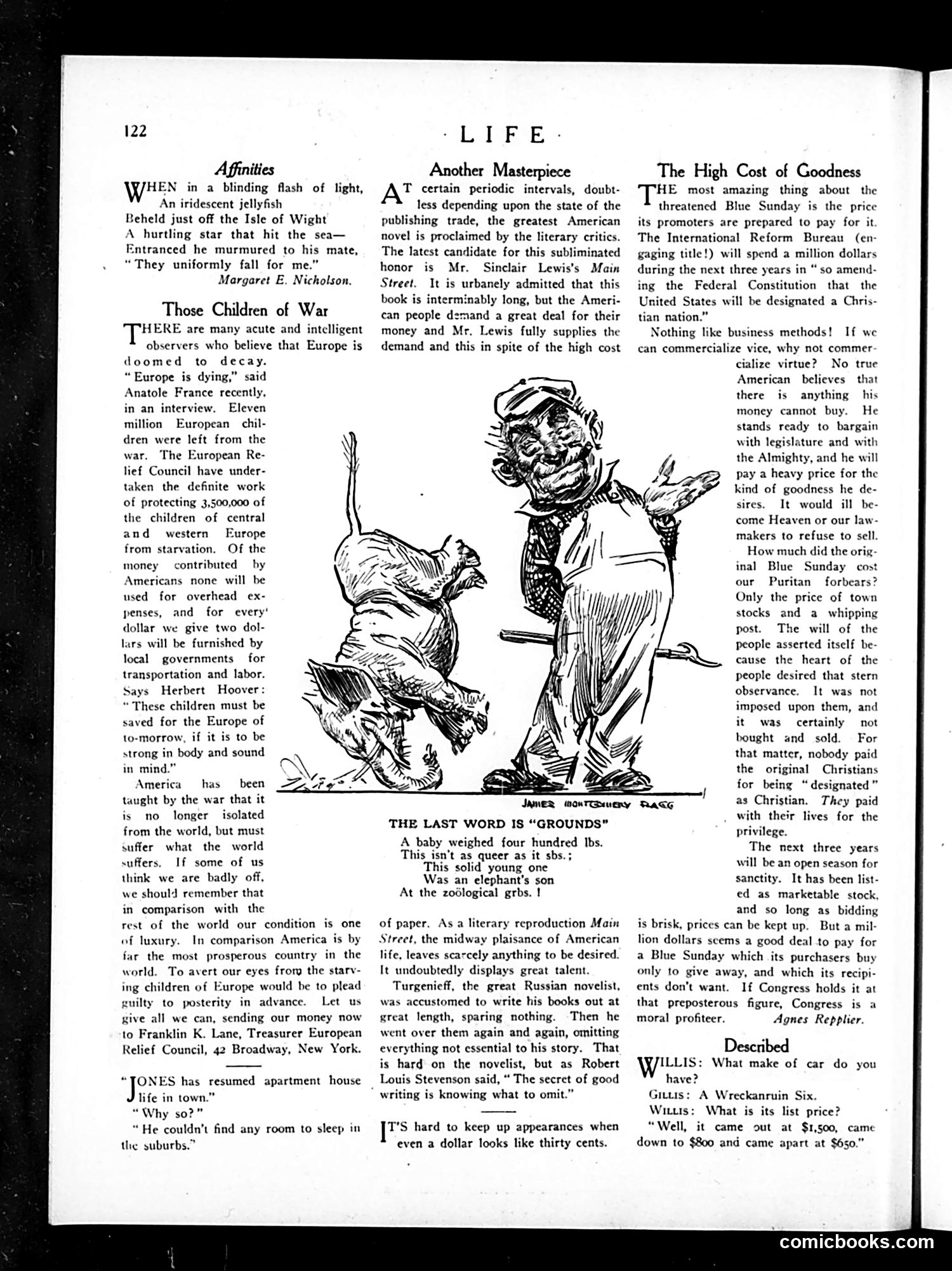
What you’re looking at
This cartoon by James Montgomery Flagg depicts two figures in what appears to be a confrontational scene, with the caption "THE LAST WORD IS 'GROUNDS.'" The accompanying text suggests this is commentary on a literary dispute. It references Sinclair Lewis's *Main Street* as "the greatest American novel" and discusses literary criticism. The phrase "grounds" likely contains a double meaning—both the literal coffee grounds visible in the cartoon and the figurative "grounds" (basis/justification) for an argument. The cartoon appears to satirize a disagreement between literary figures or critics, though the specific individuals are unclear from the image alone. The humor seems to rest on this wordplay about having "grounds" for one's position.
📄 Transcribed text from this page (OCR, searchable)
Machine-transcribed from the original scan — historical spelling and the odd misread are preserved.
122 Affinities \WHEN in a blinding flash of light, An iridescent jellyfish Beheld just off the Isle of Wight A hurtling star that hit the sea— Entranced he murmured to his mate, “They uniformly fall for me.” Margaret E. Nicholson. Those Children of War HERE are many acute and intelligent observers who believe that Europe is doomed to decay. “Europe is dying,” said Anatole France recently, in an interview. Eleven million European chil- dren were left from the war. The European Re- lief Council have under- taken the definite work of protecting 3,500,000 of the children of central and western Europe from starvation. Of the money contributed by Americans none will be used for overhead ex- penses, and for every’ dollar we give two dol- lars will be furnished by local governments for transportation and labor. Says Herbert Hoover: “ These children must be saved for the Europe of to-morrow, if it is to be strong in body and sound in mind.” America been taught by the war that it is no longer isolated from the world, but must suffer what the world suffers, If some of us think we are badly off, we should remember that in comparison with the rest of the world our condition is one of luxury. In comparison America is by far the most prosperous country in the world. To avert our eyes fror the starv- ing children of Europe would be to plead guilty to posterity in advance. Let us give all we can, sending our money now to Franklin K. Lane, Treasurer European Relief Council, 42 Broadway, New York. has “TONES has resumed apartment house life in town.” “Why so?” “He couldn’t find any room to sleep in the suburbs.” -LIFE.- Another Masterpiece A’ certain periodic intervals, doubt- less depending upon the state of the publishing trade, the greatest American novel is proclaimed by the literary critics. The latest candidate for this subliminated honor is Mr. Sinclair Lewis's Main Street. It is urbanely admitted that this book is interminably long, but the Ameri- can people demand a great deal for their money and Mr. Lewis fully supplies the demand and this in spite of the high cost INNER WONTTuRyY RACE THE LAST WORD IS “GROUNDS” A baby weighed four hundred Ibs. This isn’t as queer as it sbs.; This solid young one Was an elephant’s son At the zodlogical grbs. ! of paper. Asa literary reproduction Main Street, the midway plaisance of American life, leaves scarcely anything to be desired. It undoubtedly displays great talent. Turgenieff, the great Russian novelist, was accustomed to write his books out at great length, sparing nothing. Then he went over them again and again, omitting everything not essential to his story. That is hard on the novelist, but as Robert Louis Stevenson said, “ The secret of good ” writing is knowing what to omit.” T’S hard to keep up appearances when even a dollar looks like thirty cents. The High Cost of Goodness 'HE most amazing thing about the threatened Blue Sunday is the price its promoters are prepared to pay for it. The International Reform Bureau (en- gaging title!) will spend a million dollars during the next three years in “so amend- ing the Federal Constitution that the United States will be designated a Chris- tian nation.” Nothing like business methods! can commercialize vice, why not commer cialize virtue? No true American believes that there is anything his money cannot buy. He stands ready to bargain with legislature and with the Almighty, and he will pay a heavy price for the kind of goodness he de- sires. It would ill be- come Heaven or our law- makers to refuse to sell. How much did the orig- inal Blue Sunday cost our Puritan forbears? Only the price of town stocks and a whipping post. he will of the people asserted itself be- cause the heart of the people desired that stern observance. It was not imposed upon them, and it was certainly not bought and sold. For that matter, nobody paid the original Christians for being “designated” as Christian. They paid with their lives for the privilege. The next three years will be an open season for sanctity. It has been list- ed as marketable stock, and so long as bidding is brisk, prices can be kept up. But a mil- lion dollars scems a good deal to pay for a Blue Sunday which its purchasers buy only to give away, and which its recipi- ents don’t want. If Congress holds it at that preposterous figure, Congress is a moral profiteer. Agnes Repplier. Described ILLIS: What make of car do you have? Gittis: A Wreckanruin Six. Witus: What is its list price? “Well, it came out at $1,500, came down to $800 and came apart at $650.” If we comicbooks.com