
Life, 1921-01-27 · page 16 of 36
Life — January 27, 1921 — page 16: what you’re looking at
What you’re looking at
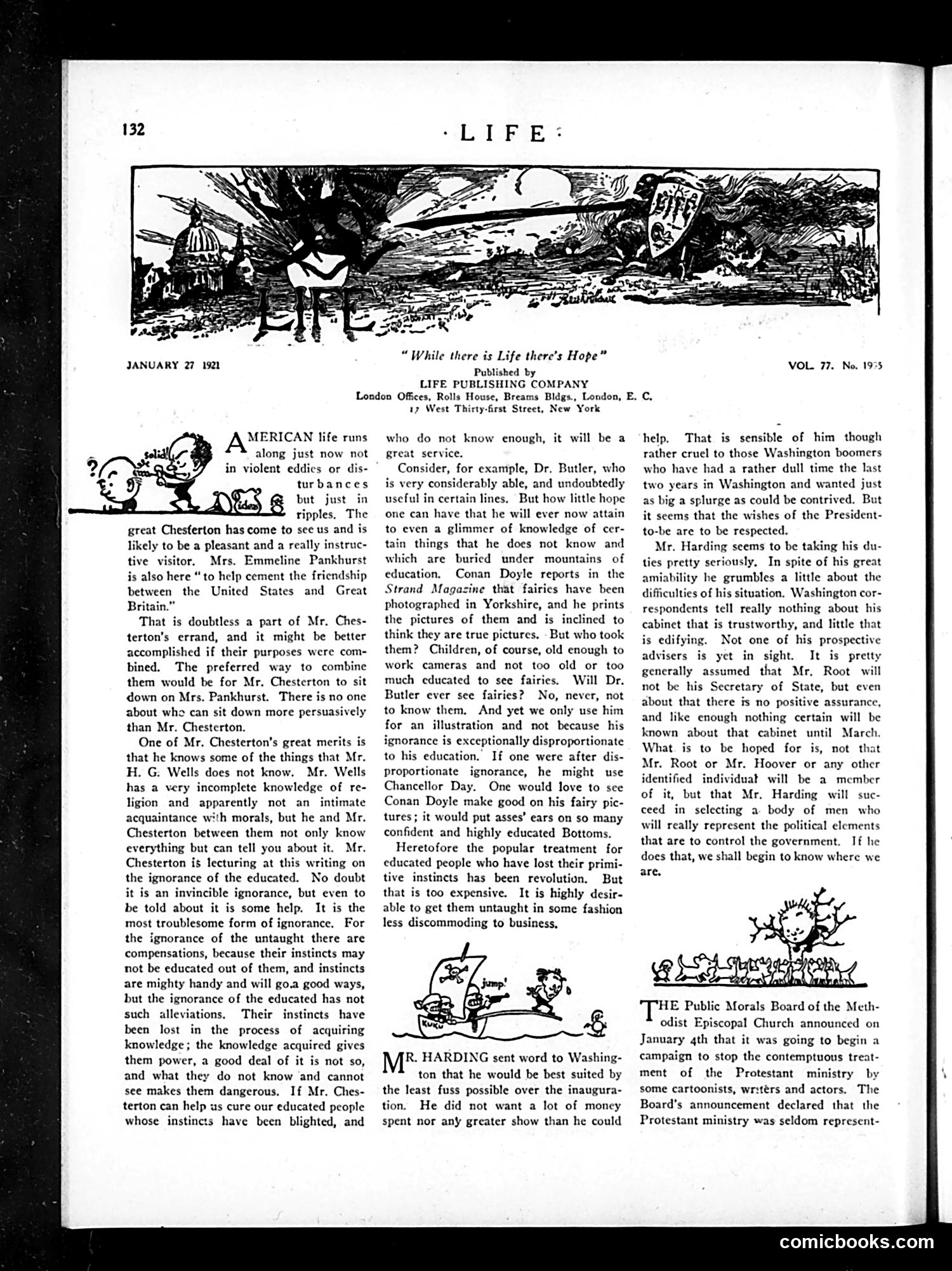
This page contains editorial commentary on American politics and social issues rather than traditional political cartoons. The main article discusses **President Harding's cabinet appointments**, specifically praising **Dr. Butler** as capable while criticizing the general lack of knowledge among Washington officials. The writer argues that educated people should help inform government policy. A secondary piece announces the **Methodist Episcopal Church's Public Morals Board** campaign against "contemptuous treatment of the Protestant ministry by some cartoonists, writers and actors." The small illustrations appear decorative rather than satirical—showing figures and scenes but lacking the sharp caricature typical of Life's political cartoons. The page reflects post-WWI anxieties about government competence and the cultural authority of religious institutions.
📄 Transcribed text from this page (OCR, searchable)
Machine-transcribed from the original scan — historical spelling and the odd misread are preserved.
JANUARY 27 1921 “While there is Life there’s Hope” Published by LIFE PUBLISHING COMPANY VOL. 77. No. 19°55 London Offices, Rolls House, Breams Bldgs, London, E. C, MERICAN life runs along just now not in violent eddics or dis- turbances but just in ripples. The great Chesferton has come to see us and is likely to be a pleasant and a really instruc- tive visitor. Mrs. Emmeline Pankhurst is also here “to help cement the friendship between the United States and Great Britain.” That is doubtless a part of Mr. Ches- terton’s errand, and it might be better accomplished if their purposes were com- bined. The preferred way to combine them would be for Mr. Chesterton to sit down on Mrs. Pankhurst. There is no one about who can sit down more persuasively than Mr. Chesterton. One of Mr. Chesterton’s great merits is that he knows some of the things that Mr. H. G: Wells does not know. Mr. Wells has a very incomplete knowledge of re- ligion and apparently not an intimate acquaintance with morals, but he and Mr. Chesterton between them not only know everything but can tell you about it. Mr. Chesterton is lecturing at this writing on the ignorance of the educated. No doubt it is an invincible ignorance, but even to be told about it is some help. It is the most troublesome form of ignorance. For orance of the untaught there are compensations, because their instincts may not be educated out of them, and instincts are mighty handy and will go.a good ways, but the ignorance of the educated has not such alleviations. Their instincts have been lost in the process of acquiring knowledge; the knowledge acquired gives them power, a good deal of it is not so, and what they do not know and cannot see makes them dangerous. If Mr. Ches- terton can help us cure our educated people whose instincts have been blighted, and 17 West Thirty-first Street, New York who do not know enough, it will be a great service. Consider, for example, Dr. Butler, who is very considerably able, and undoubtedly useful in certain lines, But how little hope one can have that he will ever now attain to even a glimmer of knowledge of cer- tain things that he does not know and which are buricd under mountains of education. Conan Doyle reports in the Strand Magazine that fairies have been photographed in Yorkshire, and he prints the pictures of them and is inclined to think they are true pictures. But who took them? Children, of course, old enough to work cameras and not too old or too much educated to see fairies. Will Dr. Butler ever see fairies? No, never, not to know them, And yet we only use him for an illustration and not because his ignorance is exceptionally disproportionate to his education. If one were after dis- proportionate ignorance, he might use Chancellor Day. One would love to sce Conan Doyle make good on his fairy pic- tures; it would put asses’ ears on so many confident and highly educated Bottoms. Heretofore the popular treatment for educated people who have lost their primi- tive instincts has been revolution. But that is too expensive. It is highly desir- able to get them untaught in some fashion less discommoding to business, R. HARDING sent word to Washing- ton that he would be best suited by the least fuss possible over the inaugura- tion. He did not want a lot of money spent nor any greater show than he could help. That is sensible of him though rather cruel to those Washington boomers who have had a rather dull time the last two years in Washington and wanted just as big a splurge as could be contrived. But it seems that the wishes of the President- to-be are to be respected. Mr. Harding seems to be taking his du- ties pretty seriously, In spite of his great amiability he grumbles a little about the difficulties of his situation. Washington cor- respondents tell really nothing about his cabinet that is trustworthy, and little that is edifying. Not one of his prospective advisers is yet in sight. It is pretty generally assumed that Mr, Root will not be his Secretary of State, but even about that there is no positive assurance, and like enough nothing certain will be known about that cabinet until March, What. is to be hoped for is, not that Mr. Root or Mr. Hoover or any other identified individuat will be a member of it, but that Mr. Harding will suc- ceed in selecting a body of men who will really represent the political elements that are to control the government. If he does that, we shall begin to know where we are, AG Tan HE Public Morals Board of the Meth- odist Episcopal Church announced on January 4th that it was going to begin a campaign to stop the contemptuous treat- ment of the Protestant ministry by some cartoonists, writers and actors. The Board’s announcement declared that the Protestant ministry was seldom represent- comicbooks.com