
Life, 1921-01-27 · page 26 of 36
Life — January 27, 1921 — page 26: what you’re looking at
What you’re looking at
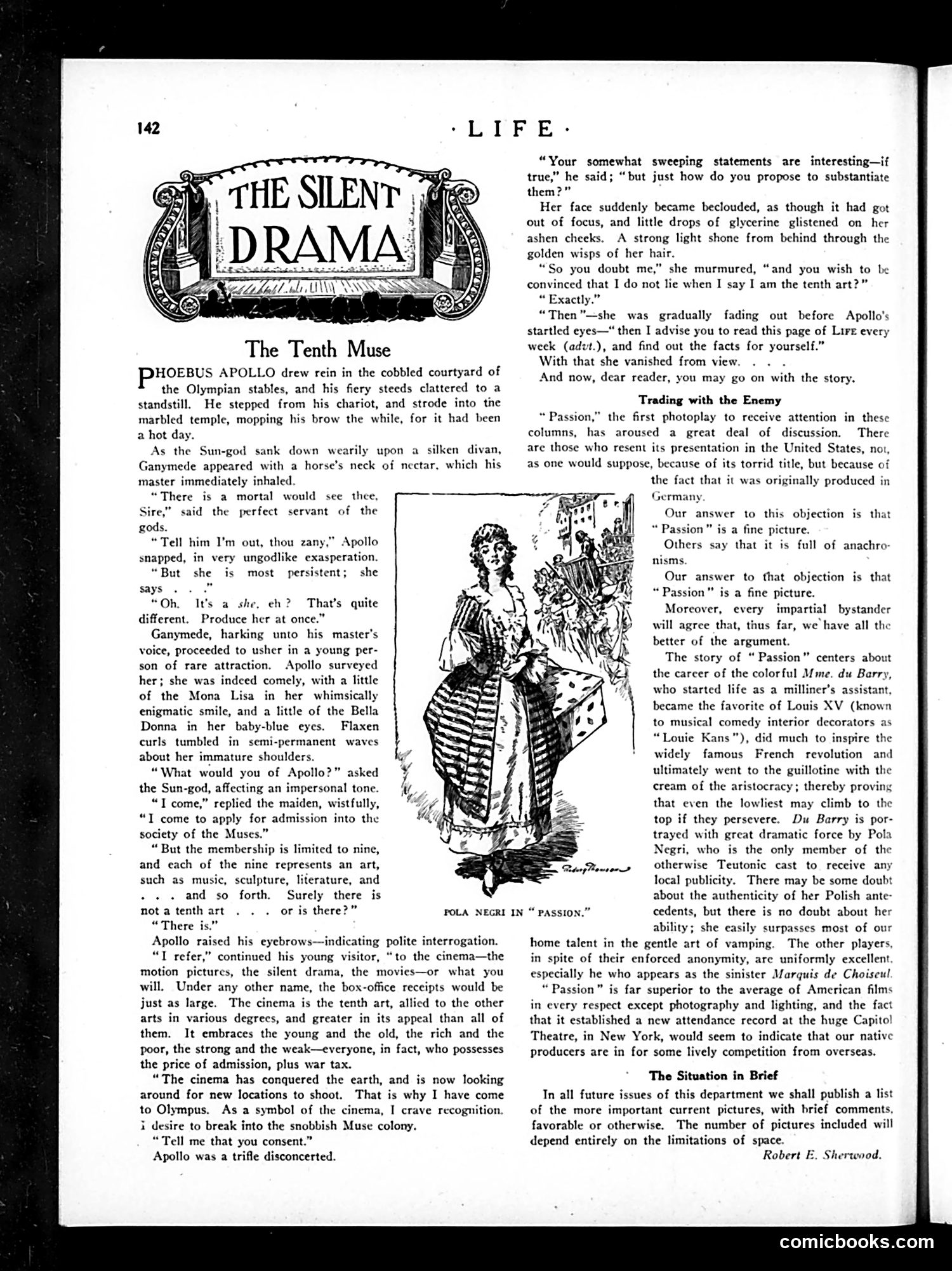
This page presents a fanciful dialogue where a young woman petitions Apollo to recognize cinema as the "tenth art" among the traditional Muses. The satire argues for motion pictures' cultural legitimacy: cinema "embraces the young and the old, the rich and the poor...everyone...who possesses the price of admission." The accompanying section, "Trading with the Enemy," defends the German film *Passion* against American objections. Critics complained it was produced in Germany (likely post-WWI sentiment) or contained historical inaccuracies. Life dismisses both objections, insisting "*Passion* is a fine picture." The featured image shows Polish actress Pola Negri in the film. The satire's point: cinema deserves artistic respect equal to traditional arts, and quality transcends national origin—a progressive stance for the early 1920s.
📄 Transcribed text from this page (OCR, searchable)
Machine-transcribed from the original scan — historical spelling and the odd misread are preserved.
“LIFE: The Tenth Muse HOEBUS APOLLO drew rein in the cobbled courtyard of the Olympian stables, and his fiery steeds clattered to a standstill. He stepped from his chariot, and strode into the marbled temple, mopping his brow the while, for it had been a hot day. As the Sun-god sank down wearily upon a silken divan, Ganymede appeared with a horse’s neck of nectar, which his master immediately inhaled. “There is a mortal would see thee, Sire,” said the perfect servant of the gods. “Tell him I'm out, thou zany,” Apollo snapped, in very ungodlike exasperation. “But she is most persistent; she says . ” “Oh. It's a she, eh? That’s quite different. Produce her at once.” Ganymede, harking unto his master’s voice, proceeded to usher in a young per- son of rare attraction. Apollo surveyed her; she was indced comely, with a little of the Mona Lisa in her whimsically enigmatic smile, and a little of the Bella Donna in her baby-blue eyes. Flaxen curls tumbled in semi-permanent waves about her immature shoulders. “What would you of Apollo?” asked the Sun-god, affecting an impersonal tone. “T come,” replied the maiden, wistfully, “TI come to apply for admission into the society of the Muses.” “But the membership is limited to nine, and each of the nine represents an art, such as music, sculpture, literature, and + + . and so forth. Surely there is nota tenth art . . . or is there?” “There is.” Apollo raised his eyebrows—indicating polite interrogation. “T refer,” continued his young visitor, “to the cinema—the motion pictures, the silent drama, the movies—or what you will. Under any other name, the box-office receipts would be just as large. The cinema is the tenth art, allied to the other arts in various degrees, and greater in its appeal than all of them. It embraces the young and the old, the rich and the poor, the strong and the weak—everyone, in fact, who possesses the price of admission, plus war tax. “The cinema has conquered the earth, and is now looking around for new locations to shoot. That is why I have come to Olympus. As a symbol of the cinema, I crave recognition. i desire to break into the snobbish Muse colony. “Tell me that you consent.” Apollo was a trifle disconcerted. FOLA NEGRI IN “ PASSION.” “Your somewhat sweeping statements are interesting—if he said; “but just how do you propose to substantiate Her face suddenly became beclouded, as though it had got out of focus, and little drops of glycerine glistened on her ashen cheeks. A strong light shone from behind through the golden wisps of her hair. “So you doubt me,” she murmured, “and you wish to be convinced that I do not lie when I say I am the tenth art?” “ Exactly “Then "—she was gradually fading out before Apollo's startled eyes—“ then I advise you to read this page of Lire every week (advt.), and find out the facts for yourself.” With that she vanished from view. z And now, dear reader, you may go on with the story. Trading with the Enemy “Passion,” the first photoplay to receive attention in these columns, has aroused a great deal of discussion. There are those who resent its presentation in the United States, no, as one would suppose, because of its torrid title, but because of the fact that it was originally produced in Germany Our answer to this objection is that “ Passion” is a fine picture. Others say that it is full of anachro- nisms. Our answer to that objection is that “Passion” is a fine picture. Moreover, every impartial bystander will agree that, thus far, we have all the better of the argument. The story of “ Passion” centers about the career of the colorful Mme. du Barry, who started life as a milliner’s assistant, became the favorite of Louis XV (known to musical comedy interior decorators as “Louie Kans"), did much to inspire the widely famous French revolution and ultimately went to the guillotine with the cream of the aristocracy; thereby proving that even the lowliest may climb to the top if they persevere. Du Barry is por- trayed with great dramatic force by Pola Negri, who is the only member of the otherwise Teutonic cast to receive any local publicity. There may be some doubt about the authenticity of her Polish ante- cedents, but there is no doubt about her ability; she easily surpasses most of our home talent in the gentle art of vamping. The other players, in spite of their enforced anonymity, are uniformly excellent. especially he who appears as the sinister Marquis de Choiseul “Passion” is far superior to the average of American films in every respect except photography and lighting, and the fact that it established a new attendance record at the huge Capito! Theatre, in New York, would seem to indicate that our native producers are in for some lively competition from overseas. The Situation in Brief In all future issues of this department we shall publish a list of the more important current pictures, with brief comments, favorable or otherwise. The number of pictures included will depend entirely on the limitations of space. Robert E, Sherwood. comicbooks.com