
A complete issue · 44 pages · 1921
Life — January 6, 1921
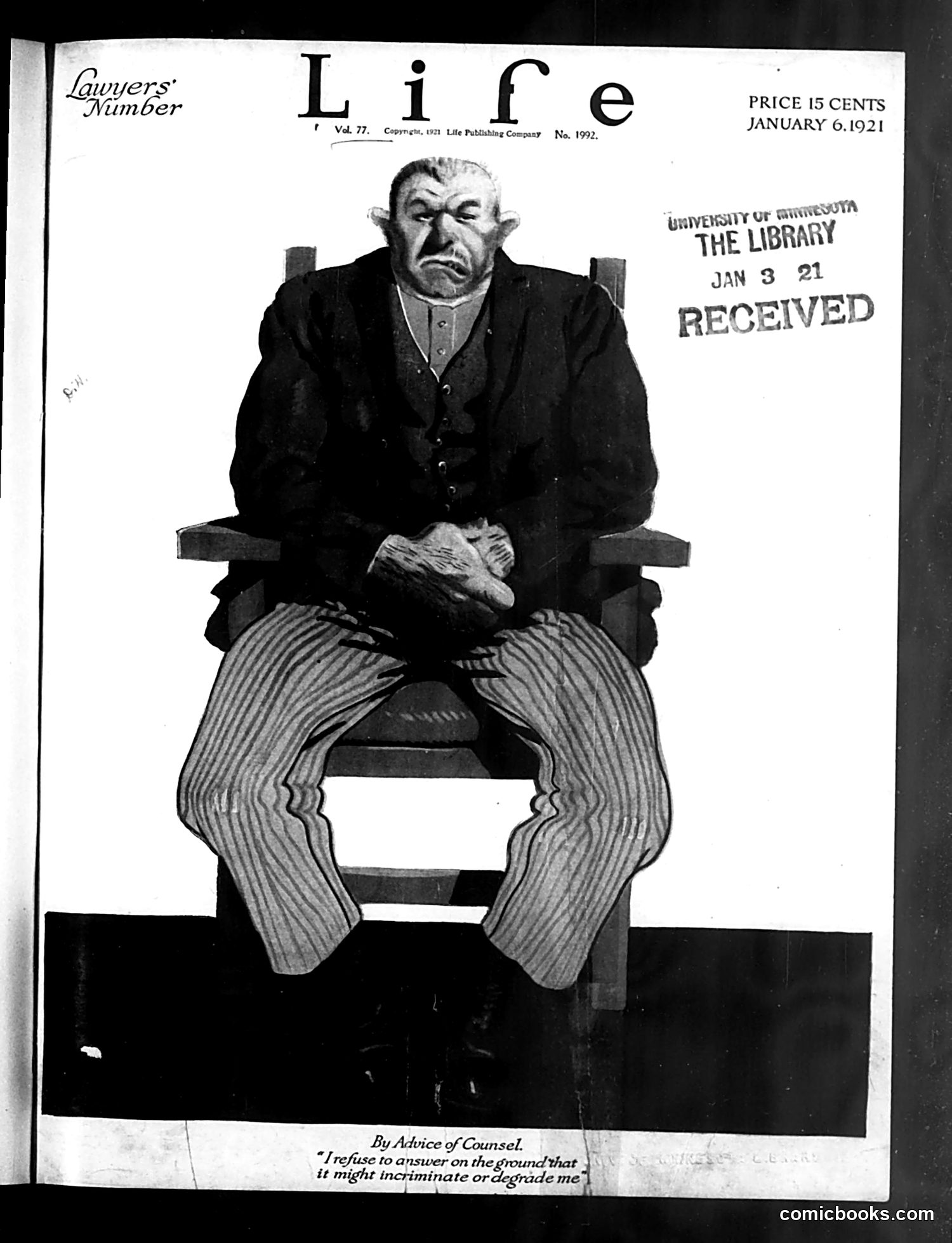
This is a "Lawyers' Number" issue of *Life* from January 6, 1921. The cover depicts a man sitting in a chair with an exaggerated, guilty or evasive expression. The caption reads: "By Advice of Counsel. 'I refuse to answer on the ground that it might incriminate or degrade me.'" The satire targets the legal defense of remaining silent to avoid self-incrimination—specifically, invoking Fifth Amendment protections. The cartoon suggests that criminals or guilty parties hide behind their lawyers' advice rather than face justice directly. The man's uncomfortable posture and expression imply dishonesty. The satire critiques how legal counsel enables evasion of accountability, a common concern during the post-WWI era when organized crime and corruption were rising topics of public debate.
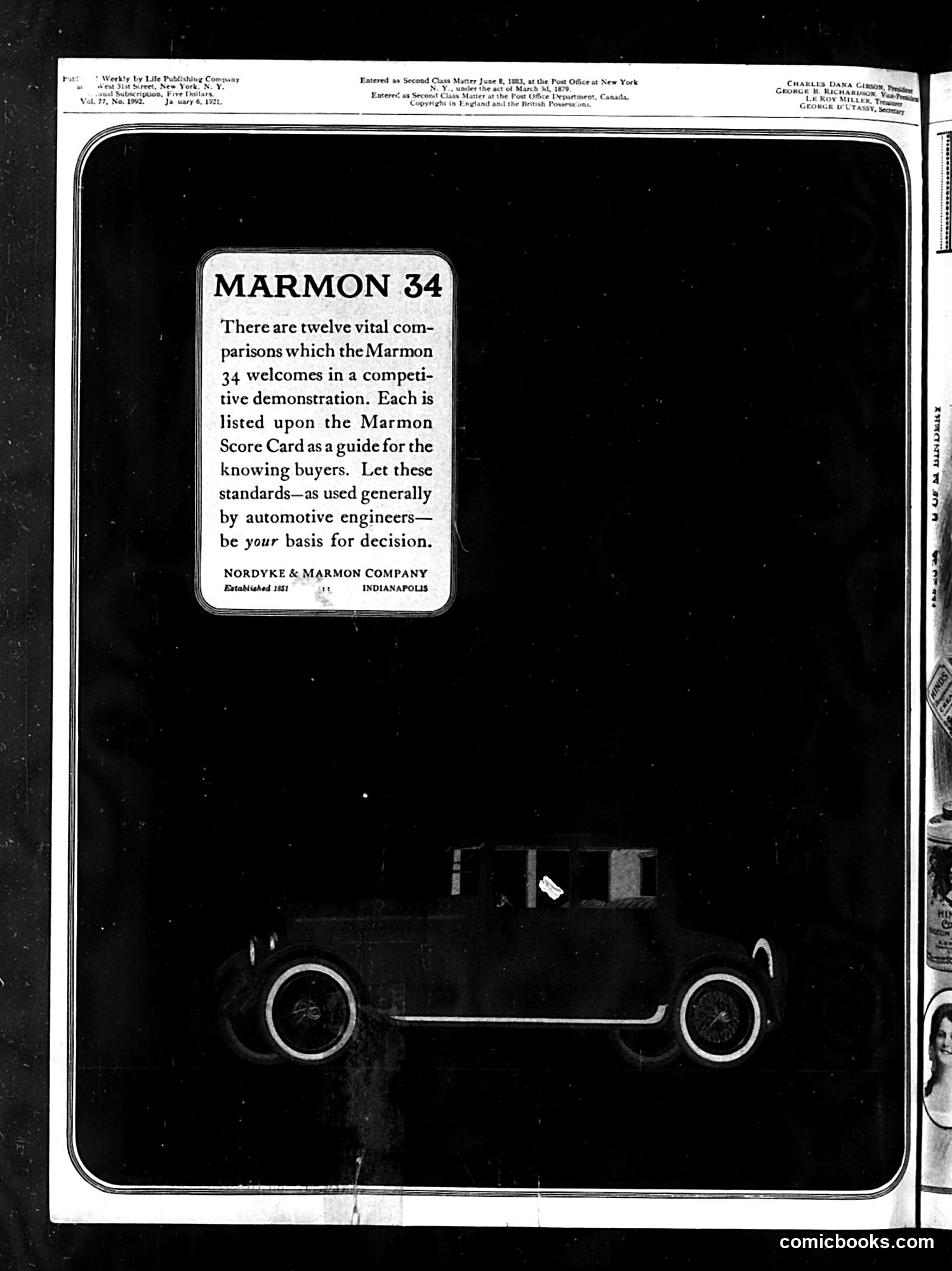
This page is primarily an advertisement for the Marmon 34 automobile, manufactured by Nordyke & Marmon Company in Indianapolis. The ad emphasizes the car's competitive advantages through "twelve vital comparisons" listed on a "Marmon Score Card." The advertisement appeals to informed buyers by suggesting these engineering standards are "used generally by automotive engineers" and should form the basis for purchase decisions. The image shows a side profile of the Marmon 34 automobile against a dark background. This is not political satire or editorial cartooning—it's a straightforward commercial advertisement from *Life* magazine's early 1920s period, designed to position the Marmon as a rationally superior vehicle choice for discerning consumers.
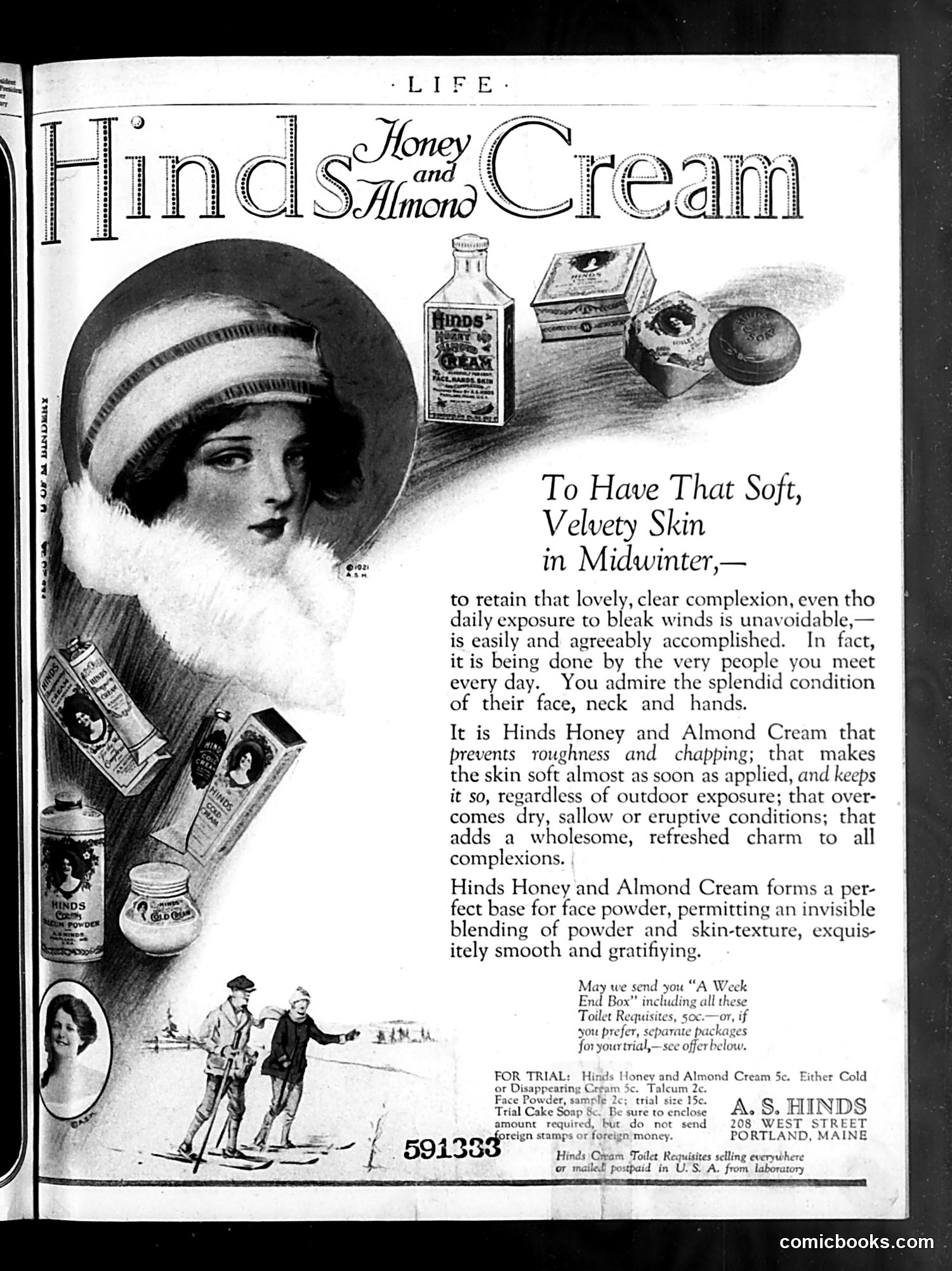
This page is **primarily an advertisement**, not satirical content. It promotes Hinds Honey and Almond Cream, a skincare product manufactured by A. S. Hinds of Portland, Maine. The ad targets women concerned with winter skin care, featuring a fashionably dressed woman in 1920s attire (cloche hat, fur collar). The marketing emphasizes that the cream prevents roughness and chapping while maintaining a "soft, velvety skin" despite harsh weather exposure. The small illustration at bottom shows people engaged in winter outdoor activities (skiing or sledding), suggesting active lifestyles requiring protective skincare. This reflects typical early-20th-century beauty advertising: positioning cosmetics as practical necessities for maintaining appearance through seasonal challenges rather than luxury items.
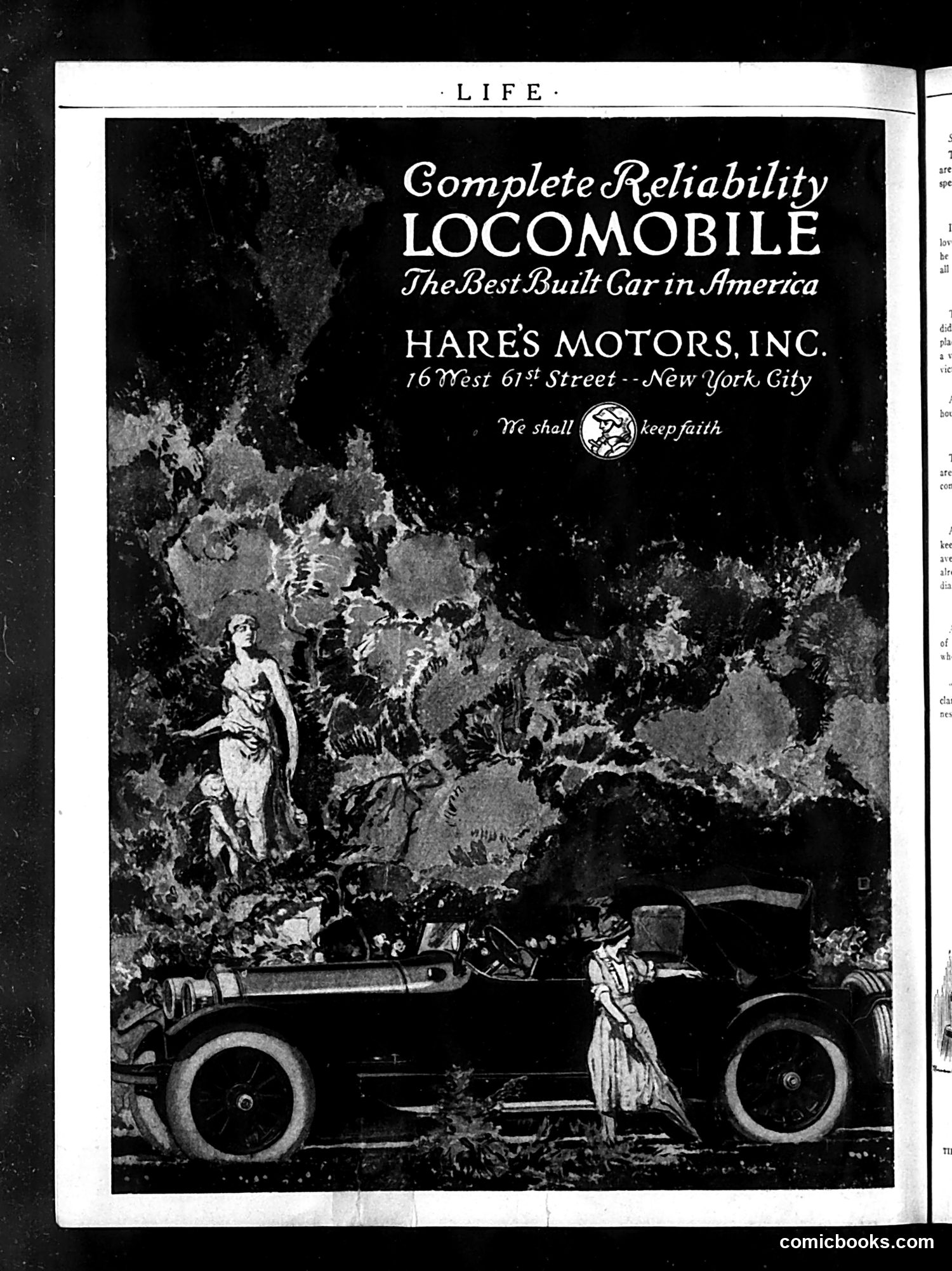
This is a full-page **advertisement**, not satire or political commentary. It promotes the Locomobile automobile, manufactured by Hare's Motors, Inc., located at 769 West 61st Street in New York City. The ad claims "Complete Reliability" and describes the Locomobile as "The Best Built Car in America." The company motto reads "We shall keep faith." The artistic imagery depicts allegorical female figures (likely representing virtue or reliability) in a romanticized garden or natural setting, positioned above an illustration of the automobile itself. This aspirational artistic approach was typical of early automobile advertising, which sought to associate cars with elegance, dependability, and prosperity rather than focusing on mechanical specifications.
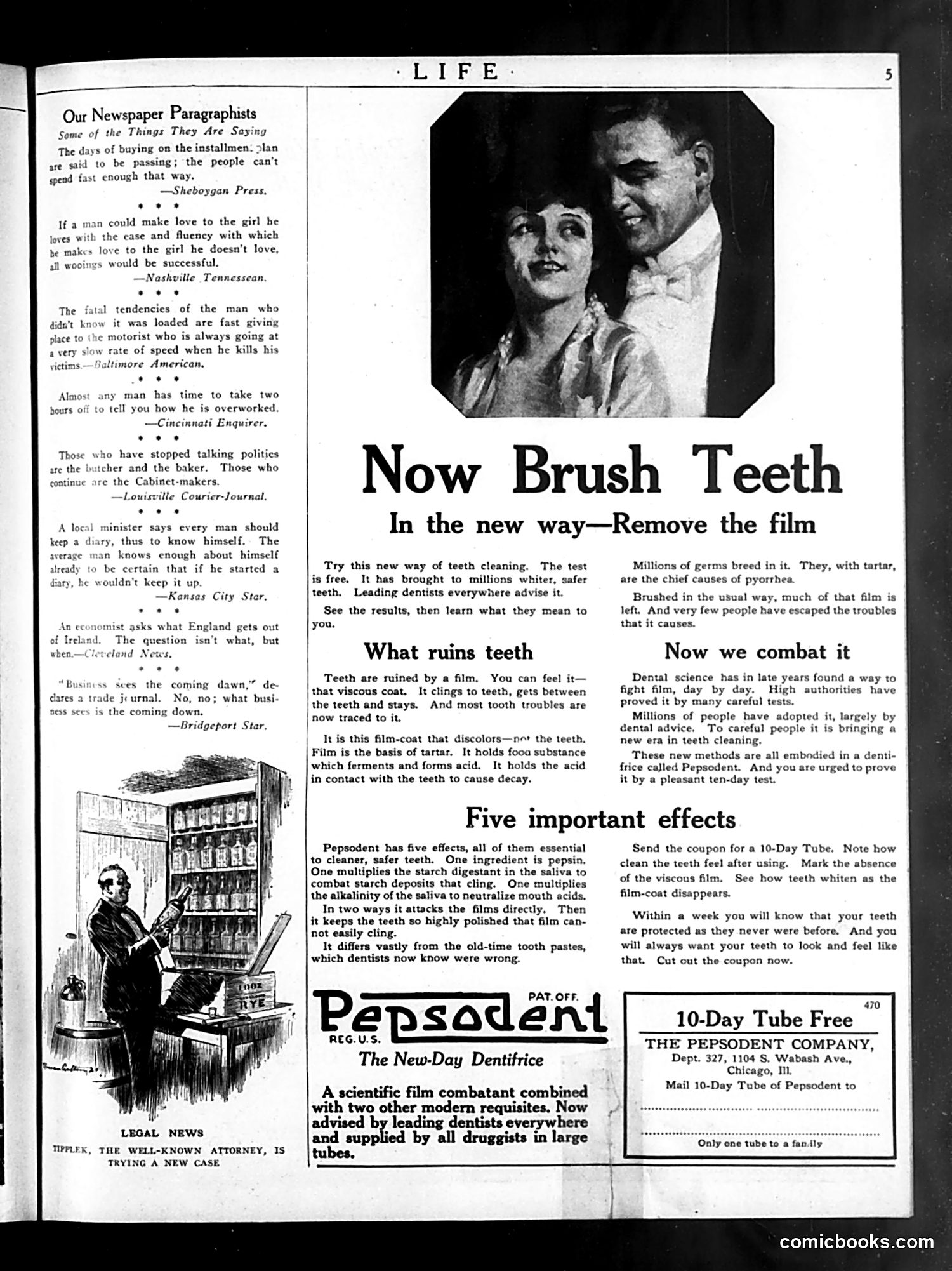
This page is primarily a **toothpaste advertisement**, not political commentary. The main content promotes Pepsodent, "The New-Day Dentifrice," claiming it removes a harmful film from teeth that causes decay and discoloration. The photograph at top shows a couple—likely meant to represent attractive, healthy people benefiting from the product. The illustration at left depicts a pharmacist or shopkeeper displaying Pepsodent bottles. The advertisement emphasizes five purported benefits of the toothpaste and includes a coupon for a free 10-day sample tube. The "Our Newspaper Paragraphists" section on the left is filler content quoting various newspapers' observations about contemporary life—unrelated to the advertisement.
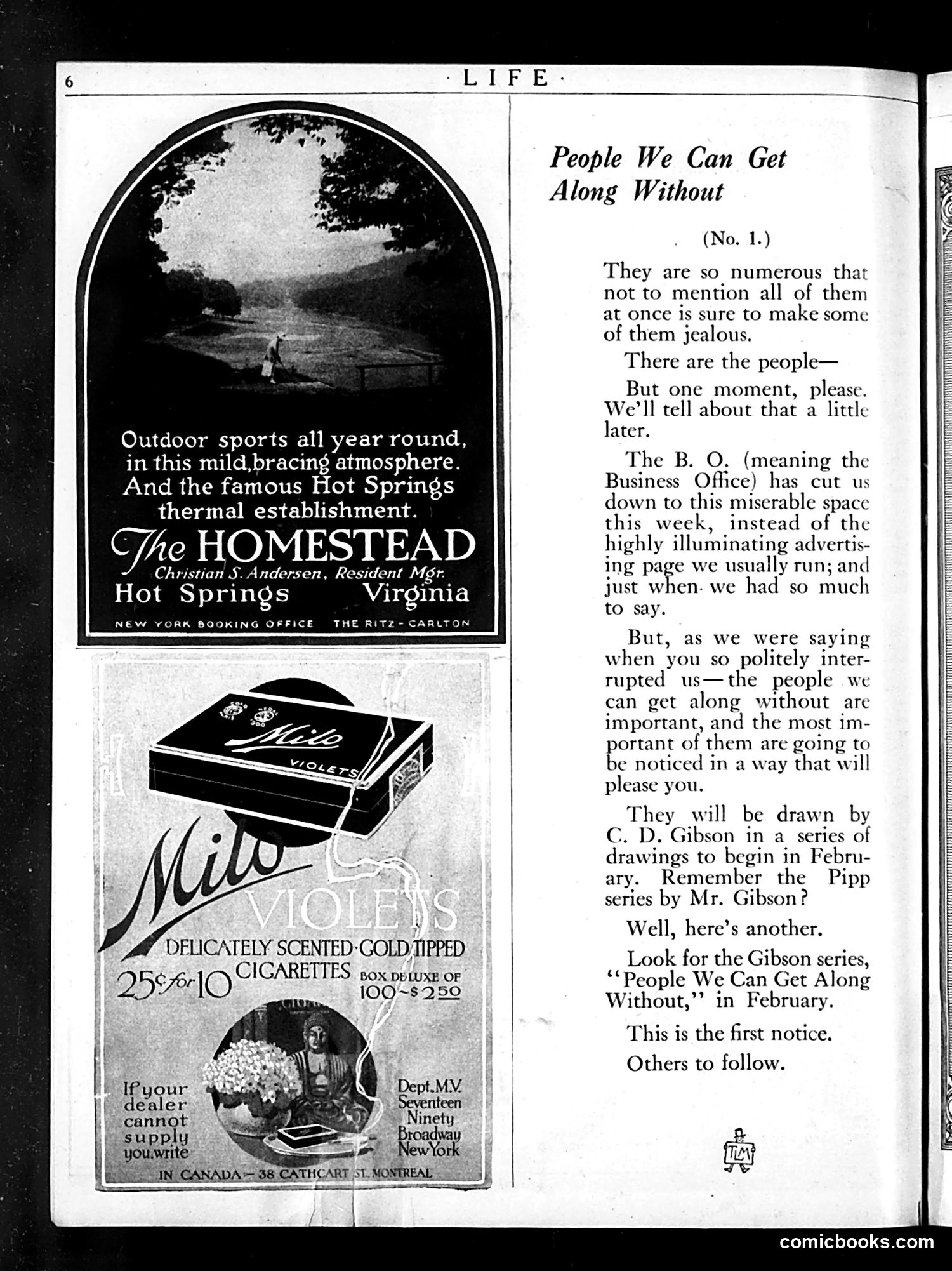
This page is primarily **advertising with editorial content**, not political satire. The advertisements include The Homestead resort in Hot Springs, Virginia (promoting year-round outdoor sports), and Milo Violets cigarettes (25¢ for 10, delicately scented and cold-dipped). The right column contains an editorial note titled "People We Can Get Along Without (No. 1)," announcing an upcoming satirical series by illustrator C.D. Gibson beginning in February. The editor humorously complains that the "Business Office" reduced their usual advertising space, forcing them into a smaller column. Gibson, apparently famous for an earlier "Pipp series," will draw figures representing types of people deemed undesirable or annoying—a common early 20th-century satirical format poking fun at social types and personality quirks.
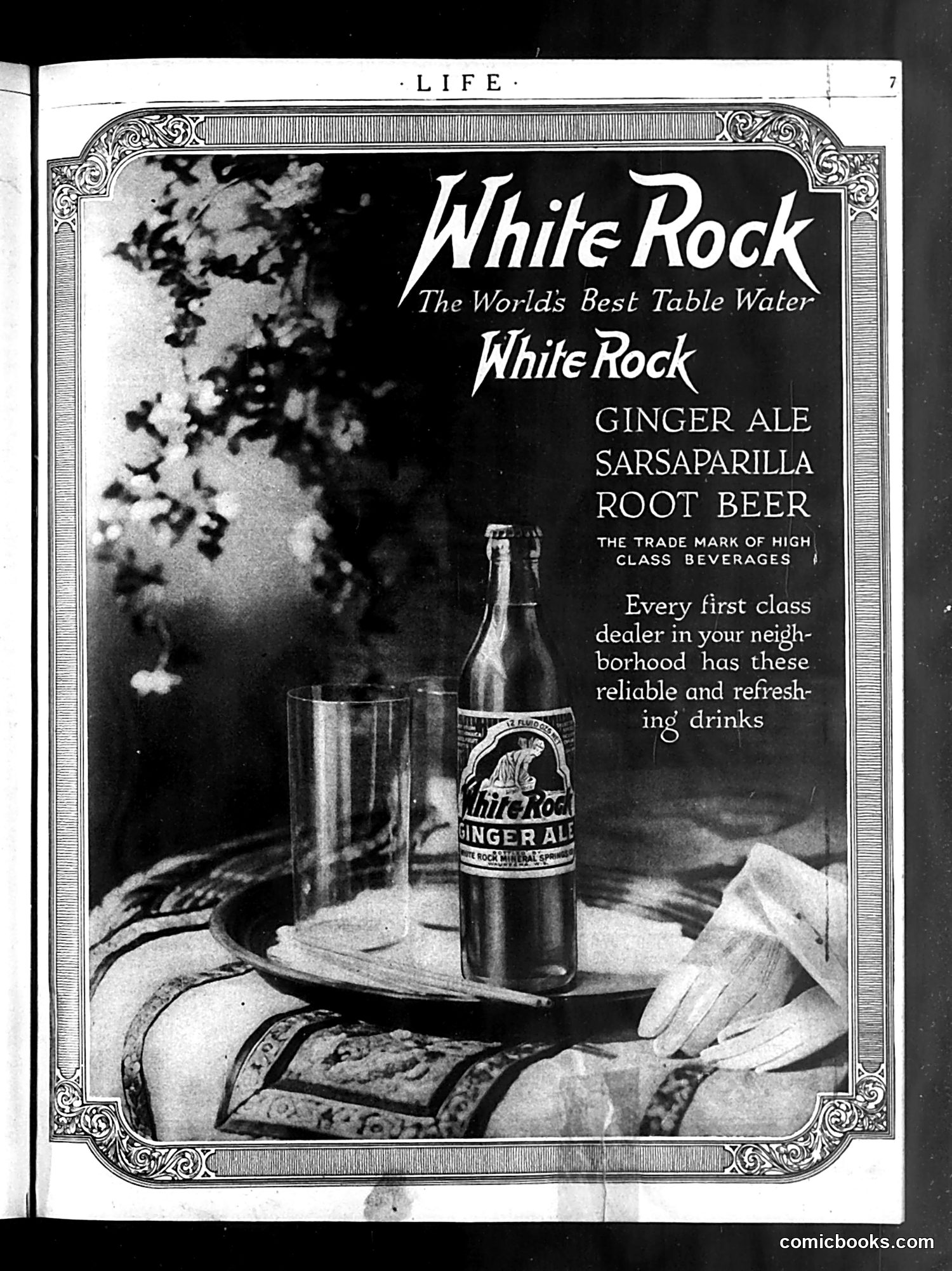
This page is primarily an **advertisement**, not satirical content. It promotes White Rock beverages—table water, ginger ale, sarsaparilla, and root beer—described as "the trade mark of high class beverages." The ad features a product photograph showing a White Rock ginger ale bottle beside a glass, positioned on what appears to be a barrel or cask. A hand reaches toward the bottle. Decorative foliage appears in the background. The copy emphasizes that "every first class dealer in your neighborhood has these reliable and refreshing drinks," positioning White Rock as a premium, widely-available brand. This represents typical early-to-mid-20th-century advertising strategy: using Life magazine's prestige readership to market upscale consumer goods. No political or social satire is present—this is straightforward commercial promotion.
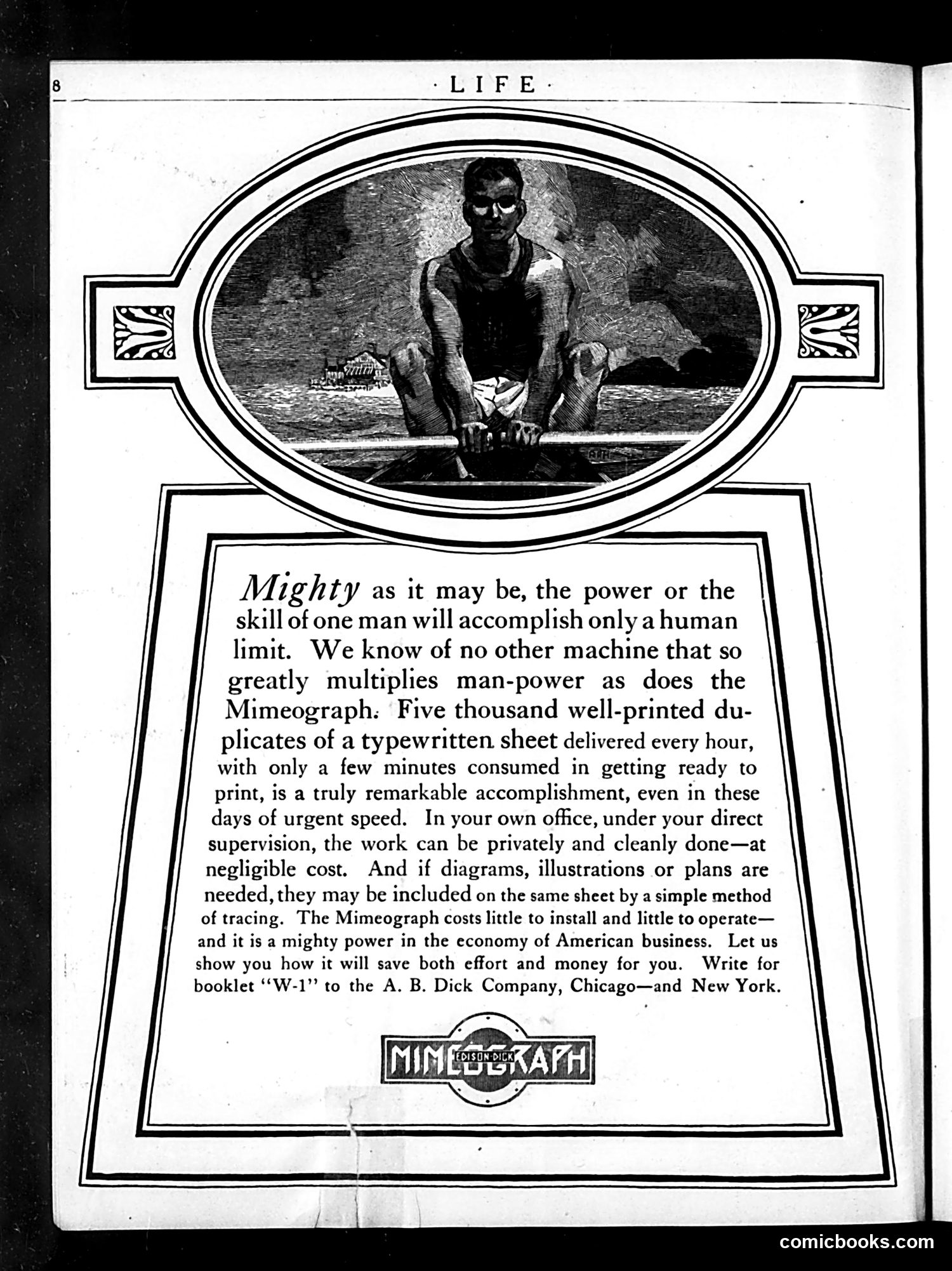
This is a **Mimeograph machine advertisement**, not a political cartoon. The page features a photograph of a man operating the device in an oval frame, with decorative borders typical of early 20th-century advertising design. The text promotes the Mimeograph as a revolutionary business tool that multiplies "man-power"—capable of producing 5,000 printed duplicates of a typewritten sheet per hour with minimal preparation time. It emphasizes the machine's utility for offices, its low cost, and its ability to reproduce diagrams and illustrations. The advertisement is from the A.B. Dick Company (Chicago and New York) and encourages readers to request booklet "W-1" for more information. This represents early industrial-era advertising celebrating mechanization's benefits to American business efficiency.
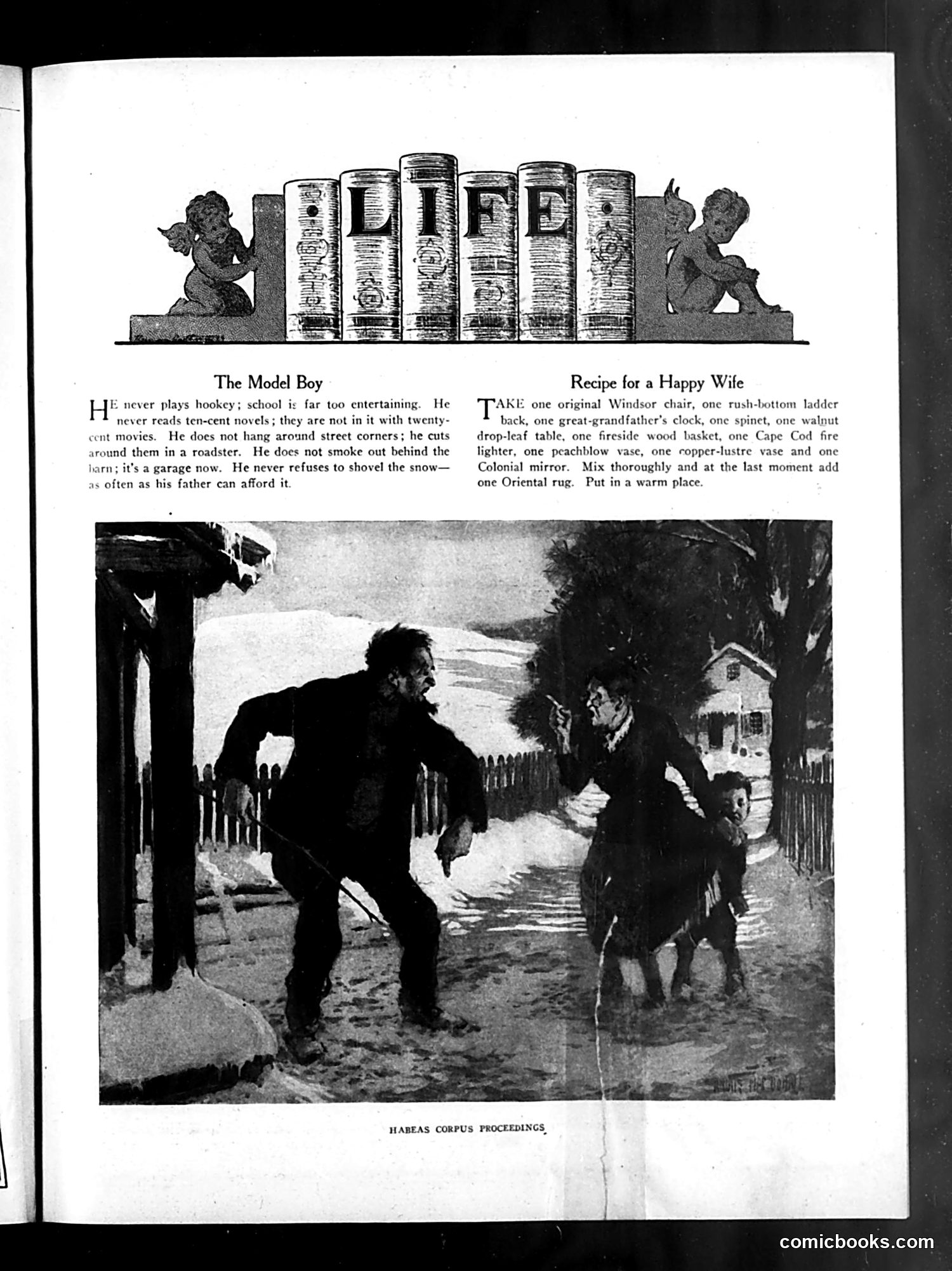
This page contains two separate satirical pieces: **"The Model Boy"** (left column) describes a boy who deliberately avoids all normal boyish activities—no hockey, cheap novels, or mischief—and refuses to shovel snow or smoke, mimicking his wealthy father's pretensions. The satire mocks excessive parental ambition and class-conscious child-rearing. **"Recipe for a Happy Wife"** (right column) humorously lists expensive antique furnishings—Windsor chairs, grandfather clocks, Oriental rugs—as ingredients for domestic contentment, satirizing the consumerist assumption that material goods ensure marital happiness. The photograph below titled **"Habeas Corpus Proceedings"** appears to show a winter scene of someone being physically forced or coerced, possibly illustrating legal proceedings or social commentary, though its exact connection to the above pieces is unclear from the image alone.
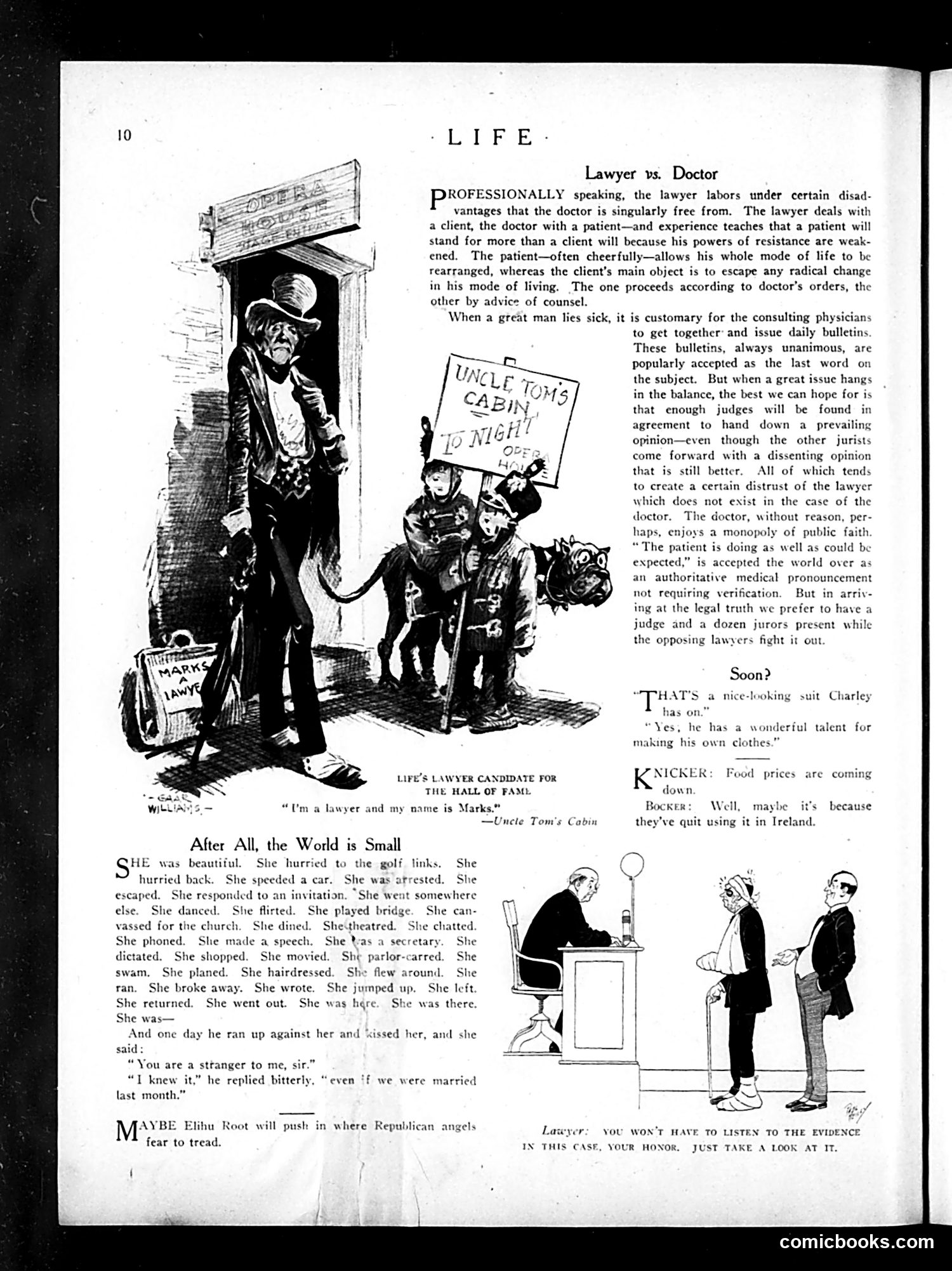
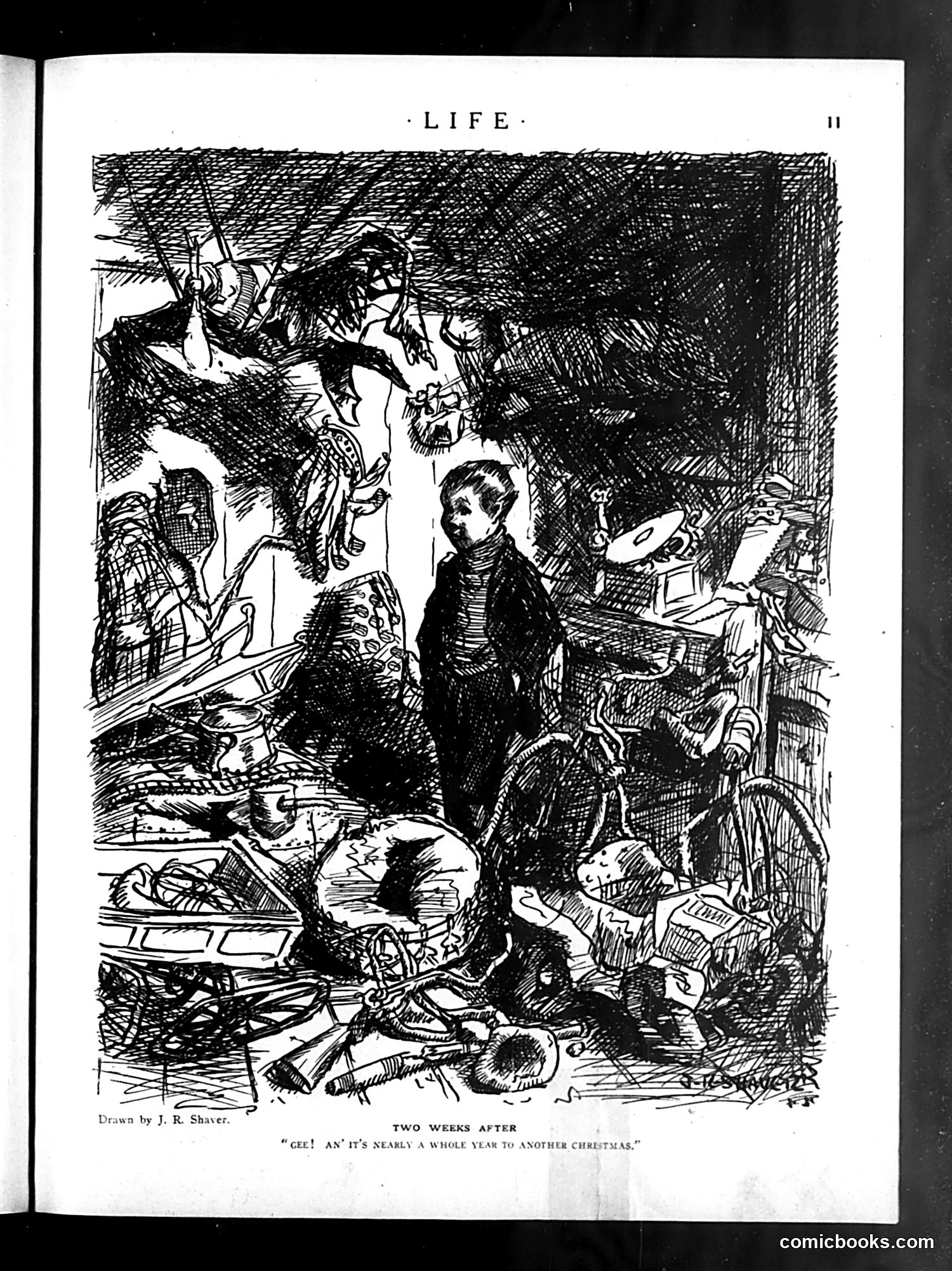
This cartoon by J.R. Shaver depicts the post-Christmas period, with the caption "'Gee!' an' it's nearly a whole year to another Christmas." The scene shows children in what appears to be a toy-cluttered room or attic, surrounded by broken and damaged toys—bicycles, mechanical toys, and other playthings in disarray. The children's expressions suggest disappointment or resignation. The satire targets the rapid deterioration of children's toys and the fleeting nature of Christmas joy. Rather than celebrating gift-giving's wonder, Shaver mocks how quickly toys break and lose their appeal, leaving children already counting down the long months until the next Christmas—suggesting both parental expense and the disappointment inherent in material gift-giving as entertainment.
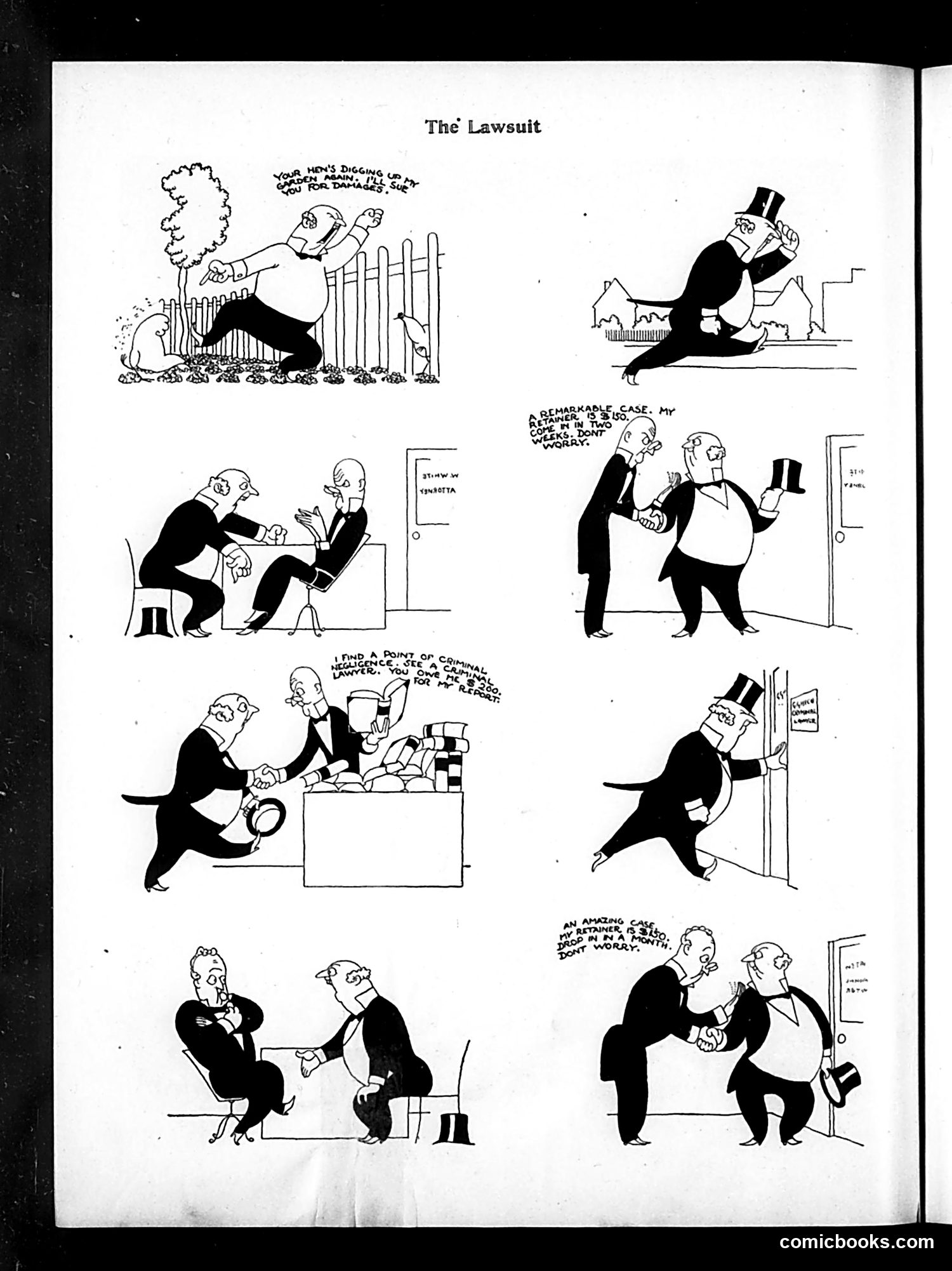
This page presents a sequential comic strip satirizing the legal process. The narrative follows what appears to be a dispute between two men in formal attire, progressing through various stages: an initial confrontation over property (a fence), consultation with a lawyer, presentation of evidence in court, attempted negotiation, and final settlement discussions. The satire mocks how litigation escalates costs and complications. Each panel shows the conflict growing more elaborate and expensive, with lawyers profiting while the original disputants become increasingly frustrated. The final panels suggest exhausted, resigned parties reaching settlement—suggesting the legal system benefits lawyers more than the disputants themselves. The cartoon critiques the American legal system's tendency to turn simple disputes into prolonged, costly affairs.
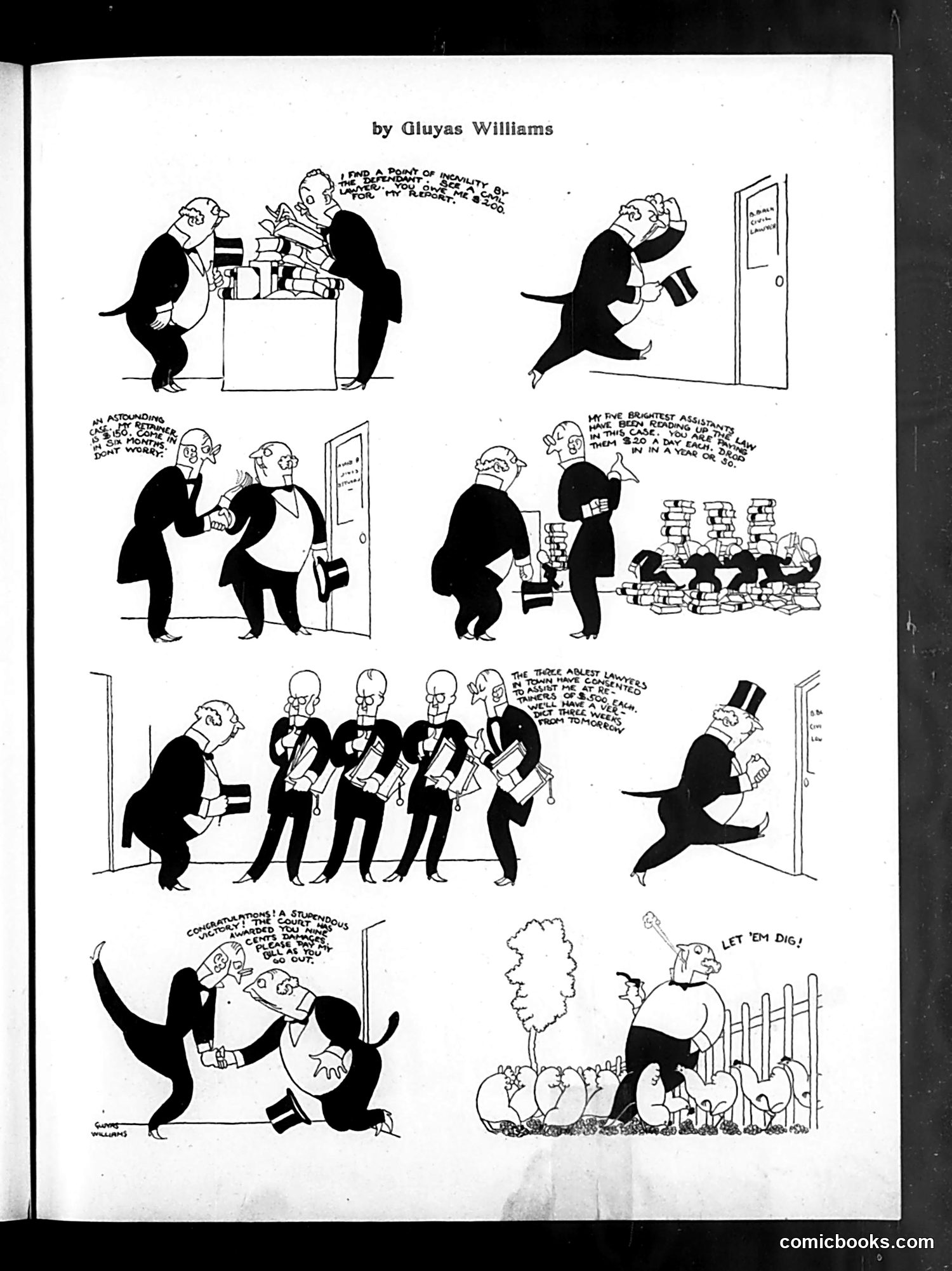
This satirical comic strip by Gluyas Williams depicts the frustrations of a businessman dealing with bureaucratic red tape and corporate inefficiency. The sequence shows: - A man attempting to conduct business but becoming increasingly exasperated by procedural obstacles - Multiple officials creating barriers and requiring endless documentation - Piles of paperwork accumulating as obstacles to simple transactions - The final panel shows him resorting to physical labor ("Left 'em dig!"), suggesting that manual work is preferable to navigating institutional complexity The cartoon satirizes early-to-mid 20th-century American corporate and governmental bureaucracy—the proliferation of rules, forms, and intermediaries that made simple business dealings unnecessarily complicated. Williams' humor emphasizes how absurd these systems had become, forcing practical people toward frustration or alternatives.
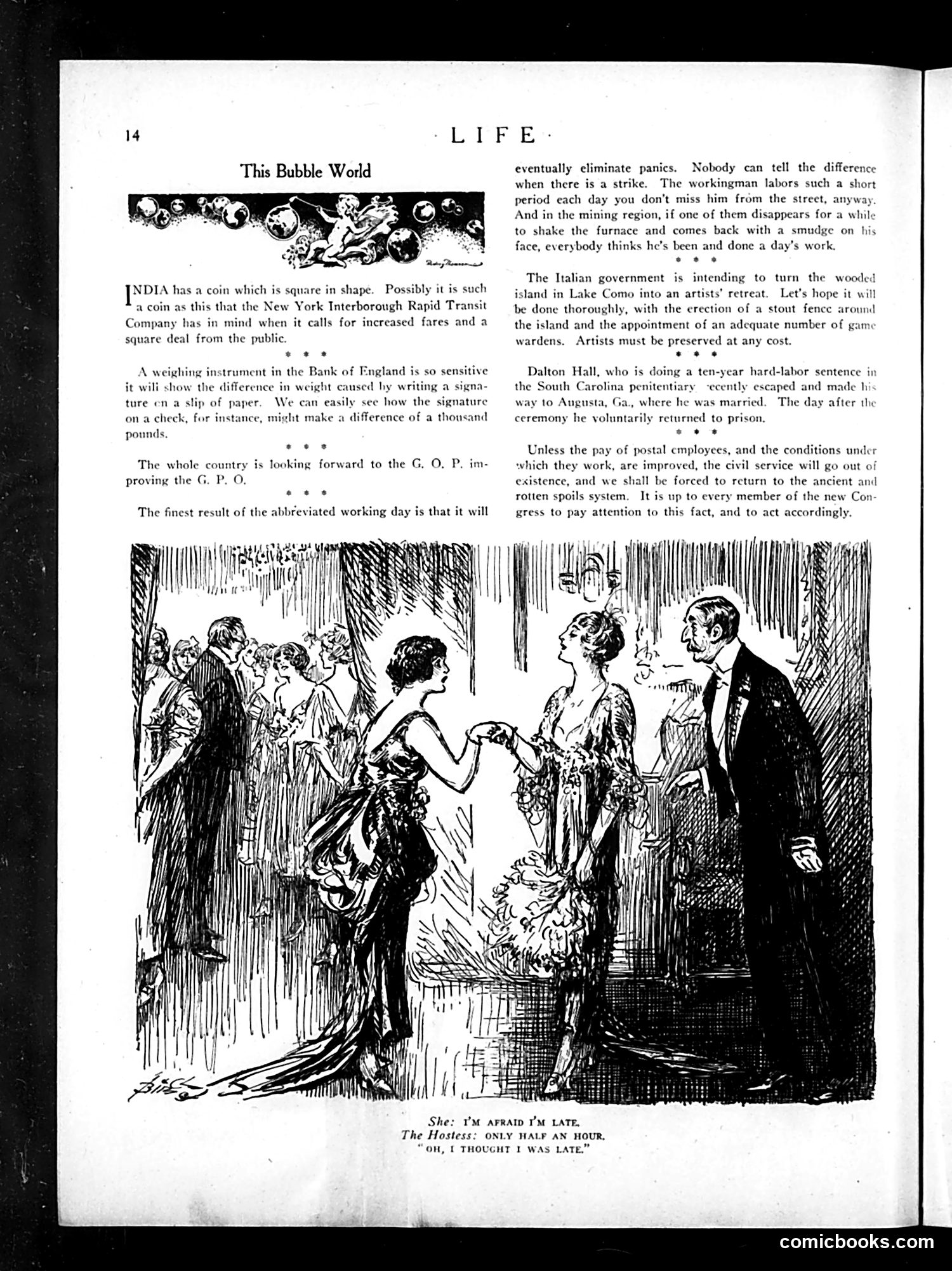
This page from Life magazine contains several brief satirical observations about contemporary issues, followed by a social cartoon. The cartoon depicts an elegant evening party where a woman apologizes for her late arrival, claiming she's "only half an hour" late. The hostess responds sarcastically: "Oh, I thought I was late." The joke satirizes the social pretense and anxiety of the upper class—specifically how fashionable society figures chronically arrive late to events, yet each guest worries *they* are the tardy one. It's gentle satire about social insecurity and the unspoken rules governing polite society gatherings, where arriving unfashionably *on time* was apparently considered poor form. The accompanying short pieces address postal service reform, international art preservation, and criminal justice anecdotes.
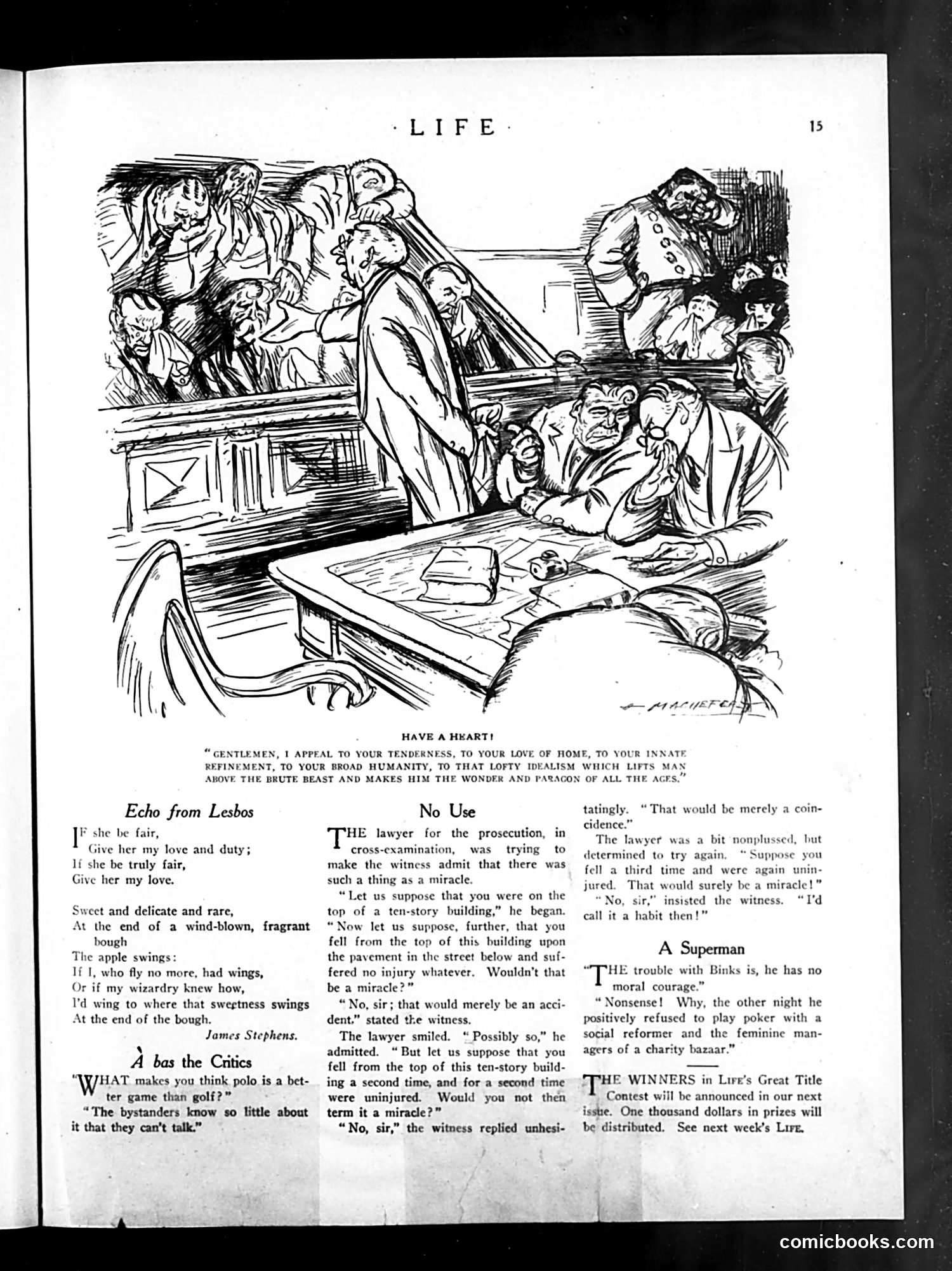
The main illustration depicts a courtroom scene where a lawyer cross-examines a witness about a miraculous injury claim. The lawyer uses absurdist logic, asking the witness to imagine increasingly improbable survival scenarios—falling from a ten-story building, surviving once, then surviving a second time uninjured—to suggest that claiming a "miracle" is unreasonable. The satire targets both overzealous lawyers using sophistry in court and perhaps insurance fraud claims relying on "miraculous" survival stories. The humor lies in the lawyer's deliberately circular reasoning: if survival isn't miraculous the first time, why would it be the second? The page also includes poetry excerpts and a brief item about a "Superman" and a charity fundraiser, typical of Life's mixed editorial format.
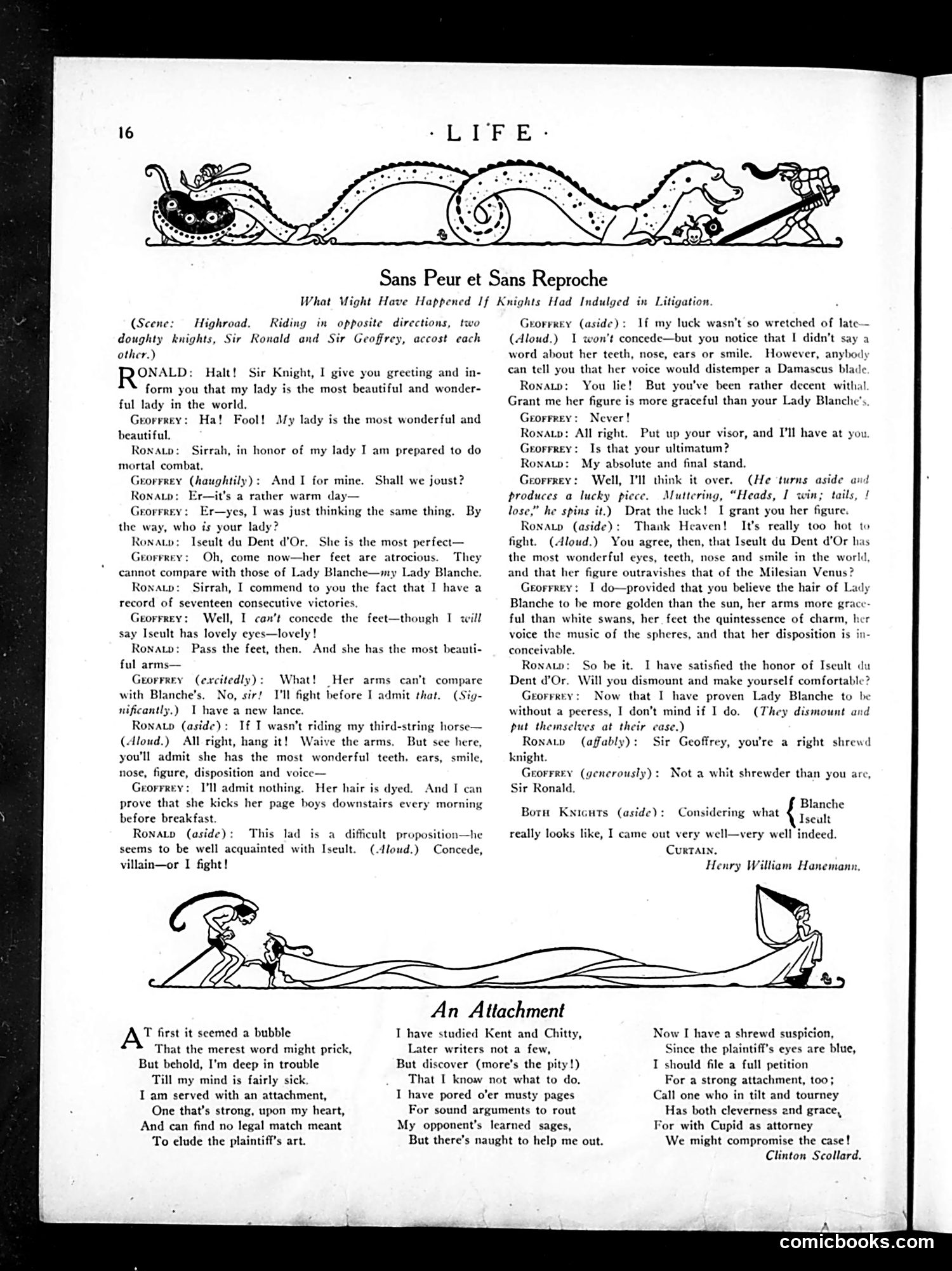
This page presents a humorous dramatic dialogue between two knights, Sir Ronald and Sir Geoffrey, who are rival suitors competing over a lady's beauty. Each knight boasts extravagantly about his rival's lady—her feet, arms, hair, eyes—while simultaneously insulting the other's own beloved. The satire mocks courtly romance conventions and chivalric posturing: the knights' elaborate, contradictory flattery reveals the absurdity of competitive courtship rhetoric. The decorative illustrations frame medieval/fantasy aesthetics, reinforcing the mock-heroic tone. Below this, "An Attachment" presents a separate comic poem about legal entanglement—likely satirizing romantic or contractual complications. The piece appears designed to entertain through linguistic wordplay and exaggerated gallantry rather than topical political commentary.
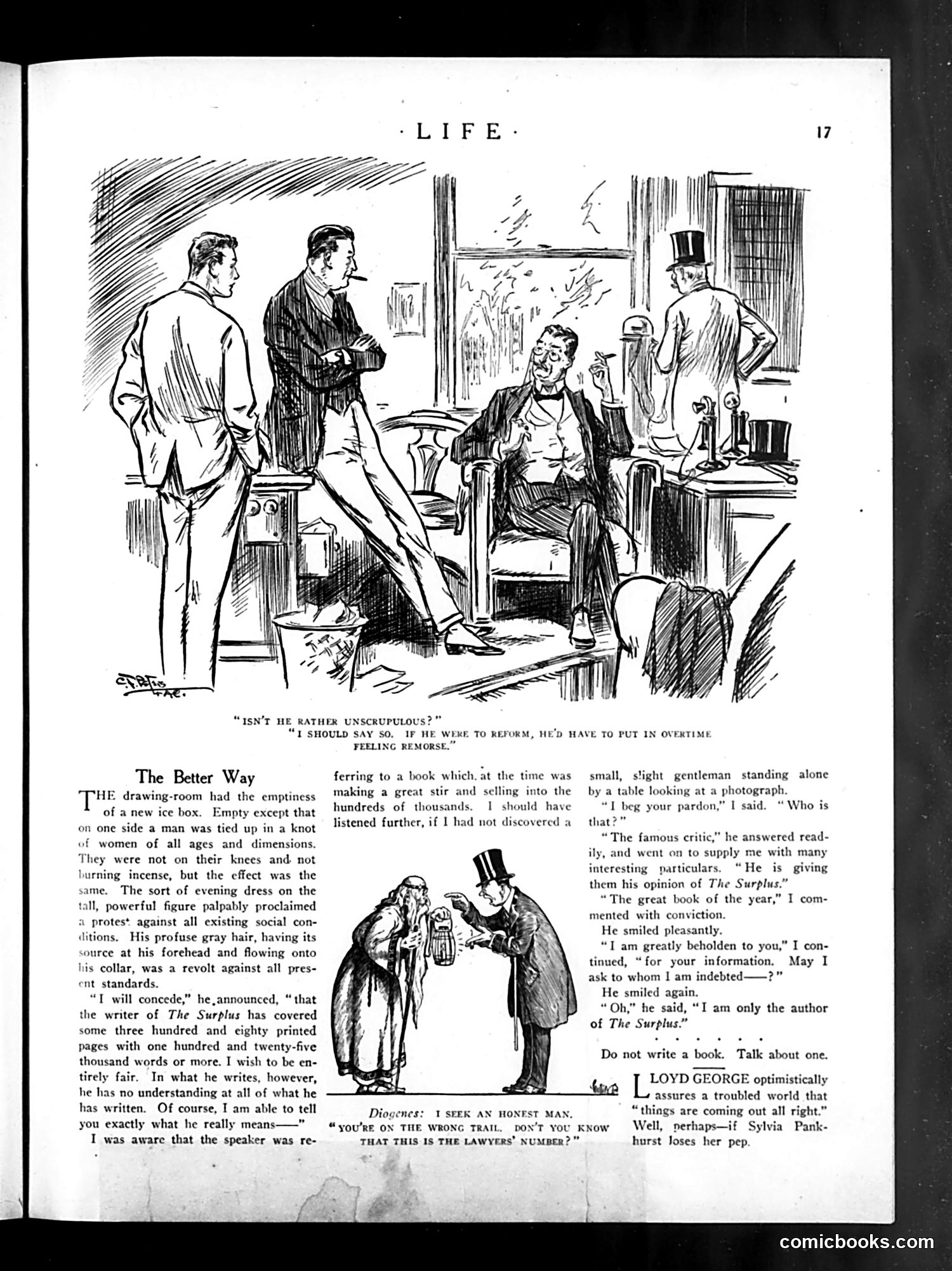
This page satirizes pretentious literary criticism and self-aggrandizing intellectuals. The main cartoon depicts a pompous man in bohemian dress (flowing hair, unconventional clothing) holding forth to admiring women about a bestselling book called *The Surplus*. The joke: he's the book's author, yet he lectures others on what it "really means" while admitting he writes without understanding his own work. The satire mocks critics who pontificate about books they haven't truly grasped, and authors who use pseudo-intellectual authority to impress audiences. A secondary joke references "Diogenes" (the ancient philosopher seeking an honest man) with a lawyer's joke—suggesting even honest men are hard to find in legal circles. The bottom note about Lloyd George and Sylvia Pankhurst appears to be separate political commentary, likely mocking British politics of the period, though context for this reference is unclear from the page alone.
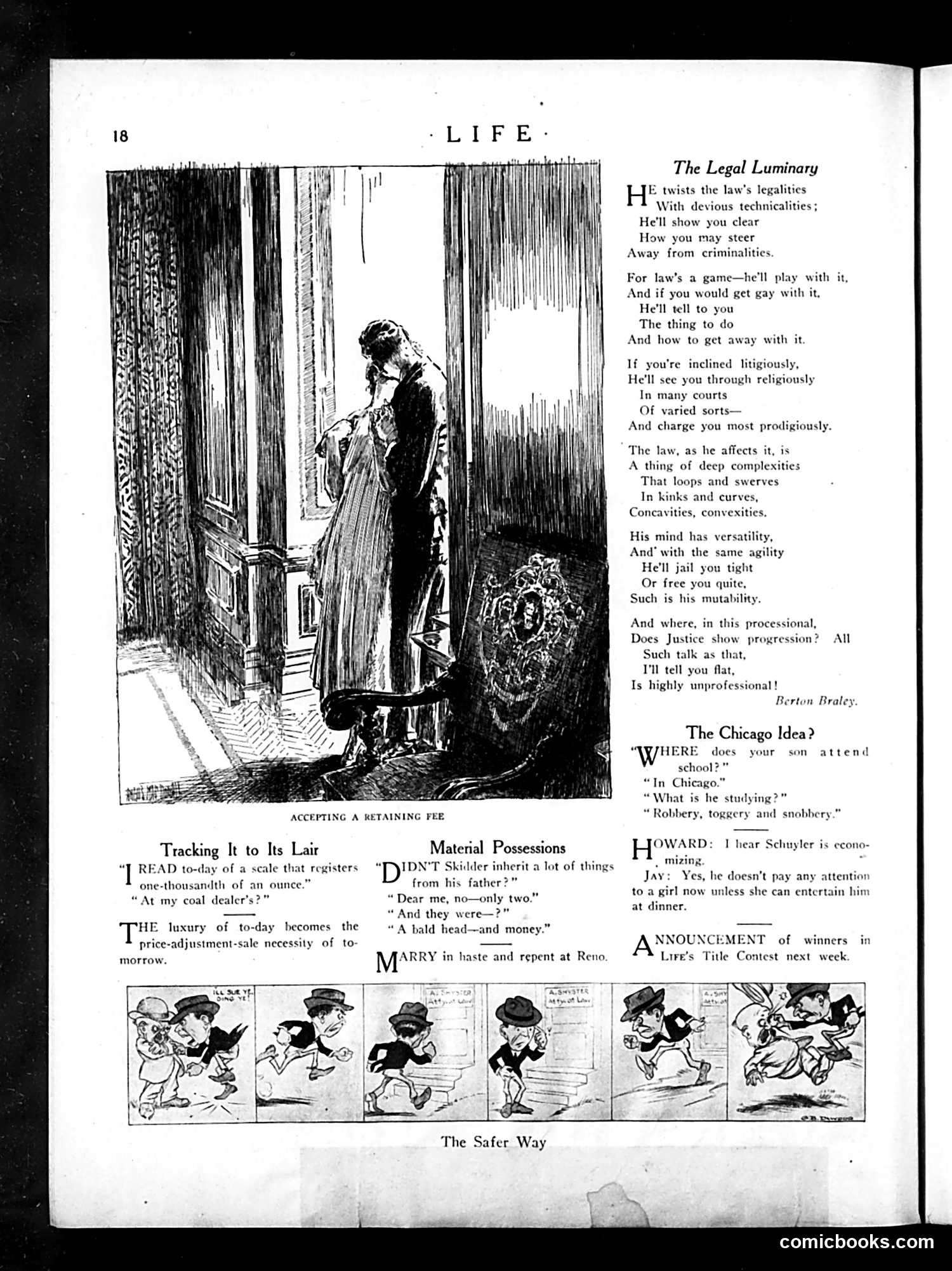
This page contains multiple satirical pieces critiquing early 20th-century American society: **"The Legal Luminary"** (verse poem by Berton Braley): Satirizes lawyers as morally flexible operators who exploit legal technicalities to help clients evade consequences. The satire suggests lawyers prioritize fees over justice, treating law as a "game" rather than a moral system. **"Accepting a Retaining Fee"** (illustration): Shows a lawyer accepting payment, visualizing the critique above. **"The Chicago Idea"** joke: Mocks Chicago's reputation for corruption, suggesting its schools teach criminality ("robbery, toggery and snobbery") rather than legitimate subjects. **Other brief humor items** address inflation ("luxury of today becomes necessity of tomorrow"), inheritance (inheriting only baldness and debt), and wealth-seeking romance. **"The Safer Way"** (comic strip): Unclear without full visibility, but the title suggests practical advice contrasted with risky alternatives. The page reflects Progressive Era skepticism toward institutions—particularly the legal profession's reputation for enabling wealthy clients to escape accountability through procedural manipulation.
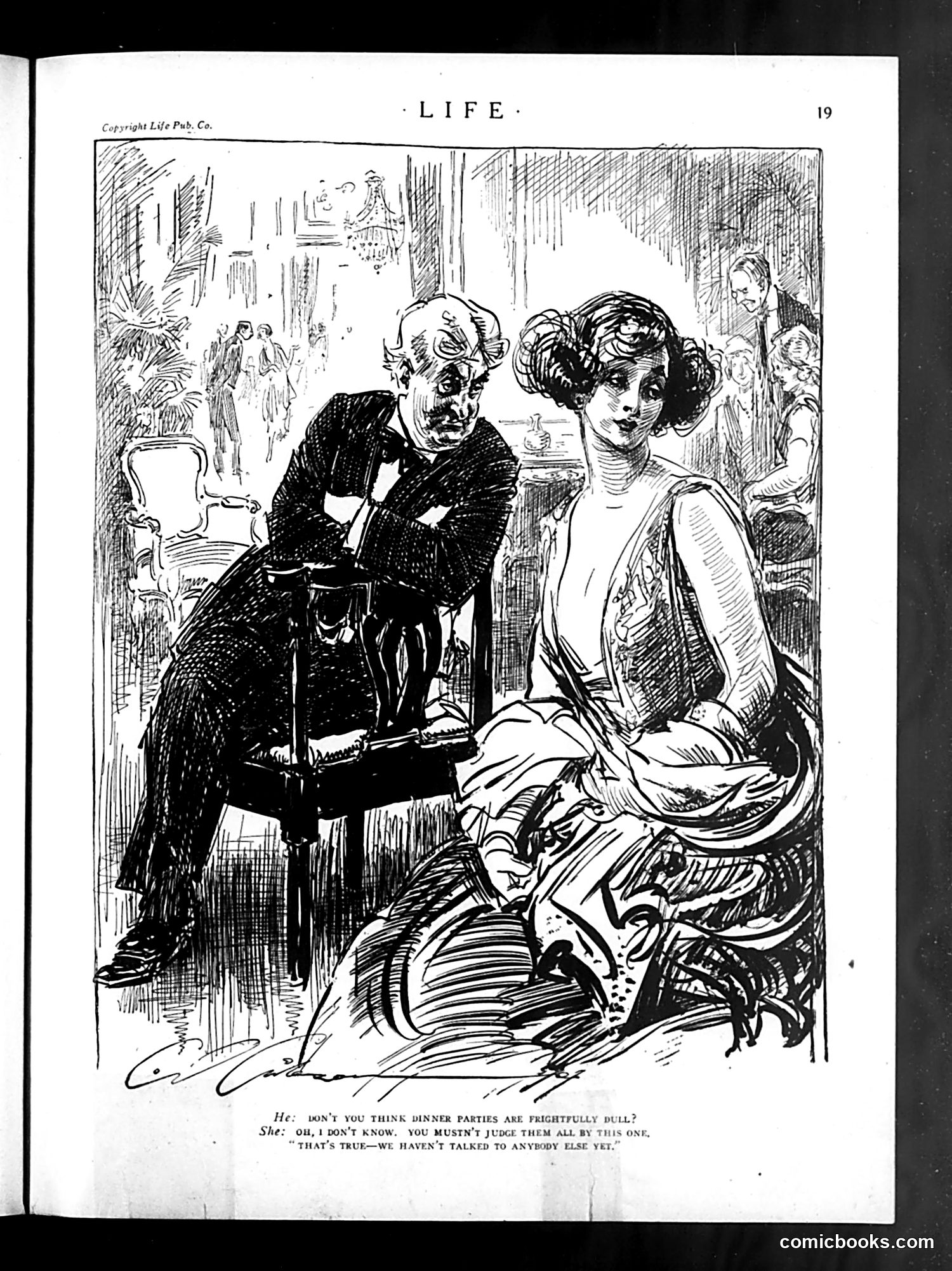
This is a satirical cartoon about the tedium of dinner parties. A well-dressed couple sits awkwardly at what appears to be a formal social gathering. The man complains that dinner parties are "frightfully dull," and the woman responds that he shouldn't judge all parties by this one—then adds the punchline: they haven't actually talked to anyone else yet. The joke targets upper-class social conventions of the era: despite attending a gathering with other guests present (visible in the background), this couple has remained isolated and uncommunicative. The satire critiques both the artificial nature of formal dinner parties and the social awkwardness or exclusivity of the attendees, who fail to engage with others despite being in a social setting designed for conversation.
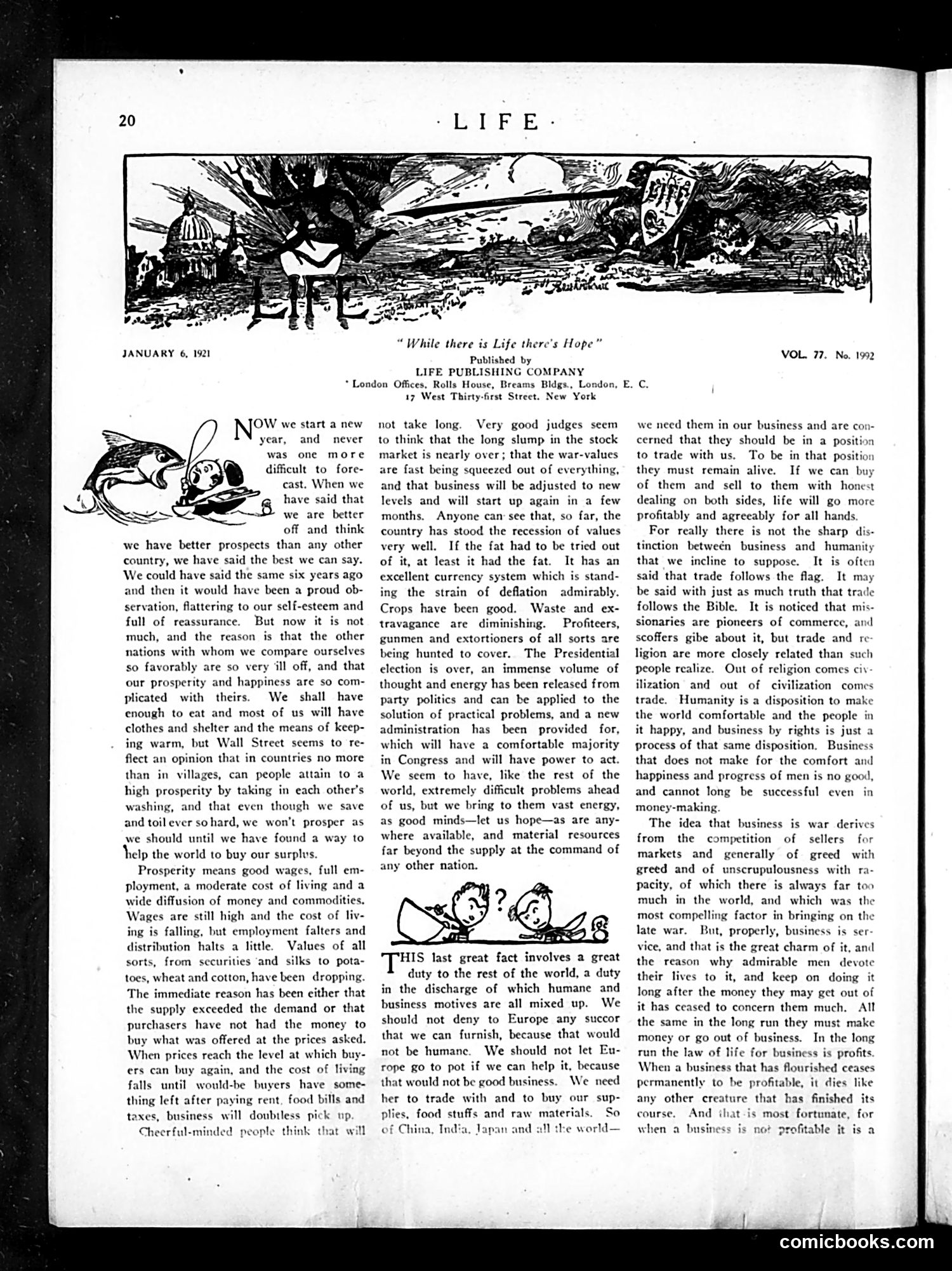
This editorial page addresses post-WWI economic recovery. The masthead cartoon—showing a figure amid classical ruins with the motto "While there is Life there's Hope"—sets an optimistic tone about American prospects after the war. The text argues that despite America's relative prosperity compared to war-devastated Europe, American success depends on global recovery. The author warns against isolationism: America cannot prosper while Europe struggles, both for humanitarian and practical business reasons. Key concerns include: deflation affecting wages and employment; stock market volatility; and the need to help Europe rebuild—not from charity alone, but because European markets are essential to American commerce. The new (Harding) administration, recently elected, is positioned as equipped to address these "extremely difficult problems." The small cartoon illustrations appear to show everyday figures, likely representing common citizens navigating economic uncertainty. The overall message reflects 1921's dawning recognition that American isolationism was economically untenable.
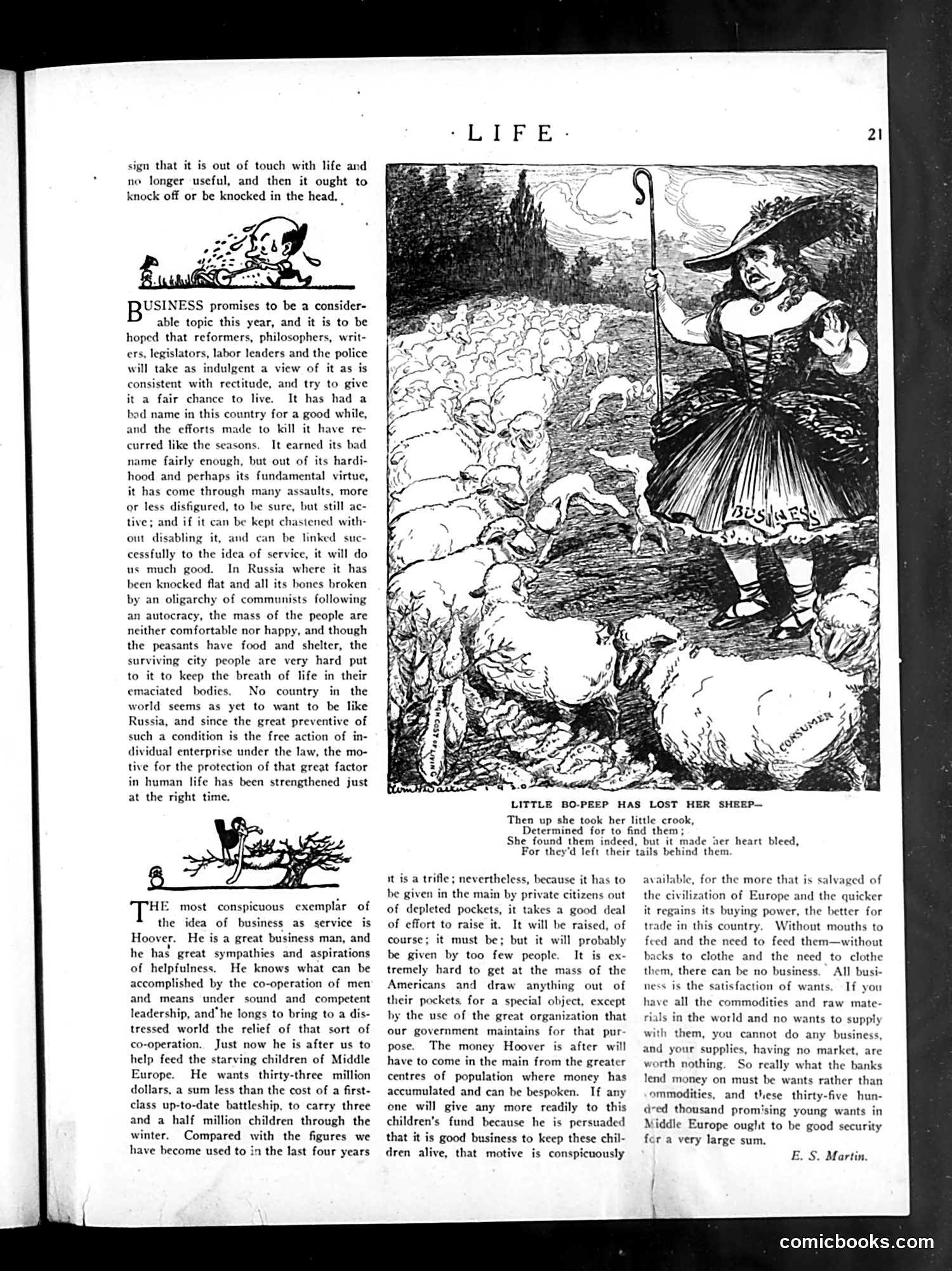
This page contains two distinct elements: **The Main Text** discusses American business as a social force, praising it as beneficial when linked to service. It notably **references Herbert Hoover's post-WWI relief efforts**, specifically his campaign to raise $33 million to feed 3.5 million starving children in Middle Europe through the winter. The author argues this fundraising demonstrates business principles applied to humanitarian aid—that helping European recovery ultimately benefits American trade. **The Cartoon** titled "Little Bo-Peep Has Lost Her Sheep" uses the nursery rhyme as political satire. The illustration shows a shepherdess discovering her flock has returned but are maimed—they've "left their tails behind." This appears to **satirize post-war European nations**: they've survived but are damaged, crippled, or diminished by WWI's devastation. The image reinforces the text's point that Europe requires aid to restore itself as a functioning economic partner. The overall message advocates for American business interests framed as humanitarian relief.
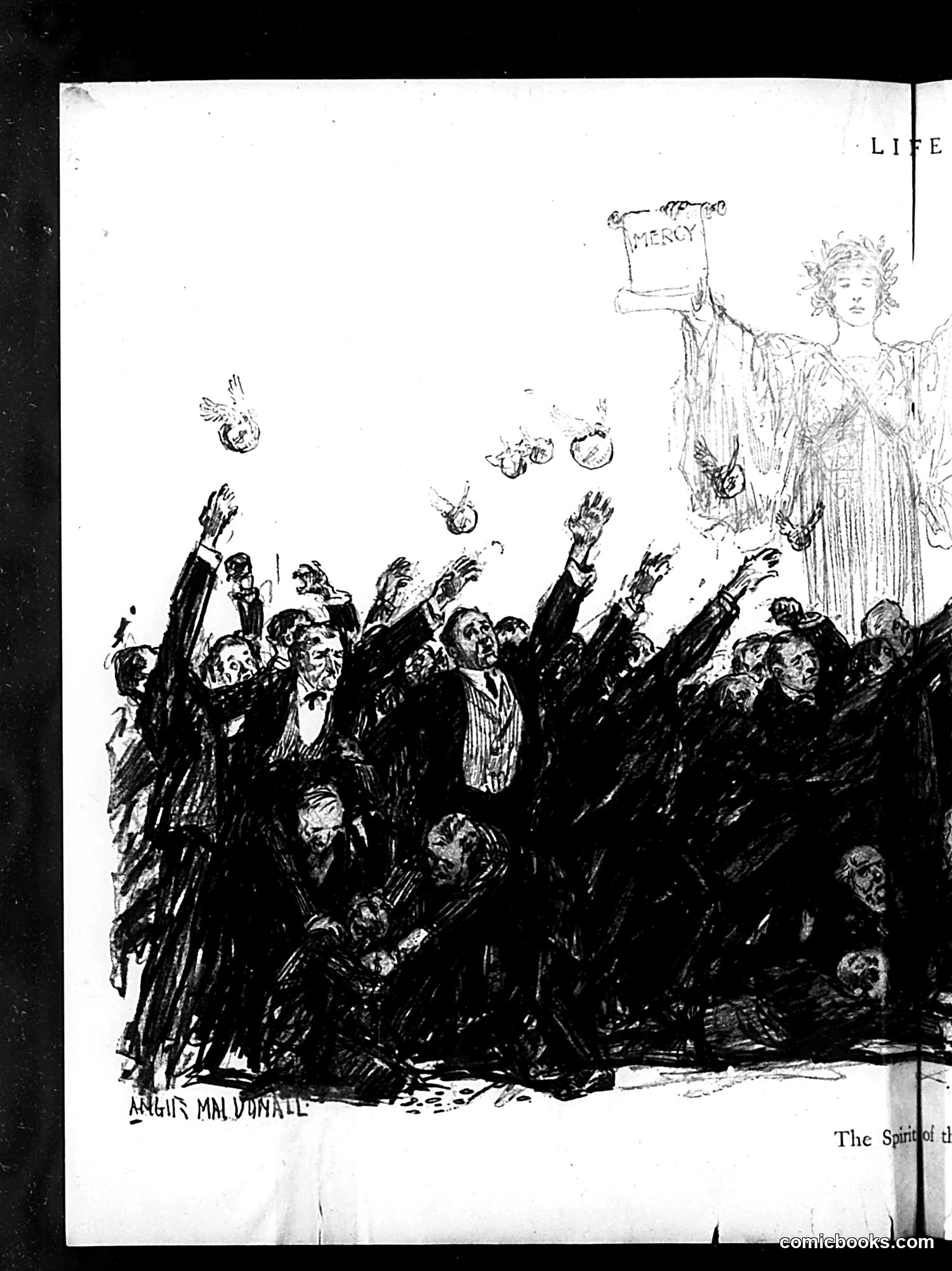
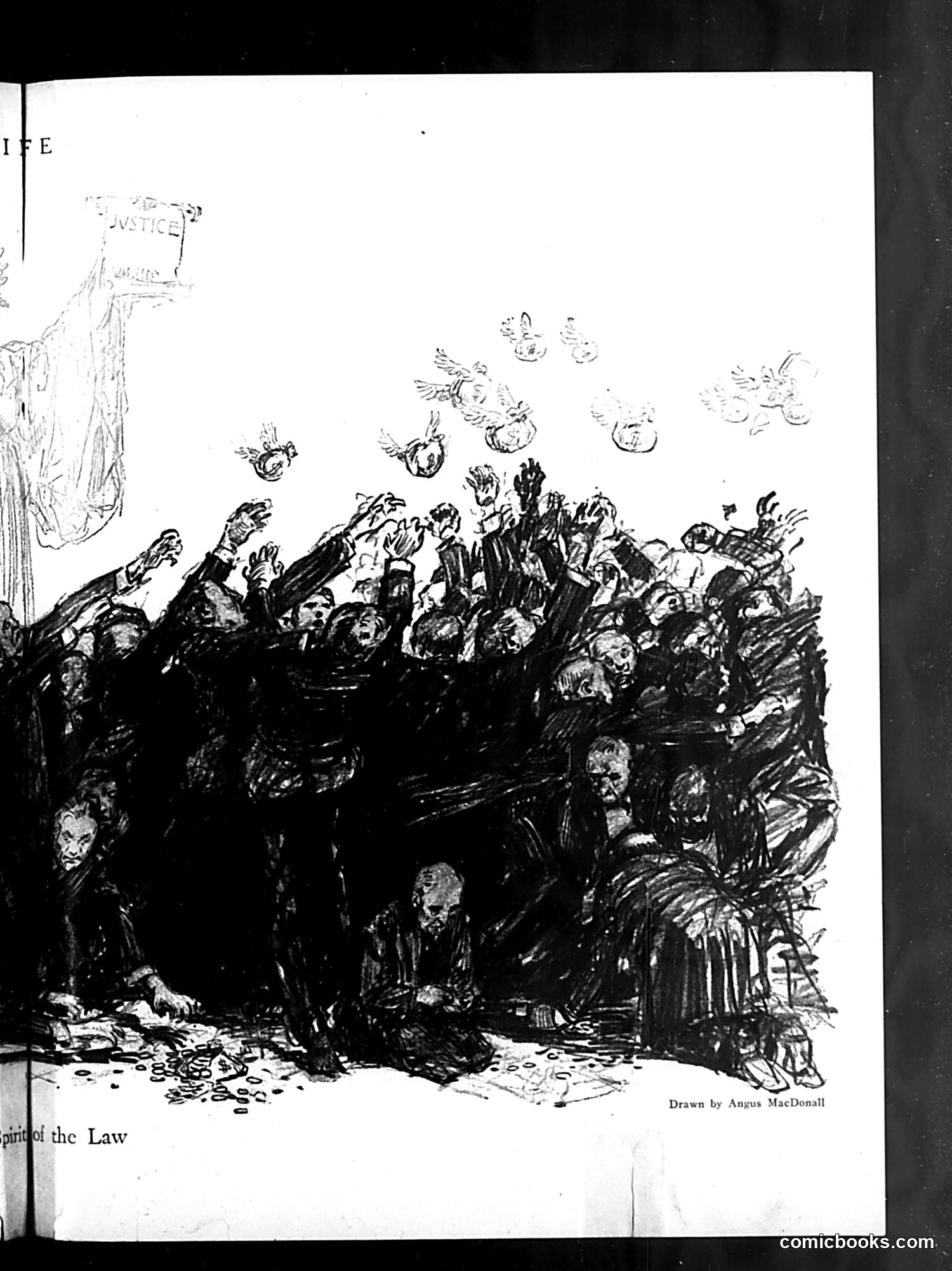
This Angus MacDonall cartoon depicts a large, densely packed crowd of common people—poorly dressed, crowded together—looking upward with raised hands and expressions of hope or desperation. Above them float angel-like figures with wings, appearing as idealized visions or aspirations. The title "Spirit of the Law" suggests satire about the gap between legal ideals and social reality. The masses below appear to be yearning for justice or fair treatment, while the heavenly figures above represent abstract legal principles that seem distant and unattainable to ordinary people. The cartoon likely critiques how formal law and justice, though theoretically noble, remain inaccessible or irrelevant to the working poor—a common Progressive Era theme in Life magazine's satirical commentary on inequality and social reform.
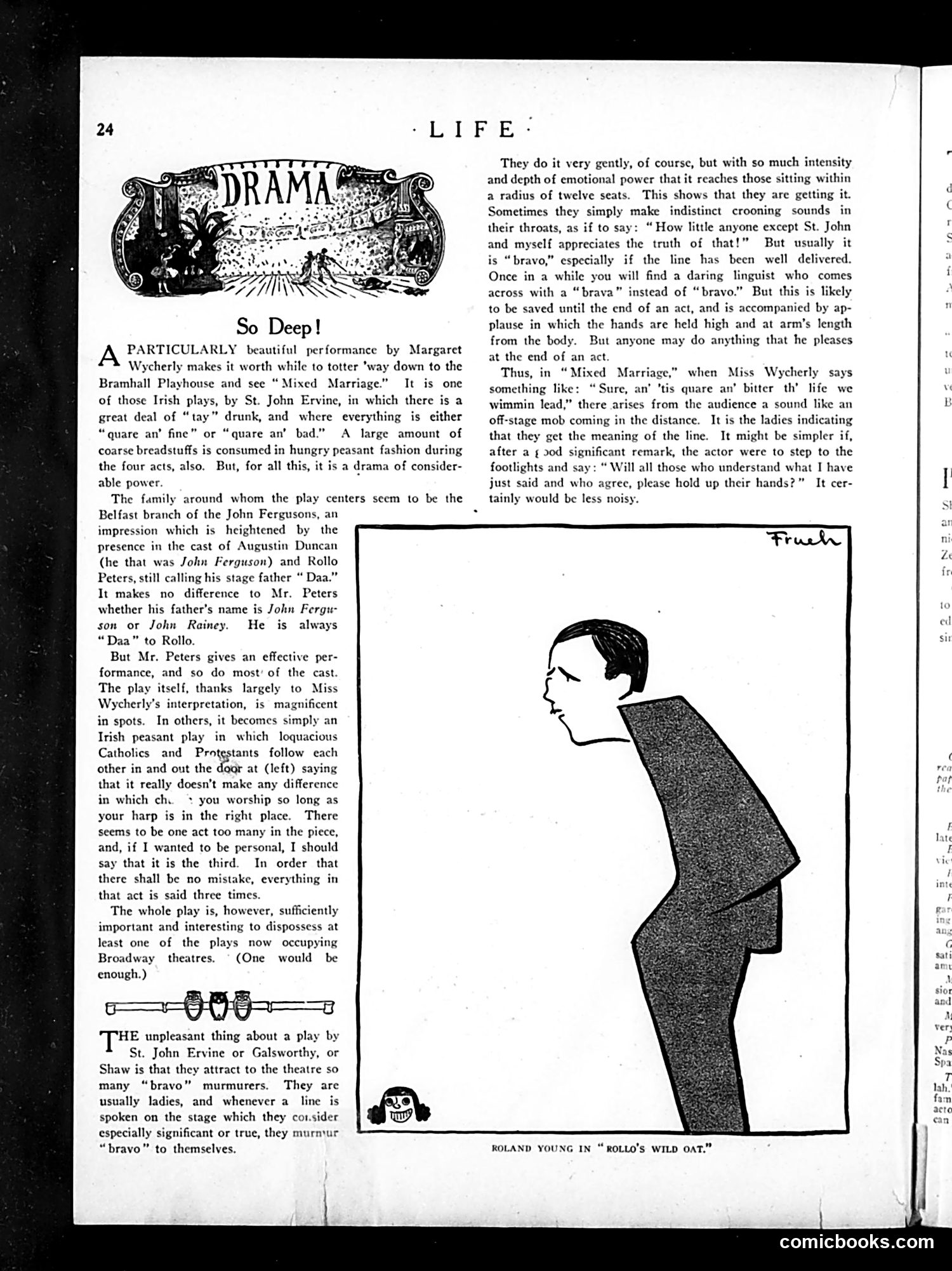
This page reviews St. John Ervine's play "Mixed Marriage," a drama about Belfast's Irish working class, featuring actress Margaret Wycherly. The text praises the performance while critiquing the play's structure and subject matter. The accompanying cartoon satirizes theater audiences of Ervine, Galsworthy, and Shaw—playwrights known for socially conscious work. Life mocks a specific audience behavior: wealthy, cultured ladies who murmur "bravo" at lines they deem intellectually or morally significant. The satire targets performative sophistication—these women announce their own refined taste through audible approval, broadcasting to nearby seats that they "get it." The author suggests that such ostentatious responses reveal pretension rather than genuine appreciation. The cartoon portrait (credited to "Rollo's Wild Oat") likely depicts Roland Young, a contemporary actor, though the specific reference remains unclear.
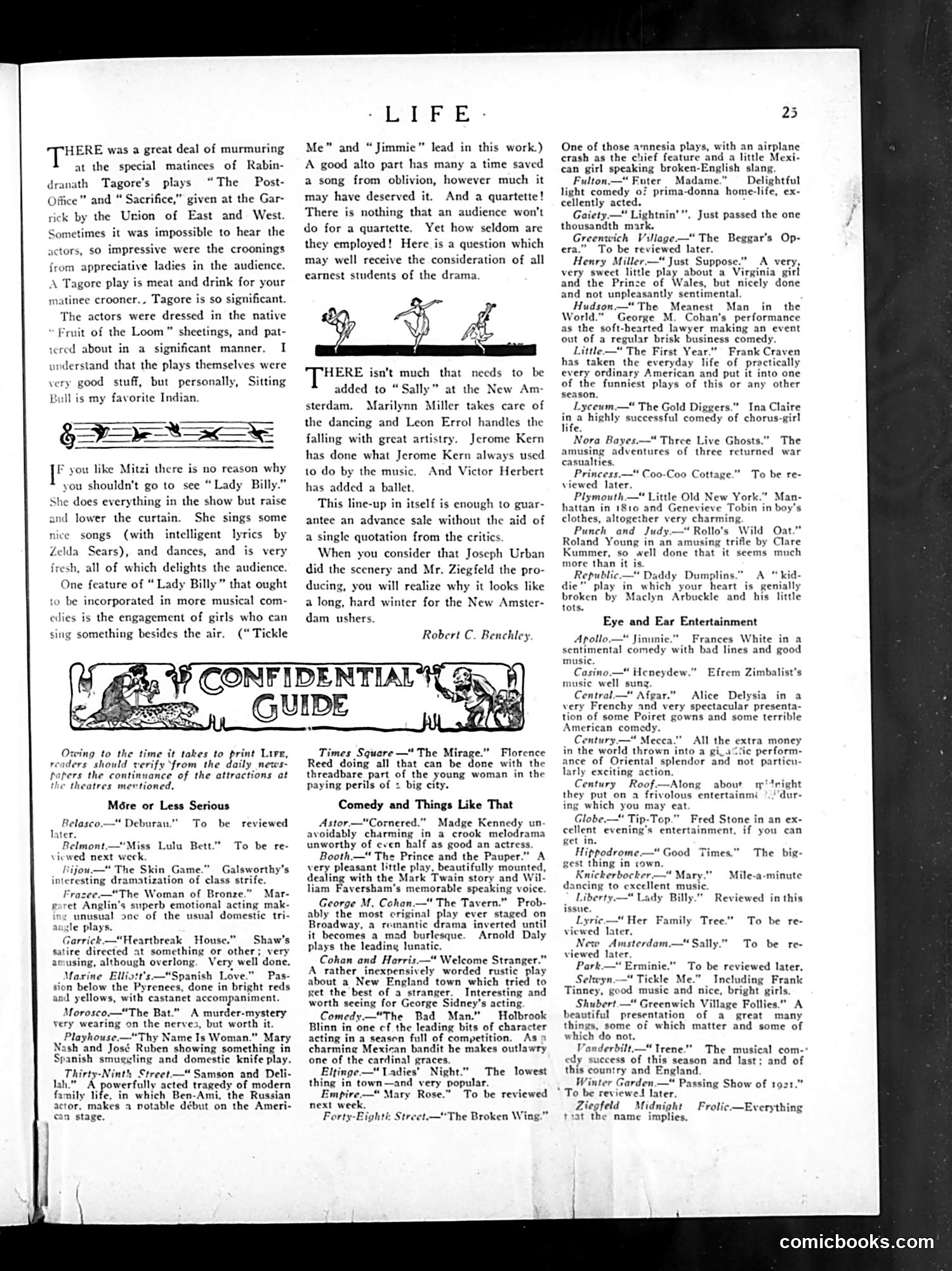
This is a theater review section from *Life* magazine, circa early 1920s. The main satirical content mocks the *audience behavior* at Rabindranath Tagore's plays rather than the plays themselves. The joke: wealthy, culturally aspirational matinee attendees ("appreciative ladies") were so eager to appear sophisticated that they drowned out the actors with admiring murmurs and sighs—defeating the purpose of attending. Tagore, the famous Indian poet-playwright, represented high culture, and the satire targets the performative nature of this audience's appreciation: they're more interested in *being seen* as refined than actually *listening*. The accompanying reviews by Robert C. Benchley praise current Broadway productions, noting standout performers like Marilyn Miller and Leon Errol, and creative teams like designer Joseph Urban and composer Jerome Kern. The "Confidential Guide" section lists current theater attractions with brief critical notes.
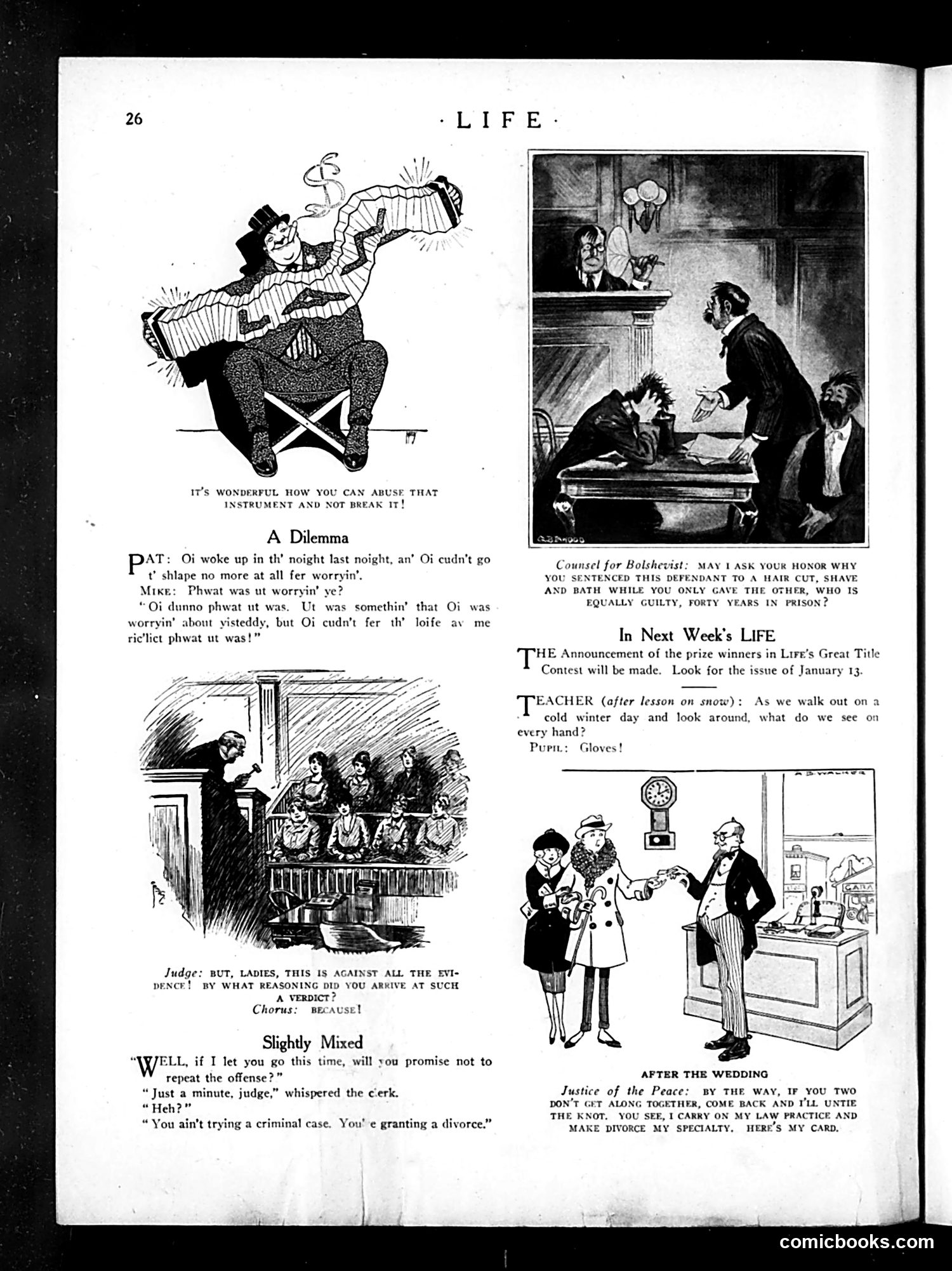
This page contains several standalone comic sketches mocking American institutions and social absurdities: **"A Dilemma"**: Irish-accented characters (Pat and Mike) joke about worrying—Mike forgot what he was worried about yesterday but can't stop worrying anyway. This satirizes circular anxiety and forgetfulness. **Courtroom sketches**: Two vignettes mock judicial incompetence. One shows a judge rendering a verdict based on "because!"—no reasoning. Another features a Bolshevik defendant questioning sentencing disparities, likely satirizing post-WWI anti-communist hysteria and judicial inconsistency. **"Slightly Mixed"**: A judge confuses a criminal case with divorce proceedings, highlighting how routine divorce has become in American courts. **"After the Wedding"**: A justice of the peace openly advertises divorce services as his specialty, satirizing the commodification of marriage dissolution and suggesting divorce is now easier than marriage. Overall, the page mocks legal incompetence, judicial absurdity, and the prevalence of divorce in 1920s American society.
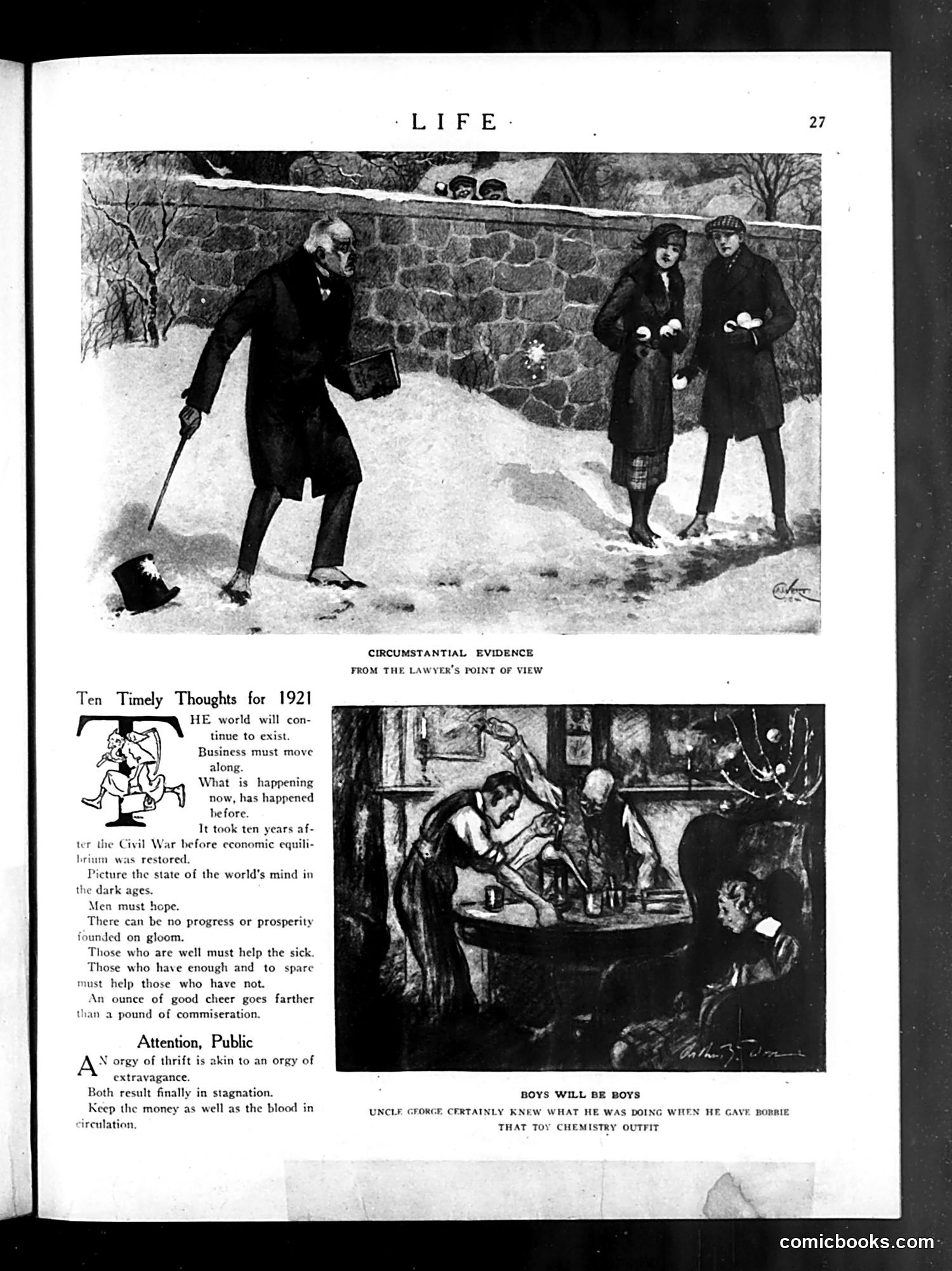
This 1921 Life page offers post-WWI optimism through two sections: **"Ten Timely Thoughts for 1921"** presents reassuring platitudes for economic recovery, comparing current hardship to the Civil War's decade-long aftermath. The message: maintain hope, help others, and keep money circulating—don't hoard it like thrift-obsessed misers. **The cartoons** satirize legal reasoning: 1. **"Circumstantial Evidence"** (top): A man shoveling snow near a stone wall watches two women with flowers. The joke: a lawyer might falsely conclude the man buried something criminal, when he's simply clearing snow—mocking how circumstantial evidence misleads. 2. **"Boys Will Be Boys"** (bottom): Uncle George gave young Bobbie a chemistry set, apparently aware of potential dangers. This likely jokes about giving children risky toys and adults feigning innocence about predictable accidents—another legal absurdity. Together, the page critiques both post-war economic anxiety and the gap between legal reasoning and common sense.
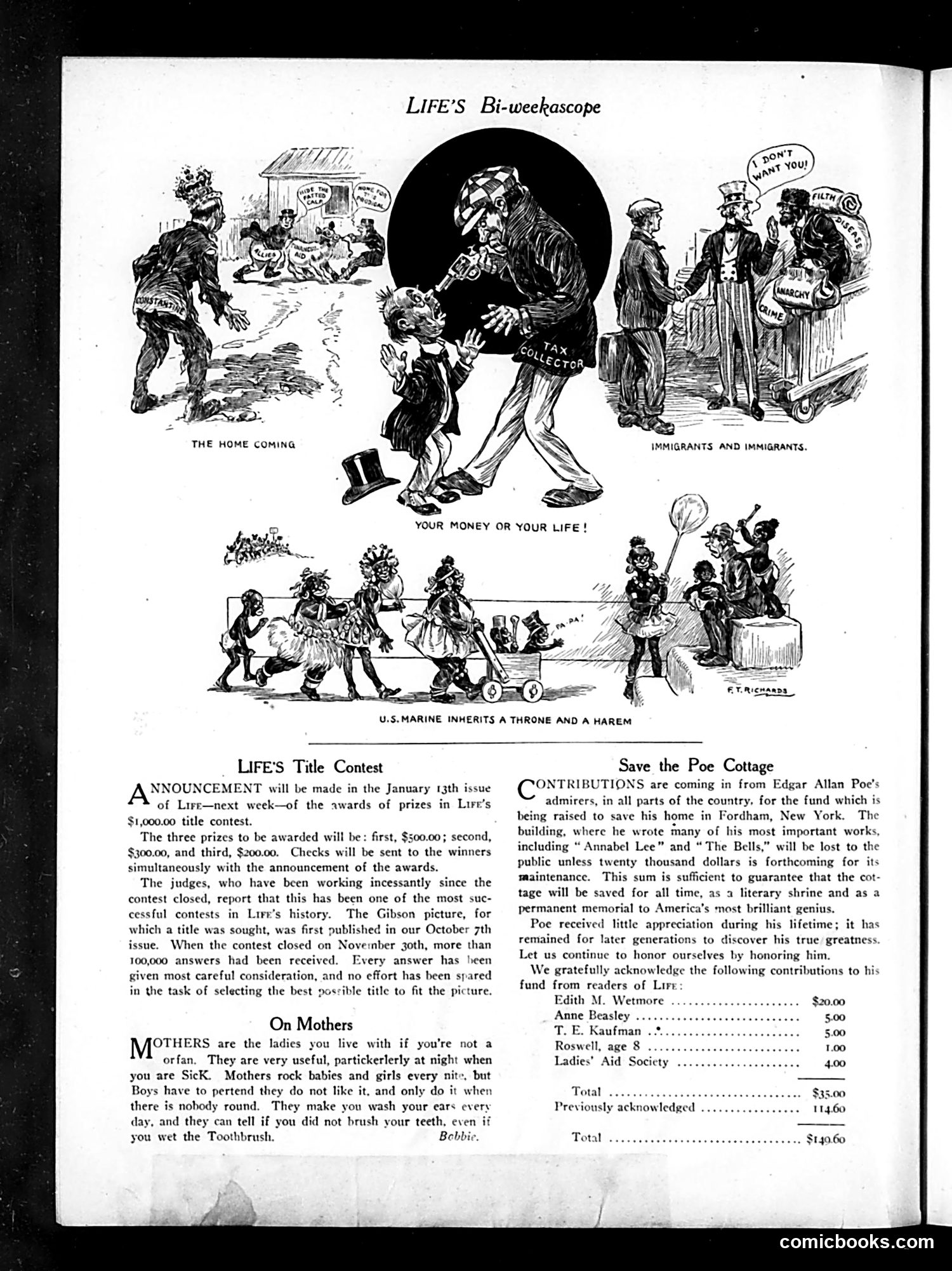
This page contains several satirical cartoons addressing early 20th-century American concerns: **"The Home Coming"** and **"Your Money or Your Life"** depict a menacing tax collector threatening citizens—satirizing aggressive taxation policies of the era. **"Immigrants and Immigrants"** shows wealthy figures with labels like "Anarchy" and "Crime," suggesting xenophobic fears that immigrants brought social disorder—a common anti-immigration sentiment of the period. **"U.S. Marine Inherits a Throne and a Harem"** appears to mock American military interventionism abroad, suggesting the U.S. military was acquiring foreign territory and its spoils. The cartoons use exaggerated caricatures and grotesque figures typical of Life magazine's satirical style to critique government overreach, xenophobia, and imperial ambitions. The page also includes unrelated content: a title-contest announcement, a humorous essay "On Mothers," and fundraising for Edgar Allan Poe's cottage preservation.
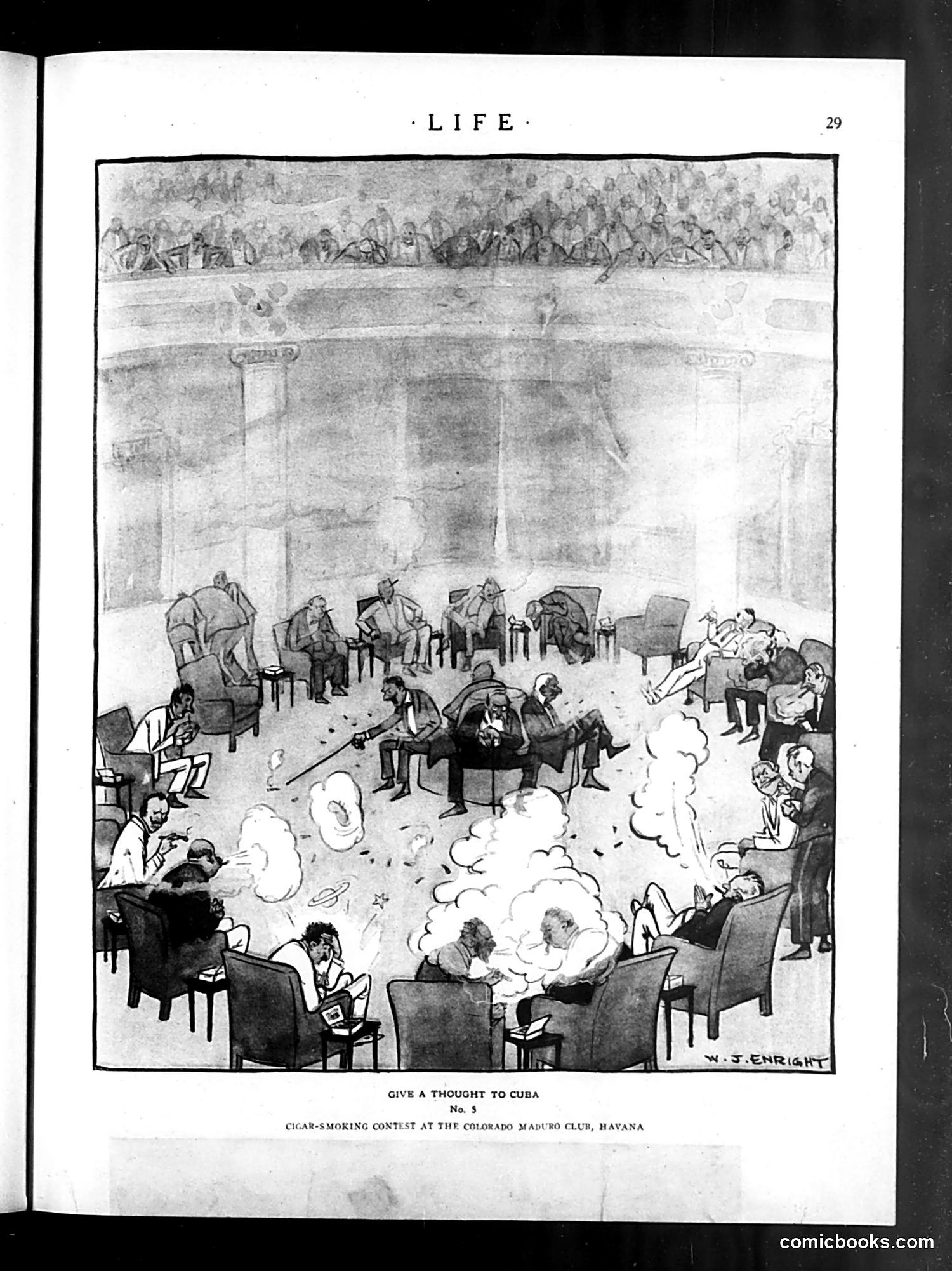
This satirical cartoon depicts a cigar-smoking contest at Havana's Colorado Maduro Club. The humor lies in contrasting the genteel seated contestants puffing cigars in the arena floor with massive clouds of smoke billowing between them—so thick they obscure much of the scene. Spectators fill the upper stands watching intently. The satire appears to mock the absurdity of a competitive cigar-smoking event, likely commenting on Cuban cigar culture or the leisure pursuits of wealthy club members. The exaggerated smoke clouds emphasize the ridiculousness of the contest's premise. The title's phrase "Give a Thought to Cuba" suggests the cartoon may also be commenting on American attitudes toward Cuba—perhaps satirizing how Americans romanticize Cuban cigars and leisure while ignoring larger political or social realities. The cartoon is credited to W.J. Enright.
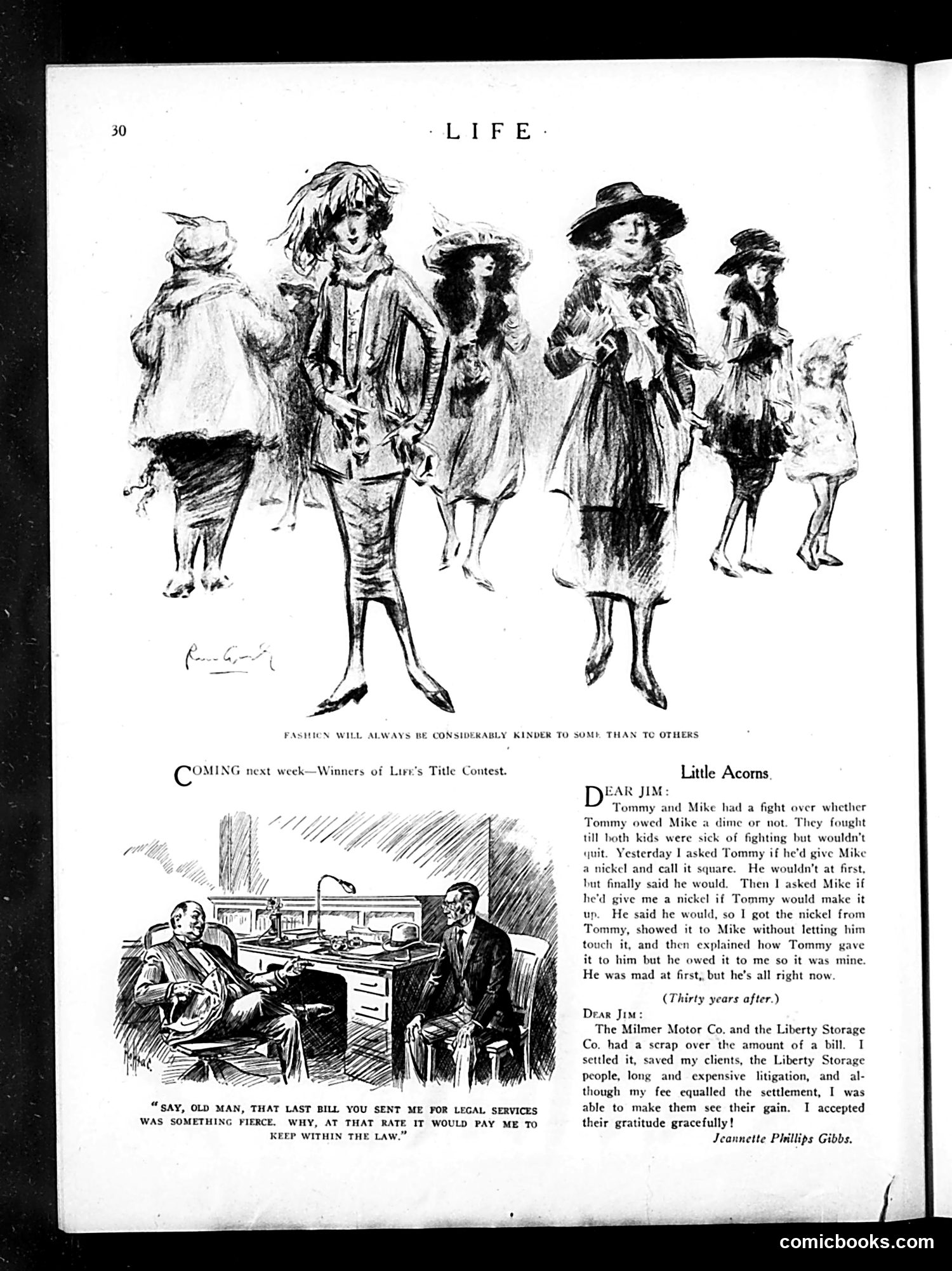
**Top Illustration:** A fashion sketch captioned "Fashion will always be considerably kinder to some than to others." This satirizes how clothing and fashion trends flatter certain body types while unflattering others—a timeless commentary on fashion's selective accessibility. **Bottom Cartoon:** A lawyer receiving complaint about his bill from a client. The humor lies in the lawyer's outrageous fee being so high that the client jests it would be cheaper to break the law than pay for legal services. This is satire of inflated legal fees—a perennial complaint about the legal profession. **"Little Acorns" Letters:** Two reader anecdotes showing how small manipulations compound. The first describes a child's confidence game with a nickel; the second, a lawyer's fee equaling the settlement amount while clients thank him for "saving" money. Both mock self-serving rationalization and the ease of duping people through clever framing. The page's theme: how people justify questionable behavior through perspective manipulation.
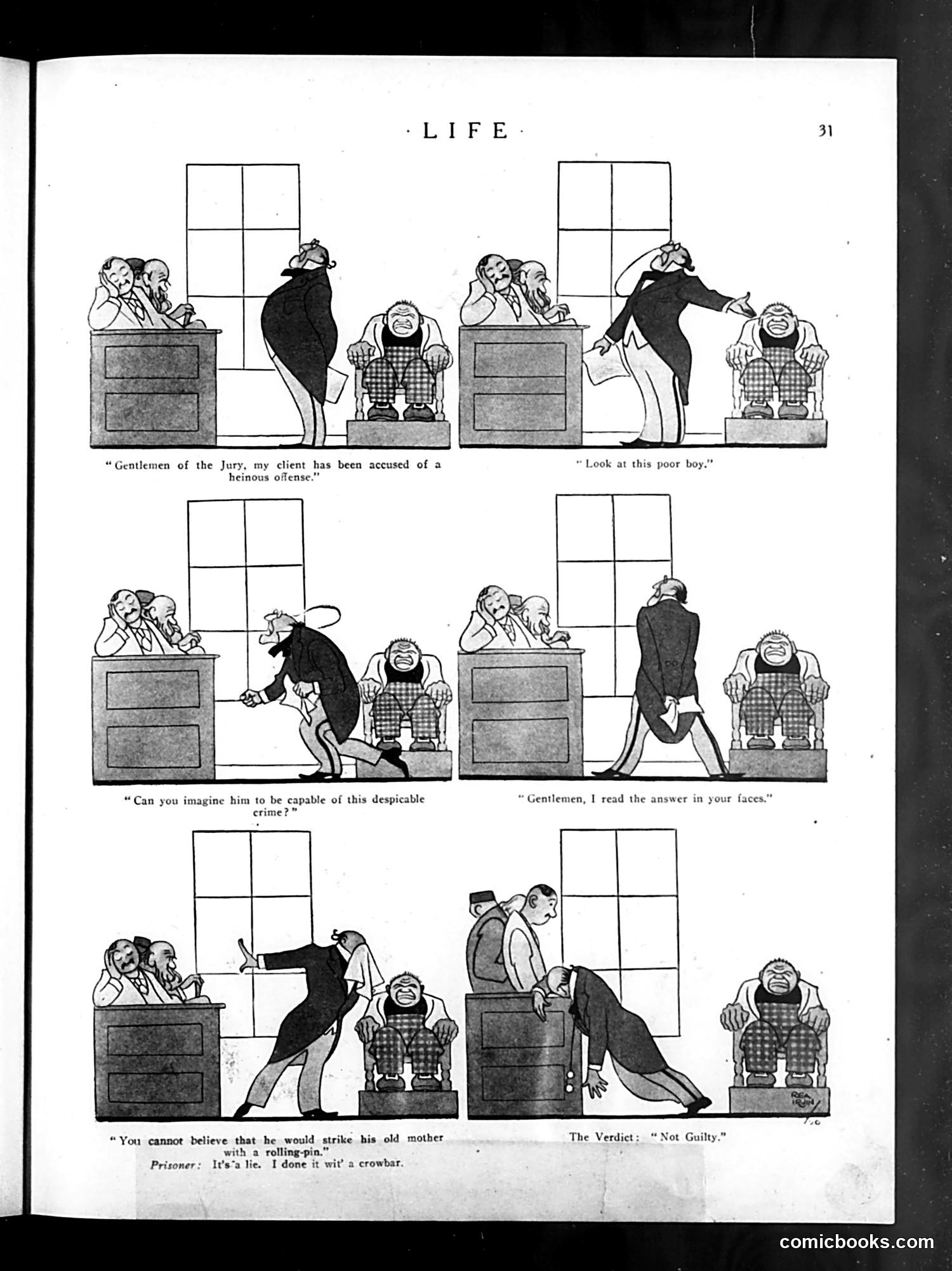
This six-panel cartoon satirizes courtroom defense tactics and jury psychology. A lawyer defends a client accused of a heinous crime by presenting emotional appeals rather than facts. The lawyer uses sympathy ("his old mother") and theatrical gestures to sway the jury, deliberately understating the alleged offense (suggesting a rolling-pin instead of the actual weapon). The punchline's dark humor: the defendant's own outburst—confessing he used a crowbar, not a rolling-pin—contradicts the lawyer's defense yet the jury still acquits him ("Not Guilty"). The satire targets how juries can be manipulated by emotional rhetoric and theatricality rather than evidence, and how a defendant's own stupidity might paradoxically aid acquittal if the jury is sufficiently prejudiced or swayed. The exaggerated expressions and body language emphasize the absurdity of courtroom performance over justice.
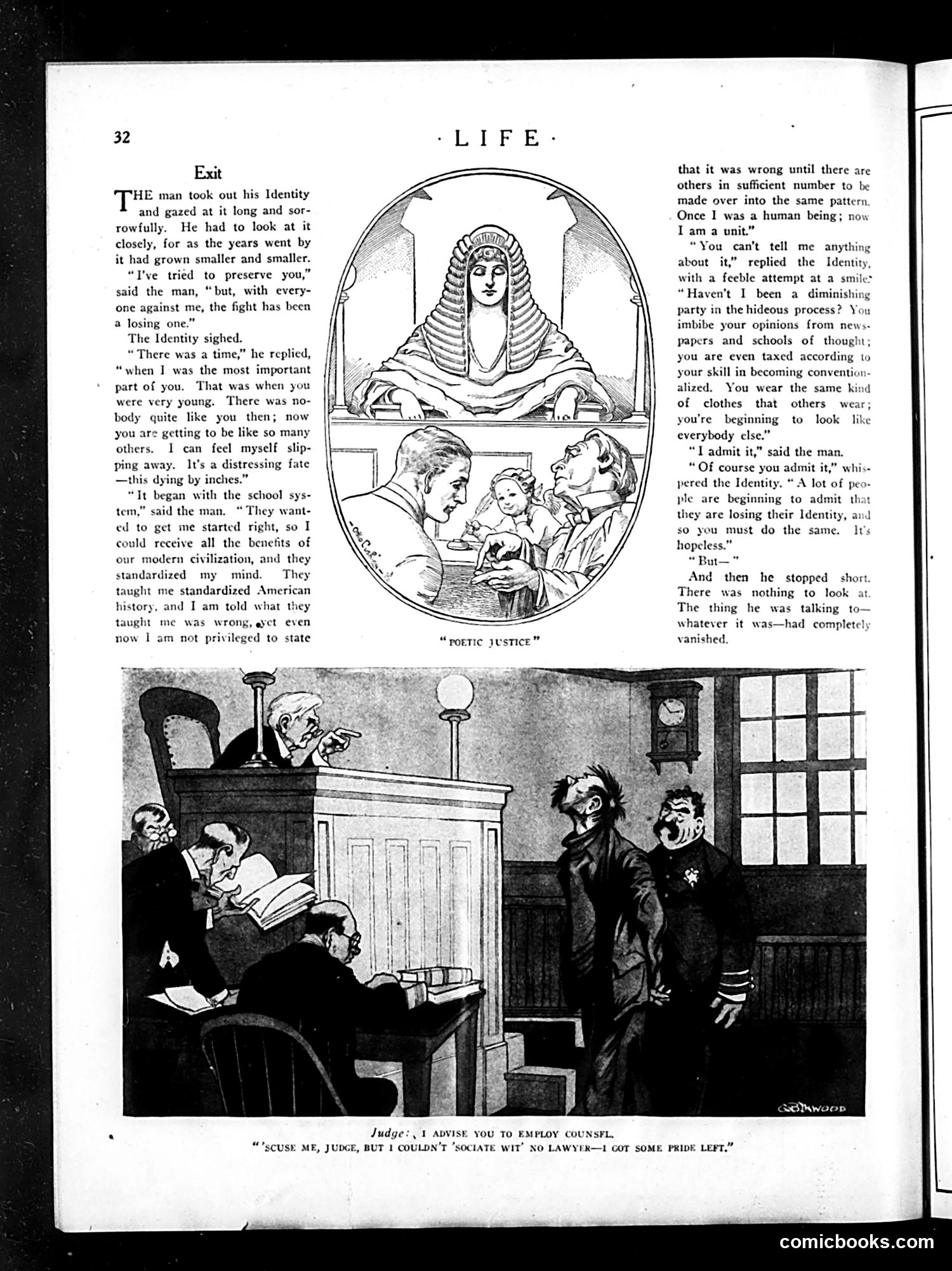
This page presents two satirical pieces critiquing early-20th-century American standardization and conformity. **"Exit"** (top): A man watches his "Identity" literally shrink and disappear. The story blames standardized education, newspaper-driven opinions, standardized fashion, and taxation policies for eroding individual uniqueness. The allegory suggests that conformist pressures—from schools teaching standardized history to wearing identical clothes—gradually eliminate personal identity until nothing remains. The illustration of an Egyptian pharaoh presiding over diminishing figures reinforces themes of dehumanization. **"Poetic Justice"** (bottom cartoon): A defendant refuses legal counsel, claiming he has "some pride left." The judge advises hiring a lawyer. The satire targets class attitudes: the poor man won't associate with lawyers (suggesting lawyers are disreputable or unaffordable), yet the legal system pressures him toward representation he cannot afford or refuses. The irony is that pride—his only remaining asset—prevents him from accessing justice. Both pieces critique how modern systems (education, commerce, law) strip away individual agency.
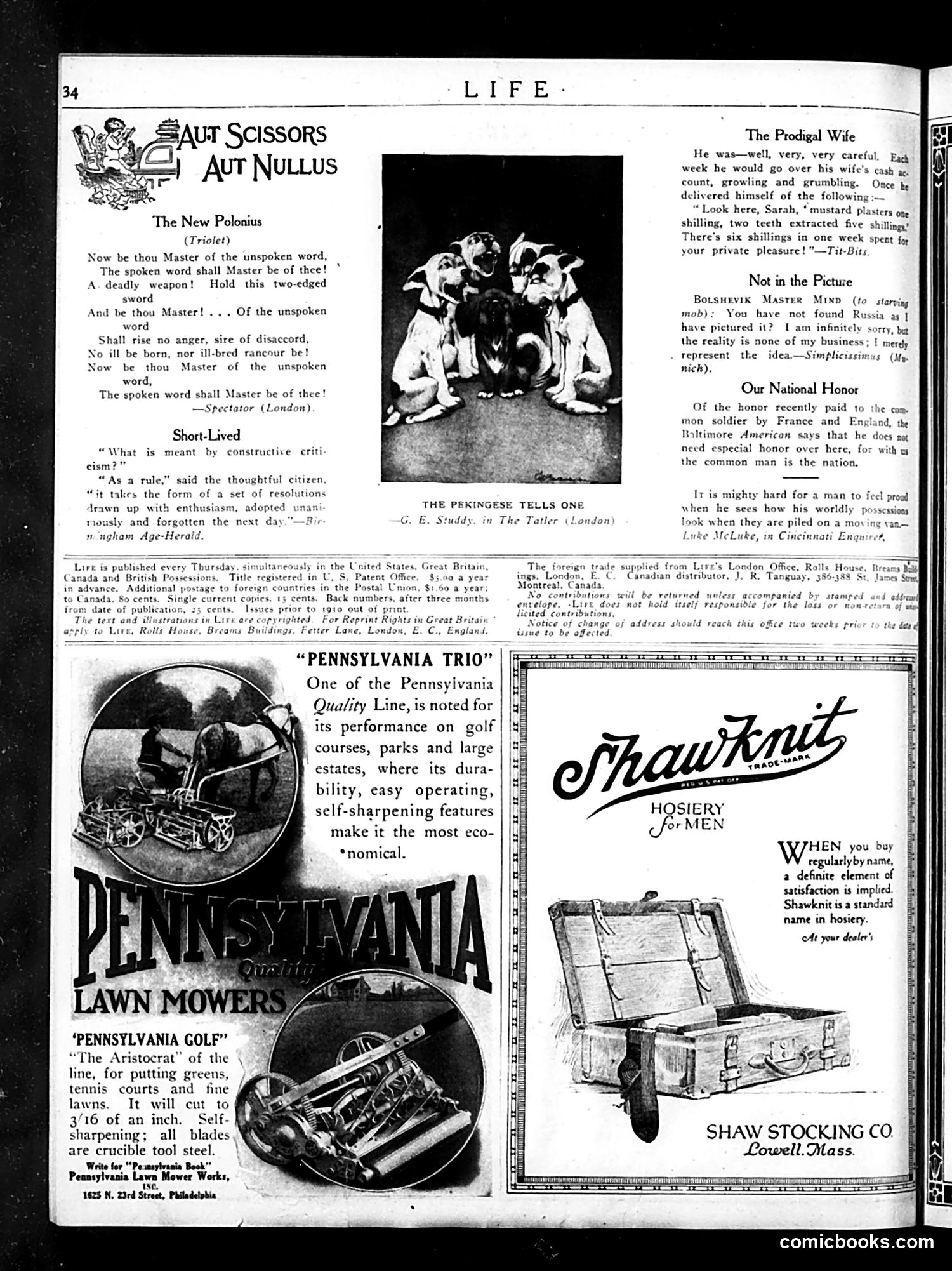
This page from *Life* magazine contains several satirical pieces and advertisements typical of early 20th-century American humor: **"The New Polonius"** is a triolet (poetic form) advising mastery of silence—the unspoken word is presented as more powerful than speech, referencing Shakespeare's verbose character from *Hamlet*. **"Short-Lived"** satirizes "constructive criticism" as resolutions enthusiastically adopted then immediately forgotten—a jab at performative civic engagement. **"The Pekingese Tells One"** shows a dog observing human behavior, likely mocking some social pretension (common in *Life's* humor). **"The Prodigal Wife"** presents domestic comedy about a frugal husband questioning his wife's modest personal expenses—typical gender-role humor of the era. **"Not in the Picture"** appears to critique a political figure (Bolshevik Master Mind) whose idealized vision doesn't match reality. The remaining content is advertising for lawn mowers and hosiery—standard commercial filler. The page is primarily satirical commentary on marriage, politics, and social behavior mixed with period advertisements.
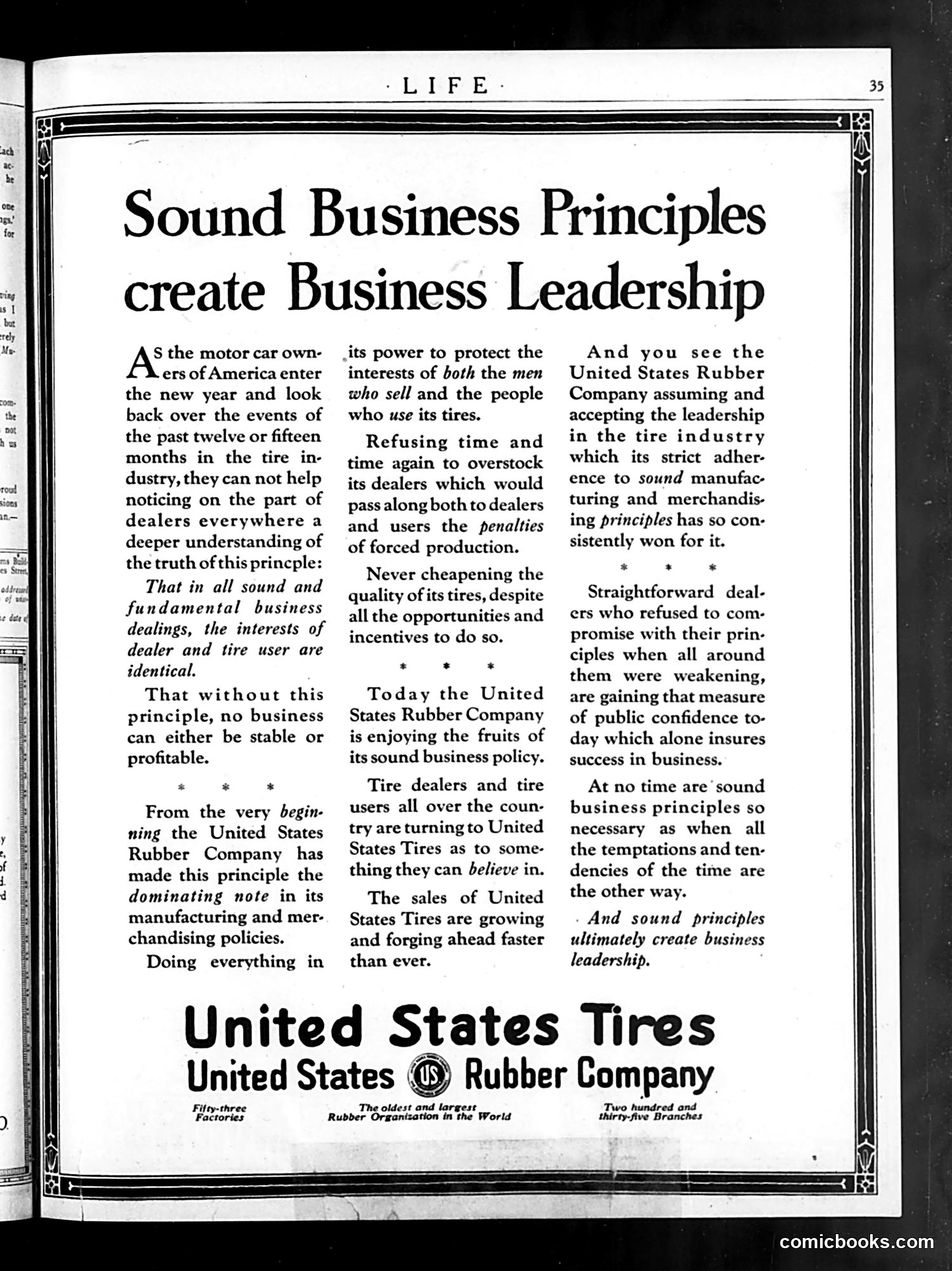
This is **not a cartoon or satire**—it's a straightforward advertisement for United States Rubber Company's tire division, published in *Life* magazine. The full-page ad argues that the company's business success stems from ethical principles: treating dealers and consumers fairly, refusing to artificially inflate dealer inventory, and maintaining quality despite cost-cutting pressures. It frames these practices as morally superior and commercially smart. The ad celebrates tire industry stability after what appears to be a recent period of instability (likely post-WWI economic turbulence). It positions US Rubber as the industry leader precisely *because* it adhered to principles when competitors apparently compromised them. There is no political satire here—this is corporate messaging presenting ethical business conduct as both virtuous and profitable, aimed at reassuring consumers and dealers about the company's reliability and integrity.
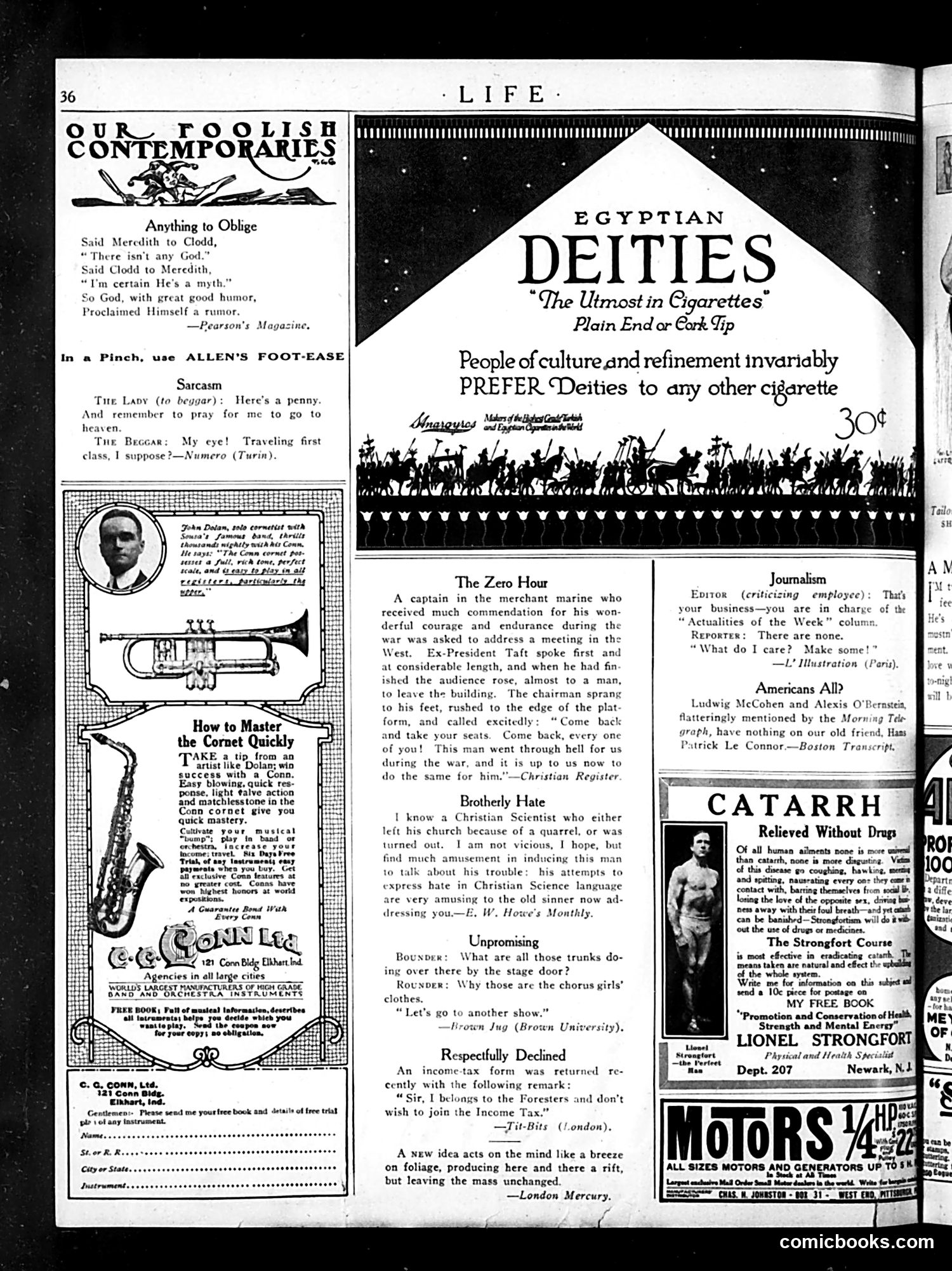
This page from *Life* magazine contains satirical content and period advertising. The left column features "Our Foolish Contemporaries"—a recurring satirical section mocking current absurdities. The opening joke ridicules atheist intellectuals (referencing figures like George Meredith and Leslie Stephen) who debate God's existence; the satire suggests their arguments are so circular that even God finds them amusing rather than threatening. Below that, a brief "Sarcasm" section jokes about class hypocrisy: a wealthy lady patronizingly gives a beggar a penny and instructs him to pray, but the beggar sarcastically responds he'd rather travel first-class. The right side is dominated by advertisements typical of the era, including cigarette ads and medical cure-alls, reflecting early 20th-century marketing practices. The small humor pieces ("The Zero Hour," "Brotherly Hate," "Unpromising") are gentle workplace and social observations. Overall, this reflects *Life*'s role as a humorous commentary on contemporary society, religion, and manners.
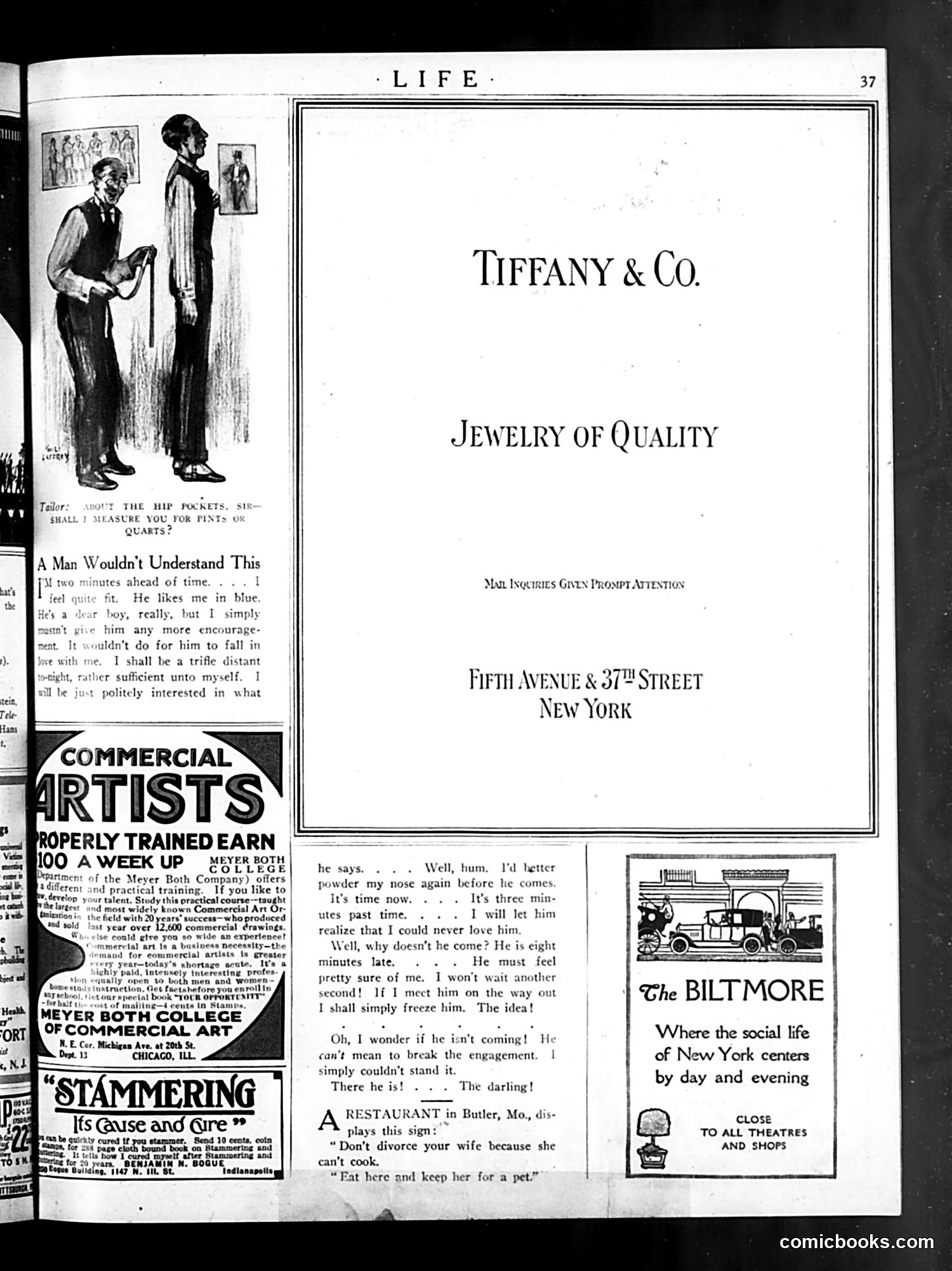
This page is primarily **advertising and title pages** rather than political satire. The main content includes: **"A Man Wouldn't Understand This"** — a brief comedic narrative (left side) depicting a woman's anxious internal monologue while waiting for a date. She oscillates between indifference ("I shall be a trifle distant") and desperate concern ("why doesn't he come?"), satirizing female romantic anxiety and mind-games of the era. The humor lies in exposing the gap between her performed coolness and actual emotional investment. **Advertisement section** features Tiffany & Co. jewelry and The Biltmore hotel, typical luxury ads for Life's affluent readership. **Educational/trade ads** for commercial art training and a restaurant sign joke about marriage appear below. The satire targets **gender relations and courtship rituals** of early 20th-century upper-class America, gently mocking women's emotional volatility and performative aloofness in romantic contexts—a common Life magazine theme.
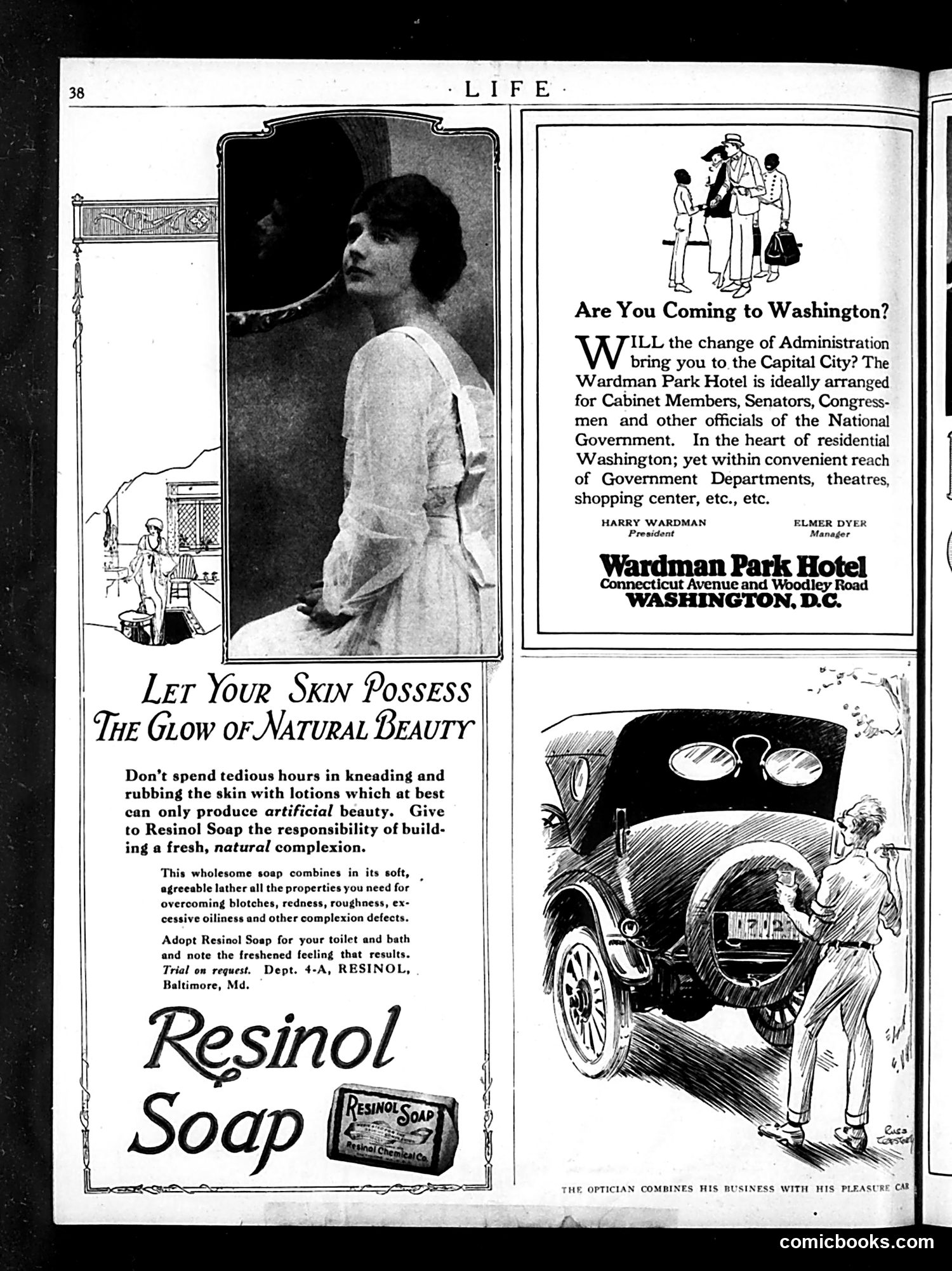
This page is primarily **advertising**, not political satire. It contains three ads: 1. **Wardman Park Hotel** (top right): A straightforward hotel advertisement targeting government officials, referencing a change of Administration coming to Washington. This likely alludes to a presidential transition, though the specific date isn't visible. 2. **Resinol Soap** (left): A beauty product ad promising "natural" complexion improvement, contrasting itself against artificial lotions. 3. **Untitled cartoon** (bottom right): A sketch captioned "The Optician Combines His Business With His Pleasure Car" showing a man with binoculars near an automobile—apparently a visual pun about an optician using his profession (eyeglasses/binoculars) while enjoying leisure time. The page represents typical *Life* magazine content from an era when satirical publications carried substantial advertising. The optician cartoon is mildly humorous wordplay rather than political commentary.
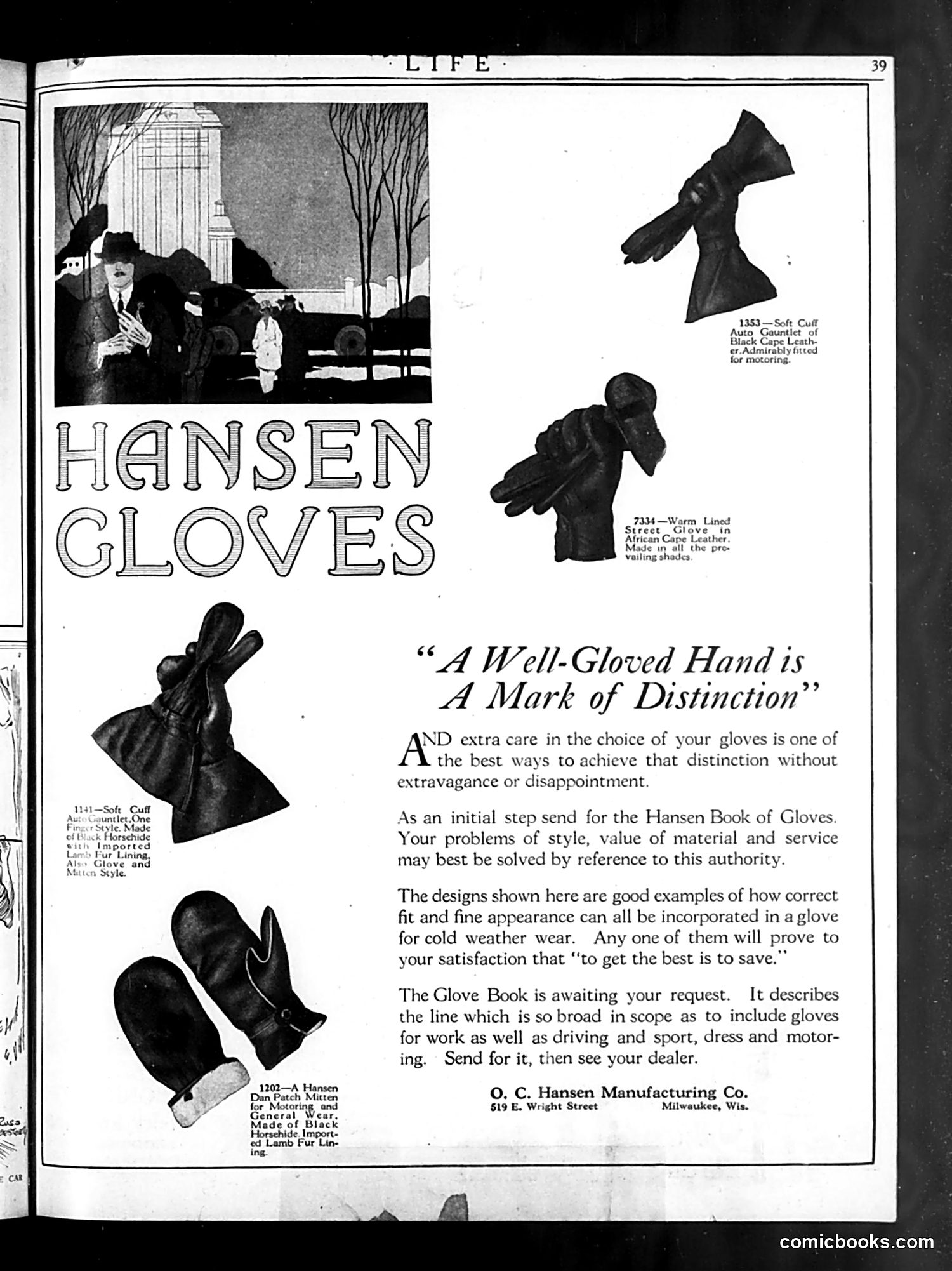
This page is **entirely an advertisement**, not political satire or cartoon content. It's a product ad for O. C. Hansen Manufacturing Company (Milwaukee, Wisconsin) promoting their line of gloves. The top includes a small illustrated scene of well-dressed people in what appears to be a formal setting—likely meant to evoke sophistication and social status. The central message: "A Well-Gloved Hand is A Mark of Distinction" emphasizes that proper gloves signal refinement and good taste. The ad displays four different glove styles with product numbers and descriptions (soft cuff auto gauntlets, lined street gloves, etc.), appealing to various uses—motoring, driving, sport, and formal wear. The text encourages readers to request a free "Hansen Book of Gloves" to solve "problems of style, value of material and service." This reflects early 20th-century consumer culture: glove selection as a marker of social class and fashion consciousness.
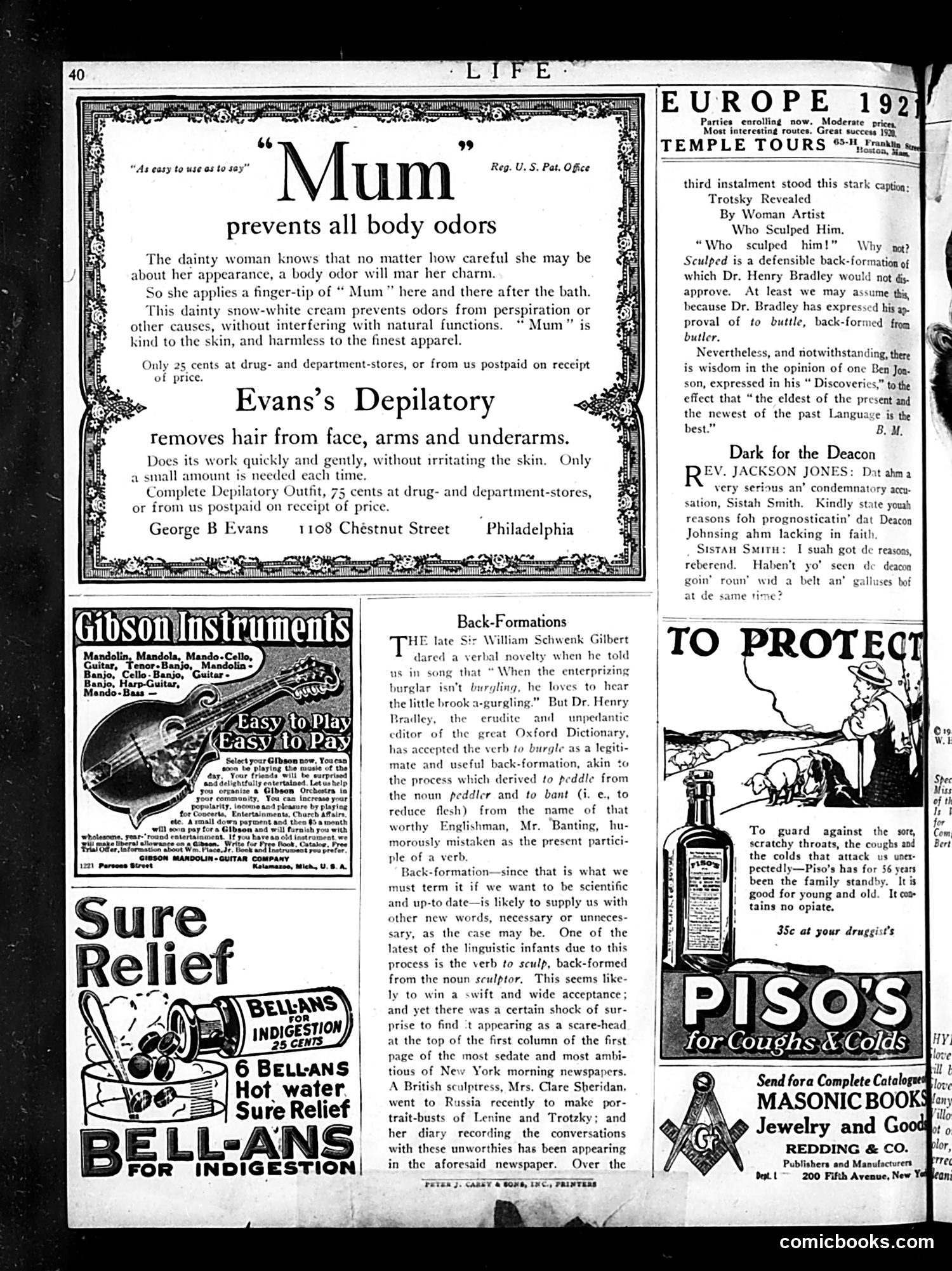
This page is primarily **advertisements and filler content** rather than political cartoons, though it contains one relevant cultural reference. The notable editorial content is a brief discussion of **linguistic "back-formations"** — words created by removing suffixes from existing words. The example given is the newly-coined verb "to sculp" (from "sculptor"), which the author notes appeared surprisingly in a prominent New York newspaper headline. The connection: this relates to a **British sculptress, Mrs. Clare Sheridan**, who recently traveled to Russia to create portrait busts of **Lenin and Trotsky**. The "stark caption" referenced mentions "Trotsky Revealed By Woman Artist Who Sculped Him" — this being newsworthy because Sheridan had access to Soviet leaders during a period of intense anti-Bolshevik sentiment in the West. The remainder of the page consists of vintage **beauty and medicinal product advertisements** (Mum deodorant, Evans's Depilatory, Bellans indigestion remedy, Piso's cough syrup), typical of 1920s commercial content, plus a racial-dialect humor piece unrelated to current events.
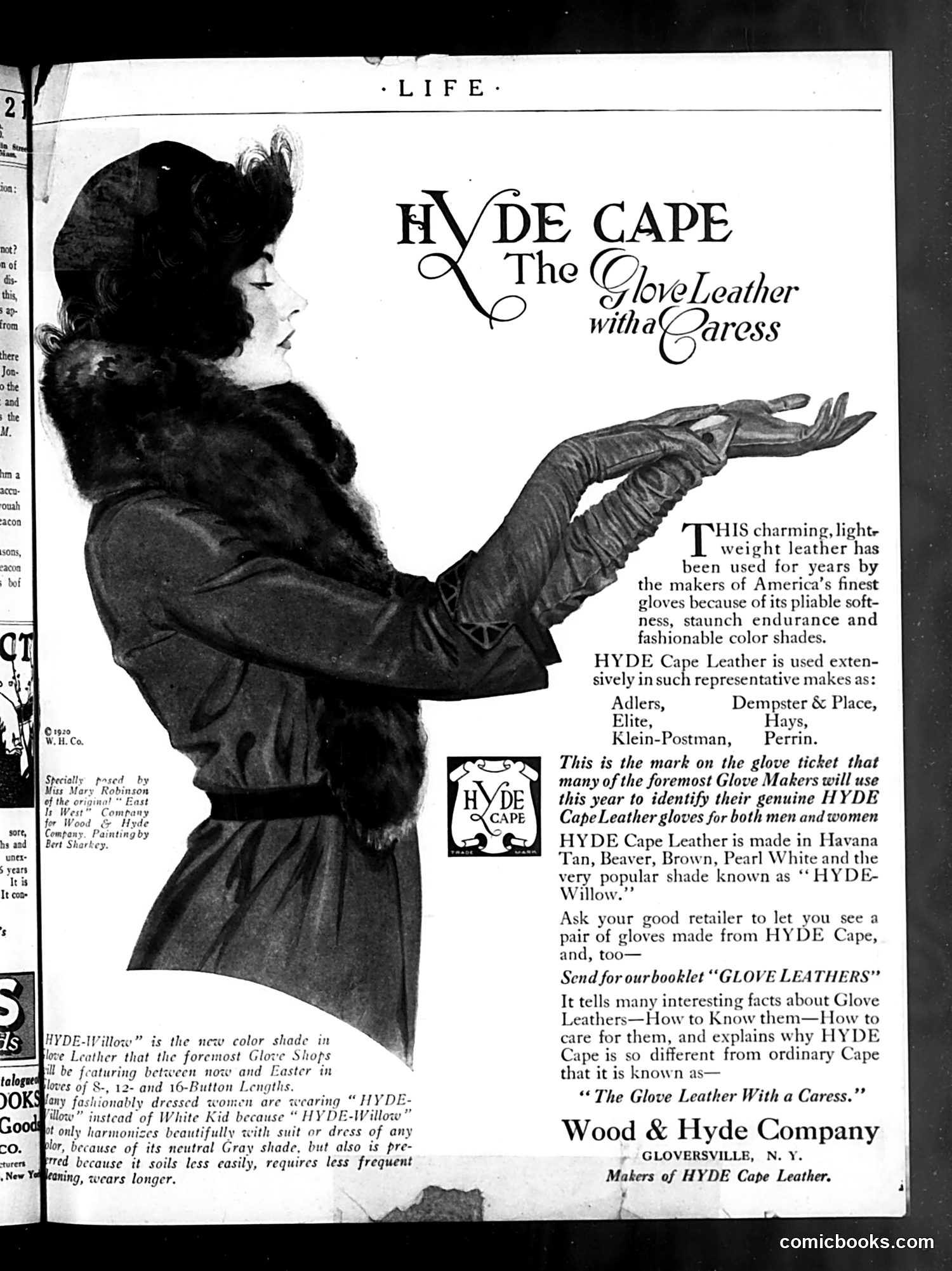
This is **not a cartoon or satire**—it's a full-page advertisement for HYDE Cape Leather gloves, published in *Life* magazine around 1920. # The Content The ad features an elegantly dressed woman in profile, modeling long gloves while gesturing gracefully. The advertisement emphasizes the leather's quality: pliable softness, durability, and fashionable colors (particularly "HYDE-Willow," a neutral gray shade). The copy highlights that the gloves are used by major American glove makers (Adlers, Elite, Klein-Postman, Perrin, etc.) and promotes HYDE Cape as superior to ordinary cape leather—marketed as "The Glove Leather With a Caress." The ad encourages readers to request a free booklet about glove care and invites them to visit retailers to examine the product. Wood & Hyde Company, based in Gloversville, New York, positioned themselves as premium glove manufacturers. This represents early 20th-century luxury goods advertising targeting fashionable women.
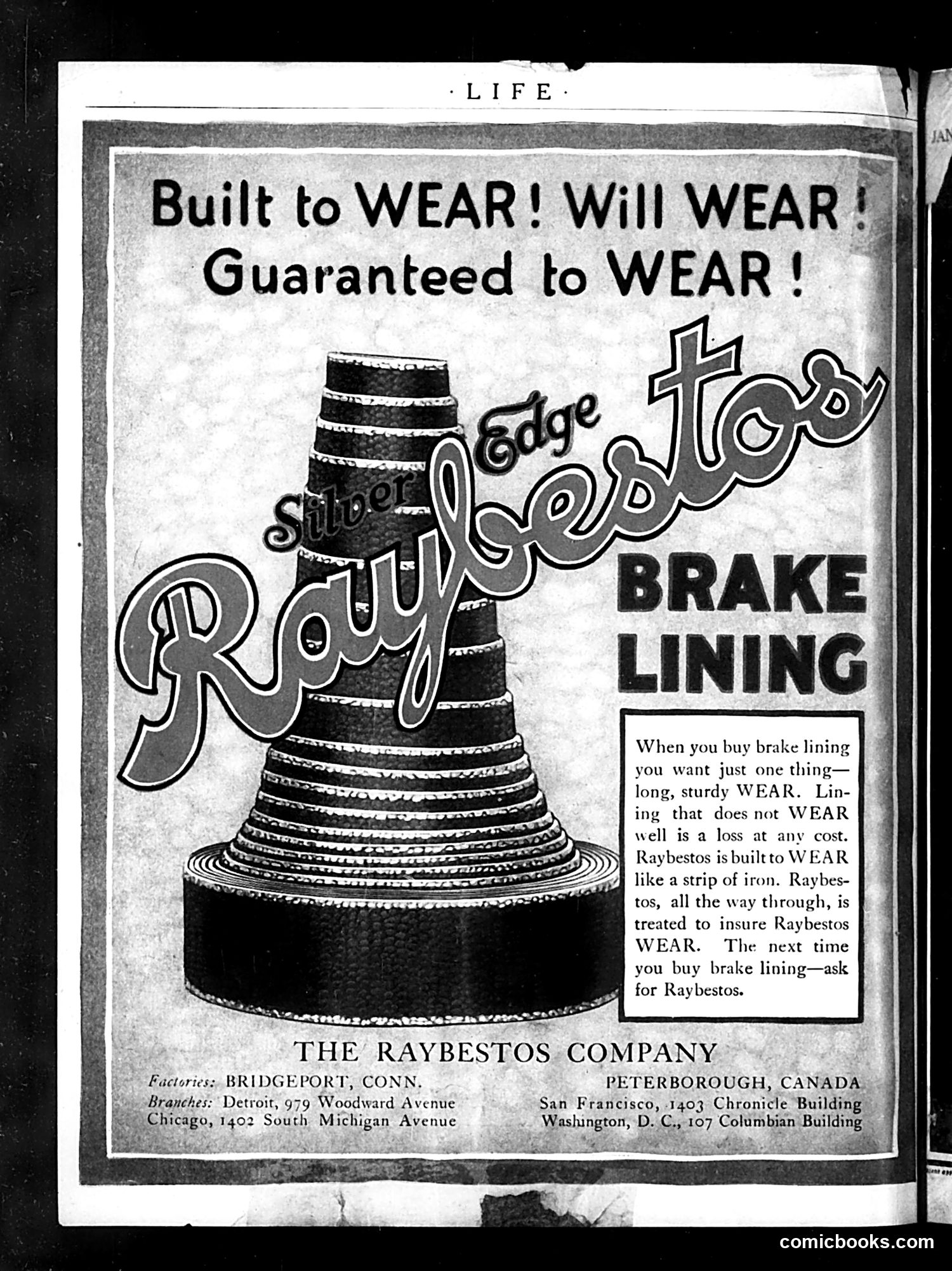
This is a **straightforward advertisement**, not satire or political commentary. The Raybestos Company promotes its brake lining product through a full-page ad in *Life* magazine. The visual centerpiece is a stylized illustration of a brake drum—the cylindrical component of automotive braking systems—rendered in bold Art Deco typography spelling "Raybestos." The drum's layered cross-section emphasizes durability and industrial construction. The advertisement's repetitive emphasis on "WEAR"—appearing five times—drives home the product's durability claim: brake lining that maintains performance over time. The accompanying text reinforces that Raybestos lining is "built...like a strip of iron" and "treated to insure" longevity, positioning durability as the key consumer concern. This reflects early automotive-era marketing, when brake reliability was genuinely important to vehicle safety and lifespan. The ad lists factories and branches across North America, indicating Raybestos's established market presence.
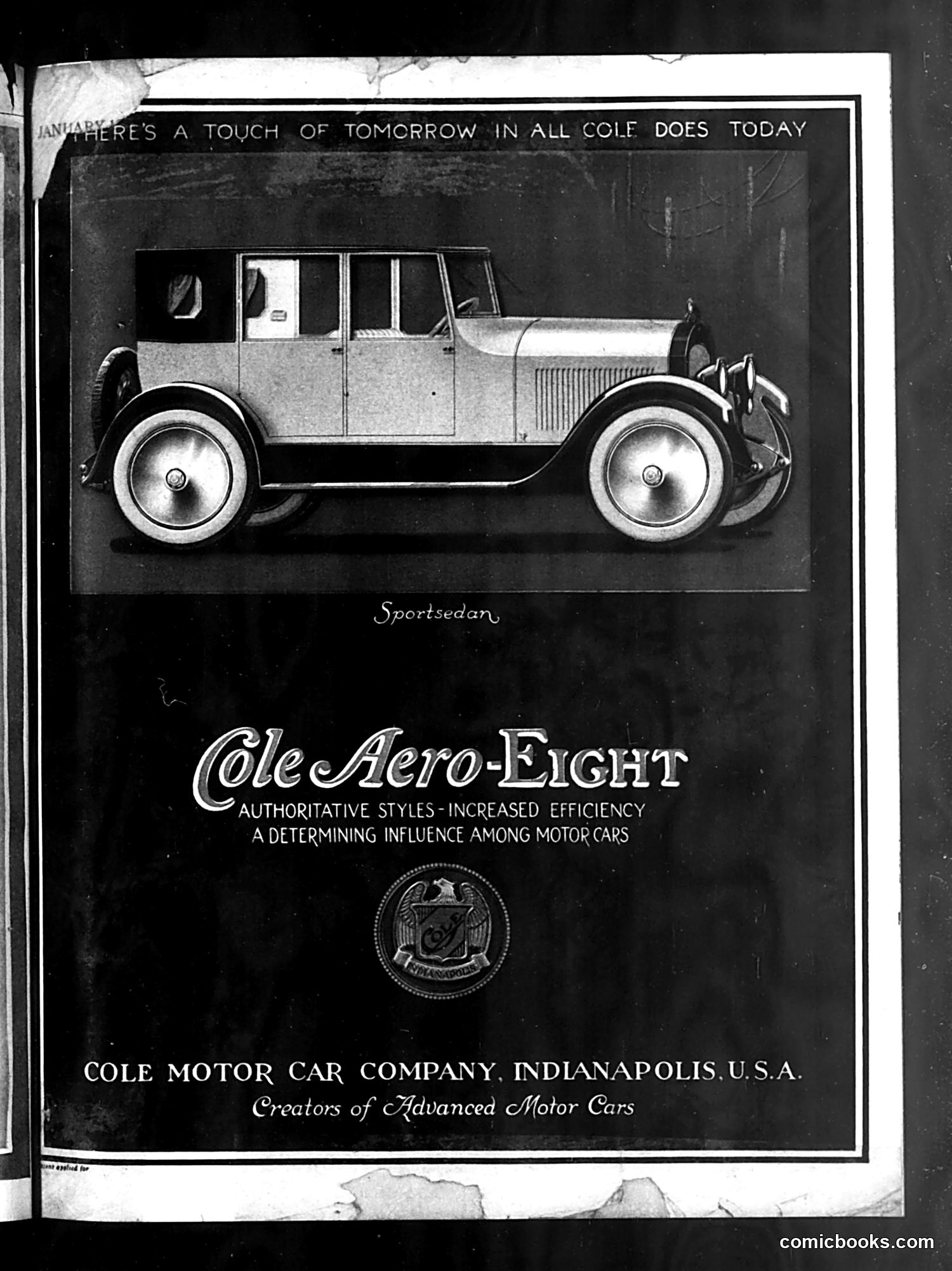
This is a vintage automobile advertisement, not a political cartoon. It promotes the Cole Aero-Eight, a sportsedan manufactured by the Cole Motor Car Company in Indianapolis. The page features a side-profile illustration of the vehicle and includes the tagline "There's a touch of tomorrow in all Cole does today," suggesting the car represents modern, forward-thinking automotive design. The ad emphasizes "authoritative styles" and "increased efficiency" as distinguishing features that influence consumer choices in the motor car market. The company positions itself as "Creators of Advanced Motor Cars," appealing to buyers seeking contemporary technology and style. This appears to be from the 1920s era of American automobile advertising.

This is a full-page advertisement for Victor Records and their catalog, not a political cartoon. It promotes the Victor Record catalog as "the world's best guide book to the enjoyment of music," emphasizing its educational value through questions about famous operas (Rigoletto, Faust, Pagliacci), national anthems, and classical composers like Chopin. The ad showcases Victor's products—a record, the catalog, and the "His Master's Voice" gramophone with its iconic dog trademark—to appeal to early 20th-century middle-class music enthusiasts. The pitch combines entertainment with cultural aspiration, suggesting that owning Victor Records and the catalog demonstrated refined taste and musical knowledge. This reflects the era when recorded music and phonographs represented cutting-edge consumer technology and a pathway to cultural self-improvement.