
Life, 1921-01-06 · page 21 of 44
Life — January 6, 1921 — page 21: what you’re looking at
What you’re looking at
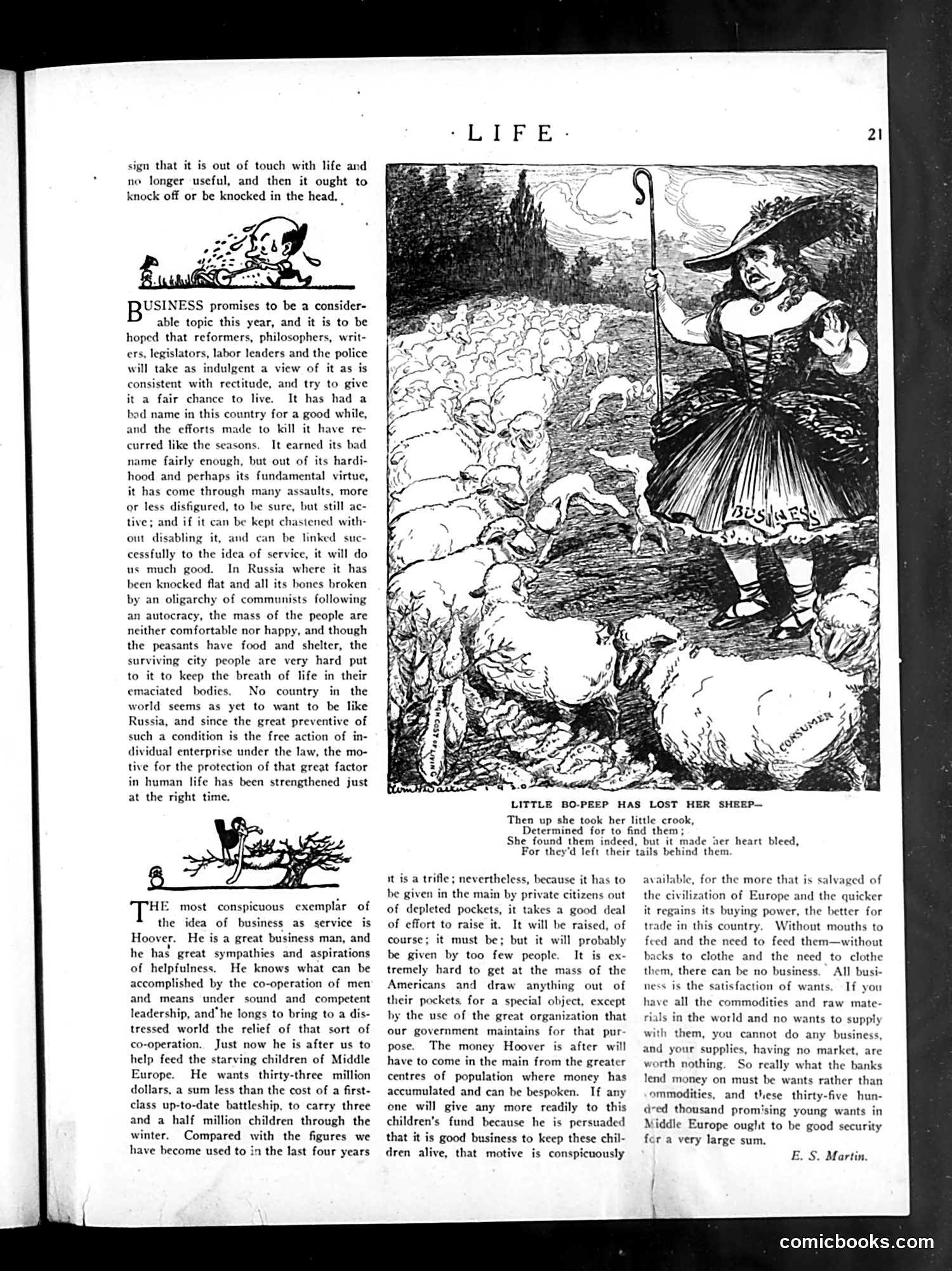
This page contains two distinct elements: **The Main Text** discusses American business as a social force, praising it as beneficial when linked to service. It notably **references Herbert Hoover's post-WWI relief efforts**, specifically his campaign to raise $33 million to feed 3.5 million starving children in Middle Europe through the winter. The author argues this fundraising demonstrates business principles applied to humanitarian aid—that helping European recovery ultimately benefits American trade. **The Cartoon** titled "Little Bo-Peep Has Lost Her Sheep" uses the nursery rhyme as political satire. The illustration shows a shepherdess discovering her flock has returned but are maimed—they've "left their tails behind." This appears to **satirize post-war European nations**: they've survived but are damaged, crippled, or diminished by WWI's devastation. The image reinforces the text's point that Europe requires aid to restore itself as a functioning economic partner. The overall message advocates for American business interests framed as humanitarian relief.
📄 Transcribed text from this page (OCR, searchable)
Machine-transcribed from the original scan — historical spelling and the odd misread are preserved.
sign that it is out of touch with life and no longer useful, and then it ought to knock off or be knocked in the head. | USINESS promises to be a consider- able topic this year, and it is to be hoped that reformers, philosophers, writ- ers, legislators, labor leaders and the police will take as indulgent a view of it as is consistent with rectitude, and try to give it a fair chance to live. It has had a bad name in this country for a good while, and the efforts made to kill it have re- curred like the seasons. It earned its bad name fairly enough, but out of its hardi- hood and perhaps its fundamental virtue, it has come through many assaults, more or less disfigured, to be sure, but still ac- tive; and if it can be kept chastened with- out disabling it, and can be linked suc- cessfully to the idea of service, it will do us much good. In Russia where it has been knocked flat and all its bones broken by an oligarchy of communists following an autocracy, the mass of the people are neither comfortable nor happy, and though the peasants have food and shelter, the surviving city people are very hard put to it to keep the breath of life in their emaciated bodies. No country in the world seems as yet to want to be like Russia, and since the great preventive of such a condition is the free action of in- dividual enterprise under the law, the mo- tive for the protection of that great factor in human life has been strengthened just at the right time, HE most conspicuous exemplar of the idea of business as service is Hoover. He is a great business man, and he has great sympathies and aspirations of helpfulness. He knows what can be accomplished by the co-operation of men and means under sound and competent leadership, and’he longs to bring to a dis- tressed world the relief of that sort of co-operation. Just now he is after us to help feed the starving children of Middle Europe. He wants thirty-three million dollars, a sum less than the cost of a first- class up-to-date battleship, to carry three and a half million children through the winter. Compared with the figures we have become used to in the last four years LITTLE BO-PEEP HAS LOST HER SHEEP— Then up she took her little crook, Determined for to find them ; She found them indeed, but it made her heart bleed, For they'd left their tails behind them. it is a trifle; nevertheless, because it has to be given in the main by private citizens out of depleted pockets, it takes a good deal of effort to raise it. It will be raised, of course; it must be; but it will probably be given by too few people. It is ex- tremely hard to get at the mass of the Americans and draw anything out of their pockets, for a special object, except by the use of the great organization that our government maintains for that pur- pose. The money Hoover is after will have to come in the main from the greater centres of population where money has accumulated and can be bespoken. If any one will give any more readily to this children’s fund because he is persuaded that it is good business to keep these chil- dren alive, that motive is conspicuously available, for the more that is salvaged of the civilization of Europe and the quicker it regains its buying power, the better for trade in this country. Without mouths to feed and the need to feed them—without backs to clothe and the need to clothe them, there can be no business. All busi- ness is the satisfaction of wants. If you have all the commodities and raw mate- rials in the world and no wants to supply with them, you cannot do any busines: and your supplies, having no market, are worth nothing. So really what the banks lend money on must be wants rather than ommodities, and these thirty-five hun- dred thousand promising young wants in Middle Europe ought to be good security for a very large sum. E. S. Martin. comicbooks.com