
Life, 1921-01-06 · page 20 of 44
Life — January 6, 1921 — page 20: what you’re looking at
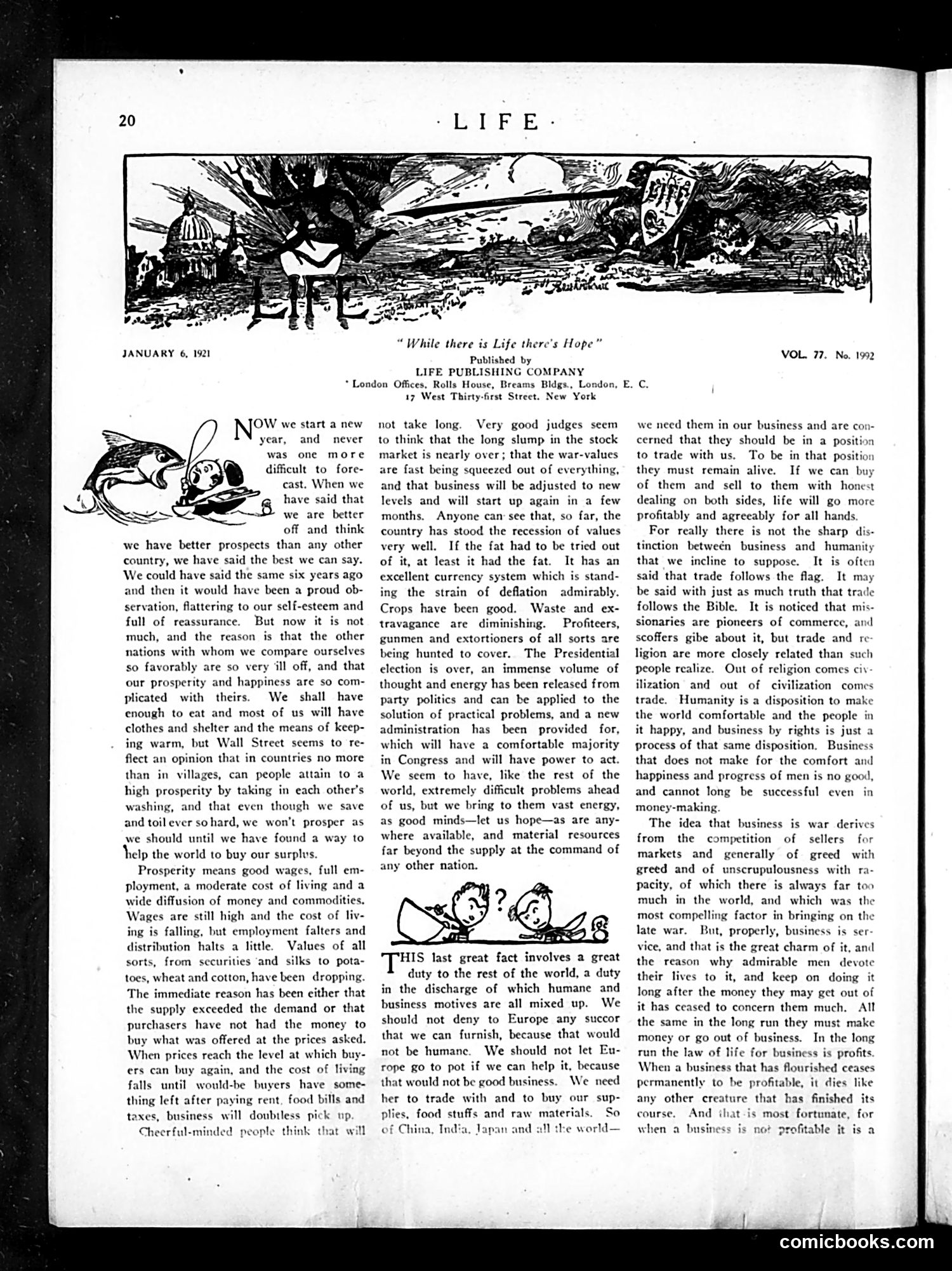
What you’re looking at
This editorial page addresses post-WWI economic recovery. The masthead cartoon—showing a figure amid classical ruins with the motto "While there is Life there's Hope"—sets an optimistic tone about American prospects after the war. The text argues that despite America's relative prosperity compared to war-devastated Europe, American success depends on global recovery. The author warns against isolationism: America cannot prosper while Europe struggles, both for humanitarian and practical business reasons. Key concerns include: deflation affecting wages and employment; stock market volatility; and the need to help Europe rebuild—not from charity alone, but because European markets are essential to American commerce. The new (Harding) administration, recently elected, is positioned as equipped to address these "extremely difficult problems." The small cartoon illustrations appear to show everyday figures, likely representing common citizens navigating economic uncertainty. The overall message reflects 1921's dawning recognition that American isolationism was economically untenable.
📄 Transcribed text from this page (OCR, searchable)
Machine-transcribed from the original scan — historical spelling and the odd misread are preserved.
JANUARY 6, 1921 “While there is Life there's Hope” Published by LIFE PUBLISHING COMPANY VOL. 77. No. 1992 * London Offices, Rolls House, Breams Bldgs., London, E. C. Now’ we start a new year, and never was one more difficult to fore- cast, When we have said that we are better off and think we have better prospects than any other country, we have said the best we can say. We could have said the same six years ago and then it would have been a proud ob- servation, flattering to our self-esteem and full of reassurance. But now it is not much, and the reason is that the other nations with whom we compare ourselves so favorably are so very ‘ill off, and that our prosperity and happiness are so com- plicated with theirs. We shall have enough to eat and most of us will have clothes and shelter and the means of keep- ing warm, but Wall Street seems to re- flect an opinion that in countries no more than in villages, can people attain to a high prosperity by taking in each other's washing, and that even though we save and toilever sohard, we won't prosper as we should until we have found a way to help the world to buy our surplus. Prosperity means good wages, full em- ployment, a moderate cost of living and a wide diffusion of money and commodities. Wages are still high and the cost of liv- ing is falling, but employment falters and distribution halts a little. Values of all sorts, from securities ‘and silks to pota- toes, wheat and cotton, have been dropping. The immediate reason has been cither that the supply exceeded the demand or that purchasers have not had the money to buy what was offered at the prices asked. When prices reach the level at which buy- ers can buy again, and the cost of living falls until would-be buyers have some- thing left after paying rent, food bills and taxes, business will doubtless pick up heerful-minded people think that will 17 West Thirty-first Street. New York not take long. Very good judges seem to think that the long slump in the stock market is nearly over; that the war-values are fast being squeezed out of everything, and that business will be adjusted to new levels and will start up again in a few months. Anyone can: see that, so far, the country has stood the recession of values very well. If the fat had to be tried out of it, at least it had the fat. It has an excellent currency system which is stand- ing the strain of deflation admirably. Crops have been good. Waste and ex- travagance are diminishing. Profiteers, gunmen and extortioners of all sorts are being hunted to cover. The Presidential election is over, an immense volume of thought and energy has been released from party politics and can be applied to the solution of practical problems, and a new administration has been provided for, which will have a comfortable majority in Congress and will have power to act. We seem to have, like the rest of the world, extremely difficult problems ahead of us, but we bring to them vast energy, as good minds—let us hope—as are any- where available, and material resources far beyond the supply at the command of any other nation. THs last great fact involves a great duty to the rest of the world, a duty in the discharge of which humane and business motives are all mixed up. We should not deny to Europe any succor that we can furnish, because that would not be humane. We should not let Eu- rope go to pot if we can help it, because that would not be good business. We need her to trade with and to buy our sup- plies, food stuffs and raw materials. So of China, India, Japan and all the world— we need them in our business and are con- cerned that they should be in a position to trade with us. To be in that position they must remain alive. If we can buy of them and sell to them with honest dealing on both sides, life will go more profitably and agreeably for all hands For really there is not the sharp dis- tinction betweén business and humanity that we incline to suppose. It is often said that trade follows the flag. It ma be said with just as much truth that trad follows the Bible. It is noticed that mis- sionaries are pioneers of commerce, and scoffers gibe about it, but trade and re ligion are more closely related than such people realize. Out of religion comes civ ilization and of civilization comes trade. Humanity is a disposition to make the world comfortable and the people in it happy, and business by rights is just a process of that same disposition. Business that does not make for the comfort and happiness and progress of men is no good, and cannot long be successful even in money-making. out The idea that business is war derives from the competition of sellers for markets and generally of greed with greed and of unscrupulousness with ra- pacity, of which there is always far too much in the world, and which was the most compelling factor in bringing on the late war. But, properly, business is ser- vice, and that is the great charm of it, and the reason why admirable men devote their lives to it, and keep on doing it long after the money they may get out of it has ceased to concern them much. All the same in the long run they must make money or go out of business. In the long run the law of life for business is profits. When a business that has flourished ceases permanently to be profitable, it dies like any other creature that has finished its And ihat-is most fortunate, for when a busir is no? profitable it is a course. comicbooks.com