
Life, 1921-01-06 · page 24 of 44
Life — January 6, 1921 — page 24: what you’re looking at
What you’re looking at
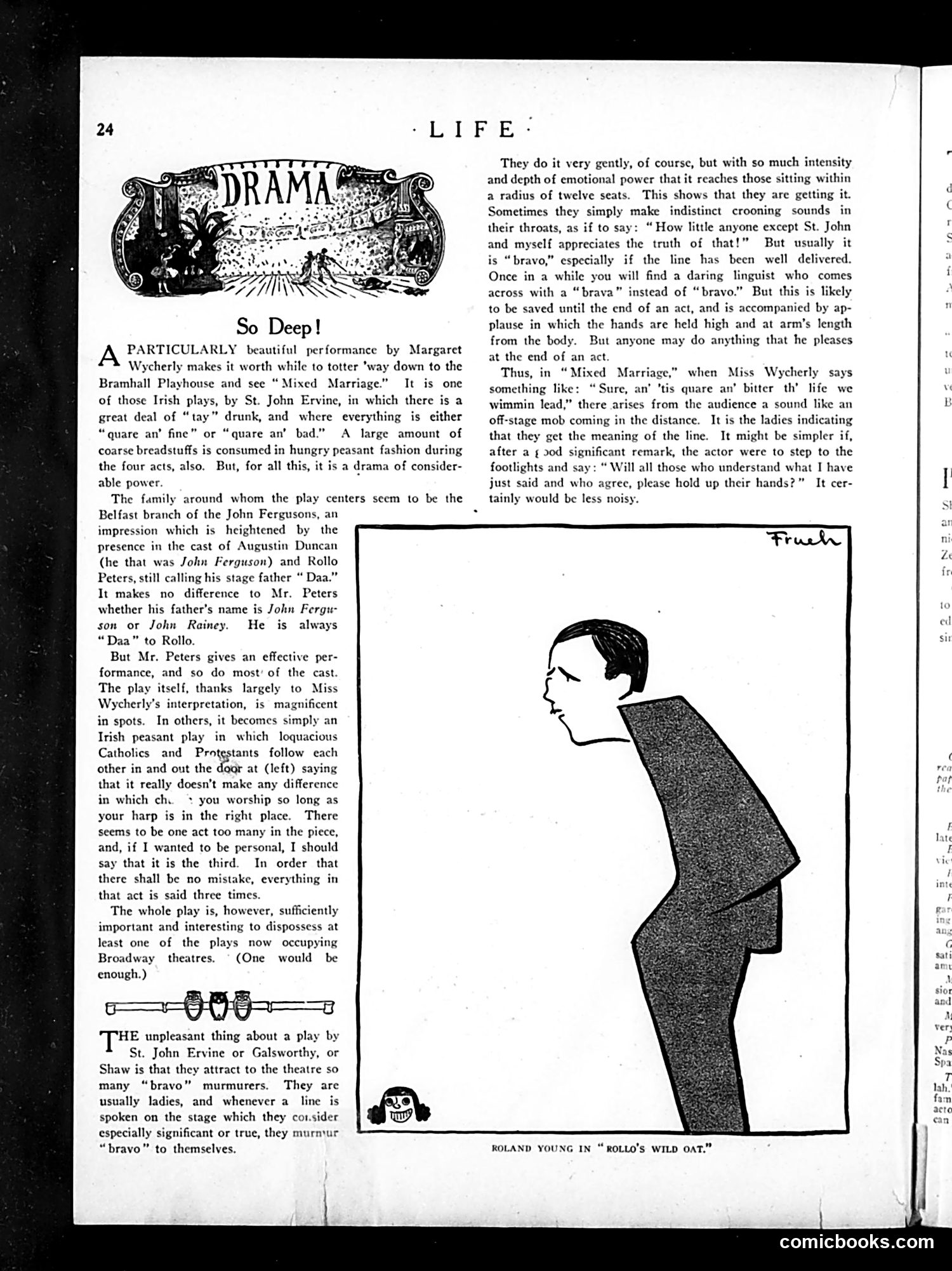
This page reviews St. John Ervine's play "Mixed Marriage," a drama about Belfast's Irish working class, featuring actress Margaret Wycherly. The text praises the performance while critiquing the play's structure and subject matter. The accompanying cartoon satirizes theater audiences of Ervine, Galsworthy, and Shaw—playwrights known for socially conscious work. Life mocks a specific audience behavior: wealthy, cultured ladies who murmur "bravo" at lines they deem intellectually or morally significant. The satire targets performative sophistication—these women announce their own refined taste through audible approval, broadcasting to nearby seats that they "get it." The author suggests that such ostentatious responses reveal pretension rather than genuine appreciation. The cartoon portrait (credited to "Rollo's Wild Oat") likely depicts Roland Young, a contemporary actor, though the specific reference remains unclear.
📄 Transcribed text from this page (OCR, searchable)
Machine-transcribed from the original scan — historical spelling and the odd misread are preserved.
-LIFE- PARTICULARLY beautiful performance by Margaret Wycherly makes it worth while to totter ‘way down to the Bramhall Playhouse and see “ Mixed Marriage.” It is one of those Irish plays, by St. John Ervine, in which there is a great deal of “tay” drunk, and where everything is either “quare an’ fine” or “quare an’ bad.” A large amount of coarse breadstuffs is consumed in hungry peasant fashion during the four acts, also. But, for all this, it is a drama of consider- able power. ° The family around whom the play centers secm to be the Belfast branch of the John Fergusons, an impression which is heightened by the presence in the cast of Augustin Duncan (he that was John Ferguson) and Rollo Peters, still calling his stage father “ Daa.” It makes no difference to Mr. Peters whether his father’s name is John Fergu- son or John Rainey. He is always “Daa” to Rollo. But Mr. Peters gives an effective per- formance, and so do most’ of the cast. The play itself, thanks largely to Wycherly’s interpretation, is magnificent in spots. In others, it becomes simply an Irish peasant play in which loquacious Catholics and Protestants follow each other in and out the ey at (left) saying that it really doesn’t make any difference in which ch. + you worship so long as your harp is in the right place. There seems to be one act too many in the piece, and, if I wanted to be personal, I should say that it is the third. In order that there shall be no mistake, everything in that act is said three times. The whole play is, however, sufficiently important and interesting to dispossess at least one of the plays now occupying Broadway theatres. (One would be enough.) ies THE unpleasant thing about a play by St. John Ervine or Galsworthy, or Shaw is that they attract to the theatre so many “bravo” murmurers. They are usually ladies, and whenever a line is spoken on the stage which they cor.sider especially significant or true, they murmur “bravo” to themselves. They do it very gently, of course, but with so much intensity and depth of emotional power that it reaches those sitting within a radius of twelve seats. This shows that they are getting it. Sometimes they simply make indistinct crooning sounds in their throats, as if to say: “ How little anyone except St. John and myself appreciates the truth of that!” But usually it is “bravo,” especially if the line has been well delivered. Once in a while you will find a daring linguist who comes across with a “brava” instead of “bravo.” But this is likely to be saved until the end of an act, and is accompanied by ap- plause in which the hands are held high and at arm’s length from the body. But anyone may do anything that he pleases at the end of an act. Thus, in “Mixed Marriage,” when Miss Wycherly says something like: “Sure, an’ 'tis quare an’ bitter th’ life we wimmin lead,” there arises from the audience a sound like an off-stage mob coming in the distance. It is the ladies indicating that they get the meaning of the line. It might be simpler if, after a ¢ 90d significant remark, the actor were to step to the footlights and say: “ Will all those who understand what I have just said and who agree, please hold up their hands?” tainly would be less noisy. It cer- ROLAND YOUNG IN “ROLLO'S WILD OAT.” comicbooks.com