
Life, 1921-01-06 · page 25 of 44
Life — January 6, 1921 — page 25: what you’re looking at
What you’re looking at
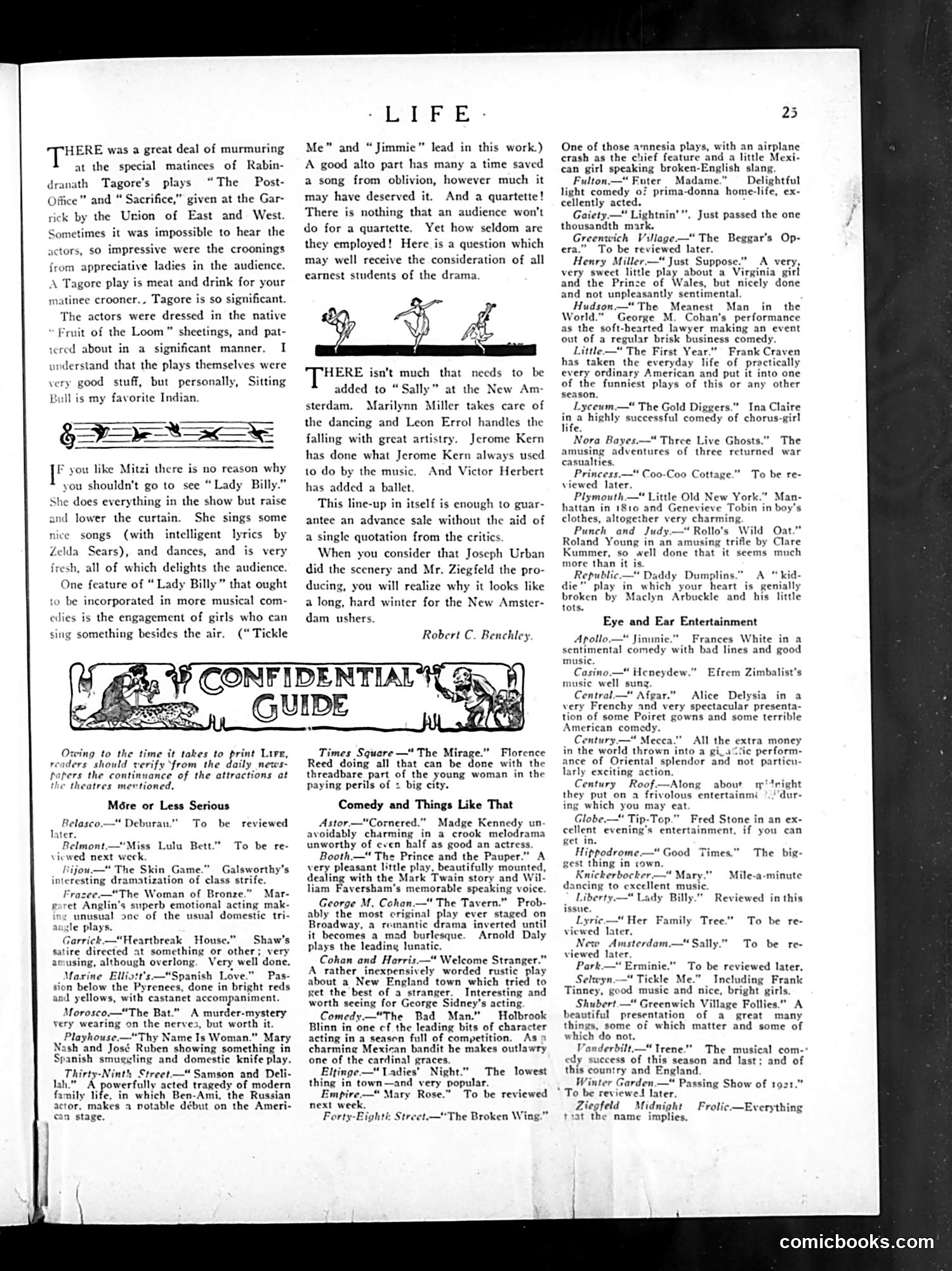
This is a theater review section from *Life* magazine, circa early 1920s. The main satirical content mocks the *audience behavior* at Rabindranath Tagore's plays rather than the plays themselves. The joke: wealthy, culturally aspirational matinee attendees ("appreciative ladies") were so eager to appear sophisticated that they drowned out the actors with admiring murmurs and sighs—defeating the purpose of attending. Tagore, the famous Indian poet-playwright, represented high culture, and the satire targets the performative nature of this audience's appreciation: they're more interested in *being seen* as refined than actually *listening*. The accompanying reviews by Robert C. Benchley praise current Broadway productions, noting standout performers like Marilyn Miller and Leon Errol, and creative teams like designer Joseph Urban and composer Jerome Kern. The "Confidential Guide" section lists current theater attractions with brief critical notes.
📄 Transcribed text from this page (OCR, searchable)
Machine-transcribed from the original scan — historical spelling and the odd misread are preserved.
TER was a great deal of murmuring at the special matinees of Rabin- dranath Tagore’s plays “The Post- Off and “ Sacrifice,” given at the Gar- rick by the Union of East and West. Sometimes it was impossible to hear the actors, SO impressive were the croonings from appreciative ladies in the audience. A Tagore play is meat and drink for your matinee crooner... Tagore is so significant. The actors were dressed in the native Fruit of the Loom” sheetings, and pat- tered about in a significant manner. I understand that the plays themselves were very good stuff, but personally, is my favorite Indian. G3] SSE | * you like Mitzi there is no reason why you shouldn't go to see “Lady Billy.” She does everything in the show but raise and lower the curtain. She sings some songs (with intelligent lyrics by Zelda Sears), and is very fresh, all of which delights the audience. One feature of “ Lady Billy” that ought to be incorporated in more musical com- edies is the engagement of girls who can sing something besides the air. (“Tickle Sitting nice and dances, Me” " lead in this work.) A good alto part has many a time saved a song from oblivion, however much it may have deserved it. And a quartette! There is nothing that an audience won't do for a quartette. Yet how seldom are they employed! Here is a question which may well receive the consideration of all earnest students of the drama. HERE isn’t much that needs added to “Sally” at the New sterdam, to be Am- Marilynn Miller takes care of the dancing and Leon Errol handles the falling with great artistry. Jerome Kern has done what Jerome Kern always used to do by the music. And Victor Herbert has added a ballet. This line-up in itself is enough to guar- antee an advance sale without the aid of a single quotation from the critics. When you consider that Joseph Urban did the scenery and Mr. Ziegfeld the pro- ducing, you will realize why it looks like a long, hard winter for the New Amster- dam ushers. Robert C. Benchley. ing to the time it takes to print Lire, readers should verify from the daily news- fepers the continuance of the attractions at theatres mevtioned. Mére or Less Serious Belasco.—" Deburau.” To be later, Belmont.—"Miss Lulu Bett.” viewed next weck. tijou.—* The Skin Game.” Galsworthy’s interesting dramatization of class strife. Frazee—"“The Woman of Bronze.” Mar- garet Anglin’s superb emotional acting mak- < unusual one of the usual domestic tri- le plays Farrick.—"Heartbreak House.” Shaw's satire directed at something or other; very amusing, although overlong. Very well done. Maxine Elliott's—*Spanish Love.” Pas- sion below the Pyrenees, done in bright reds and yellows, with castanet accompaniment. Morosco.—*“The Bat.” A murder-mystery very wearing on the nerves, but worth it. < .—"Thy Name Is Woman.” Mary Nash and José Ruben showing something in Spanish smuggling and domestic knife play, Thirty-Ninth Street—“ Samson and Deli- lah.” A powerfully acted tragedy of modern family life, in which Ben-Ami, the Russian actor. makes a notable début on the Ameri- stage. reviewed To be re- Times Square —* The Mirage.” Florence Reed doing all that can be done with the threadbare part of the young woman in the paying perils of = big city. Comedy and Things Like That Astor —“Cornered.” Madge Kennedy un avoidably charming in a crook melodrama unworthy of even half as good an actress. Booth._—“ The Prince and the Pauper.” A very pleasant little play, beautifully mounted, dealing with the Mark Twain story and Wi liam Faversham’s memorable speaking voice. George M. Cohan.—" The Tavern.” Prob- ably the most criginal play ever staged on Broadway, a remantic drama inverted until it becomes a mad burlesque. Arnold Daly plays the leading lunatic. Cohan and Harris.—* Welcome Stranger.” A rather inexpensively worded rustic play about a New England town which tried to get the best of a stranger. Interesting and worth seeing for George Sidney's acting. Comedy.—"“The Bad Man. Holbrook Blinn in one cf the leading bits of character acting in a season full of competition. As charming Mexican bandit he makes outlawry one of the cardinal graces. Eltinge—" Ladies’ Night.” The lowest thing in town—and very popular. Empire.—" Mary Rose.” To be reviewed ighti: Str “The Broken Wing.” * To be reviewed later. 25 One of those amnesia plays, with an airplane crash as the chief feature and a little Mexi- can girl speaking broken-English slang. Fulton.—" Futer Madame.” —_ Delightful light comedy o/ prima-donna home-life, ex- cellently acted. Gaiety,—" Lightnin’ thousandth mark. Greenwich Village-—" The Beggar's Op- era.” To be reviewed later. Henry Miller—* Just Suppose.” A very, very sweet little play about a Virginia girl of Wales, but nicely done santly sentimental. The Meanest Man in the “George M. Cohan’s performance as the soft-hearted lawyer making an event out of a regular brisk business comedy. Little—“ The First Year.” Frank Craven has taken the everyday life of practically every ordinary American and put it into one of the funniest plays of this or any other season. Lyceum.—* The Gold Diggers.” Ina Claire ins highly successful comedy of chorus-girl ife. Nora Bayes.—* Three Live Ghosts.” amusing casualties. Princess.—“ Coo-Coo Cottage.” viewed later. Plymouth—" Little Old New York.” Man- hattan in 1810 and Genevieve Tobin in boy's clothes, a her very charming. Punch “Rollo’s Wild Oat.” Roland Young in an amusing trifle by Clare Kummer, so well done that it seems much more than it is. Republic.—" Daddy die” play broken by tots. . Just passed the one The adventures of three returned war To be re- Dumplins.”| A“ kid- in which your heart is genially Maclyn Arbuckle and his little Eye and Ear Entertainment Apollo.—* Jimmie.” sentimental cor music. Casino.—" Hcneydew.” music well sung. Central—" Afgar.” Alice Delysia in a very Frenchy and very spectacular presenta- tion of some Poiret gowns and some terrible American comedy. Century —" Mecca.” All the extra money in the world thrown into a gi_a<‘ic perform- ance of Oriental splendor and not particu- larly exciting action, Century Roof—Along about ry 'tright they put on a frivolous entertainmi ‘dur- ing which you may eat Frances White in a edy with bad lines and good Efrem Zimbalist’s Globe—" Tip-Top.” Fred Stone in an ex- cellent evening’s entertainment, if you can get in. Hippodrome-—" Good gest thing in cown, Knickerbocker —“ Mary.” dancing to excellent music. Liberty.—" Lady Billy issue. The big- Times.” Mile-a-minute Reviewed in this Lyric—" Her Family Tree.” To be re- viewed later, New Amsterdam—" Sally.” To be re- viewed later. —"Erminie.” To be reviewed later. yn— Tickle Me.” Including Frank Tinney, good music and nice, bright girls Shubert — Greenwich Village Follies.” A beautiful presentation of a great many things, some of which matter and some of which do not. Vanderbilt" Trene””| The musical com-* edy success of this season and last; and of this country and England. Winter Garden.— Passing Show of 1921.” iegfeld Midnight tiat the Frolic-—Everything name implies, comicbooks.com