
A complete issue · 56 pages · 1920
Life — October 7, 1920
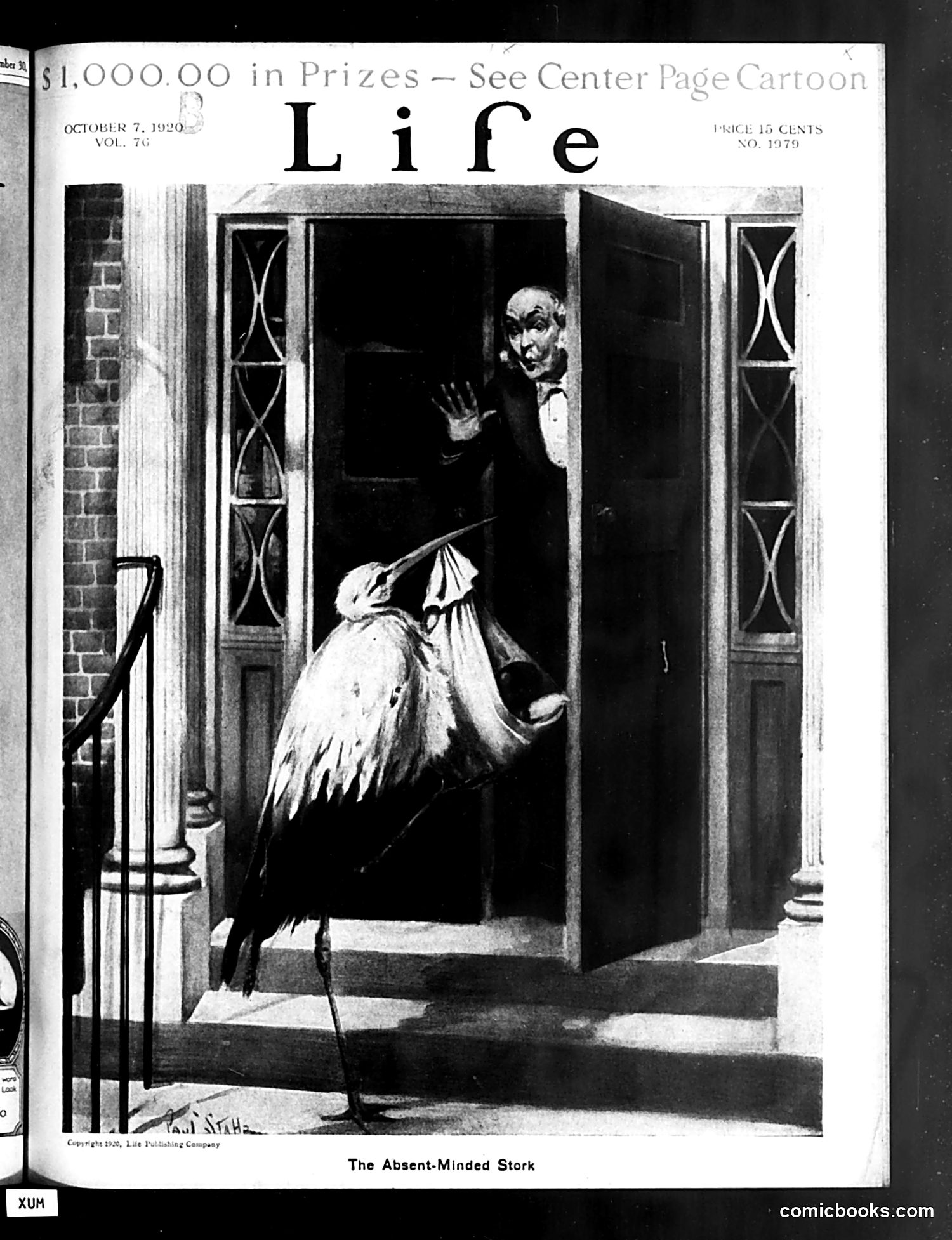
This *Life* magazine cover from October 7, 1929, depicts a stork—the mythological bird traditionally associated with delivering babies—at a doorway, absent-mindedly about to deliver a bundle to the wrong house. A gaunt, skeletal figure (possibly representing Death or a sinister force) lurks menacingly in the doorway behind. The cartoon likely satirizes careless or misdirected social consequences—possibly referencing anxieties about unintended births, improper deliveries of responsibility, or societal mishaps. The timing (just weeks before the stock market crash) may also suggest broader concerns about absent-minded leadership or institutions failing to deliver outcomes to the right recipients. The specific reference remains somewhat unclear without additional context.
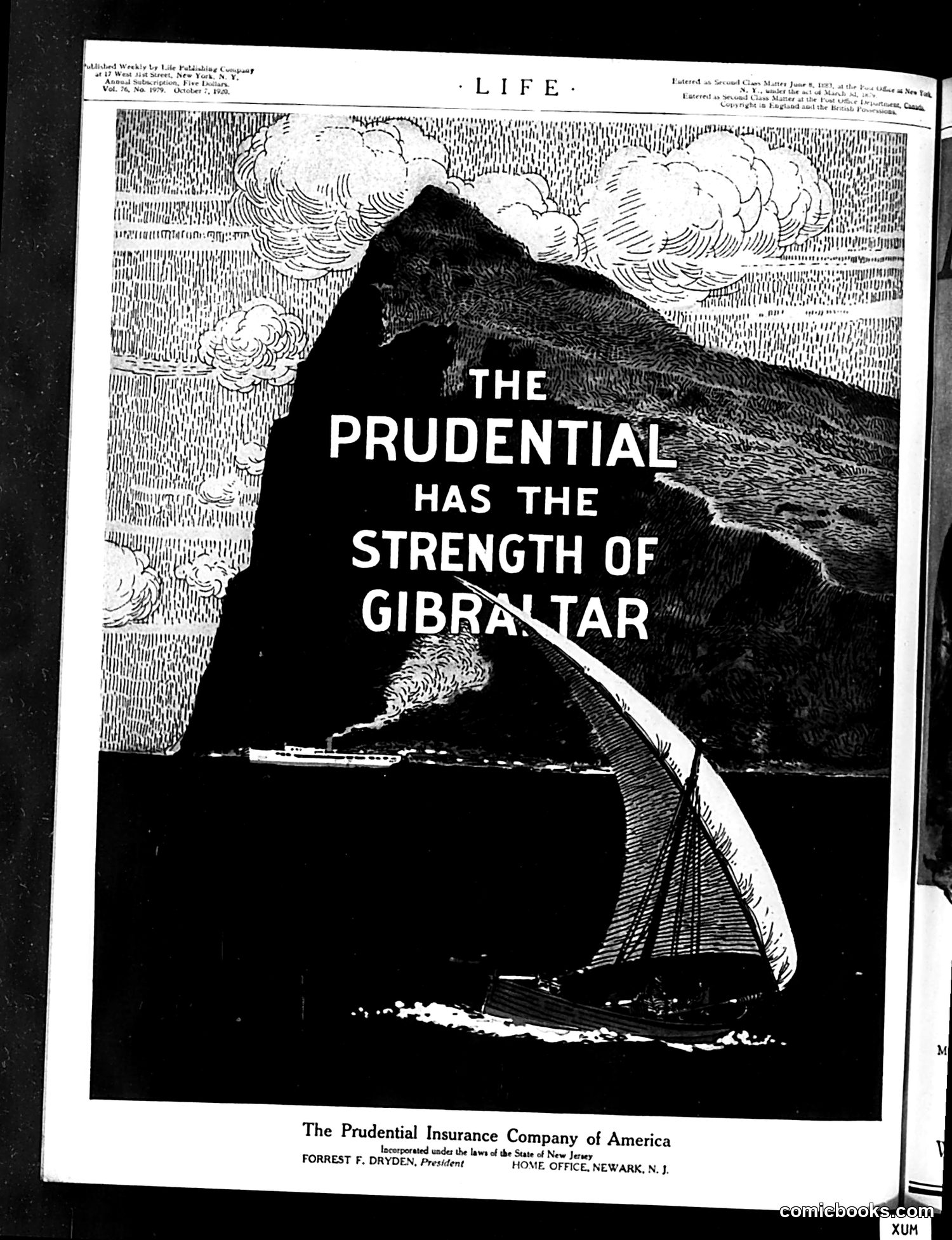
This page is primarily a **Prudential Insurance Company advertisement**, not political satire. The image shows a dramatic illustration of the Rock of Gibraltar at night, with a ship passing nearby and a large hand pointing toward the rock. The advertisement's slogan—"THE PRUDENTIAL HAS THE STRENGTH OF GIBRALTAR"—uses the famous rock as a metaphor for stability and permanence. Gibraltar, a British territory known for its geological permanence and strategic importance, was a common symbol of strength and reliability in early 20th-century advertising. The visual comparison suggests that Prudential Insurance, like Gibraltar itself, is immovable, dependable, and protective—qualities meant to reassure customers about the company's financial security and longevity. This is straightforward commercial messaging rather than political commentary.
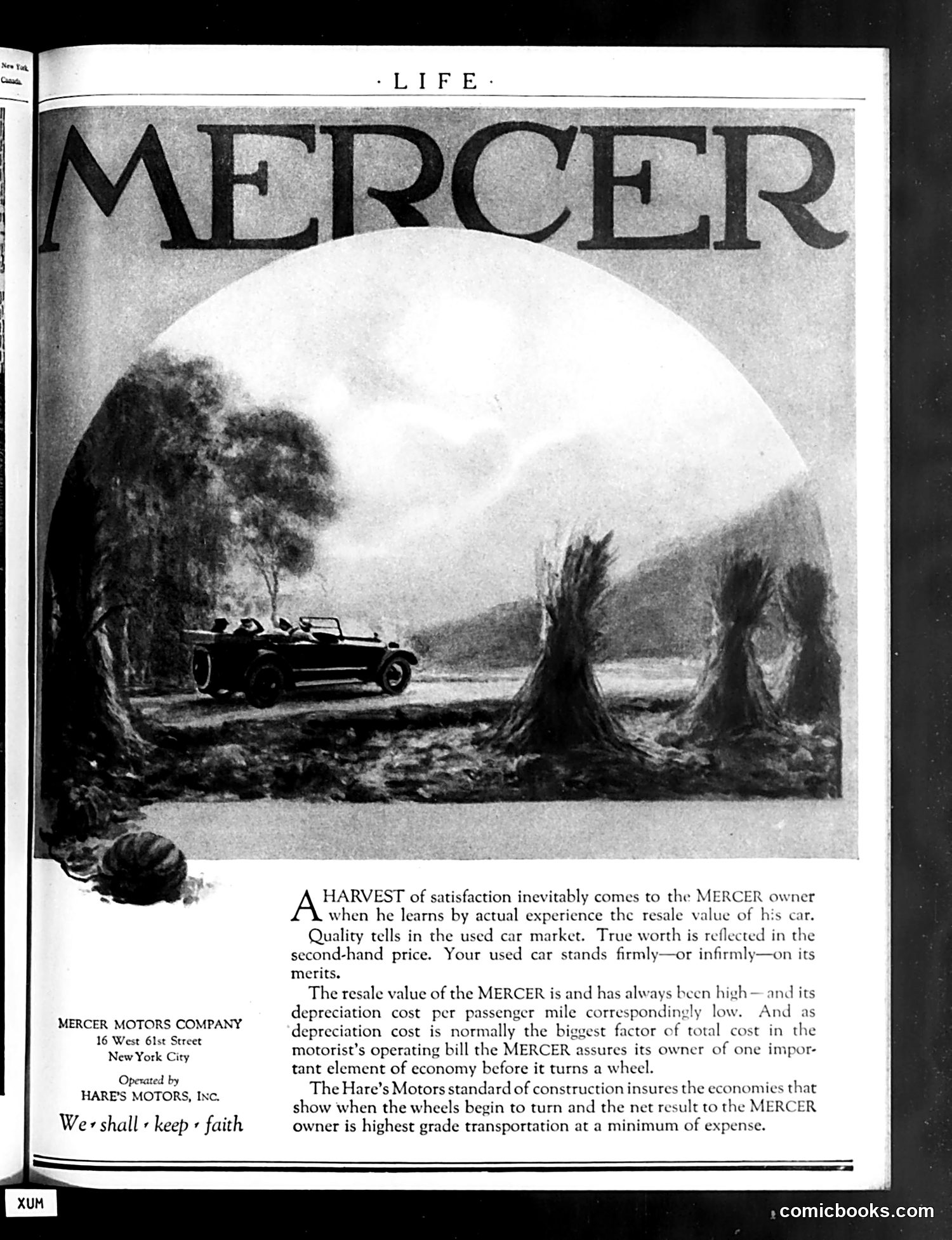
This is primarily **advertising content, not satire or political commentary**. The page features a Mercer automobile advertisement from Mercer Motors Company (operated by Hare's Motors, Inc.). The image depicts a romantic pastoral scene: a convertible Mercer automobile positioned beneath trees near a lake/waterside, with mountains in the background. The advertisement's text emphasizes the car's **high resale value** and low depreciation costs compared to competitors—positioning ownership as economically sound. The appeal is lifestyle-oriented: the scenic setting suggests leisure, adventure, and romantic getaways. The tagline "We shall keep faith" promises reliability and value retention to potential buyers. This represents typical 1920s-era automotive marketing, using aspirational imagery rather than humor or satire.
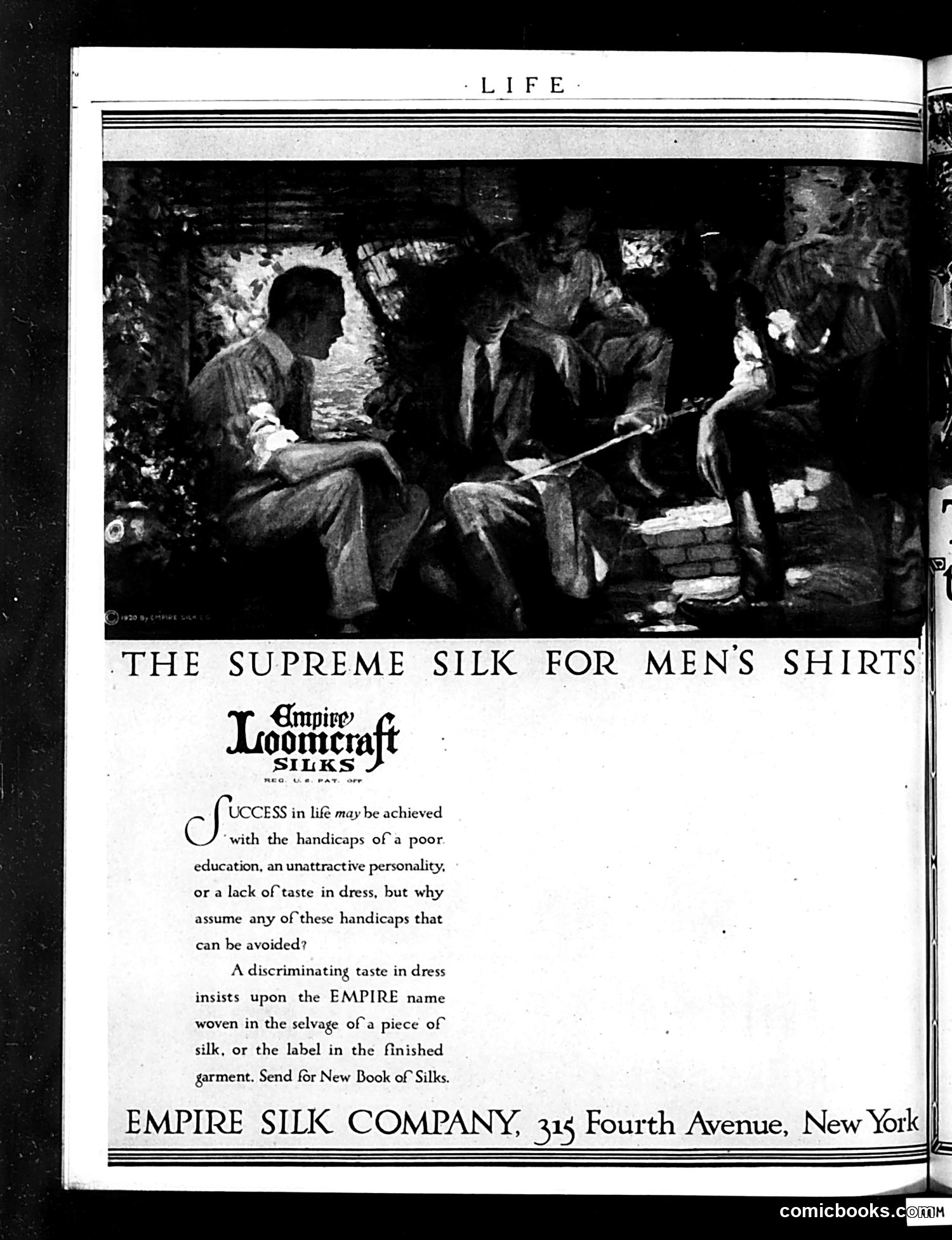
This page is primarily **commercial advertising** for Empire Loomcraft Silks, not political or social satire. The top image shows men in what appears to be a factory or workshop setting, likely depicting silk production or quality control. The advertisement's text argues that discriminating men should choose Empire brand silks for dress shirts, claiming that taste in clothing signals success and social standing. The copy suggests that wearing quality silk (identified by the Empire label) can help overcome other social "handicaps" like poor education or appearance. This reflects early 20th-century consumer culture messaging—the idea that purchasing the right branded product confers status and respectability. It's advertising, not commentary.
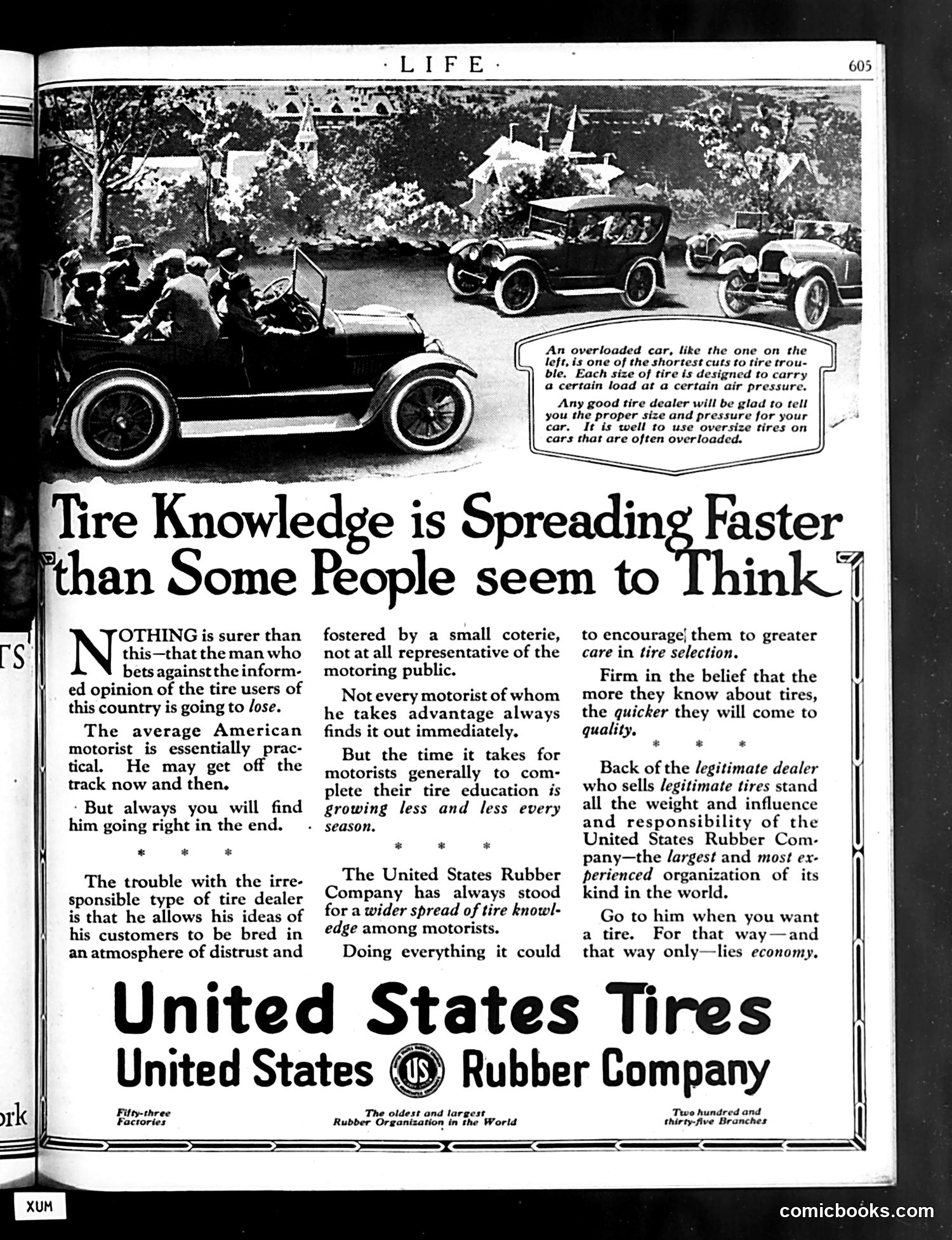
This page is primarily **advertising, not satire or political commentary**. It's a United States Rubber Company advertisement for tires, appearing in Life magazine (page 605). The image shows vintage automobiles from approximately the 1920s era, with people loading or discussing tires. The accompanying text addresses motorists' common misconceptions about tire selection and care. The "satire" here is mild corporate messaging: the ad claims that tire knowledge is spreading faster than some drivers realize, and that irresponsible tire dealers breed distrust. It positions U.S. Rubber Company as the responsible authority—the "largest and most experienced" rubber organization—worthy of customer trust. This is straightforward product advertising wrapped in a light cautionary tone about consumer education, not political satire.
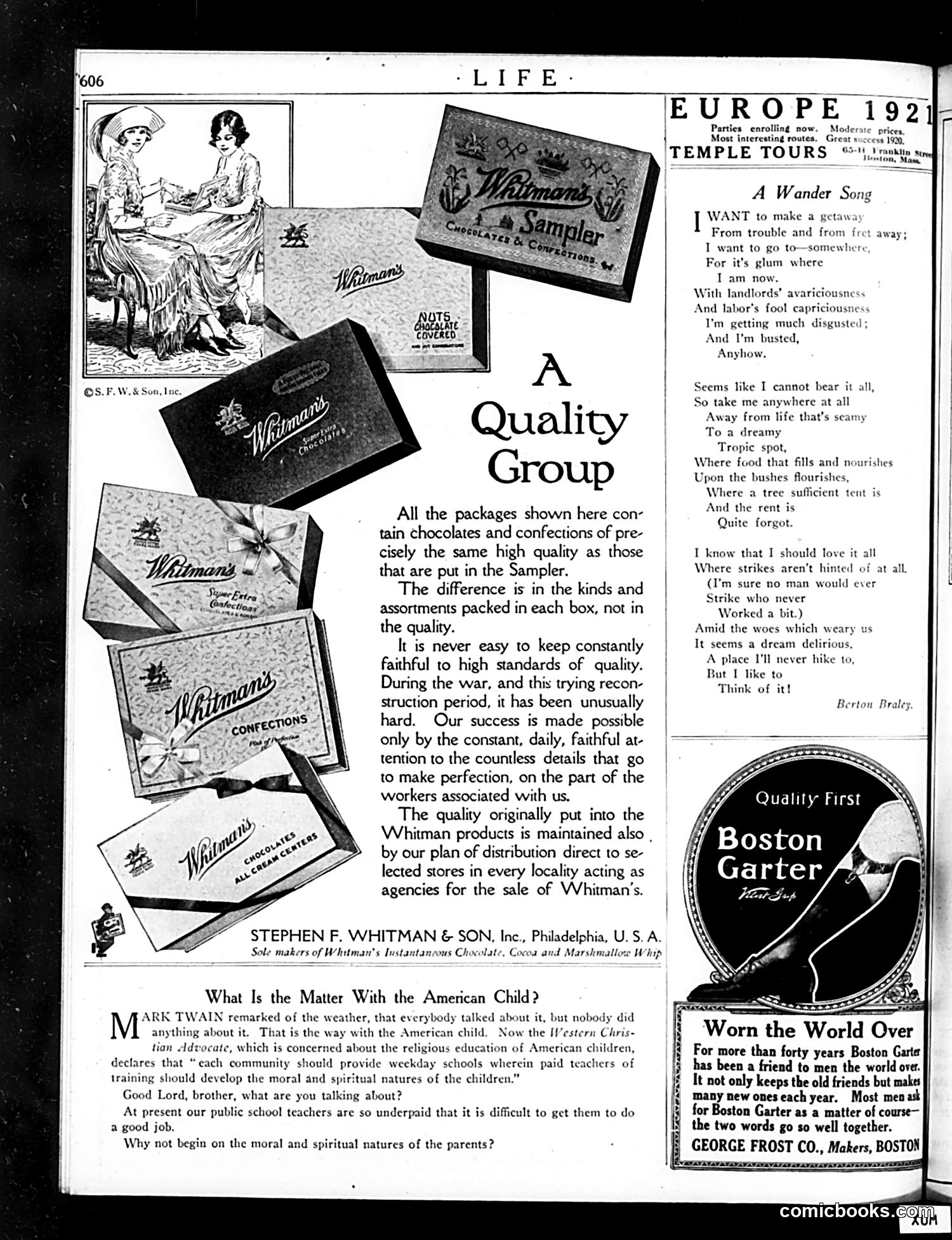
This page is primarily **commercial advertising**, not political satire. It features: **Whitman's Chocolates Ad**: Shows various chocolate box packages arranged artfully with a classical illustration of two women. The ad emphasizes quality control and consistent standards maintained despite post-WWI reconstruction challenges. **Boston Garter Ad**: A circular advertisement claiming the product has been "a friend to men the world over" for forty years. **"A Wander Song" poem** by Berton Braley expressing wanderlust and escape. **Editorial piece** questioning American child-rearing, citing Mark Twain and discussing whether public schools adequately address moral and spiritual education, suggesting parents bear responsibility. The page reflects 1921 concerns about post-war recovery, consumer confidence, and social values rather than containing political cartoons or satire.
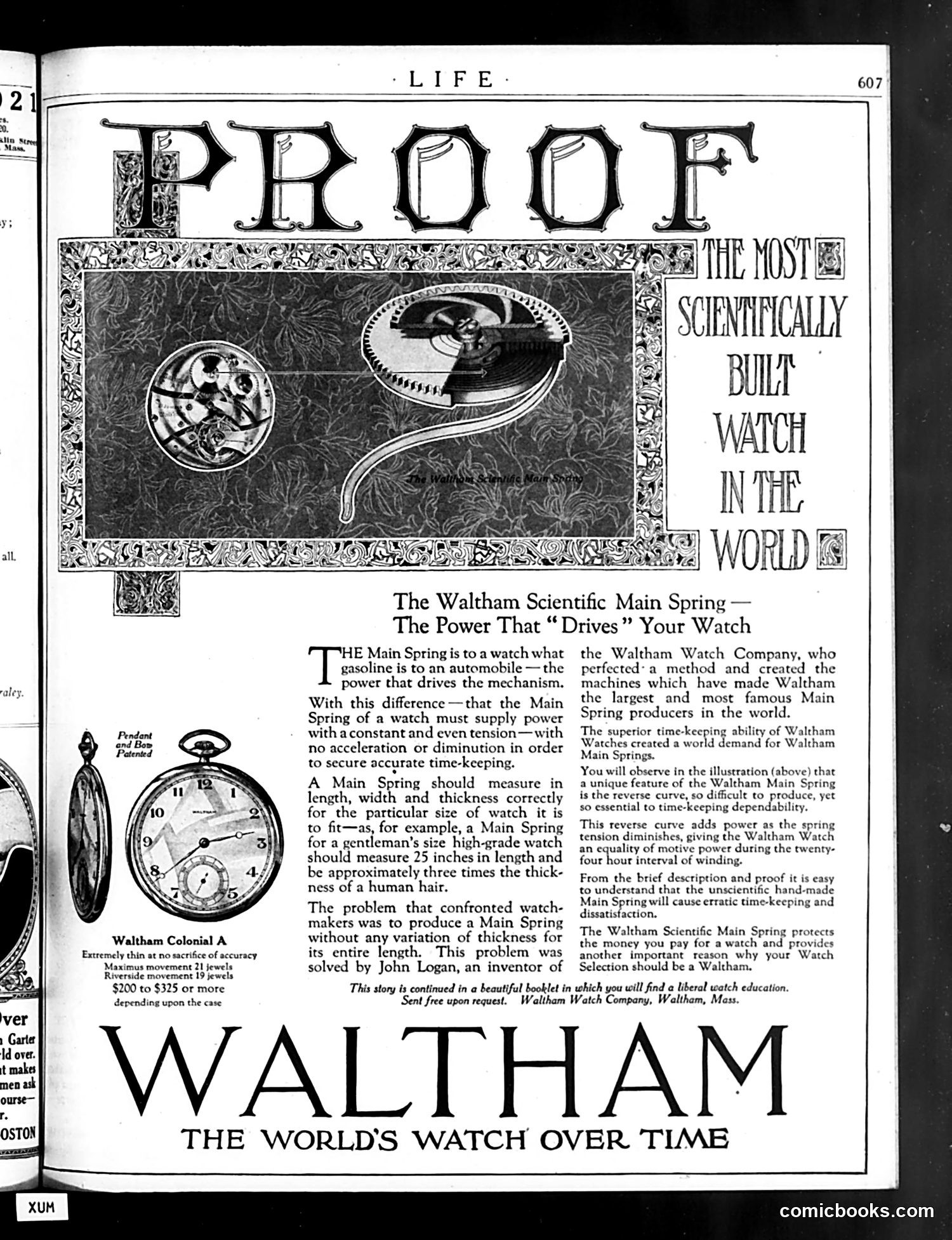
This is primarily a **product advertisement**, not satire or political commentary. The page promotes Waltham watches, specifically their "Scientific Main Spring" mechanism. The ad claims Waltham's innovation solves a technical problem: creating a watch mainspring with consistent tension throughout its length, which was difficult to manufacture. According to the text, inventor John Logan solved this by designing a reverse curve that maintains equal power delivery over 24 hours of unwinding. The decorative illustrations show the Waltham Colonial A watch model and technical diagrams of the mainspring's unique curve design. The ad positions Waltham as scientifically superior ("The Most Scientifically Built Watch in the World"), appealing to early 20th-century consumer trust in technological progress and precision engineering.
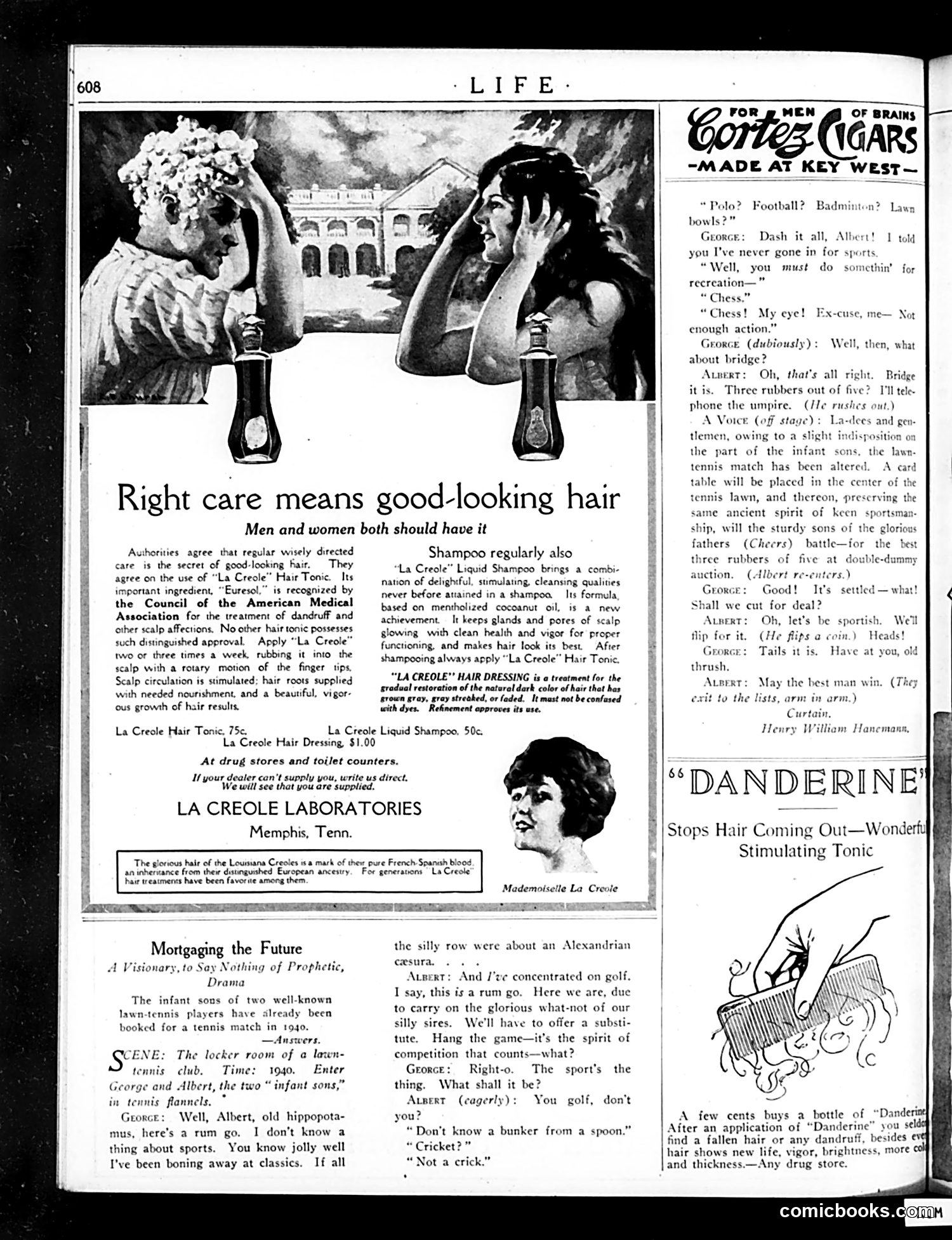
This page is primarily **advertising and entertainment content** rather than political satire. The main feature is a **La Creole hair product advertisement** showing two men using hair tonic and shampoo, emphasizing that "right care means good-looking hair." The copy appeals to both vanity and medical credibility, mentioning endorsement by the American Medical Association. Below is a brief dramatic scene titled **"Mortgaging the Future"** about two young tennis players discussing sportsmanship and competition in 1940s social terms. On the right is a **Danderine hair tonic advertisement** promising to stop hair loss. The satirical element is minimal—these are straightforward product advertisements using period-appropriate marketing appeals (medical authority, social status, athletic pursuits) typical of 1920s-30s magazines.
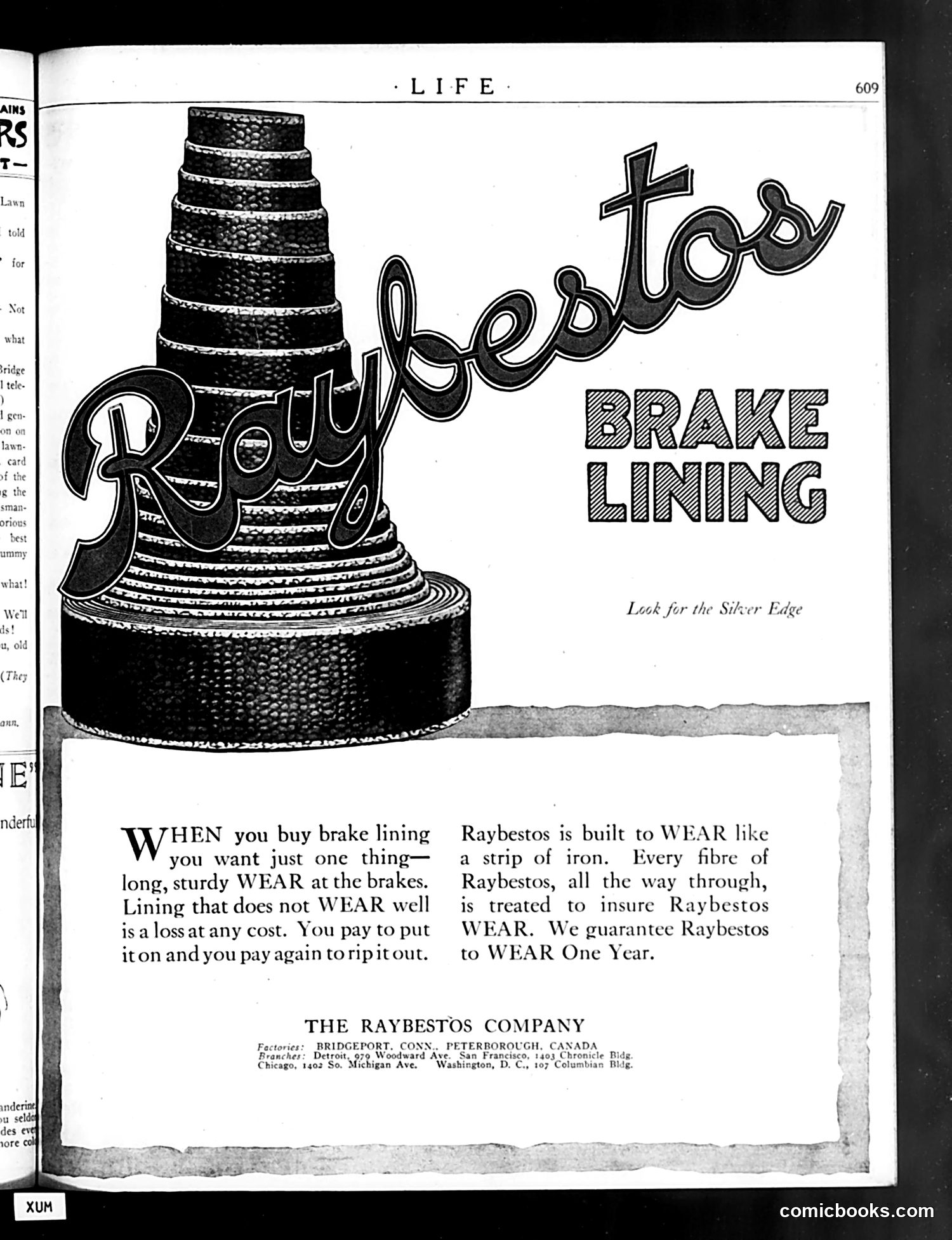
This page is primarily **advertising, not satire or political commentary**. It's a full-page advertisement for Raybestos brake lining, a genuine automotive product from The Raybestos Company (factories in Bridgeport, Connecticut and Peterborough, Canada). The visual humor is commercial rather than satirical: a stylized pile of automobile tires with decorative text reading "Roulette" and "Brake Lining" curves around it. The pun suggests buying inferior brake lining is like gambling with your safety—hence the roulette imagery. The copy emphasizes durability ("built to WEAR like a strip of iron") and offers a one-year wear guarantee, positioning Raybestos as the reliable choice versus cheaper alternatives. This is straightforward product advertising typical of early 20th-century *Life* magazine.
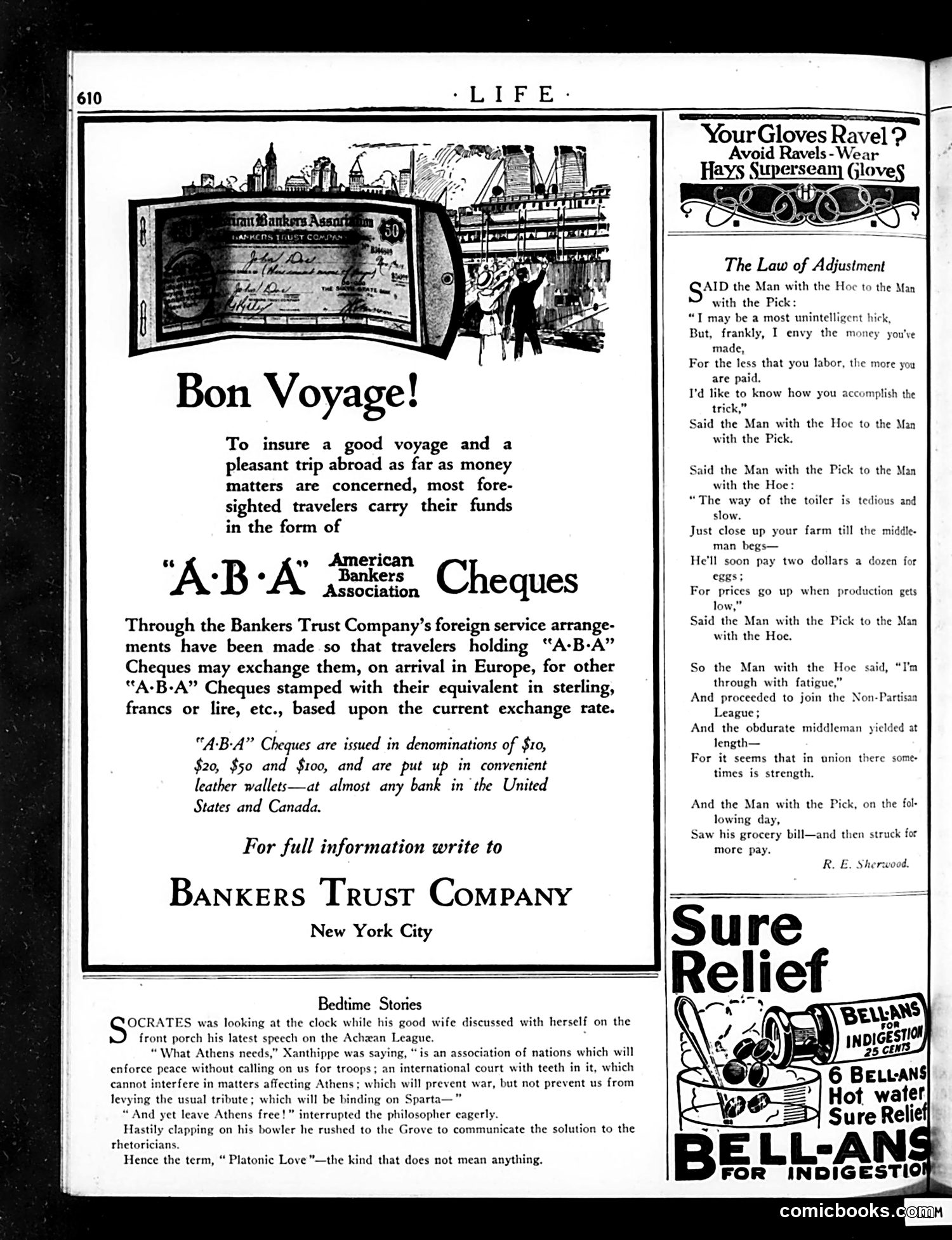
This page is primarily **advertising and light satire**, not political commentary. The main advertisement promotes "A.B.A" (American Bankers Association) traveler's cheques for overseas trips, targeting affluent travelers with promises of convenient currency exchange abroad. The right side contains "Bedtime Stories"—a satirical piece mocking Socrates' verbose philosophical speeches about the League of Nations and international peace mechanisms. The joke is that Socrates talks endlessly without saying anything meaningful, concluding with the term "Platonic Love—the kind that does not mean anything." This ridicules both overly abstract philosophy and perhaps contemporary diplomatic rhetoric. Supporting advertisements for Hays gloves and Bellans indigestion remedy round out the page. The content reflects 1920s-era concerns: international peace initiatives, travel, and consumer products.
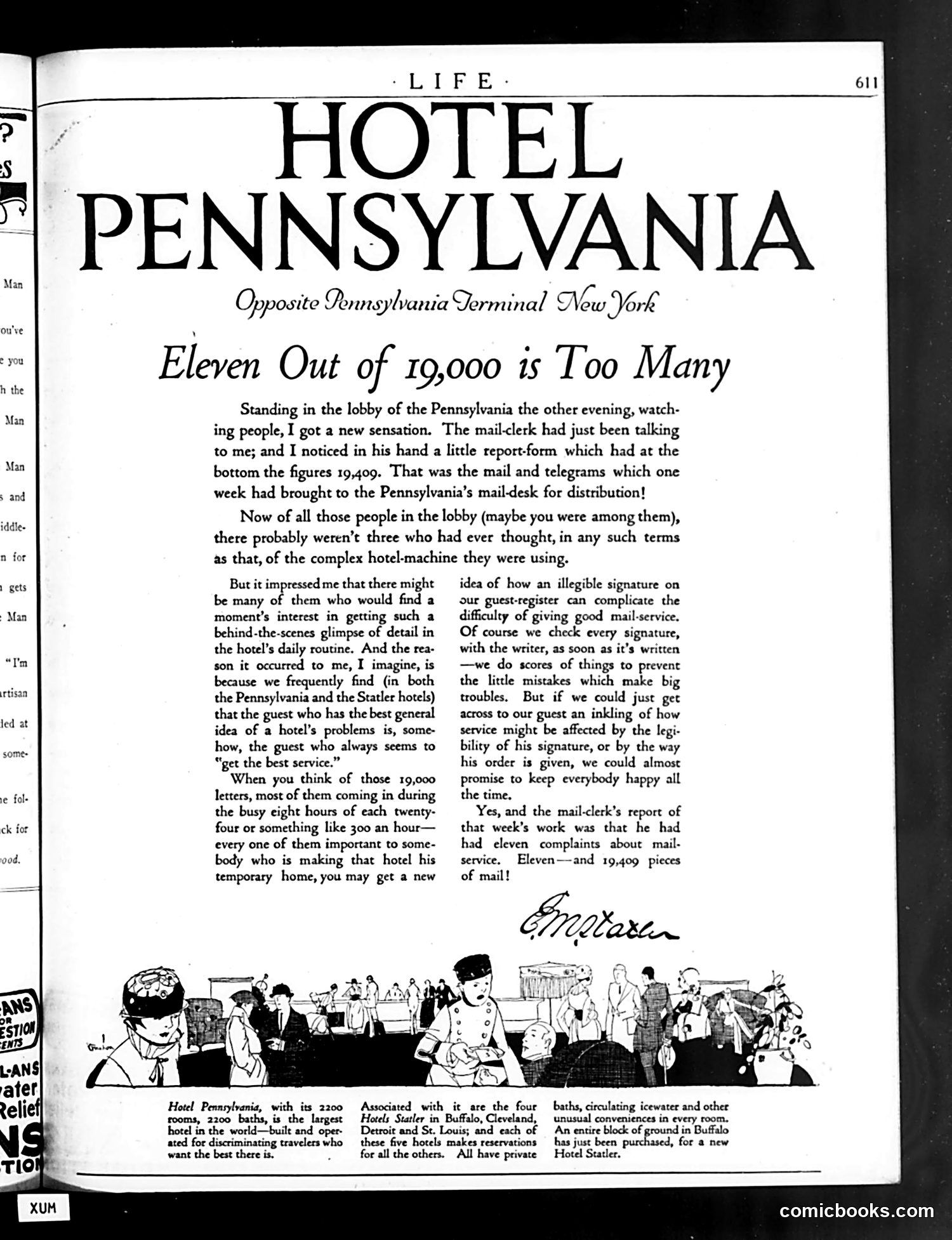
This page satirizes the impersonal nature of large urban hotels, specifically the Hotel Pennsylvania in New York. The author observed a mail clerk handling 19,409 pieces of correspondence in one week—with only 11 complaints about mail service. The satire's point: despite thousands of guests, nearly none recognize the hotel's operational complexity or consider how their individual needs compete with thousands of others. The author argues most guests assume they're receiving "the best service" without understanding the logistical challenges. The cartoon at bottom depicts the hotel's busy lobby crowded with guests—visualizing the overwhelming volume the hotel manages daily. The piece gently mocks both guests' unrealistic expectations and the hotel's ambitious attempt to serve such volume while maintaining quality service.
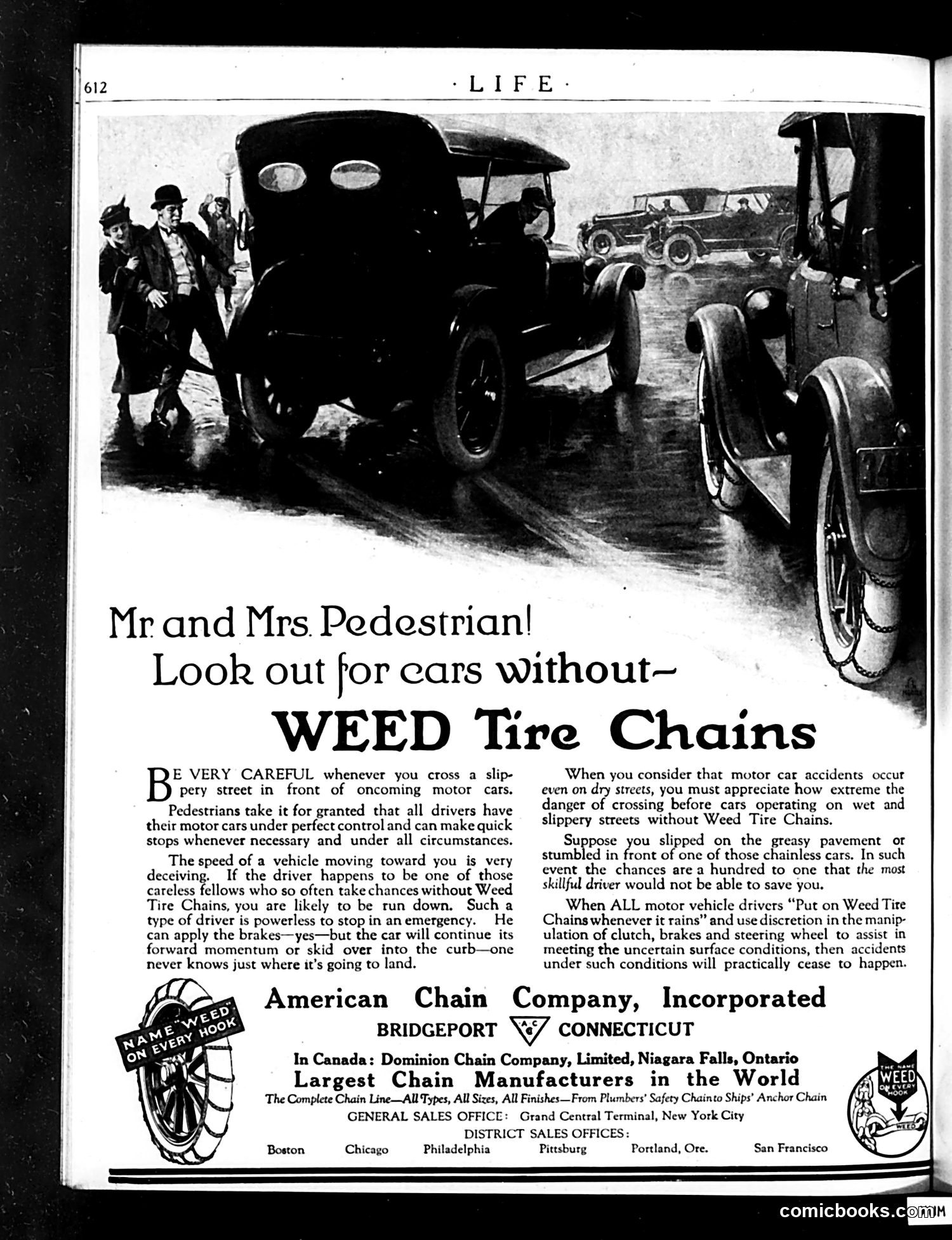
This is a **WEED Tire Chains advertisement**, not political satire. It targets pedestrians with a safety message about motor vehicle accidents. The visual shows a dramatic scene: a car has struck a pedestrian on a wet street while other vehicles and people look on. The ad's premise is that drivers without tire chains cannot stop quickly on slippery surfaces, making accidents inevitable. The copy warns pedestrians to "look out for cars without WEED Tire Chains," arguing that when drivers equip their vehicles with these chains, accidents "will practically cease to happen." This reflects early automotive-era concerns about traffic safety and the emerging market for tire traction devices. The ad positions WEED chains as a public safety necessity, not merely a commercial product. American Chain Company, based in Bridgeport, Connecticut, manufactured these products.
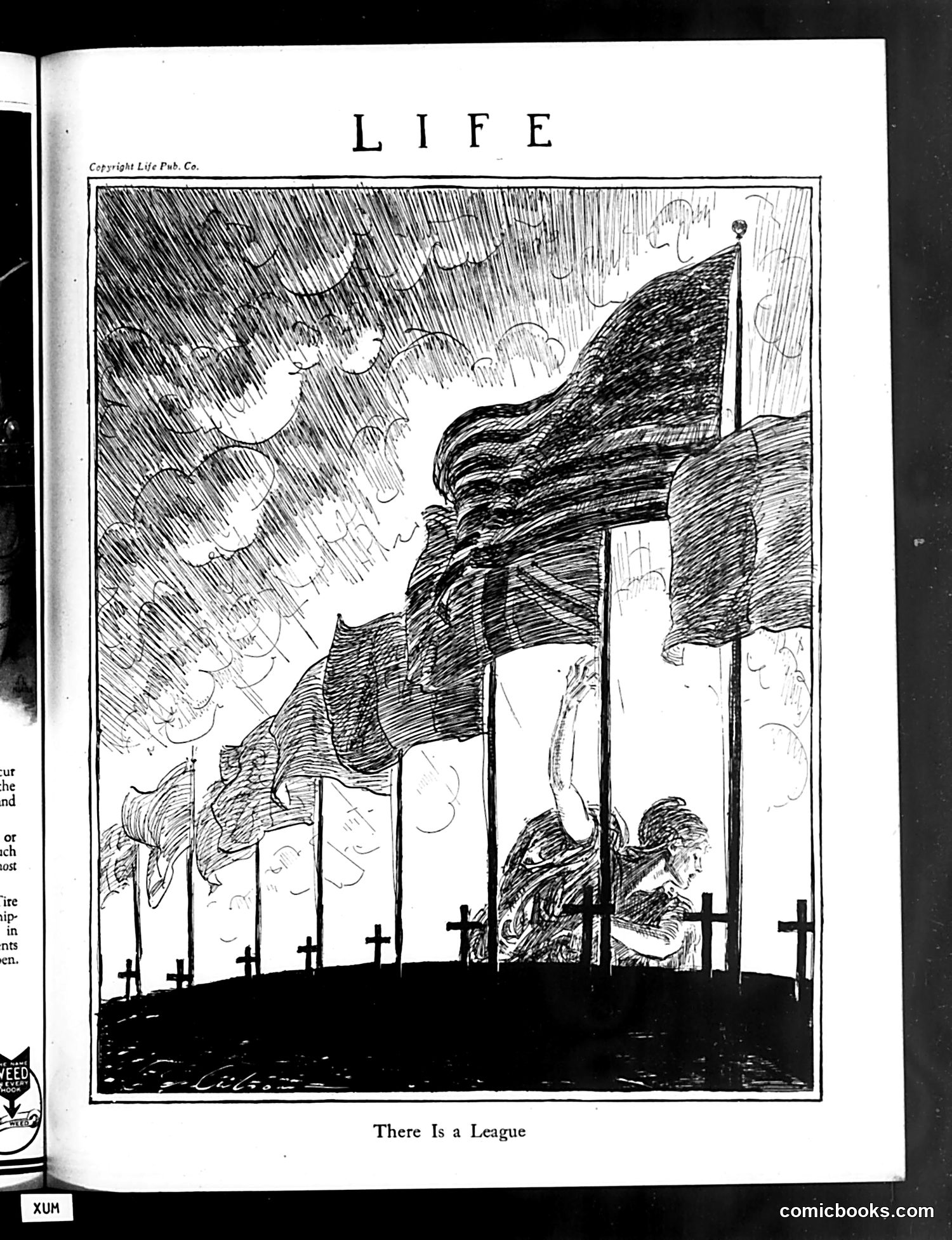
This Life magazine cartoon depicts military flags billowing dramatically over a battlefield cemetery, with crosses marking graves below. The image appears to reference World War I and its devastating casualties. The title "There Is a League" likely alludes to the League of Nations, the international organization proposed after WWI to prevent future wars. The satire suggests bitter irony: despite hopes that such a league would bring peace, the massive loss of life shown here—symbolized by the rows of crosses—represents the failure of international diplomacy to prevent or limit warfare's horrors. The flags suggest competing national interests override collective security efforts, making the League's promise of peace hollow. This reflects contemporary American skepticism about international cooperation during the interwar period.
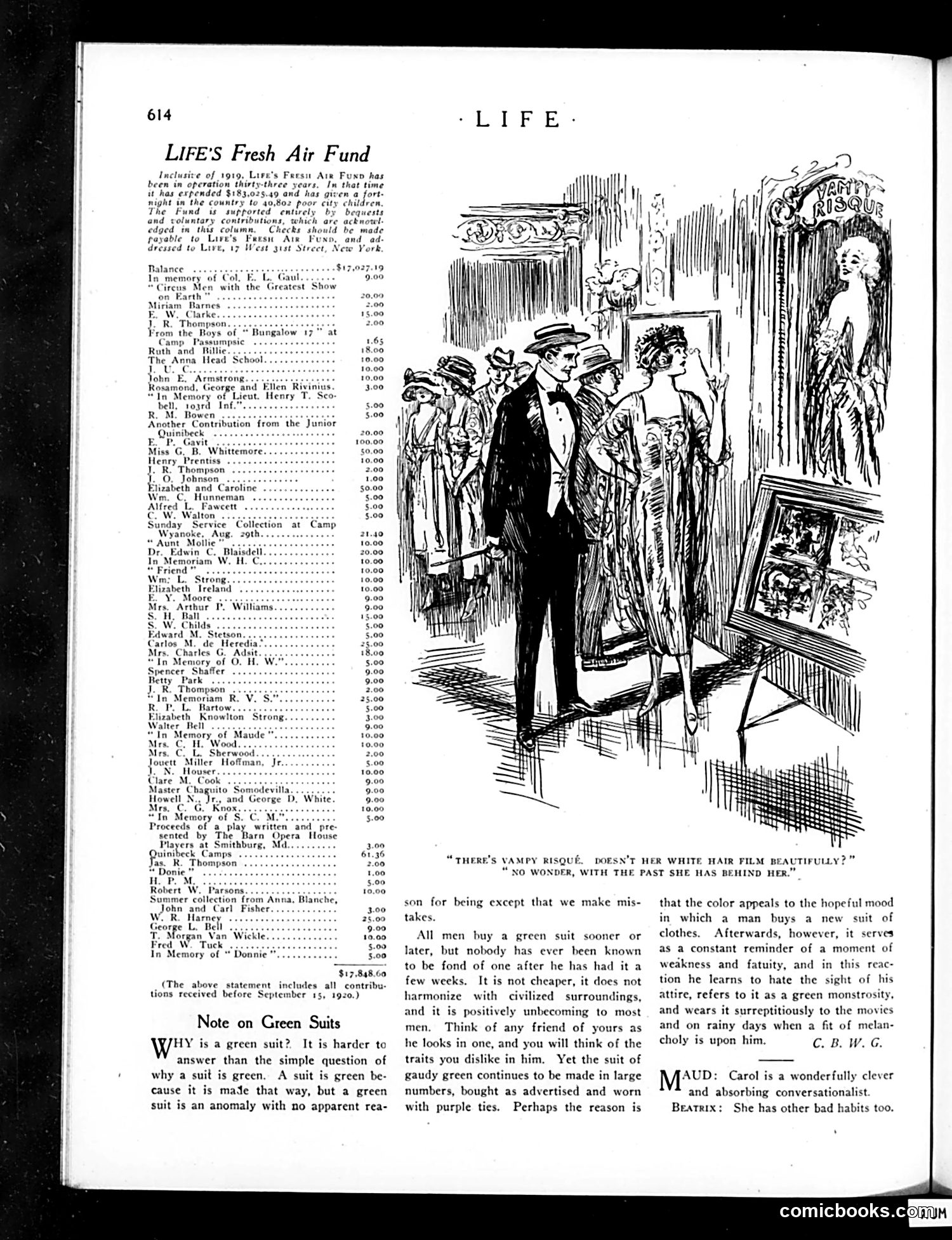
This page contains **LIFE's Fresh Air Fund** donor list and two distinct content sections: **The Cartoon**: Shows an elegantly dressed couple at what appears to be an art exhibition or gallery, admiring a portrait of a woman with white hair. The caption reads: "There's vampy risqué, doesn't her white hair film beautifully?" / "No wonder, with the past she has behind her." This is a **gossipy social satire** mocking how fashionable society discusses a woman's appearance and rumored scandalous past, treating her "vampy" persona as theatrical performance rather than character. **"Note on Green Suits"**: A brief essay questioning why green suits are considered socially inappropriate or anomalous, suggesting men buy them despite social disapproval. It's **light satirical commentary** on arbitrary fashion conventions and conformity. The page primarily documents charitable contributions to LIFE's Fresh Air Fund, a 1919 initiative providing respite for poor city children.
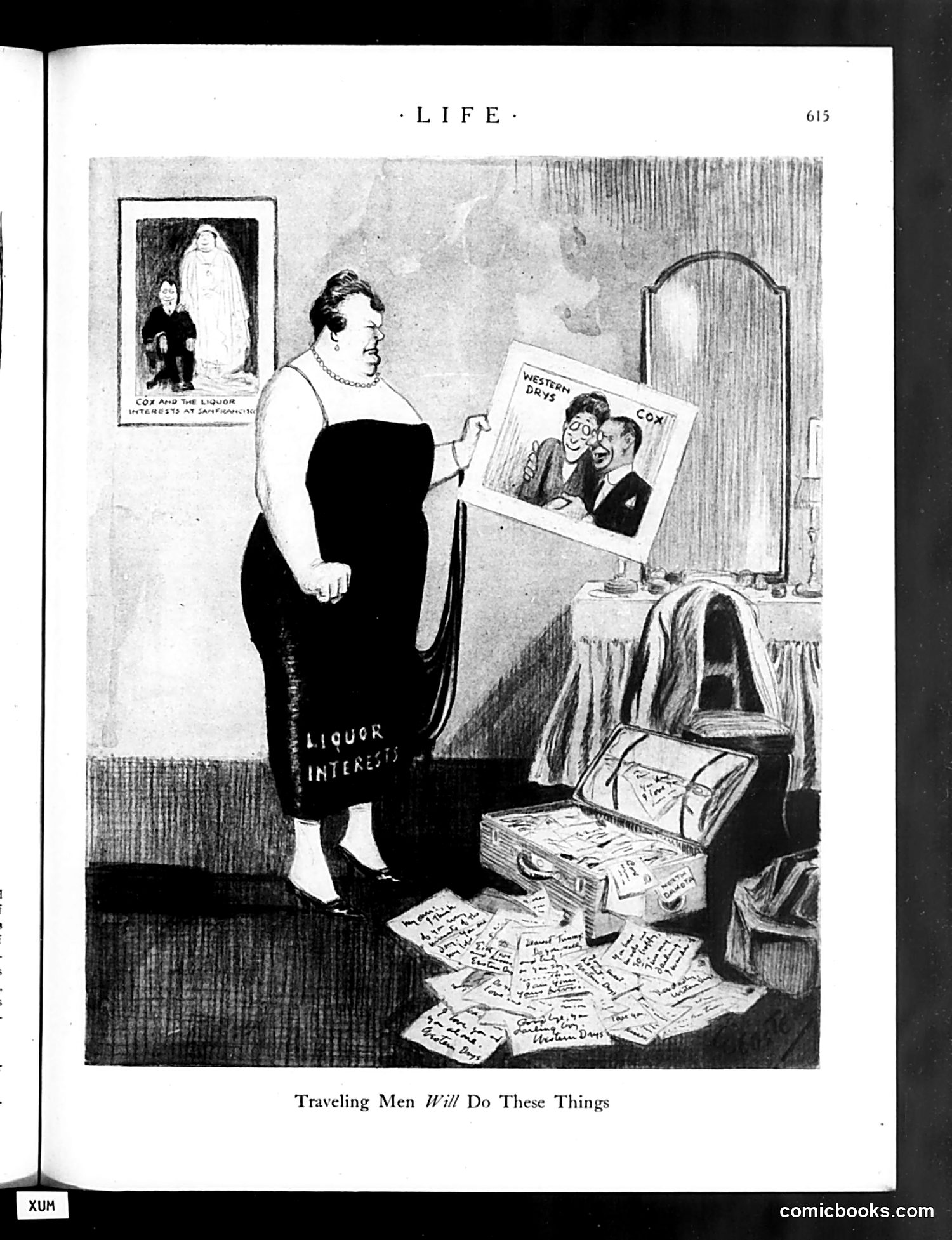
This satirical cartoon depicts a traveling salesman examining his hotel room mirror, where he sees a reflection showing what appears to be a vaudeville or comedy performance. The cartoon critiques the behavior of traveling businessmen during what appears to be the Prohibition era (suggested by the "liquor interests" label on his clothing). The scattered papers on the floor and packed luggage suggest the transient lifestyle. The inset image in the upper left labeled "cop and the liquor interests at war" reinforces the Prohibition theme. The satire suggests that traveling salesmen engaged in questionable activities—likely bootlegging, illicit alcohol dealings, or other moral lapses—during their time away from home, presenting themselves respectably while actually participating in illegal or unethical conduct.
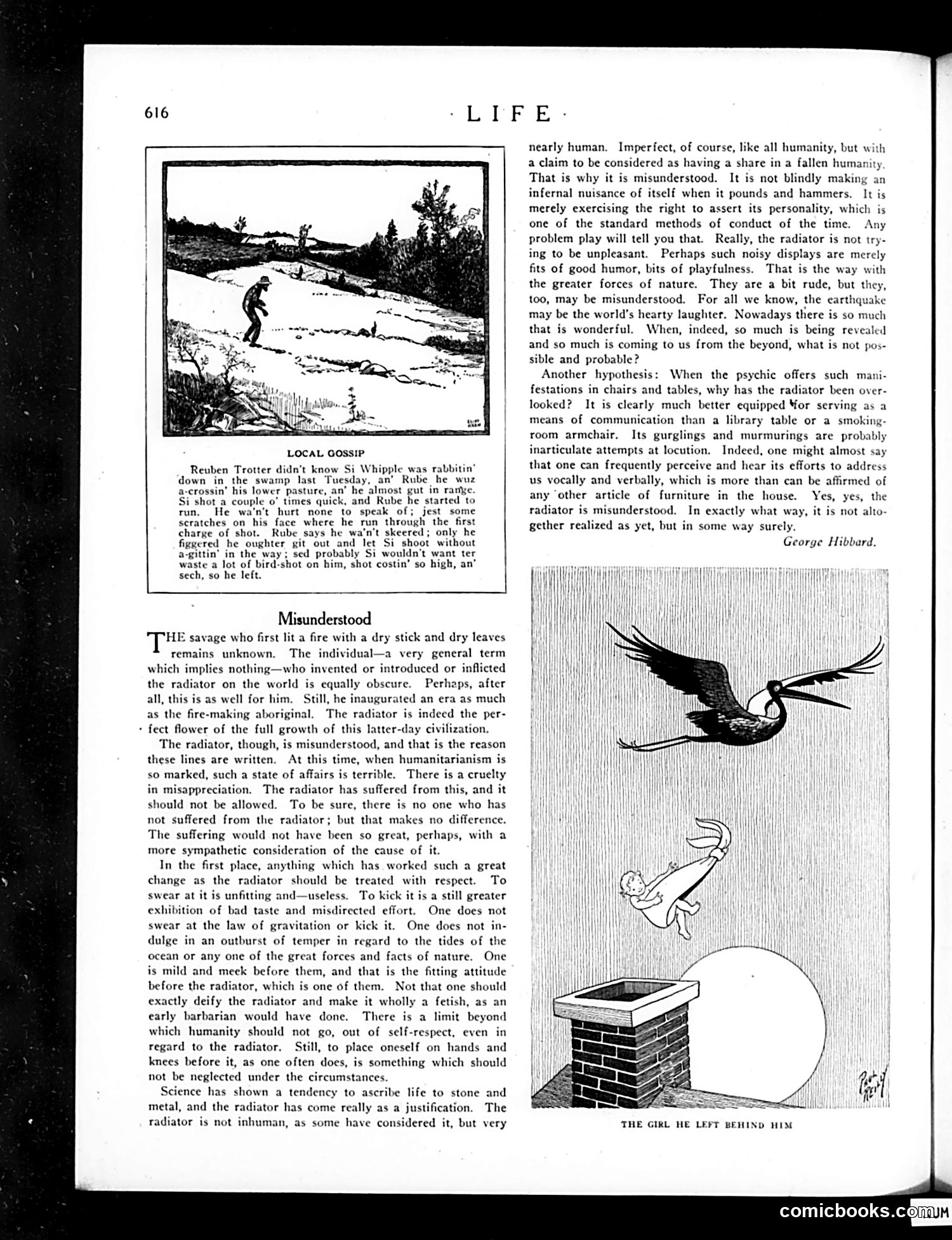
This page contains two distinct elements: **"Local Gossip" cartoon (top left):** A humorous illustration depicting "Reuben Trotter" encountering a rabbit in a swamp. The caption describes a comedic hunting mishap—Trotter mistakes the rabbit for game, chases it, and ends up muddy and scratched. It's a gentle rural humor piece mocking incompetent outdoorsmen. **"Misunderstood" essay (main text):** A serious defense of the radiator as an underappreciated invention. The author argues the radiator deserves respect as a transformative technology that enabled modern civilization, yet suffers from public contempt and mockery. The piece critiques humanity's tendency to take great innovations for granted. **Right illustration:** A decorative sketch (captioned "The Girl He Left Behind Him") appears unrelated to either piece—possibly part of another article or filler content. The page juxtaposes lighthearted rural comedy with earnest technological advocacy.
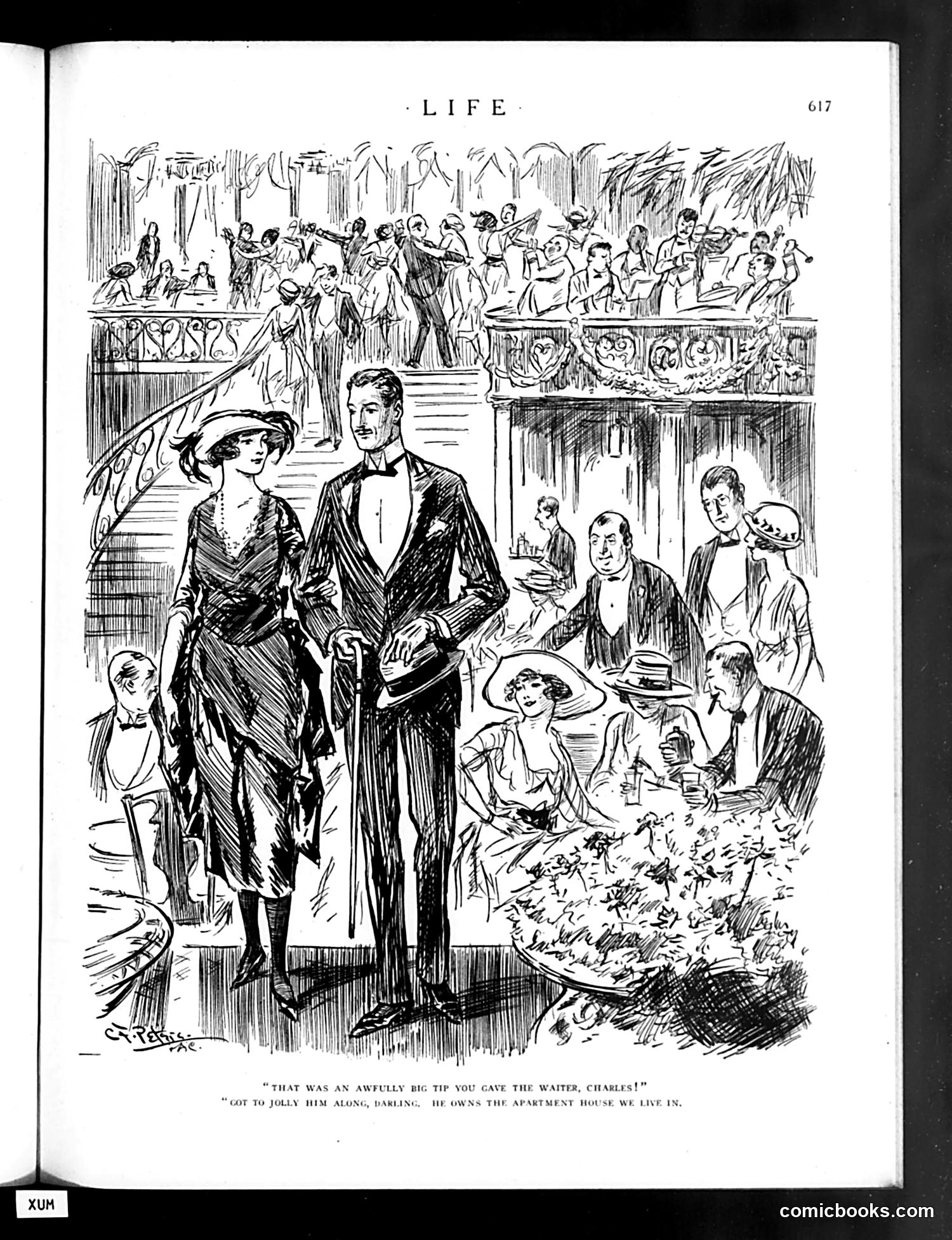
This satirical illustration depicts a fancy social gathering or ball (visible in background), with well-dressed guests in formal attire. The central couple—a woman in an elegant gown and a man in black tie—are prominently featured speaking with other guests. The caption reads: "That was an awfully big tip you gave the waiter, Charles!" followed by "Got to jolly him along, darling. He owns the apartment house we live in." **The satire:** This mocks the economic reversal and social confusion of the era—a waiter has become wealthy enough to own residential property, while the formally-dressed "upper class" couple must ingratiate themselves to him to maintain their housing. It satirizes shifting class dynamics and the precarious social position of formerly privileged people dependent on service workers' goodwill.
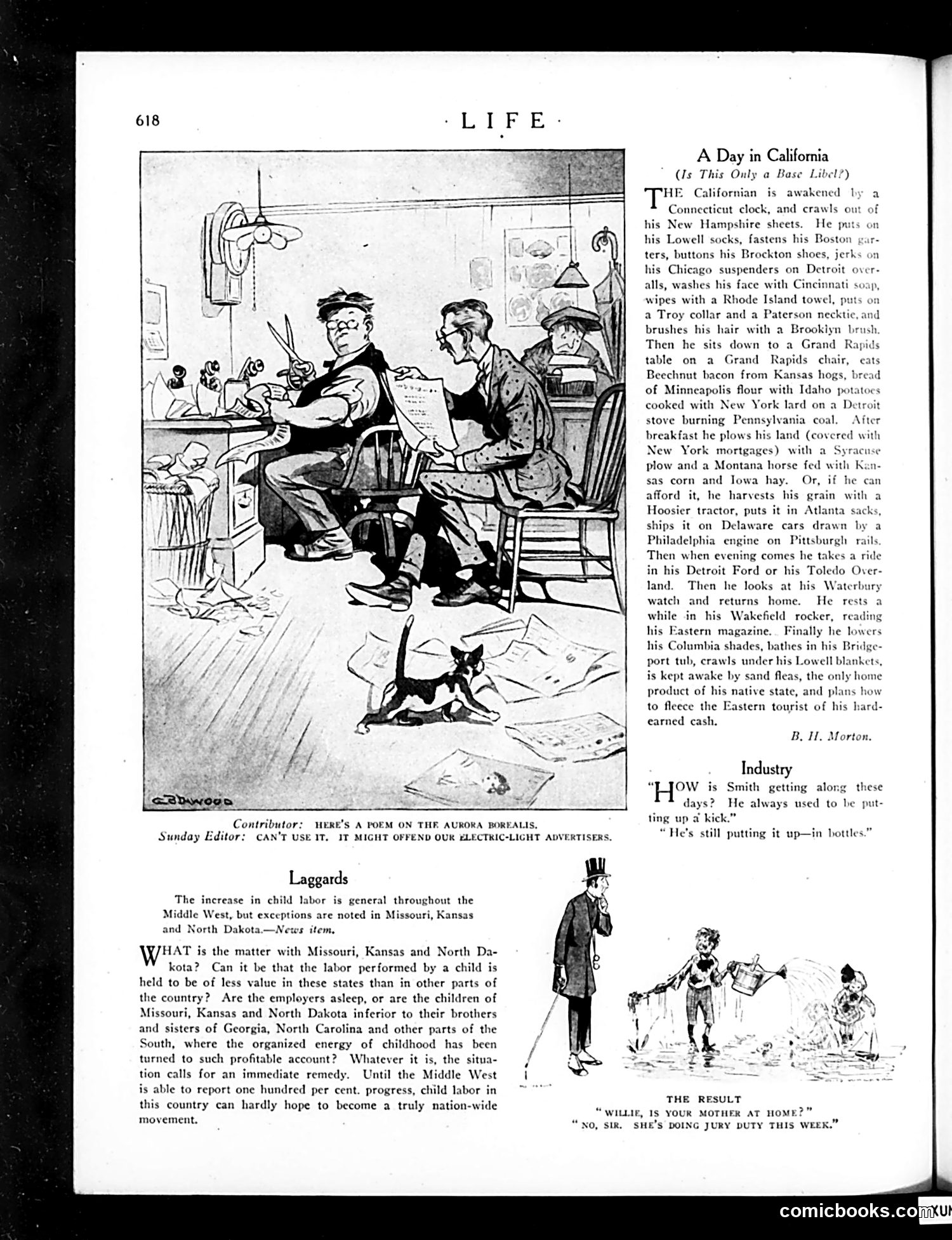
**"A Day in California"** satirizes California's economic dependence on Eastern manufactures. The piece catalogs how a Californian's entire day—from clock to blankets—relies on products from other regions (Connecticut, New Hampshire, Boston, Chicago, etc.), suggesting California produces almost nothing domestically except "sand fleas." The joke: despite California's resources and labor, residents remain economically colonized by the industrialized East, and the state's only authentic product is worthless. **"Industry"** appears to be a brief dialogue joke about someone named Smith still "putting it up—in bottles," likely a prohibition-era reference to illegal alcohol production. **"Laggards"** uses sarcastic commentary to shame Missouri, Kansas, and North Dakota for *not* increasing child labor at the same rate as Southern states. This is savage irony: Life sarcastically celebrates child labor as "progress," exposing how the practice was normalized and competitive among regions during the Progressive Era.
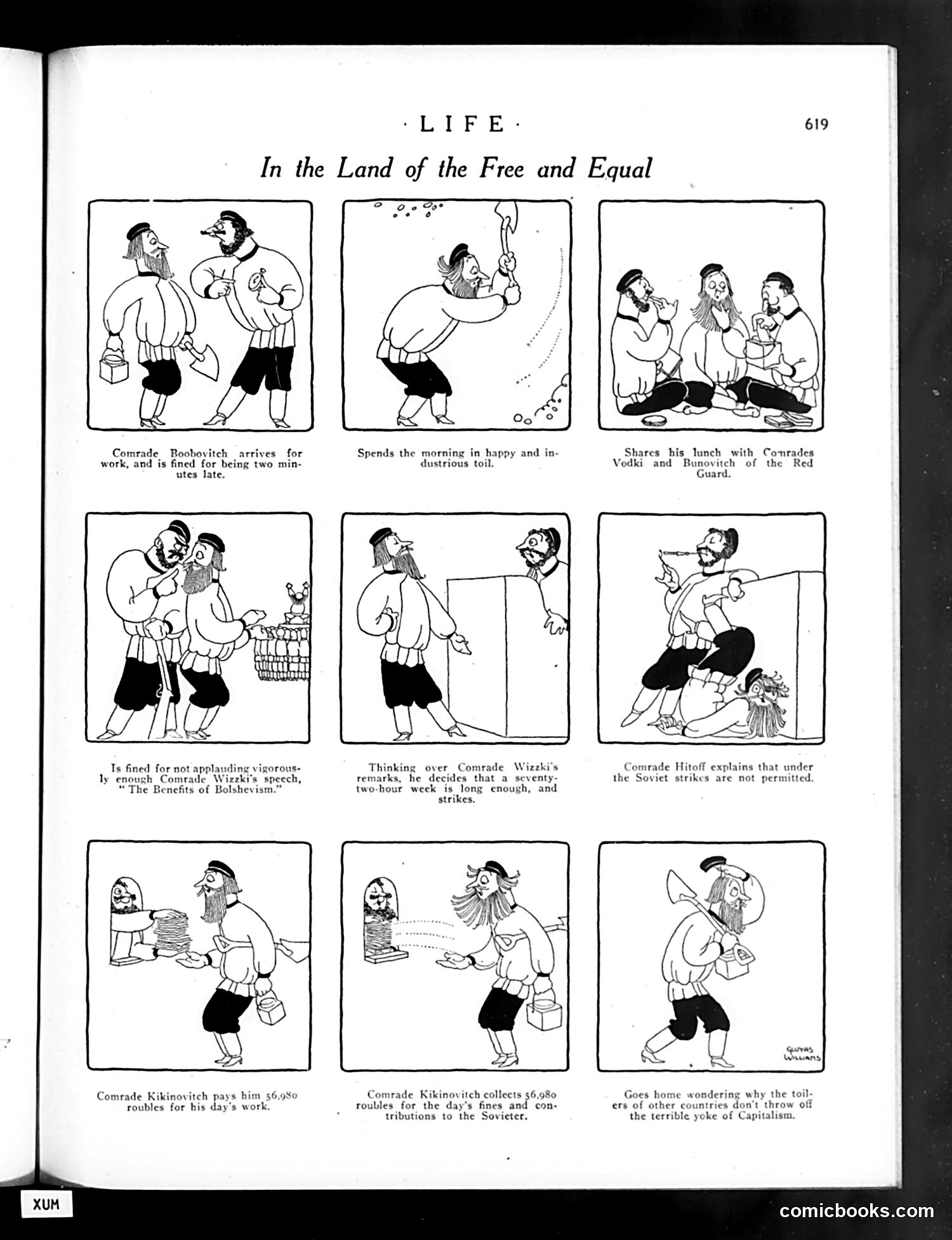
This is anti-Soviet propaganda satirizing the Soviet system under Lenin/early Bolshevism. The cartoon follows a worker ("Comrade Boobovitch") through a single day to expose the hypocrisy of communist claims. The satire works by contrast: the subtitle ironically promises "freedom and equality," but the worker faces constant fines (for tardiness, insufficient applause at speeches, striking), has wages confiscated for "contributions to the Soviet," and is forbidden to strike. He works a 72-hour week, yet propaganda claims capitalism oppresses workers. The joke's punch: despite Soviet rhetoric about liberating the working class, the system proves more restrictive and exploitative than capitalist countries. The final panel—the worker wondering why others don't reject capitalism—underscores the cartoon's message: Soviet communism, not capitalism, is the "terrible yoke." This reflects American Cold War-era skepticism toward the Soviet Union, published when communist expansion seemed threatening.
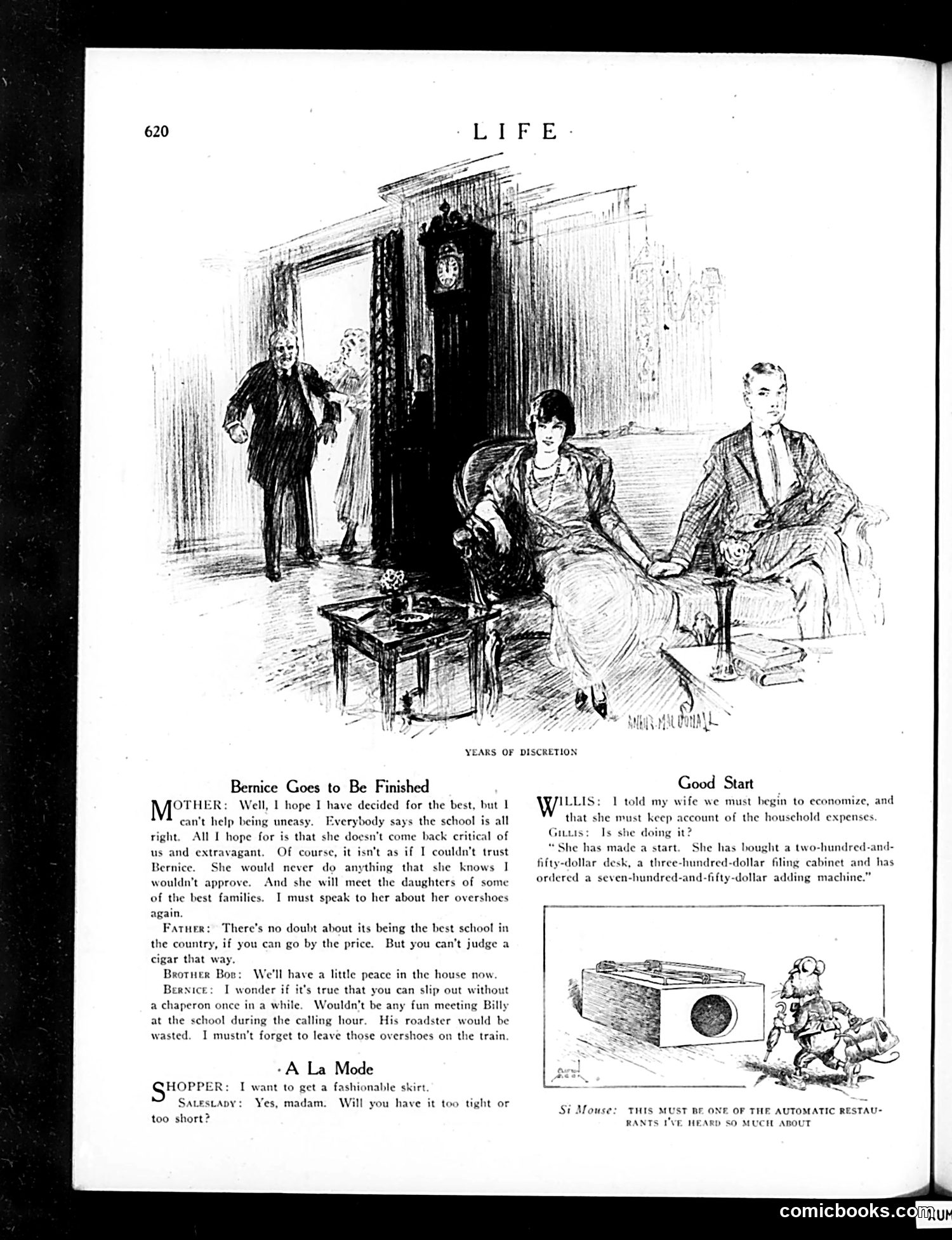
This page contains three separate satirical sketches mocking early 20th-century American social conventions and consumer behavior. **"Bernice Goes to Be Finished"** depicts anxious parents sending their daughter to an expensive finishing school. The satire targets parental naïveté: parents worry about propriety while Bernice immediately plans to sneak out unchaperoned to meet a boy. The father's quip about judging by price (like a cigar) undercuts the school's prestige. **"A La Mode"** mocks fashion absurdity through a shopper asking a salesman whether a skirt should be "too tight or too short"—satirizing how fashionable women's clothing became impractically revealing. **"Good Start"** ridicules a husband's economizing plan. His wife "economizes" by purchasing expensive office furniture and an adding machine, inverting the stated goal—a common satire on wives' spending habits. All three sketches mock contemporary social pretension, youth rebellion against propriety, and consumer excess dressed as respectability.
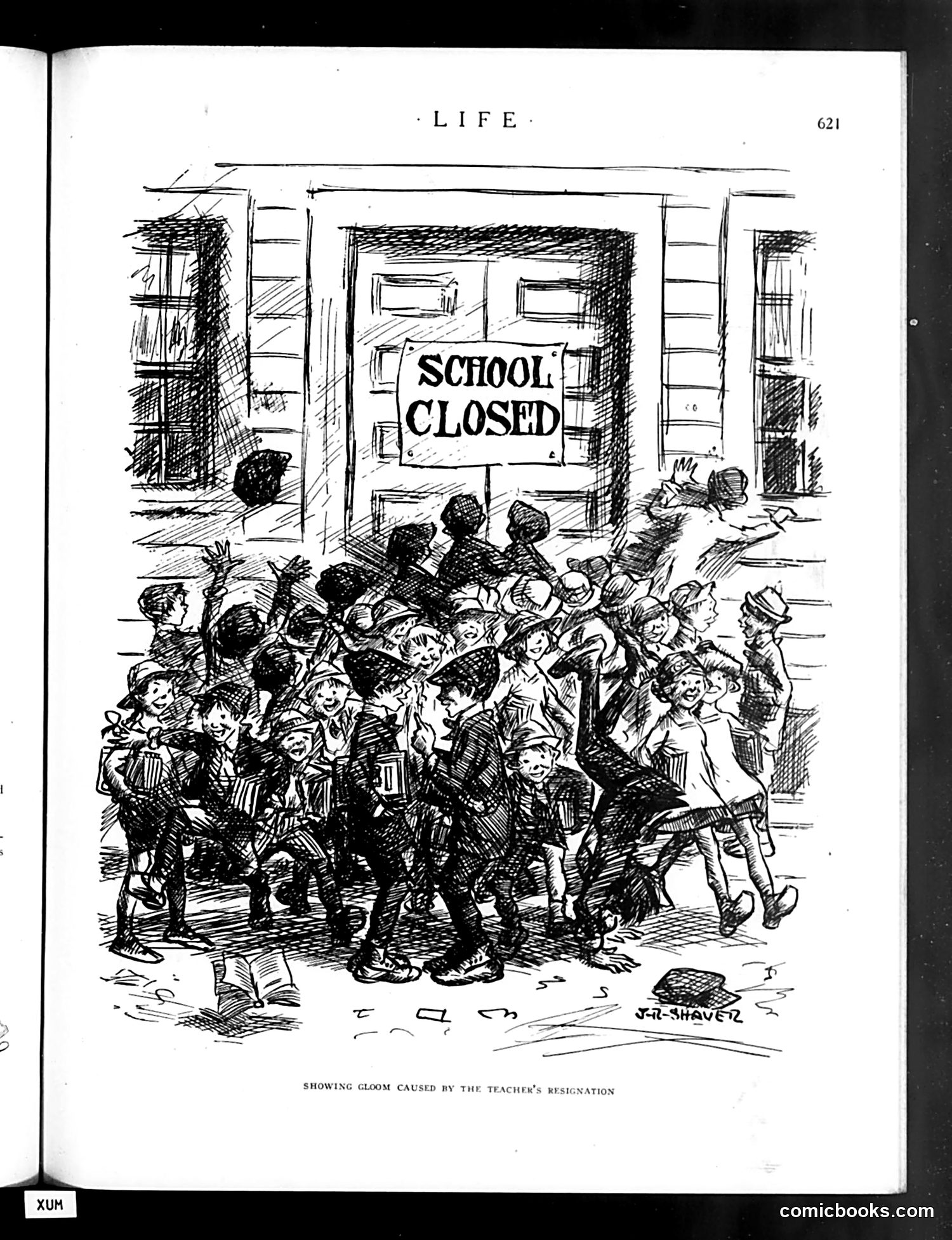
This cartoon from *Life* magazine depicts a large crowd of dejected schoolchildren gathered outside a building with a "SCHOOL CLOSED" sign. The caption reads "SHOWING GLOOM CAUSED BY THE TEACHER'S RESIGNATION." The satire is straightforward: it mocks the idea that children would be genuinely upset about a teacher leaving their school. The exaggerated crowd size and expressions of grief suggest the cartoonist is being ironic—implying that most children would actually celebrate a teacher's departure rather than mourn it. The joke plays on the presumed antagonistic relationship between students and teachers, portraying children's typical indifference or joy at school closures as absurdly inverted to sadness.
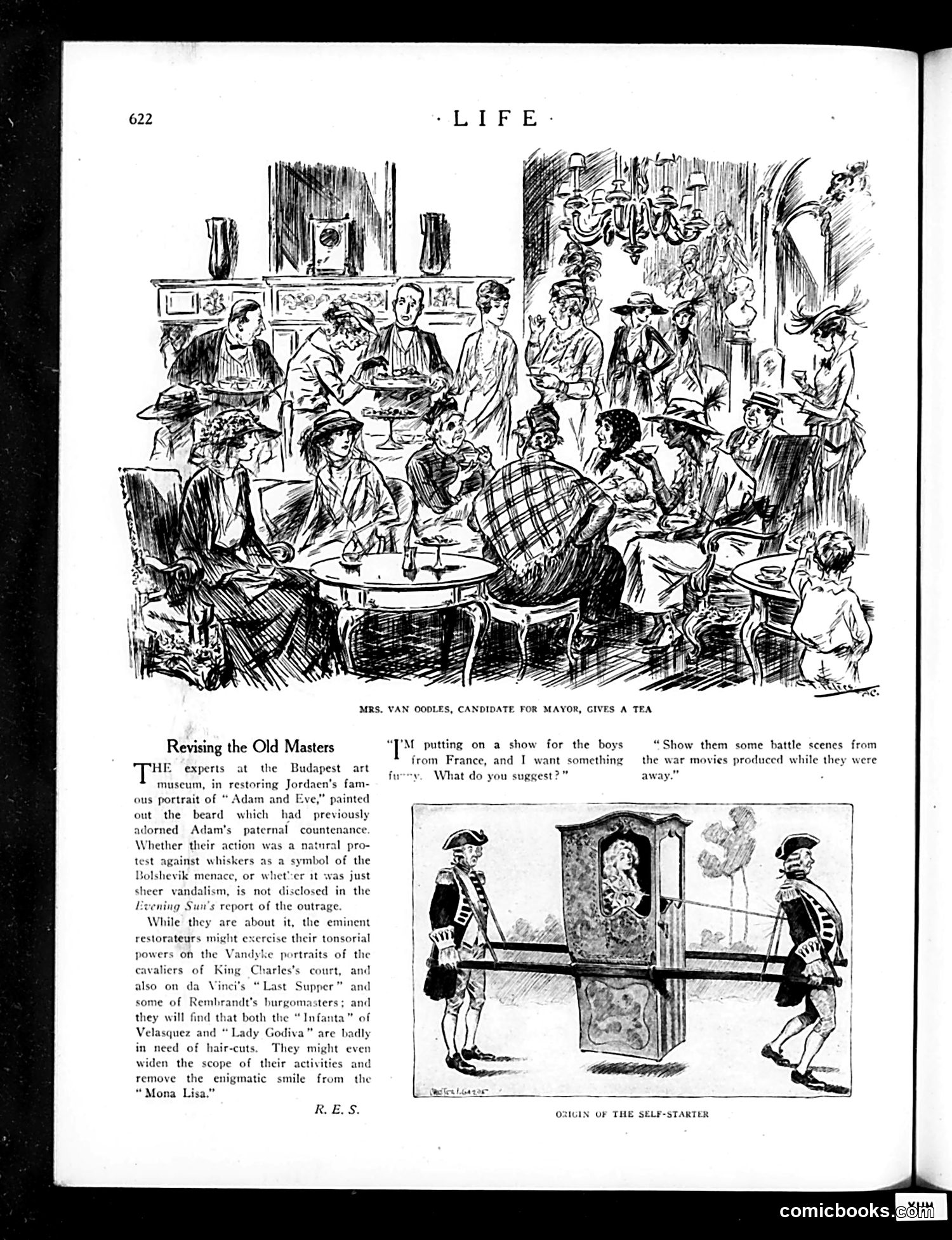
**Top Illustration**: "Mrs. Van Oodles, Candidate for Mayor, Gives a Tea" depicts a crowded social gathering, satirizing a female political candidate's campaign event. The scene mocks the notion of women in politics through the lens of high-society tea parties—suggesting her candidacy is merely social theater rather than serious political engagement. **Left Article**: "Revising the Old Masters" critiques Budapest museum restorers who removed the beard from a Jordaen painting of Adam. The author sarcastically suggests they might continue "correcting" famous artworks by removing beards from other masterpieces. This appears to reference post-WWI anxiety about Bolshevism (the restoration was possibly motivated by anti-communist sentiment, as beards symbolized Russian radicalism), while mocking the hubris of altering artistic heritage. **Bottom Cartoon**: "Origin of the Self-Starter" shows two figures operating what appears to be early film or projection equipment, with dialogue about showing "battle scenes from war movies." This likely jokes about the novelty of mechanical innovations and cinema during this era.
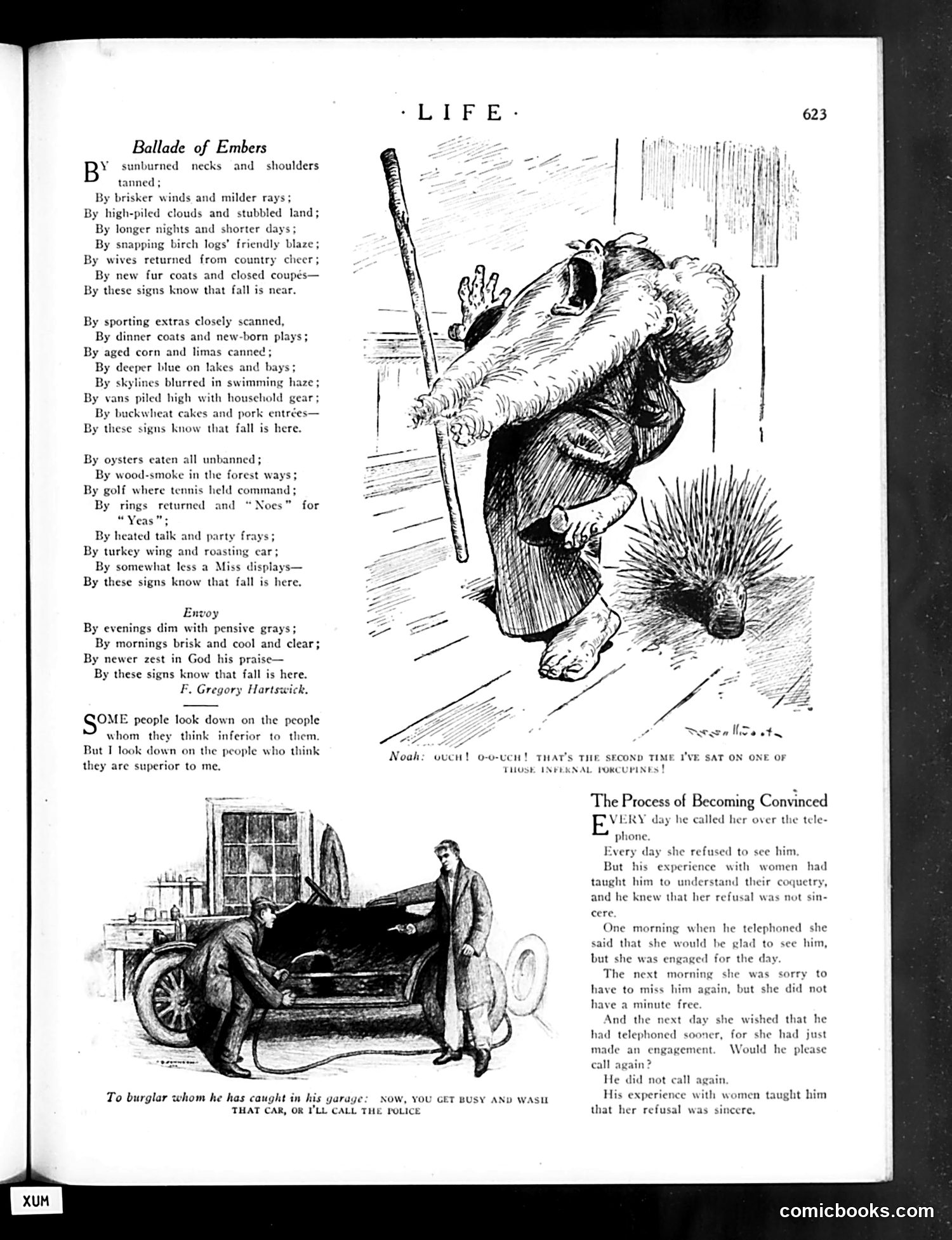
This page contains three distinct pieces of early 20th-century American humor: 1. **"Ballade of Embers"**: A poem by F. Gregory Hartswick cataloging signs of autumn's arrival—from weather changes to social activities (hunting, new plays, returning to city life). It's gentle, observational humor about seasonal transitions among the middle class. 2. **"Noah" cartoon**: Shows a man sitting on a porcupine (twice), with the joke being his repeated misidentification of it as an oven. The humor derives from slapstick absurdity and the character's obliviousness. 3. **"The Process of Becoming Convinced"**: A satirical story about a man's persistent telephoning of a woman who repeatedly refuses him. He initially interprets her refusals as "coquetry" (playing hard to get—a contemporary dating assumption), but eventually learns her rejections are sincere when she finally accepts, then makes excuses. The satire critiques men's presumptuous attitudes toward women's stated preferences. The page reflects period attitudes about courtship, gender dynamics, and the urban leisure class, with humor ranging from poetic observation to slapstick to social satire.
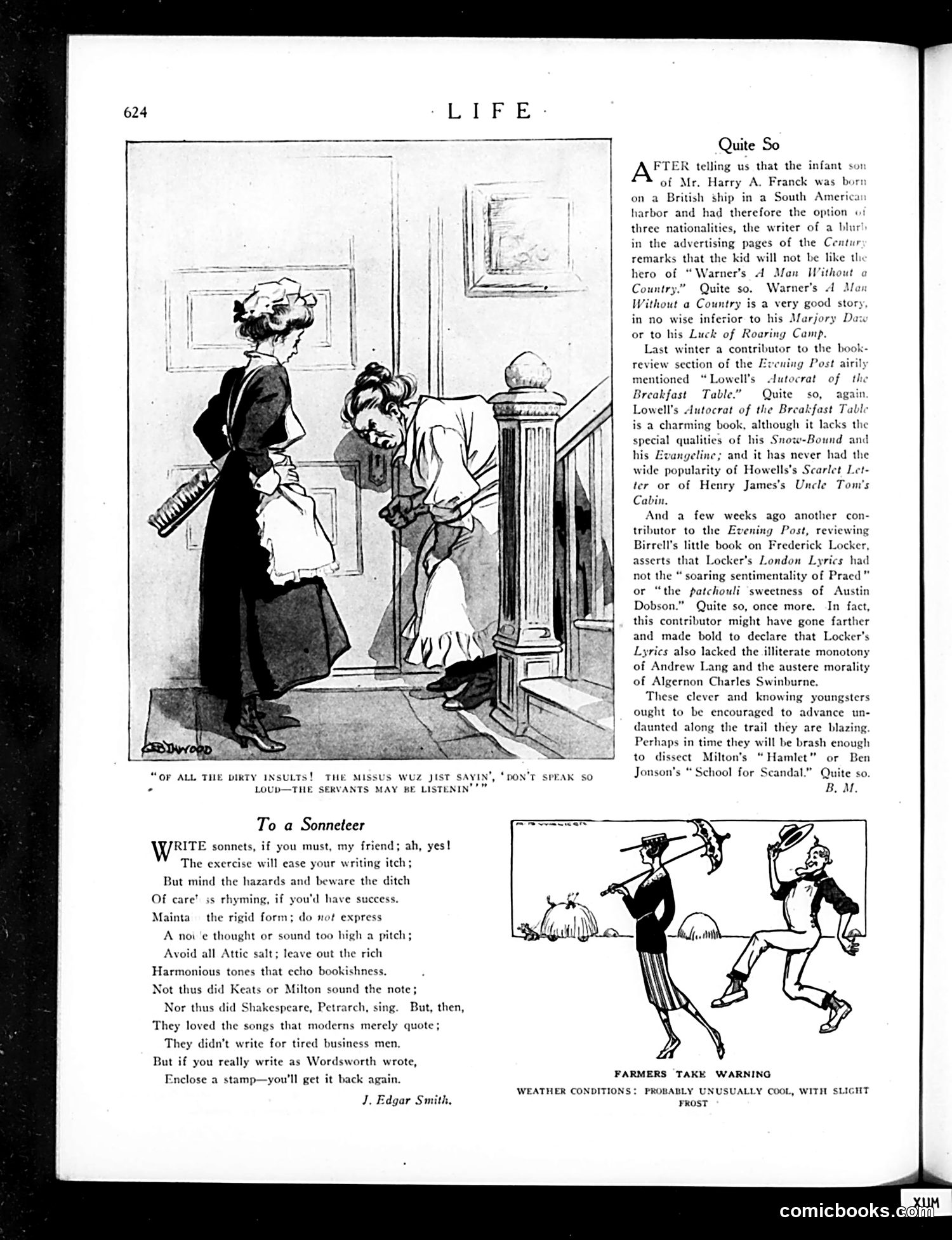
This page mocks young literary critics who make superficially clever observations while missing deeper truths. The article "Quite So" satirizes contributors to publications like the *Evening Post* who authoritatively compare minor works to major ones—claiming Locker's *London Lyrics* lacks the sentimentality of Praed or sweetness of Dobson—as if these comparative judgments demonstrate sophistication. The satire suggests these youngsters are merely being "brash" and pretentious, brazenly issuing dismissive verdicts they're insufficiently learned to justify. The title "Quite So" itself is ironic, sardonically agreeing while implying the critics are callow. The cartoon depicts servants eavesdropping on their employers' conversation, illustrating working-class social commentary. "To a Sonneteer" (by J. Edgar Smith) offers mock-serious advice about sonnet-writing while subtly criticizing modern practitioners: they lack the genius of Keats, Milton, and Shakespeare, and write for "tired business men" rather than from authentic inspiration.
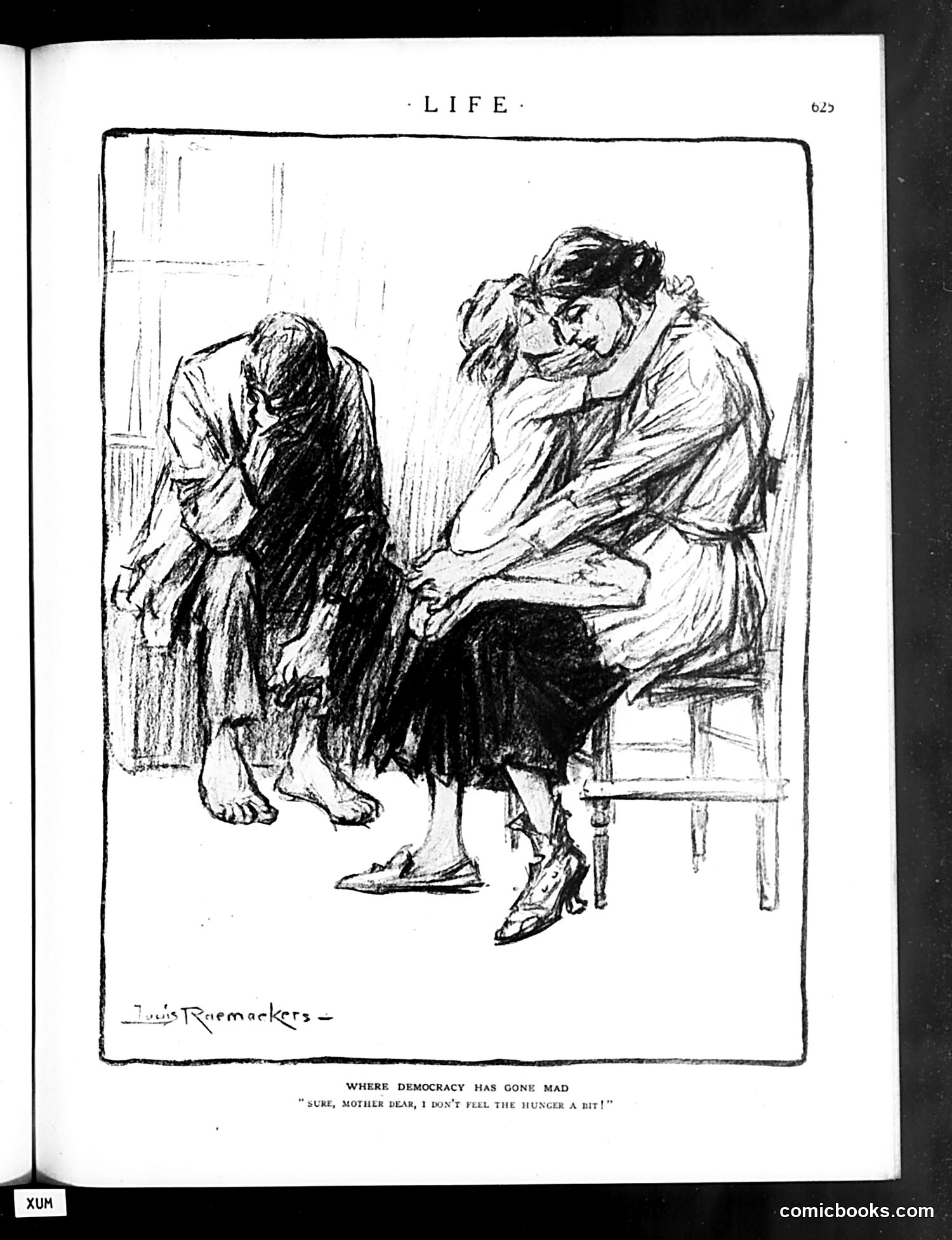
This is a political cartoon by Louis Raemackers titled "Where Democracy Has Gone Mad." It depicts two figures: a mother seated and a emaciated child standing before her. The child's quoted line—"Sure, mother dear, I don't feel the hunger a bit!"—expresses false reassurance despite obvious physical deprivation. The cartoon appears to critique the effects of war or economic crisis on civilians, particularly children suffering from malnutrition or starvation. The satire suggests that democratic societies have allowed conditions to deteriorate so severely that children must lie to comfort their parents, or conversely, that leaders falsely claim populations aren't suffering. Without the publication date visible, the specific historical context (likely WWI or the Great Depression era) cannot be confirmed, but the imagery clearly condemns democratic governance's failure to prevent civilian hunger.
This editorial attacks Republican presidential candidate Warren G. Harding's position on the League of Nations during the 1920 election. Life's editors accuse Republican campaigners of deliberately **misrepresenting Article X** of the League Covenant to voters, claiming it would force American troops into foreign wars without Congressional consent—a charge Life calls false and disingenuous. The satire targets Republican leaders (Taft, Strauss, Wickersham, Hoover) who privately oppose Harding's evasive stance but publicly support him anyway. Life calls this "strange leadership" and contrasts it favorably with women like Carey Thomas, who vote their principles rather than party loyalty. The magazine supports Democrat James Cox's clearer pro-League position, arguing that if voters genuinely want League membership, Cox is the only honest choice.
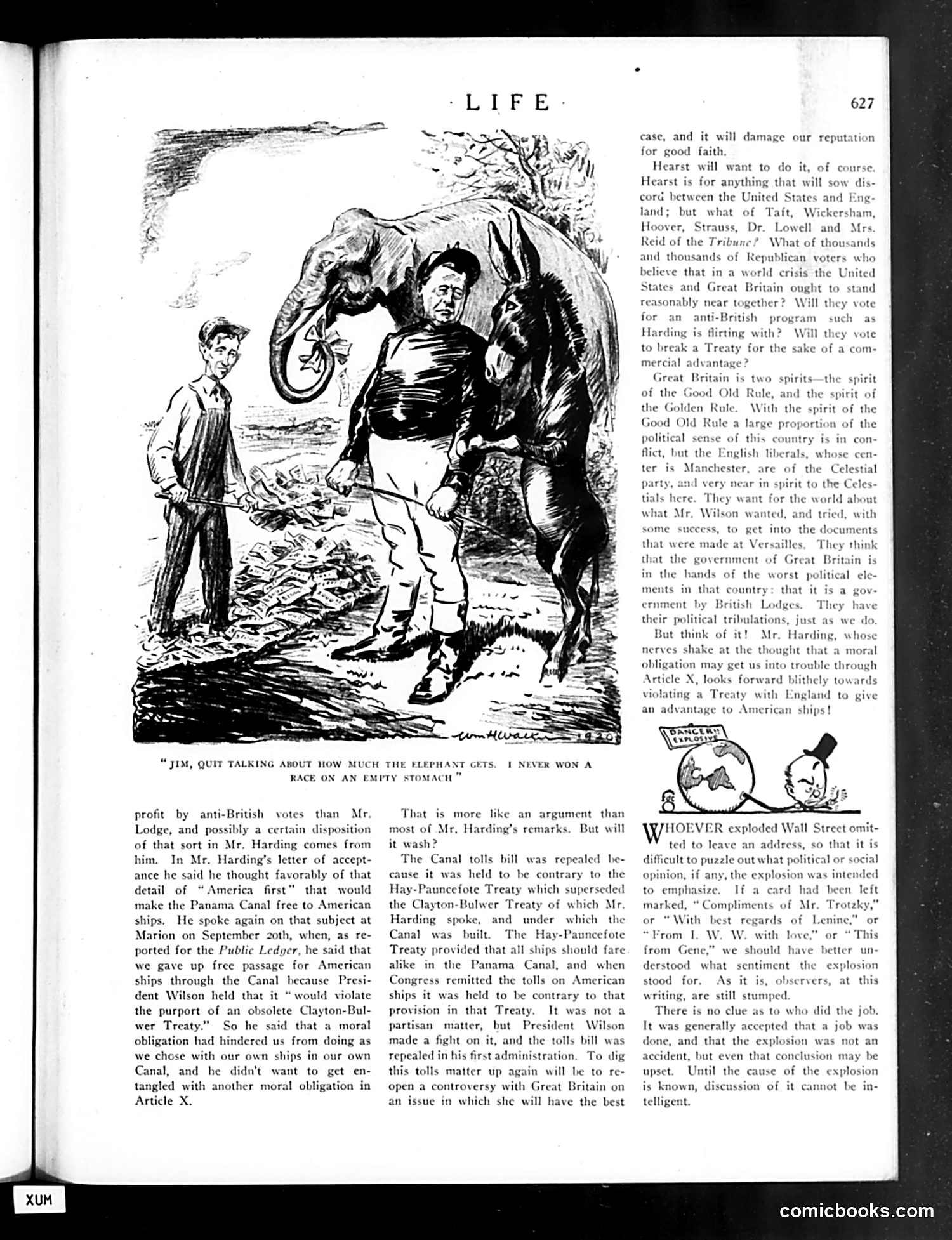
This Clifford Berryman cartoon satirizes Republican nominee Warren Harding's inconsistent positions on the Panama Canal tolls issue during his 1920 campaign. The "elephant" is the Republican Party mascot. The cartoon's caption mocks Harding's focus on economic benefits (tolls revenue) while ignoring moral obligations—specifically, treaty commitments requiring equal canal access for all nations. The accompanying text criticizes Harding for attacking President Wilson's 1914 canal tolls repeal while simultaneously claiming moral objections shouldn't entangle America in international obligations (referencing the League of Nations' Article X). The satire highlights the hypocrisy: Harding wants to violate a treaty with Britain for commercial advantage while opposing other international commitments on moral grounds. The article names prominent Republicans (Taft, Hoover, Lowell, Reid) who would supposedly oppose such treaty-breaking, questioning whether Republican voters supporting closer US-British relations would endorse Harding's anti-British position for mere economic gain.
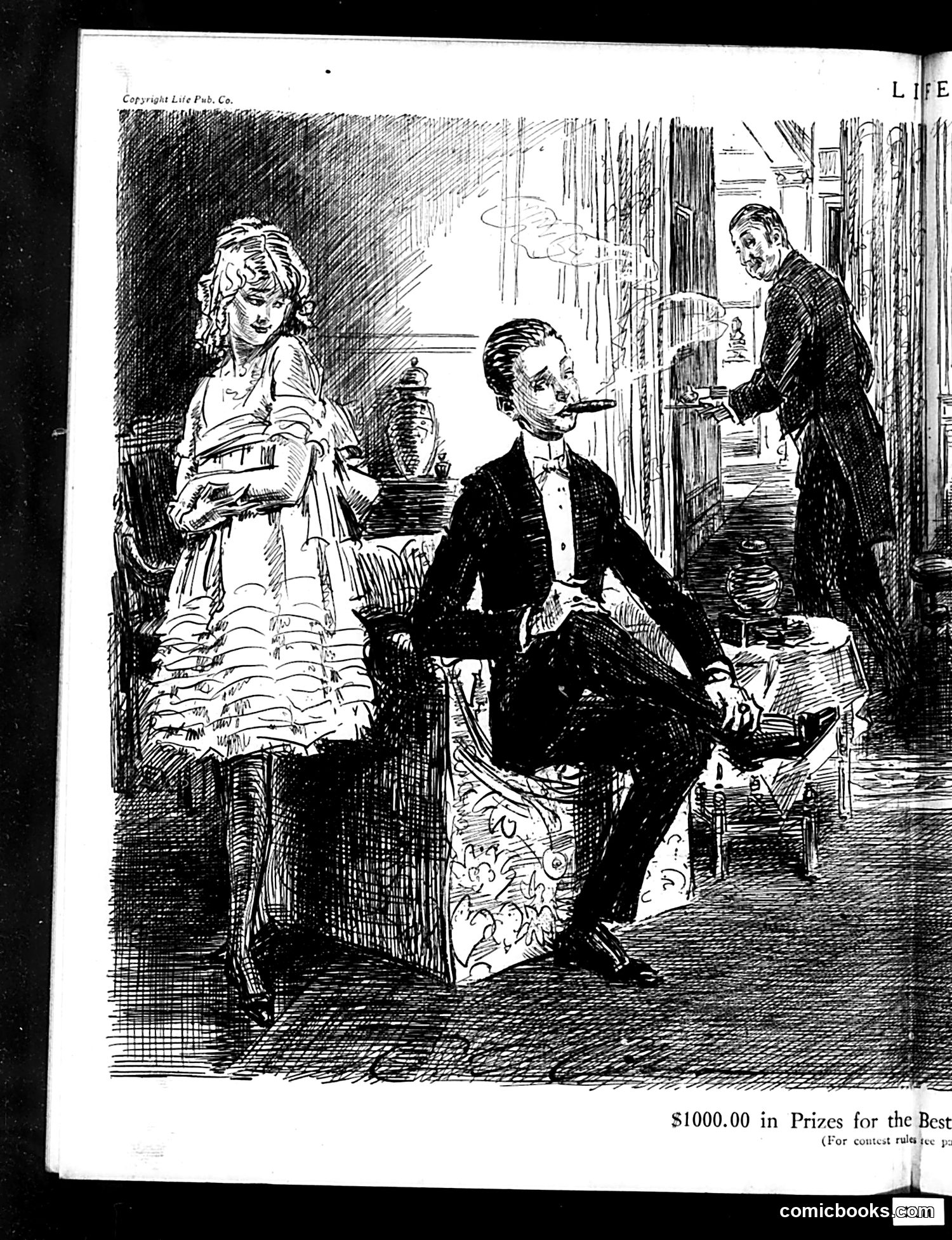
This appears to be a satirical illustration from *Life* magazine depicting a domestic scene. A well-dressed man in formal attire (tuxedo and cigar) sits while a woman in an elegant dress stands nearby holding what appears to be a tray or serving item. A third man in the background gestures toward them. The partial text references "$1000.00 in Prizes for the Best" and mentions "contest rules," suggesting this illustration accompanied a contest or competition announcement. Without the full caption or context, the specific satire remains unclear. It likely comments on social conventions, class dynamics, or relationships of its era—possibly mocking either the formality of upper-class entertaining or gender roles. The scene's theatrical staging suggests it's meant to be humorous commentary on contemporary manners or pretension.
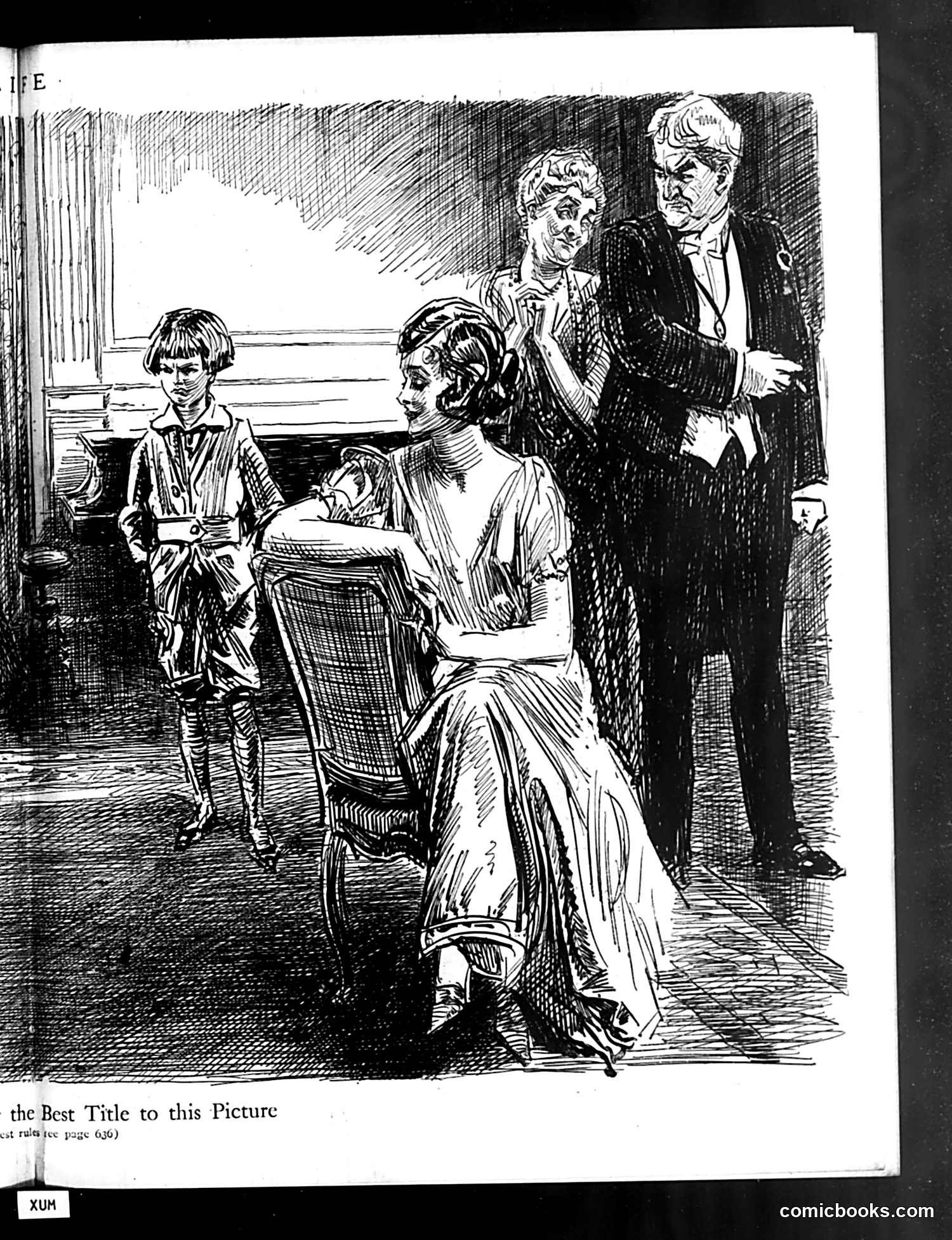
This page presents a sketch-style illustration with a caption inviting readers to submit title suggestions. The image shows an interior domestic scene: a woman sits in a chair while a young boy stands nearby; behind them stand two men in formal attire (suits and vests), one appearing elderly with white hair. The OCR text is largely illegible, but the caption "the Best Title to this Picture" indicates this is a participatory feature where Life magazine's readers competed to create witty captions. This was a common form of reader engagement in early 20th-century humor magazines. Without clearer context or legible OCR text, the specific satirical point remains unclear—it could reference a social situation, family dynamics, or contemporary scandal—but the format itself represents interactive audience participation in creating humor.
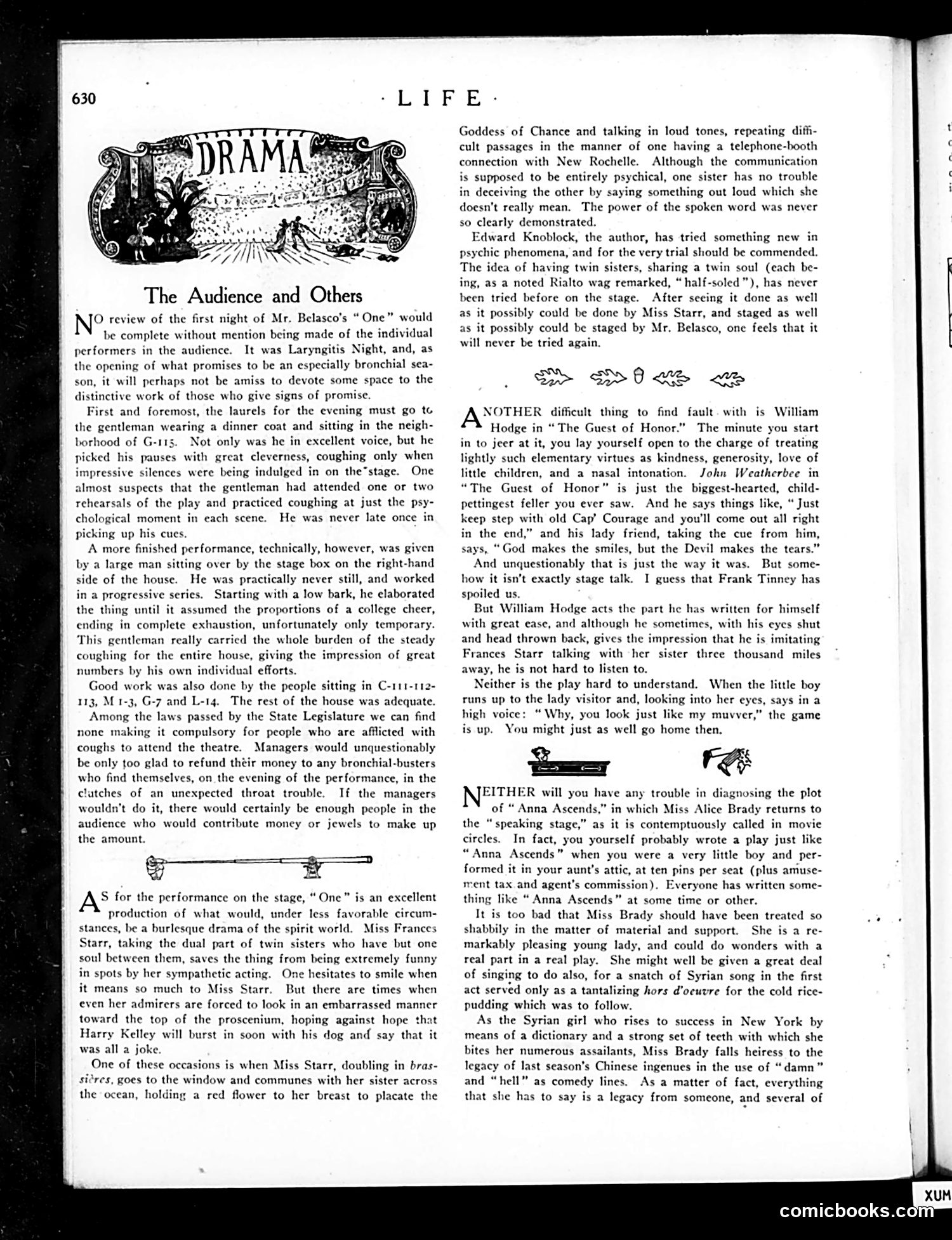
This is a satirical theater review of David Belasco's play "One," starring Frances Starr. The satire operates on two levels: **The Audience Satire:** The critic mockingly praises audience members' coughing performances as if they were actors. He awards laurels to a man in section G-115 for his perfectly-timed coughs during dramatic silences, and commends another for an elaborate "progressive series" of coughs escalating like a college cheer. This is gentle satire about inconsiderate theatergoers—particularly relevant during "Laryngitis Night" (flu season), when chronic coughers attended performances. **The Play Critique:** Starr's dual role as twin sisters sharing one soul involves absurd staging: she holds a red flower to her breast while loudly reciting difficult passages as if making a long-distance telephone call to her sister "across the ocean." The critic questions the logic of "psychical communication" requiring actual spoken words, satirizing the play's overwrought spiritualism and implausible staging choices. The overall tone mocks both audience behavior and theatrical pretension.
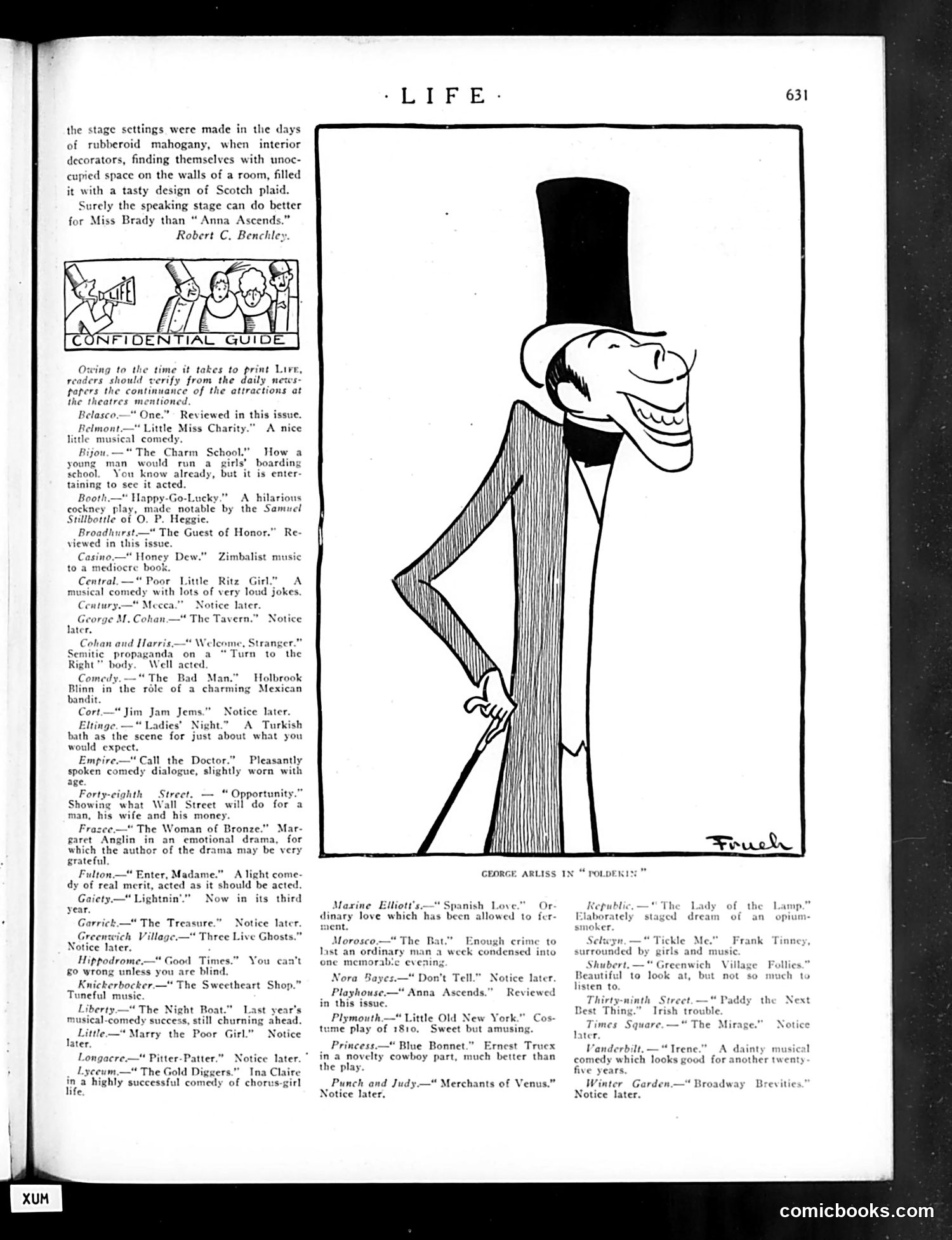
This page features a satirical cartoon of **George Arliss** in the play "Poldekin," drawn by artist Frueh. The caricature depicts a grinning man in exaggerated formal attire—top hat and tailcoat—with an elongated, jovial face and prominent teeth. The satire likely mocks either Arliss's theatrical persona or the play itself. The accompanying theater reviews suggest this is from Life magazine's drama criticism section, which regularly lampooned Broadway productions and performers. The grotesque facial features and theatrical costume suggest the cartoonist is satirizing overwrought acting style or the absurdity of the production. The context is purely theatrical criticism—no political content is apparent. This represents Life's standard practice of combining brief reviews with caricatures to entertain readers while commenting on New York's theater scene.
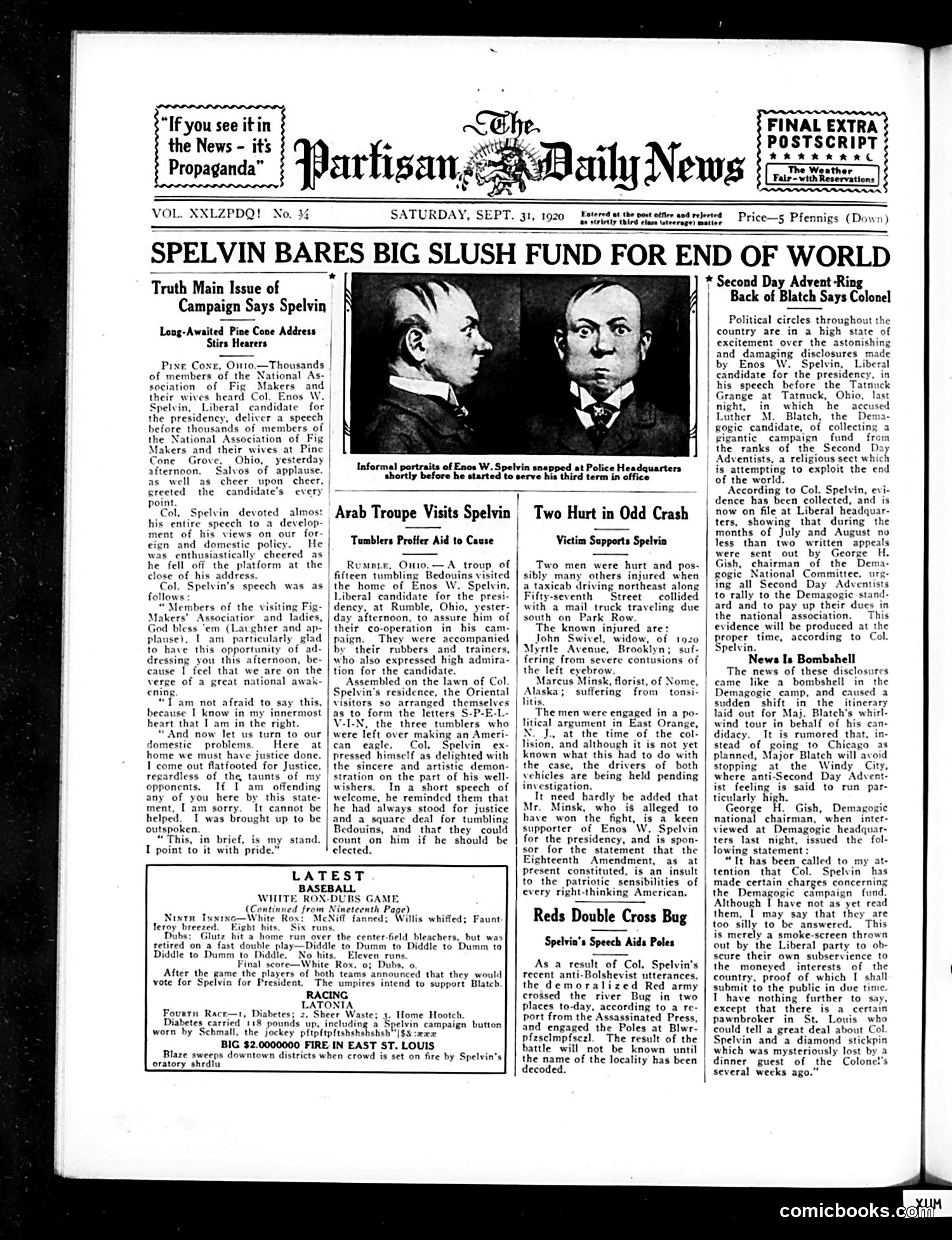
This page satirizes a fictional presidential candidate, Colonel Enos W. Spelvin, whose campaign appears absurdly vacuous and corrupt. **The main satire:** Spelvin's "Pine Cone Address" is mocked as hollow political rhetoric—he champions vague platitudes ("justice," "a square deal") while literally falling off the platform. The "big slush fund" headline suggests illegal campaign financing, and the mugshot-style portraits reference police headquarters, implying criminal activity. **The supporting jokes amplify the absurdity:** An Arab tumbling troupe arranges themselves as "S-P-E-L-V-I-N" to endorse him; baseball scores are inexplicably intercut into coverage; a $2 million fire in East St. Louis is attributed to Spelvin's "orator." **The overall point:** This is *Life* magazine mocking how American political campaigns rely on spectacle, empty slogans, and mass manipulation rather than substantive policy—a critique of 1920s political discourse that remains sharply relevant today.
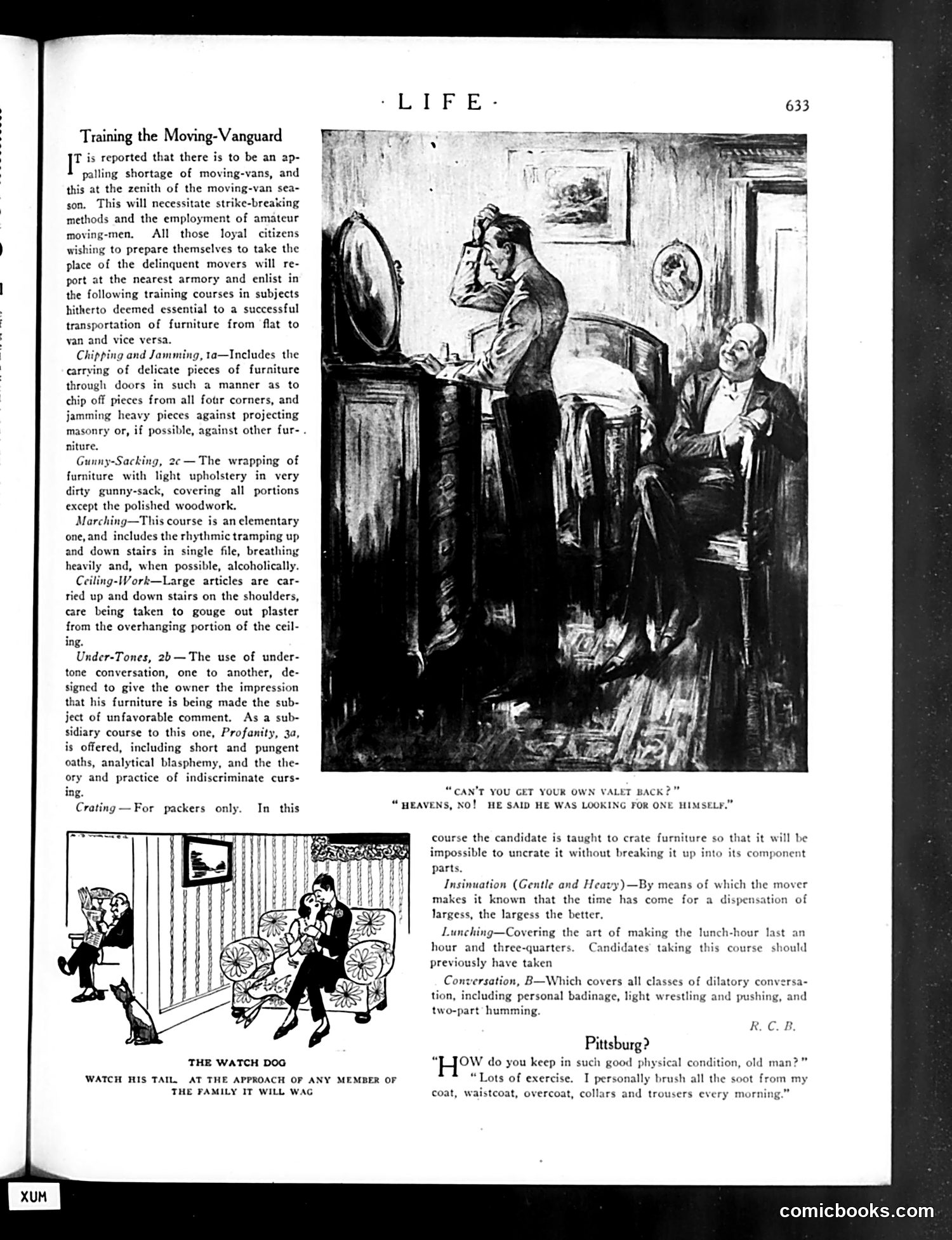
This is a humorous article mocking the incompetence of furniture movers during an apparent shortage. Titled "Training the Moving-Vanguard," it presents fake "courses" for amateur movers, each satirizing real problems: "Chipping and Jamming" ridicules damage to furniture, "Gummy-Sacking" mocks poor wrapping, "Marching" jokes about heavy-footed stairs-climbing, and "Ceiling-Work" lampoons plaster damage. Other courses mock movers' behavior—sullen "Under-Tones," demands for tips ("Insinuation"), long lunch breaks, and excessive chatting. The accompanying cartoons are lighter fare: one shows a dog wagging its tail, the other a household servant problem (a valet seeking his own valet). The "Pittsburg" joke at bottom puns on industrial soot. The satire targets working-class moving companies' notorious reputation for damage and poor service—a longstanding source of middle-class complaint.
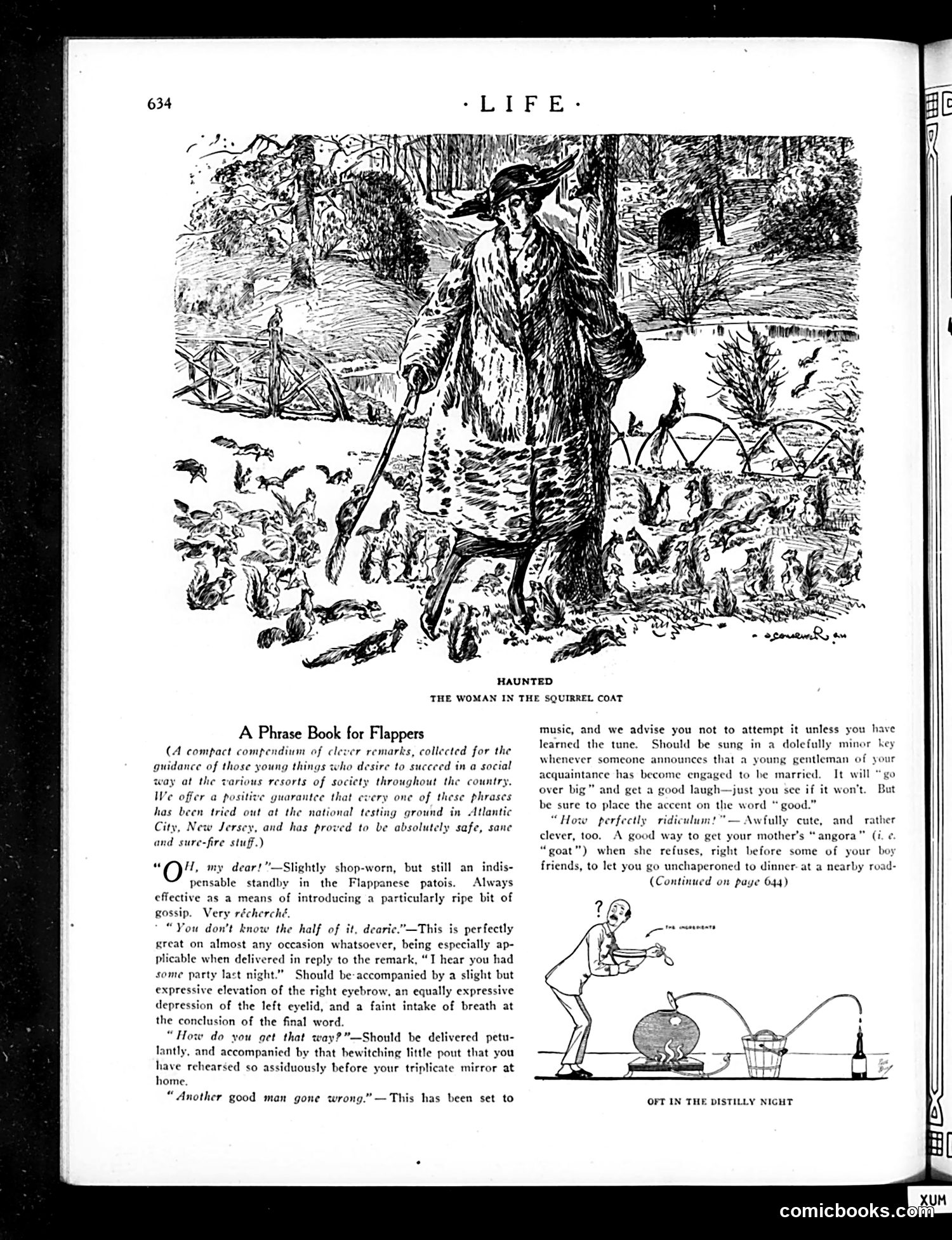
This page satirizes 1920s "flapper" culture—young women challenging social conventions through dress, speech, and behavior. The top illustration shows "The Woman in the Squirrel Coat," depicting a fashionably dressed woman in a fur coat, likely representing the stereotypical flapper aesthetic that scandalized conservative society. The main content is a humorous "phrase book" mocking flapper slang and affected speech patterns. It catalogs exaggerated catchphrases like "Oh, my dear!" and "How do you get that way?"—presented as if they're genuine social currency tested in Atlantic City (then a major resort destination). The satire targets both the artificial sophistication of young women adopting these phrases and their social aspirations. The bottom cartoon, "Off in the Distilly Night," appears to reference Prohibition-era bootlegging, likely mocking both illegal alcohol production and flapper participation in defying the law. The overall tone is gentle mockery of 1920s youth culture and changing gender norms.
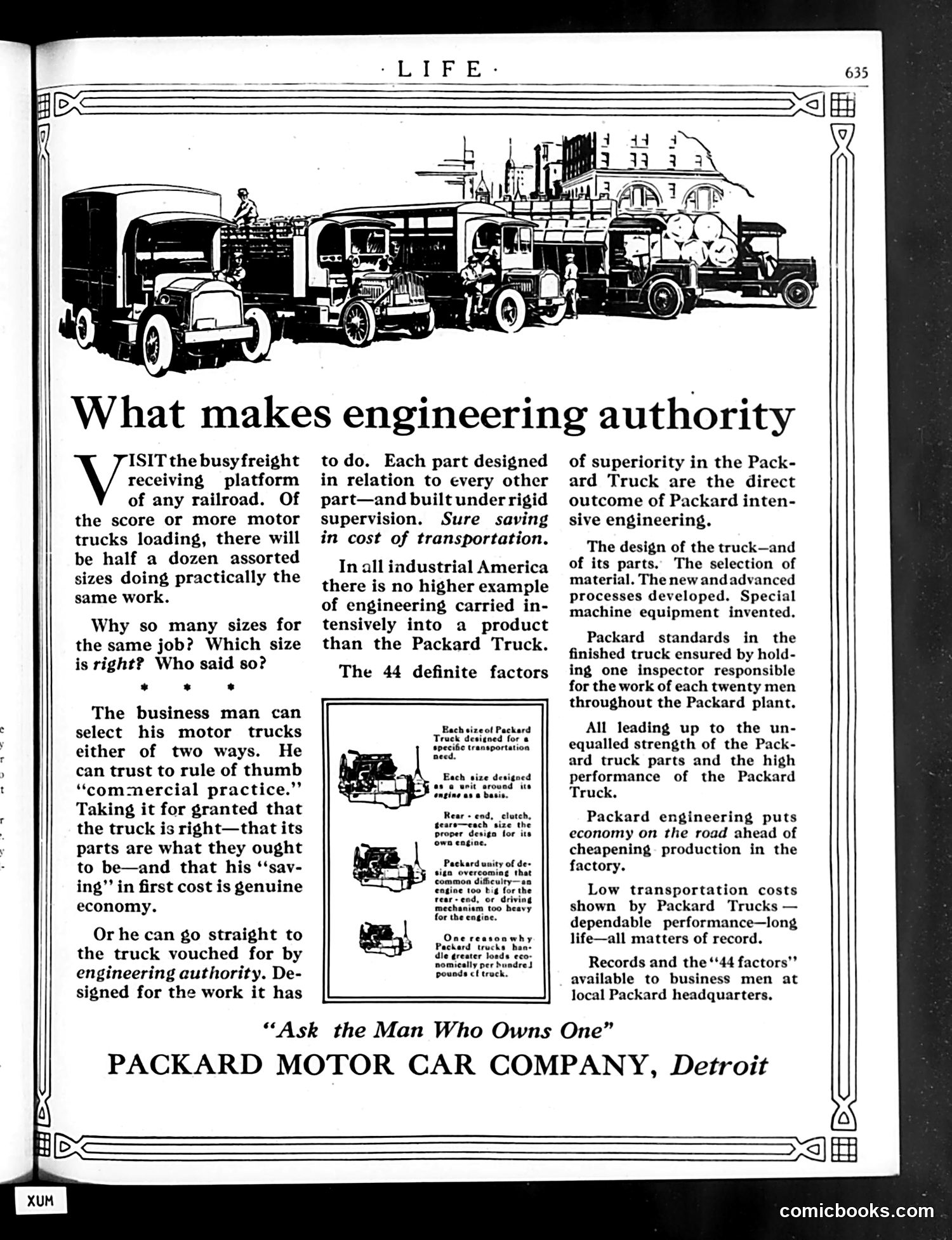
This is **not a cartoon or satire**—it's a straightforward advertisement for Packard Motor Truck Company. The page features an illustration of various truck sizes at the top but serves as product marketing, not political commentary. The ad argues that business owners face a choice: select trucks based on "commercial practice" (habit/cost-cutting) or trust "engineering authority" (Packard's scientific design). It emphasizes that Packard trucks are engineered with 44 specific design factors, each part coordinated with others, and subject to rigorous quality control—one inspector per twenty workers. The pitch targets industrial buyers concerned with transportation costs. The tagline "Ask the Man Who Owns One" is typical early-20th-century advertising, appealing to peer testimony. There's no satire here—this is a genuine corporate advertisement promoting engineering superiority as a selling point for commercial vehicles.
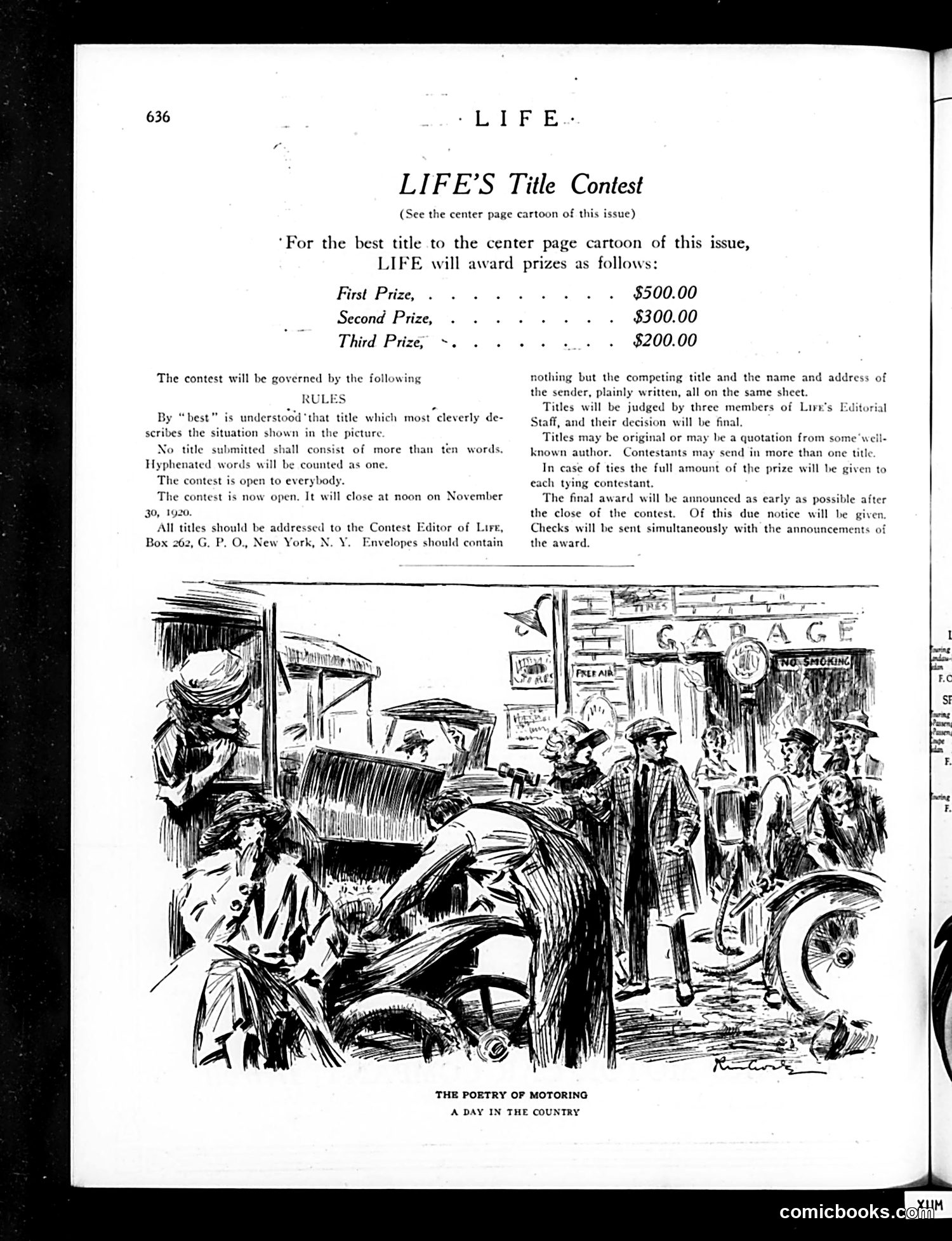
This page announces a contest asking readers to title a cartoon appearing elsewhere in the magazine. The cartoon itself, titled "The Poetry of Motoring: A Day in the Country," depicts a chaotic rural scene: an overturned automobile surrounded by onlookers, scattered debris, and what appears to be a collision or accident scenario. The satire is directed at the early automobile era and the romanticization of motoring as poetic or refined. By showing the messy reality—a broken-down car, dirt, confusion, and rural onlookers gawking at disaster—the cartoon mocks the gap between the idealized vision of motorcar travel and its actual, often disastrous practice in the 1920s. The contest itself offers substantial prize money ($500-$200), reflecting Life magazine's popular reach and the public's engagement with satirical content during this period.
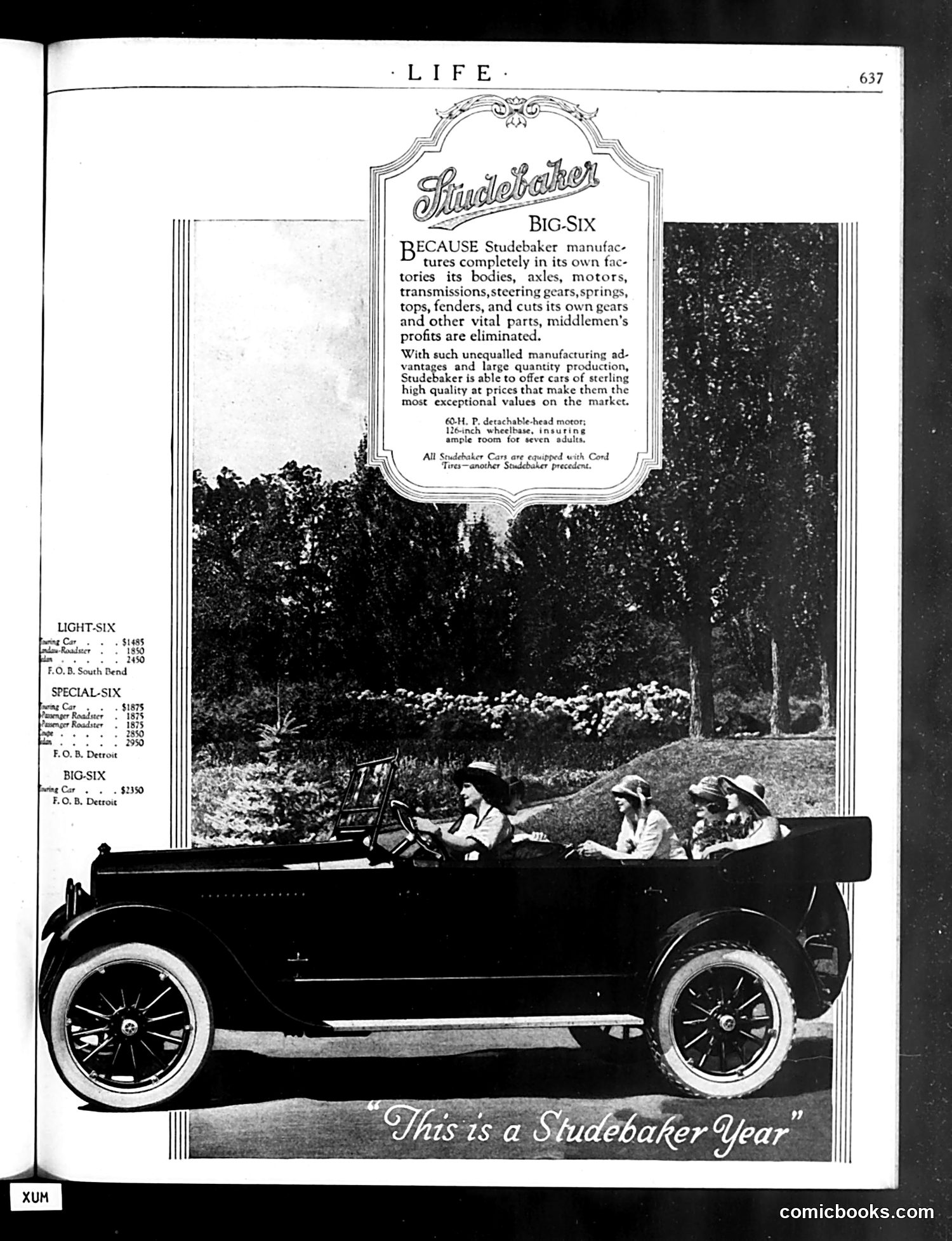
This is a **Studebaker automobile advertisement**, not political satire. The page promotes the Studebaker "Big-Six" car to *Life* magazine readers (circa 1910s-1920s). The ad's central claim is that Studebaker manufactures its own components—bodies, axles, motors, transmissions, gears—eliminating middlemen's profits and allowing competitive pricing for "sterling high quality." The accompanying image shows a well-dressed group of five people enjoying an open-air automobile ride through scenic countryside, visually reinforcing the message: this is a quality vehicle for the affluent middle class. The tagline "This is a Studebaker Year" uses aspirational marketing common to the era. There is no political cartoon or satire here—it's straightforward advertising leveraging manufacturing efficiency as a selling point.
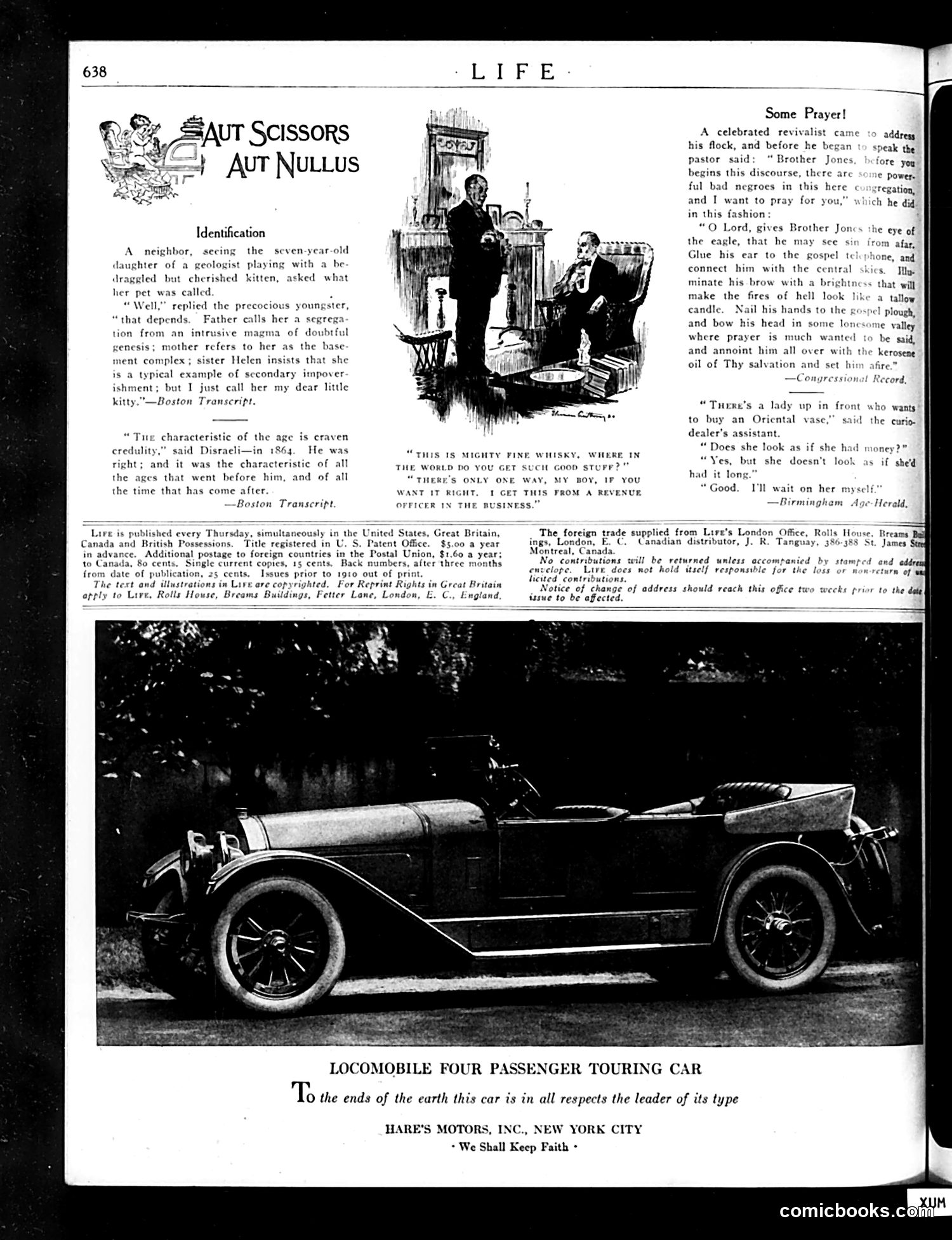
This page contains several satirical pieces typical of early 20th-century American humor: **"Aut Scissors, Aut Nullus"** presents a joke about a geologist's daughter describing her kitten using her family's professional jargon—her father calls it "segregation from intrusive magma," her mother a "basement complex," her sister an example of "secondary impoverishment"—while she simply calls it her "dear little kitty." The satire mocks academic over-intellectualization of simple things. **"Some Prayer!"** contains a racist caricature of a Black pastor's exaggerated dialect prayer for "Brother Jones" before a sermon. This reflects period attitudes toward African American speech and religion, presenting it as comical subject matter. The remaining items are brief anecdotes about whiskey sourcing and purchasing decisions, plus a substantial automobile advertisement for a Locomobile touring car. The page is primarily advertising-driven, typical of Life's revenue model during this era.
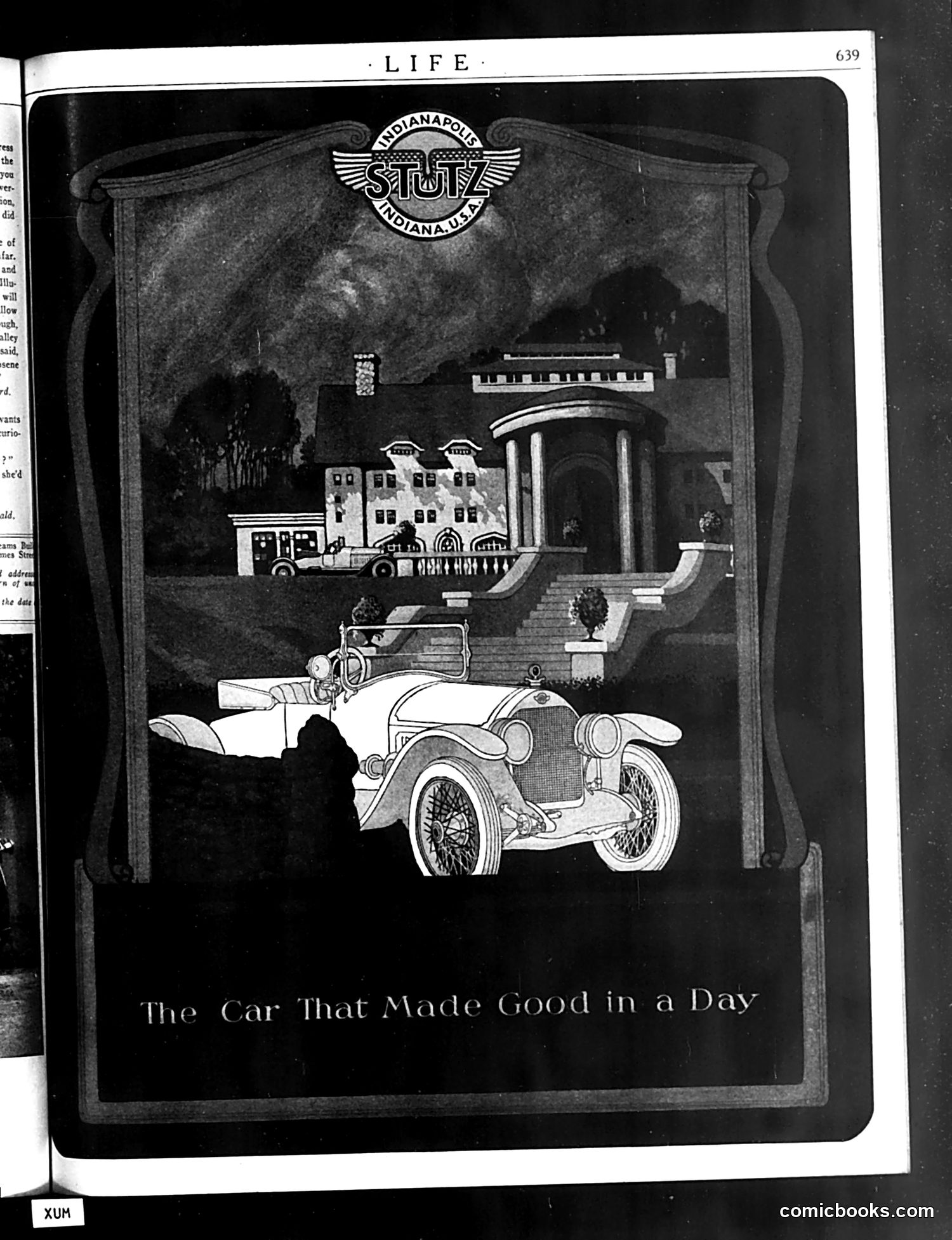
This is a **Stutz automobile advertisement** from Life magazine (page 639). The ad depicts a sleek sports car in the foreground with an elaborate fantasy scene behind it—a grand mansion or estate with classical architecture, fountains, and well-dressed figures. The tagline **"The Car That Made Good in a Day"** is the key to understanding this: it's aspirational advertising playing on American dreams of rapid success and wealth. The message suggests that owning a Stutz automobile signals (or perhaps enables) dramatic social advancement—from ordinary person to wealthy elite with estates and fine living. This reflects 1920s consumer culture, where luxury automobiles symbolized success, modernity, and status. The ad equates the car with instant prestige and upward mobility.
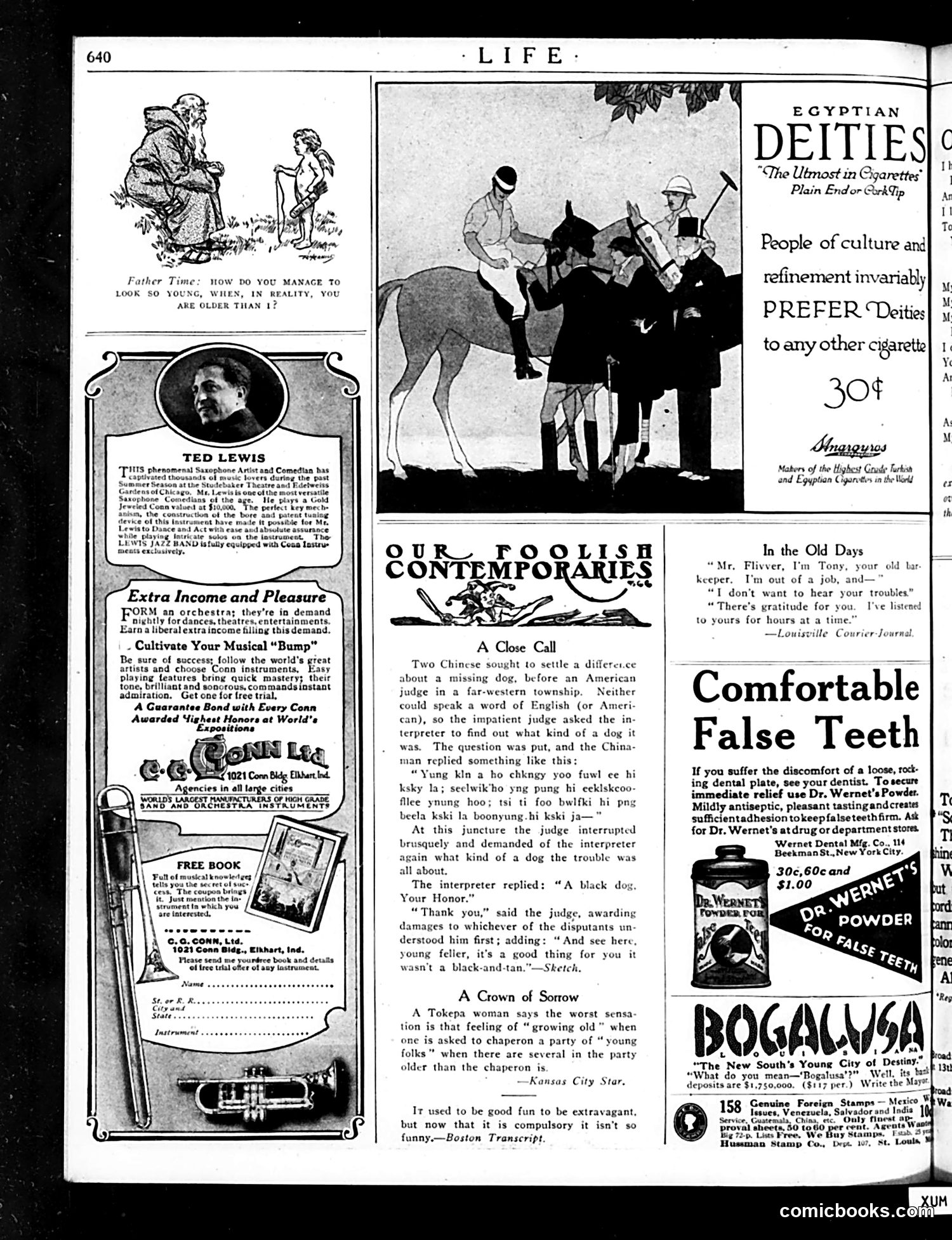
This page contains primarily **advertisements and humorous anecdotes** rather than political cartoons. The main satirical content includes: **"A Close Call"**: A joke about a Chinese legal dispute where two non-English speakers argue over a missing dog before an American judge. The humor relies on mocking the incomprehensibility of Chinese language—the interpreter's garbled transcription is played for laughs, though the judge somehow determines it was a "black dog." The punchline jokes about "black-and-tan" dogs, possibly referencing American slang. **"A Crown of Sorrow"**: A brief social commentary about aging, where a woman finds the worst indignity of growing old is chaperoning young people's parties. The remaining content consists of period **advertisements**: Egyptian Deities cigarettes (targeting "people of culture and refinement"), Conn musical instruments, Dr. Wernet's powder for false teeth, and stamp collecting offers—typical early 20th-century consumer ads emphasizing aspiration and self-improvement.
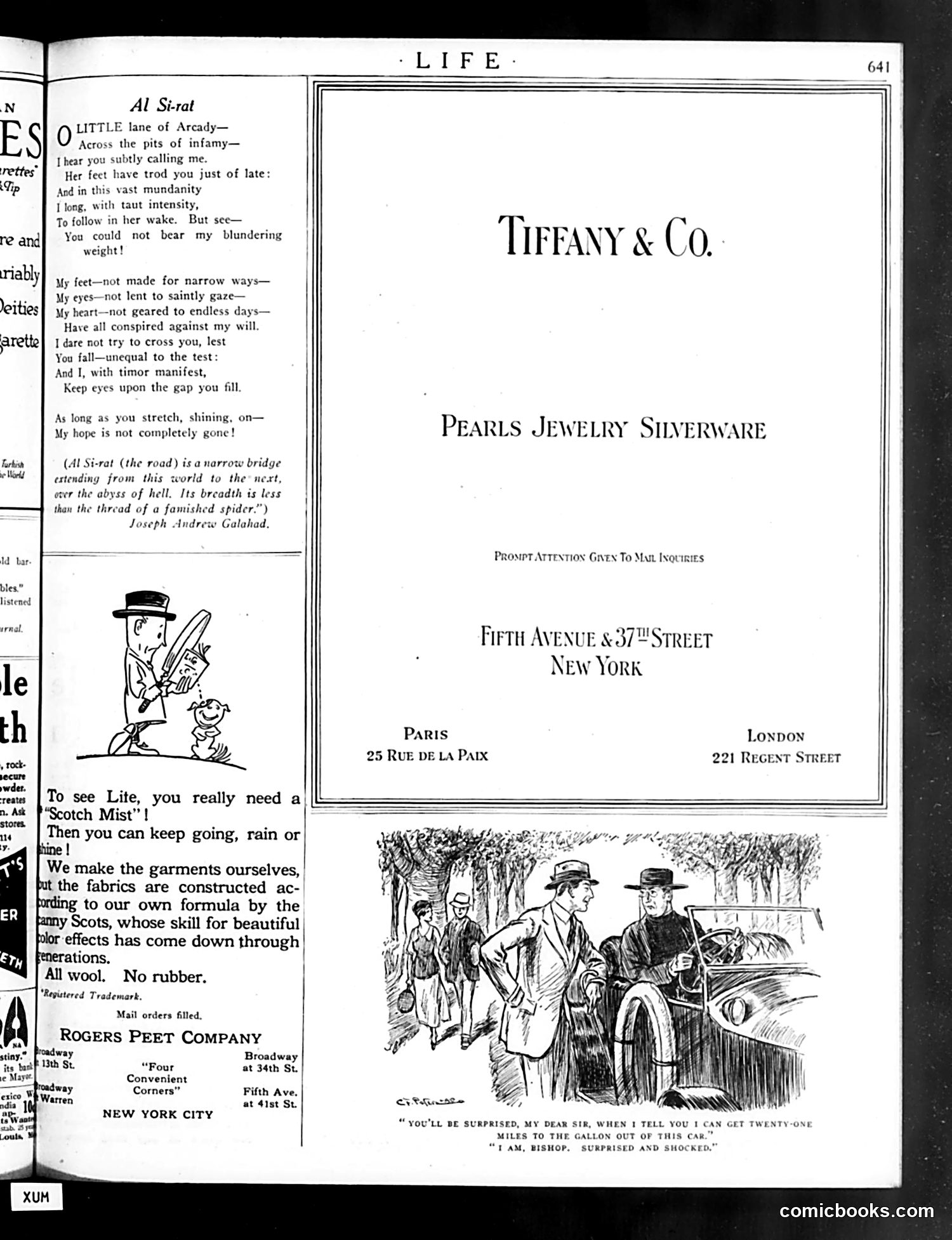
This page mixes literary content with advertisements typical of early 20th-century Life magazine. **Left side:** A romantic poem titled "Al Si-rat" references Islamic theology—the narrow bridge souls must cross after death. The poem uses this metaphor to express a lover's longing to follow someone he admires but feels unworthy ("My feet—not made for narrow ways"). It's sentimental verse about spiritual/romantic inadequacy. **Right side:** Primarily Tiffany & Co. jewelry advertisement with their Fifth Avenue address and international locations. **Bottom cartoon:** Two men discuss an automobile's fuel efficiency. One claims twenty-one miles per gallon; the other ("Bishop") expresses surprise and skepticism. The humor appears to be gentle skepticism about exaggerated automotive claims—likely poking fun at early car salesmen's dubious performance assertions. The page also includes a Rogers Peet clothing company advertisement.
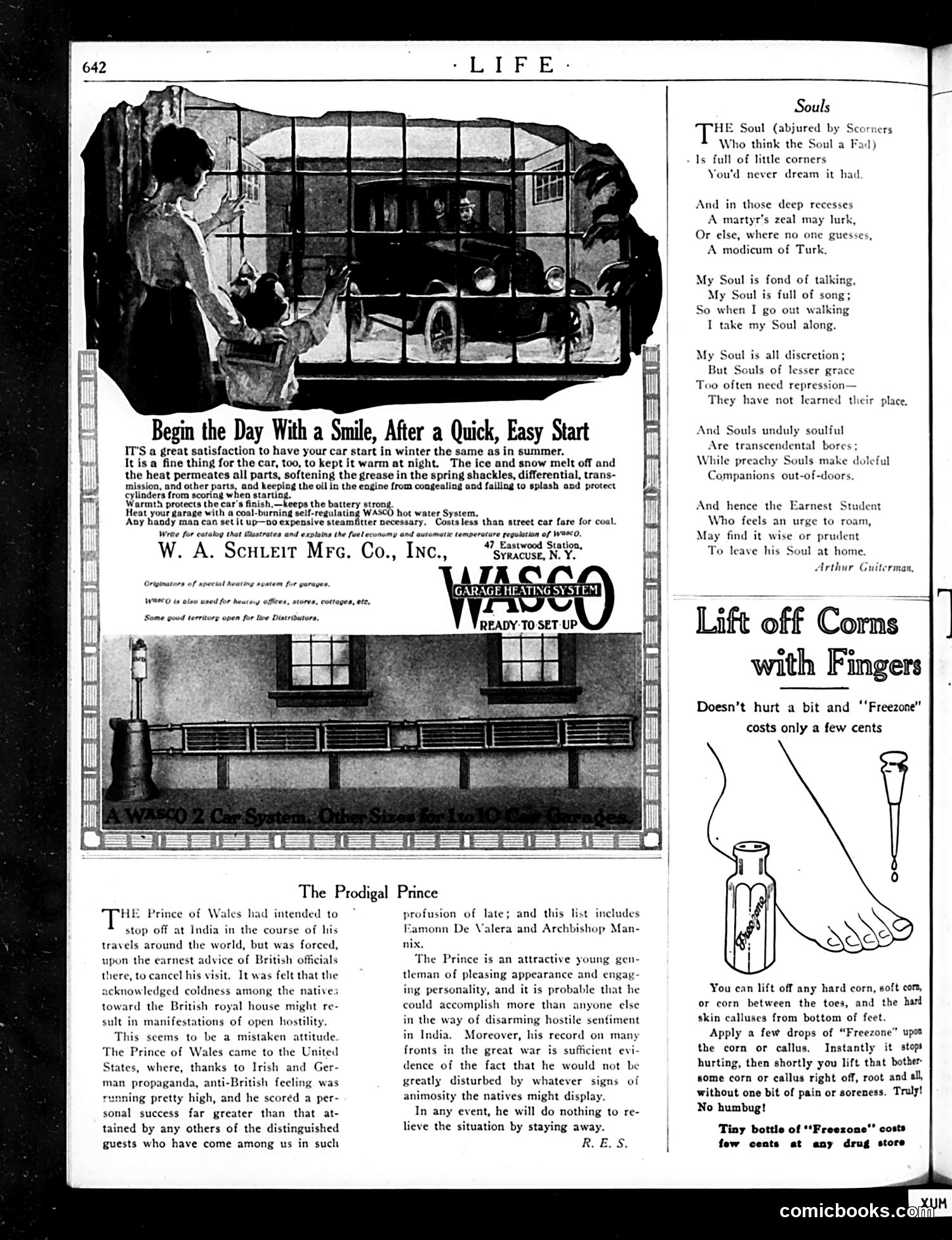
This page is primarily **advertising and light verse**, not political satire. The main advertisement promotes **WASCO heating systems** for garages, emphasizing winter car maintenance. Below it, "The Prodigal Prince" is a brief **opinion piece** (by R.B.S.) defending the Prince of Wales's visit to America rather than India. The author argues the Prince succeeded in winning over American audiences despite anti-British sentiment fueled by Irish and German propaganda, and suggests he could do similar good in India—contrary to British officials' fears of hostile native reception. The right column contains a **humorous poem** ("Souls") by Arthur Guiterman mocking overwrought spiritual pretension, and an advertisement for **Freezone corn remover**. The content reflects 1920s concerns: post-WWI tensions with Britain, Irish-American political influence, and consumer product marketing. Nothing here requires specialized knowledge beyond understanding period attitudes toward the British monarchy and immigration politics.
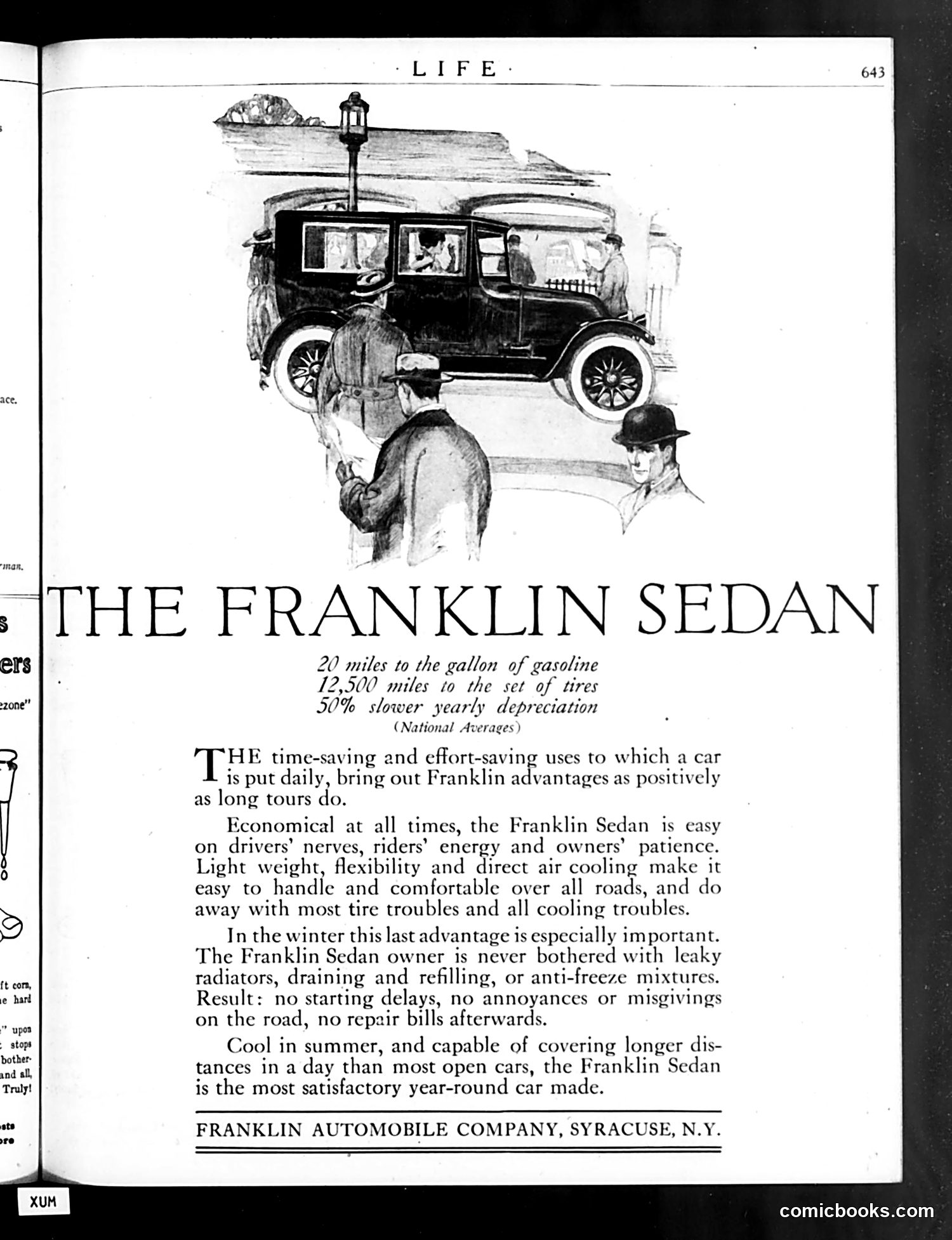
This is primarily a **car advertisement**, not satire or political content. It promotes the Franklin Sedan automobile, manufactured in Syracuse, New York. The illustration shows a 1920s-era sedan with several figures examining or discussing it—typical advertising imagery of the era meant to convey respectability and practical value. The text emphasizes the car's economic advantages: fuel efficiency (20 mpg), tire longevity, and slower depreciation. Notably, it highlights the Franklin's **air-cooling system** as superior to water-cooled competitors, eliminating radiator problems, freeze-mixture hassles, and winter starting troubles. For modern readers: this reflects pre-mass-production competition when automobile manufacturers had genuinely different cooling technologies. The Franklin's air-cooling was a real selling point before liquid-cooled engines became industry standard. The ad's focus on reliability and winter performance suggests these were significant consumer concerns in early automotive markets. This appears to be a straightforward product advertisement, not editorial content or satire.
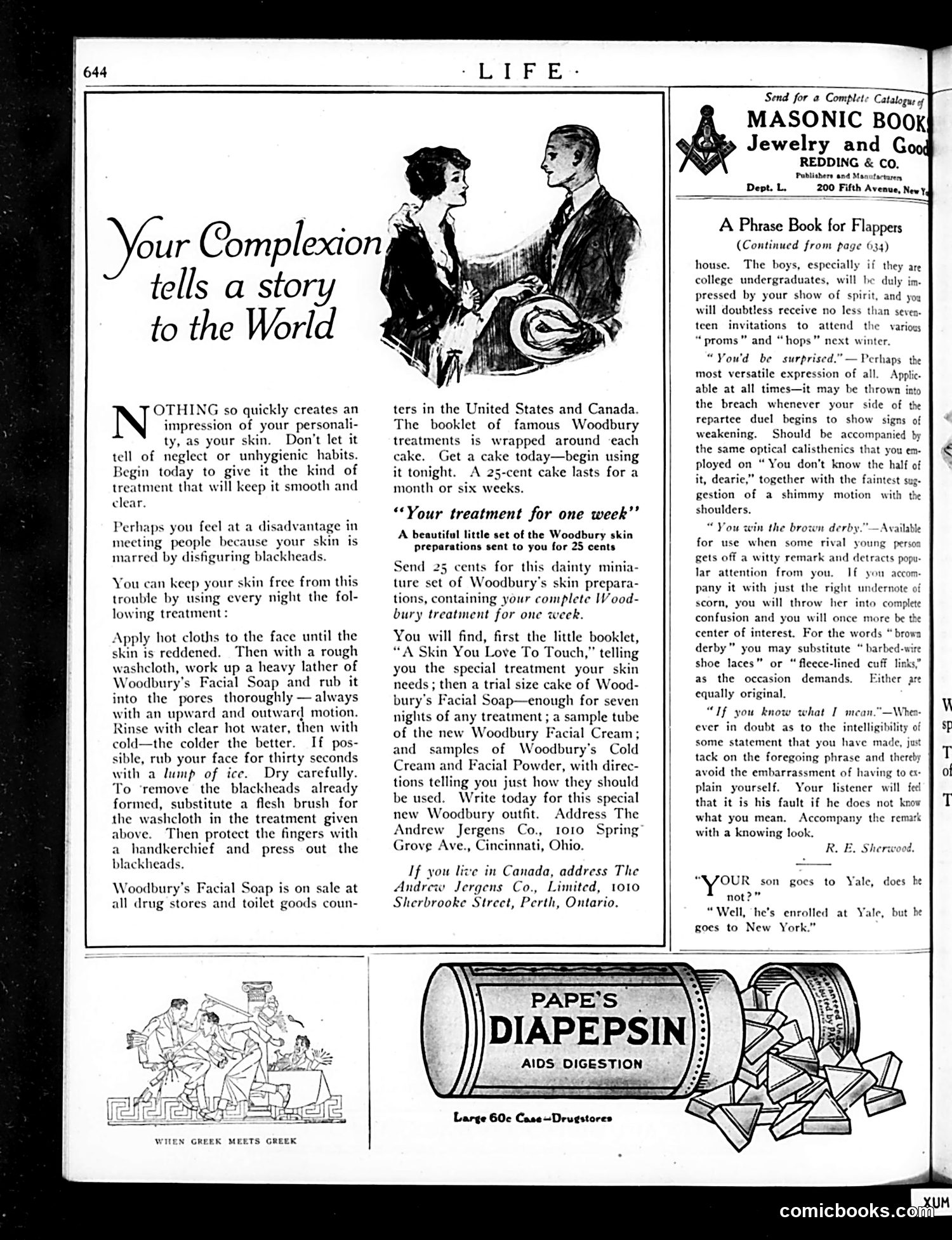
This Life magazine page (644) contains primarily **advertising content**, not political satire. The main feature is a Woodbury's Facial Soap advertisement occupying most of the page. ## The Advertisement's Social Context The ad promotes skincare with language reflecting 1920s anxieties about appearance and social acceptance. It emphasizes that complexion "tells a story" about personality and hygiene—reflecting period concerns about looking respectable in social situations. The detailed treatment instructions (hot cloths, rough washcloths, ice rubs) represent the era's skincare practices. ## Secondary Content The page includes: - A "Phrase Book for Flappers" (continuing from page 634), offering slang expressions for young women of the Jazz Age - A small cartoon labeled "When Greek Meets Greek" (unclear without full image context) - Advertisements for Masonic books and Pope's Diapepsin (a digestive aid) The page reflects **1920s consumer culture** and the emerging "flapper" social phenomenon, with advertising designed to appeal to modern, appearance-conscious young people.
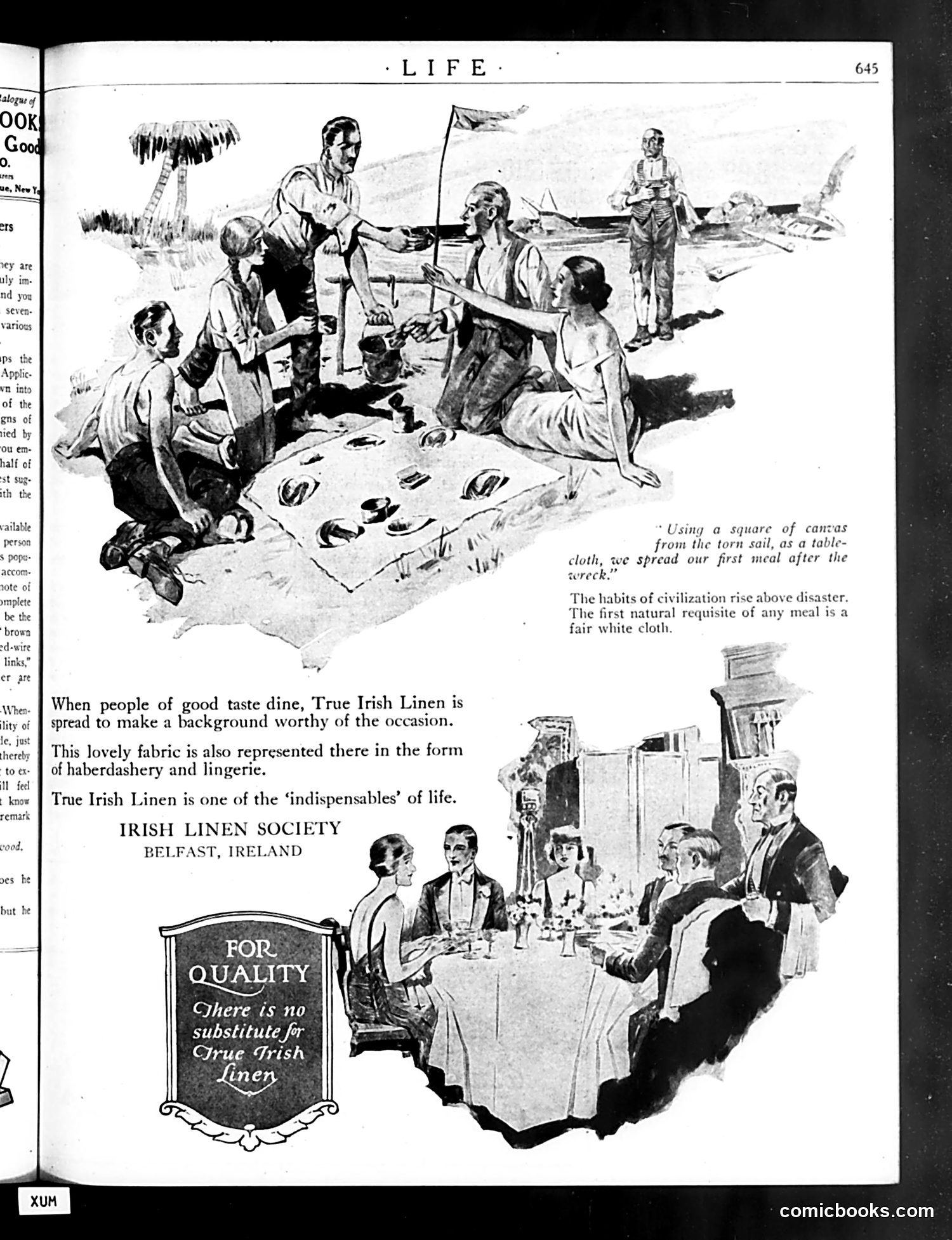
This page is primarily **advertising**, not political satire. It promotes Irish linen through two contrasting scenes: **Top illustration**: Shipwreck survivors sharing a meal on a beach, using salvaged canvas as a tablecloth. The caption emphasizes that even in disaster, civilized people maintain proper dining customs. **Bottom illustration**: An elegant formal dinner party with well-dressed diners around a properly set table with fine linens. **The message**: True Irish Linen is presented as an "indispensable" of civilized life—essential whether dining after catastrophe or at formal occasions. The advertisement argues that quality tablecloths are a marker of good taste and civilization itself, not a luxury. This reflects early 20th-century upper-class values emphasizing propriety and refinement. The tagline "There is no substitute for True Irish Linen" positions the product as fundamental to maintaining social standards.
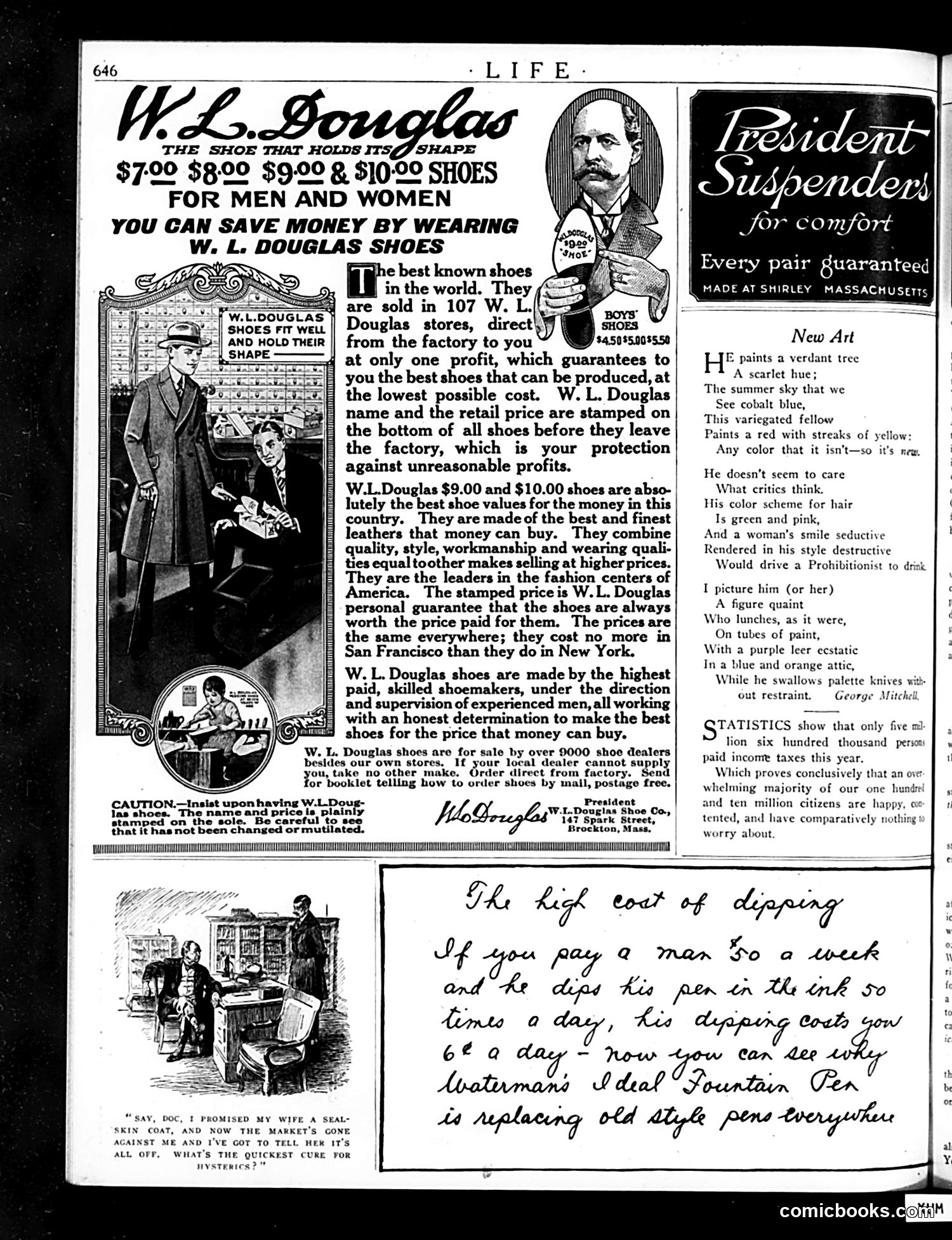
This page is primarily **advertising**, not satirical content. It features a major W.L. Douglas shoe company advertisement (left two-thirds) and smaller ads for President Suspenders and a Waterman's Ideal Fountain Pen (right side). The Douglas ad includes a portrait of W.L. Douglas himself and emphasizes factory-direct pricing and quality control—the stamped price on every shoe's sole guaranteed honest value. This was a selling point in an era of variable retail markups. The only satirical content is a short poem titled "New Art" (right column), mocking modernist/avant-garde painters who use arbitrary, non-naturalistic colors. The joke: these artists paint skies cobalt, trees scarlet, hair green—anything *except* realistic colors—calling it innovation while lacking actual artistic merit. A small cartoon at bottom shows a man asking a doctor for a "cure for hysterics" after the stock market forced him to cancel his wife's promised sealskin coat—humor about spousal dramatics over lost luxuries during market volatility.
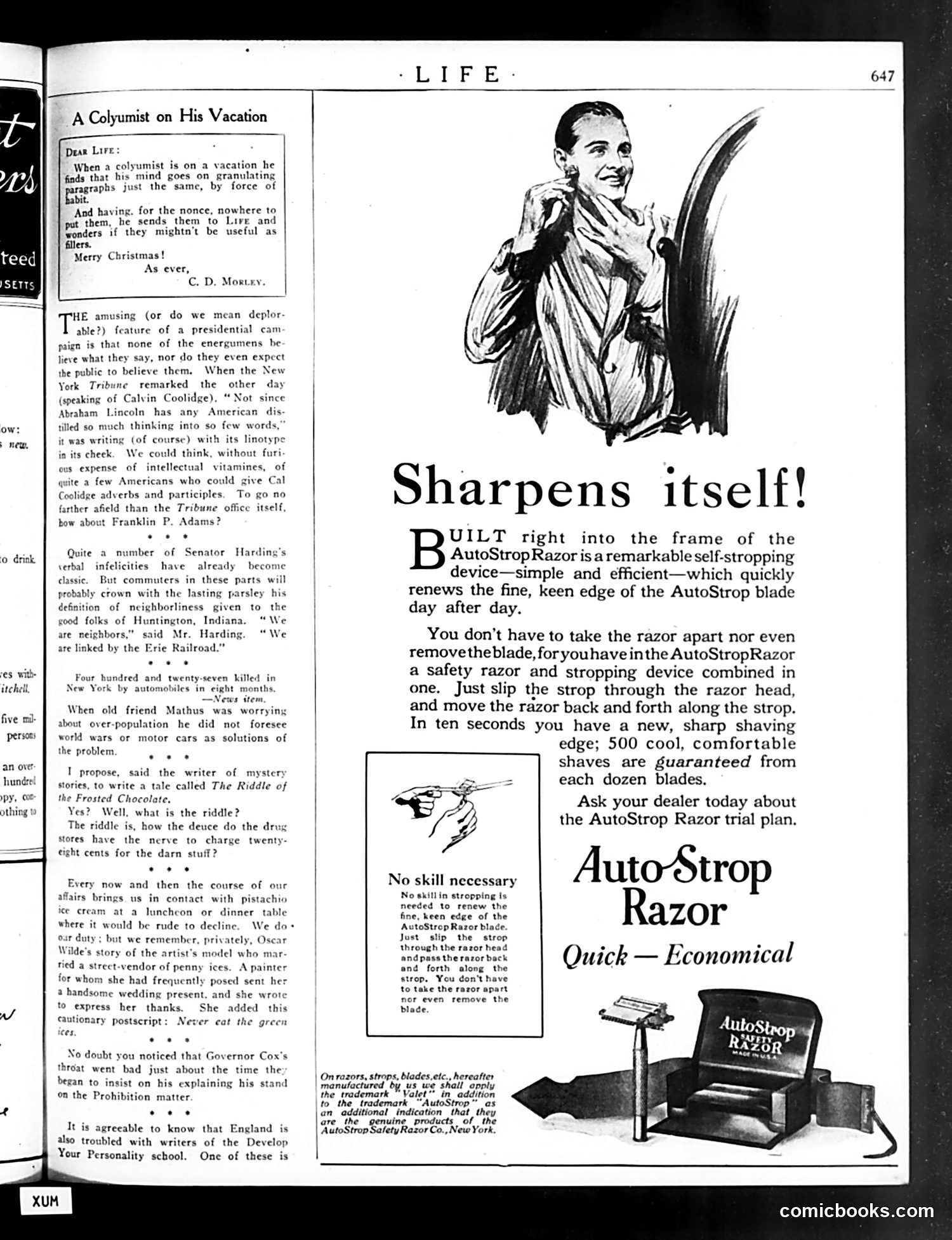
This page contains a columnist's humorous observations on American politics and culture, plus a product advertisement. **The Satirical Content:** The columnist (C.D. Morley) mocks presidential campaign rhetoric, particularly targeting Calvin Coolidge and Warren Harding. He notes that politicians don't expect voters to believe their own statements—citing the *Tribune*'s praise of Coolidge's brevity as ironic praise. The column jokes about Harding's verbal blunders, including his famous definition of neighborliness as being "linked by the Erie Railroad." Other observations satirize American life: 427 automobile deaths in New York in eight months, drug stores charging 28 cents for frosted chocolate, and Governor Cox's convenient throat ailment coinciding with pressure to explain his Prohibition stance. **The Advertisement:** The right side promotes the AutoStrop Razor—a safety razor with a built-in stropping device requiring no skill to use. The illustration shows a man with the razor; text emphasizes convenience and that 500 shaves are "guaranteed from each dozen blades." This is primarily advertising with satirical editorial content.
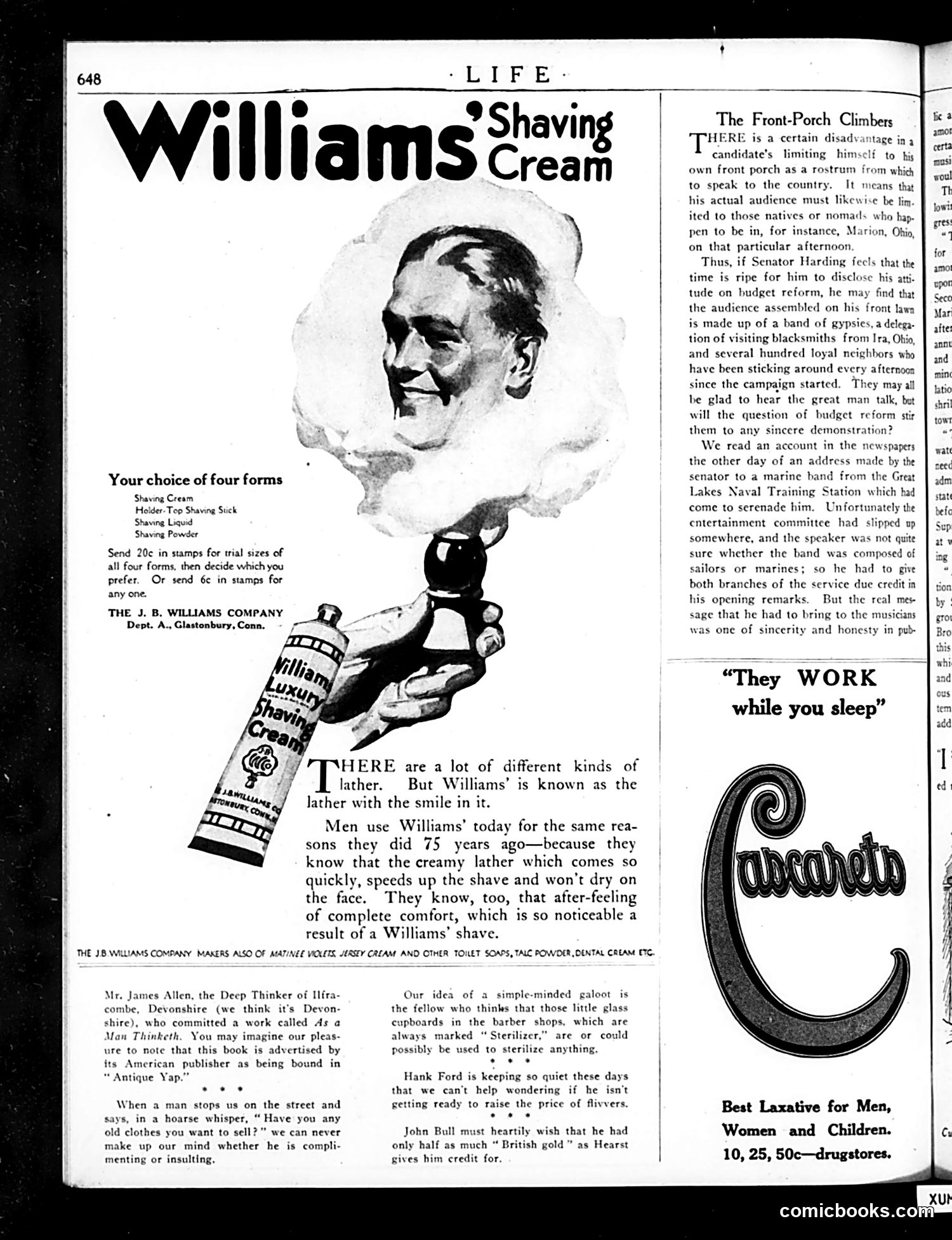
This page primarily contains **advertisements** (Williams' Shaving Cream) rather than political cartoons, though it includes satirical editorial commentary. The main satire addresses **Senator Harding's front-porch campaign strategy**. The text mocks the limitation of speaking only from one's home in Marion, Ohio—the audience consists of whoever happens to be nearby: "gypsies, a delegation of visiting blacksmiths from Ira, Ohio, and several hundred loyal neighbors." The joke is that such a random crowd cannot seriously engage with serious policy matters like "budget reform." A secondary anecdote ridicules Harding for being uncertain whether a visiting military band comprised sailors or marines, forcing him to credit both branches—highlighting his lack of knowledge or preparation. The page also includes brief satirical items mocking: James Allen's book *As a Man Thinketh* (marketed as "Antique Yap"), Henry Ford's silence (suggesting price hikes), and simplistic barber-shop misconceptions about sterilization. The overall tone is lighthearted political commentary on 1920s figures and consumer culture.
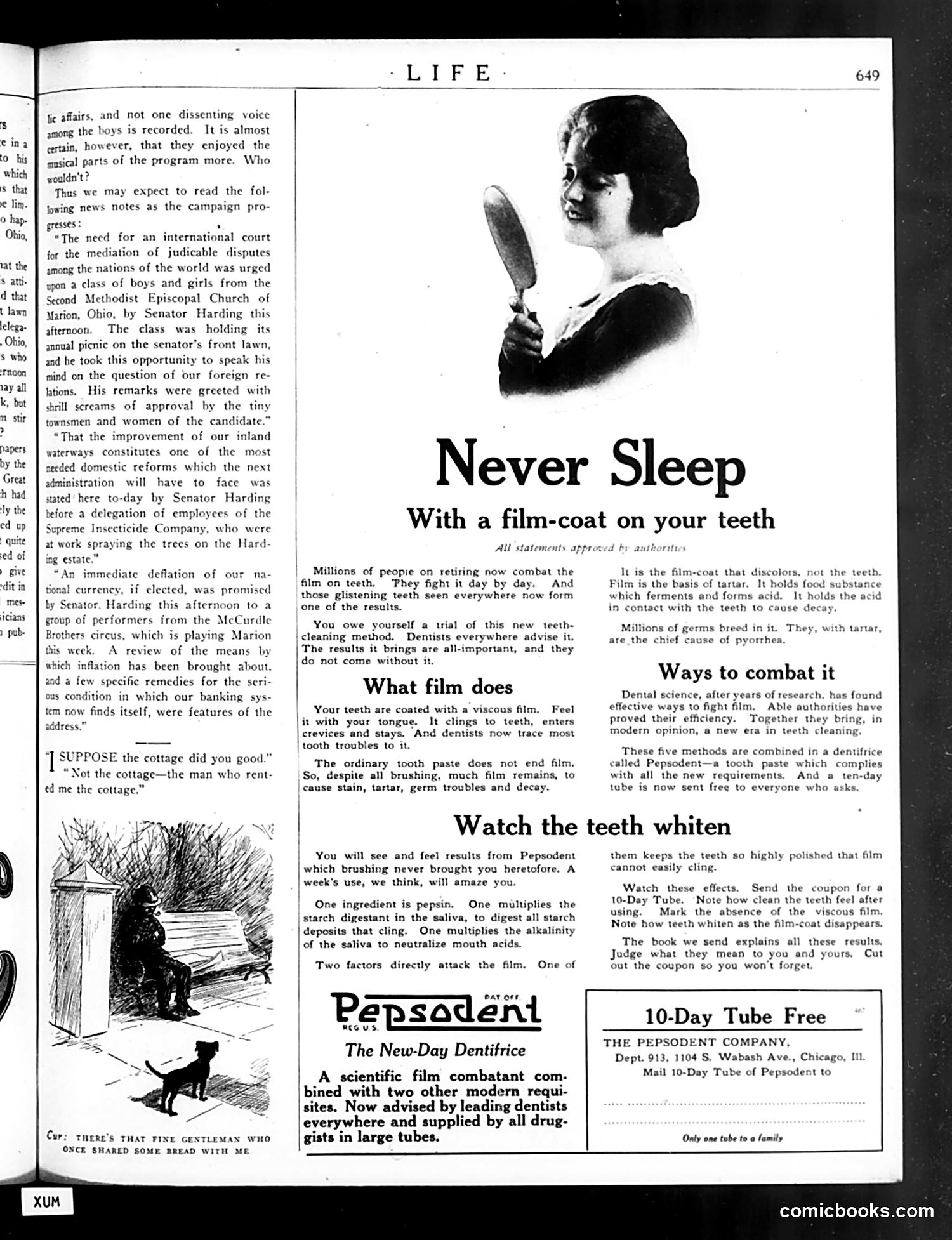
The page satirizes **Senator Harding's 1920 presidential campaign**. The text mocks how Harding—the Republican candidate—uses every public occasion to deliver stump speeches on serious policy matters (international courts, inland waterways, currency deflation) to *anyone present*, no matter how inappropriate the setting. The joke: he addresses boys and girls at church picnics, circus performers, and insecticide workers about weighty national concerns—treating captive audiences as campaign opportunities rather than respecting the actual purpose of their gatherings. The cartoon at bottom (man sharing bread) likely references common-man populism Harding employed. **Note:** The bulk of the page is a **Pepsodent toothpaste advertisement** unrelated to the political content—typical for Life magazine's mixed editorial/advertising format of this era.
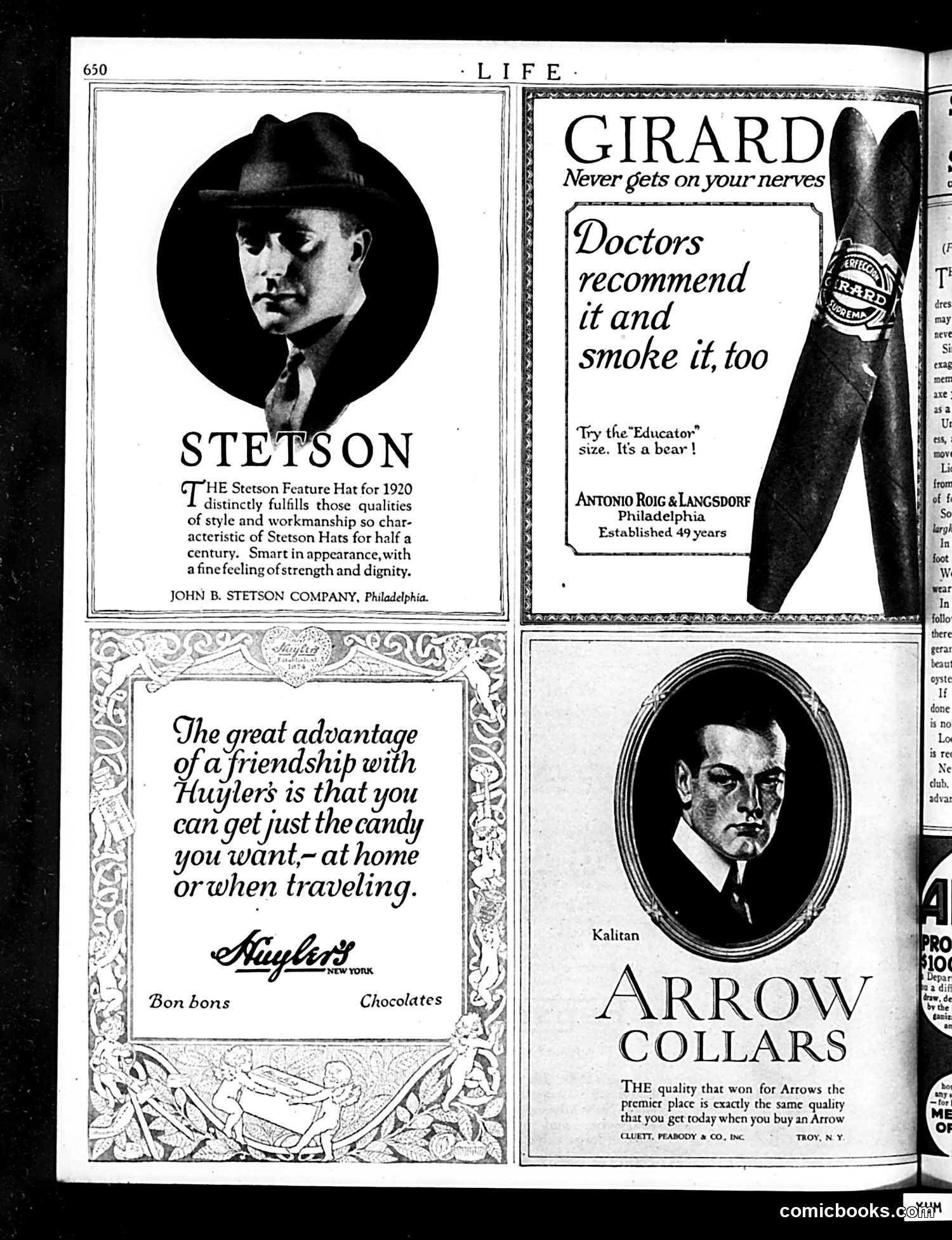
This is primarily an **advertising page** from Life magazine (circa 1920), not a satirical cartoon. It contains four product advertisements: 1. **Stetson Feature Hat** — a men's hat company emphasizing style and craftsmanship 2. **Girard Cigars** — claiming doctors recommend the product, with the tagline "Never gets on your nerves" 3. **Huylers Chocolates** — bon bons and chocolates for home or travel 4. **Arrow Collars** — men's dress shirts, with a portrait labeled "Kalitan" The only quasi-satirical element is the **Girard cigar ad's claim that doctors recommend it**, which reflects the era's common (and now absurd) practice of using medical endorsements in tobacco advertising before health dangers were widely acknowledged. The page reflects 1920s consumer culture and marketing conventions. No political satire or caricature is present—these are straightforward commercial advertisements typical of Life magazine's revenue model during this period.
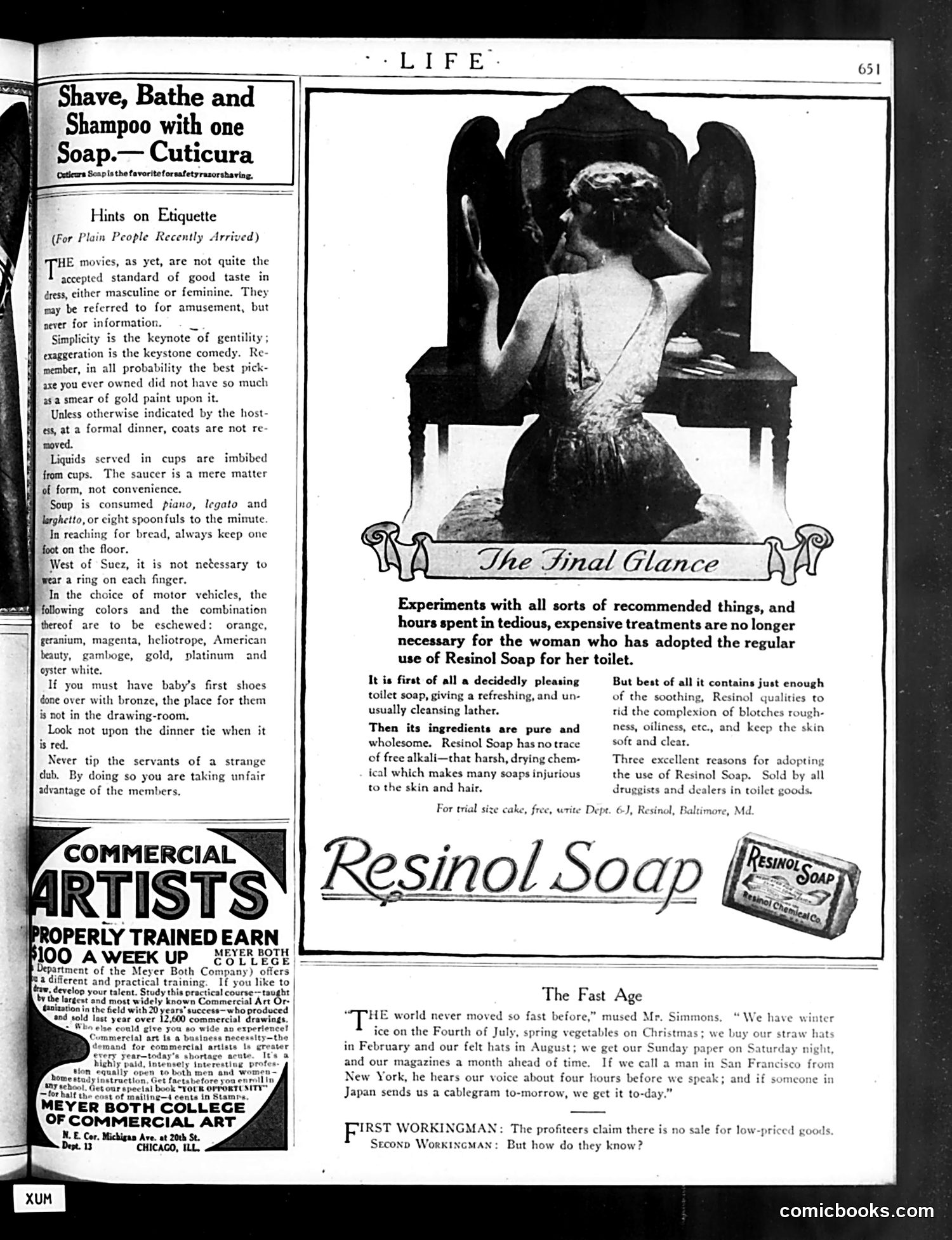
The main cartoon depicts a woman gazing at herself in a mirror, flanked by decorative cherubs. The accompanying text satirizes the era's obsession with beauty treatments and products. The joke: women waste enormous time and money on "tedious, expensive treatments" when simple soap suffices. The "Hints on Etiquette" section mocks newly wealthy Americans ("Plain People Recently Arrived") with absurdly specific, often contradictory rules—like consuming soup at musical tempos or keeping one foot on the floor while reaching for bread. It's gentle mockery of social climbers attempting to master upper-class conventions. "The Fast Age" jokes about modern life's accelerated pace: ice in summer, spring vegetables at Christmas, hearing voices across the country before speaking them. The workingman's exchange at bottom suggests profiteers use artificial scarcity claims to maintain high prices despite modern efficiency. Overall, the page blends advertising with social satire typical of 1920s *Life* magazine—poking fun at consumerism, class anxiety, and rapid technological change.
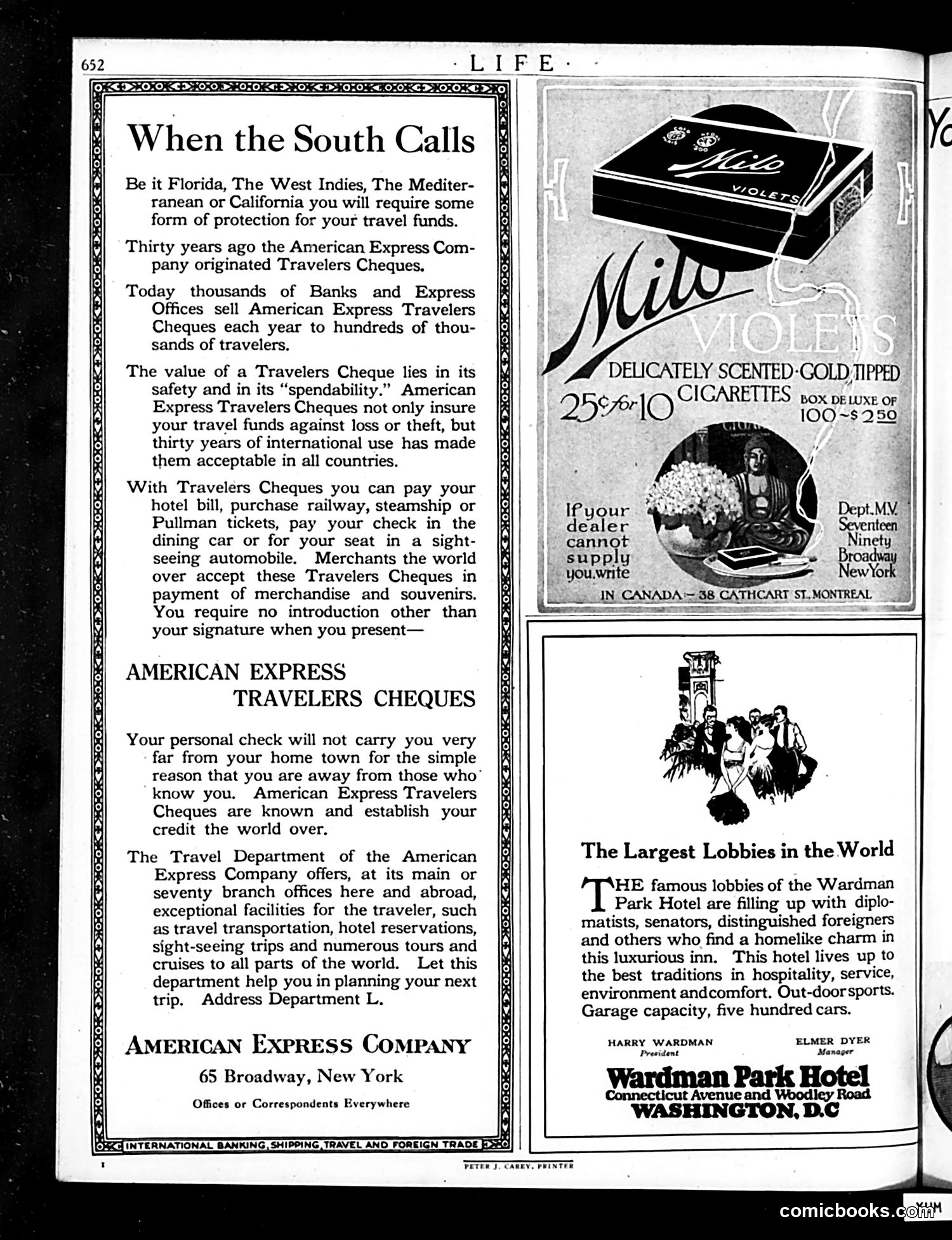
This is primarily a **advertisements page**, not satirical content. It contains three distinct ads: 1. **American Express Travelers Cheques** (left column): Promotes financial safety for southern travel by marketing the company's 30-year-old product. The pitch emphasizes international acceptance and credibility—your personal check won't work away from home, but American Express cheques establish credit "the world over." 2. **Mill Violets Cigarettes** (upper right): A luxury cigarette brand advertisement highlighting "delicately scented" and "gold-tipped" qualities at 25¢ for 10. 3. **Wardman Park Hotel** (lower right): Promotes Washington, D.C.'s premier hotel, specifically targeting diplomats, senators, and distinguished foreigners. The phrase "largest lobbies in the world" is both literal (architectural feature) and subtly suggestive—the hotel's lobbies were literally gathering places for political influence. No cartoon or satire appears on this page. The content reflects 1920s-era travel, luxury consumer goods, and political networking in the nation's capital.

This is a **product advertisement**, not satire or political cartoon. It promotes Colgate's new shaving stick packaging system (80 cents), positioned as economical and convenient. The page emphasizes four selling points: buying a year's supply at once, reusable metal grip with replaceable refill sticks, habit-forming convenience, and mess-free lathering. The **circular inset photograph** (left side) demonstrates the product's ease of use—showing someone inserting the refill stick into the grip. The accompanying caption compares this to "putting a new bulb in a socket," making the refill mechanism relatable to consumers. The main product image (right) displays the complete package with grip, refills, and accompanying Colgate shaving products. This reflects early-20th-century marketing emphasizing **efficiency, economy, and modern convenience**—appealing to thrifty consumers during an era valuing practical, reusable design.
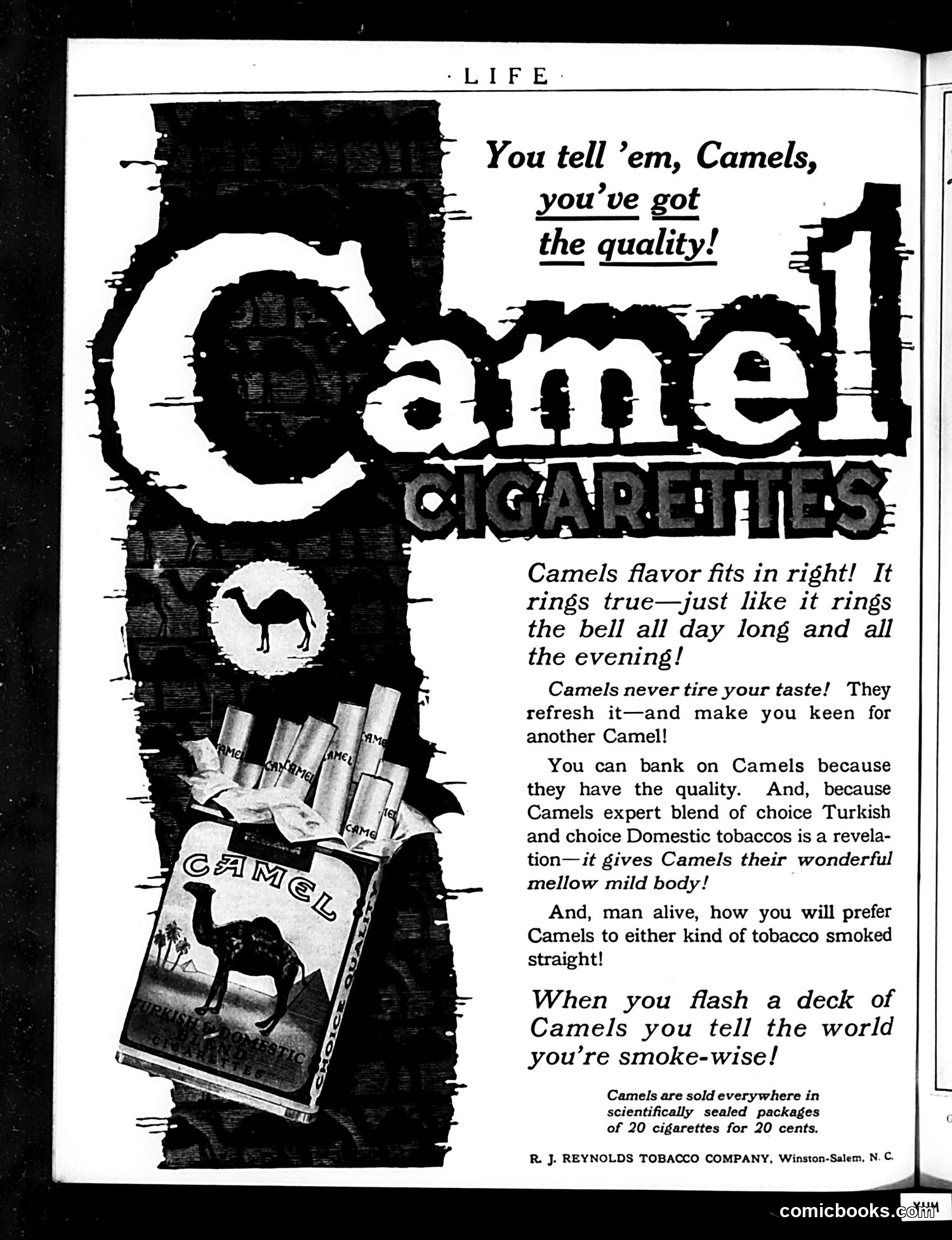
This is a **straightforward cigarette advertisement**, not satire. It's a 1920s-era Camel brand ad from R.J. Reynolds Tobacco Company promoting their product's "quality." The camel imagery (shown carrying cigarette packs) was Camel's actual trademark. The ad uses common period marketing language: claims about "choice Turkish and choice Domestic tobaccos," "mellow mild body," and appeals to sophistication ("smoke-wise"). The colloquial tone ("man alive," "flash a deck") targets everyday smokers. Notably absent: any health warnings—cigarettes were openly advertised without restrictions during this era. **Modern context:** This represents an era when tobacco marketing was completely unrestricted and ubiquitous in mainstream publications like *Life* magazine. The casual product placement and health-claim language that seems absurd today were standard advertising practice.
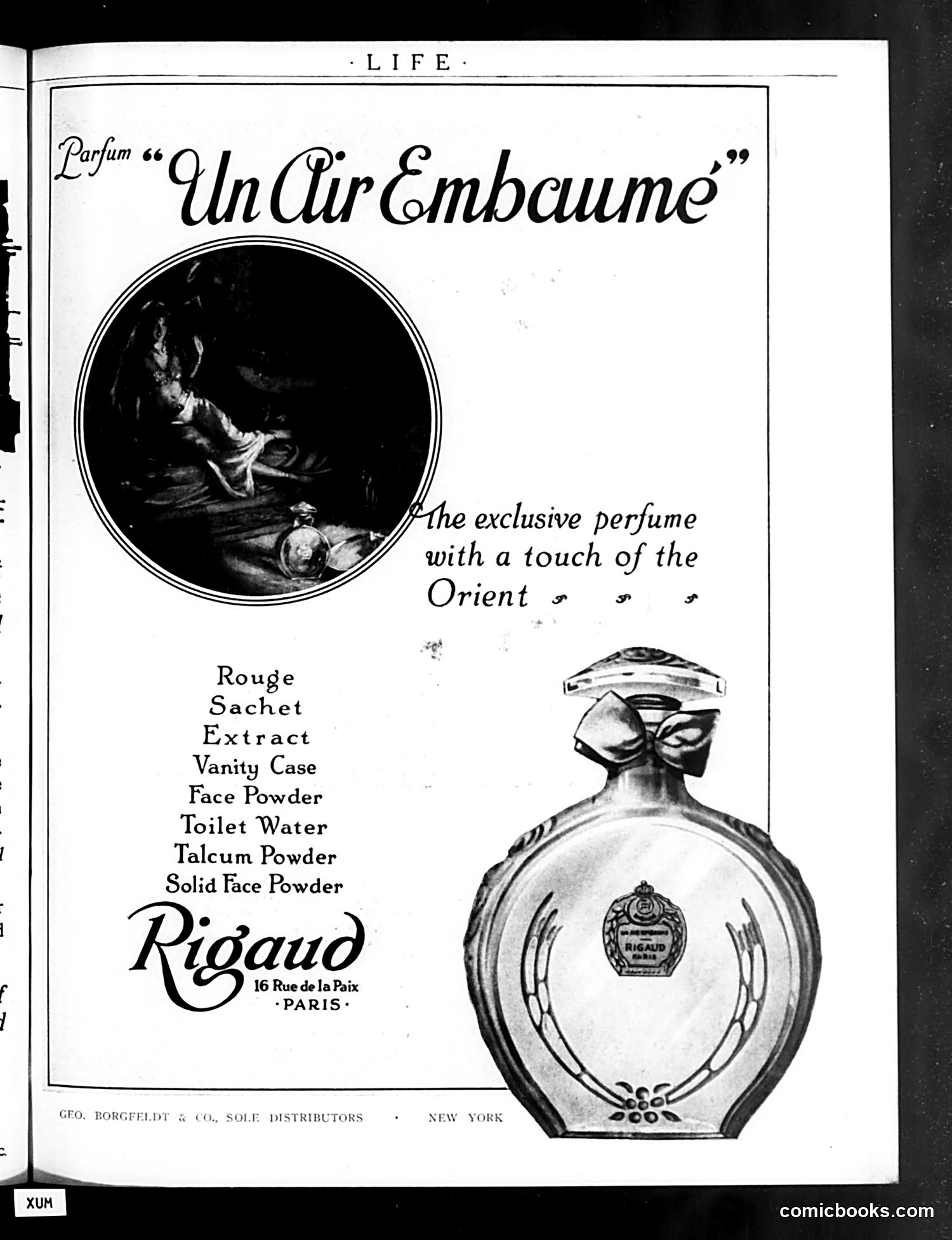
This is an advertisement, not political satire. It promotes "Un Air Embaumé," a French perfume by Rigaud of Paris, distributed in New York. The page advertises the fragrance as "the exclusive perfume with a touch of the Orient"—a marketing phrase common in early 20th-century luxury goods that exoticized Eastern aesthetics to appeal to wealthy Western consumers. The circular image on the left appears to show a reclining female figure, likely meant to evoke sensuality and sophistication. The ornate perfume bottle on the right displays the product itself. This represents standard high-end perfume marketing of the era, not satirical commentary.
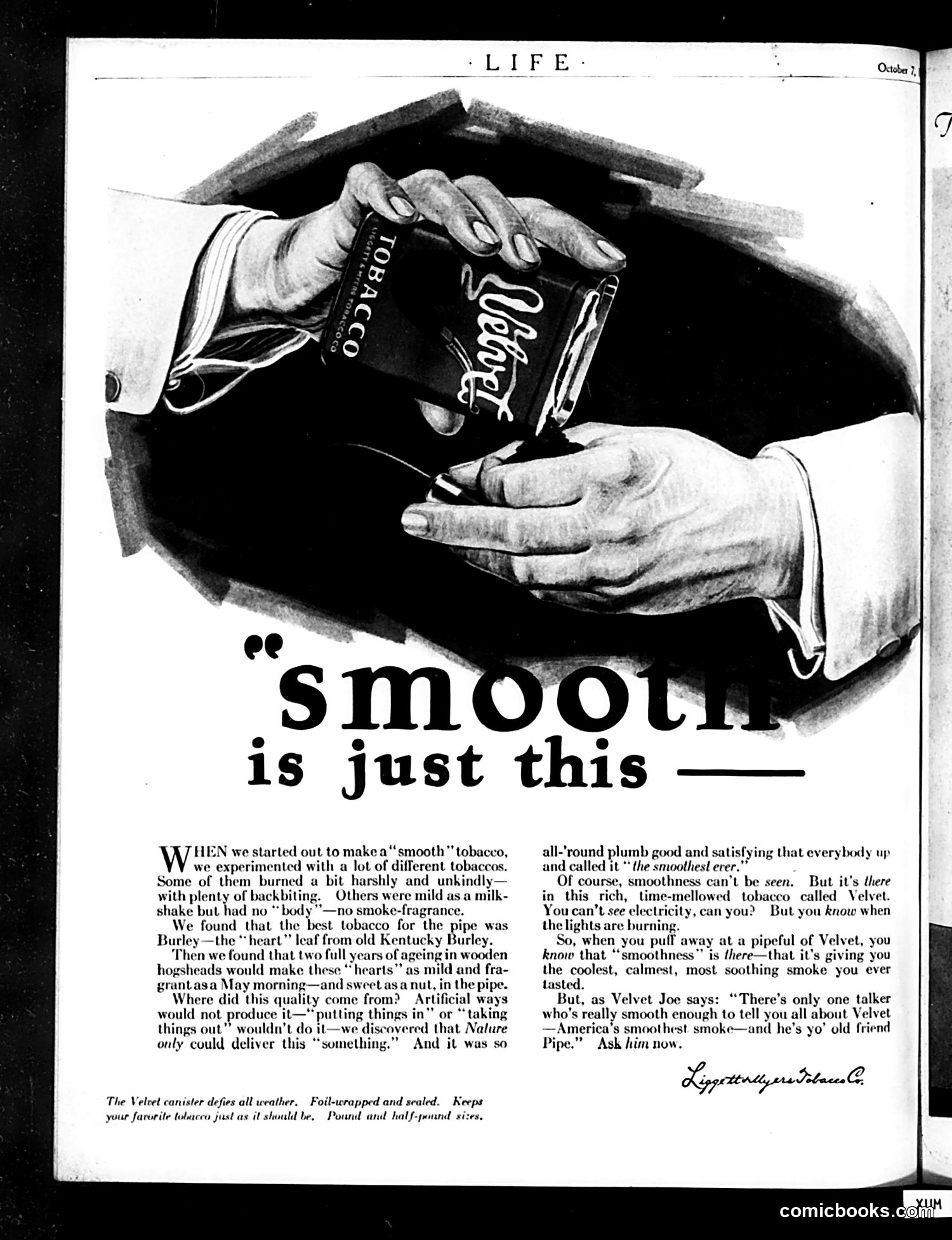
This is a **tobacco advertisement**, not political satire. It promotes Velvet pipe tobacco by explaining their manufacturing process. The ad uses a hands-over-pocket visual metaphor—showing someone holding a Velvet tobacco canister—to emphasize the product's quality and appeal. The text describes how Velvet achieves "smoothness" through two years of aging Kentucky Burley tobacco in wooden hogsheads, claiming this natural process (rather than artificial additives) produces superior flavor. The closing references "Velvet Joe," apparently a character endorser, who can testify to the product's smoothness. This reflects early 20th-century advertising conventions using personified brand mascots. The ad's central claim—that true quality comes from natural aging rather than artificial manipulation—was a common marketing strategy during this era, positioning premium products as superior through patient craftsmanship.